Syndicated

Talking Trash: In Ketchikan, you can salvage stuff from the landfill

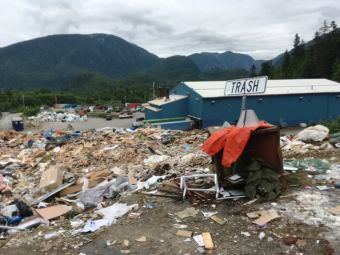
Ketchikan artist Halli Kenoyerleft, uses recycled trash to build a set piece for a community theater production. Ketchikan issues permits for locals who want to salvage metal, bowling balls and whatever else they find at the landfill. (Photo by Leila Kheiry/KRBD)
Artist Halli Kenoyer, left, uses recycled trash to build a set piece for a community theater production. Ketchikan issues permits for locals who want to salvage metal, bowling balls and whatever else they find at the landfill. (Photo by Leila Kheiry/KRBD)

Southeast communities are always looking at ways to reduce the amount of trash that ends up in their landfills or that they have to ship south. In Ketchikan, people can come up to the landfill and take what they want. In this report, part of CoastAlaska’s series, Talking Trash, we learn how that program saves the city time, space and money.

“I love the dump! I go to the dump for all of my wearable art needs. That’s where I go first,” said Ketchikan artist Halli Kenoyer.

She said the local landfill is a great place to gather material for the large, complicated pieces she makes for Ketchikan’s popular Wearable Art Show.

Kenoyer also goes there when helping to build sets for First City Players, the city’s community theater.

“We’re making trees right now for “Shrek Jr.,” the children’s musical and we need tall things that will not break. The dump is a great place to go find things for free,” she said in an interview this summer.

Nissa Dash is another Ketchikan artist who loves the landfill. She’s helping Kenoyer with sets for “Shrek Jr.,” but she also gathers material for her own art. Dash has a penchant for the patina of rusty metal.

“I have to be careful, because I will go to the dump and — I have to sneak it,” Dash said, laughing. “I have stuff in the garage and in little places tucked away. And God forbid we have to move.”

“‘Honey, I need to bring my rust collection!’” Kenoyer joked.

“Exactly!” said Dash.

Those two aren’t alone in their scavenging.

Up at the landfill, surrounded by opportunistic ravens, Solid Waste Supervisor Lenny Neely said about 40 people are signed up for the city’s salvage permit program. He said they take more than 100 tons of stuff out of the landfill every year.

That’s 200,000 pounds.

“And in some way, shape or form, all that material is getting reused,” he said. “That’s the nice part.”

That saves the city money in a variety of ways. It reduces the work load, cuts back on space taken up by trash, and reduces the volume of items the city has to barge south.

Ketchikan’s landfill offers a permit program that allows people to come up to the fill and take anything that strikes their fancy. It saves the City of Ketchikan money, and recycles items that otherwise would take up space in the fill. (KRBD photo by Leila Kheiry)
Ketchikan’s landfill offers a permit program that allows people to come up to the fill and take anything that strikes their fancy. It saves the City of Ketchikan money, and recycles items that otherwise would take up space in the fill. (Photo by Leila Kheiry, KRBD)

Neely said it’s tough to know exactly how much money the city saves a year. For some context, the city pays almost $60 per ton to ship household garbage south.

Beyond art material, Neely said salvagers collect for commercial use. Popular material includes metal pipes and wooden boards, often discarded after a home remodel project.

Neely points to a tangle of copper pipe sitting on the ground next to the fill.

“This piece laying here. Whoever came up and dumped laid that there because they know a salvager will grab that,” he said.

And the person who picks it up likely is after metal they can sell for scrap. But, there’s other salvageable stuff in the fill.

“The possibility, I guess, is the foosball table,” Neely said, pointing. “I see some metal over there that somebody will grab. Bicycles are a big item. We get a lot of bicycles for whatever reason. A little bit of everything.”

Some people come for spare parts, others for specific collectable items. Landfill employee Tim Morgan said bowling balls are one example.

“There’s two bowling ball ladies,” he said. “They just collect them for decoration in their gardens and yards.”

Staffers don’t see as many bowling balls now as they did back when Ketchikan had a bowling alley.

Neely said he was surprised by Ketchikan’s salvage permit program when he first came to work at the landfill years ago, mostly because of the liability.

City of Ketchikan Solid Waste Superintendent Lenny Neely stands at the local landfill. He says discarded metal, construction material, bicycles and more are taken out of the dump through the city's salvage permit program. (Photo by Leila Kheiry, KRBD)
City of Ketchikan Solid Waste Superintendent Lenny Neely said discarded metal, construction material, bicycles and more are salvaged from the landfill. (Photo by Leila Kheiry, KRBD)

“But, the reality is here, it’s worked really well,” he said. “That’s recycling at its finest. When I first got here, I couldn’t believe. I was like, ‘We do what?’ We may be one of the very few places in the state that does that.”

Liability is one concern cited by other regional facilities, although Wrangell used to have a salvage program before it capped its landfill years ago.

Petersburg has something similar to Ketchikan’s salvage program. The fill there is open for salvagers just twice a week, though, and the permit fee is quite a bit higher: $10 per day versus $5 a month in Ketchikan.

Ketchikan’s landfill requires permit holders to sign a waiver, wear a safety vest and stay out of the fill when equipment is running.

Back at the First City Players building, Kenoyer leads a set-building workshop for kids participating in the “Shrek Jr.” production. She said when she’s on the hunt for supplies, she goes to the landfill daily.

She showed off some of her recently salvaged items: discarded Christmas decorations, metal tomato-plant cages and a big bag of fabric leaves.

“We have two long bamboo sticks that are 12-footers from the dump,” she said. “You don’t find that very often anymore, so it’s a real treasure to find that. Tied that sucker on top of my truck and I hit the road.”

That’s salvage success.

Talking Trash: Follow the garbage Southeast ships south

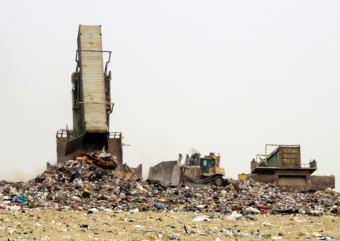
Household garbage from Sitka, Ketchikan and three other Southeast Alaska cities ends up in the Roosevelt Regional Landfill in Klickitat County, Washington. (Tom Banse/Northwest News Network)
Household garbage from Sitka, Ketchikan and three other Southeast Alaska cities ends up in the Roosevelt Regional Landfill in Klickitat County, Washington. (Photo by Tom Banse/Northwest News Network)

When you toss a candy wrapper in the trash, you’re sending it on a thousand-mile journey to a Lower 48 landfill. That’s the case if you live in one of five Southeast Alaska communities that send their garbage south via barge, truck and train.
We’ll take you on that trip, beginning in Sitka, as part of the CoastAlaska News series, Talking Trash.

Sitkan Megan Pasternak stands in her kitchen, holding a bag of garbage. So, what’s inside?

“Not much. There’s a couple used paper towels, I hate to admit,” she said. “And some stuff that could be composted because it’s vegetable stuff, but we don’t do that anymore because of the bears around here. And some plastics that I couldn’t recycle and a few odds and ends.”

And does she ever wonder what happens to it after it gets picked up by the trash truck?

“Not really, but I always like garbage day because it goes away from my house and just disappears,” she said, laughing.

Of course, it doesn’t. A garbage truck picks up her trash can, dumps the contents inside and hauls it to a solid-waste transfer station across town.

Jim Walters, with Waste Connections, operates a front-end loader to push trash aboard a container van, staged on the lower level of the Sitka Waste Transfer Station. (Robert Woolsey/KCAW)
Jim Walters with Waste Connections operates a front-end loader to push trash aboard a container van, staged on the lower level of the Sitka Waste Transfer Station. The containers are barged to Seattle. (Photo by Robert Woolsey/KCAW)

There, it and most other Sitka trash is unloaded, shoved into shipping containers and trucked back across town to a barge dock. There, it joins more containers from Sitka and other Southeast towns.

Sitka’s trash has taken that trip since the year 2000, when officials realized they were running out of space.

“The landfill was reaching a level to where it needed a new location. It was becoming a mountain,” said former Sitka City Administrator Hugh Bevan.

He said officials considered building a new dump. But more stringent environmental regulations would have made it extremely expensive.

New landfills have to virtually eliminate polluted runoff. And that’s hard to do in Southeast, where it rains up to 12 feet a year.

“And the idea of shipping waste to an off-island landfill rose to the top as being the most cost-effective over the long term,” Bevan said.

Trash from Southeast Alaska and the Pacific Northwest travel by train from Seattle to the Roosevelt Regional Landfill, near the Columbia River. (Tom Banse/Northwest News Network)
Trash from Southeast Alaska and the Pacific Northwest travel by train from Seattle to the Roosevelt Regional Landfill near the Columbia River. (Photo by Tom Banse/Northwest News Network)

Sitka now barges approximately 8,000 tons of garbage a year south. When added to trash from four other Southeast cities, it totals about 22,000 tons. Another 1,300 tons of regional recycling is shipped the same way.

The approximately 800-mile Alaska Marine Lines barge trip covers long stretches of open water and sometimes rough seas. It takes about 10 days.

After arriving at the barge dock, the containers are loaded onto trucks for a short ride to the Republic Services rail yard, just south of downtown Seattle. Once loaded onto rail cars, they head about 300 miles east to the Roosevelt Regional Landfill in southcentral Washington.

The final destination

That’s where the long journey of southeast Alaska’s trash comes to an end.

The landfill is in a wide bowl a few miles above the Columbia River. It’s bone dry and there’s not a neighbor in sight, which are two key reasons why it’s been so successful in getting contracts with cities near and far.

“It’s under the radar and that’s really the way we like it,” said Don Tibbetts, a Washington state-based manager for Republic Services, which owns the landfill.

“People like the garbage ferries to just take care of the garbage,” he said. “They don’t want to know where it goes. They just want to make sure it is being handled responsibly.”

Don Tibbets looks over piles of garbage at the Roosevelt Regional Landfill, where he served as general manager. The landfill takes in about 22,000 tons of Southeast Alaska garbage each year (Photo by Tom Banse/Northwest News Network)
Republic Services’ Don Tibbets looks over piles of garbage at the Roosevelt Regional Landfill, where he served as general manager. The landfill takes in about 22,000 tons of Southeast Alaska garbage each year. (Photo by Tom Banse/Northwest News Network)

Tibbets said the regional landfill business took off when the U.S. Environmental Protection Agency cracked down on polluted runoff from garbage dumps. He said this landfill is “highly engineered” with liners and collection systems to capture and treat whatever harmful liquid does percolate through.

Southeast Alaska’s garbage is not alone. Much of Western Washington’s trash also heads here on trains often stretching more than a mile long.

“More than likely, about 10 percent of the containers you see on the train in front of you has Alaska waste on it,” Tibbets said.

One last truck ride shuttles the garbage containers a short distance uphill to the landfill, where the trash is finally tipped out, compacted and buried.

The decomposing garbage generates landfill gas, or methane. A network of pipes and wells collects that gas and sends it next door to a small power plant to be burned to make electricity. So in a small way, the banana peels and hamburger wrappers Alaskans throw away indirectly light homes in the small towns of southcentral Washington state.

Three other regional landfills are also located along the Columbia River.

Other options

Before Southeast communities started shipping garbage to the Lower 48, they considered a similar option — not so far away.

A group of cities called the Southeast Alaska Solid Waste Authority looked at a chunk of land in Thorne Bay, a former logging camp on Prince of Wales Island’s eastern shore.

City Administrator Wayne Benner heads up the authority’s board.

“That actually was a serious prospect,” he said. “When they first started out they were looking at a regional landfill facility. But when the study was done to look at it, it did not pencil out.”

So Petersburg, Wrangell and Klawock joined Sitka and Ketchikan by hiring Republic Services to haul its garbage south. Benner said Thorne Bay will be next.

It’s always possible that new technology and attitudes will change how the region’s garbage is handled. But ‘til then, Sitka’s Hugh Bevan thinks barging it south is the best solution.

“The thing to keep in mind with solid waste is that you’re responsible for it forever,” he said. “So if you build a landfill in your town, the responsibility for it flows to the next generation, along with all the capital costs associated with it.”

Not every Southeast community ships out its trash. Juneau, with about half of the region’s population, still uses a local landfill. So does Haines.

In both cases, garbage collection and disposal is done by a private company.

Most of Juneau's garbage ends up in the local landfill, operated by Waste Management. A municipal study estimates it will fill up in about 20 years. (Ed Schoenfeld/CoastAlaskaNews)
Most of Juneau’s garbage ends up in the local landfill, operated by Waste Management. A municipal study estimates it will fill up in about 20 years. (Photo by Ed Schoenfeld/CoastAlaskaNews)

Ferry plan calls for smaller ships, public management

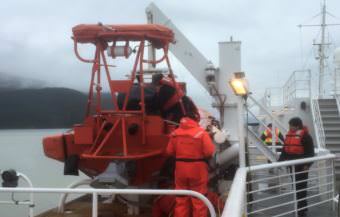
Crew members wrap up a safety drill on the deck of the ferry Malaspina during a sailing from Juneau to Haines Sept. 18, 2017. The ferry system faces changes to its fleet as part of a larger reform plan. (Photo by Ed Schoenfeld/CoastAlaska News)
Crew members wrap up a safety drill on the deck of the ferry Malaspina during a sailing from Juneau to Haines on Sept. 18. The ferry system faces changes to its fleet as part of a larger reform plan. (Photo by Ed Schoenfeld/CoastAlaska News)

A plan to reform the Alaska Marine Highway System calls for replacing some ferries with smaller, more efficient vessels. Backers want it to be run by an independent corporation and negotiate its own labor contracts.

Many Alaska Marine Highway ferries are showing signs of age. Fares are rising and sailings have become less frequent. Most importantly, funding is dropping, pointing to what could be dark times ahead.

“We can continue to admire the problem, and the resulting report, like has happened so many times in the past. Or, we can do something,” said Marc Luiken, commissioner of the state Department of Transportation, which includes the ferry system.

And the report he’s talking about? It’s a near-final draft of a plan to change how the marine highway is managed, and in some cases, operated.

“I strongly suggest crafting legislation necessary to move this effort forward and create a public corporation that will take over governance of the system,” he said at the Southeast Conference annual meeting Sept. 20 in Haines.

The report was produced by consultants for a statewide committee planning for the ferry system’s future. It’s a cooperative effort involving government and the Southeast Conference. The regional development organization formed in the 1950s to lobby for the ferry system’s creation.

The new corporation would continue to receive state and federal funds. But backers say it would provide a buffer between the ferry system and shifting political priorities.

Jim Calvin of the McDowelll Group speaks as part of a panel on reforming the Alaska Marine Highway System Sept. 19, 2017, in Haines. (Photo by Ed Schoenfeld/CoastAlaska News)

“It’s not a complete divorce from state government,” said Susan Bell, a former state commerce commissioner who is with the McDowell Group, which contributed to the report.

“There’s a lot of ways that the public has accountability. There’s a lot of ways that other agencies, like departments of transportation, law and administration, can continue to support it,” she said during a panel discussion and presentation at the Southeast Conference meeting.

The corporation would have its own staff, overseen by a seven-member board appointed by the governor. It’s modeled, in part, on the Alaska Railroad Corp.

Former Transportation Commissioner Mark Hickey was part of the effort to create that corporation in the mid-1980s.

“If I were in charge of the world, I would do a bill where I’m as far away from all the rest of state government as I possibly can be. Have your own lawyers, do your own labor negotiations. You can’t do that completely; you’re going to be tied. But generally, push to have freedom and autonomy,” he said.

Another major change is how and when the system would be funded.

Jim Calvin is senior economic analyst for the McDowell Group.

“The reason that you want this sort of advanced planning opportunity, the forward funding that can support this advance planning, is so people can plan accordingly. Particularly businesses that need long lead times to plan their business operations around the service that the marine highway can provide,” he said.

The state Legislature would have to agree for the plan to work. That’s been a difficult battle for the education budget, which has had much broader support.

An onboard diagram illustrates what's on the ferry Matanuska's Bridge Deck on Sept. 20, 2017. (Photo by Ed Schoenfeld/CoastAlaska News)
An onboard diagram illustrates what’s on the ferry Matanuska’s bridge deck on Sept. 20. (Photo by Ed Schoenfeld/CoastAlaska News)

“Forward funding at a year in advance, in this budgetary climate? I think it’s a bridge too far,” said Sen. Bert Stedman, a Sitka Republican.

He said the whole reform plan could leave the system open to deeper budget cuts.

He called forward funding “a novel idea.” But he pointed to a recently identified budget switch that could leave the ferries without operational funds this spring.

“I think you’re on the wrong track. I think the forward funding issue should be to try to get it funded through June of this year,” he said.

Rep. Sam Kito III, a Juneau Democrat, had a different take. He said he’ll introduce legislation to forward fund the system.

A third significant operational change is labor relations.

Bell said the corporation would take over contract negotiations. That would allow it to change work rules, which could reduce staff and bring operational savings.

“We think that the system would benefit from a more direct relationship between marine highway governance and the unions. We believe not only the change to the corporate structure, but direct negotiations will enhance that,” she said.

The report said wages and benefits make up about 60 percent of the ferry system’s costs. It recommends moving toward smaller and simpler ships, with fewer staff.

“We’re not going to be helping the workforce,” said Capt. Joan Sizemore, a marine pilot working in Southeast Alaska and a former ferry employee. “It seems to be that the impetus right now is to cut costs by removing people. And if you have fewer people working on those ferries, that’s fewer dollars spent in Alaska.”

The ferry reform plan calls for the fleet to remain at nine ships, the current number of active vessels.

But two large ferries, the Columbia and the Kennicott, would be gone. The same could happen to the fast ferries.

Capt. John Reeves of the Elliott Bay Design Group said several ships could be phased out and replaced.

“Some of the shorter routes, you don’t necessarily need to have a crew on board 24/7 because the vessel is just making shorter runs. So we can have a different vessel (that) has a smaller crew, it’s cheaper to operate, but still provides the same service to the communities,” he said.

The ferry reform report also includes what it calls a minimal service model.

That would reduce the fleet from nine to seven ships and the annual weeks of service by about 20 percent.

The committee overseeing the ferry reform project is gathering public comments through Oct. 6.

More information is available at Alaska Marine Highway Reform Project website.

Ferry reform’s next step at Southeast Conference meeting

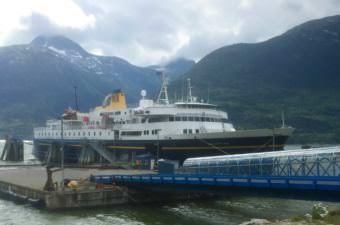
The ferry Malaspina docks in Skagway Aug. 25, 2017. The Alaska Marine Highway is being studied as part of a reform effort, which will be discussed at the Southeast Conference meeting Sept. 19-21 in Haines. (Photo by Ed Schoenfeld/CoastAlaska News)
The ferry Malaspina docks in Skagway on Aug. 25, 2017. The Alaska Marine Highway is being studied as part of a reform effort, which will be discussed at the Southeast Conference meeting Sept. 19-21 in Haines. (Photo by Ed Schoenfeld/CoastAlaska News)

An effort to reform the Alaska Marine Highway System takes another step this month.

The latest version of a reform plan will be presented at the Southeast Conference’s annual meeting. Members of the regional development organization gather Sept. 19-21 in Haines.

Executive Director Robert Venables said the effort has been underway for about two years.

“We’re going to be rolling out the major recommendations in a draft, kind of a strategic operations business plan,” he said.

Southeast Conference and the state ferry system are examining ways to save money while maintaining service to port communities.
Venables said the state’s fiscal crisis is just part of the discussion.

“There’s also the way the fleet itself is structured, the way the terminals are constructed and just kind of the overall way we can bring more standardization to operations,” he said.

He said the plan should be finished by the end of the year.

The conference is leading the effort, which included public meetings around the state. The organization formed in 1958 to push for establishing the ferry system.

Venables said the reform effort fits into this year’s meeting theme, which is Navigating the Southeast Economy.

“We all are very well versed in the economic challenges that the state is having, communities are having and businesses are having. (There are) just challenges on every front. And we know with some stick-to-itiveness and working together and some good navigating skills, we can get through this next period of time we have ahead of us,” he said.

About 60 speakers are scheduled to discuss timber, tourism, mining, fisheries and workforce development. Venables expects 200 or more attendees.

Tribal conference considers climate change impacts

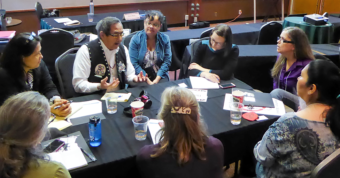
John Morris of the Douglas Indian Association speaks during a workshop at the 2016 Southeast Environmental Conference in Ketchikan. This year's conference is Sept. 5-8 in Wrangell. (Photo courtesy Central Council of Tlingit and Haida Indian Tribes of Alaska)
John Morris of the Douglas Indian Association speaks during a workshop at the 2016 Southeast Environmental Conference in Ketchikan. This year’s conference is Sept. 5-8 in Wrangell. (Photo courtesy Central Council of Tlingit and Haida Indian Tribes of Alaska)

A group of Southeast Native organizations is planning for the impacts of climate change.
Representatives of the region’s tribal governments will discuss global warming and other topics at their annual environmental conference Sept. 5-8 in Wrangell.

Conference organizer Raymond Paddock is environmental coordinator for the Central Council of the Tlingit and Haida Indian Tribes of Alaska.

He said the work starts with identifying tribal resources that have been or will be affected by warming temperatures.

“That looks like cedar, berries and other things that tribes use in the forest,” he said. “The other one being fish and how that’s affecting streams. Another one being ocean acidification and we also wrote harmful algal blooms in there as well.”

Anthony Christiansen, standing, right, speaks during the 2016 Southeast Environmental Conference in Ketchikan. (Photo courtesy Central Council of Tlingit and Haida Indian Tribes of Alaska)

Member tribes already are working together to monitor those blooms.

Toxins from the algae accumulate when ingested by clams and crabs. Consumption by people or animals can lead to paralytic shellfish poisoning.

But Paddock said the tribes want to do more than list climate change’s problems.

“We hope after we could get this plan developed, we want to go after a mitigation plan. We don’t know what that looks like just yet,” he said. “But as we’re moving forward, I think that’s our next logical step.”

Paddock said money is tight.

Tribal representatives are taking up a new effort that fits their goals and could bring in more funding.

Six tribes have come together to form the Southeast Alaska Tribal Conservation District.

Paddock expects more to join, under a U.S. Department of Agriculture program called the Natural Resources Conservation Service.

Paddock said one possibility ties into regional food security efforts.

“We can create greenhouses where we can grow vegetables and hopefully sell to our local grocery stores, so we get fresh vegetables going,” he said. “The funding opportunity is there to make this a continuing project.”

Paddock expects at least 50 to 60 people to attend the tribal environmental conference.

The event has been held for a number of years, rotating among Southeast communities.

“We wanted to put together these conferences to address these environmental issues and see how we can work together to pool our resources and partner,” he said.

This event is at Wrangell’s Nolan Center, with a water-quality-sampling field trip up the Stikine River, and it’s sponsored by Tlingit and Haida and the Wrangell Cooperative Association.

Transportation Department names new regional director

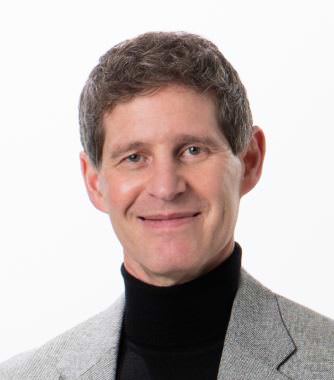
Lance Mearig is the state Department of Transportation's new Southcoast Region director. He takes over from Mike Coffey, who just retired. (Photo courtesy Department of Transportation)
Lance Mearig is the state Department of Transportation’s new Southcoast Region director. He takes over from Mike Coffey, who just retired. (Photo courtesy Department of Transportation)

A longtime Southeast resident is taking over one of the Department of Transportation and Public Facilities’ regional offices.

Commissioner Marc Luiken on Aug. 31 named Lance Mearig as the department’s Southcoast Region director. The region includes all of Southeast, plus Kodiak Island, the Alaska Peninsula and the Aleutians.

Spokeswoman Aurah Landau said Mearig has 35 years of transportation experience under his belt.

“He started working for DOT back in 1982 and then spent 25 years working in private industry, often working on projects around the Southcoast region. And (he) has a lot of experience and long-standing relationships that he’ll be bringing to the communities he’ll be serving around the Southcoast region,” Landau said.

Mearig has most recently been the Department of Transportation’s director for statewide design and engineering.

He takes over from Mike Coffey, who retired after 35 years in a variety of department positions.

Mearig is a longtime Juneau resident who grew up in Sitka, Ketchikan and Petersburg. He has a bachelor’s degree in civil engineering from the University of Alaska Fairbanks. He also has a master’s degree in the same specialty from Arizona State University.

He will oversee state roads, highways and airports throughout the region. Alaska Marine Highway General Manager John Falvey is in charge of the state ferry system.

Site notifications
Update notification options
Subscribe to notifications