Syndicated

State agencies provide stopgap timber for Southeast industry

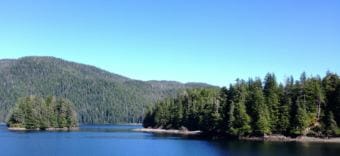
Forests along Peril Strait shine on a sunny Sept. 15, 2015. Several government agencies are selling timber to Southeast Alaska mills until larger stands of trees are made available. (Photo by Ed Schoenfeld/CoastAlaska News)
Forests along Peril Strait shine on a sunny Sept. 15, 2015. Several government agencies are selling timber to Southeast Alaska mills until larger stands of trees are made available. (Photo by Ed Schoenfeld/CoastAlaska News)

The state just sold timber from its Southeast Alaska forest to the region’s largest mill.

It’s part of a multi-agency effort to keep the area’s logging industry alive. But some say it’s time to let it go.

Klawock’s Viking Lumber was the only buyer interested in the North Hollis timber sale, about 230 acres on Prince of Wales Island, the center of what’s left of Southeast’s timber industry.

But it wasn’t sold under the usual bid program.

It was a negotiated sale based on more than the price, State Forester Chris Maisch said.

“The kind of things we’re looking for (are) would the wood be used to manufacture products in the state, how many jobs … will be created from the project,” he said. “Of course, the price being offered for the timber is also a consideration.”

The state Division of Forestry said Viking is paying $375,000.00 for mostly Sitka spruce, hemlock and red cedar.

It’s not huge acreage as timber sales go, but it’s one of several small state sales aimed at keeping Viking and other parts of the industry alive.

“We have stepped up our timber sale program because of the shortfall of federal volume here over the last several years,” he said.

The North Hollis sale was finalized in December.

The state forest also sold a second parcel to Viking last year, near Coffman Cove, also on Prince of Wales Island.

(Read Tongass in transition: Striking a chord with old growth trees.)

Another agency also plans to provide stopgap timber.

The Alaska Mental Health Trust Land Office is trading some controversial timberlands near cities for acreage in the Tongass National Forest.

Executive Director Wyn Menefee said the office is planning for sales this year and next.

“That’s going to be very vital for the timber industry down there because they’re short on timber supply and we are the ones that probably can provide, after we get the land through the lands exchange, the necessary fiber to market,” he said.

The first will be near Naukati, which also is on the island.

About 11,000 acres are involved, but it won’t all be sold at the same time.

“We will be putting that old-growth available for timber markets in Southeast, which hopefully will give them enough breathing room to allow the Forest Service enough time to get timber on the markets,” he said.

About 2,400 acres will be in the first sale, which will be offered this spring. Public comments on the overall plan are due by Jan. 15.

(Read Tongass in transition: An uncertain future for Alaska’s last big mill.)

The Tongass National Forest has been the largest source of timber on public lands for decades. But management changes, lawsuits and a shortage of older timber has slowed its sales.

Tongass officials will offer three sales this year totaling about 1,200 acres.

Spokesman Paul Robbins Jr. said two are old growth while one is young growth.

“We’re also working on environmental impact statements for sales on the Petersburg and Wrangell Ranger districts, as well as multiple sales as part of the Prince of Wales landscape level analysis,” he said.

Robbins said the Forest Service is working with other timber owners, including the state, the land trust, Sealaska regional Native corporation and the University of Alaska.

“We convened about four or five years ago to coordinate timber sales and improve economies of scale, reduce overall costs and help the economics of timber sales for Southeast Alaska,” he said.

“They just want to continue to do business the way they have been doing business,” said Bob Claus, a Prince of Wales Island resident and a member of the Southeast Alaska Conservation Council.

He and others question sales that continue supplying old-growth timber to what he calls a dying industry. He said they’re damaging the environment, including salmon, deer and wolf habitat.

“Yyou have Sealaska, you have mental health trust, you have state lands and you have the Forest Service … all pushing for more old-growth harvests out of a place that just can’t take it anymore,” he said. “They’ve already taken all the old growth that they can take. And probably more than was acceptable.”

Viking Lumber continues logging old-growth trees from a previous Forest Service sale.

What’s called Big Thorne involves about 6,000 acres between Thorne Bay and Coffman Cove.

The Tongass is being managed under a plan to move away from harvesting old-growth trees. It calls for a new industry based on younger timber, also called second growth.

But a federal agency last fall determined Congress has the right to review – and possibly overturn – the plan.

If that happens, the Tongass could resume selling larger stands of older trees, which is what the industry wants.

Storm, steering problem hit Southeast ferry service

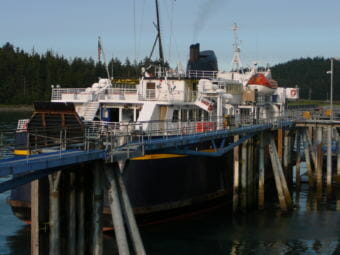
The ferry LeConte docks at Juneau’s Auke Bay terminal in 2010. Rough weather will keep it from sailing Jan. 9 to Haines. The ferry Columbia is also delayed through Jan. 11 because of a mechanical problem. (Photo by Ed Schoenfeld/CoastAlaska News)

Rough weather and a mechanical breakdown are affecting Alaska Marine Highway service in Southeast Alaska.

Fifty-knot winds and high seas predicted for upper Lynn Canal will prevent the small ferry LeConte from making its Jan. 9 sailings between Juneau and Haines, part of its route.

Officials said it will resume scheduled sailings with a trip to Kake that night.

The ferry Columbia also is sailing a modified schedule through much of the week, because the system’s largest vessel was sidelined for much of Jan. 7 due to a mechanical problem.

Alaska Marine Highway spokeswoman Aurah Landau said the ship won’t skip any port calls.

“It’s running about 12 hours late. It will be on a modified schedule through Thursday,” she said. “It’ll resume its normal schedule with a northbound schedule leaving Bellingham on Friday.”

The Columbia sails weekly roundtrips from Bellingham, Washington, to Skagway.

It stops in Haines, Juneau, Sitka, Petersburg, Wrangell and Ketchikan along the way.

The problem occurred as the Columbia sailed from Bellingham to Ketchikan. Landau said what’s called a steering-indicator rod stopped working.

“That’s the piece that when the wheel gives the command to the rudders to move, through the electrical system, tells the steering mechanism that the rudder has moved,” Landau said.

A technician had to fly into Ketchikan to make the repairs, she said. This problem took less than a day to fix, much faster than a previous breakdown.

The Columbia returned to service in late October after being sidelined for about a year after a propeller struck a submerged object.

Parts weren’t available and had to be built from scratch.

The Columbia carries about 500 passengers and more than 130 vehicles. It also has about 100 cabins.

The LeConte carries fewer than half as many passengers and about a quarter as many cars and trucks. It has no staterooms.

Feds jump into transboundary mining dispute

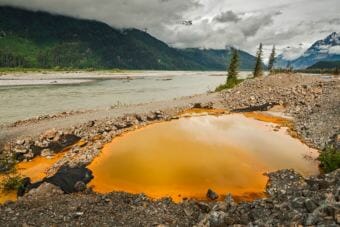
Acid drainage from the Tulsequah Chief Mine, northeast of Juneau, discolors a leaking containment pond next to the Tulsequah River in British Columbia in 2013. The U.S. State Department is addressing concerns that other B.C. mines will pollute Alaska rivers. (Photo courtesy Chris Miller/Trout Unlimited)

The federal government is taking on the transboundary mining issue.

The U.S. State Department now acknowledges Alaskans’ concerns about pollution from British Columbia mines. And it’s committed to engaging Canadian officials to protect salmon-rich, cross-boundary watersheds.

In November, the State Department issued a statement saying it was aware of Alaskans’ environmental concerns. And it said it was raising the issue with its Canadian counterparts.

But details were scarce.

Then, the department sent a letter to Lt. Gov. Byron Mallott, who released it Dec. 28. He’s headed up the administration’s efforts to address potential pollution from mineral prospects across the border in British Columbia.

Barbara Blake, special assistant to Lt. Gov. Byron Mallott, answers a question about transboundary mining while Tlingit-Haida Central Council Rob Sanderson Jr. listens at a Native Issues Form March 9, 2016, in Juneau. (Photo by Ed Schoenfeld/CoastAlaska News)
Mines adviser Barbara Blake and tribal leader Rob Sanderson Jr. participate in a forum March 9, 2016, in Juneau. (Photo by Ed Schoenfeld/CoastAlaska News)

“We’re very excited to see the federal government engaged in this issue and their response that they’ve made to us and to see the actions going forward,” said Barbara Blake, the Walker-Mallott administration’s senior transboundary mines adviser.

She said one important promise is to research what the two governments can do to protect Southeast Alaska watersheds.

“They’re looking at the gaps and limitations of cooperation between our two countries right now,” Blake said. “And so we’re anxious to see what comes about from their analysis or their review of any gaps or limitations as they currently stand.”

The State Department will release its findings at an April meeting of the International Joint Commission, the panel that addresses transboundary water concerns.

The department earlier said it would not get involved with the issue.

The federal agency’s letter came in response to a November request from the Walker-Mallott administration and Alaska’s congressional delegation to address transboundary mining.

Mine critics have repeatedly called for commission involvement.

One is Frederick Olsen Jr., who chairs the SouthEast Alaska Indigenous Transboundary Commission. He’s also tribal president of the Organized Village of Kasaan, on Prince of Wales Island.

“It looks like it’s a good first step,” Olsen said. “Of course, as it said in the letter, to have the International Joint Commission, you still have to have the Canadians support that.”

This aerial image from a British Columbia emergency office video shows the Mount Polley dam breaks and some of the damage downstream.

Heather Hardcastle of Salmon Beyond Borders agrees. She’s encouraged, but said there’s a lot more work to be done.

“I think first and foremost we’re looking at some sort of financial-assurances mechanism to be set up so that those of us downstream of these mega-mines know that appropriate bonding has been required of these mining companies,” she said.

Two mines are operating in transboundary watersheds that flow into Alaska, the Brucejack and the Red Chris. Another, the Tulsequah Chief, is closed and leaking polluted water.

Several others are in the exploration phase.

Developers and owners have said their operations are or will be safe and won’t damage the environment.

She said officials also need to press for better technology, including changes in the way waste rock from ore-processing is stored.

Mines commonly put them underwater behind earthen dams. Hardcastle said that will lead to spills of polluted water that will harm fish and people downstream.

That’s what happened in 2014, when an eastern British Columbia storage dam broke.

Observers estimated enough water, mud and rock escaped to fill 2,000 Olympic-sized swimming pools.

Southeast Alaska Indigenous Transboundary Commission Chairman Frederick Olsen Jr.,, left, and United Tribes of Bristol Bay President Robert Heyano hold the agreement their groups signed Oct. 19. (Photo by Molly Dischner)
Southeast tribal leader Frederick Olsen Jr., left, and Bristol Bay tribal leader Robert Heyano pose after signing an agreement to work together on mining issues Oct. 19, 2017. (Photo by United Tribes of Bristol Bay)

Olsen said words can’t prevent that from happening closer to home.

“Not to be rude, but it’s just a letter. That little piece of paper, if you printed it out, would not stop a lake of poison debacle like Mount Polley or something like that,” Olsen said.

The State Department’s letter mentions tribal concerns. But it doesn’t say anything about tribal involvement.

Rob Sanderson Jr. is first vice president of the Central Council of Tlingit and Haida Indian Tribes of Alaska.

“At the end of the day we are government. The tribes are government,” he said. “So we need to be able to use that leverage moving forward. Not just the state, but the tribes too.”

Walker-Mallott mines adviser Blake said officials are looking forward to learning more about the State Department’s plans.

But she said the administration is not turning the whole issue over to the federal government.

“We’re going to continue be engaged with them as necessary and wherever possible. The lieutenant governor would like the state to remain involved in this process,” she said.

She said Mallott will travel to Washington, D.C., for a federal interdepartmental work group led by the Environmental Protection Agency. He’ll also meet with Canadian officials in Ottawa.

His office also will continue following up on a cooperative agreement Alaska and British Columbia signed last year.

Kake hydro gets boost in governor’s budget

Diesel generators in the Kake Powerhouse provide electricity to the town’s residents. The Gunnuk Creek hydroproject would replace about half of the power. (Photo courtesy Inside Passage Electric Authority)

A hydroelectric plant for a small Southeast Alaska community is a step closer to reality. Gov. Bill Walker included funding for Kake’s Gunnuk Creek project in his capital budget proposal.

Kake is a village of about 600 people on Kupreanof Island, about 100 miles southeast of Juneau.

It gets its power from diesel generators, which makes it expensive.

Officials have been looking for alternatives for years.

The most likely option, at this point, is a small hydroelectric project using water from nearby Gunnuk Creek.

“It is shovel-ready,” said Jodi Mitchell, CEO and general manager of Inside Passage Electric Cooperative, a nonprofit group that also runs systems in Hoonah, Angoon, Klukwan and the Chilkat Valley.

Mitchell said Gunnuk Creek, if built, will be the third such project for its communities.

Two more are on the list.

“We have an opportunity with these hydroprojects to fix a problem and completely get ourselves off diesel,” he said.

Gunnuk Creek is ready to be built. but it’s been stalled for several years. Now, it’s included in the governor’s spending plan for the next budget year.

The nearly $4 million isn’t enough to complete all the work, but it’s a solid start.

Mitchell hopes to get additional funding through a federal grant. She said the cooperative could also borrow the remaining $3 million.

Kake is represented in the state Senate by Bert Stedman, a Sitka Republican. He supports construction, but sees some issues.

“My concern with this project is that we build Gunnuk Creek, but it’s on a postage stamp rate amongst other communities, he said. “And I’m not sure how much the communities, including Kake, are going to see their utility rate impacted.”

The rate is based the average of costs for all of the electric cooperative’s customers, which means Kake will only see some of the benefits of cheaper electricity.

But Mitchell said customers there will still pay lower bills.

“I believe now that the economics of that, even if we were to borrow the money, would still result in a small rate reduction for our consumers, our member owners,” she said.

For years, officials hoped Kake’s needs would be met by a new, 60-mile power line to Petersburg, which would connect to a regional grid linked to two large hydroprojects.

The line and an accompanying road have been studied intensely. And, it has some of the permits it needs. But it’s been shelved because the tens of millions of dollars it would cost isn’t there.

The power line project recently lost a $2 million grant from the Alaska Energy Authority. And some on the hydro agency that held the grant hoped the money could be spent on Gunnuk Creek or another project in the region.

Energy authority spokeswoman Katie Conway said that’s not how it works.

“The Gunnuk Creek project is not connected at all to the Kake-Petersburg intertie,” Conway said. “It is unique, the project was high enough on the list through the solicitation process and the application-vetting process required in order for projects to get funding.”

Gunnuk Creek will use a dam built last decade to provide water to Kake. The structure was also designed to be used for a hydroproject.

Mitchell said it needs a 2,100-foot penstock, or large pipe, to carry water down to generators. She said they’ll provide more than half of Kake’s electricity. The rest will come from its diesel power plant, which was recently upgraded to be more efficient.

The penstock will also provide water for the local hatchery. That was purchased last spring by a regional aquaculture association based in Sitka.

Can an Alaska lawmaker restore net neutrality in the state?

Protesters demonstrate in favor of net neutrality near the home of Federal Communications Commission Chairman Ajit Pai in May 2017. Some Alaska officials are looking at what they can do to restore the Obama-era policy.
Protesters demonstrate in favor of net neutrality near the home of Federal Communications Commission Chairman Ajit Pai in May. Some Alaska officials are looking at what they can do to restore the Obama-era policy. (Creative Commons photo by Anne Meador/cool revolution)

Alaska could join the ranks of states fighting to restore net neutrality. While the Walker-Mallott administration has no immediate plans, a state lawmaker does.

Rep. Scott Kawasaki doesn’t like what just happened to the internet. In particular, he’s opposed to the increased power telecommunications companies have over their customers.

“As it stands with repeal of net neutrality, it sounds like they’re going to have the ultimate hammer and be able to direct traffic and that’s simply not the way the internet was made great. And I think we can do better,” Kawasaki said.

The Fairbanks Democrat is preparing a bill addressing those concerns.

Rep. Scott Kawasaki, D-Fairbanks, at a press availability held by House Democrats Feb. 23, 2016. (Photo by Skip Gray/360 North)
Rep. Scott Kawasaki, D-Fairbanks, speaks at a press availability held on Feb. 23, 2016. (Photo by Skip Gray/360 North)

He hasn’t worked out all the details. But he said it will attempt to reverse the Federal Communications Commission’s recent decision on net neutrality.

“You couldn’t throttle down certain sites; certain sites wouldn’t be demoted or certain sites wouldn’t be enhanced. Basically, that every Alaskan would have the freedom to choose which site they’d like to go to without having it be essentially slowed down by the internet service provider,” Kawasaki said.

Gov. Bill Walker and Attorney General Jahna Lindemuth support the principles of net neutrality. In a letter to the FCC, they say unrestricted broadband internet is a lifeline for rural Alaskans. They point to telemedicine, distance education and other services that are provided online.

The administration said it hasn’t determined what to do next. But Washington state has.

“We’re here to say that we are not powerless today and we will act to protect Washingtonians against violations of net neutrality,” said Democratic Gov. Jay Inslee, just before the FCC’s vote.

Inslee said the state can use its purchasing power to favor compliant companies. It can make access to utility poles more difficult for others. And it could permit public utility districts to offer retail broadband to increase consumer choice.

Fairbanks legislator Kawasaki said his bill will include some of the same terms. He’s also looking at similar legislation proposed in California.

Alaska’s two large internet service providers say they’ll maintain net neutrality, even if they don’t have to.

“We believe in a free and open internet,” said Heather Handyside of GCI, Alaska’s largest internet provider. “GCI’s always believed customers have the freedom to make their own choices on the internet. We do not impede or prevent or direct or in any way discriminate on the access that customers have,” she said.

GCI’s largest competitor said the same thing.

“We plan to continue offering unlimited internet, just as we always have. We do not prioritize internet traffic today and we don’t plan to do so in the future,” said Hannah Blankenship of Alaska Communications, which some know as ACS.

Kawasaki worries that could change if new providers join the Alaska market. Or, if either company is bought out by someone with a different approach.

But he understands there’s limits on what Alaska’s government can do.

“It looks like state laws and state statutes probably won’t hold up because the FCC and the federal government and Trump, specifically, said that states would not have any power or authority, even if it’s within their own state,” he said.

The FCC decision’s backers say it will increase competition, which could lead to better service and lower rates.

Kawasaki doesn’t expect either to happen in Alaska.

Northwest News Network’s Tom Banse contributed to this report.

Walker budget proposes fix for spring ferry funding foul-up

The ferry Malaspina makes a rare appearance near downtown Sitka in 2010. A new report suggests a public corporation be formed to manage ferry operations. (Photo by Ed Schoenfeld/CoastAlaska News)
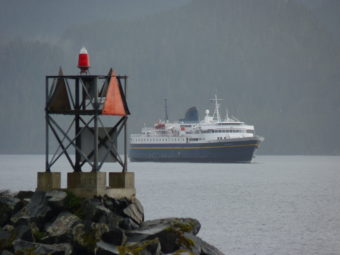
The ferry Malaspina makes a rare appearance near downtown Sitka in 2010. All marine highway vessels will have to shut down this spring if a budget gap isn’t filled. (Photo by Ed Schoenfeld/CoastAlaska News)

Gov. Bill Walker’s new budget fills a gap that could have shut the ferry system down for much of the spring. The spending plan, released Dec. 15, also funds the full Alaska Marine Highway schedule for the next fiscal year.

A complex provision in this fiscal year’s budget cut about a fifth of the marine highway’s funding.

If the money isn’t replaced, General Manager Capt. John Falvey said ships will stop sailing.

“We feel we can operate the ferry system until approximately the middle of April 2018. Then we would in essence have to shut the system down,” he said.

It wouldn’t start up again until the next budget year starts July 1. So all ferries would be tied up for about two and a half months.

But there’s a remedy in the Walker administration’s budget. It restores the funds – about $24 million. And that would allow the ferry system to continue serving its about 35 port communities — if it remains in the spending plan.

The fast ferry Fairweather docks at Juneau's Auke Bay Ferry Terminal in 2013. (Photo by Ed Schoenfeld/CoastAlaska News)
The fast ferry Fairweather docks at Juneau’s Auke Bay Ferry Terminal in 2013. (Photo by Ed Schoenfeld/CoastAlaska News)

“I would think the Legislature will support it,” said Sitka Republican Sen. Bert Stedman, who chairs his chamber’s transportation committee.

He said he expects opposition. But so far, House and Senate Finance Committee leaders haven’t disapproved.

“The co-chairs have been notified over a month ago by letter that this was coming and if they didn’t agree to it to let the administration know. As far as I know, there was no objections to it,” he said.

The Alaska Marine Highway System money is in what’s called the supplemental budget. It includes appropriations that fills gaps in this fiscal year, which ends June 30.

Funding for the fiscal year starting July 1 is listed in the operating budget. Walker’s version proposes a small drop in ferry system funding, less than 1 percent.

But Falvey said service will increase slightly, because some ships are cheaper to sail than others.

“We will run the Columbia a little less and the Malaspina a little bit more. Because of the ship configuration that we have this year, even with a little less money, we will be able to run a few more weeks of service,” he said.

Next year’s marine highway budget is just under $140 million.

Walker’s spending plan also includes money for a small, separate nonprofit Inter-Island Ferry Authority.

“It’s the thing that keeps us solvent,” said General Manager Dennis Watson.

It sails one route connecting Hollis on Prince of Wales Island and Ketchikan.

“We come within 15 to 20 percent of making our operating costs out of the fare box. So we fall a little bit short at the end of the year. And this helps. This makes up that,” he said.

The amount is $250,000, the same as has been requested in earlier years.

The governor’s budget lists his administration’s priorities. But the Legislature will make the final decisions. That means it could take months before either ferry system knows what it’s funding will be.

Site notifications
Update notification options
Subscribe to notifications