Syndicated

Landless communities continue fight for land

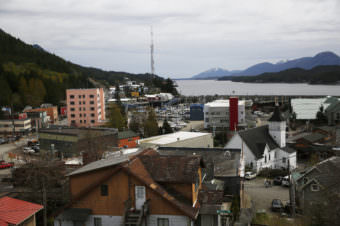
Ketchikan sits on an island at the southernmost end of southeast Alaska, a prime spot for cruise ships navigating Alaska's Inside Passage. (Photo by Elissa Nadworny/NPR)
Downtown Ketchikan in spring 2017. The Southeast city is one of five without its own Alaska Native corporation. A bill before Congress would change that. (Photo by Elissa Nadworny/NPR)

Representatives of five Southeast Alaska communities continue their fight for recognition under the Alaska Native Claims Settlement Act.

But they’re still facing opposition.

It’s been almost a half-century since Congress passed the Alaska Native Claims Settlement Act, which created more than 200 corporations with land, money and shareholders.

It left out Ketchikan, Wrangell, Petersburg, Tenakee Springs and Haines, known as the landless communities.

Alaska’s Congressional delegation has introduced a number of bills over the years to address the situation. None has passed.

Supporters haven’t given up, and they said it’s not about money.

“It’s about the land, said Joseph Reeves, president of the Landless Natives of Ketchikan. “The land is our centerpiece and we ain’t ready to give up that idea.”

“Let’s have just a sliver of what we used to totally own,” he said. “And that’s all it is, 23,000 acres in Ketchikan out of the millions of acres around us that we always owned.”

He supports terms of the latest legislation, the Alaska Native Claims Settlement Improvement Act, which also includes provisions to transfer land in other parts of Southeast and the rest of the state.

U.S. Sen. Lisa Murkowski co-sponsored the measure with Sen. Dan Sullivan.

“This is a matter of equity,” she said. “To have five communities that were left out was not right then and it’s not right to this day that they continue to be on the outs.”

The bill was introduced last summer and had its first hearing in February.

It remains in the Senate Committee on Energy and Natural Resources, which Murkowski chairs.

Its best chance of passing is to be part of a larger lands measure.

The bill is opposed by a number of environmental organizations, because it would transfer a total of more than 100,000 acres of Southeast’s Tongass National Forest to the five new corporations.

One critic, Andy Moderow of the Alaska Wilderness League, also opposes land transfers elsewhere in the state.

“Under the guise of correcting past wrongs, Sen. Murkowski is pushing ahead with a bill that will create a whole bunch of new sets of problems in Southeast Alaska and around Alaska by privatizing up to 600,000 acres of land in our state with very few protections for areas that currently are public resources,” he said.

The Southeast Alaska Conservation Council, or SEACC, also opposes the measure as written.

There’s no consensus on why the five communities didn’t get their own corporations.

Some have said they weren’t historically Native communities or didn’t have large enough Native populations.

A University of Alaska study showed strong similarities to other communities that did get corporations.

Others said the Forest Service and the then-thriving timber industry didn’t want to lose access to the land.

Still others have said it was a paperwork mistake in the rush to pass the legislation.

Reeves thinks that like its predecessors, this bill may not make it through Congress. But he and others will continue the work begun decades ago by people who are now elders or have passed away.

“We still have their children and their children’s children here that will benefit from this,” he said. “It will help them in their seeking of an identity as an Alaska Native person in this community. To be a part of an ANCSA corporation is something that we hope will help our people for generations to come.”

Most of the people who would gain stock in the new corporations already are shareholders of Sealaska, Southeast’s regional Native corporation. That’s the case for most members of the region’s other 13 urban or village corporations.

New state Forest Service leader has Alaska experience

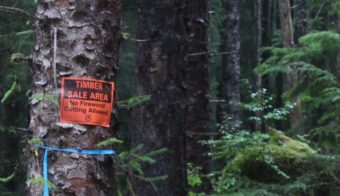
A timber sale sign is posted in the Tongass National Forest on Prince of Wales island. (KRBD file photo)
A timber sale sign is posted in the Tongass National Forest on Prince of Wales Island. The new Forest Service regional forester for Alaska, who takes over in April, was a district ranger on the island. (KRBD photo)

The U.S. Forest Service controls 22 million acres in Alaska, including most of Southeast. It’s overseen by a regional forester, whose staffers manage logging, mining, recreation and fish habitat.

The agency is getting a new top official in April. David Schmid will have to deal with a particularly controversial land management plan that’s under attack.

David Schmid

Schmid began his Forest Service career in Alaska. He and his wife moved here in the early 1980s for his first agency job, in Southcentral’s Chugach National Forest. Later, he worked in the Tongass in Southeast.

“Over the years I think we spent 23 years together in Alaska and just having an opportunity to come back and re-engage with folks and work on Alaska issues has just been a dream of mine,” he said.

He’s leaving his post as deputy regional forester for the agency’s Northern Region, based in Missoula, Montana.

He’ll take over the Juneau-based Alaska Region job from Regional Forester Beth Pendleton, who’s retiring after eight years in the position. She’s spent about 30 years in the Forest Service, two-thirds of it in Alaska.

Pendleton served as acting associate chief of the nationwide agency during the transition to the Trump administration. And recently, the agency’s chief stepped down amid allegations of sexual misconduct.

Despite shakeups at the top, she said there was no pressured to leave.

“My plans to retire were in 2018. So this is per my choice to retire at this time,” she said.

Beth Pendleton

Pendleton oversaw the Forest Service’s Alaska region during development of the most recent Tongass Land Management Plan. It’s been challenged in court and in Congress, largely because it begins the phase-out of old-growth logging.

She believes the plan will survive because it’s flexible and can absorb change.

“We’ve been really focusing on that transition to young-growth harvests and renewable energy. There is an adaptive management component that’s associated with the plan, where there’s room … to further amend the plan in the future if needed,” she said.

She said she’ll bring her replacement up to speed before she leaves the office.

Schmid hasn’t been part of this version of the Tongass planning battle. But he’s familiar with the issues from his days as district ranger for Thorne Bay, on Prince of Wales Island. Before the big mills closed, it was a center of Alaska’s timber industry.

He said he’s dealt with similar conflicts in his current job.

“I think I’ve had something like 75 or 80 objection resolution meetings here in Montana and Northern Idaho and North Dakota. And often times, mostly around tribal planning or large vegetation management, I would say it was almost identical to my experiences in Alaska with some very polarized issues,” he said.

A March 15 Forest Service press release announcing the transition said Schmid will be acting regional forester. But he said he’ll be here for the long haul.

The Forest Service has nine regional offices. Not a lot are overseen by women.

But Pendleton said she’s not unique.

“I would say in the last 10 to 15 years we’ve seen more women and minorities come into some of these leadership positions. And I have had nothing but support and encouragement as I have worked in the agency and as I have served here in Alaska,” she said.

A recent investigation showed a pattern of gender discrimination, bullying, sexual harassment and assault against women in fire crews and some other sections of the Forest Service.

Alaska’s top Forest Service official is retiring

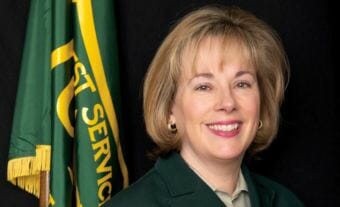
Alaska Regional Forester Beth Pendleton is retiring in April. Her replacement will be Montana’s David Schmid, who worked in Alaska’s Tongass and Chugach National Forests for more than 20 years. (Photo courtesy U.S. Forest Service)

The top official overseeing Alaska’s national forests is leaving her job.

Regional Forester Beth Pendleton will retire in April after eight years in the position. She oversaw the U.S. Forest Service’s Alaska region during development of a controversial Tongass Land Management Plan that’s being challenged in Congress.
Pendleton also served as acting associate chief of the agency during the transition from the Obama administration to the Trump administration.

Forest Service officials announced her retirement plans Friday in a press release.

Officials also named David Schmid as her replacement, in an acting capacity.

Schmid is deputy regional forester for the agency’s Northern Region, based in Montana. He also worked in Alaska’s Tongass and Chugach national forests for more than 20 years. He begins his new Alaska job in mid-April.

The state’s two national forests total 22 million acres of land in Southeast and Southcentral Alaska.

Southeast tribes broaden transboundary alliance

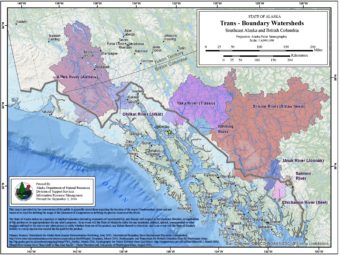
The state has identified eight transboundary watersheds feeding Southeast Alaska rivers. (Map by Alaska Department of natural Resources.)
The state has identified eight transboundary watersheds feeding Southeast Alaska rivers. Tribal governments and groups from Southeast and British Columbia met March 12-13 to talk strategy in their fight against B.C. mines in those watersheds. (Map by Alaska Department of Natural Resources.)

Southeast tribal leaders are gaining new allies in their battle against British Columbia mining projects.

Representatives of a dozen Alaska tribal governments and organizations met earlier this week with their counterparts from British Columbia, Idaho and the Yukon River watershed.

Southeast Alaska Indigenous Transboundary Commission Chairman Frederick Otilius Olsen Jr. said the gathering strengthened an informal alliance.

“The purpose of the meeting was to continue the unification of the indigenous voices around the issue of the so-called transboundary mines and also any transboundary industrial activities,” said Olsen, who is also tribal president of the Organized Village of Kasaan.

The more than 30 representatives met Monday and Tuesday at the Tulalip Indian Reservation, between Seattle and Vancouver, British Columbia.
The alliance released this proclamation at the end of the meeting:

Olsen said they shared concerns about damage to traditional waterways and lands. He said they also talked about state, provincial and national environmental programs they say don’t work.

“We call on the federal governments to do their jobs. To listen to us and work with us. And you know what, if they can’t do it or won’t do it, as one of our members said, ‘Give us a shovel. Let us do it,'” he said.

Southeast’s indigenous transboundary commission is already working with the United Tribes of Bristol Bay. That group opposes Southwest Alaska’s Pebble Mine project.

Developers on both sides of the border challenge the assumption that their projects will damage fish and other resources.

Trump tariffs could jack up boat prices

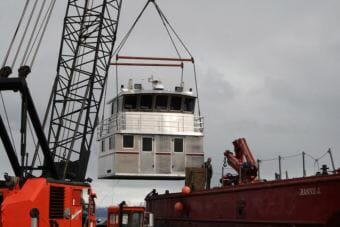
A crane moves an aluminum replacement cabin made by Homer's Bay Weld Boats. The company is one of a number of Alaska businesses already affected by President Trump's imported metals tariffs. (Photo courtesy Bay Weld Boats.)
A crane moves an aluminum replacement cabin made by Homer’s Bay Weld Boats. The company is one of a number of Alaska businesses already affected by President Donald Trump’s imported metals tariffs. (Photo courtesy Bay Weld Boats)

In at least one sector in Alaska, the impacts of President Donald Trump’s steel and aluminum tariffs are real.

Homer’s Bay Weld Boats makes custom aluminum watercraft, from 60-foot tenders to 22-foot seine skiffs.

General manager Eric Engebretsen has been keeping an eye on plans for a 10-percent tariff on imported aluminum.

He’s not alone.

“The supply chain heard this was potentially going to happen back in early January and the whole marine aluminum supply chain started to adjust itself and prepare itself for this,” he said.

His company buys sheet aluminum from a local supplier. He said his understanding is that it’s manufactured in the United States.

But that hasn’t made any difference.

Bay Weld and other aluminum users started buying up supplies in advance of the announcement.

“We’ve seen over 35 percent and in some cases 50 to 60 percent increase in our pricing structure of purchasing aluminum,” he said.

The second-generation business owner hopes the hikes will level out soon, but he’s not counting on it.

He said that will increase prices on the 12 to 18 custom boats his up to 32 employees make in a year.

Alaska has a number of other aluminum boatbuilders.

Other businesses make or repair steel ships, including Vigor Marine, which runs the Ketchikan Shipyard, where state ferries have much of their work done, including rusty steel replacement.

Trump’s imported steel tariff is 25 percent.

The state Department of Transportation includes the ferry system.

“DOT doesn’t expect the tariffs will impact our state transportation,” spokeswoman Aurah Landeau said. “DOT doesn’t purchase foreign steel because we operate under the Buy America program.”

The ferry Malaspina is in drydock and the Columbia is tied up at the Ketchikan Shipyard in February, 2012. Federal funds have covered millions of dollars of repairs. (Photo by Ed Schoenfeld/CoastAlaska News)
The ferry Malaspina is in drydock and the Columbia is tied up at the Ketchikan Shipyard in 2012. Marine Highway System fleet repairs require the use of American steel. (Photo by Ed Schoenfeld/CoastAlaska News)

Beyond shipbuilding, Alaska businesses fabricate fuel tanks and other goods out of the embargoed metals. But not a lot.

“We tend to have a pretty small manufacturing industry in Alaska,” state economist Karinne Wiebold said.

The tariffs could still drive up prices, she said, which will affect stores, warehouses and other sellers. She said their response could shake up sectors of our economy.

“If the cost of the final product goes up, the demand may fall as consumers either cut back on that product or substitute for something that (has) a comparably lower cost,” she said.

That’s also the case for steel and aluminum used in bridges, buildings, ports, pipelines and other public projects. And overall, many parts of Alaska’s construction industry have slowed down.

“Road construction, airport construction, that’s still very healthy and it’s been under the Buy America Act for years,” said John MacKinnon, executive director of the Alaska Chapter of Associated General Contractors.

Steel’s role in construction is pretty obvious. But he said many people aren’t aware of how much aluminum is used.

“On the building side, you’ve got a lot of aluminum because all the windows, storefronts and that sort of thing are aluminum,” he said. “The structure is usually steel or concrete. And the highway projects, road projects, most of your signage and there’s other components in there, are aluminum.”

He said prices change for a variety of reasons. Tariffs, such as Trump’s, are only one type of variable in his industry.

“Will it make much difference? Not from the practices that we’ve been going on for the last few years,” he said.

Back at Homer’s Bay Weld Boats, Engebretsen said some in the business are scratching their heads.

“There was a political layer to this that really wasn’t driven by the industry itself,” he said. “The industry didn’t ask for the aluminum pricing to be adjusted. It was kind of something that was forced on us and now here we are,” Engebretsen said.

He’s already considered how much he’ll have to raise his prices.

It could be 5 to 10 percent, which is not out of line with other adjustments for inflation, he said.

“But it’s also a fairly high-dollar product. I suspect it will have an impact,” he said. “But we just don’t know yet.”

The president has granted exemptions for metal imports from Canada and Mexico, which could lessen some of the price hikes.

The exemptions are only temporary, and they’re dependent on negotiations to update the North American Free Trade Agreement.

Ferry LeConte down for repairs

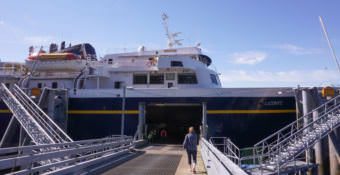
A passenger boards the Alaska Marine Highway System ferry LeConte in Pelican on Aug. 6, 2017.
A passenger boards the Alaska Marine Highway System ferry LeConte in Pelican on Aug. 6, 2017. A generator breakdown has halted sailings at least until March 7. (Photo by Jeremy Hsieh/KTOO)

A mechanical problem is keeping the ferry LeConte tied up through at least March 7.

Alaska Marine Highway spokeswoman Aurah Landau said it’s docked in Juneau.

“The LeConte suffered a bent push rod and it’s an internal component on a generator. So one of the generators was out and the Coast Guard can’t certify the ship to sail without that generator,” she said.

The Juneau-based ship will miss sailings to and from Gustavus, Hoonah, Haines and Skagway.

But Landau said repairs could take longer than March 7. That could cancel sailings to and from Angoon and Tenakee Springs.

The LeConte also makes port calls at Kake and Pelican, but not until later this month.

The ferry is 44 years old. It can carry 225 passengers and approximately 33 vehicles. It has no staterooms and was built to serve small communities.

Site notifications
Update notification options
Subscribe to notifications