Syndicated

Former ferry Taku headed to the scrapyard

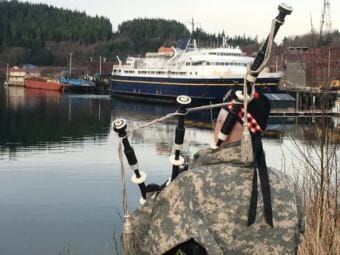
Rob Alley plays the bagpipes as a send off for the ferry Taku as the ship departs Ketchikan’s Ward Cove on March 13, 2018.
Rob Alley plays the bagpipes as a send-off for the ferry Taku as it departs Ketchikan’s Ward Cove on March 13, 2018. Alley first arrived in Alaska aboard the Taku in 1992. Now, the ship is headed to the scrapyard. (Photo by Leila Kheiry/KRBD)

The former state ferry Taku sailed past Singapore on Friday on the way to being scrapped. It will go for close to 10 times its purchase price.

Jabal Al Lawz Trading bought the 55-year-old ship earlier this year.

The Taku left Ketchikan’s Ward Cove, where it had been stored, March 13. The company sailed it across the Pacific Ocean in hopes of finding a buyer to keep it in service. But negotiations with interests in Singapore and Fiji didn’t work out.

Co-owner Ben Evans of New Zealand said it will end its sailing days in India later this month.

“She’s going to go to the scrapyard and sold for demolition. So that’s the end of the Taku,” he said, calling it a tragedy.

The state sold the ship in January for $170,000.

Evans said his company will probably get about $1.5 million for the ship. But sailing it 12,000 miles across the Pacific was expensive.

“It costs us $55,000 to insure it for the voyage. My crew payroll’s running about $2,000 a day. The fuel bill was probably just under $400,000. There’s some big figures there, you know,” he said.

State officials put the Taku up for sale a little more than a year ago. The original minimum bid was $1.5 million. But it took several tries to sell it, each with a lower price.

The Taku has not been a working ferry for several years. It was tied up in 2015 because of its age, as well as budget cuts.

Robert Venables heads up the state’s Maine Transportation Advisory Board. He also works for the Southeast Conference, which pushed the state to start the ferry system more about 60 years ago.

He said the ship’s condition left few choices.

“It’s not surprising, but it does leave you with a little bit of sadness that she’s not going to be in service,” he said.

Evans said most of the Taku will be recycled. Some parts, such as generators, will be sold whole.

The cut-up hull will be reprocessed into rebar. Among other things, it’s used to strengthen concrete in building construction.

Co-owner Evans said an investor in Fiji wanted to use the Taku as a ferry. He said interests in Singapore were interested in retrofitting it into what’s called a superyacht.

But all backed out.

Sealaska dividends boosted by other corporations’ oil and zinc earnings

A worker portions halibut as part of a processing line at Odyssey. (Photo courtesy Sealaska Corp.)
A worker portions halibut at a processing line at Odyssey, one of Sealaska’s recent Seattle-area seafood investments. The corporation says those investments boost earnings and dividends. (Photo courtesy Sealaska Corp.)

Sealaska Corp. will distribute more than $23 million to its shareholders Friday. It’s twice last spring’s amount, in part because the Southeast regional Native corporation’s own businesses are making more money.

But the largest part of many shareholders’ checks come from other regional Native corporations’ earnings.

The Alaska Native Claims Settlement Act of 1971 created 12 regional corporations.

Some ended up with large stands of trees, rare mineral deposits or other valuable natural resources. Others did not.

So the act – and a later legal agreement – required those with more to share their wealth with those with less. It’s known as section 7(i/j).

Juneau-headquartered Sealaska used to be one of those with more. It made a lot of money off its timberlands and shared 70 percent with other regional corporations. But in more recent years, it’s been getting considerable revenue from two of its northern cousins.

One is Arctic Slope Regional Corp., which is in the oil business.

“That’s been down from historic levels and is still down from historic levels,” said Anthony Mallott, Sealaska’s president and CEO.

The other owns the rights to a profitable mine in northwest Alaska.

“This last year, zinc prices have been headed upward. And there’s more income from the Red Dog Mine that NANA (Regional Corp.) is the landowner of,” Mallott said.

Dividend totals differ. This year, they range from $13.50 to $2.36 per share. That’s because the corporation’s more than 22,000 shareholders are divided into classes.

For those getting the largest dividends, more than 80 percent comes from the shared revenue pool. A little more than 10 percent comes from the corporation’s own businesses. The remainder is from the corporation’s permanent fund earnings.

Mallott said they’re doing well.

“The land-management (and) natural resource business is one of the leaders. We’re actively investing in the seafood side, meaning expectations that seafood will quickly be the greatest source of income for Sealaska,” he said.

The corporation also continues to earn money through investments and government contracting.

“They were all profitable in 2017 just like they were all profitable in 2016. And they’re all growing,” he said.

“If this a trend line for Sealaska, that’s great news,” said Nicole Hallingstad, a former vice president and corporate secretary for Sealaska.

She’s also run for its board of directors as an independent – and sometimes critical – candidate.

“Shareholders want to support the corporation and they’re excited that the corporation seems to be on a trend of profitability,” she said.

It’s hard to tell how well Sealaska’s different subsidiaries are doing. That’s because the corporation reports financial results by sector, not for each separate company.

Hallingstad said that’s understandable because corporations don’t want competitors to know too many details. But she thinks Sealaska could be more transparent in its dividends breakdown for shareholders.

“It would be great if there was a number that showed the earnings from our subsidiary holdings as opposed to the investment holdings. And that way, shareholders really can begin to track what our subsidiary operations are doing,” she said.

About five years ago, Sealaska’s revenues dropped significantly due to more than $30 million in losses from its construction subsidiary and some other operations.

The losses were spread out over several years. But Mallott said they’re no longer part of the dividend equation.

Read a study of the shared resource earnings pool here: A Summary of the Economic Benefits of ANCSA Sections 7(i) and 7( j) Revenue

Alaska Energy Desk’s Elizabeth Jenkins contributed to this report.

Alaska ferry officials consider fuel alternatives

FVF Fairweather engine room
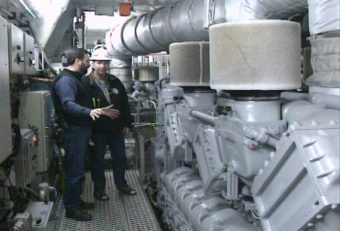
The fast ferry Fairweather’s engines run on diesel. Marine highway officials are not considering replacing them with electric engines. But they’re installing dual-fuel engines that could use natural gas on three ships. (Photo by Skip Gray/KTOO)

Washington state is considering converting some of its ferries to electrical power, and its Legislature recently voted to spend $600,000 to study the option.

Alaska, on the other hand, is not. But officials here are considering a different alternative ferry fuel.

Alaska’s nine working ferries all burn diesel, which is expensive.

It also contributes to climate change, which melts sea ice and permafrost, damaging roads and communities.

So it would make sense for the state ferry system to look for alternatives, such as electricity.

“It’s not a new question. This question has come up in years past with the marine highway,” said Capt. John Falvey, general manager of the Alaska Marine Highway System.

He said research showed it would be much harder to make electrical engines work in his fleet.

“Because we run longer, on average, routes than Washington State Ferries does, with their entire fleet being a day fleet where they will stop once a day to be able to recharge their batteries,” he said. “(It) makes it a little tougher for the marine highway.”

Falvey said the most likely ship to be converted would be the Lituya. The small ferry sails a short route connecting Ketchikan and Metlakatla, in southern Southeast.

He said electric engines also might work in Prince William Sound and northern Lynn Canal, which also have some short routes.

The cost would be high at a time when the ferry system barely has enough money to keep its fleet sailing.

He said other challenges include the time needed to recharge batteries and the availability of cheap electricity at some ports.

Falvey’s not writing off electrical conversions forever.

“Not to say technology hasn’t changed. And maybe we look at it again,” he said. “That’s something that I could do if I was asked.”

Renewable Energy Alaska Project Executive Director Chris Rose believes electricity will be an option in the future.

“I think the price of the batteries has been a key factor,” he said. “And as that price comes down, it will open up opportunities for entrepreneurs to figure out ways to displace fossil fuel-burning motors with electrical motors.”

Alaska’s ferry system is planning for a different alternative fuel. Falvey said it’s liquefied natural gas.

“Right now, LNG is cheaper than diesel fuel and it burns a lot cleaner,” he said. “We are seriously looking at that.”

The marine highway is installing engines on two new Alaska-class ferries that will burn either diesel or natural gas. The small ships will link Juneau, Haines and Skagway.

Falvey said it’s also installing dual-fuel engines on the larger ferry Matanuska.

The same will happen when a replacement for the large Southwest ferry Tustumena is built.

“Some of the issues with LNG in the past has been the supply chain coming into Alaska,” he said. “But it appears that as time goes by that may become less and less of a problem.”

He also said onboard storage could be tricky. Safety rules are very strict and have limited LNG use on passenger vessels.

Those rules are evolving, he said. And cruise ships that run on natural gas are being built and put into service.

Sealaska Corp. doubles April payout to shareholders

Sealaska directors on Friday approved a spring distribution totaling $23 million. The amount paid to each shareholder depends on the number of shares, as well as their class.
Sealaska directors on Friday approved a spring distribution totaling $23 million. The amount paid to each shareholder depends on the class of their shares. (Graphic courtesy Sealaska Corp.)

Sealaska’s spring shareholders’ payout is more than twice the size of the previous year’s.

The Southeast regional Native corporation announced Friday it will distribute $23.1 million to tribal members beginning April 13. Last spring’s dividends totaled $10.6 million.

The Juneau-headquartered corporation has more than 22,000 shareholders, almost all of Tlingit, Haida or Tsimshian descent. Dividends will range from approximately $236 to $1,586 each, depending on the class of shares and the number owned.

In a press release, officials said the corporation is also investing more money into its scholarship endowment. President and CEO Anthony Mallott cited rising costs for secondary education and the need to advance shareholders and their descendants.

The corporation’s board will also look into creating a burial-assistance program. Some Sealaska critics have lobbied for the benefit.

Officials cited increased business earnings as one reason for the larger payout and scholarship increase.

Sealaska began investing in Seattle-area fish-processing businesses in 2016.

Campaign takes different approach to racism

First Alaskans Institute officials discuss racism and reconciliation at the Elizabeth Peratrovich Hall on Thursday in Juneau. From the left are Angela Gonzales, Andrea Sanders and Liz Medicine Crow.(Photo by Skip Gray/360north)
First Alaskans Institute officials discuss racism and reconciliation at the Elizabeth Peratrovich Hall on Thursday in Juneau. From the left are Angela Gonzales, Andrea Sanders and Liz Medicine Crow. (Photo by Skip Gray/360 North)

A statewide Native organization wants Alaskans to recognize, discuss and repair the impacts of racism.
The Anchorage-based First Alaskans Institute brought its Truth, Racial Healing and Transformation campaign to Southeast on Thursday.

President and CEO Liz Medicine Crow spoke at a Juneau hall named for Tlingit civil rights leader Elizabeth Peratrovich.

“What we’re trying to achieve is a process by which we transform the way that we as a society view one another and work with one another and value one another,” she said. “When you transform things, they can never go back to how they were.”

Medicine Crow said the effort seeks to tell the truth about racial relations without being punitive.

She also said the campaign can benefit all Alaskans.

“It is not just about Alaska Native people. It is about righting wrongs,” she said. “It is about utilizing justice as a tool to advance us as a society and not just to delineate somebody being in the wrong or in the right.”

The program was held in Juneau as part of the institute’s Alaska Native Civic Engagement Training, which will repeat April 6-7 in Fairbanks.

State ferries won’t stop sailing April 16, after all

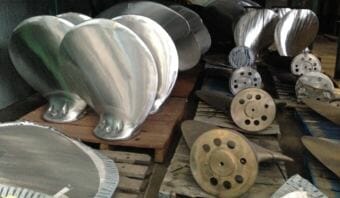
Ferry props wait for use Feb. 19, 2014, at the Alaska Marine Highway Warehouse in Ketchikan. The ferries will continue sailing this spring and early summer thanks to a bill signed Tuesday. (Photo by Ed Schoenfeld/CoastAlaska News)
Ferry props wait for use at the Alaska Marine Highway Warehouse in Ketchikan on Feb. 19, 2014. The ferries will continue sailing this spring and early summer thanks to a bill Gov. Bill Walker signed Tuesday. (Photo by Ed Schoenfeld/CoastAlaska News)

The Alaska Marine Highway System will not have to shut down in April.

Gov. Bill Walker signed a supplemental appropriations bill Tuesday funding the ferry system through the end of the current fiscal year in June.

The gap would have left an 11-week hole in the system’s budget. April 16 was set as the shutdown date.

Sitka Republican Sen. Bert Stedman represents many of the Southeast communities most dependent on the ferry system.

“I think that’s great. We can get the marine highway through the first of July and then have a fairly flat schedule going forward, with a few little improvements for the next year and continue to try to move the marine highway forward instead of backwards,” he said.

The supplemental bill provides about $24 million for the ferry system.

The shortfall was caused by an earlier spending bill meant to fund Medicaid if it ran out of money. It called for that money to come from the ferry system. Those terms were not widely known.

Stedman sounded the alarm about the shortfall in September. He called it “skullduggery and downright sleazy.”

“It’s not how we should do budgets or how we should deal with the public purse. So I think the negative press from those type of actions goes a long way to keep them from recurring” he said.

The $110 million fast-track supplemental bill also funds gaps in state Medicaid and prison programs.

Ferry funding for the budget year beginning in July still needs to be approved by the full Legislature. So far, it’s passed the House but not the Senate.

Site notifications
Update notification options
Subscribe to notifications