Syndicated

Marine highway reform bills introduced in state House

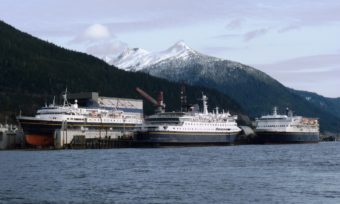
Three ferries dock at the Ketchikan Shipyard in 2012. Four ships are slated to be tied up for the 2016 season. (Photo by Ed Schoenfeld/CoastAlaska News)
Three ferries dock at the Ketchikan Shipyard for repairs and storage in 2012. Legislation has been introduced as part of a marine highway reform project organized by port community leaders and the state. (Photo by Ed Schoenfeld/CoastAlaska News)

Three bills aimed at protecting the Alaska Marine Highway System are before the state Legislature. Two would stabilize funding and maintain routes. A third, addressing governance changes, is up for its first hearing March 8.

The state ferry system has seen significant cuts in recent years. While the routes remain the same, the number of sailings has dropped. One ship has been sold and another is tied up with no plans to return.

Juneau Rep. Sam Kito III has introduced legislation that’s part of a larger plan to restructure ferry funding and management.

One measure, House Bill 377, would move nearly $200 million from the Alaska Permanent Fund’s earnings reserve into a ferry operations account.

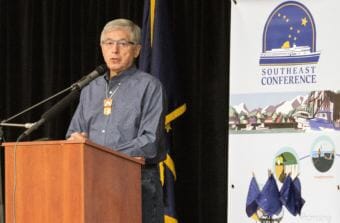
Kito wasn’t available for immediate comment. But in a speech last fall, he pointed to schedules published before the system knew how much money it had.

“So if the budget passes on July 1 and the budget is significantly different from year to year, that we don’t have to work about the marine highway system having to terminate runs that have already been scheduled,” he said.

The money would fill a funding gap that could shut down the ferries this spring. It would also forward fund the following budget year, which starts in July.

Forward funding is a significant part of the Alaska Marine Highway Reform Project, led by the Southeast Conference, which pushed to create the system about 50 years ago.

But state Transportation Commissioner Marc Luiken, who’s part of that project, said he’s no longer using that term.

“I’ve really changed my tune, if you will, at least the verbiage or the syntax I’m using around this and it’s really stable funding,” he said.

Another measure introduced by Kito, House Bill 378, would put all ferry port communities into law. His office said that would keep officials from ending ferry routes without public debate.

Other legislation changing the ferry system from a state agency to a public corporation is also in the works.

Kito has said he doesn’t expect his bills to pass in this year’s legislative session, which is supposed to end mid-April. But he wants to get the discussion going.

At a February meeting in Juneau, the Southeast Conference encouraged regional leaders to lobby lawmakers to make them aware of the issue.

McDowell Group consultant Susan Bell also urged ferry supporters to take their campaign to the public.

“This isn’t going to happen unless it’s important outside of the Capitol. … All the legislators need to hear that it’s important in their community and to their constituents,” she said.

The ferry reform project has collected information demonstrating the system’s value to the state.

Elliott Bay Design Group consultant John Waterhouse said meetings in communities, including those without ferry ports, show support.

“One of the resonating messages was that people do recognize the worth of the marine highway system. Not just to Southeast Alaska, not just to Southwest Alaska, but to all of Alaska,” he said.

The legislation faces opposition at several levels. Some lawmakers see the ferries as too expensive while others consider it state-funded competition to private enterprise.

Some don’t want to take money out of the earnings reserve. Still others, including Sitka Sen. Bert Stedman, say the bills will make the system vulnerable to further funding cuts.

Editor’s note: This report was changed to reflect that only one ferry reform measure will be before the House Transportation Committee March 8.  


Southern Southeast scrap metal recycling to restart this spring

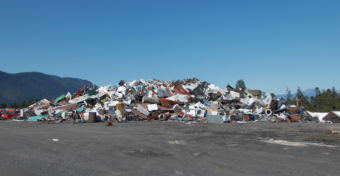
Scrap metal and junk cars are piled up at Petersburg’s landfill this month. (Photo by Joe Viechnicki/KFSK)
Scrap metal and junk cars are piled up at Petersburg’s landfill in 2017. Eight Southeast cities are working to set up regular barge runs to recycle metal junk. (Photo by Joe Viechnicki/KFSK)

Eight Southeast Alaska communities will resume scrap metal recycling as early as this April.

The Southeast Alaska Regional Solid Waste Authority is working with Waste Management, a large garbage removal and recycling business. The authority includes Petersburg, Wrangell, Craig, Klawock, Thorne Bay, Kasaan, Hydaburg and Coffman Cove.

Petersburg Public Works Director Karl Hagerman said old cars, broken construction equipment and other scrap metal has been piling up for several years.

Hagerman said prices have been low, so it would have cost more to ship scrap metal south than could be recovered by selling it for recycling. He said the price was $175 a ton last summer, but could be up to $230 a ton later this spring.

“That’s the value in Seattle, not in Petersburg, Alaska. So, the trick is transportation and the cost of getting that metal to market,” he said.

The solid waste authority reached a scrap metal recycling agreement with another company about four years ago. But it fell through. Wrangell has had a large amount of scrap metal barged off through a separate agreement.

Hagerman told the recent Southeast Conference Mid Session Summit that the spring collection will be a one-time deal.

“The second part of the scrap metal agreement with Waste Management is hopefully to set up a long-term agreement with the company to remove metal from the communities on an ongoing basis,” he said.

The authority is also looking at what’s needed to continue hazardous waste pickups from Southeast communities.

The current contract is running out and the company doing the work doesn’t want to continue. Hagerman said a committee is considering three proposals to keep the pickups going.

Several larger Southeast communities have their own contracts for recycling scrap metal and hazardous waste.

Learn more about Southeast trash issues through our eight-part series, Talking Trash. 

Forest Service official says fighting Lower 48 wildfires is cutting into Alaska forest services

The Pioneer Fire has been burning in Idaho since July, and hot, dry weather caused the fire to grow rapidly this week. (National Forest Service)
Idaho’s 2016 Pioneer Fire is one of an increasing number of wildfires in national forests. The cost of fighting such blazes is cutting into other U.S. Forest Service programs, including those in Alaska. (Photo courtesy National Forest Service)

Wildfires in the Lower 48 are affecting what the federal government can do in the Tongass and other national forests.

U.S. Forest Service Associate Deputy Chief Chris French told Southeast Alaska leaders his agency is spending more and more money on firefighting.

“We’ve seen 8,000 positions across the agency that we have essentially shifted from either providing services, forest management (or) recreation management to fire suppression,” he said.

French said firefighting is expected use up about 60 percent of the Forest Service budget within a few years. That’s three to four times what it was 15 years ago.

He said his agency is also spending more time and money responding to floods, droughts, diseases and insect infestations. He didn’t speak about climate change, but many scientists have said that’s the reason behind such extreme events.

French addressed the Southeast Conference Mid Session Summit in Juneau earlier this month.

He also said he’s looking at ways to speed up the agency’s permitting process. He said it has a backlog of more than 6,600 special use permits.

“This includes permitting outfitter guides, folks that are coming to us asking for access to mines or permitting ski areas or even range allotment permits” he said.

He said the agency is looking at excluding more types of projects from extensive environmental assessments. That will include an analysis of prior reviews under the National Environmental Policy Act.

Mallott lambastes Juneau’s annexation bid

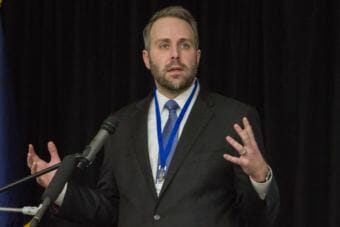
Lt. Gov. Byron Mallott addresses the Southeast Conference Mid Session Summit on Wednesday, Feb. 14, 2018, in Juneau. He urged capital city leaders to talk more with its neighbors about annexation plans. (Photo by Heather Holt)

Lt. Gov. Byron Mallott said Juneau is not behaving like a good neighbor.

During a Wednesday speech to the Southeast Conference Mid Session Summit, he lambasted officials for trying to annex parts of nearby Admiralty Island.
Leaders from Angoon, the island’s only city, oppose what they call a land grab.

“Juneau needs to recognize that it’s the capital of Alaska but also the regional center of Southeast,” he said. “And it has a responsibility and an obligation to reach out affirmatively to every other community in Southeast and say, ‘Let’s be neighbors and let’s work together and let’s build a place that is unassailable by the Legislature or anyone else who would seek to divide us.'”

The Juneau Assembly voted in January to add four parcels to its borough, including parts of northern Admiralty Island.

It later dropped one parcel after hearing objections from cabin-owners, most of whom live in Juneau.

A former Juneau mayor, Mallott said officials should respond similarly to objections from the island’s traditional residents.

“The people of Angoon feel so passionate and spiritual about all of Admiralty Island,” he said. “They’re concerned about economic development on that side of the island now. What’s the future of their island, that they share with the rest of our country as one of the most beautiful places on the face of the Earth.”

Most of Admiralty Island’s million acres are protected as a national monument.

It’s used for subsistence hunting and fishing. But it also has a mine on its north end that has already been annexed by the capital city.

Juneau Mayor Ken Koelsch said Mallott is wrong about officials not reaching out to its neighbors.

“We attempted to go over to Angoon several times and were not able to find one (time) that was acceptable to the mayor and the group over there that we were trying to meet up with,” he said.

Koelsch said he’ll continue to try to set up a meeting.

He also noted that Angoon Mayor Pauline Jim has since come before the Assembly.

Angoon residents cite their traditional ties to the island.

Koelsch said Juneau also has longtime connections to the land it’s trying to annex. The land includes historic trade routes and areas are claimed as traditional territory by Juneau’s Aak’w Kwáan and Taku Kwáan.

The annexation process can take a least a year.

Koelsch said that gives Angoon and other opponents more chances to object.

“The Local Boundary Commission that’s set up by the state has public hearings once we put the application in and it involves everyone possible that could be affected by it,” he said.

Juneau began looking at the parcels after losing a boundary battle with Petersburg.

Both boroughs claimed rights to absorb acreage on the mainland between the two communities.

Juneau lost, in part because Petersburg petitioned for the property first. So it began looking at other areas within model borough boundaries set years before.

Industry leaders say salmon initiative would hinder development

A panel of industry leaders discusses timber, mining and other topics during the Southeast Conference Mid Session Summit Feb. 13 in Juneau. (Photo by Heather Holt)
A panel of industry leaders took up timber, mining and other topics Tuesday, Feb. 13, 2018, during the Southeast Conference Mid Session Summit in Juneau. Josh Kindred of the Alaska Oil and Gas Association, right, spoke against the Stand for Salmon initiative. (Photo by Heather Holt)

Industry representatives are telling Southeast leaders they need to oppose the Stand for Salmon initiative and related legislation.
The measure, which is being challenged in the courts, would create stronger protections for Alaska’s salmon streams and rivers.

During the Southeast Conference Mid Session Summit in Juneau, power company and oil industry officials told about 100 regional officials Tuesday that the initiative would hinder development.

“What’s implied is that currently in Alaska, salmon or anadromous fish habitat isn’t protected,” said Josh Kindred, environmental counsel for the Alaska Oil and Gas Association. “And nothing could be further from the truth,”

He said the initiative and somewhat similar legislation would require unnecessary environmental reviews and its new regulations would be unenforceable.

“One of the fundamental problems here is that if this passes, you are basically giving the state five years of litigation,” Kindred said. “Given all the ambiguity in the proposal, all the gaps, all the contradictions, the state is going to be sued on this time and time again, because there is no clear path for the state to implement this without getting sued.”

That’s not the case, backers said. They said the Stand for Salmon initiative would update a 60-year-old law that does not give enough priority to Alaska’s fisheries.

The Alaska Power Association told the conference it also opposes the proposals.

Spokesman Michael Rovito said the legislation, House Bill 199, could hold up new and updated hydropower projects.

“It contains a grandfather clause to where if you already have an existing project, as long as you don’t make any significant changes, you fall under your past permitting regime,” Rovito said. “But as soon as you make a significant change, you can fall under this new major permit.”

Sealaska Corporation also is concerned about the additional limits on development.

CEO Anthony Mallott said it requires too much regulation. The regional Native corporation is Southeast’s largest private landowner.

Initiative opponents have organized a well-funded campaign through the group Stand for Alaska.

The business leaders urged the Southeast Conference to adopt a resolution opposing the Stand for Salmon initiative.

It’s already considering such a resolution, which will likely be approved.

Ferry Malaspina out of service for an extra month

ferry Malaspina
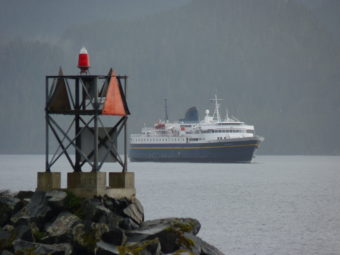
The ferry Malaspina makes a rare appearance near downtown Sitka in 2010. The 450-passenger ship will return to service a month later than scheduled this spring. (Photo by Ed Schoenfeld/CoastAlaska News)

The state ferry Malaspina will return to service about a month later than expected. That will affect nine Southeast port communities.

The 450-passenger ship was supposed to come out of a scheduled overhaul at Ketchikan’s Vigor Marine dry dock March 31. Instead, it will resume sailing April 28.

It usually travels a route between Prince Rupert in British Columbia and Haines, with seven other port calls along the way.

Alaska Marine Highway System spokeswoman Aurah Landau said no other ships are available to fill in.

“The Malaspina is the community boat for Southeast Alaska. It gets into smaller ports that the mainliners can’t get into. And impacts to the Malaspina, we understand, are significant for passengers and communities,” she said.

The ferries Columbia and LeConte will sail to and from those ports as scheduled. But service will be less frequent without the Malaspina.

The delay is due to a scheduling problem, not the need for additional repairs. A barge used as a floating cruise ship berth in Ketchikan will be in the Vigor Marine dry dock longer than expected. City Ports and Harbors Director Steve Corporon said it’s being overhauled.

“It’s in dry dock for routine maintenance to clean it, recoat it and put new zincs on it. And being Southeast Alaska, whenever you’re trying to essentially paint something this time of year, sometimes it can take a little longer to get it done than you would hope,” he said.

The berth and its supporting structures were struck by a cruise ship in 2016. Corporon said most of those repairs have been completed.

Landau said the Malaspina work is routine, part of the marine highway system’s regular maintenance plan.

“The Malaspina in overhaul is going to get painted on its underside, the propeller hubs will be reconditioned and there will be some steel inserts on the car deck to replace wasted steel. And they’ll go through with normal annual inspections,” she said.

In addition to Prince Rupert and Haines, the Malaspina stops at Juneau, Ketchikan, Wrangell, Petersburg, Kake, Hoonah and Sitka.

Site notifications
Update notification options
Subscribe to notifications