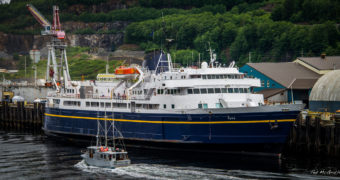
The Alaska Marine Highway System’s ferry Taku is for sale. The bid deadline has been extended to allow a potential buyer more time to examine the ship. (Creative Commons photo by Ted McGrath)
The state has pushed back the bid deadline for the ferry Taku until Sept. 15. That’s because a potential buyer wants more time.
It’s the fourth extension since the Alaska Marine Highway System began advertising the ship back in March.
Spokeswoman Aurah Landau said the reason is simple. A potential, yet-to-be-named buyer hasn’t decided yet.
The ferry Taku loads up at the Prince Rupert, B.C., ferry terminal July 24, 2014. Rupert officials are in Juneau, lobbying for continued ferry service. (Ed Schoenfeld/CoastAlaska News)
“They’ve looked it over once and they’re coming back. It’s like going to the house you’re going to buy a second time just because you want to make sure it’s got the exact things you want on it,” she said.
She said the state doesn’t expect any more bid deadline delays.
Officials are not releasing the asking price, though it’s below $750,000, the most recently advertised minimum.
The state wants to get rid of the Taku because it’s old and new vessels are being built. The 54-year-old ship was taken out of service in June 2015 as a budget-cutting measure.
But it was already being targeted for retirement.
While the focus is on one interested buyer, Landau said the bid extension is for all parties.
“Anybody who puts in a bid that is near the reserve price is one that the state will consider very seriously,” she said.
The Taku was built for long sailings, with room for about 350 passengers and 50 vehicles. It has 40 staterooms, a cafeteria, observation lounges and a covered solarium. It’s in long-term storage at Ketchikan’s Ward Cove.
The two ships under construction are smaller and meant for shorter sailings. They’re scheduled to come into service within the next two years, connecting Juneau, Haines and Skagway.
Marine highway employees tie up the Fairweather in Sitka Aug. 6, 2012. A federal lawsuit alleges the marine highway violates family medical leave rules. (Photo by Ed Schoenfeld/CoastAlaska News)
The U.S. Department of Labor alleges the Alaska Marine Highway System violates federal leave laws.
A civil suit filed in U.S. District Court alleges the ferry system miscalculates time off mandated by the Family and Medical Leave Act.
State officials deny that claim.
The act requires large employers to provide 12 weeks of unpaid leave when a child is born, fostered or adopted. Terms also cover care for a seriously ill family member – or the employee him or herself.
The conflict surrounds what are called “rotational employees.” Those are ferry staffers who work for one or more weeks straight, then take the same amount of time off.
The federal complaint, filed Aug. 16, said the ferry system counts such time off as part of the 12 weeks leave required by federal law. It said that’s illegal.
U.S. Department of Labor attorneys in Anchorage and Seattle did not return calls for comment by this report’s deadline.
Cori Mills, with Alaska’s Department of Law, said the ferry system did nothing wrong.
“The state continues to assert its long-standing interpretation of the Family (and) Medical Leave Act, and will continue to support that in the court action,” she said.
She said the state is aware of the complaint, but has not been served with an official copy.
The complaint asks the court to order the state to follow the Labor Department’s interpretation of the rules.
It asks that any fired employee be reinstated and compensated for lost wages and benefits. It also calls for any worker who lost pay or leave time to have it restored.
The suit does not say how many employees have been affected or what jobs they held.
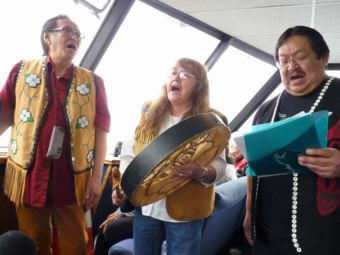
Members of the Yaaw Tei Yi Tlingit Dancers sing during a July 28, 2107, tour of the Taku Tlingits' traditional territory. (Photo by Ed Schoenfeld/CoastAlaska News)
The Douglas Indian Association organized the July 28, 2017, tour. (Photo by Ed Schoenfeld/CoastAlaska News)
Tribal government administrator Andrea Cadiente-Laiti speaks during a Taku Inlet stop. (Photo by Ed Schoenfeld/CoastAlaska News)
Traditional T’aaḵu Kwáan territory in Alaska is shown in this map posted for the tour. It continues into British Columbia and the Yukon.
Paul Marks. right, and David Katzeek speak in Tlingit and English during a recent tour of traditional T’aaḵu Kwáan lands. (Photo by Ed Schoenfeld/CoastAlaska News)
The Allen Marine catamaran St. Peter carried more than 100 tribal members and officials, plus government staffers and media members, on the Taku territory tour. (Photo by Ed Schoenfeld/CoastAlaska News)
Clouds and mist cover mountaintops in Taku Inlet. (Photo by Ed Schoenfeld, CoastAlaska News)
Elder Margaret Dutson speaks during the Taku territory tour. (Photo by Ed Schoenfeld/CoastAlaska News)
Flowers were left in Taku Inlet in memory of those who have passed on.
Andy Ebona speaks between songs during the Douglas Indian Association tour of traditional T’aaḵu Kwáan territory. (Photo by Ed Schoenfeld/CoastAlaska News)
Lyrics to the Wooshkeetaan Love Song.
Norman Sarabia, right, addresses the group during the Taku territory tour. (Photo by Ed Schoenfeld/CoastAlaska News)
An old cannery still stands in Taku Harbor. The area was home to a T’aaḵu Kwáan village. (Photo by Ed Schoenfeld/CoastAlaska News)
Children play on the back deck of the catamaran St. Peter during the tour of T’aaḵu Kwáan territory. (Photo by Ed Schoenfeld/CoastAlaska News)
It’s important to know where you come from. But when others make assumptions that are wrong, it’s hard to maintain your identity.
A Southeast Alaska Tlingit tribal government is letting its neighbors know its members come from a vast territory that still bears their names.
The tour boat St. Peter sails around Douglas Island, which is part of Juneau, headed to nearby Taku Inlet.
On board are local and state government officials and members of the Douglas Indian Association, which represents the T’aaḵu Kwáan, the area’s original residents.
At the front of the boat, elders Paul Marks and David Katzeek explain where they are, in Tlingit and English.
“You’re hearing the words and the voices of those who have gone before us on these waters. … And this is how we know today, and we’ve known for thousands of years, that this land belongs to us,” Katzeek translated.
The Douglas Indian Association organized the July 28, 2017, tour of traditional T’aaḵu Kwáan territory. (Photo by Ed Schoenfeld/CoastAlaska News)
Traditional T’aaḵu Kwáan territory includes the southeast part of Juneau, Taku Inlet, a smaller cove called Taku Harbor and up the Taku River into Canada.
Tribal members, some known as Inland Tlingits, also live in Atlin, British Columbia, almost 80 miles to the north, and Teslin, Yukon Territory, about 60 miles farther.
The association also includes some members of the A’akw Kwáan, whose traditional territory is to the north and west.
Westerners began exploring the area in the late 1800s, and built mines and cities. Taku people lived nearby, but weren’t treated as the original property owners.
They were shut out of traditional lands.
A Tlingit cemetery was later knocked down and paved, to make room for a road and a school. Later, local government burned down their village to build a boat harbor.
Tribal government administrator Andrea Cadiente-Laiti said colonization, disease, limits on fishing and other factors decimated the population.
“We lost everything that was precious to other … federally recognized tribes and that’s land, fishing rights, community, all the way down to sacred sites,” she said.
Some of that’s finally being addressed.
The Douglas Indian Association and Juneau’s Goldbelt Heritage Foundation are working with government officials to recognize and remember the area’s first peoples.
One totem has been carved and raised at the site of Douglas’ Gastineau School. A second pole and memorial are in the works.
University of Alaska Southeast anthropology professor Dan Monteith told the group that it’s important to reconcile, but never forget.
Douglas Indian Association Administrator Andrea Cadiente-Laiti speaks during a Taku Inlet stop. (Photo by Ed Schoenfeld/CoastAlaska News)
“Hopefully we can make this history a part of the history here that’s no longer repressed, no longer brushed over, no longer ignored,” he said.
The boat motors past Point Arden, where an inlet, a channel and a passage meet.
Katzeek said the competing currents weave the waters, giving them their Tlingit title.
“The name is Kanaasnoo. Everybody say, Kanaasnoo. That is a powerful, powerful word. When you look into hydrology, if there’s any kind of contamination going, this is the place where it would be mixing and it would be sending it out to the other places,” he said.
The Taku people are particularly worried about pollution from the long-closed Tulsequah Chief Mine, across the border in Canada. Acidic water drains from abandoned tunnels into the mine’s namesake river.
Some studies have shown it does not damage fisheries as it flows into the Taku River, but a recent British Columbia report points to unsafe pollutant levels in some areas.
The Indian association’s John Morris said it’s an issue for all the region’s tribes.
“The Taku, the Stikine, the Unuk, the Alsek, the Chilkoot,” he said. “All of our rivers are being threatened by these mining operations that are being proposed in British Columbia.”
Entering Taku Inlet, the boat stops at a steep cliff face for a memorial, and off a cove, for another. There, and in a harbor to the south, speakers point out where the T’aaḵu Kwáan once lived.
An old cannery still stands in Taku Harbor, south of Juneau. The area was home to a T’aaḵu Kwáan village. (Photo by Ed Schoenfeld/CoastAlaska News)
Michael Kell, a historical archaeologist for the state, gestures toward an old cannery and the site of a long-abandoned fort. It’s where the area’s Tlingits established one of their many communities.
“We know for a fact that there are summer and winter camps and these camps indicate that people were here and using the land,” he said. “That’s the important recognition here, is that the culture has been here and the culture’s still here.”
Old village sites are hard to spot, since most Taku people moved to town decades ago.
Tribal administrator Cadiente-Laiti said many are not part of the Douglas Indian Association. Leaders would like them to join.
“Part of the challenge is to have other government agencies, the powers that be that dictate where and when and how much funding comes to the tribe based on its membership, that it’s not just the tribal member numbers, it’s the area that was traditionally and historically the tribe’s,” she said.
She said more members would increase government grants that fund economic development, environmental protection and youth education.
Hear David Katzeek tell the Tlingit story of two giants, or mountains, by T’aaḵu Kwáan elder Elizabeth Nyman:
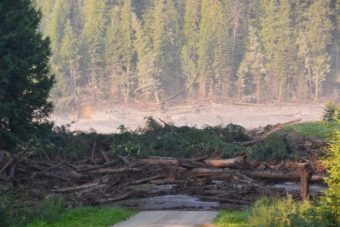
Muddy water from the breached Mount Polley Mine tailings pond dam floods a downstream creek and road Aug. 4, 2014. Fishing and environmental groups say the same could happen at new B.C. mines near the Southeast border. (Photo by Cariboo Regional District Emergency Operations Centre)
Critics in Southeast Alaska say the lack of enforcement action increases their concerns about similar mines near salmon-rich transboundary rivers, which begin in British Columbia and flow through Southeast.
Mount Polley’s tailings dam broke Aug. 4, 2014, sending millions of gallons of silt and water into nearby creeks and rivers.
The three-year statute of limitations for filing charges is over and the province said it is taking no legal action.
The central B.C. mine is owned by Imperial Metals, which also owns the Red Chris Mine in the Stikine River watershed.
Southeast Alaska Conservation Council Mining Coordinator Guy Archibald said he’s very disappointed.
“The Mount Polley investigation found that the contractors were not following the plan of operation for maintaining the tailings dam and that contributed to its failure,” he said. “Why nobody’s being held responsible for this is very surprising.”
B.C. environmental officials issued a statement Aug. 1 calling the dam collapse, “one of the worst environmental disasters in our province’s history.”
Environment Minister George Heyman said the investigation is not over.
He promised provincial officials would work with Canada’s federal government to complete their inquiry.
Archibald said he doesn’t expect federal charges to be filed, either.
“Since the Mount Polley investigation, we’ve seen mines moving forward with the same failed technology as in the case of Mount Polley,” he said. “Mines continue to be permitted and existing water-tailings structures are still on the books. Nothing has really changed on the ground from business as usual in the last three years.”
Industry and prior British Columbia representatives have pointed to improvements in tailings-dam design and construction, saying they’re safe.
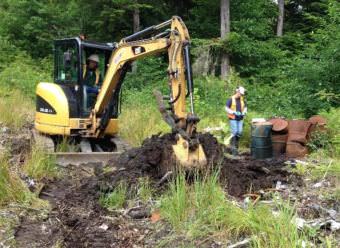
A backhoe digs up part of the old Byford Junkyard in Wrangell in 2014. After removing old cars, oil drums and other trash, the state is treating and moving contaminated soil to a rock quarry south of town. (Photo courtesy Department of Environmental Conservation)
The U.S. Forest Service could put the brakes on a state plan to store contaminated soil near a Wrangell recreation area.
The Department of Environmental Conservation plans to truck almost 20,000 cubic yards of lead-laced soil to a rock quarry near the Pat’s Creek area, south of town, as part of a multi-million-dollar effort to clean up an old junkyard.
Officials say the soil has been treated with a phosphate-based product called EcoBond, so the lead won’t leach into soil or waterways.
The trucks carrying the soil will have to use a Forest Service road, which requires a permit.
Tongass National Forest spokesman Paul Robbins Jr. said that could take a while.
“The Tongass National Forest will not issue a road authorization before a NEPA process is completed and we’ve received substantial public involvement,” he said.
NEPA, or the National Environmental Policy Act, requires federal agencies to assess the effects of resource development and other actions on federal property.
The process can take six months to two years.
State officials originally scheduled the work to begin July 31. Earlier this week, they said they hoped to begin later this month.
The soil-storage plan has been controversial, with residents questioning its safety and limited public comment opportunities.
The Department of Environmental Conservation plans a public workshop Aug. 21 and an Aug. 22 meeting with the Wrangell Borough Assembly on. Further details will be announced later.
Officials say the soil needs to be moved because it threatens the marine environment.
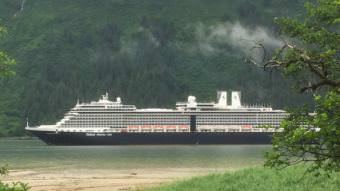
A Holland America cruise ship sails up Juneau’s Gastineau Channel June 19, 2017. (Photo by Ed Schoenfeld/CoastAlaska News)
More tourists will come to Alaska next summer on cruise ships.
Research by Wells Fargo Securities predicts about 6 percent growth from this summer’s number, which is 1.06 million passengers. The company projects growth from 5 to 10 percent in other markets around the world.
The numbers are based on capacity, not tickets booked.
“Most of these are publicly traded companies, so they’re looking at where they can take these assets, the ships, and move them to the destination where they’re able to get the best return on investments for their shareholders,” he said.
Passengers walk a downtown Juneau dock where three cruise ships are tied up June 11, 2017. (Photo by Ed Schoenfeld/CoastAlaska News)
“Right now, Alaska is popular and people want to travel to Alaska. That allows them to charge a little higher price, because there’s a high demand.”
Binkley said factors include Alaska-based reality TV shows, interest in the Arctic and strong marketing.
He also said many tourists consider the state to be safe and secure.
“Some geopolitical problems around the world in some areas cause people to want to go to a domestic location that’s exotic, like Alaska, rather than a foreign destination where the perceived safety might be in question,” he said.
Binkley expects growth to continue into the 2019 season, though he doesn’t have the numbers yet.
Passenger capacity hovered just under 1 million from 2012-2015.
The Wells Fargo study projects 6 percent market growth worldwide in 2018, the same as in Alaska. More and larger ships are driving the boom.
Australia will have even more capacity, as will Europe, excluding the Mediterranean. The Caribbean and China are expected to see lower growth.
Close
Update notification options
Subscribe to notifications
Subscribe
Get notifications about news related to the topics you care about. You can unsubscribe anytime.