Syndicated

Native brotherhood leader calls for more youth involvement

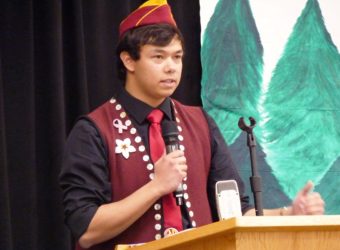
Yakutat ANB Camp President Devlin Anderstrom delivers the keynote speech Wednesday at the Alaska State Brotherhood and Sisterhood Grand Camp Convention in Juneau. (Photo by Ed Schoenfeld/CoastAlaska News)

A 19-year-old Yakutat man says the state’s oldest Native organizations are taking important steps to reach out to young people.

But they need to do more, he says.

Devlin Anderstrom was the keynote speaker at this year’s Alaska Native Sisterhood and Brotherhood Grand Camp Convention.

He spoke Wednesday to leaders and delegates gathered in Juneau.

“I’m just a young man, but even though I’m young, you still wanted to hear my voice,” he said. “And that shows that you really care what your children and your grandchildren think and how they feel in the present situation, and what we think about how we can improve our situation.”

Anderstrom is president of his hometown’s Alaska Native Brotherhood chapter and teaches Tlingit language and art at Yakutat High School.

He praised efforts to support and expand Native rights and culture.

But he said those efforts need to grow.

“It’s … important that we get all of our youth involved in not only furthering their education in the Western sense, but also in the cultural sense,” he said. “Because it’s that base, that identity, that I have that is my drive and my motivation to do well and to succeed and to help the Tlingit people.”

Alaska Native Sisterhood Grand Camp President Johanna Dybdahl, lleft, and Alaska Native Brotherhood Grand Camp President Sasha Soboleff listen during convention proceedings Wednesday. (Photo by Ed Schoenfeld, CoastAlaska News
Alaska Native Sisterhood Grand Camp President Johanna Dybdahl, left, and Alaska Native Brotherhood Grand Camp President Sasha Soboleff listen during convention proceedings Wednesday. (Photo by Ed Schoenfeld, CoastAlaska News

The Alaska Native Sisterhood and Brotherhood are each more than 100 years old.

And most attending the convention are in their 50s, 60s or 70s.

But this year, Anderstrom was joined by other, younger delegates.

He said that’s important.

“When our children know who they are, then they’ll have something to fight for and they’ll fight for it. They’re going to want to further their education. They’re going to want to do everything they can to help the Tlingit people,” he said.

The ANB-ANS convention continues in Juneau through Saturday. The convention’s theme is, “Bridging the Past, Present and Future with Our Youth.”

Hear Anderstrom’s full speech:


Kennicott ferry fills in while Columbia is repaired

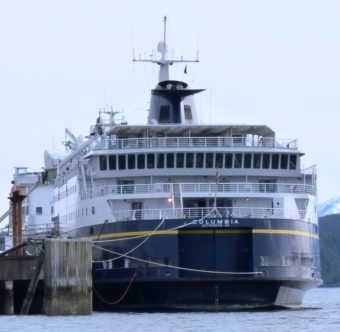
The state ferry Columbia will soon sail south for repairs to a damaged propeller. That will leave Sitka without marine highway service for two weeks. (Photo by Ed Schoenfeld/CoastAlaska News)
The state ferry Columbia will be out of service for repairs through mid-November. The Kennicott will fill in starting Oct. 7. (Photo by Ed Schoenfeld/CoastAlaska News)

Alaska’s largest ferry will be down for repairs longer than expected. Another ship will fill in, but it’s smaller and some travelers will have to make other arrangements.

The Columbia’s drive system was damaged in mid-September, possibly by a log.

Divers reported finding a bent propeller.

The ferry sailed south at reduced speed to a Portland, Oregon, drydock. But Alaska Marine Highway spokesman Jeremy Woodrow said crews found the propeller was OK.

“But the shaft and the gears that are inside the propeller system have all been damaged, likely due to some sort of strike below water,” he said. “And what will need to happen is that whole system needs to be taken apart and put together with new gears, new pieces and be cleaned.”

That could take until mid-November.

Woodrow said the ferry Kennicott was approaching its winter layup when the extent of the damage was discovered. So it will begin sailing the Columbia’s route Oct. 7. That includes Bellingham, Washington, port calls.

“The Kennicott is a little bit of a smaller ship when it comes to vehicle capacity and it’s a little bit of a slower ship. So it’s going to shift that schedule back a little bit. But for the most part, we will be able to fill in the Kennicott for the Columbia … through the middle of November,” he said.

Fishermen pass the ferry Kennicott in Whittier's harbor at the end of the 2011 season. Ferries and cruise ships deliver tourists to Southcentral at this port. Photo by Ed Schoenfeld.
Fishermen pass the ferry Kennicott in Whittier’s harbor at the end of the 2011 tourist season. The ship will fill in for the Columbia, which is down for repairs. (Photo by Ed Schoenfeld/CoastAlaska News)

He said no port calls will be canceled, though arrival and departure times will change. But because the Kennicott carries fewer vehicles than the Columbia, some Bellingham reservations will be delayed or changed to ships traveling to Prince Rupert, British Columbia, which is also on the mainland road system.

The Columbia can carry 133 cars and trucks, while the Kennicott can hold up to 78 vehicles. Both have a passenger capacity of just below 500.

Woodrow said ferry employees are contacting affected travelers.

He said new reservations will not be taken until Columbia passengers are rebooked.

The Columbia is expected to resume sailing Nov. 13, allowing the Kennicott to tie up for the winter. But the date depends on how long repairs take and whether other problems are found.

When the Columbia stopped sailing, most of Southeast Alaska’s larger cities lost one or two port calls a week.

Sitka is going two full weeks without ferry service.

Brotherhood, Sisterhood prep for convention

ANB-ANS members march in a parade during the 2015 Grand Camp Convention in Wrangell.-(Photo courtesy Peter Naoroz/ANB)
ANB and ANS members and leaders prepare to march in a parade during the 2015 Grand Camp Convention in Wrangell. (Photo courtesy Peter Naoroz/ANB)

Alaska’s oldest Native organizations are working to attract younger members.

That, subsistence and other issues are on the table at the Alaska Native Brotherhood and Sisterhood’s Grand Camp Convention Oct. 5-8 in Juneau.

The Grand Camp Convention attracts 80 to 100 delegates and members from local chapters, also called camps.

Most are from Southeast, but camps are also in Washington, Oregon and Southcentral Alaska.

ANB and ANS Camp 70 in Juneau host this year’s event.

ANB chapter President Marcelo Quinto said the convention sets the regional, or Grand Camp’s, agendas.

“We are a civil rights organization, but we concentrate on our Native people both in Southeast and we try to assist whenever we can with the rest of our brothers and sisters throughout the state,” he said.

The Alaska Native Brotherhood and Sisterhood are each more than a hundred years old. And in recent decades, many of their programs have been taken over by tribal governments, Native corporations and other organizations.

That means the organizations are smaller than they once were. And their membership is older.

But ANB Grand Camp President Sasha Soboleff said that’s starting to change.

“The youth wave is coming and so we dedicated last year’s convention and this year’s convention to having a focused effort on the young people and how this organization can best respond with their leadership,” he said.

Alaska Native Sisterhood members march in Wrangell during the Grand Camp's 2015 Convention in Wrangell. (Photo Courtesy Peter Naoroz/ANB)
Alaska Native Sisterhood members march in Wrangell during the Grand Camp’s 2015 Convention in Wrangell. (Photo courtesy Peter Naoroz/ANB)

One is Yakutat youth leader Devlin Anderstrom, who will deliver the keynote address.

And Soboleff said in the past year, he’s installed 19 sets of local camp officers who were in their mid-20s or early 30s.

Convention delegates spend the four-day event hearing reports from other Native organizations.

They include the Southeast Alaska Regional Health Consortium, the Central Council of Tlingit and Haida Indian Tribes of Alaska, and the Sealaska regional Native corporation.

They also elect officers and debate and vote on resolutions.

“We come together and talk over all of the ways the local camps are being affected by subsistence, by the economic decline that’s happening, by the impact of what (fisheries) have been going on in terms of subsistence and whether the commercialized part is doing any good, and putting the land that we occupy, whether or not it can be put into trust,” he said.

The Brotherhood and Sisterhood are also considering changes to their constitution.

They address membership, committee structure and other issues. One would create a new, joint executive committee with equal numbers of ANB and ANS members.

Quinto said the camps are trying to modernize.

“We are taking a look at our constitution this year to determine if it needs to be revised so it’s appropriate for this day and age,” he said.

Despite the names, the organizations don’t restrict their membership by race.

Soboleff said many camps have members who are not Alaska Natives.

“So there are lots of people who are welcome to come and who are actually active in our local camps and feel welcome to come down and witness and participate and see how this slice of the world works,” he said.

The convention also includes a culture night and a memorial service.

Forest Service adds to Admiralty Island wilderness

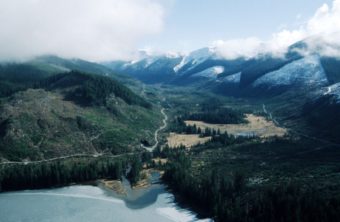
Logged lands near Lake Kathleen, on Admiralty Island, are among those Shee Atiká has agreed to sell to the Forest Service. (Photo courtesy U.S. Forest Service.)
Logged lands at the head of Lake Kathleen, on Admiralty Island, are among those Shee Atiká has sold to the Forest Service to add to its Kootznoowoo Wilderness Area. (Photo courtesy U.S. Forest Service.)

About 4,500 acres of heavily-logged forest will return to wilderness under a deal involving the federal government and a Southeast Alaska Native corporation.
The U.S. Forest Service purchased the acreage near Cube Cove, on the west side of Admiralty Island,  about 30 miles south of Juneau and 20 miles north of Angoon.

Just under $4 million was paid to the owner, Shee Atiká, the Sitka-based Native corporation. It comes from the Forest Service’s Land and Water Conservation Fund.

Recreation, Lands and Minerals Director James King said the property is surrounded by Admiralty Island National Monument and its Kootznoowoo Wilderness Area.

“This restores the concept of creating an island and a monument that is left relatively intact,” he said.

The purchase price covers two of 13 parcels of Cube Cove land owned by Shee Atiká.

The total area is about 22,000 acres and the full value is around $18.3 million.

Cube Cove-area land is being sold to the Forest Service. The two southernmost parcels were purchased for about $4 million. (Map courtesy Forest Service)

The once-forested area was acquired by the corporation under terms of the Alaska Native Claims Settlement Act.

It was extensively logging over an 18-year period ending in 2002.

King said the Forest Service may spend additional funds to speed its restoration.

“It’s possible that as we do further analysis on it, that if we determine to better help the habitat that thinning may occur. But those decisions have not been made yet,” he said.

He said the agency hopes to purchase the remaining Cube Cove acreage, which includes three lakes, over time. But that depends on future federal budgets.

The sale also is part of legislation introduced by Alaska U.S. Sen. Lisa Murkowski earlier this year. Some environmental groups have said it would allow Shee Atiká to purchase and log timberlands on Prince of Wales Island.

Shee Atiká President and CEO Ken Cameron said  the Native corporation hasn’t decided what to do with the $4 million it’s being paid.

Cameron, who declined to be recorded, said it’s on the agenda for a fall planning meeting. He said the corporation understands further sales depend on Congressional appropriations.

The sale has its critics.

The Southeast Alaska Conservation Council’s Buck Lindekugel calls it a mixed bag.

“We’re glad that these valuable lands will be back in public ownership where they can heal,” he said.

“It’s sad, though, because we worked really hard in the 1980s and early 1990s to see if we could come up with an exchange so Lake Florence and Lake Kathleen could have been returned to public ownership before they were clear-cut,” he added.

In an earlier interview, Sitka Conservation Society Executive Director Andrew Thoms said it seemed like an odd deal.

“And now, in this situation, the government would buy back the lands that were logged? And Shee Atiká made a profit on them? And now the government’s buying it back from them? It’s a strange situation,” he said.

And Shee Atiká shareholder Mike Kinville said the corporation shouldn’t give up any of its property.

“Shee Atiká is not making, what is in my opinion, sound decisions. To sell our last pieces of land concerns me,” he said.

The purchase was announced Sept. 16 in a joint news release from the federal agency and the corporation.

King, of the Forest Service, said there’s a reason these particular parcels were bought first.

“It was determined that the most logical way to purchase the lands was to start at the backs of the property or the furthest from the water. And purchase our way out to the waterfront, so that we didn’t isolate pieces of property without access to them,” he said.

The Forest Service said buying up wilderness inholdings is a high priority for the Tongass and is listed in its land management plan.

Did a large ship kill this Sitka Sound whale?

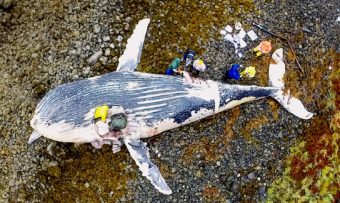
Researchers collect samples from a beached humpback whale carcass Saturday on a Sitka Sound beach. (Drone photo by Joe Serio)

A dead whale found floating near Sitka last week was probably killed by a ship, according to a pathologist who inspected the carcass.

The humpback whale was spotted floating in Sitka Sound on Sept. 13.

A team from the Sitka Tribe of Alaska and the University of Alaska Southeast arrived last weekend to check out the carcass, which was beached.

The whale was a sub-adult, about 42 feet long, said Kathy Burek of Alaska Veterinary Pathology Services.

It had been dead for about a week.

“It had indications of hemorrhage where it had been struck and possibly carried by a ship,” she said. “So there are areas of trauma that look convincing that it had had a major blunt impact.”

It was likely a large vessel, such as a tanker, cruise ship or ferry, she said, but she’s not positive.

“We can’t quite say it definitively at this point,” she said. “First of all, we’ve only had a limited amount of time to access the animal because of the tides. Also, because there’d been a lot of changes because the animal had rotted for a while.”

Researchers collect samples from a beached humpback whale carcass Saturday on a Sitka Sound beach. (Drone photo by Joe Serio)

The team cut into the whale, removing blubber and other tissue for further study.

Burek said they climbed into the carcass for the difficult task of finding and removing its ear plugs.

“These plugs are formed by yearly laying down of ear wax,” she said. “And since a whale doesn’t have a big opening out from the ear, it just tends to accumulate. If you can get that, there are ways to count those rings and be able to be more definitive about how old the animal was.”

The whale’s age is not yet determined. It takes a month to analyze the plugs, Burek said.

Other samples will be used to determine whether the whale had been exposed to toxic algae blooms.

Those have become more common as climate change has warmed the Pacific Ocean.

Scientists are also interested in discovering what the whale had been eating, Burek said. In a southern Baranof Island whale death earlier this summer, the animal turned out to be malnourished.

“We didn’t actually figure out a cause of death at all on that one,” she said. “But its body condition did not look optimal, so that’s another reason why we’re doing those studies on nutrition.”

The most recent whale carcass was left tied up on the beach, a present for the bears, Burek said.

She also hopes follow-up examination will reveal more information about its injuries.

Bent Columbia propeller shrinks Southeast ferry service

The state ferry Columbia will soon sail south for repairs to a damaged propeller. That will leave Sitka without marine highway service for two weeks. (Photo by Ed Schoenfeld/CoastAlaska News)
The state ferry Columbia will soon sail south for repairs to a damaged propeller. That will leave Southeast with fewer port calls. (Photo by Ed Schoenfeld/CoastAlaska News)

The Alaska Marine Highway System’s largest ferry needs work on one of its propellers.

The 500-passenger Columbia will soon head to a Portland, Ore., shipyard for repairs.

As a result, most of Southeast Alaska’s larger cities will lose one or two port calls a week.

Sitka will go two full weeks without ferry service.

Crews noticed a vibration last week when the ferry ran at full speed, Marine highway spokesman Jeremy Woodrow said. Divers then inspected the ship’s two propellers during a stop in Wrangell and discovered why the ship shook.

“They noticed that one of the blades had a noticeable bend to it, where it looked like it had been hit by something,” he said. “The assumption is maybe a submerged log or something along those lines that can do some damage to a large propeller like that.”

The Columbia is sailing a delayed schedule through Sept. 25, before heading to Portland for repairs.

Woodrow said the Columbia continues using both its propellers, but the damage to one means its maximum speed is 13 knots, two slower than its regular rate of travel.

“If you’re running shorter distances, maybe Haines to Skagway and back every day, you wouldn’t really notice that difference. But if you’re doing 18-hour, longer hauls, say Juneau to Ketchikan and Ketchikan to Bellingham, that two-knot difference really adds up,” Woodrow said.

Communities affected are Haines, Skagway, Juneau, Sitka, Petersburg, Wrangell, Ketchikan and Bellingham, Washington.

Woodrow said budget cuts mean no other ferries are available to fill in during the reduced schedule.

“The soonest the Columbia is likely to come back into service is Friday, Oct. 7, if repairs go as planned in Portland,” he said.

The Columbia is more than 40 years old.

Site notifications
Update notification options
Subscribe to notifications