Juneau could get three to seven inches of snow starting in the middle of the night through Monday afternoon. The National Weather Service issued a winter weather advisory in effect from 3 a.m. to 3 p.m. Monday.
“I think the worst of it will actually happen during your morning commute on Monday morning. Going into midday, especially in the afternoon, I think things will turn a bit messy. We could have a changeover to rain,” said Wes Adkins, meteorologist with the National Weather Service in Juneau.
Adkins said the rain will dampen snow totals. Besides a hazardous morning commute, people can expect reduced visibility and possible disruption to aviation operations.
Adkins says Juneau could get a break between systems on Wednesday before another heads in by the end of the week.
Juneau’s city manager is making changes to key leadership positions. Shortly after the New Year, Deputy City Manager Rob Steedle will be the Director of Community Development and Human Resources Director Mila Cosgrove will move into the deputy city manager role.
Steedle has been serving as interim head of community development since former director Hal Hart left in September. City Manager Kim Kiefer said after two rounds of recruitment, no one in the applicant pool was a good fit.
“Then I looked at Rob and he knows what is needed both internally and externally to continue to move economic development forward in our community,” Kiefer said.
As community development director, Steedle will oversee the department responsible for the city’s land use laws, including building and zoning codes. For Steedle, the job change is a voluntary demotion.
To fill the deputy city manager position, Kiefer appointed Cosgrove.
“Her skill set, her understanding of the departments – because she’s the HR director, she touches all departments within the city and she has a good understanding of our workforce,” Kiefer said.
The manager and the deputy city manager split supervision duties of department heads. The deputy city manager also assists the assembly, fills in as acting city manager when needed and serves as the city’s hearing officer for parking violations, among other duties.
Kiefer says Cosgrove will also help with the transition to a new city manager. Kiefer originally planned to retire at the end of this month, but extended her time through the end of April. The city has already gone through one recruitment period and is set to start a new one soon.
To fill the human resources director opening, Kiefer has the option to appoint someone or go out for a new hire. The city’s HR director is also head of HR for Bartlett Regional Hospital.
Kiefer also announced a brand new city job – chief housing officer.
“That person will be a very outward focused person, really working with developers and lenders and contractors to build housing in this community, a variety of different kind of housing and maybe bring in new ideas on how we can do it possibly different than how we’re doing it to bring more stock out there,” Kiefer said.
The chief housing officer job announcement is open until filled. The salary ranges between $92,000 and $98,000 annually.
Juneau filmmaker Lisle Hebert is making a film based on Harold Napoleon’s essay “Yuuyaraq: The Way of the Human Being.” Napoleon gave Hebert his blessing to do the adaptation, but he says it’ll be a challenge to translate the message to film.
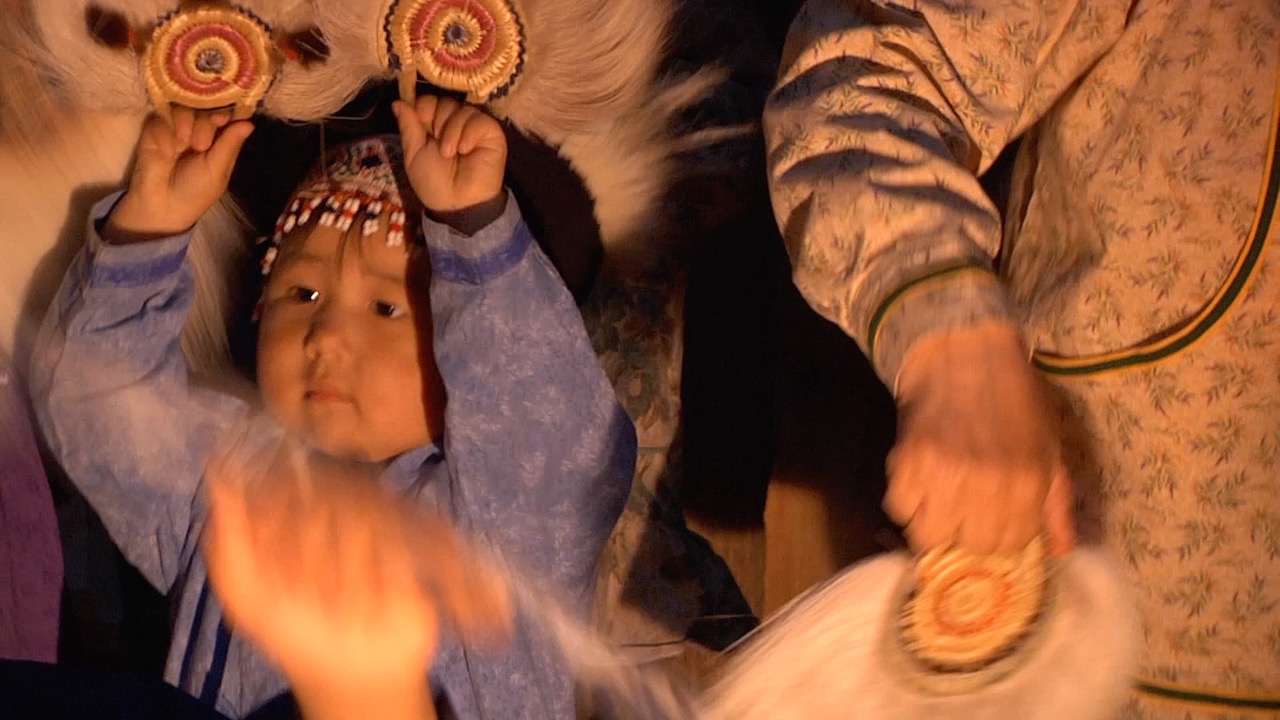
The beginning of Lisle Hebert’s film “Yuuyaraq” is a re-enactment depicting life on the Yukon-Kuskokwim Delta before Western contact. The narration stays true to Harold Napoleon’s original words.
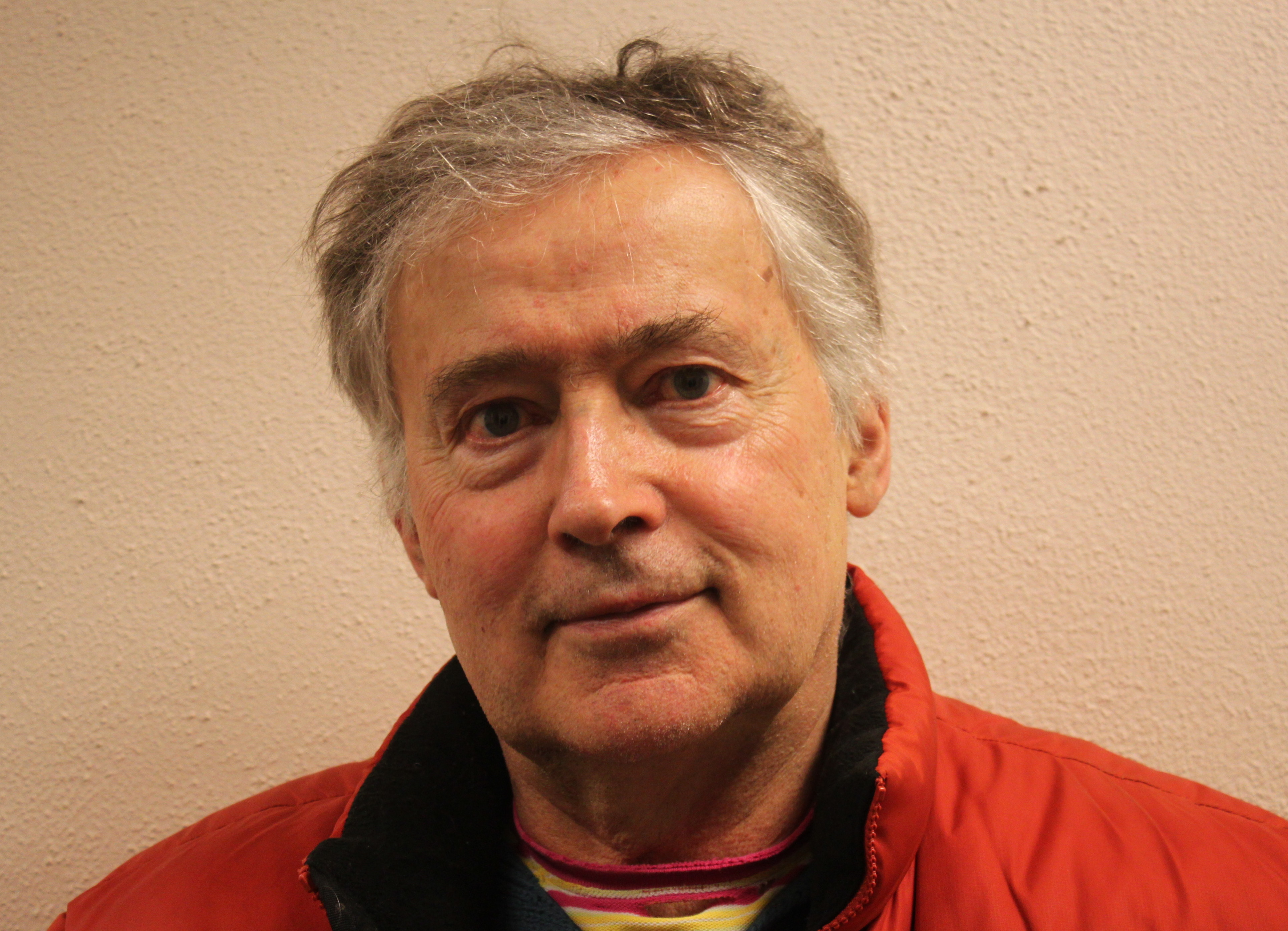
Juneau filmmaker Lisle Hebert (Photo by Lisa Phu/KTOO)
“It’s verbatim because his writing is so poetic, and so I couldn’t do better than that,” Hebert said.
The re-enactment conveys what the Yup’ik word Yuuyaraq means.
“Their spiritual beliefs, the way they viewed the world, everything had a spirit. Everything was in harmony and it was kind of like a code of living,” Hebert said.
Napoleon wrote Yuuyaraq in 1988 when he was in prison for the death of his son. He says he was so drunk, he blacked out and doesn’t remember it. Without any memory of what happened, he couldn’t defend himself and so he pled no contest to second degree murder. He never went to trial and no matter how it happened, he blames himself.
He started writing to figure out why he and so many people he knew struggled with alcohol abuse.
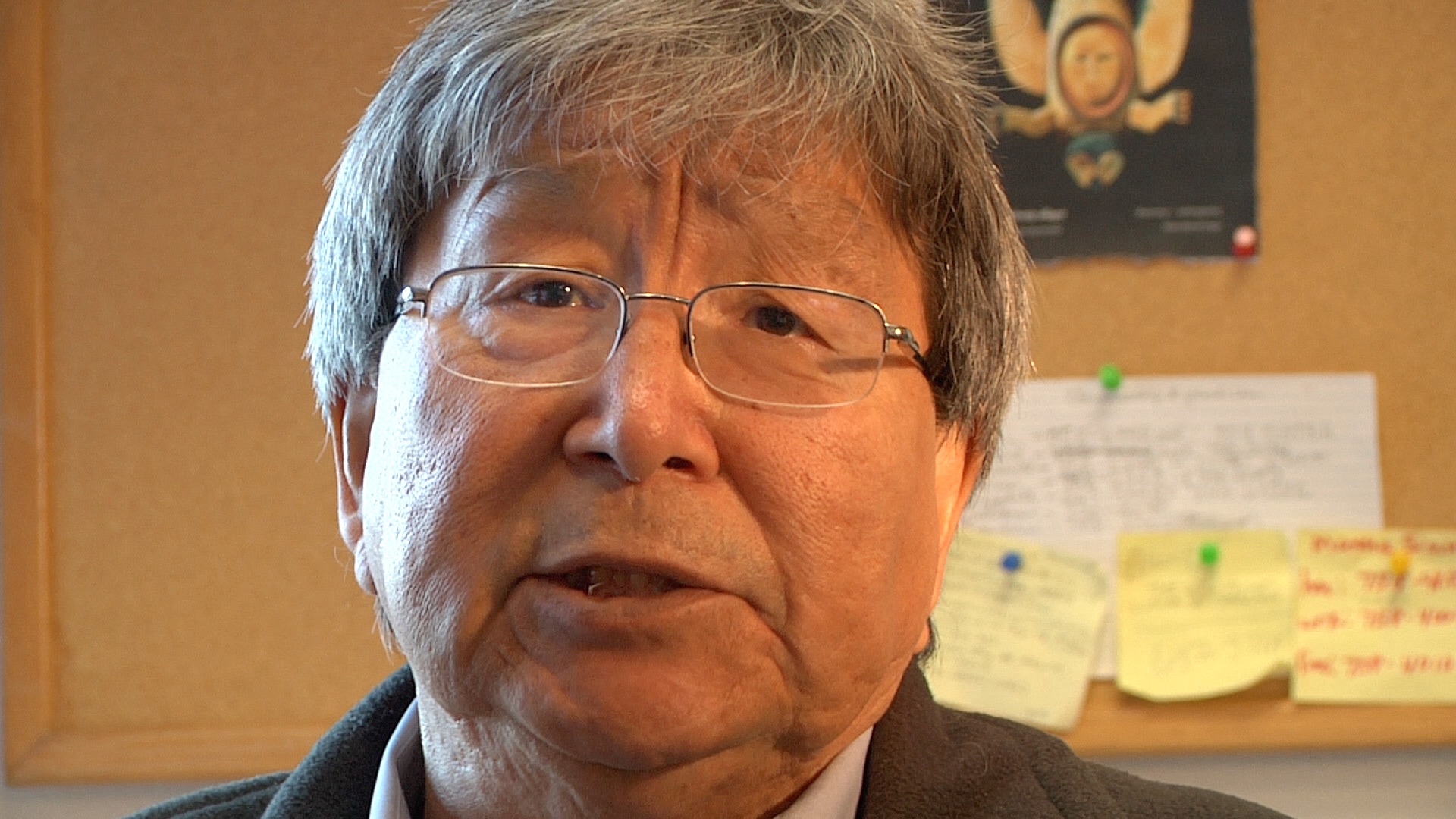
Napoleon is Yup’ik Eskimo from Hooper Bay.
“I had been baffled for many years about why we knew so very little about our own history and why there was so much shame about our own culture,” Napoleon said.
Napoleon is 66. He said he grew up in a very confusing world, being neither fully Yup’ik nor white and Christian. There was suffering in the missing pieces of his village’s history.
“There was also a lot of disconnect between parents and children and that disconnect was not just personal, it was also cultural,” Napoleon said.
“As children, we were not abandoned literally, but we somehow ended up in nowhere land.”
Napoleon experienced abuse as a child and drank as an adult. While in prison, he read a lot about trauma and post-traumatic stress disorder in Vietnam War veterans.
“Having never been to war and never experienced war or witnessed war, I found it odd that I would have the same symptoms as Vietnam veterans. And not only me but all the other people in my village had the same symptoms,” Napoleon said.
After more research, Napoleon learned about the flu epidemic of 1918. In Yuuyaraq, he calls it the “Great Death” and wrote that it spread like wildfire, killing 6 of every 10 people and wiping out Alaskan villages. “It gave birth to a generation of orphans,” he wrote.
Harold Napoleon wrote “Yuuyaraq: The Way of the Human Being” in 1988. (Video still courtesy Lisle Hebert)
Up until then, Napoleon said Yup’ik people had resisted Christianity and white influence.
“But after ‘The Great Death,’ there was mass conversion and people began to abandon, in a sense, their own culture and in abandoning their culture, they abandoned themselves. There was also born in them a sense of shame and guilt because what they were being taught is that the way they had lived their lives had caused them to die in such great numbers,” Napoleon said.
He said the trauma, shame and violence he and others in his village experienced traces back to that time. And it still reverberates today.
Writing Yuuyaraq, Napoleon said, helped him to understand his village and his family, the past and the present.
“With understanding there came forgiveness. I had found a trail of truth through our experiences as Native people,” he said.
Napoleon said Alaska Native cultures are going through a reawakening and he hopes Lisle Hebert’s film adaptation of Yuuyaraq will contribute to it.
“If the young people become interested in their own stories, in their own history, then I think it will have done a good job,” Napoleon said.
As a young man, Hebert said he spent time in Hollywood and used to be egotistical about filmmaking, but Yuuyaraq is about something else.
“I’m hoping that people will be moved by it and have more compassion and also realize what (Alaska Natives) have been through, and try to look at people like people,” Hebert said.
For Hebert, Yuuyaraq is a meaningful film, and that has given meaning to his own life.
Lisle Hebert plans to finish the film in June. An Indiegogo campaign is currently underway to help him do that. You can also attend a community potluck and “fun-raiser” on Wednesday, Dec. 16 at St. Ann’s Parish Hall from 5 to 8 p.m.
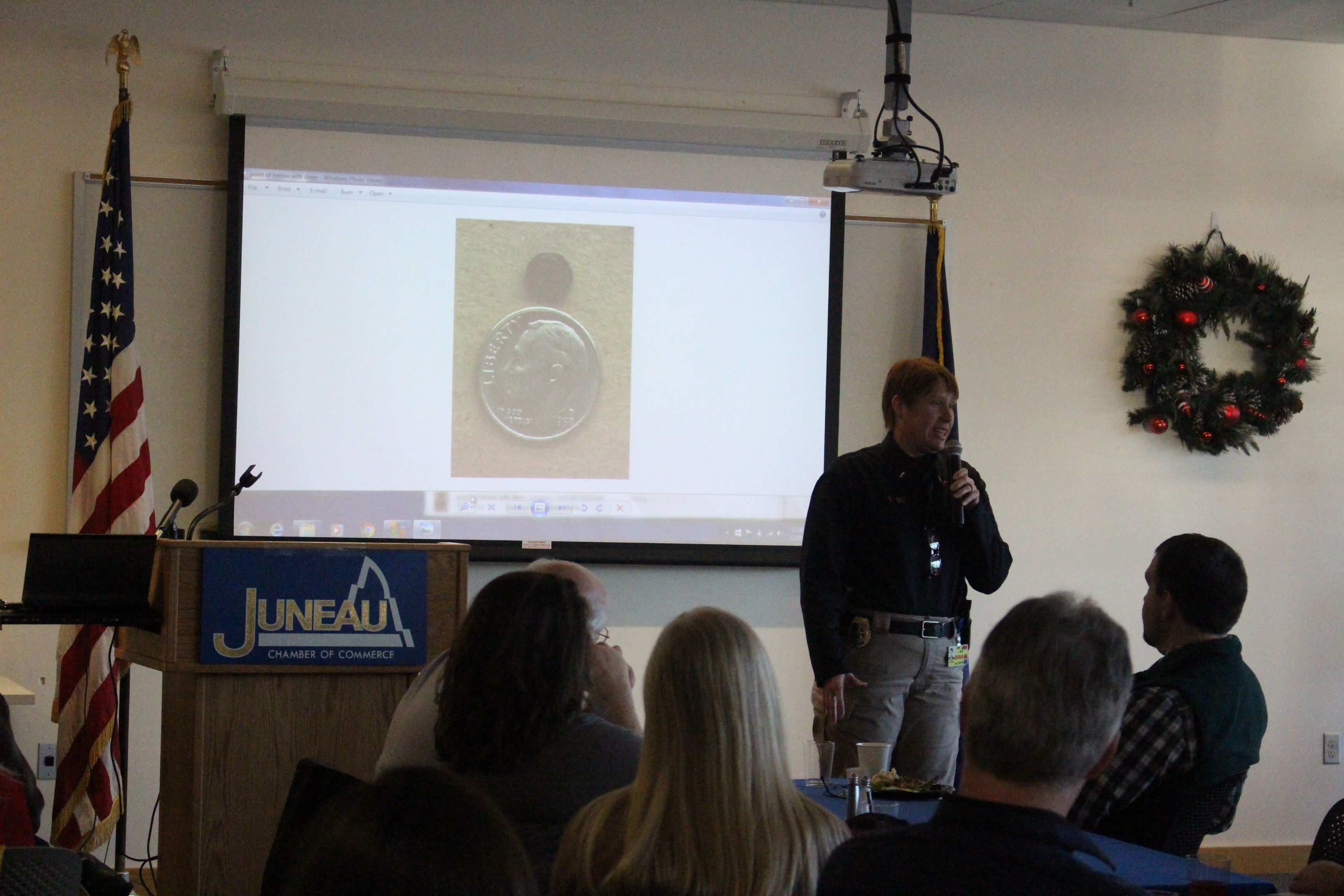
On Thursday, Lt. Kris Sell with the Juneau Police Department spoke to a packed chamber of commerce lunch about heroin. Chief Bryce Johnson is attending Sunday’s Stop Heroin, Start Talking event. (Photo by Elizabeth Jenkins/KTOO)
Legislators, police officers and behavioral health specialists will gather this weekend in Juneau for a townhall discussion on heroin. They’ll be focused on finding local solutions to help people suffering with addiction.
Michele Morgan started Stop Heroin, Start Talking as a grassroots initiative — a homespun way to get the word out about what she saw happening in her community. After throwing events and printing our flyers on her own dime, Morgan is now the one getting help.
“We realized that what Juneau Stop Heroin was doing is exactly what NCADD wanted to start doing more of,” Morgan said.
NCADD provides advocacy, education, and some clinical services. Being under the umbrella of the nonprofit means donations to Stop Heroin, Start Talking will be tax deductible. It also connects the organization to a slew of other agencies that NCADD has developed partnerships with, such as the California-based Harm Reduction Coalition.
Katie Chapman, executive director of the Juneau’s NCADD, said her organization saw the work Morgan was doing and thought it would be a good fit.
“It’s amazing. It’s really inspiring to see that. I think a lot of change happens from individuals, community members that have the passion,” Chapman said.
For Sunday’s community meeting, Morgan invited Juneau representatives Sam Kito and Cathy Muñoz to weigh in on the Good Samaritan law and Senate Bill 23.
“All I did was email these people and they responded and said, ‘yes I will do this.’ That is a testament to how forward thinking Juneau is getting to be. It’s great,” Morgan said.
The Good Samaritan law passed last year. It protects people who report an overdose from criminal prosecution. SB 23 could prevent deaths by holding harmless those who administer a drug called Naloxone in an attempt to save someone who has overdosed
Another topic at the meeting will be the lack of treatment options for people who want to get clean. There’s practically nowhere to clinically detox in Juneau.
“I hope it’s not adversarial, but it is something that sticks in your head. We can arrest someone for using drugs and put them in jail immediately. But if we want to put them in treatment, which I think is fiscally and for our future more responsible, we don’t have beds.”
City Manager Kim Kiefer has been looking into a program in Gloucester, Massachusetts that helps people get into treatment. She learned that it costs about $50 to connect someone with services and about $230 to incarcerate them.
Like Juneau, Gloucester is a small town of about 30,000. The town is about an hour outside of Boston, and people suffering with an addiction there can go to a police department and ask for help. Then they can get into a detox program and long-term treatment.
“In the six months they’ve been doing this, they’ve had over 300 people that say, ‘I want to get clean,’” Kiefer said.
Kiefer says she doesn’t know much about heroin addiction, but she’s trying to learn more. That means reaching out to people in and outside of Juneau to find what’s working.
More than $800,000 of the city’s social service funds are funneled through the Juneau Community Foundation. The Hope Foundation is pitching in $1 million for grants to look into these issues.
For Morgan — the woman who started the Stop Heroin, Start Talking program — the biggest hurdle has been changing attitudes about addiction, including her own. Three years ago, her sister died of a heroin overdose. She wrote in the obituary she died of cancer.
“My sister would have died this year, I would have said the truth. I would have said my sister Eva died after a long battle of addiction and I would feel fine. But three years ago we were ashamed. We didn’t want anyone to know or smudge her reputation,” Morgan said. “But now people are looking at it as it is a health crisis and in that sense, that’s the big change.”
The Community of Compassion will hold an open dialogue about addiction Saturday at 4 p.m. at the @360 studio. The Stop Heroin, Start Talking panel begins at 2 p.m. Sunday at the Mendenhall Valley Public Library.
The poster for Costa’s 6th Annual Christmas Bazaar Extravaganza happening Saturday, Dec. 12, at the Gold Town Nickelodeon.
In the near future, Santa Claus can no longer afford to stay at the North Pole, and with climate change, it’s not really that cold anymore. He’s outsourced his workshop to Pluto and his only hope to save Christmas lies with the U.S.S. Underdrive, which is sailing through the galaxy on a rescue mission.
If this sounds like a plot fit for a movie house, that’s because it is. This Saturday, Collette Costa’s infamous take on traditional holiday fare returns to The Gold Town. Her 6th Annual Christmas Bazaar Extravaganza is taking on a Star Trek theme, with captain Costa at the helm.
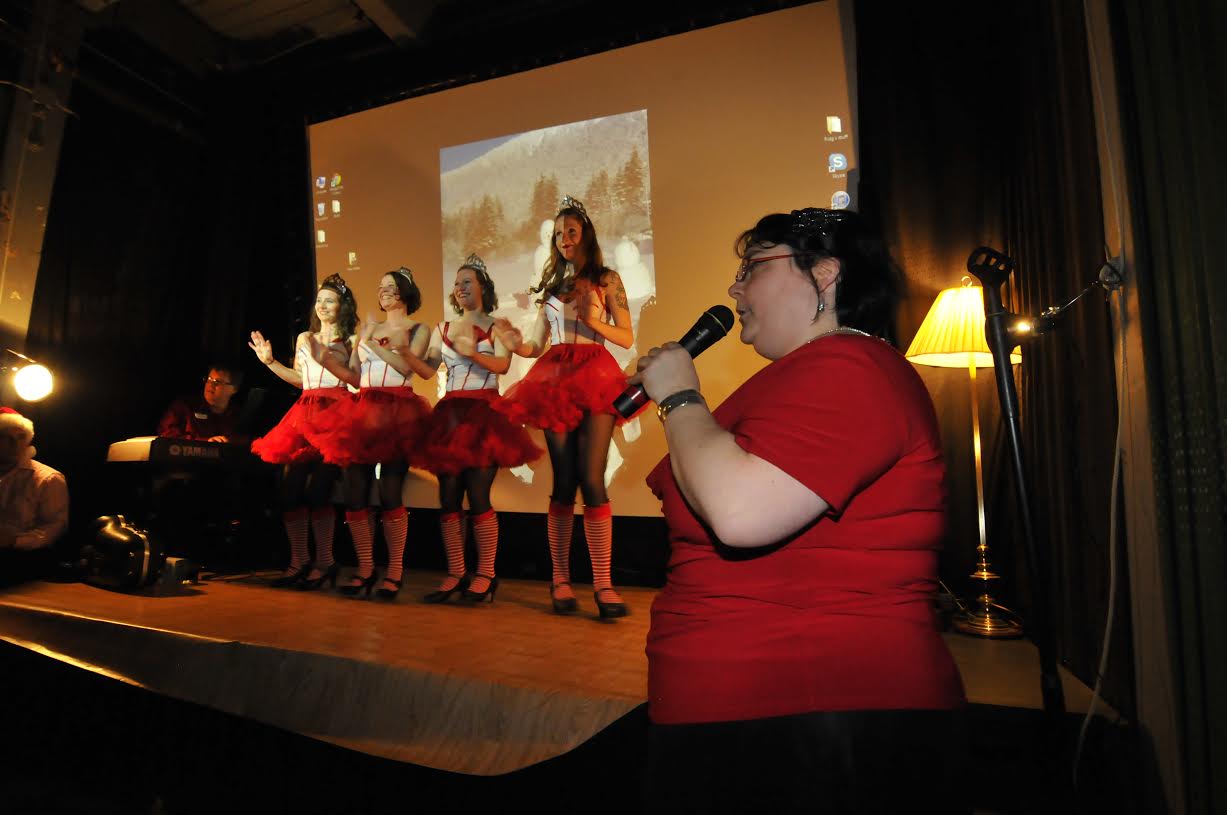
Collette Costa emcees with her Dancing Girls during last year’s Christmas Bazaar Extravaganza. (Photo courtesy Collette Costa)
“We have all the kinda usual suspects. Our dancing girls, our dancing ladies, our dancing ukulele people, our dancing jugglers and some live music.
The idea was born out of her love for the old time television variety shows and a desire to bring Juneau her own.
“Donnie and Marie always had variety shows at Christmas and they were awesome and they had a bunch of dumb stuff,” Costa said. “They had some dancing and it was always completely nonsensical and unrelated and someone was always knocking on the door like, ‘Oh, I wonder who that could be,’ and it was Bing Crosby or something ridiculous.”
But the show isn’t all about the holidays. Since they’re visiting the planets, some of the acts will take on a cosmic focus, including an encounter with the inhabitants of Venus.
“There may be a couple Uranus jokes. But it’s nothing dirty. I mean, it’s as dirty as Uranus can be. And how dirty can that really be? I mean, it’s way out there. Most people can’t even see Uranus from where they’re sitting. So, it’s not a big deal.”
Like last year, the two Saturday performances are expected to sell out, and get increasingly loose as the night progresses.
“I like to stick to the things that are important to me at Christmas. Presents, cookies and a fat man in a red suit giving me stuff,” Costa said.
Costa says “Playboy Spaceman, Bridget and George, Kari and Jason and many, many, many others,” will be at the party.
Tickets to Costa’s 6th Annual Christmas Bazaar Extravaganza can be purchased at the Gold Town Nickelodeon website or at their box office.
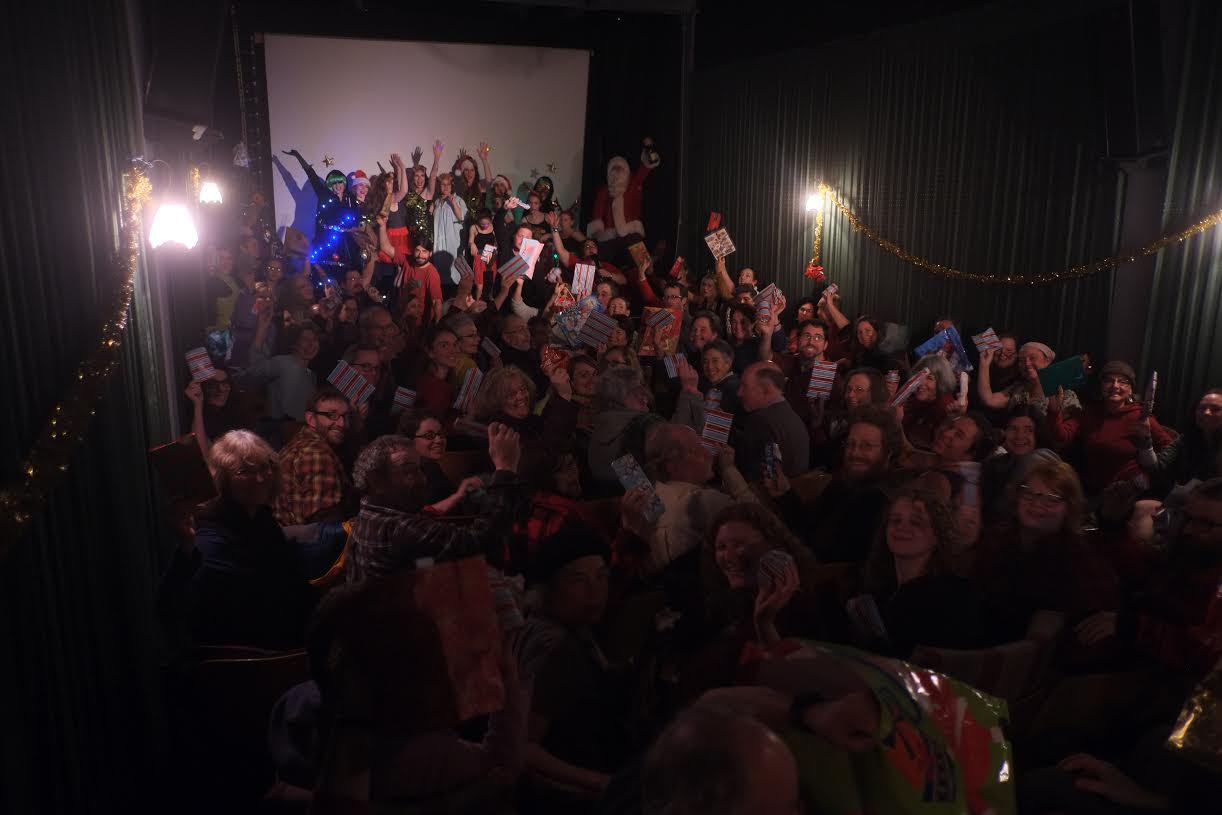
Audience members hold up their gifts during the 2014 Christmas Bazaar Extravaganza at the Gold Town. (Photo courtesy Collette Costa)
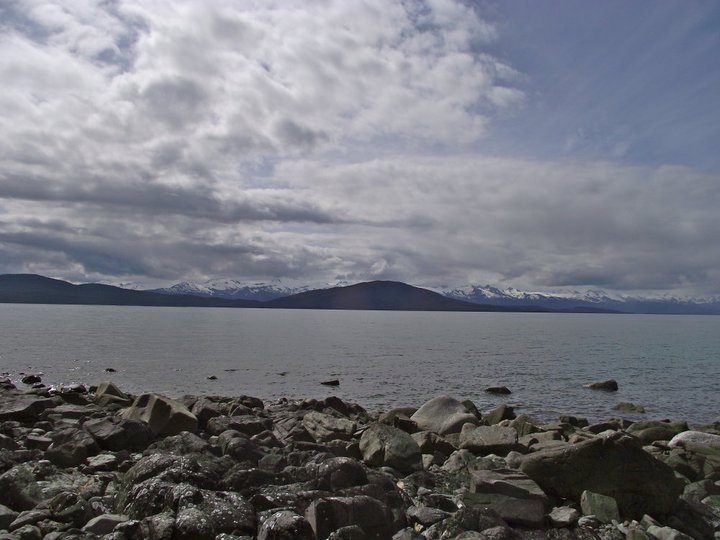
One approach to battling addiction and other behavioral health issues lies just outside our front doors. (Photo by Theresa Soley/KTOO)
Police reports, the press and social media are flooded with stories of substance abuse, heroin overdoses and deaths in Alaska’s capital.
One approach for battling addiction and other behavioral health issues lies just outside our front doors.
“Across the world people seek solitude or wilderness experiences because there is a healing process,” said Jerrie Dee, clinical director at Alaska Crossings.
Alaska Crossings is a wilderness therapy program for youth with behavioral issues, including those with a history of drug abuse. The program takes adolescents, ages 12-18, on 64-day canoe trips into wild Southeast from Wrangell.
The program uses wilderness as a catalyst for healing, Dee said. Natural challenges, silence and a sacred process emerge when immersed in the outdoors. Dee said these things can redirect someone’s life.
Dee said wilderness immersion gives recovering drug users an opportunity to reset because external triggers and temptations are not present in the outdoors.
“Often times substance use is more an emotional process than it is physical,” she said.
Using surveys before, during and after immersion, Alaska Crossings has documented a substantial decline in participants’ negative symptoms. Long term effects after leaving the wilderness are harder to measure.
Dee said the process works for adults, too, but as far as she knows, there aren’t any wilderness therapy programs for people over 18 in Alaska.
Larry Olson, a licensed master addiction counselor in Juneau, said that many of the patients he sees started using prescription drugs in high school. With time, the habits spiraled into full addictions. He said there is no formula; some of his patients come from rough homes, but many come from loving families.
Most of the six people who died of heroin overdoses in Juneau since February were under the age of 30, according to Alaska Dispatch News. And Olson said a large portion of his patients are under 30.
Alaska Crossings admits youth who have struggled with addiction, but it is not a drug treatment program. Dee said that in the wilderness, guides can’t monitor for health issues, including withdrawal.
When substance abuse is an applicant’s primary issue, it must be treated before admittance to Alaska Crossings and entering the wilderness, Dee said.
This two-tier theory, detox then therapy, is common for wilderness addiction treatment programs.
Olson, the addiction counselor, said that many adults who are battling addiction have weak, deteriorated bodies. High levels of activity may not be an option.
But Olson said less rigorous wilderness experiences could provide opportunities for healing. He said that many of his patients speak of the importance of nature in their personal spirituality. Rekindling the human relationship with the natural world can be very healing, he said.
“If people can redevelop a sense of awe and wonder at just life, that is really very, very good,” he said.
The program follows a three-step process. The first is to develop discipline and routine, next is a focus on the participant’s unique treatment ambitions and third is learning to apply new skills to everyday life at home, said Alaska Crossings Director Stephen Helgeson.
Helgeson said that paying for wilderness therapy programs, both as an organization and for participants, is the greatest challenge. Lack of funding makes it difficult to provide help to those who need it most.
He hopes that as Medicaid expansion develops, more funding will become available for low-income adults.
Close
Update notification options
Subscribe to notifications
Subscribe
Get notifications about news related to the topics you care about. You can unsubscribe anytime.