This week, the Juneau Crime Line is highlighting a rifle and ThinkPad laptop that were stolen from a Mendenhall Valley business.
The business’s window was broken and items taken Monday night in the 2200 block of Jordan Avenue.
Juneau police Lt. Kris Sell described the rifle in a statement.
“The rifle is a Game Master 760 pump-action 30.06 with a scope. The rifle is only worth about $500 but has sentimental value as it was given to the owner by his late father,” Sell said.
Report tips to Juneau police at 586-0600 or at juneaucrimeline.com. You may be eligible for a reward.
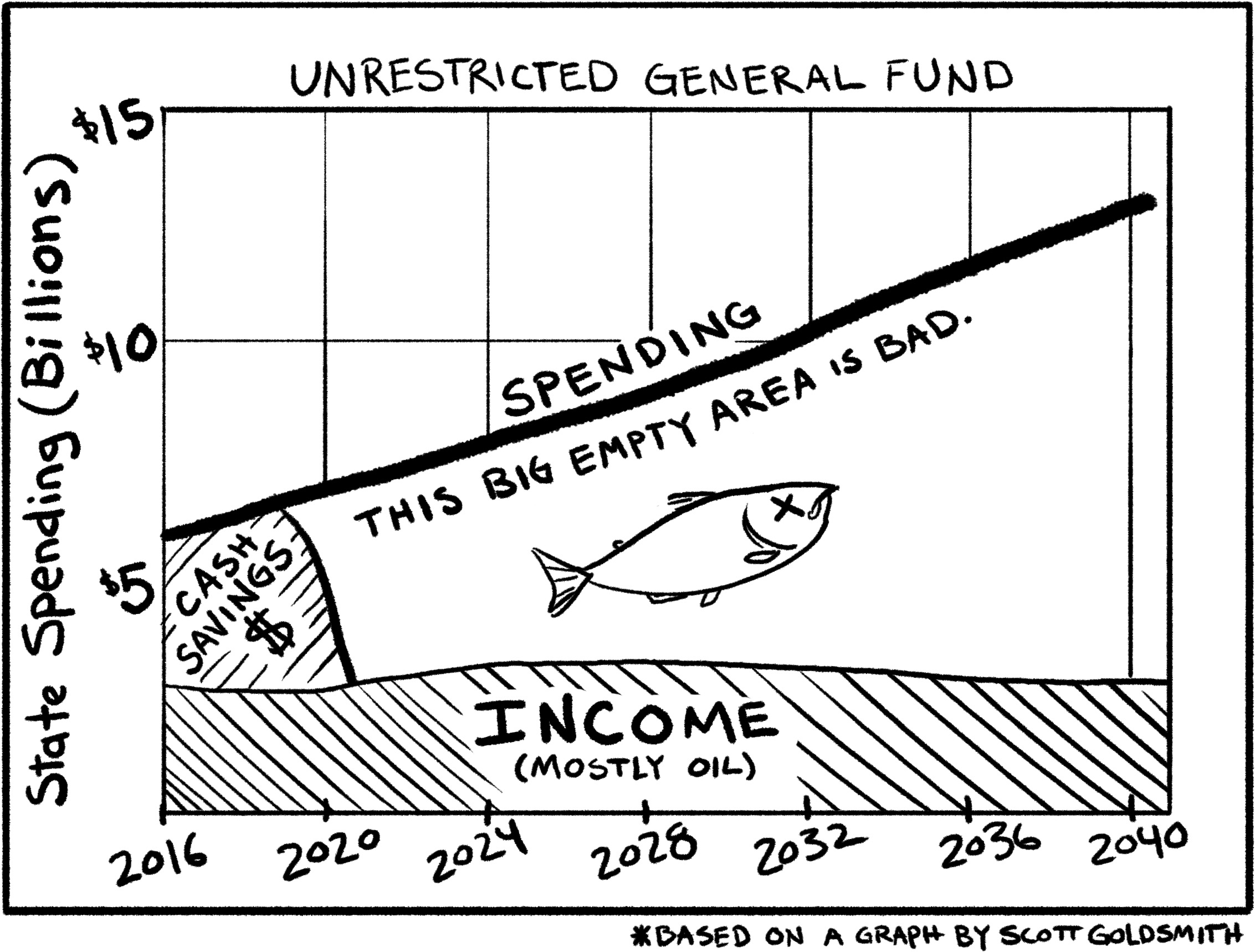
State budget pessimists warn that fewer barrels and a growing budget deficit could turn the state into an economic wasteland. But as some Juneau residents have learned, things could still turn around.
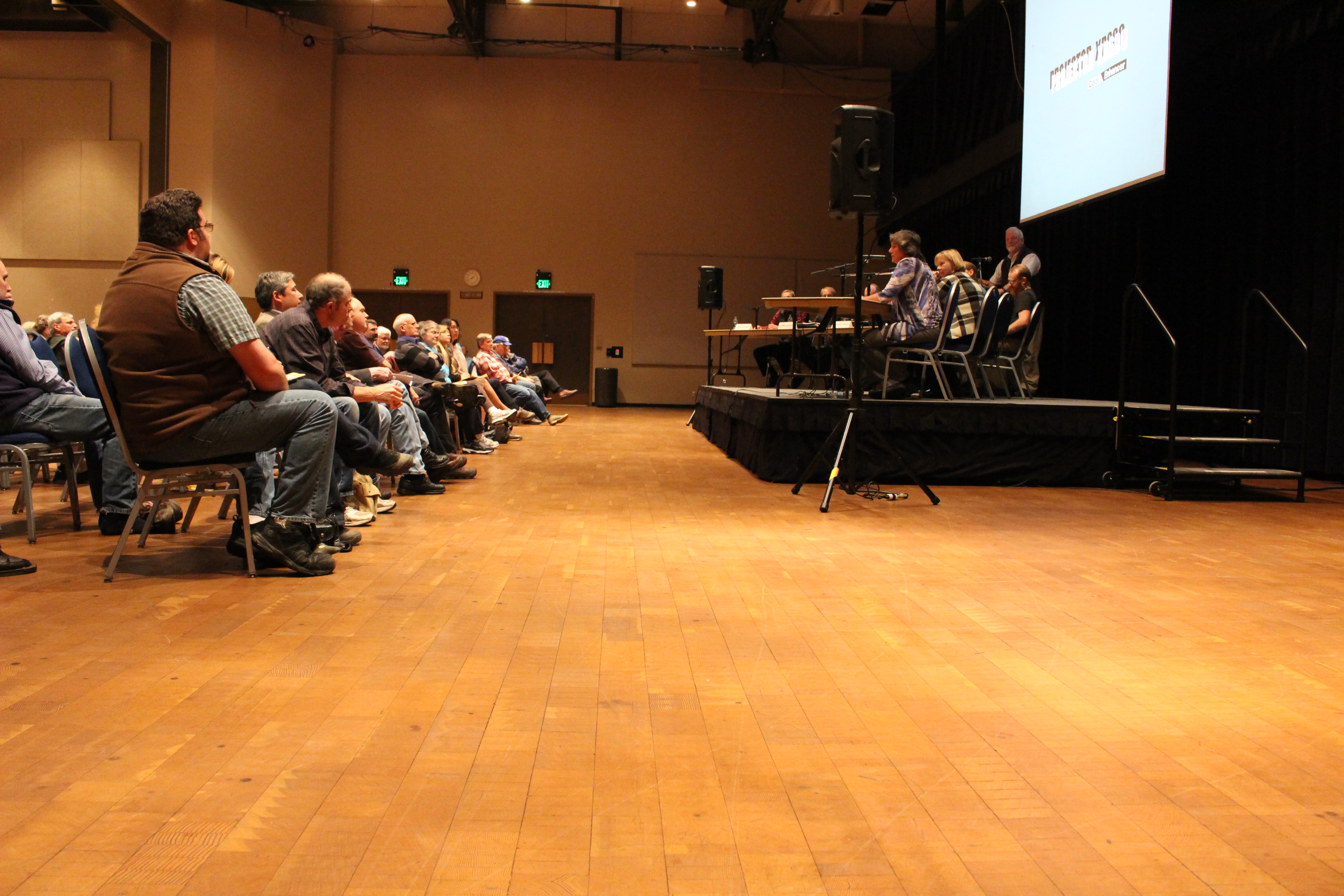
In a packed a ballroom at Centennial Hall Wednesday evening, a panel of two oil and gas consultants and two economists debated Alaska’s fiscal future.
Some of the more dire predictions inspire comparisons to Mad Max, a late 70s apocalyptic thriller in which oil reserves have been depleted, financial chaos and famine have set in, and roving biker gangs are the only law.
A warning from the movie’s trailer: “In the future, cities will become deserts, roads will become battlefields, and the hope of mankind will appear as a stranger.”
https://www.youtube.com/watch?v=c4TdPxOXuYw
In Alaska, fewer barrels of oil are being produced and the price has dropped to under $50 a barrel — about half of what it used to be. The state is expecting a deficit of $3 billion next year.
And with deeper cuts comes a loss of jobs and school funding.
“It’s not going to take 10 or 15 years. I think two or three years, you’ll see a noticeable drop in Alaska’s population,” Larry Persily said. He, along with a panel of three, spoke at Juneau’s Forum on Alaska’s Fiscal Future.
Persily worked for the Obama Administration on Alaska’s natural gas pipeline and now works for the Kenai Peninsula Borough. He said the proposed LNG pipeline offered a glimmer of hope that could add $1.2 billion a year into the budget.
“But in and of itself, it is not going to solve our problem,” Persily said.
A big topic of conversation at the forum was the possibility of a state income or sales tax. But some of the panelists agreed a sales tax could be regressive and hurt struggling people.
Brad Keithley, a consultant firm that focuses on oil, gas and policy matters, said that’s what adding state taxes would do.
“Think about this for a second. If we’re going into a recession, the last thing you want to do is reduce personal incomes,” Keithley said. “The last thing you want to do is take money out of the private economy. Take money out of people’s hands. That’s what taxes do. ”
Persily sees it differently.
“You look at taxes as taking money out of individuals’ hands. I look at taxes as a way of paying for community services, “Persily said. “That’s how it works. That’s how communities work.”
Open seats were scarce at the Juneau’s ficscal forum. (Photo by Elizabeth Jenkins/KTOO)
Persily said some people could also afford a reduced PFD check or forgoing it altogether. I asked Josh Warren an attendant at the forum, what he thought of that.
“I love my PFD. I’ve gotten it every year since I was born here. But if that’s what the state needs to educate children, then I think that’s OK,” Warren said.
Juneau has a 5% city sales tax. Places like Anchorage and Fairbanks don’t.
To help with the fiscal crisis, panelists advised municipalities to come up with solutions on their own. Brad Keithley said that meant “thinking local.”
“Because the state’s not going to be riding over the hill to build the next school, to build the next AstroTurf football field, to build the next UAF athletic arena, to build the next crime lab. They’re not going to ride over the hill to do that,” Keithley said.
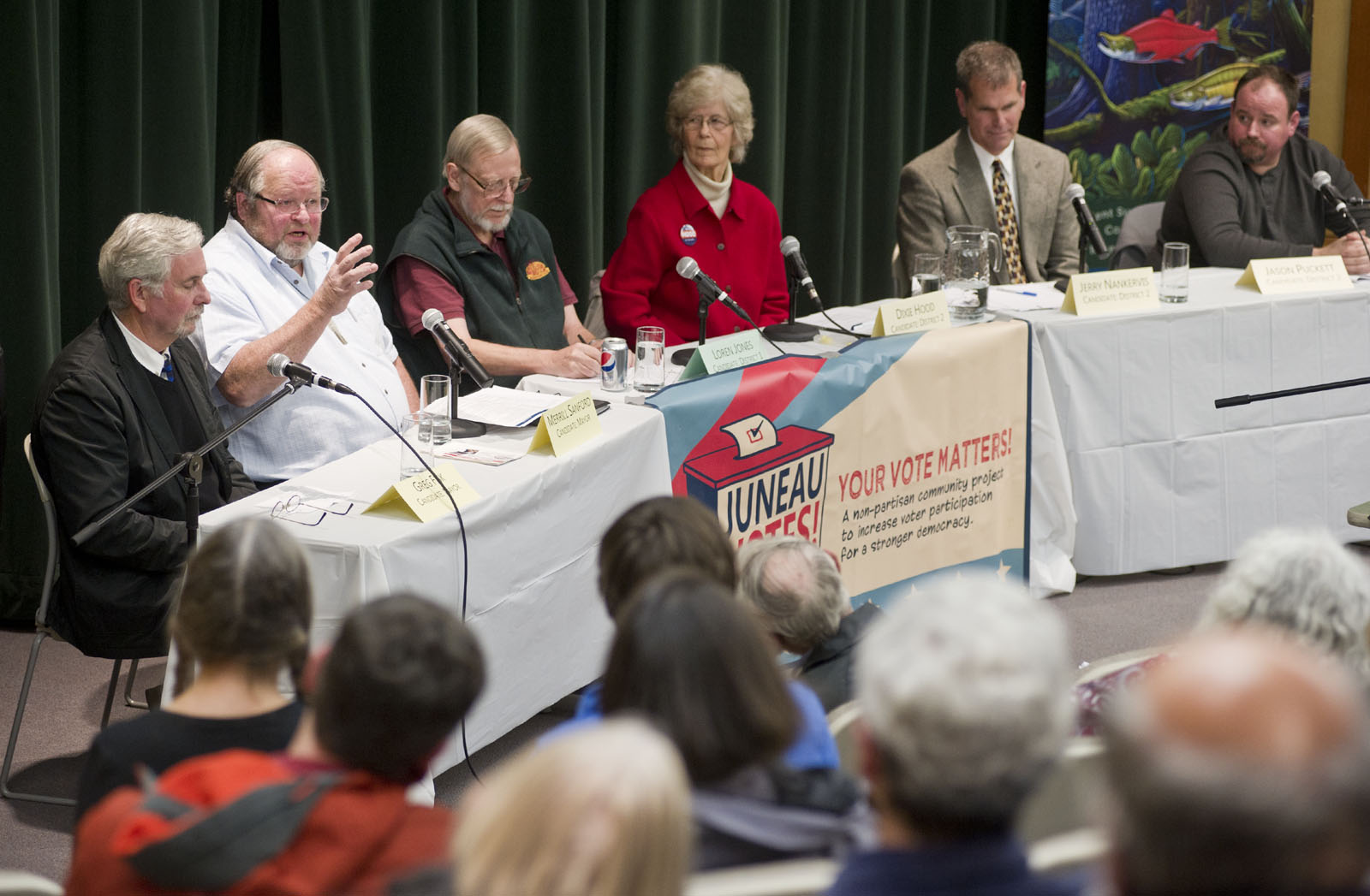
About 40 people attended a debate between the candidates for Juneau Assembly on Tuesday. The candidates fielded questions about marijuana legalization, extending the road north, capital creep, sewage, garbage, property taxes and more.
Watch the debate here:
The debate was put together by Juneau Votes, KTOO and the Juneau Empire. Find out more about the candidates and issues in the Oct. 6 elections from our election guide.
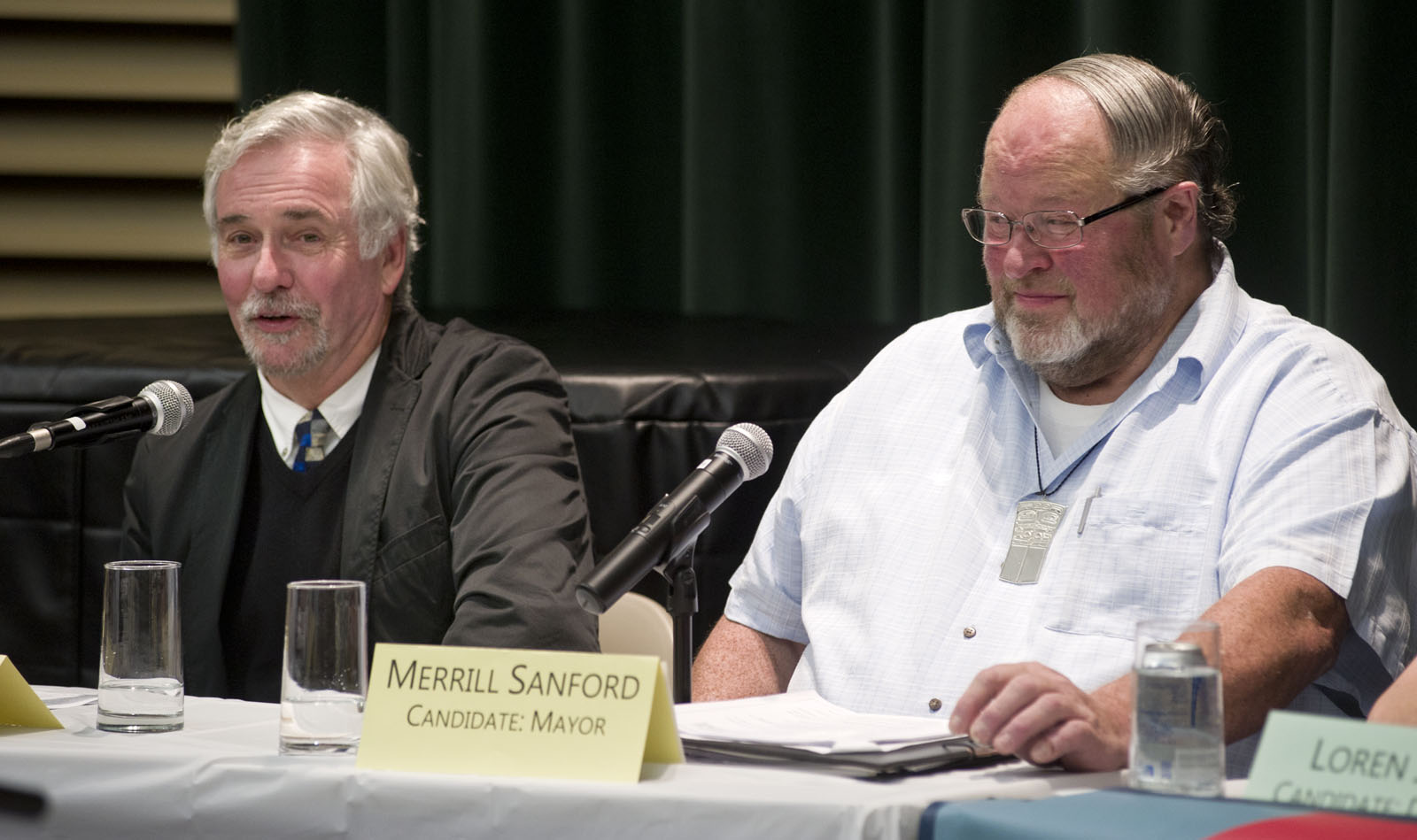
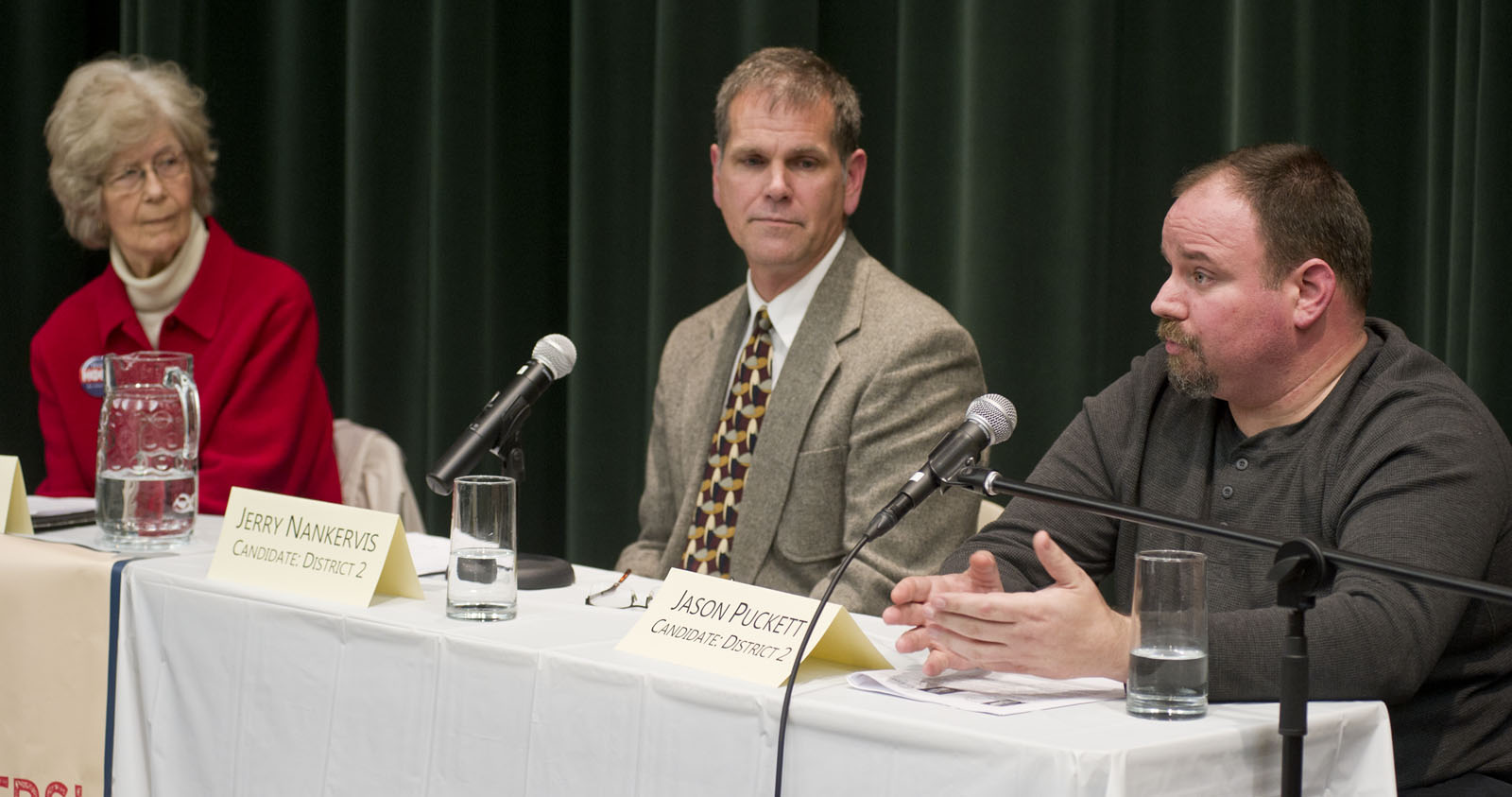
Juneau Assembly mayoral candidates Greg Fisk, left, and Merrill Sanford. (Photo by Michael Penn/Juneau Empire)Juneau Assembly District 2 candidates Dixie Hood, left, Jerry Nankervis, center, and Jason Puckett. (Photo by Michael Penn/Juneau Empire)Juneau Assembly candidates answer questions from the audience during the Juneau Votes debate at the University of Alaska Southeast on Tuesday. The candidates from the left are: Greg Fisk, Merrill Sanford, Loren Jones, Dixie Hood, Jerry Nankervis and Jason Puckett. (Photo by Michael Penn/Juneau Empire)
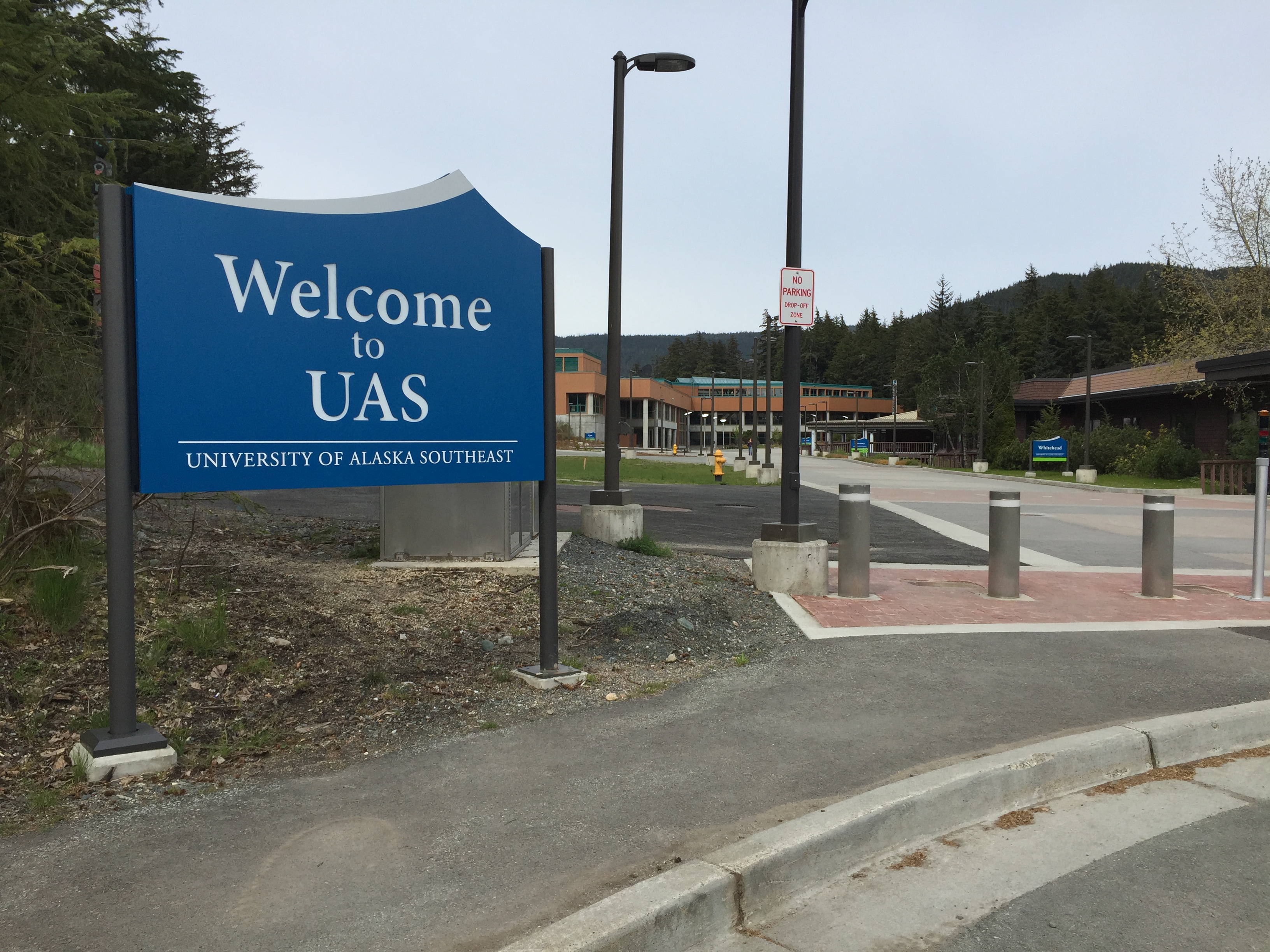
Students at the University of Alaska Southeast will recognize Indigenous Peoples’ Day on Oct. 12, a day otherwise known as Columbus Day. The student government recently passed a resolution to do this on the second Monday of every October.
David Russell-Jensen is a third-year student at the UAS. He’s a member of the student government and cosponsored the resolution.
“I had an essay assigned to me in high school about whether or not we should even celebrate Columbus Day and so I think that’s where some of my thoughts came about why we shouldn’t celebrate it,” Russell-Jensen said.
Growing up in Juneau, he said Columbus Day has never been a big deal. But he knows it’s still recognized in other parts of the country.
“They do Columbus Day sales, I guess. That’s kind of weird, but does that just mean you just walk into a store and just steal whatever you want?” he said.
For Russell-Jensen, Christopher Columbus represents the beginning of colonization and the genocide of indigenous people, not the discovery of America.
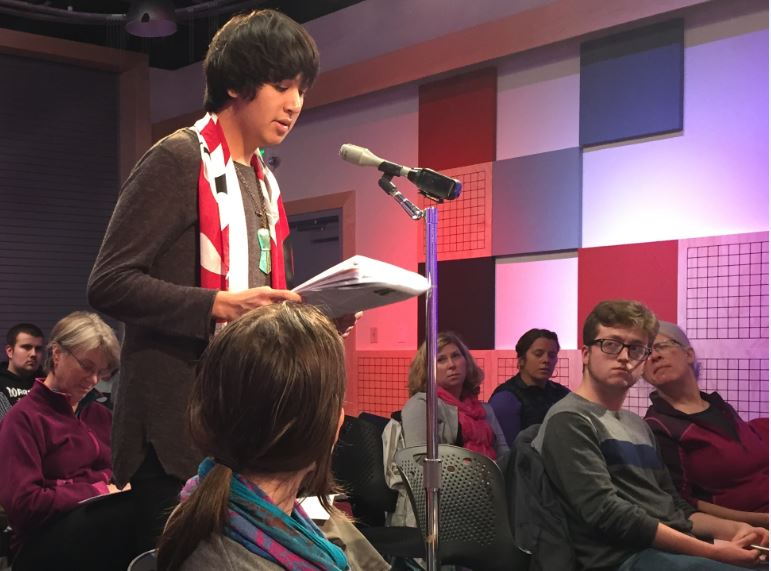
At a recent local municipal candidate debate, David Russell-Jensen asks school board candidates if they’d support a Tlingit language immersion school. (Photo by Lisa Phu/KTOO)
He got the idea to bring the resolution forward from Seattle. Its city council unanimously voted to rename Columbus Day as Indigenous Peoples’ Day last year. Minneapolis did it beforehand. Berkeley, California has been recognizing it since the 1990s.
The State of Alaska and the university system do not recognize Columbus Day as an official holiday. But Russell-Jensen said we’re all a result of colonization.
“We’re all results of genocide and language loss. I mean, I’m speaking English. That’s kind of weird. A hundred years ago, I’d probably be speaking three different languages if I lived here,” Russell-Jensen said.
He hopes the resolution continues the dialogue UAS is already having. Russell-Jensen is a Tlingit language student and says the college is playing an important role in revitalizing Alaska Native languages.
“UAS is doing some really amazing things about the importance of indigenous languages and culture, so I know that this isn’t going to be one day on the calendar, where, ‘Oh, we’re done.’ It’s not going to be like that,” he said.
But Russell-Jensen still thinks UAS can do better. He wants to see more Alaska Native teachers. Of the 102 full-time faculty members at UAS, only 3 are Alaska Native.
Chancellor Rick Caulfield said that’s something the college is focusing on through a new diversity action committee. He says UAS is continually looking at ways to expand educational opportunities around Alaska Native culture.
“It is something that I believe is important for all Alaskans and I think, to the extent that UAS is located in the homeland of the Tlingit, Haida and Tsimshian peoples … we have an obligation to provide education to include the languages and cultures of the peoples in this ancestral homeland,” Caulfield said.
UAS currently offers Alaska Native Languages and Studies as a minor or as an emphasis for a liberal arts degree. Caulfield says university faculty are discussing the possibility of turning it into its own degree program.
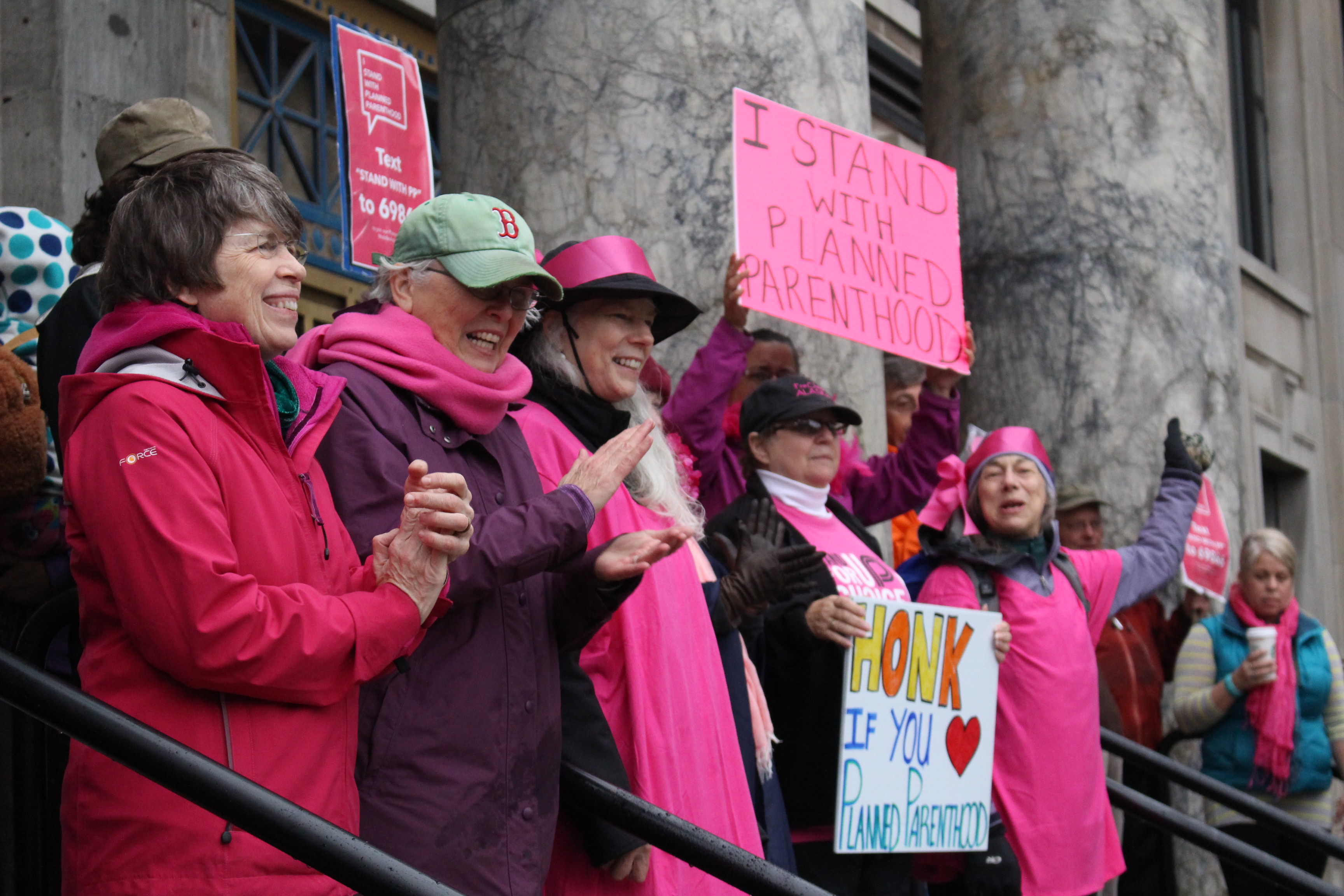
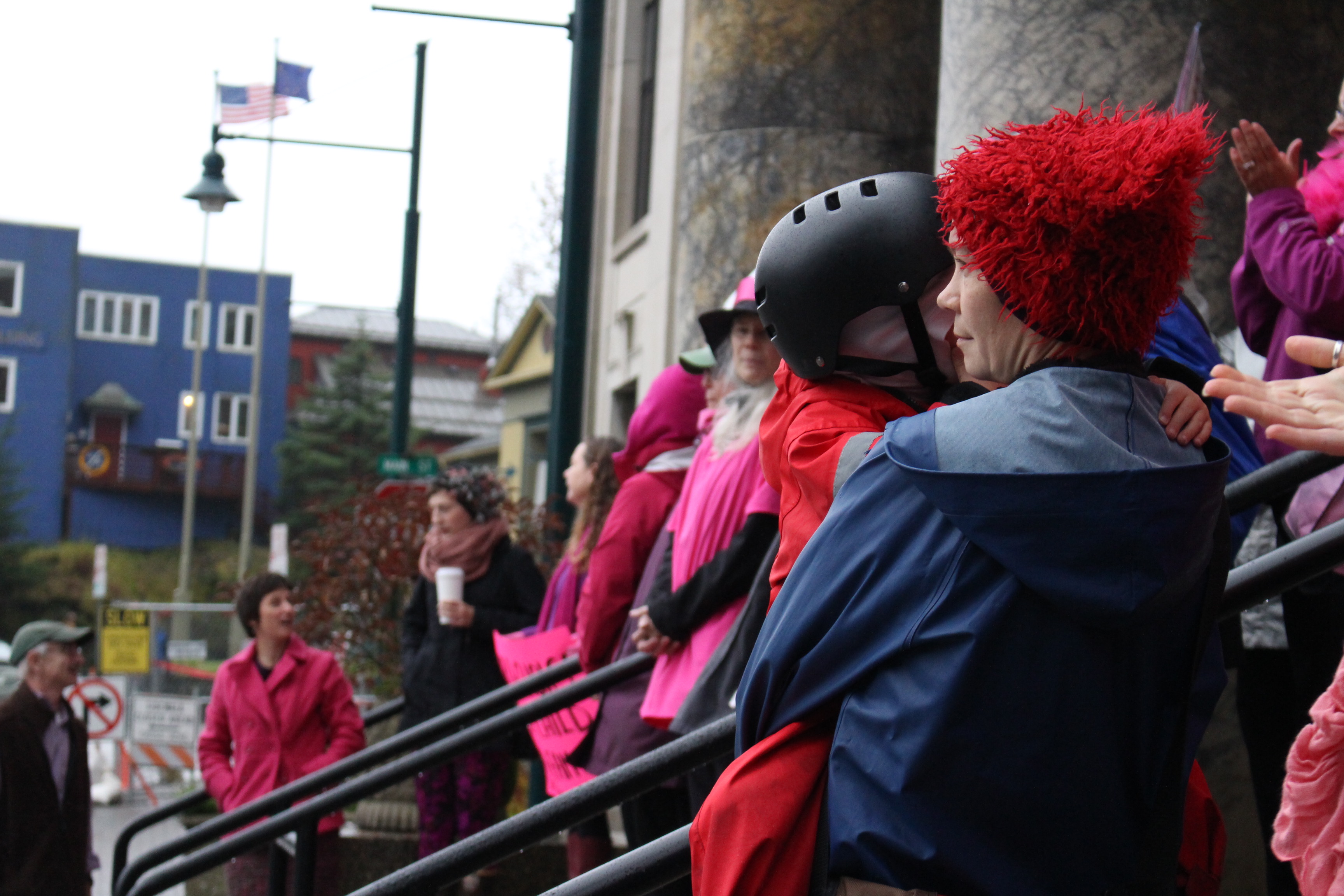
Rally goers gathered at noon on the capitol steps. (Photo by Elizabeth Jenkins/KTOO)
A crowd gathered on the capitol steps Tuesday to show their support for Planned Parenthood. In recent weeks, Republican lawmakers in Congress have tried to strip the organization of its federal funding.
Rally goers clutched signs that said, “Have your children by choice not chance”, “Grandpas support Planned Parenthood” and, of course, a sign to honk “if you love Planned Parenthood.”
Dave Sturdevant borrowed his wife’s hot pink scarf for the rally. He blended into a sea of pink shoes, T-shirts and knitted hats that the crowd of about 30 was encouraged to wear.
“It’s about 90 percent senior citizens like myself. You have senior citizens well past reproductive age out here to support the cause for younger women and families,” he said.
There are four Planned Parenthood clinics in Alaska. They provide STD and cancer screenings for men and women, pap smears, sex education and LGBT services. And yes, three of the clinics provide abortions.
Planned Parenthood has been in the headlines lately because of a sting video showing affiliates discussing the harvest of aborted fetal parts. And conservative Republicans are using the controversy to justify defunding federal dollars. Jessica Bogard skipped her lunch break to attend the rally.
“Today is important because the decisions being made have a deadline and a vote. And so we need to make our opposition to the decisions being made to unfund or defund known today,” she said.
Inari Kylanen brought her child to the rally. She said it’s important for her daughter to have choices when she grows up. (Photo by Elizabeth Jenkins/KTOO)
A bill to defund Planned Parenthood failed to get enough votes in the Senate. But a potential government shut is looming if lawmakers can’t come to an agreement in the House.
Last week, Alaska’s U.S. Sen. Lisa Murkowski voted against a bill to defund Planned Parenthood, and she said she doesn’t support a government shutdown. She was one of eight Republicans to vote against the bill.
Bogard says she’s happy the senator voted with the Democrats.
“But I don’t think it’s a party issue, it’s a health issue,” Bogard said. “And if you view it that way, the decision is clear. You keep funding Planned Parenthood.”
A woman in an SUV drove by the rally, rolled down her window and shouted “no government funding for private business.” The crowd quieted for a minute before the chanting picked back up.
Amanda Krafft said she thinks most of the reaction to the rally has been positive.
“Maybe only just a couple people have not waved or just looked,” Krafft said. “Maybe one or two stink eyes. But that’s okay. That’s alright.”
Krafft leads the next chant of “Reproductive rights for all! Hurrah, hurrah!” She said she came up with it on the fly.
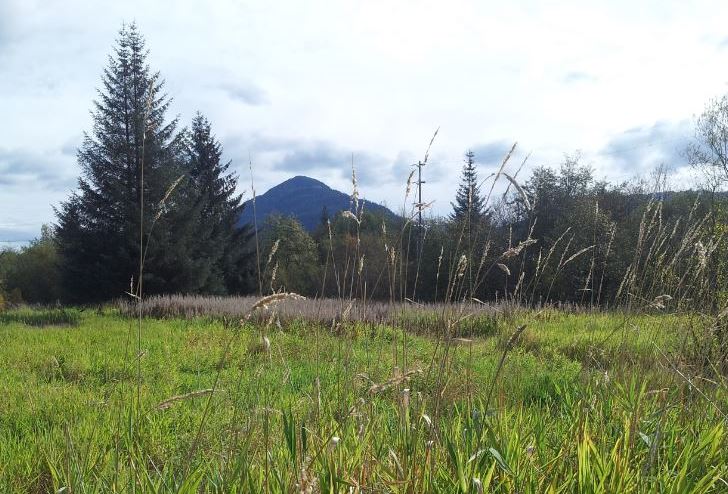
Juneau’s St. Vincent de Paul Society and Seattle-based GMD Development were supposed to break ground on low-income senior housing on this land near the airport. With the partnership over, the land remains untouched. (Photo courtesy St. Vincent de Paul Society)
A partnership that was going to bring 41 units of low-income senior housing to Juneau has ended, leaving a Seattle-based developer with $9 million in funding and no land to build on.
“We put in a lot of time, effort, money, blood, sweat, tears into this project and it’s very disappointing, very disappointing,” Austin said.
Both entities say it was the other that withdrew from the partnership.
Austin said St. Vincent de Paul and GMD Development weren’t able to agree on things like the administration of the project and the role of the housing’s thrift store.
“It’s mainly differences in management philosophy and mission between the two organizations. One is not necessarily better than the other, but we got to a point where it appeared that they were incompatible,” Austin said.
The proposed project targeting low to moderate income seniors was to be a mix of studio, one-bedroom and two-bedroom units with a thrift store on the ground floor. The plan was to build it on a lot adjacent to the nonprofit’s current property near the airport.
Alaska Housing Finance Corporation awarded the $9 million in financing to the project. With the broken partnership, director of planning and program development Mark Romick said the award contractually stays with GMD Development.
The Seattle-based company has until Dec. 31 to find another partner for the proposed Juneau housing.
“The project has to be exactly the same as it was proposed — same units, same energy efficiency, techniques, same design, same everything,” Romick said.
Romick hopes the proposed project can still happen.
“We want to see the units developed in Juneau and we’re hoping that this whole thing can work itself out,” Romick said.
If GMD Development doesn’t use the financing, AHFC gets it back. Romick says there’s a possibility it could be restricted to a Juneau project.
GMD may still have the financing, but it doesn’t have the land. That belongs to St. Vincent de Paul.
Project manager Emily Breidenbach said GMD is looking for new development sites and a new nonprofit partner. It’s been in discussions with a few agencies in Juneau, including Tlingit-Haida Regional Housing Authority, but doesn’t have anything concrete.
“Certainly because these are going to be seniors, we are looking for a site that’s well connected that has access to buses and sidewalks so that seniors can get out and be connected to the community,” Breidenbach said.
GMD and St. Vincent de Paul are still partners on a current renovation to Channel Terrace apartments in Douglas, and have funding applications in for other projects.
As GMD looks for another partner and land to build on, St. Vincent de Paul continues to pursue developing its land for low-income senior housing. Austin says he’s meeting with a potential partner in a few weeks.
Close
Update notification options
Subscribe to notifications
Subscribe
Get notifications about news related to the topics you care about. You can unsubscribe anytime.