A rendering of the ferry designed to replace the Tustumena. (Image courtesy Alaska Department of Transportation & Public Facilities)
The state Department of Transportation has a design for the ship that will replace the ferry Tustumena.
DOT Deputy Commissioner Mike Neussl said the new design focuses on two key issues. First, to make the new ferry carry as many people and vehicles as possible. The second goal was to make it small enough and shallow enough to use all the docks and shore side infrastructure used by the Tustumena right now.
“Both of those design criteria were put in. The design is complete but the process going forward is to get that design into construction, build a vessel, put it into service and replace the existing Tustumena on its runs with a new more capable vessel,” said Neussl.
The Tustumena has served communities in southcentral and southwest Alaska for a little more than 50 years. The ferry’s home port is in Homer and it regularly travels to 13 ports between Homer and Unalaska.
Neussl isn’t sure when construction will start on the new ferry or how long it will take. He said a vessel of that size typically takes at least two or three years to build. He said it depends on contract terms with the shipyard doing the work.
“As a comparator, the Alaska Class Ferries being built out in Ketchikan … the construction period was intentionally lengthened to drive the cost of those ferries down. Instead of having three ship builders working around the clock to try and build it as fast as possible, you work on it at a slower pace,” explained Neussl.
Neussl said none of those decisions have been made for the Tustumena and the construction contract has not been opened up for bidding.
He said the new ship is estimated to cost around $237 million and about 90 percent of that money is expected to come from the federal government through Alaska’s Statewide Transportation Improvement Plan or STIP.
“That is the mechanism by which all projects compete for those federal funding dollars. … That provides millions of dollars for the State of Alaska for federal aid projects. Highway projects, marine highway projects, dock replacement projects,” Neussl said.
The rest of the money would come from the state. He said the vessel is listed among the projects seeking STIP funding but it’s listed in fiscal year 2019.
“Which is quite a ways down the road. Our job now is to pull that forward through the amendment process to get it funded through that process and out for construction … hopefully sooner rather than later. That’s where the project currently stands,” said Neussl.
Neussl said once the new ferry is built, the old Tustumena will be sold to either continue sailing under a new owner or it will be used for scrap.
This video still from Kodiak Police Department bodycam video shows Nick Pletnikoff on the ground about to be pepper sprayed by Sgt. Francis de la Fuente on Sept. 16, 2015.
It’s been almost five months since three Kodiak police officers pinned an autistic man to the ground and pepper-sprayed him at point-blank range. Nick Pletnikoff was not charged with any crime after the incident, but the Kodiak Police Department hired a police consultant from Soldotna to investigate the actions of its officers. The report, released last week, found the officers acted appropriately.
Others disagree, including the Pletnikoff family, who Tuesday filed suit in Kodiak Superior Court against the city, the police department and two of the three officers involved. Named as defendants are Sgt. Francis de la Fuente and Officer Phillip Christman. Not named in the suit is officer Kathleen Gambling, who also participated in the detention of Pletnikoff.
When contacted Tuesday, family attorney Josh Fitzgerald said the reason Gambling was not named would eventually be explained.
The 15-page complaint accuses Christman of not alerting his fellow officers of Nick Pletnikoff’s special needs condition, since they have known each other since high school, and it accuses de la Fuente of escalating an incident that was nonviolent until he arrived. The complaint claims Nick Pletnikoff’s special needs condition should have been obvious to any reasonable officer at the scene.
The suit accuses both Christman and de la Fuente of negligence and accuses de la Fuente of assault and battery. It also blames the city and police department for a lack of training and holds it liable for the actions of its officers.
The Pletnikoffs are asking for judgment in excess of $100,000 as well as punitive damages. They are asking for a jury trial to be held in Kodiak.
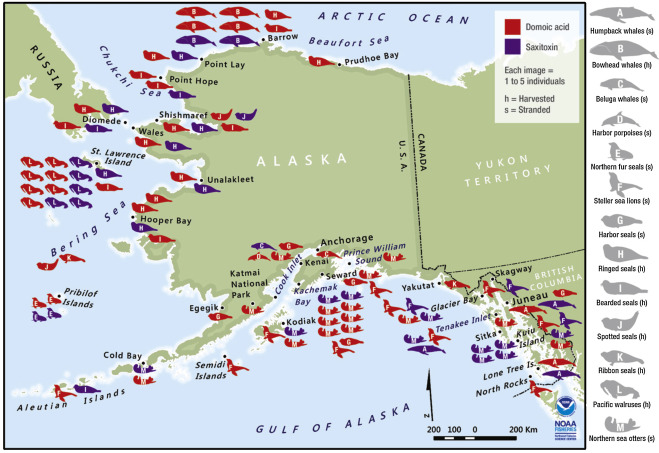
Whale, otter and other marine mammal carcasses were found with evidence of two algae-carrying toxins along most of the Alaska coastline in a study released Thursday. (Map courtesy Northwest Fisheries Science Center)
For the first time, scientists have documented the prevalence of two biotoxins in Alaska’s marine mammal population above the Arctic Circle.
That’s according to a new study out Thursday in the Journal Harmful Algae. But it’s not clear if algal toxins have always existed in the Arctic, because scientist never looked before now.
Scientists did not expect to find algal toxins in ocean water or marine mammals that range north of the Gulf of Alaska and the state’s Southeast region.
“This is really important, because these are animals that are integral to the culture and the community and food security here in Alaska,” said Frances Gulland, a commissioner with the federal Marine Mammal Commission. She co-authored the new study.
“There are detectable levels that have actually been measured of two different biotoxins: domoic acid and saxitoxin and both these toxins are produced by harmful algal blooms,” Gulland said.
The two are known to cause amnesic shellfish disorder and paralytic shellfish disorder in people.
“Now that we see that algae is there,” said Gay Sheffield, a biologist with the Alaska SeaGrant Marine Advisory Program and a study co-author.
“What would be the best coarse of action to make it comprehensive knowledge is to find out how our Russian neighbors have seen any of these unusual algaes or if they have any unusual concerns and more importantly is there traditional knowledge on shellfish poisoning or algal blooms or is there strange behavioral events with marine mammals,” she said.
After algae dies in the ocean, what’s left gets consumed – or filtered – by shellfish like clams and mussels, staple foods for many marine mammals. So, if there are algal toxins present they could end up in the gut contents of an unsuspecting Pacific Walrus, for example. Sheffield said of the 13 marine mammal species sampled over the course of nearly a decade, walrus had the highest levels of algal toxins.
“Because its such an important subsistence food item for the Bering Strait, there’s of course interest both from an animal health perspective, but a public health, human health, food security as well, but right now, there’s no problem,” said Sheffield.
According to the study, levels of algal toxins measured do not exceed regulatory limits for seafood safety in Alaska, or at the federal level. It’s also not clear if the toxins have always been present in the Far North, because scientists never tested for them before now.
Frances Gulland added that the study is not only limited in size, but the data itself can’t provide information about the magnitude of exposure, because toxins like domoic acid are cleared from an animals bloodstream and the gastrointestinal system so quickly.
“If the animal ate some food 10 minutes ago that was full of domoic acid, it would have a high level, but if its 12 hours since the animal ate, the levels will be lower,” she said.
“If it’s two days since the animal ate, the levels will be really low,” said Gulland. “So, really the data are limited because they’re only telling you what’s in that snapshot in time.”
Research does indicate an increase in the occurrence of algal blooms in the Arctic. Gulland believes that’s due to warming ocean temperatures and changes in sea ice.
“They’re plants, they grow, they are temperature dependent,” she said, “so clearly, with warmer waters, they’re going to replicate quicker, so its sensible to assume that temperature is important, but there also changes in micro-nutrients – things like iron and different components of water – that will affect how they bloom as well.”
Funding for study sampling came from the U.S. Fish and Wildlife Service, the National Marine Fisheries Service and the Alaska Department of Fish and Game. Additional money came from the National Institute of Health and the National Science Foundation.
For 40 years, someone from Bristol Bay has sat on the Alaska Board of Fisheries. For the first time next fall, that might not be the case.
Gov. Bill Walker announced five nominations to the state fisheries and game boards on Tuesday. On the list again for a fish board seat is scientist Robert Ruffner of Soldotna, who would replace Fritz Johnson, a commercial fisherman from Dillingham.
That was a surprise for many in Bristol Bay — including long-time drift fisherman Robin Samuelson, a former fish board member himself.
“This is a sad day for Bristol Bay,” Samuelson said shortly after the announcement was made. “Fisheries is everybody’s livelihood in Bristol Bay and I’m very disappointed in the governor’s action.”
Johnson, also a Bristol Bay drifter, wanted to serve a second term on the board. He was appointed to replace Vince Webster, of King Salmon, who replaced Dillingham’s Robert Heyano. As far back as 1975, when the board of fish and game was split into two, someone from Bristol Bay has sat on the board of fish. Dillingham’s Herman Schroeder was the first appointee from the region. Samuelson said he wasn’t expecting the governor to change that pattern.
“I could see him replacing Fritz, but it would seem that with having the biggest herring fishery in the state of Alaska, having the biggest salmon fishery in the world, that we’d be afforded a board of fish member,” Samuelson said.
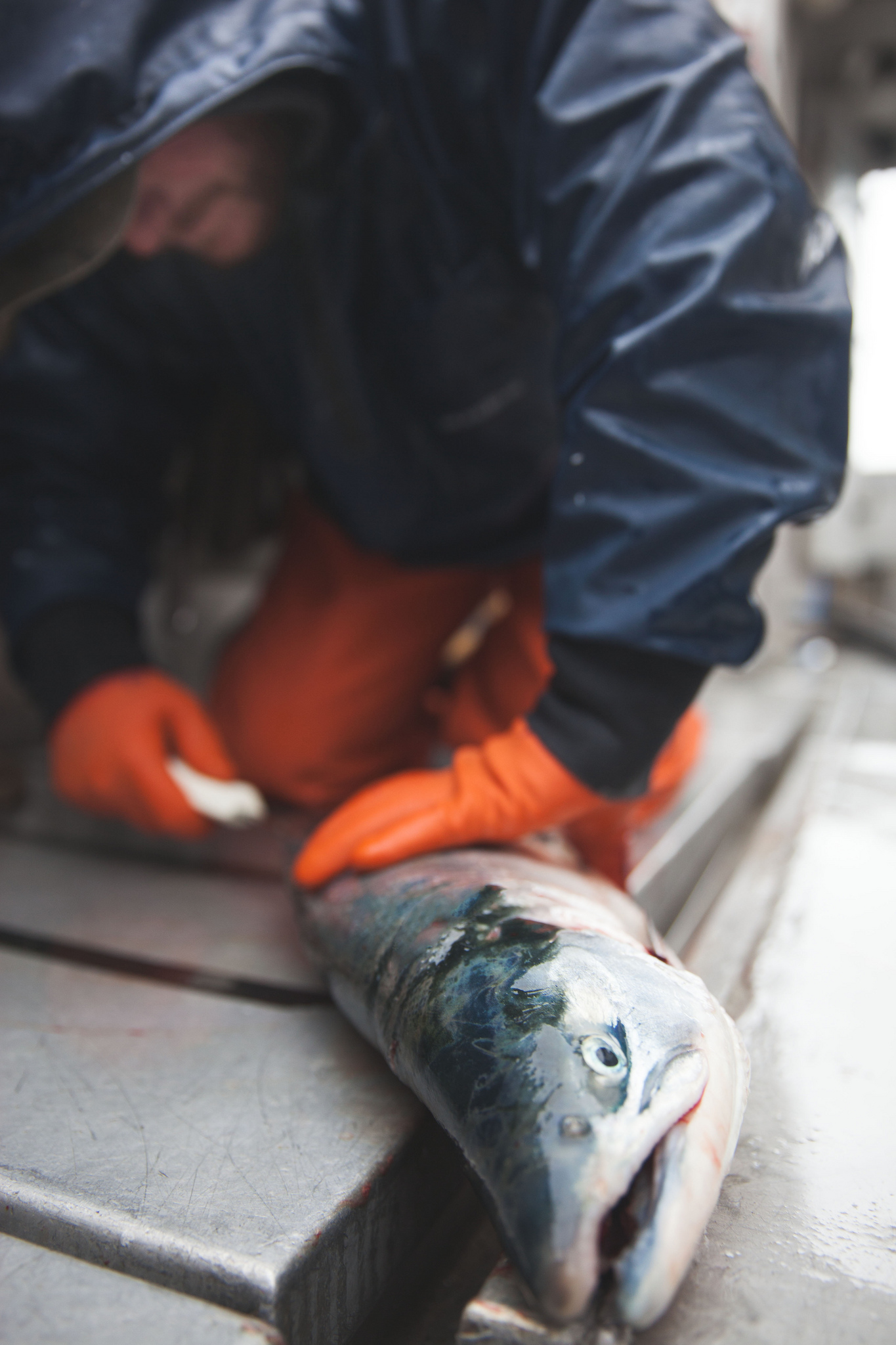
A commercial fisherman and salmon in Bristol Bay, July 2, 2013. (Creative Commons photo by Chris Ford)
Norm Van Vactor, CEO of Bristol Bay Economic Development Association, said the news was a surprise to him as well. Although he’s been a supporter of the governor, he was frustrated by the lack of outreach to Bristol Bay stakeholders before the decision was made.
“And I think that the lack of process that the governor and the commissioner have not gone through is really sad,” he said. “… I think all of us were put in a position of not being able to rally and ask why.”
But Walker said he was ready for something different and didn’t make the decision lightly, knowing it was a big change for the bay.
“I just wanted a little different balance, not necessarily of user groups but a regional balance a little bit for a change,” Walker said. “I certainly wouldn’t look at this as a trend in anyway, but I think that there’s a lot of angst in the Cook Inlet, Peninsula region. … I looked at the individuals, both were obviously quite good. Fritz has been a good board member. And I look at Robert Ruffner, and … what I think he brings to the board, and I just felt I needed to have a little bit of a different, a little bit of a shift, and use Fritz in a different way.”
Although Johnson received a ticket for fishing three minutes after the fishing period closed this summer, Walker said that wasn’t a deciding factor in the decision not to reappoint him. Instead, Walker said he’s hoping Johnson will help with a new advisory group he’s forming to review the board process.
“I know he’d much rather be on the board, but I need somebody from the board to be part of this advisory group,” Walker said. “I want to look at some potential changes to the board process in some way, but I need to put together this advisory group to do that and so, like I said, I’ve asked Fritz to be part of that if he’s willing to.”
Walker said he met with Samuelson and Rep. Bryce Edgmon after the announcement was made.
Johnson’s replacement, Ruffner, is actually a second-time nominee. Last year, the state legislature voted him down after he was selected to replace former board chair Karl Johnstone, citing concerns that his appointment would change the balance. Johnstone was considered a sportfishing representative; Ruffner had a science background, and said he would put the resource first.
Walker later appointed Robert Mumford, a former Alaska wildlife trooper, to Johnstone’s seat after Ruffner wasn’t confirmed. Mumford served for most of the year, but announced in late January he planned to resign in March.
Walker has nominated Anchorage’s Al Cain, another former trooper, to replace him. The governor rounded out his fish board nominees with Israel Payton, a Wasilla resident who has worked as a hunting and fishing guide. He’ll replace Tom Kluberton, who said in December that he didn’t plan to serve another term.
The appointments change the balance on the seven-member board, which makes policy and allocation decisions for the state’s fisheries. Typically, there are three representatives of the sportfishing industry, one subsistence representative and three from commercial fisheries. The most recent round of nominations, if confirmed, will change the balance.
Samuelson said it isn’t just commercial fishing representation he’s worried about.
“Subsistence is the most important fishery in our state, especially in rural Alaska, and who’s gonna carry the torch on that board for us,” he said. “Not only our commercial fishery but our subsistence fishery.”
All of the governor’s nominations are subject to confirmation by the legislature, a process that’s been contentious in the past couple of years. Walker said he expects Ruffner to be confirmed this time around.
“I’ve received, I believe, assurances that it will go significantly differently. Otherwise I would not have put him back up as a nominee,” he said.
Specifically, Walker said individuals from the Kenai Peninsula told him they thought the vote would go differently this spring. But one Kenai Peninsula lawmaker, Republican Rep. Mike Chenault, said it remains to be seen how the confirmation process will go.
“It is contentious,” Chenault said. “I have never seen a board member just kinda sail through unscathed without somebody taking pot shots at ‘em. And you know, why some (people) even would want to be on this board? I have no idea.”
Chenault said the fish board appointees will likely face multiple confirmation hearings before the legislature meets in a joint session to consider the nominees. That hearing is typically occurs toward the end of the session.
In addition to the fish picks, the governor reappointed Nathan Turner for the state Board of Game, and appointed Guy Trimmingham for a first term.
Thomas Tom. (Image courtesy Alaska State Troopers)
After discovering a dead man with a gunshot wound in his head at an Aniak man’s home last weekend, Alaska State Troopers have now located the home’s resident, also dead.
Troopers found 57-year-old Tommy Tom of Aniak after four days of searching. Trooper spokesperson Megan Peters said Tom was found Thursday around noon in the woods near a trail used by heavy machinery in the village.
“Mr. Tom was located behind a tree which was not visible from the air or from the trail. It appears he was not dressed for the weather, and it looks like he tried to start a small campfire, it doesn’t look like his body has been disturbed at all,” said Peters.
Troopers are investigating both deaths. They identified the other dead man as 32-year-old Clarence Cutter of Aniak.
Officials in Russian Mission issued a community wide lockdown on Sunday after hearing reports of someone heading to their village for refuge after killing someone in Aniak. The lockdown was lifted Monday evening.
Tom’s body has been sent to the State Medical Examiner office for autopsy.
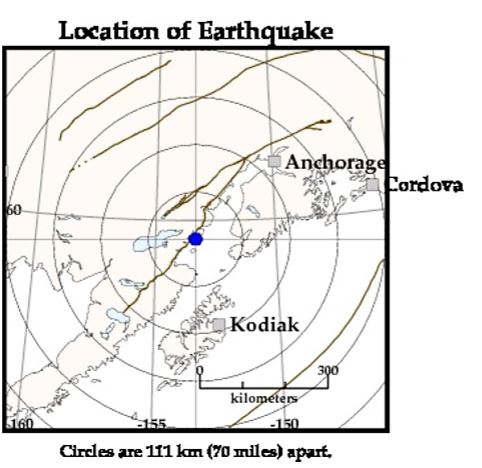
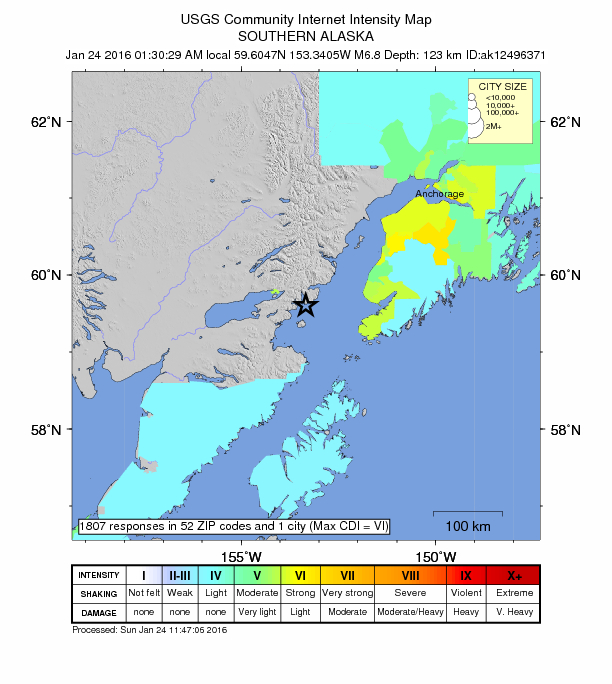
The National Weather Service’s Pacific Tsunami Warning Centerissued a statement saying no action is required for tsunami risk: “BASED ON ALL AVAILABLE DATA … THERE IS NO TSUNAMI THREAT BECAUSE THE EARTHQUAKE IS LOCATED TOO DEEP INSIDE THE EARTH.”
Anecdotal damage reports are circulating on social media of intense shaking and scattered power outages.