Southwest

At the mouth of the Kuskokwim, a pioneering wind system

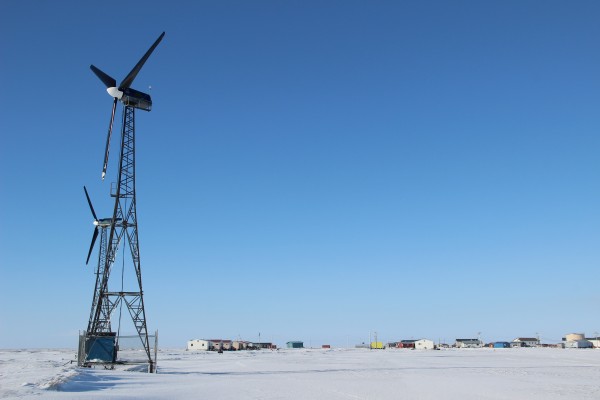
Kwigillingok has five wind turbines, four of which are currently working. (Photo by Rachel Waldholz/APRN)

In rural Alaska, one problem thwarts a thousand good ideas: the high cost of energy. From generating electricity to heating homes to fueling boats and snow machines, energy expenses eat into budgets, are a barrier to business and add to the prohibitive cost of water and sewer systems.

But communities around the state are trying to change that. At the mouth of the Kuskokwim River, the four villages in the Chaninik Wind Group – Kwigillingok, Kongiganak, Tuntutuliak and Kipnuk — are pioneering a system that combines wind turbines, diesel generators, and storage systems with smart grid controls.

The goal? Replace 50 percent of diesel use in the next few years.

Along the way, they’re pushing the limits of what’s possible when it comes to integrating renewable energy into the grid.

It’s senior carnival night in Kwigillingok, about a 40-minute flight southwest of Bethel. The school is raising money to send its four seniors on a graduation trip, to Hawaii. There’s a cake walk in the brand-new gym. The student store is serving up popcorn and slushies.

And right now, all of this – the lights, the music, the popcorn, the slushie maker — it’s all being powered entirely by the wind.

The cake walk during the Kwigillingok School’s senior carnival. The night of the carnival, the entire village was powered by wind. (Photo by Rachel Waldholz/APRN)

Kwigillingok sits on the tundra just about a quarter mile from the Bering Sea. Outside, there is a serious blizzard blowing in.

Walk around the corner from the school, and you can see the village’s five wind turbines, four of which are turning. If you take a walk down to the powerhouse, you hear — almost nothing. The diesel generators are off. The turbines are carrying the load for the entire village.

That’s thanks in large part to William Igkurak.

Igkurak has worked for the local utility, the Kwigillingok Power Company, since 1983. And for decades, he’s had a problem.

“Diesel,” he said. “You cannot control the price of fuel. We were always at the mercy of the fuel supplier.”

Plus, diesel generators break down. Repairs are expensive. And when Igkurak applied for grants from the state, he said, Kwigillingok was always overlooked. With fewer than 400 people, it was too small.

So about 10 years ago, Igkurak set out to change that.

Chaninik Wind Group founder William Igkurak with his wife Rachel and grandson Ty, standing in front of one of the system’s electric thermal stoves. (Photo by Rachel Waldholz/APRN)

He convinced the four villages along the coast to band together and pool their resources. Together, they created the Chaninik Wind Group — focusing on one thing the region has plenty of.

“Wind is free, all you need to do is harness it and find ways to store it,” he said.

Igkurak approached Dennis Meiners, who runs Intelligent Energy Systems.

“He came to me, and said, let’s put up a wind turbine,” Meiners said. “I said no, let’s not put up a wind turbine.”

Meiners had something more ambitious in mind.

“You need a wind system,” he said. “A wind system that could really displace a significant amount of diesel fuel.”

There are about 200 Alaska communities which, like Kwigillingok, run their own isolated power grids, or microgrids. Statewide, about 30 use wind in some way. But there are major challenges to adding wind or any renewable to a small grid. Wind is unpredictable. Sometimes it blows, sometimes it doesn’t.

And Meiners and Igkurak wanted to go further, to integrate more wind than any of the existing systems — which meant finding new ways to do things.

“It just doesn’t exist,” Meiners said, of the technology the Chaninik Wind Group needed. “Big companies don’t invest in technology for villages, so a lot of solutions had to be hand-crafted.”

Patrick Boonstra of Intelligent Energy Systems, and Kwigillingok wind tech Benny Daniel check a turbine after a blizzard the night before. (Photo by Rachel Waldholz/APRN)

They decided the only way to displace a large enough amount of diesel would be to design a system that would turn the diesel generator entirely off whenever there was enough wind to power the full village.

To do that — without wrecking your generator or causing an outage — you need two things: storage, and controls.

For storage, the system uses batteries – Chevy Volt batteries, in fact. There are also small electric thermal stoves in homes throughout the village, which absorb excess wind energy – and cut the need for heating fuel.

And all the different parts of the system have to talk to each other, turning on and off as the conditions change.

Meiners: We’re controlling loads across the grid, across a community, about every half second. We’re changing the loads across the community. So that’s how we’re managing it. That’s our smart grid.

Waldholz: Is that unusual?

Meiners: Is that unusual? I don’t know anybody else doing it.

As in, anywhere. It’s one of the very few systems, not just in Alaska, but in the world, using all these pieces in this way.

Last year, Kwigillingok, the first village to get the full system in place, was powered by only wind more than 30 percent of the time, Meiners said.

So far, the project has been funded with about $13 million in state and federal grants to the four Chaninik communities. They’ve received money from Alaska Legislature; from the Alaska Energy Authority’s Renewable Energy Fund and Emerging Energy Technology Fund; from the Denali Commission; and from the U.S. Department of Energy’s Tribal Energy Program.

But the goal is to make the system economically competitive with diesel – and easy to replicate.

“I’m not going to tell you that we are here today with that,” Meiners said. “But we are very, very close. Very close.”

And he predicts this model isn’t only for remote communities.

“These systems are going to be very, very common,” he said. “Will your subdivision at your house have that? Well, maybe. Will your community have a community wind system and they sell energy across the grid? …The technologies are still the same. Are you going to have your own microgrid at your house? Well, probably.”

Back at the Kwigillingok School, the carnival has ended, and Patrick Boonstra, who works for Meiners at IES, is watching the system work in real time on his laptop.

Outside, the wind is slowing.

Boonstra: It’s dropped to 15 [miles per hour]…to 11…

It’s a real-world test of the system. Will the different parts adjust?

And they do. One by one, the turbines turn themselves off – and the diesel generator comes on.

Boonstra: I just saw one kick on..three kicked off…and the diesel is taking all of the load. And we’re sitting [here] and the lights didn’t flicker!

And he’s right. The lights stay on in Kwigillingok.
Yukon-Kuskokwim tribes demand special convention on regional self-governance

Association of Village Council Presidents’ 51st Annual Conference. (Photo by Dean Swope/KYUK)

Yukon-Kuskokwim tribes are demanding the Association of Village Council Presidents hold a special convention next month to discuss regional self-governance.

Akiak tribal member Mike Williams says almost 30 tribes have signed a resolution calling for the convention, scheduled for March 22-23 in Bethel in the ONC multipurpose room. The timing allows tribes to gather before summer subsistence hits.

The demand comes, Williams says, after AVCP regional delegates unanimously passed a motion at last fall’s annual convention to hold a special gathering Feb. 16 on regional determination, but the event failed to occur.

“We had been looking at a borough and constitutional form of government under the tribes. We had been examining a lot of options to unite the region,” he said.

Williams says the tribes have received no response from the AVCP administration on their demands.

But AVCP Executive vice president Mike Hoffman says he has not received any information from the tribes on this issue and that Feb. 16 was never a hard date for a special convention.

Rather, Hoffman says, the delegates floated the date at the annual convention, but the executive board nailed down the official days for June 8-9 at its meeting last month.

Akiak Native Community Chief Ivan Ivan says he signed the resolution and will attend whenever the convention occurs.

On Thursday Ivan announced his resignation as Unit 4 representative for the AVCP Executive Board.

His resignation began immediately and left no executive AVCP representation for Akiachak, Akiak, Kwethluk or Tuluksak.

“I served on their behalf to the best of my abilities to protect their subsistence hunting and fishing life and to fight against alcohol and drug issues and our quest to continue our yuyurag as instructed by our family members and area elders,” he said.

Ivan says he will continue working on these issues as Chief of the Akiak Native Community.

Aleknagik man charged with attempted murder after stabbing wife 27 times

Chythlook, 52, allegedly stabbed his wife 27 times with two knives. She was hospitalized but reported to be in stable condition. (Photo courtesy of Dillingham Public Safety Department)

An Aleknagik man was taken into custody Tuesday night on attempted murder and assault charges.

According to state troopers, Robin K. Chythlook, 52, stabbed his wife multiple times and pointed a hunting rifle at the unarmed Village Public Safety Officer Tuesday evening.

A sobered Chythlook was in court Wednesday morning for arraignment on two felony charges, the most serious of which carries a maximum penalty of 99 years behind bars.

State troopers said he stabbed his wife 27 times with two different knives Tuesday evening at their home in the ATSAT subdivision on Aleknagik’s South Shore. His wife said the attack began following an argument, adding that both had been drinking. She was hospitalized at Kanakanak but was reported to be in stable condition Wednesday morning.

“It is a very serious case, and it’s charged attempted murder one. When he was assaulting her with the knife he was saying he was going to kill her,” said assistant district attorney Pamela Dale.

VPSO Jason Creasey was the first responder to the Chythlook home Tuesday evening. In the trooper report, Creasey described seeing “a lot of blood in the snow outside.” Creasey could see Robin Chythlook through the porch door’s window.

“I lost sight of him for a little while and when he walked back into view I could see him holding a scoped hunting rifle,” Creasey wrote. He said Chythlook warned him that he had four seconds to leave. “I thought he was going to kill me,” Creasey said.

For that, the state charged Chythlook with third-degree “fear” assault against an officer.

Trooper Ethan Norwood and VPSO Creasey set up a hasty perimeter and arrested Chythlook “after a brief struggle on the porch” just before 7 p.m.

The victim, A.C., was interviewed at the hospital and described a brutal attack. She said they had been drinking and got into an argument, then Robin punched her a few times. He held her on the ground and began stabbing her with a large, white-handled knife, then with a smaller knife after she managed to knock away the first. She ran to a neighbor’s home but didn’t remember how she got away.

Magistrate Judge Tina Reigh ordered Robin Chythlook held on $100,000 bail at his Wednesday arraignment.

In November, he was arrested by Dillingham Police after he threatened people with a knife at his own birthday party, reportedly intoxicated at that time too. That felony case was dismissed by prosecutors in December.

As first legislative budget cuts emerge, some question rural impact

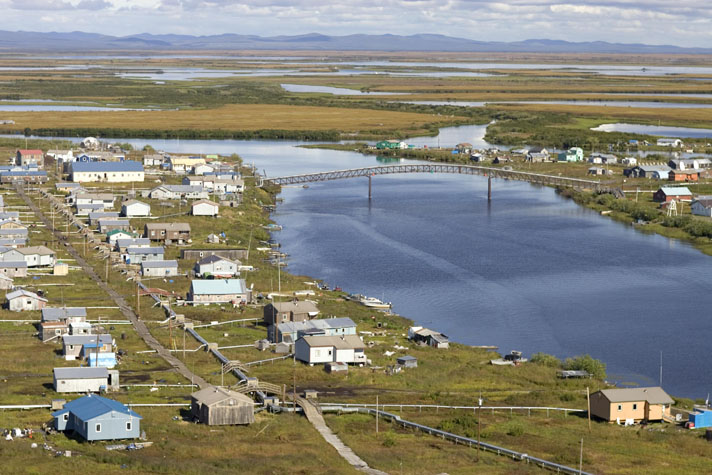
The community of Selawik, near the mouth of the Selawik River, is home to over 800 people. The site of the village, spread between riverbanks and an island, is also called Akuligaq, meaning "a river fork." (Photo by Steve Hillebrand/USFWS)
The community of Selawik, near the mouth of the Selawik River, is home to over 800 people. The site of the village, spread between riverbanks and an island, is also called Akuligaq, meaning “a river fork.”
(Photo by Steve Hillebrand/USFWS)

Legislators are looking to cut the state budget deeper than Gov. Bill Walker’s proposal to reduce spending by $100 million.

But some lawmakers – especially those from rural areas — are raising concerns about where these cuts will fall.

More than five weeks into the legislative session, House finance subcommittees recommended the first cuts to the budget for the fiscal year that starts July 1.

They include $9.8 million in cuts to education programs, as well as cutting all $2.7 million in state funding for public broadcasting.

Rep. Daniel Ortiz, a Ketchikan independent, says eliminating the $2 million for a prekindergarten program is a mistake.

“It’s about investing now so that you don’t have higher costs later,” Ortiz said. “And it just makes good economic sense to do this. Yeah, we get the $2 million reduction but, you know, it’s going to be hard for anybody to chart the costs to the state later on down the road.”

Other proposed cuts include eliminating state funding for rural schools and libraries to increase broadband internet access. As well as a state program to fund mentors for teachers, which is aimed at retaining new teachers in rural Alaska.

Wasilla Republican Rep. Lynn Gattis says none of the cuts are easy, but they’re necessary. That’s because the state has a $3.5 billion budget shortfall.

“There’s nobody sitting here, and I suspect nobody in the audience, that’s very comfortable with any of these cuts,” Gattis said at an education subcommittee hearing. “Somebody said to me, ‘You’re making me make a choice: the right arm or the left arm. And the unfortunate part is — which arm do you write with — is where we’re at in making these cuts.”

Juneau Democratic Rep. Sam Kito says the state should be looking for new revenue, like Walker has proposed, before cutting programs that disproportionately benefit rural areas.

“The libraries in many of these communities become the focal point in trying to maintain connections with the outside world to try and engage students with technology,” Kito said.

For Anchorage Republican Rep. Mike Hawker, the debated education cuts are a small fraction of the overall cuts that are needed to close the state’s budget gap. He contends that the state expanded programs during oil boom years that it can no longer afford.

“The decisions that I want to see coming out of this Legislature are the difficult decisions to reduce our spending to a level that is sustainable,” Hawker said. “To do that, there is no question that we are going to have to be reducing programs in areas across the state that are good, that are desirable that people want but that respectfully we just can’t afford these days.”

Nome Democratic Representative Neal Foster says he hopes, before the budget is completed, the effects of the cuts are geographically balanced.

“I agree that cuts have to be made,” Foster said. “I’m sad to see that so many of these cuts are being made out of rural Alaskan programs. And so, I know it’s the beginning of the process, so I’m hopeful.”

Subcommittees are completing their work on the budget over the next week.

Manokotak educator honored as special education ‘Teacher of the Year’

Le'Esia O'Sullivan, selected as Alaska Special Education 'Teacher of the Year,' is in her fourth year with the Southwest Region School District. (Photo courtesy of SWRSD)
Le’Esia O’Sullivan, selected as Alaska Special Education ‘Teacher of the Year,’ is in her fourth year with the Southwest Region School District. (Photo courtesy of SWRSD)

A Manokotak teacher has been chosen as Alaska’s Special Education “Teacher of the Year” by the Council for Exceptional Children.

Le’Esia O’Sullivan received the honor at a statewide special education conference in Anchorage this month.

Deb Forkner, Principal of Manokotak Nunaniq School, says O’Sullivan works tirelessly in balancing a caseload of 18 elementary-age students.

“Probably the thing that makes her the best is the relationship she builds with her students,” said Forkner. “She really gets to know them on a personal level, so that she can meet their needs and make that connection with them. She also is just really involved in the school and everything that happens at the school, but also any community events so she gets to know students and their families outside of school, which really helps too.”

O’Sullivan is in her third year at the Manokotak school; before that, she spent a year at the Aleknagik school.

She is currently working on her master’s degree in special education, and was nominated for the Teacher of the Year award by her professor, Phillip Patterson.

6 U.S. senators, energy secretary accompany Murkowski and Walker to Oscarville

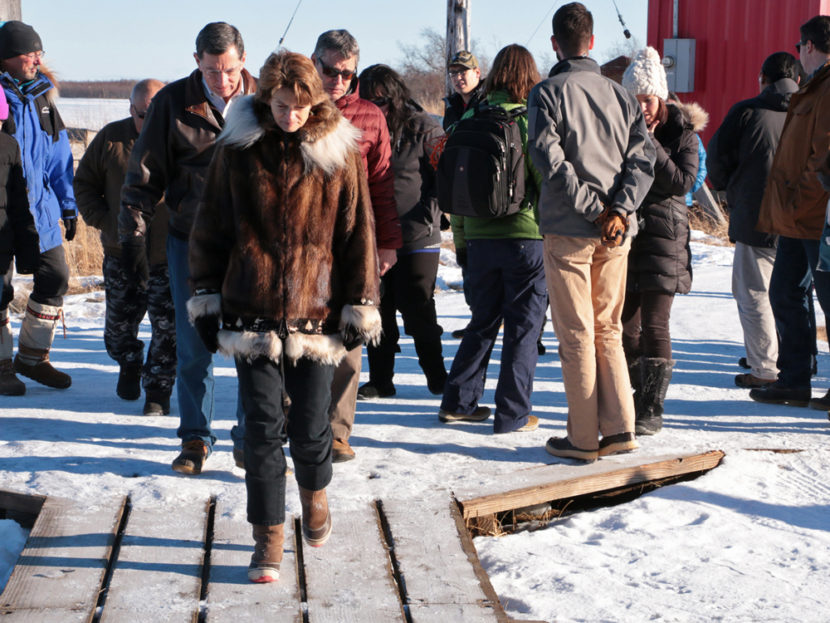
US Sen. Lisa Murkowski walking through Oscarville, followed by U.S. Sen. John Barrasso and AVCP Executive Vice President Mike Hoffman. (Photo by Dean Swope/KYUK)

Six United States senators and the Secretary of Energy traveled to Bethel Monday to hold a hearing on Alaska’s energy challenges and innovations. The team included the Senate Energy and Natural Resources Committee, lead by Republican Sen. Lisa Murkowski.

But before the hearing, the group went on a field trip to see where those challenges and innovations intersect.

The group, joined by Gov. Bill Walker and others, loaded in vehicles and drove five miles up the frozen Kuskokwim River to Oscarville, population 60.

Nearing the village, the first thing the group saw was a line of branches sticking out of the ice, and around them, men are pike fishing. Then the group stepped inside the school. Elders greeted them, and students, wearing black and yellow kuspuks, danced and sang in Yup’ik. Later they performed Native games like the two-foot high kick and one-arm reach.

“I was almost crying earlier. Like, really too happy,” said Oscarville tribal administrator Michael Stevens. “Everybody’s here, and I just stopped myself. I never really thought there’d be lots of senators, the governor and secretary of energy would be here in Oscarville.”

He says he hopes the group’s visit jump-starts funding for basic necessitates like water, sewer, electricity, and housing. He says Oscarville uses rain and river water. Only the school has treated, running water. And all the residents use honey buckets.

For over a year, a group of Alaska agencies has been trying to bring those services Stevens mentioned to the village. They’re using the community as a pilot project to develop these services together rather than individually.

One reason they chose Oscarville is because of the community’s strong local leaders and commitment to place. That is what the senators and secretary were seeing during their visit—in the subsistence pike fishing, the active elders, and Yup’ik dancing and games.

Jackie Schaeffer is helping facilitate the pilot project and tells her hopes for the visit.

“The goal would be for them to not only see the connection to a place from the people and the culture but to see the challenges and how happy people are living here even with those challenges,” she said.

Whether or not the group left with that understanding, U.S. Secretary of Energy Earnest Moniz says the trip was better than a day in the office.

“You don’t get the same feel sitting in Washington [D.C.] and hearing this town doesn’t have water and we should do something,” he said.

If the pilot project succeeds, Oscarville won’t be without water for long. The agencies are looking into drilling a 400-foot community well.

Site notifications
Update notification options
Subscribe to notifications