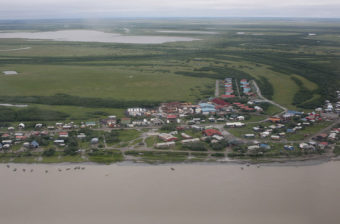
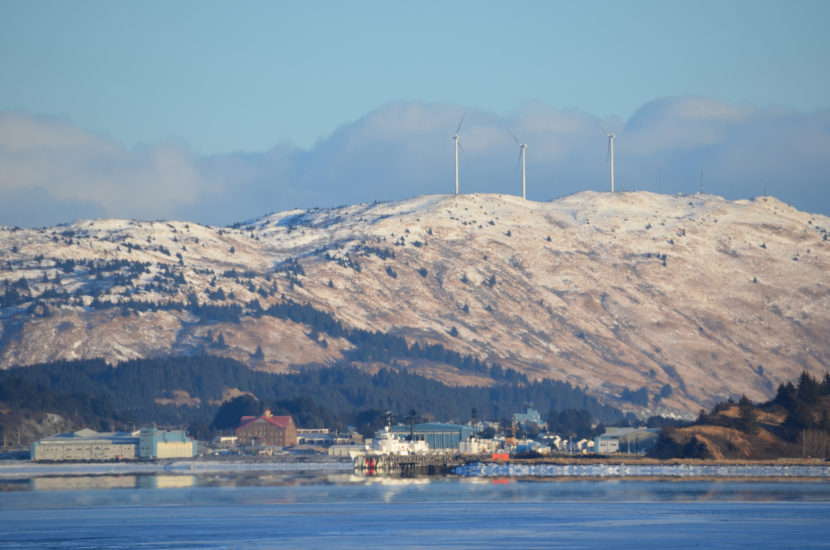
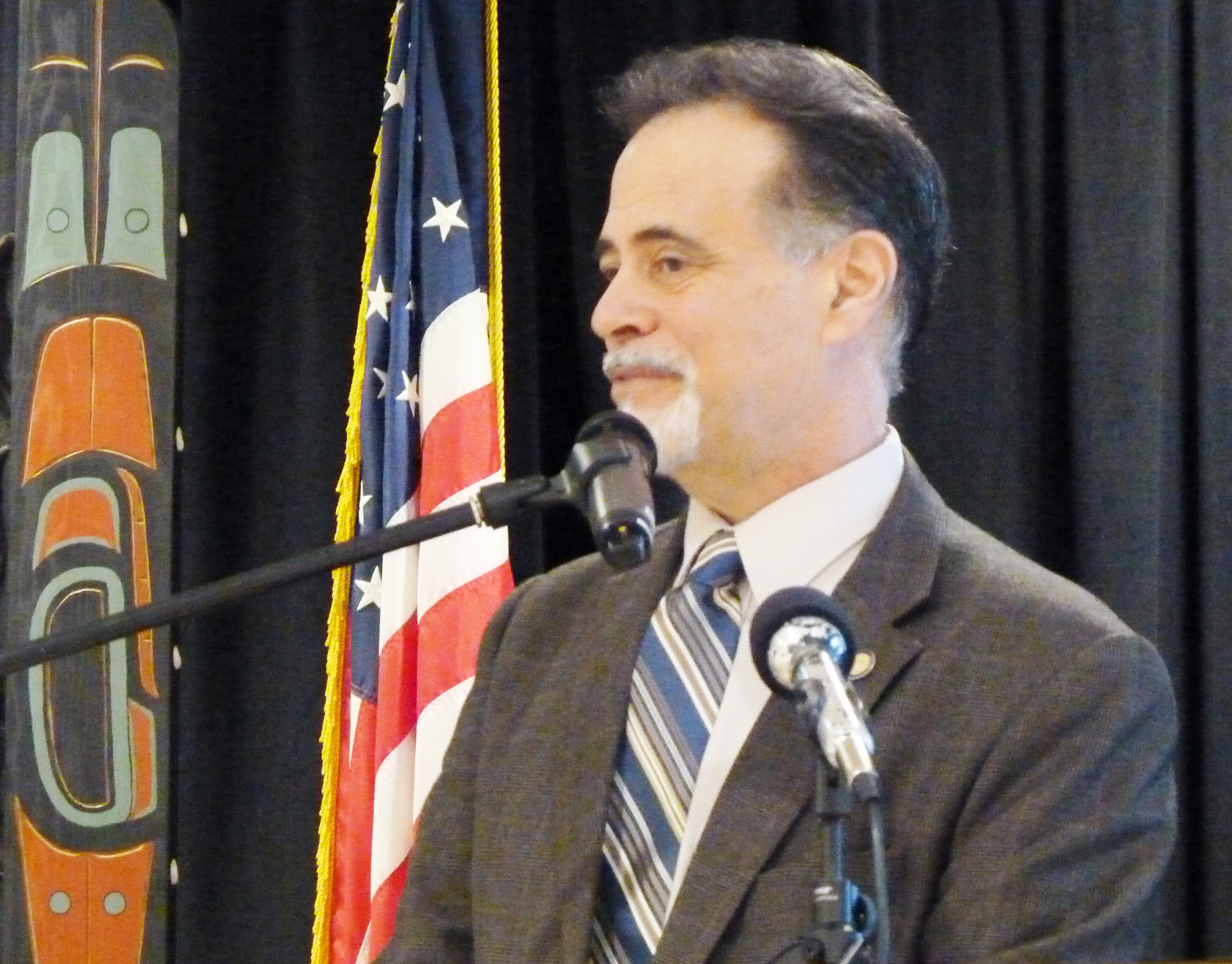
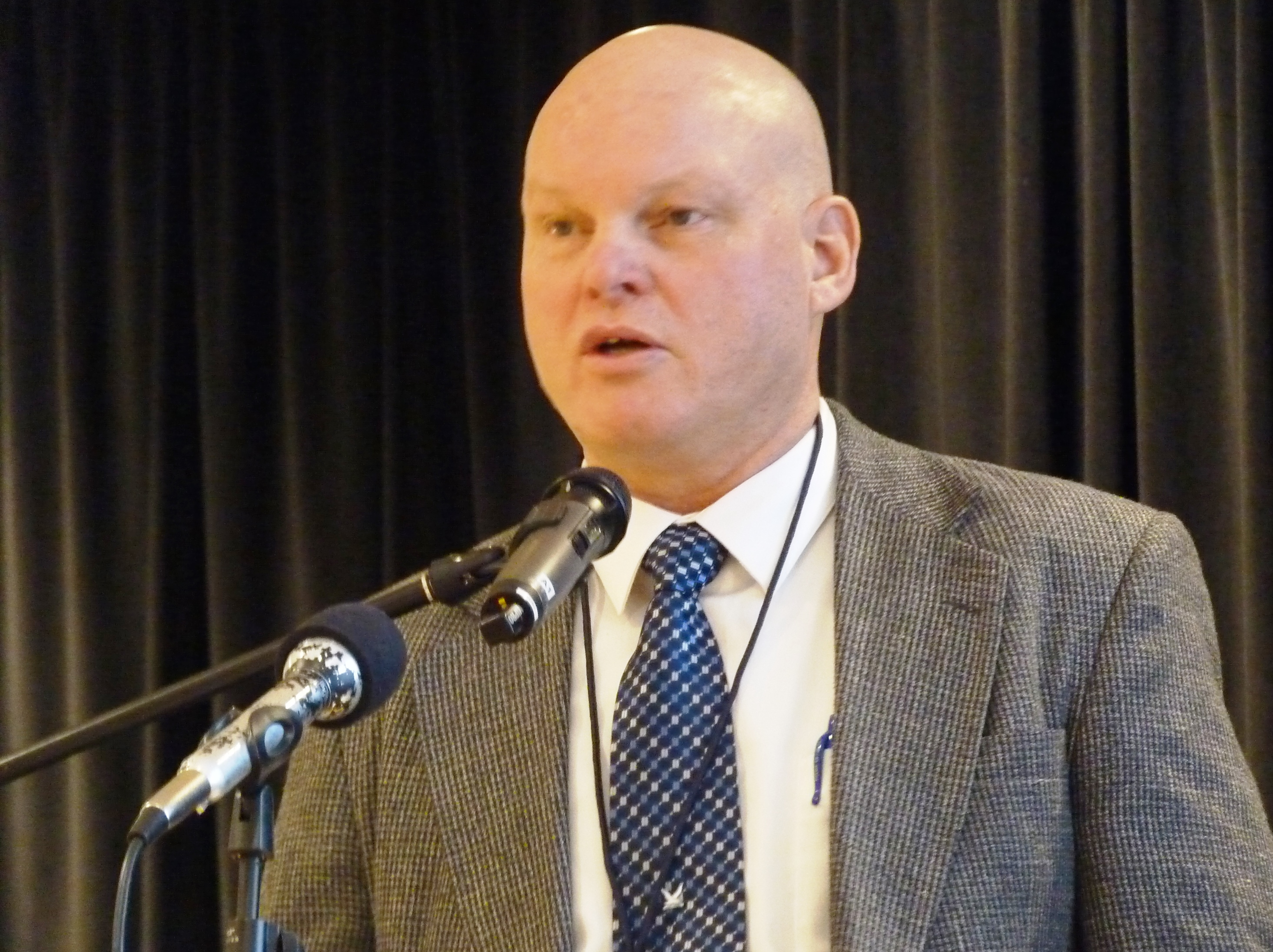
Emmonak in July 2013. (Photo by Adam DuBrowa/FEMA)
A fire in the village of Emmonak destroyed five commercial buildings and caused an estimated $3 million in damages over the weekend.
According to a report filed by the Alaska State Troopers, local troopers and the Village Public Safety Officer were called around 1:30 p.m. Saturday. Smoke was seen billowing out of the Kwik’Pak Fisheries warehouse. Kwik’Pak is a commercial fisheries business and the village’s largest employer.
According to the report, efforts to put out the fire were unsuccessful due to “failed and inoperable equipment.” The fire spread rapidly, destroying three Kwik’Pak Fisheries buildings. It also engulfed and destroyed two buildings belonging to Yukon Marine Manufacturing, a local boat-building business.
When the trooper report was filed more than 24 hours after the incident, the fire was still burning. No injuries were reported and no foul play is suspected. Damage to all five commercial buildings is currently estimated at $3 million.
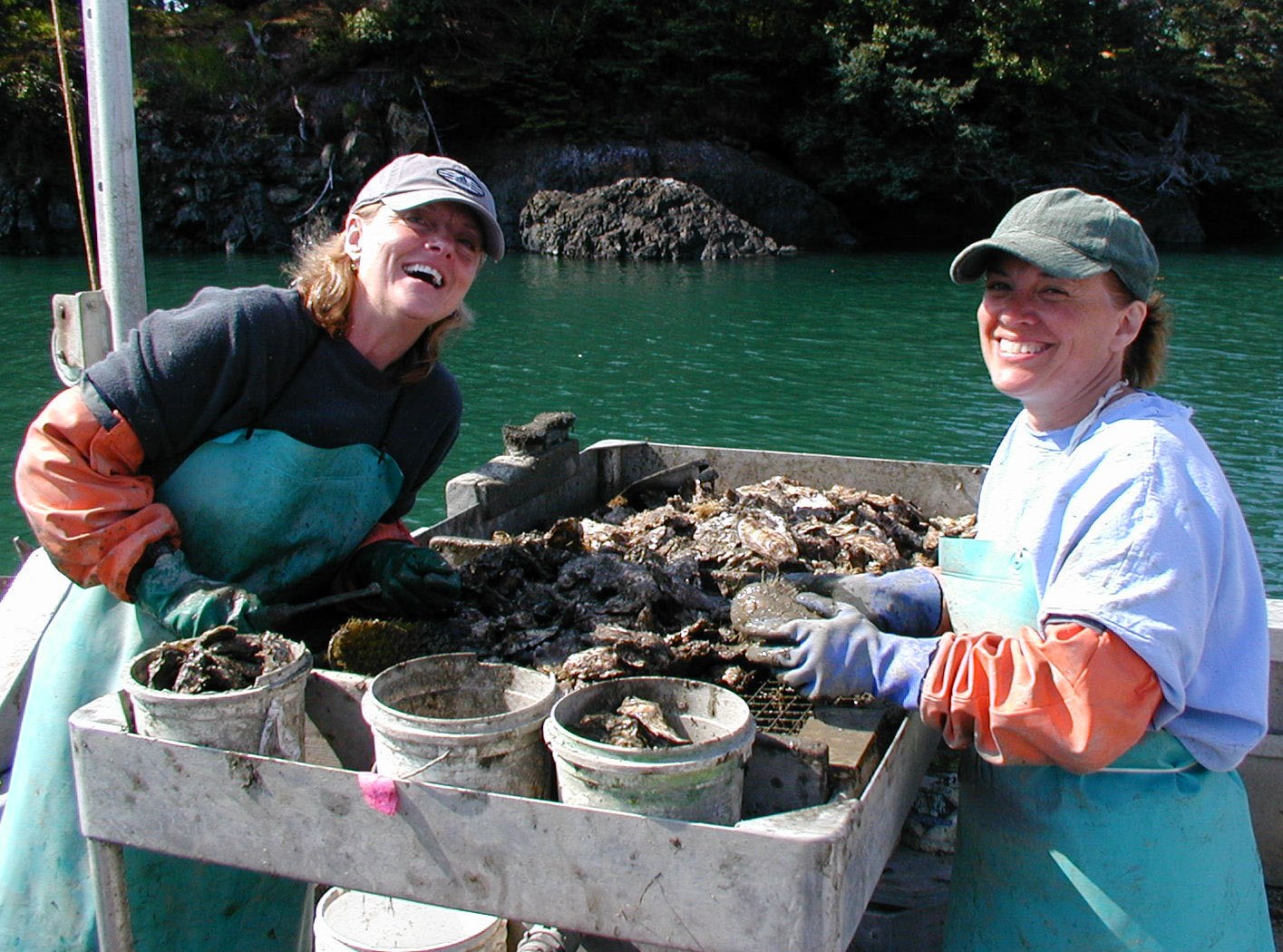
Brenda Bryan, left, and Jackie Whitmore clean shellfish at the Moss Island Oyster Farm in Peterson Bay, across from Homer. (Photo by Ron Bader/Moss Island Oyster Farm)
Alaska shellfish farmers hope a new state mariculture initiative will help boost their businesses. But they warn it’s not an easy industry to expand.
The state began allowing Alaskans to farm shellfish almost 30 years ago.
The resulting farms raise scallops, mussels and several species of clams. In recent years, oysters have gotten more attention.
“I think the market in Alaska has not been fully saturated. So I think there’s plenty of room here,” said Margo Reveil, president of the Jakolof Bay Oyster Co. as well as the Alaska Shellfish Growers Association.
She said a lot of sales are within the state. But growers are looking farther away.
“I think that some farmers are similar to salmon fishermen, finding that direct sales and online sales can bring a premium that makes your farm viable,” she said.
The Walker-Mallott administration sees growth potential too.
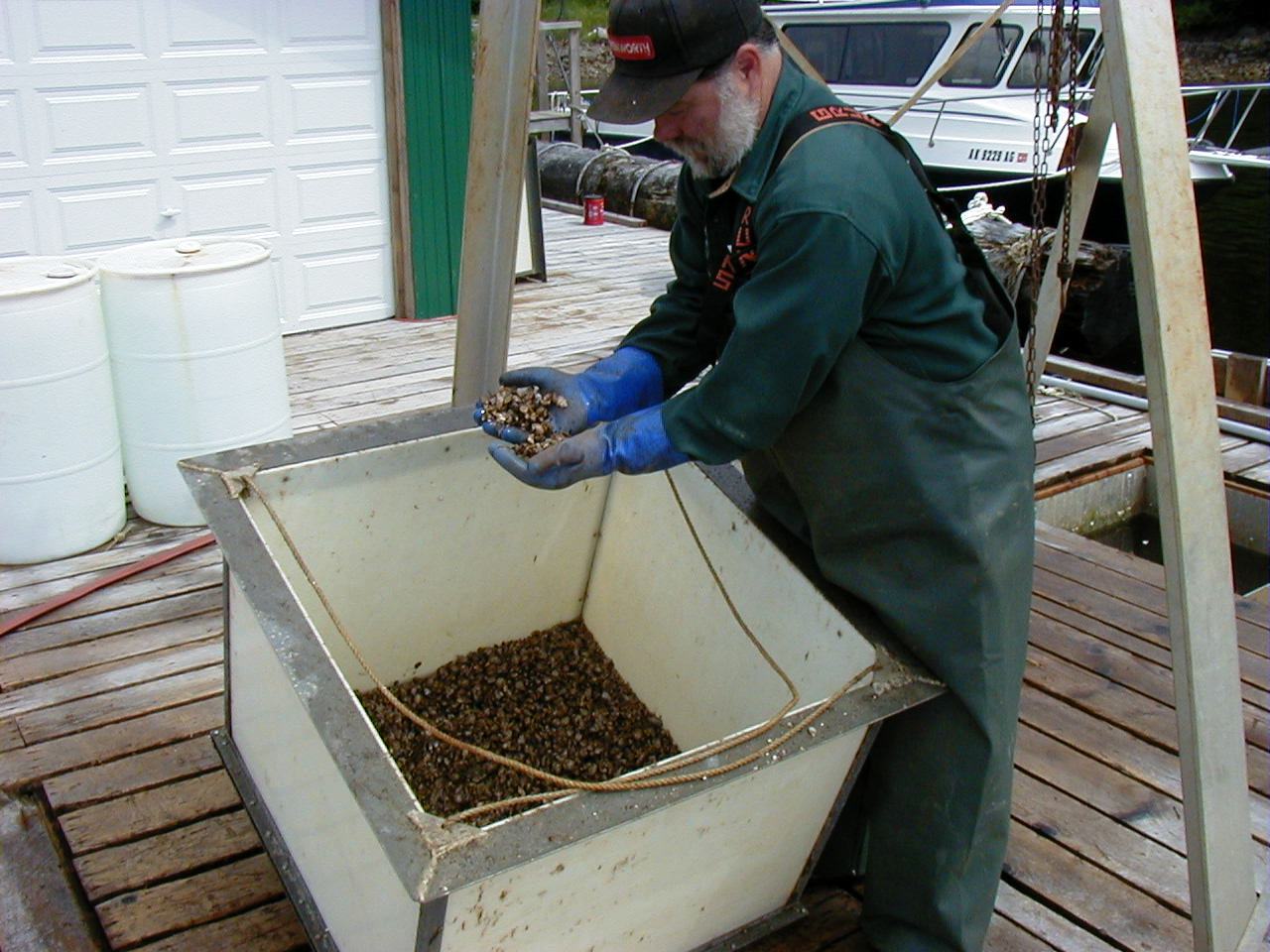
Randy Porter checks young oysters, called “spat,” at the oyster nursery in Naukati in 2007. (Photo by Ed Schoenfeld/CoastAlaska News)
The governor signed an administrative order in February setting up the Alaska Mariculture Task Force. It’s charged with making recommendations for a long-term plan to advance the state’s mariculture – or ocean farming – industry. It, by the way, does not include fish.
Barbara Blake, special assistant to the lieutenant governor, said the task force will play an important role in industry growth. She notes other shellfish-farming states have that in common.
“No state has been successful without first coming to the governor’s office and having the governor lead an initiative that would bring all those resources together, pull all of those who are interested or who are already developing in that world to one table to help develop a framework that would be statewide, individual or even region-wide,” she said.
She said the panel will learn from experienced farmers and outside industry experts.
“And we think that we can apply mariculture in Alaska in a way that Alaskans want it to be applied and do something that’s really positive that’s good for our communities, the environment and the economy as well,” she said.
Not that there aren’t significant barriers to the business.
Oyster farmer Reveil starts with Alaska’s water temperature.
“It takes three to seven years depending on your location and what size oyster to grow to size, so there’s a long lag time between changes and what farmers see out in the water and actually in their businesses,” she said.
Another barrier is the availability of brood stock. Competition and environmental conditions have led to shortages of shellfish larvae.
Oyster seed can be purchased from out of state. Decker said that’s not the case for other farmed species.
“If you want to grow geoducks, if you want to grow king crab, if you want to grow rock scallops (or) sea cucumbers, production of that seed must occur inside the state,” she said.
In-state supplies have improved, but more may be needed to support industry growth.
Then there’s the problem of finding people in the right situation and with resources to do the job.
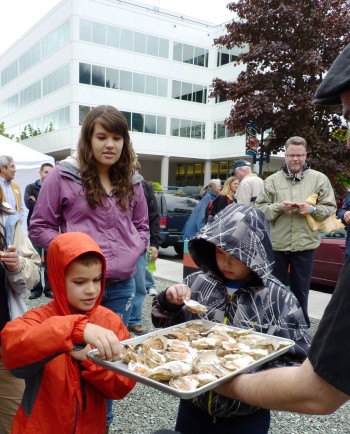
A family samples offerings at 2012’s OysterFest. The shellfish came from a Haa Aani-supported oyster farm. (Photo by Ed Schoenfeld/CoastAlaska News)
The Sealaska regional Native corporation’s Haa Aaní division has a mariculture program that helped start oyster farms in several Southeast locations.
But the division’s Shawn Blumenshine said it’s difficult to find people who can keep them going.
“The farmers we’ve been working with over the past number of years have, for different reasons, decided to quit farming more or less,” she said.
Haa Aaní provided loans and expertise. But Blumenshine said the farmers had a hard time making ends meet while they waited for their crop.
“There’s a lot of cash investment up front and it takes a while before it starts paying off. And it makes it tougher for the farmers who have families and responsibilities to … survive in that interim while they’re cultivating the oyster and getting it ready for market,” she said.
Decker said there’s a new crop that could help build the industry. It’s seaweed and kelp, which are in demand for food and beauty products.
“It’s a very short turnover, six to nine months. So you have more of a cash flow involved for farmers, instead of waiting three, four to 10 years or so for a crop, depending on the species,” she said.
Farmer Reveil said it’s worth trying.
“We, actually, on our farm are experimenting with it right now. I think there’s some potential there. There’s a lot to be worked out on the processing side and the shipping side,” she said.
The new Mariculture Task Force will involve shellfish farmers, industry associations, the university and state officials. The cost of its work will come out of existing agency budgets, so it will require no new appropriations.
Officials are in the process of choosing its 11 members. Their recommendations are due within about two years.
Coast Guard Base Kodiak as seen from across Women’s Bay, Dec. 31, 2011. (Creative Commons photo by James Brooks)
A former Kodiak Coast Guardsman charged with killing a colleague and injuring two other people on Cape Cod over a year ago is scheduled to go to trial at the end of May. The accused, from Chesapeake, Virginia, and two victims were once stationed at Coast Guard Base Kodiak.
The Cape Cod Times reports that Adrian Loya’s trial date of May 31 was set by a judge on Tuesday.
Loya is charged with fatally shooting Lisa Trubnikova and wounding her wife, Anna, in Bourne, Massachusetts, in February 2015. Both were also in the Coast Guard. Loya is also charged with wounding Bourne Police Officer Jared MacDonald.
Loya has been at a state psychiatric facility for the year since the shootings, and his attorney said he plans to argue that Loya is not criminally responsible because of mental illness.
Police said Loya wrote a 250-page essay stating his reasons for wanting to kill Lisa Trubnikova. Loya and Trubnikova had met, and according to previous statements by her family, he became obsessed with her when they were both stationed in Kodiak.
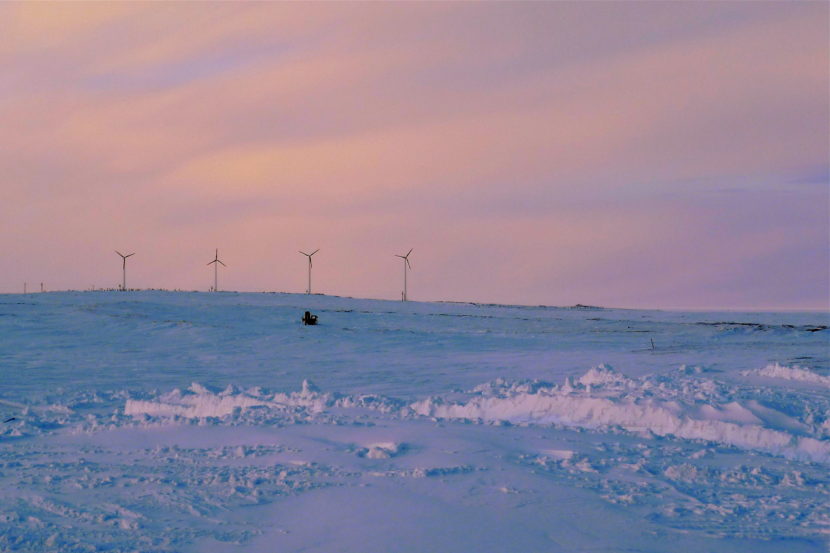
These four wind turbines in Chevak, pictured in March 2012, provide some renewable electricity to the village, but residents still pay high rates. (Creative Commons photo by Joseph)
Rural Alaskans can pay three to five times more for electricity than those in urban areas. That’s why the state launched the Power Cost Equalization Endowment Fund in 2000. It’s paid roughly $40 million annually to subsidize rural energy bills.
But some are questioning if the fund, now worth $900 million, should be committed to benefit only about one in nine Alaskans.
Senate Finance Committee Co-Chairwoman Anna MacKinnon alongside Sen. Pete Kelly. (Photo by Andrew Kitchenman/KTOO)
Senate Finance Committee Co-Chairwoman Anna MacKinnon, an Eagle River Republican, said the state government could consider tapping the fund.
“You’ll see Power Cost Equalization come before us. There’s a billion dollars in that fund,” she said. “That billion dollars has been benefiting a selected group of Alaskans with Power Cost Equalization. But is that the highest and best use of those dollars now?”
MacKinnon is a sponsor of Senate Bill 196, which would rebudget fund earnings for other purposes. In years where fund earnings are greater than what’s needed for the Power Cost Equalization program, 60 percent of the excess earnings would go to the state government, 30 percent would go to renewable energy projects, and 10 percent would build up the endowment.
The fund lost money this year, so no excess money is available. It’s not clear whether MacKinnon and other lawmakers are looking beyond Senate Bill 196, to use the fund itself to help close the state’s budget shortfall.
Bethel Democratic Sen. Lyman Hoffman – another sponsor of the bill – sees Senate Bill 196 as a way to protect the fund’s principal while helping the state.
“So what we’re trying to do with this bill is to assure that during those high years, the fund only pay for its intended purpose – and if there are excess earnings, that those earnings be sent back to two different programs,” Hoffman said.
Rep. Bob Herron, another Bethel Democrat, said power cost equalization is fair to rural residents. He notes the endowment was started after the government paid for dams that provide power to cities.
Gov. Bill Walker wants to make sure that if changes are made to the fund, they’re considered along with his plan to close the budget shortfall. He wants to ensure everyone in the state shares the burden.
Walker expressed concern that the combined impact of Power Cost Equalization changes with Permanent Fund dividend changes would put too much of the burden on rural Alaskans.
“That’s why we have focused on a sustainable plan that is a broad-based plan, so that we take into consideration rural Alaska’s situation, which is unique versus urban Alaska,” Walker said. “We’ve tried to take all of that into consideration. That’s why one piece at a time doesn’t really work.”
The Senate Finance Committee heard testimony supporting Senate Bill 196 on Wednesday, but didn’t vote on the bill.
Principal Sam Crow addresses students and their families at the grand opening ceremony at Kipusvik. (Photo by Charles Enoch/KYUK)
After four long months being split under two roofs, Ayaprun students were welcomed into the Kipusvik building with a grand opening ceremony Tuesday morning.
Ayaprun Elitnaurvik Yup’ik Immersion school students returned from spring break, not to the classrooms they left, but gathered together at the newly renovated Kipusvik building. Ayaprun principal Sam Crow says everyone is excited for this day to finally come.
“The children are really excited, all the teachers are excited, and all the parents that came and helped out yesterday are very excited. Today feels right. It seems like March 15 is a blessed day for all our students,” said Crow.
Ayaprun Elitnaurvik burned down in November last year. Since then the district quickly responded by moving the Ayaprun students to the District Office and Gladys Jung Elementary. Kuskokwim Learning Academy Students who also lost their dorm and school have found a place at Yuut Elitnaurviat. Now, with the help of local organizations, parents, volunteers, outside groups and other students, all of the Ayaprun students can begin learning again under one roof.
One parent, Bosco Hooper, says both of his daughters attended Ayaprun Elitnaurvik, the younger one still enrolled. He says it was hard for his daughter to grasp what it meant when her school burned down.
“She was kinda sad at first but she didn’t really understand what was going on at the time,” said Hooper.
Ayaprun student Joette Alexie, or Angukarnaq in Yup’ik, is the daughter of Sharon and Harry Alexie. She was excited about the grand opening and getting back to school. Alexie says her favorite subject is Yup’ik, her native language. The thing she likes most about the new school is how much space there is.
The grand opening ceremony began at 10 a.m. Tuesday. There was dancing, a few blessings for the students and traditional story knife folk tales. Then after lunch, it was back to the classrooms for the children and back to daily life for parents and supporters.
The Lower Kuskokwim School District began leasing the Kipusvik building from the Bethel Native Corporation in December at a rate of $50,000 per month plus utilities. They plan to lease the building for three to five years until, hopefully, the district can build a new school. BNC says business for Suurvik Cinema will continue as usual.
Sen. Peter Micciche talks about the ferry budget at a Southeast Conference meeting in Juneau on Tuesday. (Photo by Ed Schoenfeld/CoastAlaska News)
A state lawmaker with a significant role in transportation funding decisions says parts of the Alaska Marine Highway should be privatized.
Sen. Peter Micciche is a member of his chamber’s Finance Committee and oversaw crafting of its transportation budget.
He said the ferry system should consider management changes.
“I think parts of the system should be privatized. I think Prince William Sound is the perfect example of some fairly local runs that should be privatized,” he said at a Juneau meeting of the Southeast Conference, a regional development organization.
The Soldotna Republican also chairs the Senate Transportation Committee, which oversees roads, airports and ferries.
Micciche said he doesn’t advocate privatizing the entire ferry system.
“Keep the long runs, the longer routes, in control of the state. Privatize the smaller ones. And the cost savings could go to reliable service for the communities that absolutely depend on a state-run portion or segment of the ferry service,” he said.
The idea’s already being considered in several coastal areas.
Alaska Marine Highway System Capt. Mike Neussl addresses the Southeast Conference on Tuesday. (Photo by Ed Schoenfeld/CoastAlaska News)
Marine Highway Capt. Mike Neussl told the Southeast Conference it’s a possibility. He said he’s also met with those interested in taking over Prince William Sound routes, such as Cordova, Valdez and Whittier.
“If a public entity, not necessarily a private entity, but an entity other than the … Alaska Marine Highway System was interested in operating a ferry service there, I think the state would enter serious negotiations with them to discuss vessel transfers, facility transfers and assistance to have them do that as opposed to the state doing that function,” he said.
One part of the marine highway already separated from the larger system.
The Inter-Island Ferry Authority has run a ship between Hollis, on southern Southeast’s Prince of Wales Island, and Ketchikan for about 15 years. It’s a nonprofit operation, run by a board of community representatives.
Most of its revenue comes from the fare box. But it has also received state subsidies most years.
Close
Update notification options
Subscribe to notifications
Subscribe
Get notifications about news related to the topics you care about. You can unsubscribe anytime.