Rep. Sam Kito III, a Juneau Democrat, authored House Bill 292, which had its first hearing last week in the House Transportation Committee.
He called it a simple, one-line bill that could help the financially-strapped ferry system.
“The intent is not that it goes back into a specific community, but that that money goes into a general pot to be used for the betterment of the marine highway system in some way,” he said.
That could be increased marketing or another effort.
Committee member Shelley Hughes, a Palmer Republican, asked whether the bill would exclude communities that don’t contribute.
Kito said it wouldn’t. And he said his legislation isn’t just about money.
“I see it more as a tool to bring the communities more to the table with the Department of Transportation, get them talking, maybe even formally over some kind of a memorandum of understanding or memorandum of agreement that you become engaged as a shareholder in the marine highway system,” he said.
The bill remains in the House Transportation Committee and is not expected to progress this session.
Chairman Robert Venables said he could see at least one possible use of the funds.
“Years ago there used to be interpretive specialists on board that would give talks along the way the different ports. There could be a scenario to where on certain vessels and certain routes those communities could possibly put together a program in and perhaps cooperatively hire that person,” he said.
Transportation Department officials said they’re drafting language to clarify that contributions would benefit more than the donating community.
The villages of Aleknagik, Ekwok and Twin Hills are slated to get high school programs next year.
The Southwest Region School Board voted unanimously Thursday night to establish K-through-12 programs at all the district’s sites, including the three that are currently K-through-8.
Speaking to the school board Thursday, chair Kay Andrews indicated this plan is the district’s response to state budget cuts and other threats to the existence of small school sites in recent years.
“It’s not an expenditure, it’s an investment in our children, and making sure that our schools stay open,” said Andrews. “And the families that want to have their children stay home, and go to school at home, have an opportunity to do so, just like Anchorage and others around the state.”
Until now, high school-age students in Aleknagik, Ekwok, and Twin Hills have had to choose between options of homeschooling, attending Mount Edgecumbe, enrolling in a correspondence school, or boarding with a family in another community.
According to district administration, the details are still being ironed out, but the new K-12 programs will rely partially on distance delivery technologies and online courses.
“The district is working on calendar synchronization, in addition to bell schedule synchronization, to ensure that distance-delivered courses can be handled between sites as needed,” said Superintendent Piazza in an email Tuesday.
Piazza says Aleknagik and Twin Hills will each get one more staff member; enrollment numbers at Ekwok don’t necessitate any additional staff.
The high school programs are expected to begin in the fall.
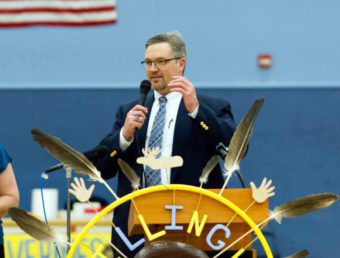
Bill Schwan will finish his fourth year at DHS, then head to Wrangell. (Photo by Kevin Tennyson)
Two well-respected school principals in the Bristol Bay area are leaving their posts this spring.
Bill Schwan says the culture at the Dillingham Middle-High School has come a long way since he became principal four years ago.
“I think probably the biggest thing is taking a divided, non-engaged staff and turning them into a cohesive team,” said Schwan. “And I don’t mean I did that individually, but when you build teams, it takes a team to do that. And I think our staff has accomplished that, and we’re headed in a great direction.”
Schwan has accepted a job as principal in Wrangell – he says it’s a move he’s making to be closer to his family.
“Two weeks ago, I wasn’t looking for a job, necessarily,” explained Schwan. “I had the opportunity to spend spring break with my son, and really recognized how much I missed the opportunity to spend time with him. This presents a closer, one-flight-away type thing, so that really was the thing that solidified it for me.”
Schwan says Dillingham City School District is just starting the search for a new principal.
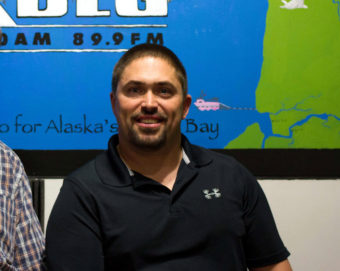
Cody McCanna, longtime SWRSD educator and Koliganek Principal, stopped by KDLG studios for a sports show in 2013. (KDLG photo)
In the Southwest Region School District, Cody McCanna has been an educator for 18 years, spending a few years as itinerant science teacher between Manokotak, New Stuyahok, Koliganek and Togiak before joining Koliganek full-time 15 years ago.
McCanna says there have been many highlights during his seven years as Koliganek School Principal.
“You know, seeing a lot of kids go on and get an education and even the ones who stay around, just the quality of life that they have. And seeing the next generation of your students’ kids now back in the building, it’s just very rewarding,” said McCanna. “And being a part of this community has been a lot of fun. It’s a close-knit community with a lot of great people.”
Next year, McCanna will be the new administrator at Aurora Borealis, a K-8 charter school in Kenai.
Taking over the lead position in Koliganek will be Michael Lee, who was an assistant Principal in Togiak a few years ago.
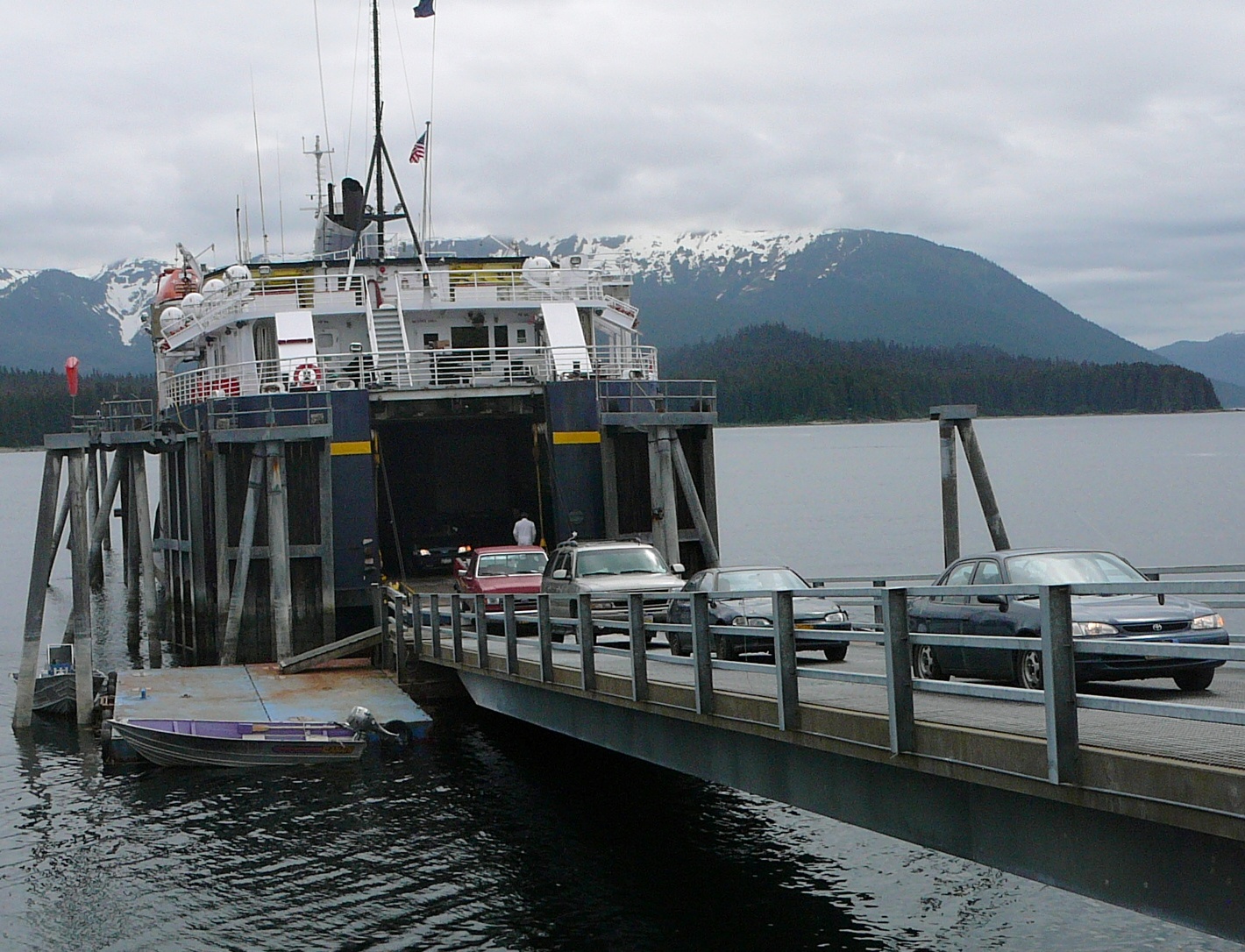
Drivers move their cars and trucks off the ferry LeConte at the Angoon terminal in 2010. (Photo by Ed Schoenfeld/CoastAlaska News)
The Alaska Marine Highway System has been having problems with its new reservations website.
The site has gone offline a number of times since its installation late last year. That sometimes impacts the larger ferry system website, which it’s linked to.
Transportation Department spokesman Jeremy Woodrow said the problem involves connecting a state-designed website with one created by an outside contractor.
“They do have fixes in place and then sometimes either something will happen again or there will be another issue that crops up. It’s one of those items that they are working through and they hope to have a permanent fix soon,” he said.
As of Thursday, the system had gone for almost a week without problems. Woodrow said he hasn’t heard of unusually long wait times for those calling in reservations.
He said the website issues have been sporadic.
“The first time it happened, I believe it was over a weekend and it was down for over a day. But most of the occurrences since have been very brief. Sometimes they’re well less than a half-hour or maybe even less than 15 minutes,” he said.
Woodrow said the ferry system continues working toward a permanent solution.
Right now, there are two different systems handling ferry reservations. One is for travel through April 30 and the other for later travel. Details are on the website.
Correction: In an earlier version of this story, the caption to the ferry photo misidentified the vessel pictured. It’s the LeConte, not the fast ferry Fairweather.
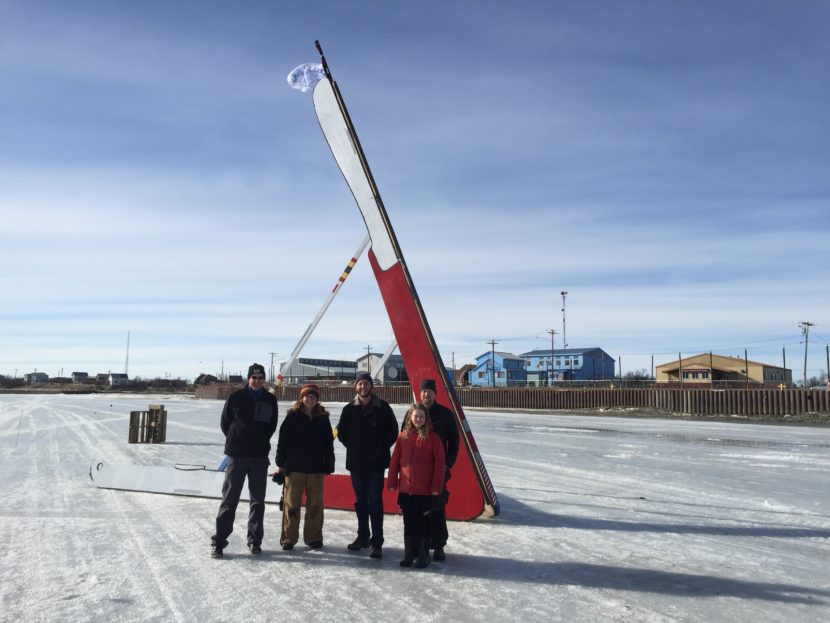
The Kuskokwim Ice Classic tripod construction crew. (Photo courtesy Michelle DeWitt)
The Kuskokwim Ice Classic tripod is up. The clock is counting down to breakup and to that coveted $10,000 prize. The money goes to whoever guesses closest to when the tripod drifts away, unplugging a clock, and marking the official start of spring.
It’s also, of course, a time to invest in youth programs from dance to archery to the lifesaving skill of swimming.
“I think people tend to forget about that part of it — that it’s actually benefiting really valuable causes, which is fine. It’s a fun game, too,” said Paul Basile, the Kuskokwim Ice Classic manager.
Last year 6,000 guesses competed for the $10,000 jackpot and raised over that amount for youth programs. This year six programs are selling tickets at $5 a pop and will keep half the proceeds. Basile said some people consult tide tables to make their guess. Last year, a winner wrote down her daughter’s birthday.
The tripod tradition started in the early 1980s. Basile said, in the past, the classic threw together some lumber to make the structure.
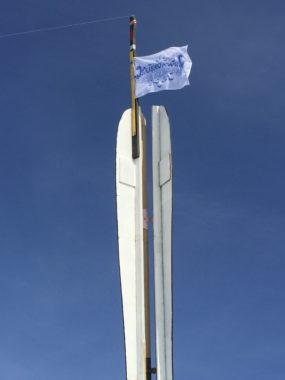
Kuskokwim Ice Classic flag on top of the story knife forming the mast of the tripod. (Photo courtesy Michelle DeWitt)
Last year, the group upped their game. They asked the Lower Kuskokwim School District’s STEM program — Science, Technology, Engineering, and Math — to submit tripod designs. From a 9-inch model, the classic constructed a 28-foot tall sculpture. It’s a story knife reaching into the sky with two kayaks streaming out beneath.
If it sounds familiar, Basile said, that’s because you’ve already seen it.
“Never before in the history of the Kuskokwim Ice Classic has a tripod been recovered after breakup. But somebody noticed it washed up on the shore a little bit below town.”
Eric Whitney, a Kuskokwim Ice Classic board member, rescued the tripod.
“The first time I went out in a kayak just to get across the slough and get something on it, so it wouldn’t end up in Oscarville or something,” he said.
He attached anchors to the wooden frame until he could retrieve it with a larger boat.
“And that worked. I really wasn’t sure if that was going to work at all. You never know if the water is going to come up and a big ice floe is going to come and just sweep it down and crush it to bits. But we got lucky,” he said.
Something else good happened this year — a forklift. Last year, the group put up the 28-foot tripod by hand, which, Basile said, involved people standing on ladders on the ice pushing up the structure with a broomstick.
“Last year I was glad I double-checked our insurance,” said Michelle DeWitt, executive director of the Bethel Community Services Foundation, which operates the Kuskowkim Ice Classic.
She said the tripod tradition marries a community event with fundraising, using the excitement of breakup.
“As soon as that water starts flowing on the Kuskokwim, boats are going out nearly immediately and people start engaging in the summer activities. So it’s a really exciting time for the community,” she said.
Which could be soon. Overflow is spilling over the river’s edge, the top layer of ice is crumbling, and forecasts predict highs in the upper 30s through next week.
Kuskokwim Ice Classic tickets are on sale at Bethel Community Services Foundation and Swanson’s until April 18.
The USACE presenting the Donlin Gold EIS in Nunapitchuk. (Photo courtesy of KYUK)
The US Army Corps of Engineers has completed a week of back-to-back meetings collecting public comment on the Donlin Gold draft environmental impact statement, or EIS, with a visit to Nunapitchuk.
The Army Corps is the lead federal agency on the document and has contracted the international environmental and engineering firm AECOM to create the draft.
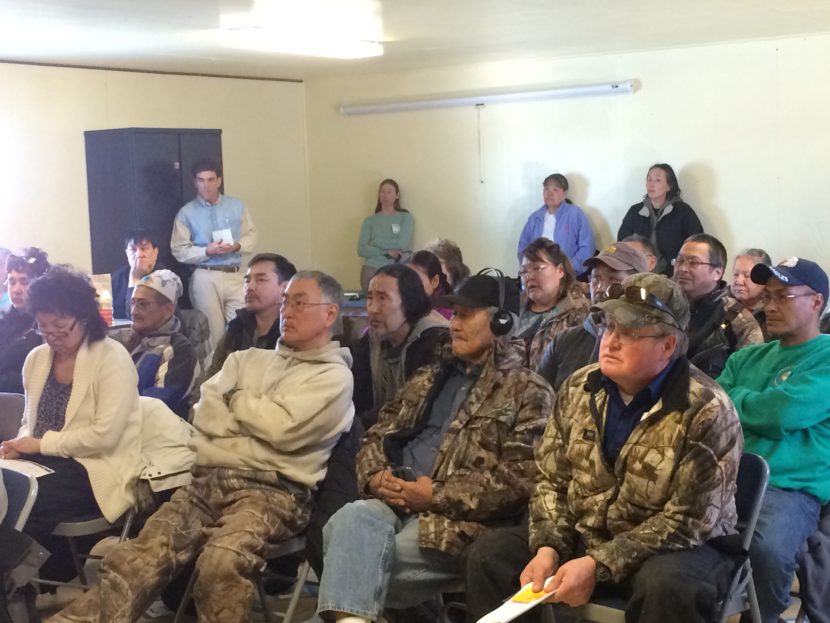
About 25 people from Nunapitchuk, Kasigluk, and Atmautluak attended the gathering on Thursday to testify on the proposed open pit gold mine located about 10 miles north of the village of Crooked Creek and the Kuskokwim River.
The comments at the meeting remained consistent with concerns expressed in other villages throughout the Yukon-Kuskokwim region on the project; mainly residents want the economic benefits of jobs without assuming the environmental impacts mining could have on subsistence.
But Bobby Hoffman, a Calista Corporation board member, says subsistence users can’t have one without the other.
“If we don’t have money we can’t get subsistence. Since our subsistence is away from our villages and our towns, we have to go get them. Without gas, without equipment— snow machines, shells, food— we can’t get them,” Hoffman said.
Calista owns the mineral rights to the mine site and plans to increase shareholder dividends with revenue generated from its operations—an estimated $1.5 billion over the life of the project and an additional quarter million dollars in right-of-way lease payments from a proposed pipeline, according to the draft EIS.
Nunapitchuk resident Barbara Evan says she’s torn about the mine.
“I know there (are) a lot of unemployed people all over these small rural communities. It’s a good opportunity for them, but then there’s that side where the elders are concerned about our subsistence,” Evan said.
Her son is one of those unemployed people. He’s 21 years old and living at home. She says he dropped out of high school, and she’s encouraging him to get his GED so he can work.
Evan says even though she’s concerned about environmental hazards if the mine offered her son a job, she’d encourage him to take it. And if the mine were operating, she says maybe he wouldn’t be in his situation, because more employment opportunities would motivate young people to finish school.
But Morris Alexie, a subsistence hunter from Nunapitchuk disagrees.
“It’s been 20 years since these guys showed up,” Alexie said. “I haven’t seen any improvements in our graduation rates.”
According to the draft EIS, in 1995 Placer Dome US began exploring the mine site, setting up camps and support facilities like an airstrip and roads to advance their assessments.
In 2007 Barrick Gold North America and NOVAGOLD Resources Alaska, Inc. formed Donlin Creek LLC in a 50/50 partnership. They changed the company’s name to Donlin Gold LLC in 2011.
Since then Donlin has committed to a Calista shareholder hiring preference, and the draft EIS estimates the mine would employ 1,600 to 1,900 YK residents during construction and 500 to 600 residents during operations.
Alexie says those numbers don’t substantially benefit the region.
“They say jobs. But there (are) 13,000 shareholders right now, and if we add the descendants, it’ll be 40,000 shareholders,” he said. “It outweighs the shareholders for the number of jobs available.”
Alexie says the possibilities for environmental impacts override the possibilities for employment. Jobs, he says, would benefit a few while subsistence consequences would affect everyone.
No matter what happens, Henry Tikiun Sr., an elder from Atmautluak, wants the region to hold the mine’s estimated 27-year lifespan in perspective.
“Subsistence outweighs jobs. You can have a job for so long. The gold mine can be open for so long and then close. Subsistence,” Tikiun said, “will last forever.”
The Army Corps will return to the YK region the final week of March to collect public comment on the draft EIS in Chuathbaluk, Holy Cross, and Lower Kalskag.
Lillian Michael provided Yup’ik translation for this story.
Close
Update notification options
Subscribe to notifications
Subscribe
Get notifications about news related to the topics you care about. You can unsubscribe anytime.