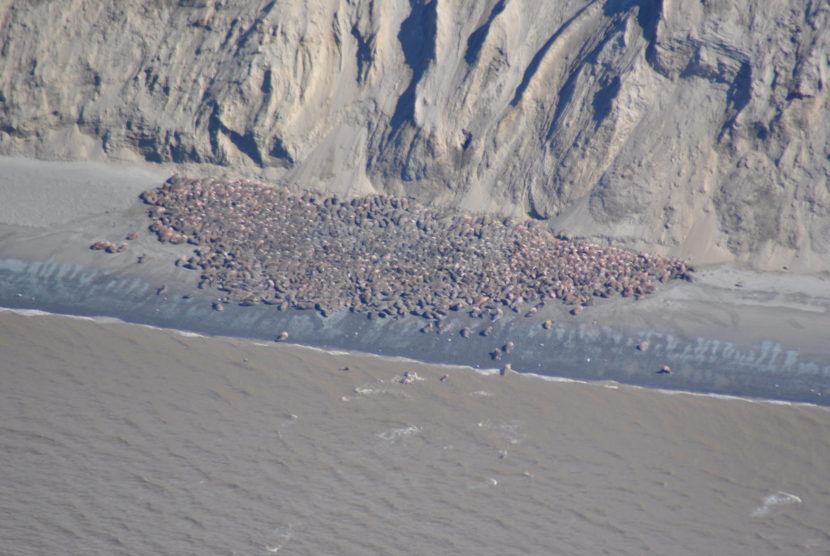
A large number of Pacific walrus have been spotted hauling out at a new spot in Bristol Bay.
This spring, pilots and residents who fly frequently over the Alaska Peninsula coast north of Ugashik started noticing walrus hauled out a spot called Cape Grieg. The Fish and Wildlife Service was made aware, and though that spot is not on refuge lands, the Alaska Peninsula and Becharof Refuge staff took on the task of looking into it. Manager Susan Alexander was aboard flights last month that verified what residents were saying.
“We have, since early April, seen concentrations of walrus hauled out at Cape Grieg, which as far as we know is a new haulout location for them,” she said Thursday. “They seem to be coming and going; we’ve seen as many as 2000 and as few as zero.”
Those numbers have led the Fish and Wildlife Service to wonder if Cape Grieg is a temporary spot or something more permanent. Walrus also seem to have arrived at their Bering Sea haul outs early this year. In the spring and summer, the females and younger walruses follow the ice break up into the Chukchi Sea. It’s the big males distribute along the other main Bering Sea haulouts in Bristol Bay: Cape Seniavin further southwest on the Peninsula; capes Pierce and Newenham along the northwest coast; and of course the famous spots in the Walrus Island Sanctuary like Round Island.
“You know, Round Island has been kind of declining for the last several years,” said Jim McCracken, a USFWS supervisory wildlife biologist. “I guess one of the leading thoughts there might be that they’ve been there a long time, and they’ve probably started to deplete the food that’s within range of their swimming and resting capacity. So maybe they’re looking for other places.”
While US Fish and Wildlife Service is interested in the walrus behavior, there’s another reason why staff are monitoring this spot.
“The chief concern is that walruses are protected under the Marine Mammal Protection Act, which makes disturbance of hauled-out walrus illegal,” said Alexander. “So we’re concerned that we need to keep an eye on these guys.”
Cape Grieg is located between Ugashik and Egegik, which is a busy transit spot for marine vessels during the Bristol Bay salmon season. It’s also along common air routes. Planes flying too low and vessels traveling too close can disturb the animals, and even lead to dangerous stampedes.
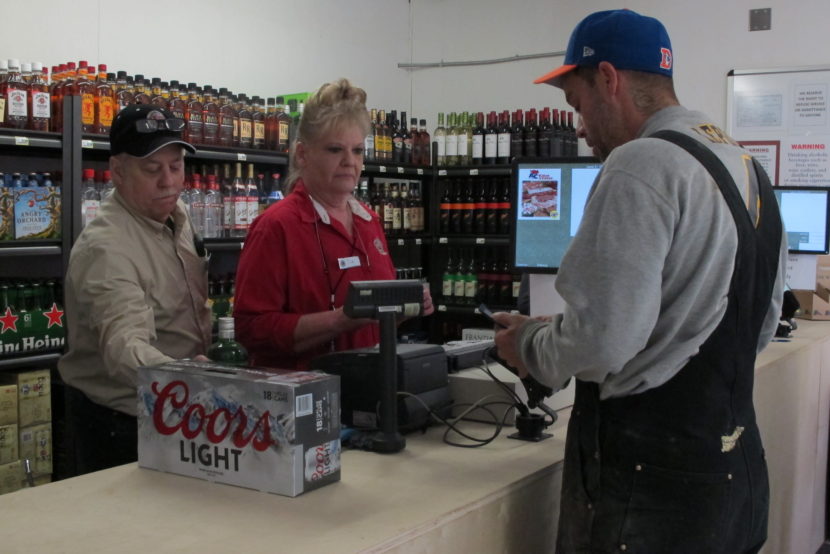
Opening day of the AC Quickstop liquor store in Bethel on Tuesday. (Photo by Geraldine Brink/KYUK)
AC Quickstop opened Bethel’s first liquor store since the city banned alcohol sales in 1977.
The store opened at 11 a.m. Tuesday. At a quarter till, a line of about 10 people were waiting for the historic doors to open.
“I want to be the first customer that walked into the liquor store in Bethel after 40 years. I’m going to hold onto the receipt as well. I’ll plaque it. And say, hey, ‘This is to lifted prohibition,’” said Corey Stelmach.
Stelmach is turning 40 this month, and this is the first time he could legally buy spirits in Bethel. Once the doors opened, he had competition from Mike McIntyre to be the first customer.
“I’m buying Alaskan Amber, trying to beat Corey here to be the first one,” McIntyre said.
McIntyre is at one cash register, Stelmach is at the other.
“We’ll consider ourselves the first ones,” Stelmach said.
They pull out receipts to compare times; they both say 11:01.
“I bought one bottle of Jameson, one bottle of Crown Royal, and two six packs of Corona. And I’m going to go enjoy them right now,” said Stelmach.
Toni Tony is right behind them, buying a box of wine. She’s with her wife Christine Nick.
They won’t be enjoying the wine together.
“I am glad to say I’m happily sober,” Nick said. “I’ve been sober more than seven to eight years.”
The liquor store opening made her mad at first.
“But I can’t do anything about it. I’m always there for her,” Nick said.
James Kelly came with the couple. He’s Tony’s cousin and is hopeful that the liquor store will be a good thing for the community.
“It’ll deter bootleggers to bootleg,” Kelly said.
The store’s already helped Jeremy Lee, one of the new security personnel. Lee had spent seven months applying for jobs before getting hired.
“I’m happy where I am,” Lee said. “Cause now I can feed my kids more, and I can support my family. I’m looking at it as a family man.”
Lee said Bethel is in a new era. Those old times over 40 years ago when things got so bad that Bethel banned alcohol sales — he calls those the immature years.
But not everyone is so sure. Ignace Matthies bought a six-pack of Alaskan Amber, but said he’s torn about what legal sales mean for Bethel.
“It’s kinda really uncomfortable. It’s going to be hard for the community,” Matties said.
Bethel lifted its ban on alcohol sales seven years ago. The public was also conflicted, citing fatigue with the stiff penalties of restricted sales but not really embracing legal sales. A community vote in 2010 showed a majority of people opposed legal alcohol sales. But that trend reversed last year when another vote showed a majority supported sales, but only for a package store like AC. The Quickstop received its license a month later.
The liquor store is a small white box, a former storage area. Wine, beer and spirits line the few shelves behind the service counter. Walter Pickett, AC general manger, said the selection is a fifth of what it’ll be in the fall when the store completes its more than $1 million renovation and expansion. For now, he said it’s mostly bestsellers from their other stores.
“Spirits? R&R is the best seller. The best seller on the beer is Budweiser by far. Coors Lite is second there. And then our customers do like box wine, because it’s portable,” Pickett said.
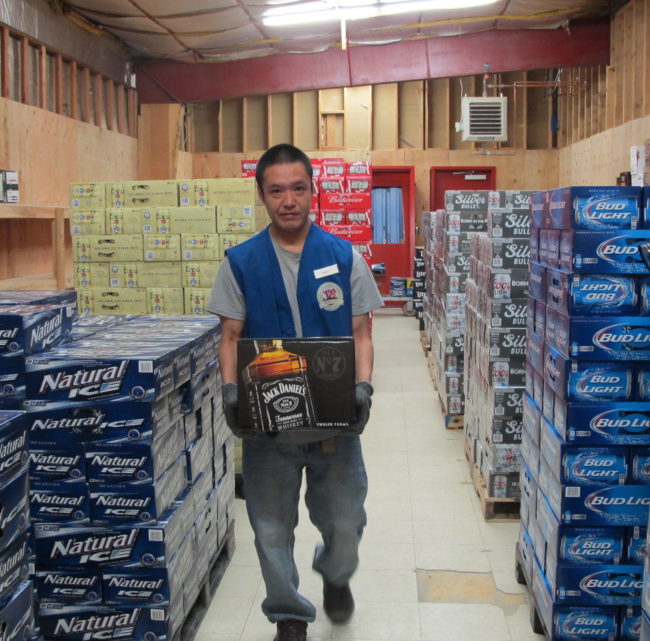
There were three people behind the counter, two people ready to grab stock, two security guys, and a host of four managers, plus Pickett. He said he had so many personnel out of caution.
Reno Moore pulling stock on opening day of the AC Quickstop liquor store. (Photo by Geraldine Brink/KYUK)
“Making sure we had enough people to ensure the transactions were orderly and that it didn’t get overwhelmed in here,” he said.
Pickett said the opening wasn’t exactly the mad rush they were preparing for. Others in town are also bracing for possible impacts. Both the Bethel police and fire chiefs expect call volume will increase with the store’s opening. Facebook comments predict inevitable death and abuse. But no one knows what’s going to happen.
One of the first customers, John McIntyre, who bought a six-pack of Blue Moon and a bottle of rum, said whatever does happen will say a lot about Bethel.
“I do think it’s time we grew up. There’s legal booze sales in Dillingham, McGrath, Nome, Kotzebue. If it doesn’t work here it’s us, not the booze,” McIntyre said.
The store earned about $1,350 in the first hour and served more than 500 customers throughout the day.
Beginning in May, it will cost 14 percent more to take the ferry to and from the Lower 48.
Crew check the Fairweather while docking in Petersburg in 2014. It and the Chenega could be tied up for most of the fall, winter and spring.(Photo by Ed Schoenfeld/CoastAlaska News)
The fare boost is part of another round of Alaska Marine Highway System tariff increases. Officials said they’ll increase income and help equalize rates across all routes.
Transportation Department spokesman Jeremy Woodrow said Bellingham, Washington, sailings are in high demand.
“Those routes always sell out during the summertime. And by putting on that premium, that will generate additional revenue, which will allow the marine highway system to provide ferry service in other parts of the system,” he said.
A passenger traveling one way from Juneau to Bellingham without a vehicle or stateroom now pays about $410, a $50 increase.
That’s about 14 percent more. Woodrow said it’s part of the effort to equalize all ticket prices.
“A 50-mile trip in Southeast Alaska will cost the same as a 50-mile trip in Southwest Alaska. Right now, that’s not necessarily the case. We have a lot of imbalances across the entire system,” Woodrow said.
The rate hike is the third in the past year. Two previous increases raised fares a total of about 10 percent, across the board.
Woodrow said the fare equalization effort will take about five years. But you can’t find the latest rates without making – or trying to make – a reservation online or on the phone.
“We have thousands of different route combinations. Before it was easier to say which ones were not being increased, compared to now. Now, almost every single route is being affected, because … we’re applying a formula to those routes,” he said.
The power system on station in Kvichak River. (Photo courtesy of ORPC)
An effort to bring renewable energy to Western Alaska was recognized Tuesday by the federal government. The Ocean Renewable Power Company was named the 2016 Outstanding Stewards of America’s Waters for its ability to bring hydropower to the Bristol Bay village of Igiugig.
The Kvichak River flows out of Lake Illiamna and into Bristol Bay. It helps support the world’s largest sockeye salmon run in the world. More recently, it’s been helping fuel the nearby village of Igiugig
Randy Alvarez has lived in Igiugig for over thirty years. He was born and raised in Naknek, another small town in Bristol Bay. As a longtime resident, Alvarez is familiar with the fact that fuel is often two or three times as expensive in the bush as it is on the road system. He’s also keenly aware because of his job.
“I’ve commercial fished since I was old enough to go in the boat with my father and I still do it. I’m planning on doing it as long as I can,” Alvarez said.
But it was a big surprise to his fellow fishermen when Alvarez got behind a project that would test an underwater turbine in the Kvichak.
“Putting a turbine in the river was a big concern for a lot of fishermen,” said Alvarez.
But it wasn’t going to be the first time the turbine was used in Alaskan waters. The first prototype was tested in the Tanana River near Fairbanks.
“That river is very silty,” Alvarez said. “Not only is it silty, it has lots of woody debris in it and other challenges.”
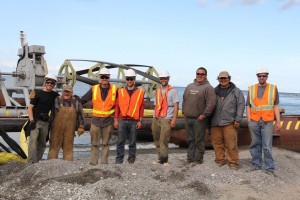
Local contractors and ORPC team members in front of RivGen. (Photo courtesy of ORPC)
Monty Worthington is the Ocean Renewable Power Company’s director of project development in Alaska. He says debris did what it does best—it got stuck. Worthington says silt made it so they couldn’t see what else besides water was moving through the underwater blades. So Worthington’s team turned to Bristol Bay’s Kvichak River.
“The Kvichak River is fairly unique in Alaska in that it’s a large, fast-flowing, and clear river,” said Worthington.
The turbine, or RivGen, as Worthington calls it, was lowered into the Kvichak for its first test run from August until September of 2014. Randy Alvarez said they placed the turbine very strategically.
It was about 20 feet of water where they put it in. They put it in the deepest part of the river so that ice and anything floating downriver on top or even boats could go over the top of it.”
RivGen is outfitted with five underwater cameras. The crew kept a close eye on all the underwater action during its first test run. They didn’t see any salmon getting stuck, so it was put back to work the following summer. Alvarez explains the second test run was from July until September, overlapping with the more than a million sockeye running up the Kvichak.
“After two years of studying it, it didn’t have much impact at all, which was a great relief to us,” Alvarez said. “It showed that we can have it and not worry about it chewing up our salmon.”
Those results earned the Ocean Renewable Power Company this year’s Outstanding Stewards of America’s Waters Award, but the real reward won’t be known until the next phase of the project when Worthington begins work on a commercial turbine. Alvarez says a commercial RivGen could cut Igiugig’s energy bill in half,
“Forty years ago, it was different. It didn’t cost much money to live in villages. Now, it’s expensive,” said Alvarez. “So we need the jobs and we need cheaper electricity.”
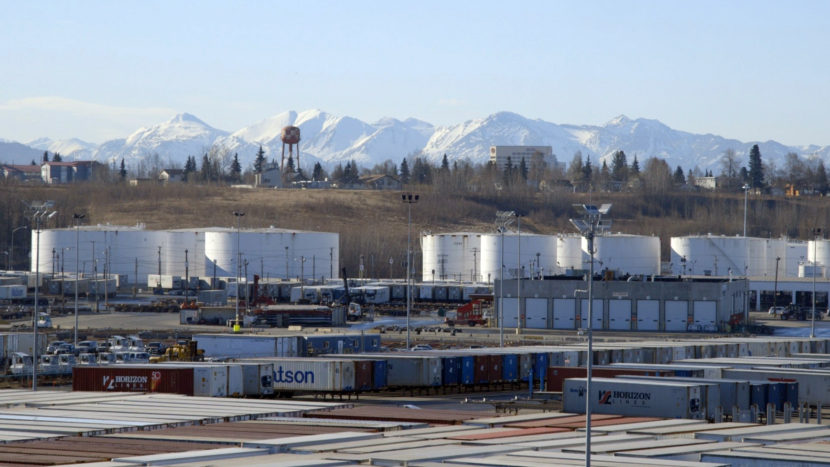
The cargo yard at the Port of Anchorage. (Photo by Eric Keto/Alaska Public Media)
An enormous share of Alaska’s food, fuel, and supplies come into the state through just a single access point: the Port of Anchorage. Even small communities in distant parts of the state rely on the steady flow of goods over the port’s docks. It’s a critical supply-chain that connects hundreds of communities, and is under threat from deteriorating infrastructure.
On a recent crystal clear morning, semi-trucks barreled up and down long drawbridges connecting the asphalt docks of the port to the belly of a massive container ship. Tractor-trailers hauled full 40-foot metal containers out from within.
Depending on how it’s categorized, as much as 85 percent of the waterborne freight reaching Alaska’s Railbelt comes through the Port of Anchorage. (Photo by Eric Keto/Alaska Public Media)
Twice a week, two cargo ships travel 66 hours from Tacoma, Washington, to dock at the port. This one is run by Tote Maritime, and for hours a frenzy of heavy equipment moves 485 containers onto shore. According to officials with the the city, the port, and the shipping companies, the unloading process here is fundamental for Alaska’s main supply chain.
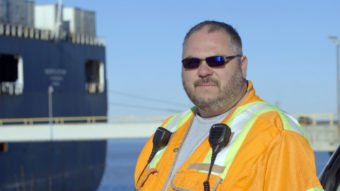
Billy Godwin supervises operations at Tote Maritime. (Photo by Eric Keto/Alaska Public Media)
“Everything you see in the store comes up either on this ship, or the ship next door over there at Matson,” said Billy Godwin, operations supervisor for Tote. “Small amounts of stuff come up over the road, but pretty much everything that comes to Alaska comes in one of these two ships.”
For the Railbelt and Western Alaska, it’s these ships that haul up a vast spectrum of goods. As Godwin is talking we see trucks leaving the ship carrying pipes, heavy equipment, and a 20-foot v-hulled boat. In the parking-lot are about a dozen single-story modular houses.
“I believe we only had four today,” Godwin said, referring to the number off-loaded by longshoremen starting at 7 a.m.
Godwin drove up onto one of the ship’s five decks, filled with a chaotic ballet of trucks negotiating tight bends and somehow avoiding collisions. Containers were squeezed like Pez candies into every available corner of the vessel.
“It’s just a big parking garage in here for trailers,” he said calmly.
After parking, we walk up a few spiraling staircases to the bridge of the ship, which looks out over the port’s enormous staging area, packed with elaborate grids of containers arranged according to what has to be moved where at what time.
“No one ever sees what happens here,” Godwin said. He pointed out a row of refrigerated trailers beyond a knot of freshly disembarked new cars. The cooled containers are packed with perishables, and get priority heading to nearby stores, where they might be stocked by day’s end. Godwin ticks off other freight classes spread across the main cargo lot.
On average, a full-length Conex container loaded up with what’s called FAK: Freight of All Kinds, weighs 30,000 pounds. The volume of goods pouring off this one ship on a single morning is staggering.
“If you eat it, wear it, use it, or drive it, it’s on the ship,” said Grace Greene, vice president and general manager for Tote in Alaska, sitting in her office overlooking the company’s ship as it unloads.
Tote rents one of the three terminals that stands to be improved if funding moves forward for the port’s modernization project. Greene thinks Alaskans don’t always understand the Port’s role as a critical piece of infrastructure not just for Anchorage or Southcentral, but the whole state.
“85 to 90 percent of the freight that comes to the state comes here through the Port of Anchorage, comes on one of these ships, and then it gets distributed out either on trucks, on rail, or via air to nearly every single community in the state,” Greene said.
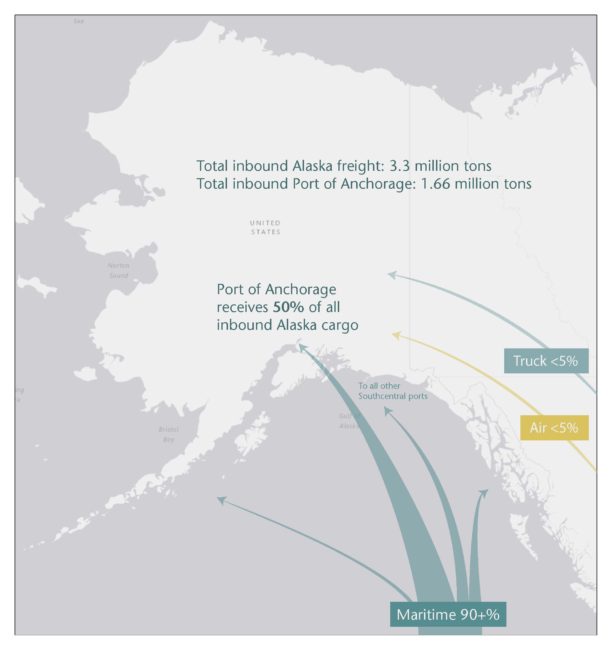
The Port of Anchorage’s inbound freight patterns. (Graphic courtesy Port of Anchorage)
That 85 percent figure doesn’t include certain construction materials, or account for goods barged directly to communities off the road system. Southeast Alaska, for example, received 90 to 95 percent of its freight by barge directly from the Lower 48, according to 2012 figures from the Southeast Conference.
When you look at the total amount of cargo coming into the state by air, road and over water, the port handles half of everything coming in, according to a 2016 analysis from the McDowell Group.
And while 32 percent of all the refined fuel consumed in Alaska moves through the facility, the McDowell report notes, “All aviation gas consumed within Southcentral and the Railbelt first enters the state through POA docks.” Though a small fraction of aviation fuel heads directly to communities beyond Anchorage, the port handles a “substantial majority” of it.
As if to stress that particular point, Greene is interrupted midsentence by a fighter plane flying overhead on a training run out of Joint-Base Elmendorf-Richardson.
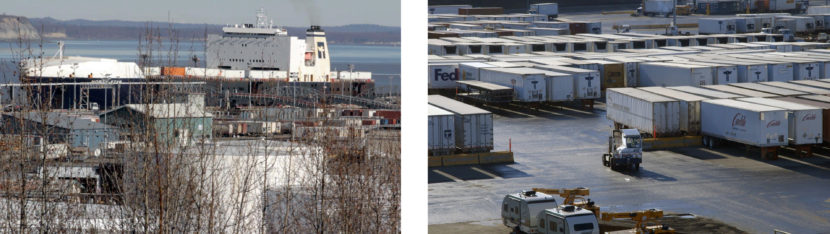
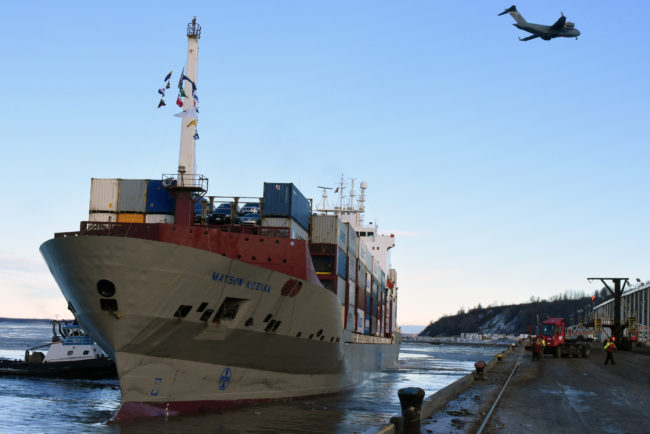
An aircraft heading toward Joint Base Elmendorf-Richardson as Matson’s Kodiak container ship approaches the dock in February. (Photo courtesy Port of Anchorage)
“That’s fuel,” said Michael Thrasher, Greene’s senior operations manager.
What he means is that fuel for the jet planes out of Alaska’s two main military bases came through the port. That’s also true of the commercial jet fuel that supplies large airports like nearby Ted Stevens International, as well as the armada of small planes knitting together communities off the road system.
A few miles down the road is a breakdown center, which is something like a big sorting room filled with forklifts. The cross-dock facility is managed by Carlile, a trucking company owned by Saltchuk Resources Inc., the same parent corporation that oversees Tote. As trailers are backed up to the cargo bays, Operations Manager Tom Hubbard opens one of the containers from that day’s ship, and points out labels for where the products are bound.
“Fish House in Seward,” he said of a box sitting atop several piles of paper headed to an Office Max.
Of all the material shipped on a delivery like this one, 45 to 50 percent of it moves on to communities beyond Anchorage. Exact data on where freight moves is treated by companies as a trade secret. But estimates from the McDowell report suggest 15 percent of the cargo moving beyond Anchorage goes to the Interior, 10 percent goes to the Kenai Peninsula, 20 percent goes to the Mat-Su Valley, with the remaining quantities bound for Kodiak, the Aleutians and Western Alaska.
Regardless of whether shipments are headed next, Hubbard and his crew unpack the containers and re-organize them for delivery.
“We’ll do the same thing and then backfill these trailers to send them on to where they’re going next,” Hubbard said.
The whole operation hinges on ships being able to dock and unload at the port. And in part two of this series, we’ll look at why that key step is threatened as the port’s basic infrastructure erodes into the sea.
Aaron Fedolfi in Anchorage Jail Court. (Photo courtesy of KTVA 11 News)
The family of a sexual assault survivor brings allegations of racial preference by the justice system to a sentencing hearing in Bethel.
At the sentencing hearing of former Bethel police officer Aaron Fedolfi on Tuesday, a debate about race and how it may have influenced his case broke out between the survivor’s family and the defense.
The State of Alaska has charged Fedolfi with one count of third-degree attempted sexual assault and one count of official misconduct after he attempted to force a Bethel woman to perform a sexual act on him while on duty.
Tuesday the state sentenced him to one year in prison— a sentence which his survivor’s family says is not harsh enough.
“The seriousness was not taken into account because of the misdemeanor charges instead of felony charges,” the survivor’s father, who will remain unnamed for his protection, said.
The family requested the court charge Fedolfi with a felony. But the court ruled to charge the defendant with a misdemeanor.
The survivor’s father says Fedolfi got a light sentence because he’s not from Bethel, he’s rich, but most of all because he’s white. The survivor’s mother says she agrees with her husband.
“We’re all human beings, we deserve to be treated just like everybody else,” she said.
Bethel lawyer Heather Sia consulted the survivor’s family throughout the trail. Her remarks before the sentencing hit on similar racial themes.
“We’re sick of it. You have white teachers;. You have white cops. You have white priests that are coming into this area. And they get away with it,” Sia said.
Though Fedolfi did not respond to these comments, his attorney, James Christie, said in his opening remarks that Sia’s words were some of the most offensive he’d heard in a courtroom.
“We’re not punishing Mr. Fedolfi for being white, and we’re not here to set an example for all white people by punishing Mr. Fedolfi. That’s not what this system of justice is about,” Christie said.
Fedolfi’s sentence comes on the heels of a national spotlight on race and police misconduct. Prosecutor in the case, Assistant Attorney General of The State of Alaska Adam Alexander, says these events shake the trust survivors and communities holds in the police force.
“The punishment, from my personal perspective, is not always proportionate to the degree of harm that’s inflicted upon a victim,” Alexander said.
Fedolfi will be remanded in Anchorage at the end of the week where he will begin his sentence. Fedolfi’s attorney says his defendant will leave Alaska after completing his sentence and finish his parole in Florida.
Close
Update notification options
Subscribe to notifications
Subscribe
Get notifications about news related to the topics you care about. You can unsubscribe anytime.

 A large number of Pacific walrus have been spotted hauling out at a new spot in Bristol Bay.