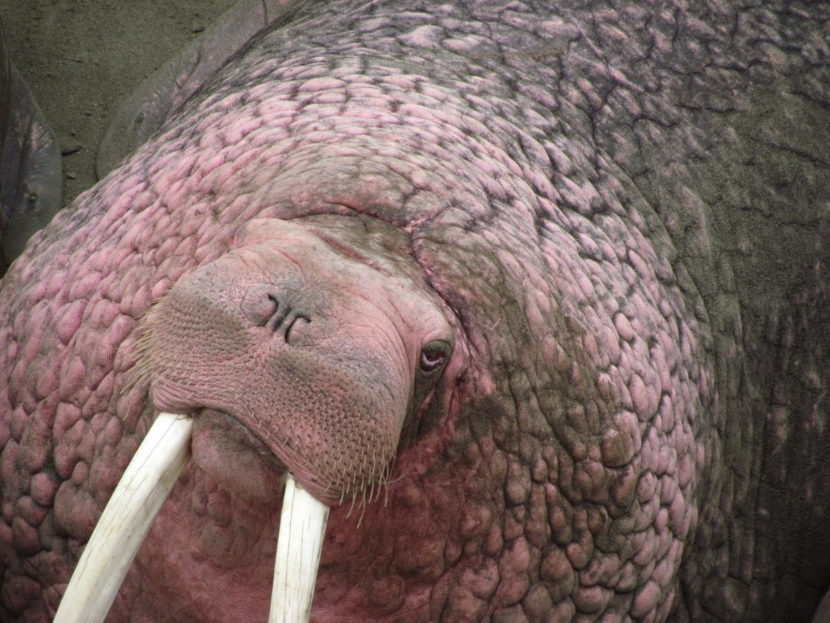
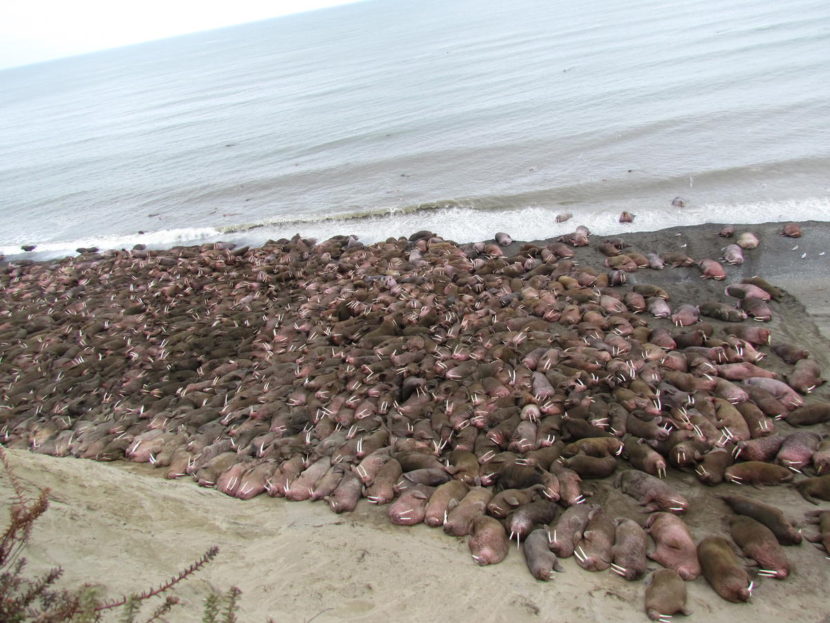
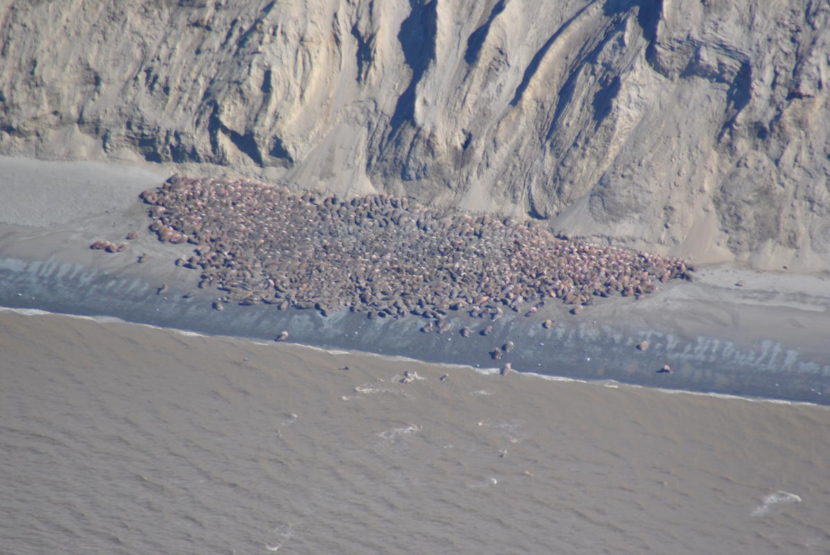
Walrus hauled out at Cape Greig, north of Ugashik Bay. Thursday May 19, 2016. (Public Domain photo by Brett Nigus/USFWS)
The Department of Fish and Game said Friday that it will be moving the north boundary of the Ugashik commercial fishing district approximately one mile south on account of the walrus hauled out at Cape Greig.
“Well the reasoning is that the animals are there, and there are lots of federal regulations that require certain distances be kept from endangering threatened species. That’s the short story,” said area management biologist Paul Salomone Friday morning. “We have to maintain some distance between us and them.”
The walrus showed up at Cape Greig, 8 miles north of Ugashik Bay, this spring. Bristol Bay has several other main haulouts used by male Pacific walrus during the summer, including the iconic spot at Round Island. Residents and pilots flying the Peninsula coast this spring noticed the walrus, and US Fish and Wildlife Service staff at the nearby refuge office in King Salmon documented them by aerial survey.
Cape Greig walrus, on Thursday May 19, 2016 Public Domain photo by Brett Nigus/USFWS
Their location is about a half mile north of the Ugashik district boundary’s north line, which quickly prompted concern about the proximity to the fishery and its many vessels and nets.
According to an ADF&G release Friday, starting Monday at 9:00 a.m. the new northern line of the Ugashik District will be defined by the following points:
The northeastern (onshore) corner will be located at 57o 42.69’ N by 157o 42.30’ W.
The northwestern (offshore) corner will be located at 57o 42.69’ N by 157o 44.47’ W.
“All vessels transiting the area are asked to maintain one nautical- mile of distance from the haul out when traveling to or from the Ugashik District,” the agency wrote.
Salomone said he expects to hear from the Ugashik and Egegik fleet this weekend, which is why the Department put the announcement out Friday ahead the change going into effect Monday.
Photo of walrus hauled out at Cape Grieg, just north of the Ugashik fishing district line, earlier this spring. (Public domain photo courtesy of U.S. Fish and Wildlife Service)
The Alaska Department of Fish and Game says it will be up to fishermen to avoid problems with the walrus hauling out near Ugashik north line this summer.
The new walrus haul out at Cape Greig in Bristol Bay could create some problems for the Ugashik and Egegik salmon fishing districts. But right now the Department of Fish and Game says they’ll start the fishery business-as-usual.
The new haul out was spotted this spring, first by residents flying over the north coast of the Alaska Peninsula. It was confirmed by the US Fish and Wildlife Service. No one is sure yet why the walrus are there, but hope that they might go elsewhere is running thin.
“I’ve seen them anywhere from 300 to 2000 on the beach at Cape Grieg,” said Daniel Peppin, a wildlife biologist and pilot with the Alaska Peninsula/Becharof NWR. Peppin has been keeping an eye on them by air this spring. “I mean, it’s anybody’s guess how long they’re going to be there.”
On a flight last week he counted 1500.
While a new, more accessible walrus haul out might be welcome by some, that spot is awfully close to the boundaries of the Ugashik commercial fishing district. The Dept. of Fish and Game area management biologist for Ugashik and Egegik is Paul Salomone has been looking at pictures of the haul out over the past month or so.
“There’s a bluff right on the north line of Ugashik, and it seems to be towards the north end of it,” said Salmone. “My best estimate of it, at this point, there about a half mile north of the north line.”
That could be a problem in one of the busiest, most crowded fisheries in the state. Last July, when the fishing in Ugashik got hot, there were over 300 Bristol Bay drift permits registered to fish there. Just north of that district, even more fishermen keep their nets wet in the Egegik district. With tenders and other transiting vessels, the amount of traffic near the haul out increases the concern for the safety of those walrus hauling out near the line and feeding wherever it is they feed. Walrus are protected from disturbance by the Marine Mammal Protection Act.
There are guidelines published by the US Fish and Wildlife Service concerning how close vessels can come to haul outs, what operations are not allowed nearby, and how much sound can be generated. If the fleet familiarizes and follows those rules, Salmone believes the fishing should not be interrupted.
“As of right now, we’re still planning on business-as-usual. We’re not planning on making any changes to the way we approach the season at this point,” he said, adding a big caveat concerning enforcement of those federal rules. “We are putting a lot of the onus on the fishermen.”
The consequences of fishing boats triggering a stampede or walrus showing up dead from obvious fishing related causes could be severe, Salomone warned. He said he’s hoping it’s a non-issue.
The federal government has jurisdiction over enforcement to protect the mammals. Commercial fishing in the district opened Wednesday.
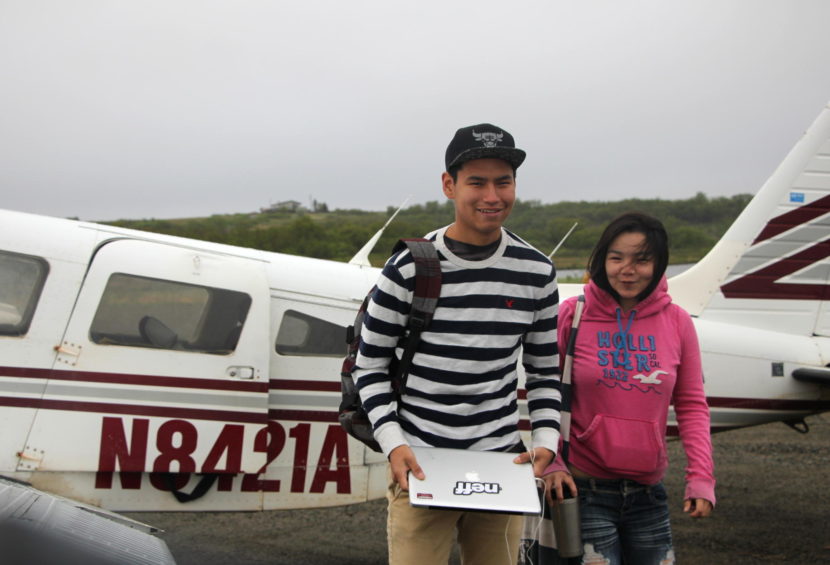
Peter Geffe and Amy Angasan deplane on their way to school on a breezy May morning. (Photo by Hannah Colton/KDLG)
For decades, the Bristol Bay Borough School District has relied on a unique form of pupil transportation; a daily air charter brings students in the village of South Naknek to the north side of the river to attend school in Naknek.
According to the state Department of Education and Early Development, it’s the only daily air taxi to school in the state of Alaska, and it could well be the only one in the nation.
When school lets out 3:30 p.m., Peter Gaffe and Amy Angasan climb into a 15-passenger van. Both brother and sister put in their earphones for the one-mile drive from the school to the small gravel landing strip that is the Naknek airport.
Now teenagers, Peter and Amy moved to South Naknek from Anchorage when they were in elementary school and have been flying to school ever since. Though the twice-daily flight seemed fun at first, Peter says the novelty wore off pretty fast.
“As time moved on it got a little more boring,” he says. “And nowadays it’s just something I do.
Amy says she enjoys getting to see her two hometowns from the air every day – especially in the spring when everything greens up.
Operated by King Air, it’s a short flight; the plane will touch down on the south side in less than five minutes. And besides being fast, the air taxi is the most reliable and safest way to get across the Naknek River.
Twenty-foot tidal fluctuations make it impossible to launch a boat at the same time day after day, and the river doesn’t freeze consistently enough to drive vehicles across in the winter. An effort to build a bridge between the two communities never got enough support or funding.
Of course, there are times when Peter and Amy can’t fly back across the river after school. Sometimes they get weathered out by fog or wind, or they have to miss the flight to stay for sports practice.
“I have to stay over here most of the time during basketball,” says Peter.
When they have to stay at school, Peter and Amy sleep at a friend’s house, or at their Aunt Nola Angasan’s place — a big, cheerfully noisy house in Naknek.
Nola Angasan with her adopted granddaughter, “Little” Nola. (Photo by Hannah Colton/KDLG)
Nola and her husband have hosted South Naknek students for the last 30 years. Between her own four kids, foster children, adopted grandkids and a popular day care business, Nola has always had a full house.
“I really liked it, too,” says Nola. “You know, kids these days always seem to want to be somewhere else or take off. With my kids I never had to worry, they always wanted to be home because there was always someone here for them to play with or something to do.”
Nola’s husband Steven grew up in South Naknek. He and his siblings took the air taxi to school in the 70s.
“Can I ask you what that was like back then?”
“Like nothing! Like riding a bike! It was everyday life.”
Back then, South Naknek still had an elementary school for grades K-5. Still, Steven says there were enough middle and high school students to fill four plane loads every day.
But then, just over a decade ago, the primary school closed too. South Naknek has been shrinking ever since.
It’s a familiar story around Bristol Bay – communities like Portage Creek, Ivanof Bay, and Clarks Point have lost their schools in recent years to low enrollment.
“For some it’s an instant decline,” says Steven Angasan. “After the school, then the mail planes quit coming, then everybody moves out to bring their kids to school. There (are) a few villages in this region that’ve shut down over the years.”
Recently, the Trident Seafoods plant in South Naknek closed, taking with it a few more jobs and facilities. But the village is still hanging on, with 30-50 residents at any given time.
I ask Steven if he thinks the air taxi is keeping some families around who would otherwise have to move to put their kids in school.
“Yeah, probably,” he said. “Probably.”
The daily air service is funded by a grant from the state Department of Education and Early Development. Each district gets a different amount per student – it’s a number set years ago based on factors including fuel costs, how much road there is, vehicle maintenance and local wages. The number for each district has grown at times, with inflation and legislative action.
At nearly $3,000 per student, the Bristol Bay Borough School District has the highest per-student transportation allocation in the state, by a margin of hundreds of dollars. For comparison, the Anchorage School District gets about a sixth of that per student.
It’s a figure that may cause some to cringe in a time when the state is grappling with a massive budget shortfall.
But what’s important, says Superintendent Bill Hill, is that all the students in the Borough have access to school.
“Students do have a right to an education in the state of Alaska,” says Hill. “This service provides South Naknek students the education that every student deserves. So we appreciate the fact that this can happen.”
Peter Geffe and Amy Angasan are the last school-age kids in Naknek right now. After Peter graduates next spring, Amy might be doing the river hop alone in her senior year.
But South Naknek isn’t a ghost town yet. There are still families who come and go, from Anchorage or Naknek or elsewhere, and as long as there’s state funding, the Superintendent says the air taxi will always be an option.
A King Salmon air taxi operator has been charged with multiple counts of sexual abuse of a minor.
In an online dispatch, Alaska State Troopers said a monthslong investigation led to the arrest of 40-year-old Robert Joseph May, who owns and operates RJ Aviation out of King Salmon.
May was arrested Friday night and charged with five counts each of second-degree and third-degree sexual abuse of a minor, as well as one count of Reckless Endangerment. He’s being held without bail at the King Salmon jail.
State Troopers are asking that anyone with information regarding similar complaints against May contact the King Salmon Post at (907) 246-3464.
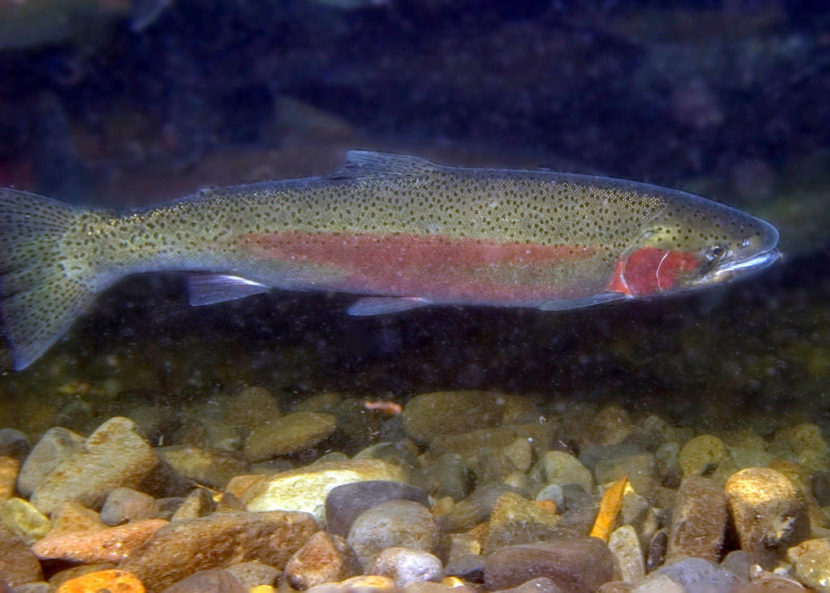
Researchers used steelhead, like the one pictured, to see whether group size affected fish’s ability to choose the right stream to swim home in. (Photo courtesy Oregon Department of Fish and Wildlife)
Each summer, millions of fish return to Bristol Bay and then swim on to the stream where they were born to spawn, and die. Exactly what compels them to return to the right spot is unknown, but scientists think that some hatchery-raised steelhead in Oregon might hold a clue.
Peter Westley, an assistant professor at the University of Alaska Fairbanks School of Fisheries and Ocean Sciences, and colleague Andrew Berdahl, from the Santa Fe Institute, are trying to figure out why salmon choose to swim up a given stream.
“(Some 50 million) fish last season migrated into Bristol Bay in the course of just a couple of weeks, and that’s a classic thing is that the fish all come at the same time, and it’s kind of curious to think, is there a potential social role in that?” Westley asked. “They all come as a major wave, and is it because they are in these groups and they are sort of following the leader and using social dynamics to aid their migrations.”
To try and parse that out, the researchers have been digging fake streams at an Oregon lab for steelhead to swim in.
“We actually tested this idea by giving steelhead that had migrated home to a hatchery, we brought them to the Oregon Hatchery Research Center and gave them a choice between water that smelled more like home, or all of the foreign water that came from the stream where the hatchery research center was based,” he said. “One of the things we showed with this steelhead system that indeed, fish that are moving upstream and are moving around are very social. They don’t move independently. They’re in groups moving around.”
Westley said steelhead are a good proxy for salmon because they’re pretty similar fish in terms of life history and a predictable return to their birthplace.
“They are a good model for these migratory sea-going fish that come back home,” he said. “They have subtle differences in life history but in terms of the social aspects and the migration and the orientation, I think they are a good model.”
Right now, the research is relatively small, and Westley said there are many details to work out and enhance in future experiments: this is really just a tantalizing teaser of some possible results. But it’s a little step closer to figuring out what compels salmon to come home each year.
Westley and Berdahl have been interested in this social side of fish behavior for some time, and their collaboration started with a paper that just looked at existing literature and data.
“(The paper) poses this idea of a collective social role of salmon as they are migrating home, such that salmon or other migratory fish can school together, and by being in groups, they can share information and pool their abilities to navigate and orient and by doing so the group is much more likely to get home than if the group was smaller or the individual is traveling by itself and the onus of getting to the right spot would all be on the individual,” Westley explained.
The idea behind the study is that salmon may smell their way to the right stream.
“So you can imagine, fish that are headed to the Kvichak versus the Nushagak, if it’s better to be with your Nushagak group, how do you know that you’re with the right group? Salmon have an amazing ability to use pheromones and essentially of course they’re smelling their way home once they’re in freshwater,” he said.
The role of scent is another thing the team would like to test. Westley said they’d like to repeat the experiment with a stronger scent of home-streams.
There are other changes the team is looking at in the future, too – like trying larger groups of fish, and adjusting the timing to tie-in more closely to when salmon are actually on the move.
Somewhere on the list, Westley said he’d also like to look at how wild fish fare, rather than just using hatchery steelhead – a choice made, so far, to keep things simple. And, he said, using hatchery fish can look at another interesting question: how hatchery fish impact wild fish when the two are mixing in places where they co-exist, like Alaska.
Westley said the issue of straying, or hatchery fish that go home to the wrong place, could result from those fish just following wild fish to spawning grounds.
“The challenge is always trying to scale from what you’re doing at sort of an experimental level up into the complexity of nature, and trying to assess what you’ve done at this small controlled scale, does it relate to nature as a whole,” he said. “It’s always a challenge.”
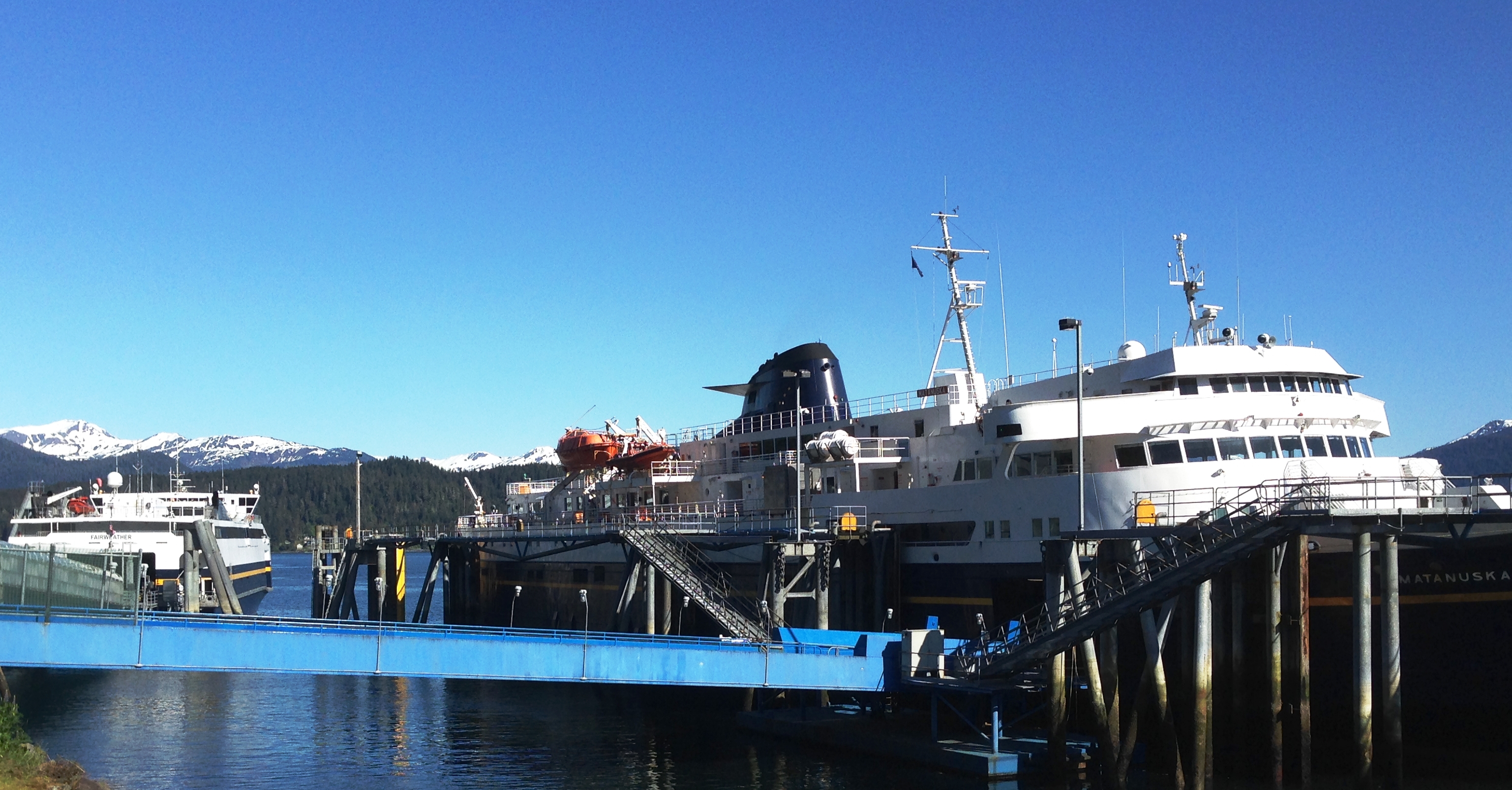
The ferries Matanuska, right, and Fairweather, left, tie up at Juneau’s Auke Bay Ferry Terminal May 19, 2016. (Photo by Ed Schoenfeld/CoastAlaska News)
Next winter’s ferry schedule will be leaner than this year’s, and that one was pretty lean. It’s the result of budget cuts, which could lead to the sale of the ferry Taku.
A couple of numbers tell the story of the next budget year’s ferry schedule.
The first is 356. That’s the number of weeks ships are sailing during this fiscal year, which ends in June. The second is 330, the number of weeks of sailings for the next budget year, which begins in July. That adds up to a reduction of around 7 percent.
“What happened this legislative session, I don’t like at all,” said Sen. Dennis Egan, who represents Juneau, Haines and Skagway.
“I think it’s decimated the Marine Highway System and the problem is a lot of people don’t understand that it’s a highway. Sure it costs money to run, but we pay for a lot of it.”
This next year’s total budget, in its latest version, is almost 10 percent lower that this year’s spending plan. And some of the money will come out of an account that’s being spent down quickly.
Ferry spokesman Jeremy Woodrow said cuts will be most visible later this year.
“It is not the department’s intention to change any of the summer schedule. Any changes will be reflected in the winter schedule or next spring and the beginning part of summer, 2017.”
In all, five of the state’s 11 ferries will tie up for much of the fall-winter-spring schedule. That includes both fast ferries, the Kennicott and the Columbia.
The other tied-up ferry is the Taku, which hasn’t sailed since last July.
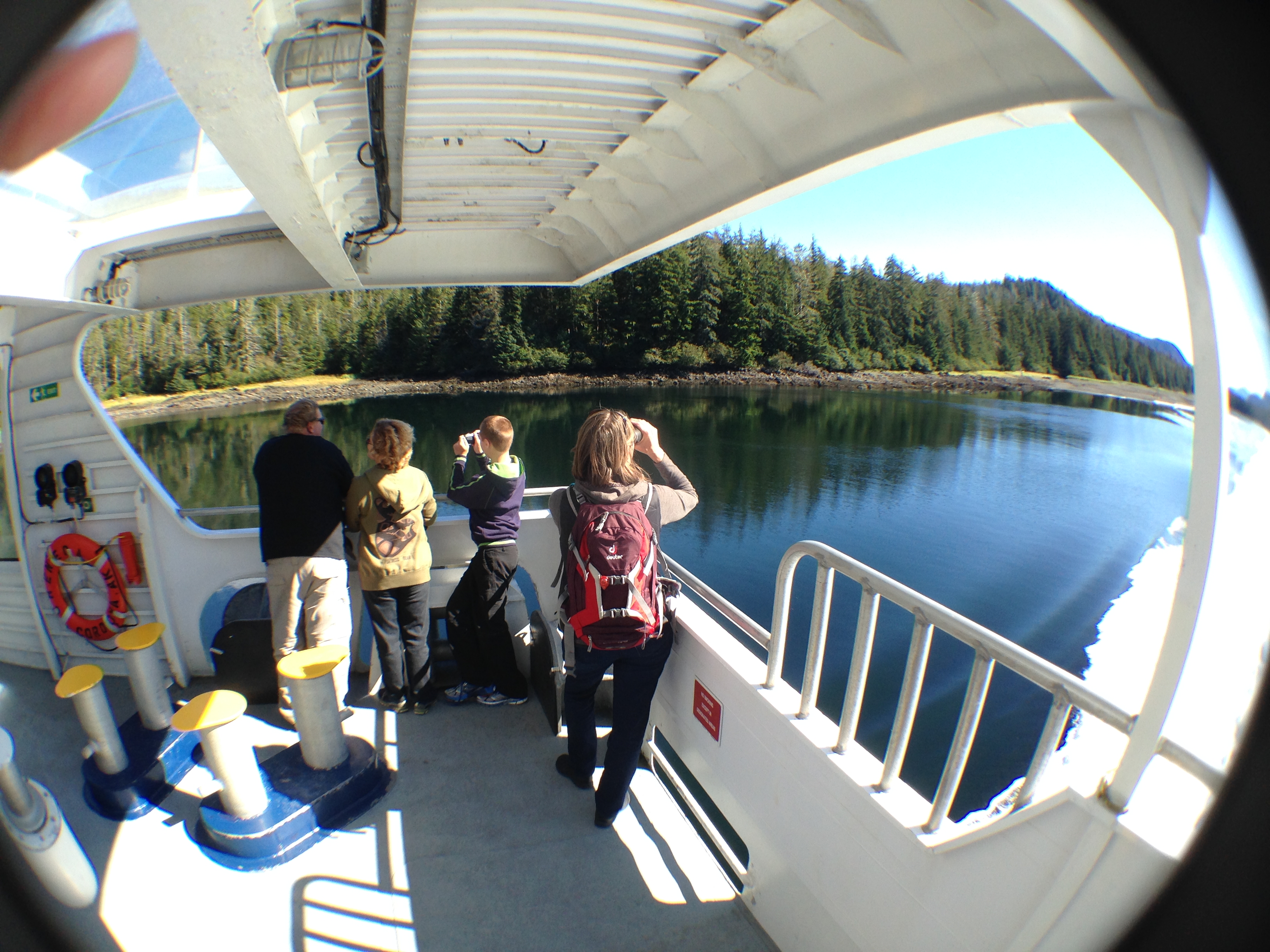
Passengers enjoy the scenery during a Sept. 3, 2015, fast ferry Chenega sailing between Sitka and Juneau. (Photo by Ed Schoenfeld/CoastAlaska News)
Woodrow said officials are researching what needs to be done to sell it off. And that’s not restricted to outside buyers.
“There has been a lot of discussion of … communities creating their own ferry authorities to improve ferry service. So, those are some of the discussions that are being had (about) what to do with the Taku,” he said.
The ferry system estimates it spends about $3 million a year to lay up the ship. That covers a skeleton crew, insurance and a fuel for the generators. So selling it off would reduce operating costs. There are other factors, such as the ship’s age and condition.
Ketchikan Rep. Dan Ortiz, who also represents Wrangell, said he’s concerned about the loss of a ship that’s served Southeast for years.
“It’s been a mainstay. And while it would require some refurbishment and some significant (money) to do that, I want to make sure that in the long run, it wouldn’t be more cost-effective to do that refurbishment rather than to build another ferry or something like that,” he said.
The last ferry to be sold off was the Bartlett, which went up on eBay in 2013.
Ferry officials are taking written comments on the fall-winter-spring schedule until June 21 via fax at 907-228-6874 or by email at dot.amhs.comments@alaska.gov.
A public teleconference to hear additional comments and consider adjustments is scheduled for June 22 at 10 a.m. for Southeast schedules and at 1 p.m. for Southwest and Southcentral schedules.
The meeting will be held in Ketchikan at the Alaska Marine Highway Central Office, 7559 North Tongass Highway. The toll-free number is 1-800-315-6338, conference code 03902#.
Close
Update notification options
Subscribe to notifications
Subscribe
Get notifications about news related to the topics you care about. You can unsubscribe anytime.