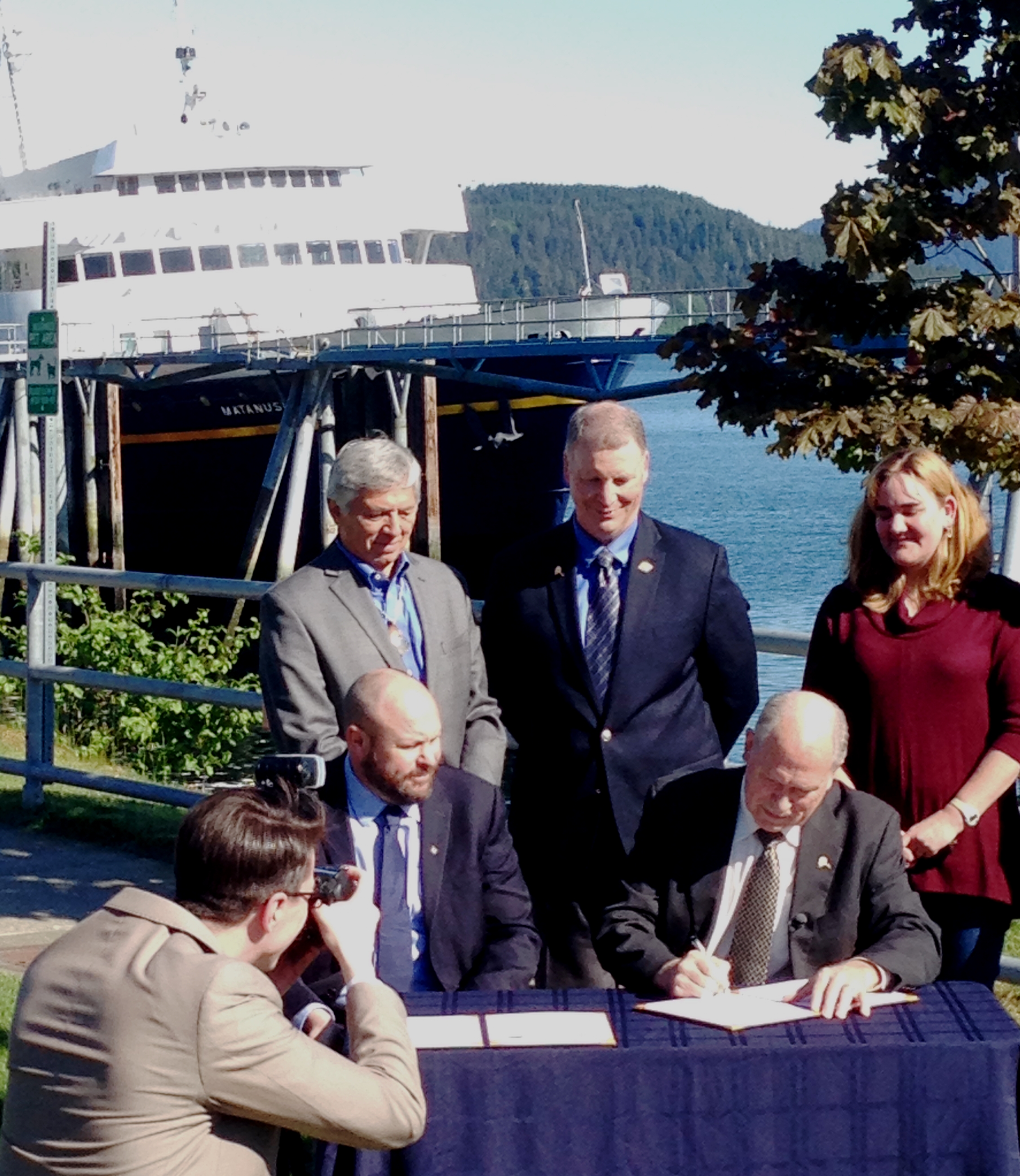
Gov. Bill Walker shakes hands with Southeast Conference President Gary White on Thursday at the Auke Bay Ferry terminal after signing an agreement to consider changes to Marine highway management. Transportation Commissioner Marc Luiken, left, Lt. Gov. Byron Mallott, second from left, and ferry Capt. Mike Neussl, right, look on. (Photo by Ed Schoenfeld/CoastAlaska News)
The state and a regional development group are combining forces to come up with a new business and management plan for the Alaska Marine Highway System.
Gov. Bill Walker and Southeast Conference President Gary White signed a memorandum of understanding Thursday to begin the process.
Speaking at a ceremony at Juneau’s Auke Bay Ferry Terminal, Walker said he hoped the effort would stabilize ferry funding.
“Every year you sort of wonder what’s the budget going to be. How much money’s going to be there? You don’t do that on the Seward Highway or the Richardson Highway because it’s always going to be there.”
“That’s why we want to have a stable level of funding that we’re talking about that we’ll have available to us if we’ll just sort of replumb our revenues a bit, so we can look out and say we know what the budget will be five years from now.”
The Southeast Conference, which includes regional municipal, business and tribal officials, was the main force behind creating the ferry system more than 50 years ago.
White said the conference wants to create a new governance structure for the ferry system.
“We’re really looking forward to working with our statewide partners to collaborate and move forward in this new direction to find sustainable solutions and reliable ferry systems for all of our state communities.”
Gov. Bill Walker signs a memorandum of understanding with the Southeast Conference as its President, Gary White,and others watch Thursday at the Auke Bay Ferry Terminal. (Photo by Ed Schoenfeld/CoastAlaska News)
The state already has a Marine Transportation Advisory Board made up of port city leaders, ferry customers and the travel industry. But it has no real authority and is often ignored when important decisions are made.
The memorandum of understanding commits the state to contracting with the conference to develop a new strategic plan.
Conference Executive Director Shelly Wright said members are ready to start.
“We’ll find a contractor, evaluate all the plans that are out there, go far and wide and then come up with three or four alternatives. Take those alternatives out to the people of the state of Alaska, have a discussion, take it on the road, get the input and eventually come up with one option for governance and in January, take it to the Legislature,” Wright said.
The conference has been pushing for a planning effort for years.
During a meeting this spring, members heard from a Seattle consultant who described how ferries are managed in a half-dozen other parts of the country.
Rocky Mountain School seventh-grader Alexie Evan using the HMH Read180 program. (Photo by Sherri Carmichael.)
Pizza is a rare treat in Goodnews Bay. No pizzerias or even restaurants exist in the 250-person community in southwest Alaska. So Wednesday morning when 22 fresh pizzas arrived at the school, it was a big deal. But the even bigger deal was the national award winner inside the building.
Alexie Evan is a seventh-grader at Rocky Mountain School, and he’s just won a national reading award from the education company Houghton Mifflin Harcourt, or HMH. His teacher, Sherri Carmichael, nominated him.
“I chose Alexie because he’s a very, very hardworking student. And he’s read so many books. He’s read over two million words this school year,” Carmichael said.
To celebrate, HMH flew pizzas from Bethel on the morning plane. Evan’s family and about a third of the town came to the party.
But in a video Evan sent to HMH, he says all those words he read this year didn’t come easy at first.
“When I was little I had surgery on my ears that helped me hear better,” Evan said. “I’m really shy, but as I do well in school, I’ve been talking a bit more.”
Evan’s hearing problems delayed his language skills, which he’s been building through HMH’s Read180 program. Carmichael says the program strengthens reading fluency, comprehension, and the grit to finish a book.
“That’s one thing Alexie has in spades,” Carmichael said. “He sticks with it and gets it done.”
Evan just finished reading Charles Dicken’s Great Expectations—a more than 500-page rags-to-riches Victorian novel.
The seventh-grader says he carries a book most places and prefers reading to most things. His favorite books are science fiction, and he says he’s learned an important lesson from his award.
“Hard work pays off,” he said.
Prizes abounded. Evan won $1,000 to use for his education; Carmichael won $1,000-worth of reading programs, and the school won a pizza party.
“And we don’t get a lot of pizza out here,” Carmichael said, laughing, “not that’s not frozen from the store anyway.”
Evan attended the Alaska Native Science and Engineering Program in Anchorage. In the fall, he’s skipping a grade in all subjects.
Each summer, millions of fish return to Bristol Bay, and then swim on to the stream where they were born to spawn, and die. Exactly what compels them to return to the right spot is unknown. But scientists think that some hatchery-raised steelhead in Oregon might hold a clue.
Are salmon social creatures? That’s the question a pair of researchers are trying to figure out.
“Fifty-some million fish last season migrated into Bristol Bay in the course of just a couple of weeks, and that’s a classic thing is that the fish all come at the same time, and it’s kind of curious to think, is there a potential social role in that?” said University of Alaska Fairbanks Fisheries Professor Peter Westley. “They all come as a major wave, and is it because they are in these groups and they are sort of following the leader and using social dynamics to aid their migrations?”
By digging fake streams at an Oregon lab, Westley and colleague Andrew Berdahl are trying to figure out why salmon choose the streams they do.
“So we actually tested this idea by giving steelhead that had migrated home to a hatchery, we brought them to the Oregon Hatchery Research Center and gave them a choice between water that smelled more like home, or all of the foreign water that came from the stream where the hatchery research center was based,” Westley said. “One of the things we showed with this steelhead system that indeed, fish that are moving upstream and are moving around are very social. They don’t move independently. They’re in groups moving around.”
Westley said there are plenty of details still to work out, and so far, they just have a tantalizing teaser of some possible results. But it’s a little step closer to figuring out what compels salmon to come home each year.
Westley and Berdahl have been interested in this social side of fish behavior for some time, and their collaboration started with a paper that just looked at existing literature and data.
“It poses this idea of a collective social role of salmon as they are migrating home, such that salmon or other migratory fish can school together,” said Westley. “And by being in groups, they can share information and pool their abilities to navigate and orient and by doing so, the group is much more likely to get home than if the group was smaller or the individual is traveling by itself, and the onus of getting to the right spot would all be on the individual.”
Westley said smell, or pheromones, play a role in salmon communication. But that’s part of what he’d like to test. Westley said steelhead are a good proxy for salmon because they’re pretty similar fish in terms of life history and a predictable return to their birthplace.
“They are a good model for these migratory sea-going fish that come back home,” Westley said. “They have subtle differences in life history but in terms of the social aspects and the migration and the orientation, I think they are a good model.”
Not everything about the study is a direct translation to the natural world, and there are plenty of changes and questions to address in the future. Westley said they hope to do the experiment again, with a stronger scent of home streams. And they might change the timing of the study, to tie in more closely to when salmon are actually on the move. Somewhere on the list, he said, he’d also like to look at how wild fish fare, rather than just using hatchery steelhead – a choice made, so far, to keep things simple.
“The challenge is always trying to scale from what you’re doing at sort of an experimental level up into the complexity of nature, and trying to assess what you’ve done at this small controlled scale, does it relate to nature as a whole,” said Westley. “It’s always a challenge.”
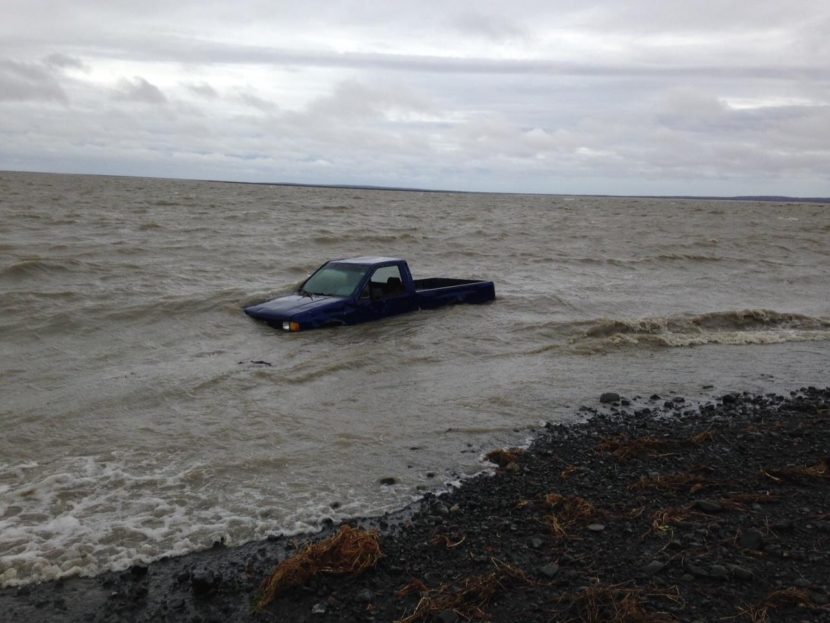
This week’s monster high tide in Dillingham claimed this truck left overnight at Kanakanak Beach.
A Dillingham man launched a skiff and parked an Isuzu pickup truck and trailer on Kanakanak Beach on Monday. On Tuesday, the Nushagak River saw one its biggest tides of the year and swamped the truck. (Photo by Dave Bendinger/KDLG)
The driver launched a skiff for Clark’s Point on Monday night and parked an Isuzu pickup truck and trailer on the beach.
Parking far up the beach is often suitable for most tide changes. A vehicle’s tires may get wet on a 20-foot tide. But on Tuesday, the Nushagak River saw one its biggest — and one of its lowest — tides of the year, and this Isuzu’s swamped interior can now attest that parking up the road would have been the wiser course.
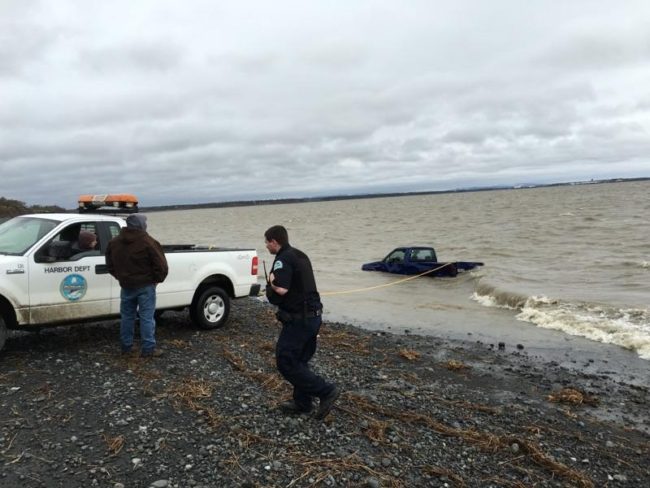
Beachgoers Tuesday afternoon were shocked to see the outline of the truck appearing as the water receded on the afternoon ebb, and called police. The surf, fueled by 30 mph southwest winds, continued to pound the truck until police and harbor staff were finally able to tow it out around 2:15 p.m. Tuesday.
(Photo by Dave Bendinger/KDLG)
Initially, police suspected the vehicle might have been stolen and left on the beach after a joyride. It took just a few phone calls after the license plate became visible for the owner to clarify that wasn’t the case. The vehicle had been parked Monday night to launch a boat, was apparently swamped on the Tuesday morning high tide, and dragged perhaps 75 yards seaward with the ebb.
According to NOAA’s Tides and Currents page, the Nushagak River’s high tide Monday night was 18.5 feet at 5:47 p.m. The low tide went down to negative 2.8 feet at 12:29 a.m., one of the lowest tides of the year. At 6:55 a.m., a monster 24.1-foot high tide smothered beaches and climbed shorelines, including several feet up Kanakanak Beach. That tide receded to 3 feet by 1:26 p.m. Tuesday, revealing the missing truck.
When pulled from the water, Andrew Lind had a core temperature of 92 degrees Fahrenheit. (Photo by Miranda Lind)
On April 28, Andrew Lind’s marine adventure turned into a near-death experience when he spent over an hour and a half in frigid water without a flotation device. A search-and-rescue-effort out of the Alaska Peninsula village of Port Heiden reached the swamped kayaker just in time.
Port Heiden (Meshik) Bay is partly sheltered from the ocean by a narrow strip of land that stretches north across the mouth of the bay. At the end of it is Stroganof Point, a popular subsistence hunting spot about five miles across the water from the village.
That’s where 36-year-old Andrew Lind was headed on a Thursday afternoon.
“Well, it was a beautiful, flat calm day, and I wanted to go out kayaking out on the ocean and look at the wildlife.”
Lind describes himself as a “normal village guy.” Originally from Chignik Lake, he does subsistence and he’s a crew leader for the hazmat remediation project at Port Heiden’s former military base, Fort Morrow.
Lind set out just after 1 p.m. and paddled to Stroganof Point in his 8.5-foot plastic kayak. He took in the sights and then turned around
“On my way back, halfway back I texted my wife and told her I’m on my way back.”
Lind sent that text at 3:37 p.m. He’s not sure how long it was after that that the water got really rough.
“By that time the wind and the waves started picking up and I got caught up on the main channel and a white-cap tipped me over. It all happened slow motion.”
Lind got himself out of the boat and came up for air. Then he started trying to put the kayak upright. But every time he tried to flip it, it would just scoop up water and get more swamped.
“So I just left the kayak upside down so there was an air pocket in the bow.”
He wasn’t wearing any floatation device, but he was able to keep his head out of the water by hanging onto his boat. Lind says pretty soon his arms just cramped around the kayak, holding him in place.
Based on the time of the text message, Lind and his friends and family figure he was in the water somewhere between one and a half and three hours. According to NOAA, the average water temperature there this time of year is less than 40 degrees.
“It felt like I was in there forever, like nobody was gonna come.
Somebody did come, even before the rescue crew. But it wasn’t a human someone.
“I must have passed out or something, because I heard a knock on the kayak, like somebody knocking on the door, you know? And when I woke up a seal was like two feet away from me, like a guardian angel, keeping me awake.”
Back in Port Heiden, Lind’s wife Miranda realized he was overdue. Around 5:30 she started calling people to help. James Christiansen is Lind’s brother-in-law and a pilot who owns the only private plane in the village.
“Went out over the ocean check the islands across the bay, and couldn’t find him. So we started searching between the bay side and the mainland, and my daughter saw something in the water.”
It was just 15 minutes after they took off that Christiansen’s daughter spotted Lind about two miles offshore. They began circling low over him and radioed to people in the village who were launching two skiffs.
Bruce Bishop, a co-worker of Lind’s, drove one of the boats.
“Ironically, the first skiff went out in front of me and got almost to him and ran out of gas. Somebody had taken the gas out of his skiff!”
Luckily Bishop’s skiff had a full tank, and he and two other men made it to Lind just after 7 p.m.
“Oh my god, he was just this horrible blue color,” recalls Bishop. “And Andrew’s a big boy, probably 260 or better. It was everything three of us could do to drag him over the side of the boat.”
The boat crew says Lind was coherent as they got him out of his wet clothes and into dry ones. Lind doesn’t remember anything from when he was pulled from the water until he came to at the clinic. His core temperature had dropped to 92 degrees by the time health aides started warming him up with heated blankets.
This is not your typical search and rescue story; the entire operation happened in less than two hours, with no outside help from State Troopers or the Coast Guard.
Of course, there was plenty of luck involved. If Lind hadn’t had cell phone service, if Jimmy Christiansen had been flying elsewhere that day… so many little things could have ruined this happy ending.
But one thing that didn’t seem like luck is the way people in Port Heiden knew how to spring into action.
Bruce Bishop, the skiff driver, says that’s not an accident. He and some of the other rescuers all work at the hazardous waste cleanup site, so they all have up-to-date first aid, CPR, and other training.
But, says Bishop, it’s more than just the training.
“We work together every day, so we have really good communication skills between us. That’s probably what made this all work.”
Andrew Lind says what kept him kicking was faith and his family.
“There was lots of praying to God, talking to my family, my kids and my wife. Who would take care of them if something did happen? I think that’s what pushed me to hold on.”
He doesn’t know what to make of the seal’s appearance. Later, the rescuers would report that seal lingered near the kayak until well after Lind was safely out of the water.
Correction: A previous version of this story was credited to the wrong author.
Patrick Durbin, 83, lives alone at a tidy place on Nerka Loop. Police believe he was scammed by three people seeking money to fund drug habits. (Photo by Dave Bendinger/KDLG)
Dillingham police are investigating three cases of elderly residents being robbed or scammed for drug money, and chief Dan Pasquariello believes more have occurred.
“There’s been a pattern recently, and it’s pretty much the same crowd of people, part of what we call the ‘milieu’, that are taking money from elderly people mostly likely to purchase controlled substances,” he said.
The cases involve theft using ATM cards or forged checks, and “flat out scamming” the elderly, said the chief.
“We’ve charged two individuals with theft where they approached an elder man, represented themselves as from a fuel company, and had the elder write them checks,” he said.
Sydnie Dawn Schlosser, 26, and Pearl Lucille Harless Lyle, 22, were charged with one count of third-degree theft each. Police believe John Filipek, 27, was behind the scam, but because he doesn’t have a checking account, the evidence pointed only to his two alleged female accomplices.
The man these three targeted in their alleged fuel selling scam was Patrick Durbin, the retired city harbormaster. Durbin keeps a tidy house on Nerka Loop where he lives alone. Discussing the matter Wednesday evening, he often chuckled about being duped.
“It’s a life lesson,” said the 83-year-old.
Durbin began his story with an incident from three years ago, when he injured himself lifting a heavy stump in the yard. He finally sought medical care in Anchorage, spent three months there, and came home with medication to take.
“So I’m still on medication, and not thinking straight, and I got conned into giving money out, you know? And trouble of it is, I’m sitting there wondering about it, but I still went along with it,” he said, laughing a bit.
When the young adults he didn’t know approached him, they claimed to be his new fuel delivery company and were there to collect payment.
“I specifically asked, I said ‘I got that Delta Western, I’ve had ‘em for years.’ ‘Well, they’re going out of business.’ They specifically said they were going out. ‘We’re taking over,’ direct statement. Well, I said ‘how come they never sent me a notice?’ Little things like that I remember saying. So I questioned it. But somehow in the conversation, they got me talked into it.”
Durbin believes they stole his money three times. Once he gave them cash, and twice he wrote checks for over $300.
“Yeah. Two of ‘em was on the same conversation, one after the other,” he said laughing. “That should’ve been a send-off to me right away, but the way I was thinking, you know.”
He checked his fuel tank regularly and realized no deliveries had been made, and eventually contacted Bristol Alliance Fuels to ask why they hadn’t delivered yet. The company helped Durbin realize he may have been scammed, and he contacted the police and his bank to see what could be done.
Having succeeded a few times, did his scammers try other ways to rob Durbin? He’s not sure, but he laughed as he described coming home one day and interrupting what he does think was a theft of his fuel in progress.
“I think I did, you know, but you’re never for sure about these con games. They can catch me at my very gullible time. I’m only 83, but … what can they give me if I beat ‘em up? Twenty years? So that gives … 103? With room and board? That’s the way I’m looking at things now. Otherwise, I just don’t give a … I’m gonna do what I’m gonna do when things happen. If I can catch it, with my mind. And I’m pretty good, most of the time.”
KDLG has reported other instances of crime tied to drug habits, including last month when several on the front lines of Dillingham’s drug abuse issues discussed the theft and even sex trafficking they see happening. Last year a Dillingham man was convicted of stealing from a dying man who had hired him to work around his house, admitting he needed the money to fund an addiction. And in recent conversations with village leadership in Togiak, including as reported when the tribe banished a Dillingham man from town, they say elders there are being frequently robbed of money and goods to support drug habits.
“There’s always been thefts here,” said DPD’s Pasquariello. “Years ago, when I first started, people stole money to buy alcohol. The thief could get their daily dose of alcohol for, say, $20. If you’re a heroin addict, it’s going to cost you at least $100 a day to get your daily dose of heroin, maybe more.”
Pasquariello said more charges will likely be coming, but he suspects authorities will only see the tip of the iceberg of similar activity. Some elders may never know they’ve been robbed or scammed, and some may be ashamed to admit it or report their relatives.
“We’re talking about it so people can be wary, and perhaps not to be as trusting as they once have been in our small community,” said the chief.
Close
Update notification options
Subscribe to notifications
Subscribe
Get notifications about news related to the topics you care about. You can unsubscribe anytime.