Three cruise ships dock in downtown Juneau at the height of the tourist season on July 14. (Photo by Ed Schoenfeld/CoastAlaska News)
Alaska’s cruise industry is on track to hit the magic million-passenger mark this year.
Industry leader John Binkley said that many passengers are projected to sail to the 49th state by the end of the season. That will be the first time in half-a-dozen years.
Binkley, president of Cruise Lines International Association Alaska, said the number is about 2 percent higher than last year.
“Worldwide, it’s about a 8 percent annual growth. … So we see a smaller percentage, but we’re kind of moving along with the trend in the industry,” he said.
The Celebrity Millennium and a smaller cruise ship doubled Unalaska’s population for a day when about 3,800 people disembarked from the vessels. (Photo by John Ryan/KUCB)
The trade group said Alaska-bound ships used to carry about 8 percent of the worldwide cruise market. That’s almost double the current amount.
Binkley said global competition is the reason for the change.
He said the fastest-growing market is in Asia, which is attracting new customers, especially from China. He said that could help Alaska in the long run.
“Once that capacity and that growth is seen in Asia, then the hope is that in later years it will be a source for cruise passengers coming to Alaska. So, initially competition. Later, a market that will increase more dramatically visitors to Alaska,” he said.
He said anecdotal evidence and market research show many new customers in the Asian market also want to cruise to Alaska.
Other factors could affect the state’s cruise industry in the coming years. One is an improved marine link.
“With the Panama Canal expanding in size, larger vessels can now move from the Atlantic, for example the Caribbean trade in the wintertime, through the Panama Canal into the Pacific and up to Alaska for the summer trade,” he said.
Binkley said overseas terrorism is another factor. He said that could make more Americans want to travel closer to home.
Archaeologist Randy Tedor shows kids how to sift through dirt at the “Quk Taz’Un” house site. (Photo by Hannah Colton, KDLG – Dillingham)
On the north shore of Lake Clark, there’s a place called Kijik. It’s the historic homeland of the Dena’ina Athabascans of the area, and also the site of a culture camp where youth and elders from the village of Nondalton came together last week. Dozens of abandoned homes dot the area.
“A little pushdown, flick out, and then you wanna keep going down the wall,” said Randy Tedor.
Tedor kneels in front of a 50-centimeter square of dirt. The bushy-bearded archeologist is showing a group of kids how to carefully excavate the quadrant.
“Excavation is an art,” he tells them, deftly pulling layers of soil loose.”
11-year-old Cordelle Balluta-Trefon puts down a metal detector he’s been playing with and gets to work in the dirt with a dustpan and a trowel.
After a while, Balluta-Trefon puts down the trowel and hands something to Tedor. It’s a tiny red speck.
“Good eye, man! I can’t believe you saw that” Tedor said laughing. “A little baby bead.”
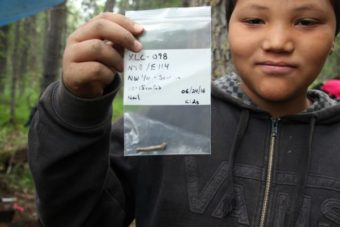
That little bead, Tedor explained, is a huge clue. This type of glass bead was only manufactured in Europe after a certain date, so it helps archaeologists like Tedor figure out how old the site is. They think this house was occupied between 1840 and the 1880s.
As he explores more into the site, Balluta-Trefon said he’s getting a picture in his head, visualizing what it might have looked like when people lived here
“I don’t see people, but I just see a house. There’s a fire pit, there’s a storage room, a bedroom, that’s the front door over there,” Balluta-Trefon mused. “I’m still kinda putting the picture together.”
This curiosity is exactly what Tedor is trying to inspire; he wants the kids to wonder how people lived back then, maybe to realize that the people living on this land were, in many ways, just like us.
But like many old village sites in Alaska, this land, and its people have a troubled history.
Fur hunters and explorers from Russia started plundering Lake Clark’s Dena’ina villages in the late 1790s. Next came the Russian Orthodox missionaries, who by the 1830s were traveling around regularly to baptize and hold services in villages.
And of course, with this new contact came new diseases. Around 1900, measles and flu epidemics devastated the population at Kijik. The survivors moved down the lake to what is now the village of Nondalton, seeking better access to salmon runs and trading posts.
They left Kijik behind, along with a lakeshore full of graves and sad memories.
“They’re estimating up to 200 graves here,” said Karen Evanoff, a Dena’ina Athabascan cultural anthropologist with Lake Clark National Park. For five years she’s been working with the Nondalton Tribal Council and researchers to identify and mark the graves.
The work culminated in a blessing ceremony last summer.
“Close to a hundred people were here, and we combined the traditional way of spirituality and blessing with the Russian Orthodox way, so it was a huge celebration,” Evanoff said. “This is a healing place.”
There’s still controversy over the land at Kijik; parts of it are now owned by a Native allotment and a homesteader, who built structures on and around the church and grave sites. The Kijik Corporation has managed to buy a few acres back, and Evanoff said they hope to regain more of the land the people consider sacred.
“That’s part of the vision,” she said, “to clear this of the cabins and have some plaques here to identify who’s buried.”
Holding the culture camp here is another part of that healing process. Evanoff planned the camp along with Michelle Ravenmoon of Pope-Vanoy on Lake Iliamna
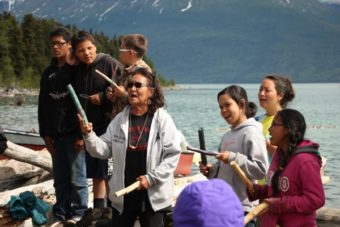
Michelle Ravenmoon (right), Nondalton elder Pauline Hobson (left) and kids sing a Dena’ina song at the end-of-camp potluck (Photo by Hannah Colton, KDLG – Dillingham)
“Of course, we want the kids to have a lot of fun and enjoy themselves and grow their self-confidence and pride,” Ravenmoon said. “But we also wanted to make sure they learn their history and their identity, where they come from, who they are.”
Each activity – from wood carving to caribou hide-tanning to language classes – is meant to help kids understand their Dena’ina culture.
“We’ve been very unsuccessful as Native people sending them out, preparing them for this outside world,” Ravenmoon said. “We give them computers, and we teach them (the) history of the United States, but we’ve taught them so little about who they are where they come from. I think it’s important for kids to know their history.”
A piece of that history lies in the ground at the archeological site, waiting for the kids to get their hands on it.
Up until recently, the archaeological site was known to scientists as “house pit XLC-098.” But Michelle and Karen were happy to share that the site is now being officially renamed: “Quk Taz’Un,” the same name as the culture camp.
It means “the sun is rising,” hopefully on a brighter future for the Dena’ina Athabascans of Lake Clark.
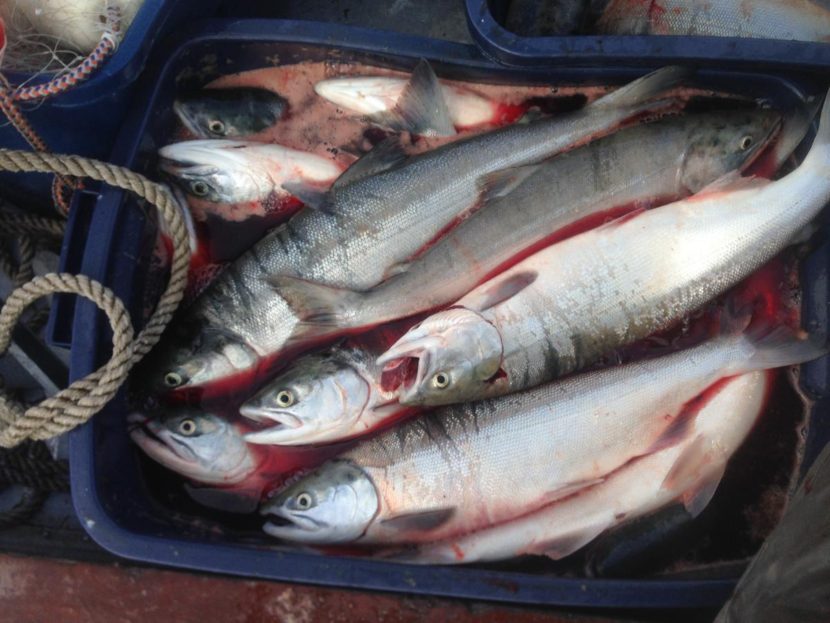
Wood River sockeye are pictured in this June 2016 photo. (Photo by KDLG Staff)
Alaska’s sockeye salmon came back shorter and lighter than usual last year. As sockeye runs return this summer, biologists have been keeping an eye on their size, tracking whether they’ll be like last year – shorter and lighter than average – or back to their normal weights.
Longtime Bristol Bay fisherman John Bennett said that at least for the start of the Bristol Bay season, the sockeye in his net have been smaller than they used to be, just like last year.
“Everything’s changed,” he said in late June. “Even the size of the fish has changed, nothing’s the same.”
Fish and Game’s Jack Erickson said on July 3 that’s what he’s seeing in the numbers, too.
“We’re still looking at smaller fish, similar to last year’s numbers,” Erickson said.
So far, Erickson said the three-ocean fish, those that have spent three years in saltwater before swimming back, are a little smaller even than last year. The fish that have spent just two years at sea are a little larger than 2015.
“And on average right now, from our very initial catches, it’s averaging about the same as last year for size,” he said.
Fish size estimates come from samples taken at counting towers as well as in the commercial harvest. Although that data is available now, Erickson says it’s too early to draw very many other conclusions about the 2016 run, and the size info is far from final.
Prince William Sound and Cook Inlet also had small fish last year. But as the runs progress in those regions, they don’t appear to be quite as small.
“Well this year in Prince William Sound, we saw fish originally coming in a little bit smaller,” Erickson said. “But since the beginning of the season, the fish have gotten larger. I think we’ve put on an average of about half a pound. We’ve seen an increase in the average size of sockeye. So that’s good news to see out in Prince William Sound/Copper River.”
Erickson said the very first Cook Inlet fish have also been about half a pound larger than last year, too.
“So in those two areas we’re seeing some improvement,” he said. “And hopefully, we’ll see that larger size show up in Bristol Bay as well.”
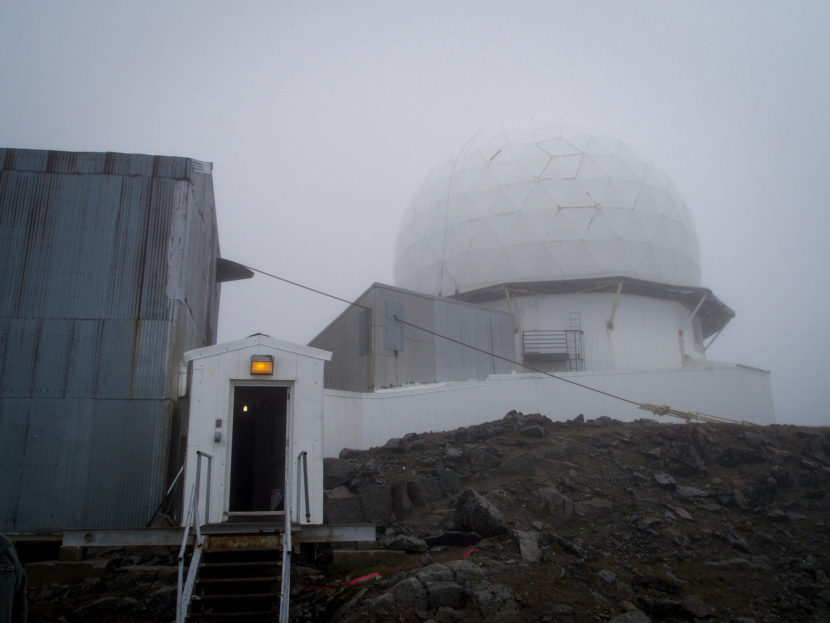
The Romanzof radar site was built in the early 1950s. (Photo by Zachariah Hughes/Alaska Public Media)
At the height of the Cold War, the military built secretive radar sites all over Alaska. Most of them are still operating, doing essentially the same thing: scanning the sky for anything that’s not supposed to be there, particularly Russian long-range bombers.
But technology and policy have reshaped the sites themselves. Recent equipment upgrades have shrunk the size of electronic packages enabling radar operations, and camps that initially housed hundreds of military personnel now house tiny crews of private contractors. In spite of those changes, the structure of Alaska’s vast air defense system remains essentially the same.
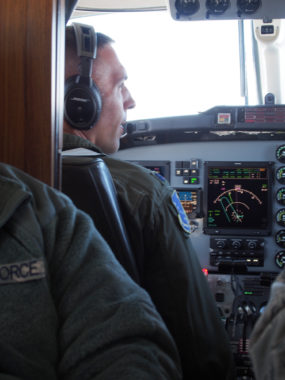
An Air Force airman pilots a C-12 flying from Elmendorf to Cape Romanzof. One of the six passengers was Col. Frank Flores, who oversees the LRR assets in Alaska and the Pacific. (Photo by Zachariah Hughes/Alaska Public Media)
The first barrier getting to one such site was weather. Low gray clouds kept our plane circling in the air, the pilots hoping for an opening after two hours of flying from Anchorage to Cape Romanzof in a small C-12 plane.
The Long Range Radar site looks out over the mouth of the Yukon River, about 15 miles from Hooper Bay.
The site’s radar technician, Max Jones, waited by the airstrip in a pickup truck.
“This is Cape Romanzof weather,” Jones said. “We have a saying here: come because you have to, stay because the weather won’t let you out.”
Jones is one of four contractors who work year round at Romanzof. Technicians like him maintain the equipment and facilities at Alaska’s 15 LRR sites, which means doing everything from electrical engineering to plowing the miles of winding road tying the air-strip to the radar building perched a few thousand feet up.
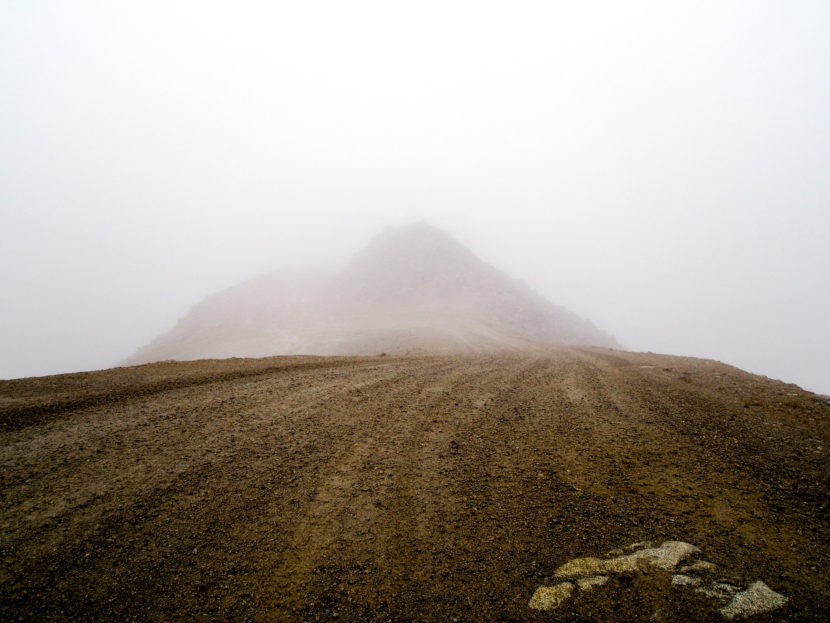
We drove past the two giant domes that house the crew and their heavy equipment before climbing into fog so dense it hid the truck driving behind us.
Technicians spend as many as 14 hours a day during the winter clearing snow on the roads connecting different installations at the LRR sites. (Photo by Zachariah Hughes/Alaska Public Media)
“This is an old volcano,” Jones said of the steep hill, the sides a few feet away totally obscured. “It’s 3,200 feet straight down right there.”
For the last two years Jones has worked for ARCTEC, the private company that’s held the contract to run the sites since 1994. The Air Force began privatizing site operations in the ’70s.
Jones, who spent 20 years in the Navy, said it’s the best job he’s ever had – largely because of the variety of the work. He stays out around three months, then goes home to Tennessee for a month at a time.
“Being out on a remote site doesn’t bother me,” Jones said, slowing the truck to a halt. “But it’s not for everybody.”
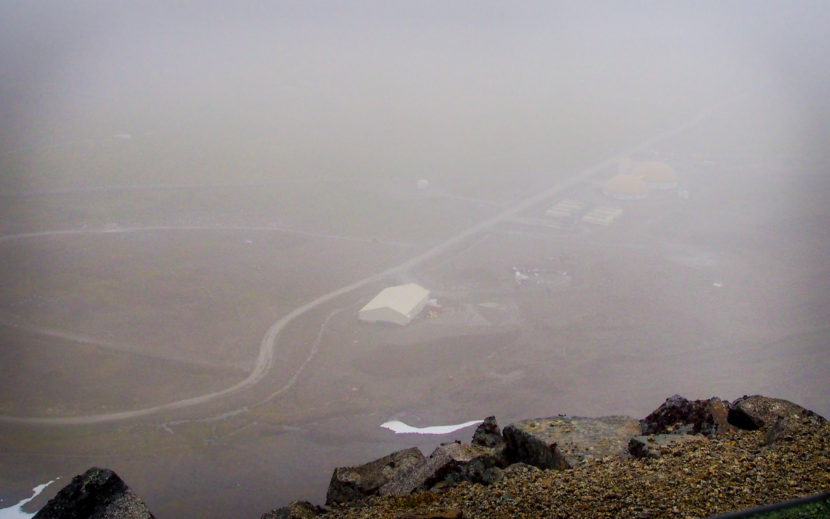
A view of the lower camp from the upper site housing the actual radar facility. Large insulated domes house the small crew and cover the heavy equipment and generators powering the site. (Photo by Zachariah Hughes/Alaska Public Media)
We got out and walked into the most important part of the Romanzof site: a cluster of low-slung structures built into the rocky ridge, a defunct tram system dangling off the edge. Propped atop the metallic rectangles is the giant golf-ball shield that houses the Air Force’s Long Range Radar.
“You’re about to enter a restricted area,” Jones said at the end of a worn wooden hallway, a perfunctory tone flattening what sounded like a familiar speech. “There’s no photography inside the restricted area. And the two civilians: I’ve got to have eye contact with you at all times.”
Inside, it looks like a tidy mechanic’s garage, with blocky metal cabinets, industrial fans, and rectangular monitors. My microphone picks up an eerie hum that makes me wonder about radiation. Jones walked us to a backroom with a glowing map of Alaska showing where the other 14 LRR’s are beaming pulses 250 miles in every direction, probing the sky for abnormalities. Jones hovered near a box called the Radar Signal Data Processor that looks like a dehumidifier.
“Without this the radar can’t do nothing,” he explained. “Everything that the radar creates, transmits, receives, is all fed through this.”
If the processor is like the body of a camera, Jones walked us up a metal staircase to show off the optical lens filtering many rays of light. We craned our necks up to peak at the radar itself from underneath.
“See that white wagon wheel up there?” He asked. “You can actually see the bottom of the radar turning.”
He half-joked that we couldn’t look at it up close while it’s spinning because it would melt our insides.
Jones spent his Naval career working on similar radars, and knows his way around the equipment. But he doesn’t decipher the signals. The whole site – all the machinery, the roads, the dome homes – they’re all in place so that this radar can work like a nerve ending, feeding signals back to a distant brain.
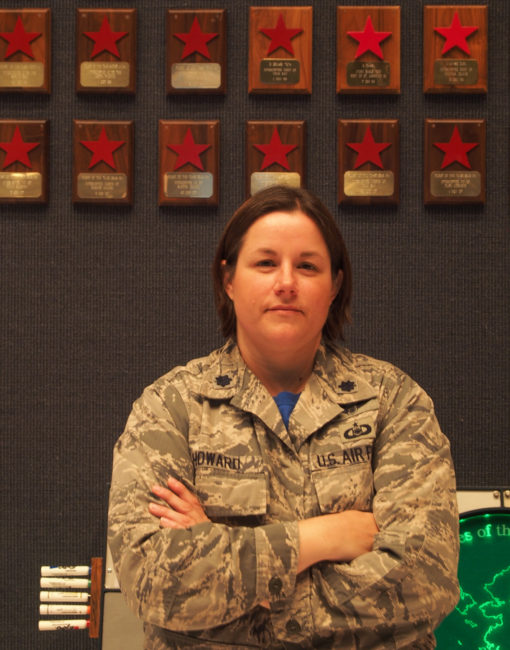
“We detect, identify, track and intercept if necessary, any unidentified traffic within the airspace of Alaska,” said Lt. Col. Carrie Howard of the 176th Air Defense Squadron, part of Alaska’s National Guard.
Howard oversees the large crew at the Regional Air Operations Command, a windowless subterranean facility at Joint-Base Elmendorf-Richardson, 540 miles from Romanzof. It’s filled with glowing computer monitors and looks basically like the war-room in every movie ever made. A piece of equipment gives off a faint green light in the corner, like a Cold War relic. In fact, it was decommissioned in 2006.
An Alaska National Guardsman monitoring radar signals sent to the Regional Air Operations Command in Elmendorf. (Photo by Zachariah Hughes/Alaska Public Media)
“The radars that are around the state, all of those sensors and all of that data feeds into our facility to display on our battle control system,” Howard said. “It shows up as dots on a screen and location, and from there we can determine if they’re actual aircraft or not.”
Most of the time, the colorful clusters of dots speckled across the maps are noise, flocks of birds or reflections off the ice. But the instruments are sensitive enough to tune out signal interference.
When the RAOC finds something that could be a plane, notifications begin working up the chain of command. The Air Force shares information collected from the radars with civilian partners at the Federal Aviation Administration, who can better assess whether it might be a private or commercial aircraft that is off course. If military commanders decide it’s a foreign craft, they may decide to scramble fighter jets.
According to Howard, personnel here detect Russian military aircraft probing international airspace near Alaska around 10 times a year. Though she declined to speculate on what motivates the incursions, Howard pointed out they tend to happen on U.S. national holidays like the Fourth of July. The background on a nearby computer monitor showed an image of an American F-22 escorting a Russian Bear Bomber last July.
“We’re the front lines, I guess you could say, of air defense,” Howard said.
On the wall were hundreds of red stars for each time such an escort has happened since the radar system was built in the early ’50s.
Lt. Col. Carrie Howard stands in front of intercept stars at the Elmendorf Regional Air Operating Command. (Photo by Zachariah Hughes/Alaska Public Media)
The information gathered at the RAOC also feeds into the headquarters of the North American Aerospace Defense Command in Colorado, which aggregates similar data from around the continent.
Back at Romanzof, Max Jones explained that the whole expansive apparatus of the LRR defense system — the personnel, equipment, the constant pulse of signals through the air — depends on the radars quietly spinning atop mountains and old volcanoes.
“That’s the mission. Everybody else out here, the plane that you came in on, it’s mission is to support that radar, the thing that goes around above your head.”
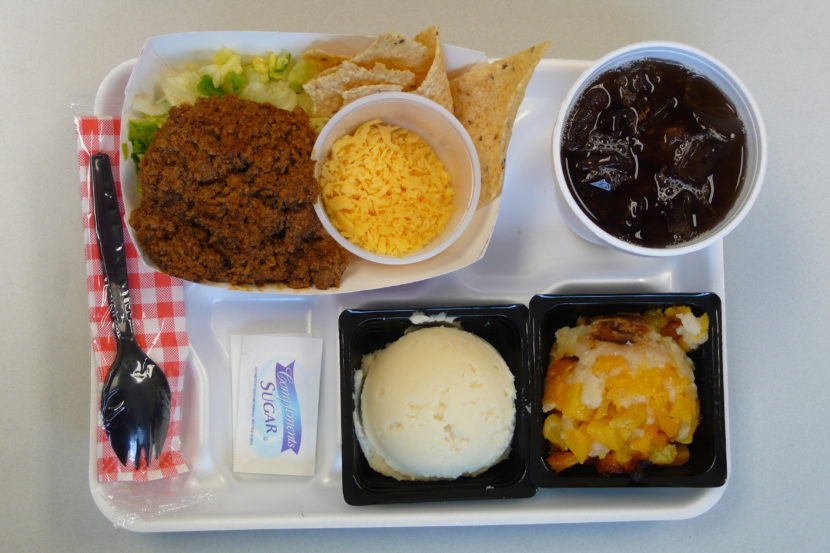
A school lunch of turkey taco salad, iced tea, mashed potatoes and peach cobbler. (Creative Commons photo by Laura Taylor)
Seven million dollars for a brand new kitchen and cafeteria at the Bethel Regional High School survived the governor’s veto pen this week.
BRHS does not have a cafeteria. At lunch, some students sit at tables in the gym while they eat, and others wander the halls.
“But the trouble is the gym at BRHS is used from 6 p.m. in the morning until 8 p.m. at night, including lunch time,” said Susan Murphy, who chairs the Lower Kuskokwim School Board.
At lunch, the gym is split into two sections. And while some students are eating, some have class on the other side. Murphy said this arrangement is not working for kids.
But the biggest reason for building a new kitchen is to consolidate all the different kitchens the district is presently using.
“You have to have store rooms at each of the facilities. You have to have cooks at each of the facilities. It’s much cheaper to have one central kitchen, with one storage area, where all the meals are prepared and then sent out,” said Murphy.
Some of these kitchens may not even be available for the school district’s use for much longer, Murphy said.
“We are now leasing space from BNC for our immersion school Ayaprun. And that lease includes the lease of the kitchen in the BNC building. However, when that lease is up, we won’t have access to that kitchen anymore. And we need a kitchen,” she said.
Murphy said the construction of the building probably won’t happen until next year, but when it does, maybe lunchtime will feel more like a lunch break for Bethel students.
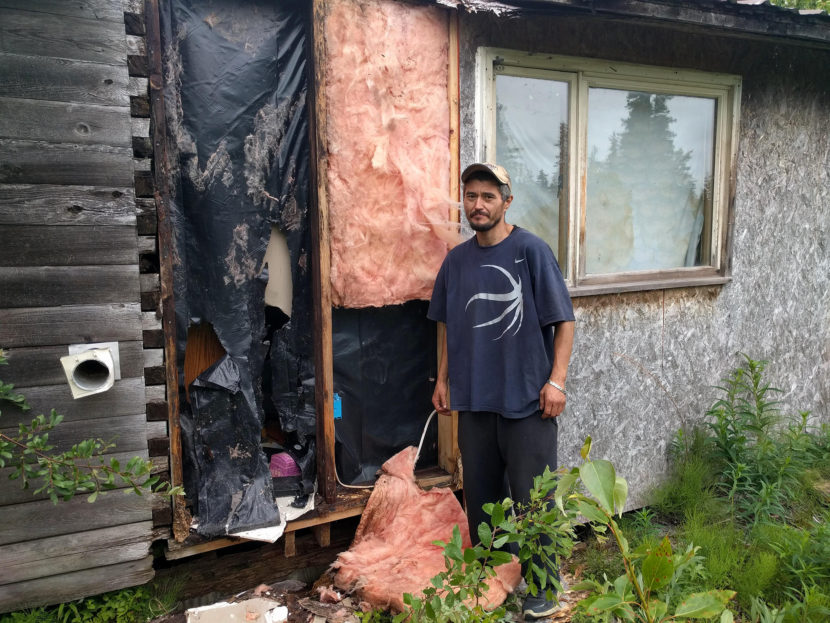
Aaron Hiratsuka stands by the damage caused by a brown bear attempting to get into his home Thursday, June 23. (Photo by Spencer Tordoff/KDLG)
At least two bears have been disturbing Dillingham residents over the past two days.
18-year-old Perez Hiratsuka was home alone taking a nap Thursday afternoon when sounds just outside the family’s wooden cabin woke her up.
“When I finally got the courage to get up and look at what’s going on because neither of my parents were home, I looked towards the door and a big thump from behind me made a move,” Hiratsuka said. “It shook the whole wall. I didn’t know what to do. I was scared to death.”
The bear tore a hole in the wall and tried to get inside. Hiratsuka grabbed an ax, left the house, and walked up to a neighbor’s house without incident. She saw the large brown bear just once, still trying to get in the hole it tore.
Perez Hiratsuka’s dad, Aaron Hiratsuka, was at the Gusty’s Yard working on a boat when he got word of the incident and began running home as fast as he could. He was grateful to Diane Folsom, who picked him up and sped him the rest of the way to his driveway.
“I got down here, and I was hollering for my daughter and she wasn’t in the house. I didn’t know she’d gone up to the neighbors,” Aaron said. “That’s when I really started getting hysterical. I was looking for any kind of blood trails, anything, you know scared, freaking out.”
Animal Control Officer Dan Boyd, who responded to the Kanakanak Road incident, said the two bears have been causing trouble in different areas of town.
“We have a bear, a small bear, that is running around in HUD, Snag Point area, out to the Harbor, that’s where it’s been it’s been headed,” Boyd said. “And this bear here has been terrorizing Bea Avenue, Arctic Boulevard, and now over here on Kanakanak Road.”
Both bears have been sighted numerous times Wednesday and Thursday. Fish and Game, State Troopers, Dillingham Police and other authorities have responded quickly to each location but haven’t said if they plan to trap or kill the nuisance bears.
Authorities are advising caution with children and pets, and recommend cleaning up anything that might attract bears into yards like trash, pet food, and especially fish guts.
Close
Update notification options
Subscribe to notifications
Subscribe
Get notifications about news related to the topics you care about. You can unsubscribe anytime.




 And of course, with this new contact came new diseases. Around 1900, measles and flu epidemics devastated the population at Kijik. The survivors moved down the lake to what is now the village of Nondalton, seeking better access to salmon runs and trading posts.