The United Fishermen of Alaska is working on a project to figure out what issues the salmon fleet is concerned about – and how to reach the commercial fishermen.
“Our goal is to get more efficient as a committee, to get more efficient as an organization, to help consolidate information, to ensure that salmon fishermen in Alaska are as informed as they want to be about what’s happening with salmon habitat,” said Lindsey Bloom, an at-large board member of UFA. “Our hunch is that they will then be engaged with decision-makers about what’s happening.”
The project developed as UFA board members noticed just how overwhelming the wide-range of salmon habitat concerns and information can be.
“There’s just so much coming at us in such a quickly changing world, that we are hoping that we can help consolidate information, distill it down, and present it and provide it to a fishermen in a way that’s more tangible and less overwhelming,” Bloom said.
The group is exploring communication to find a more tangible, less overwhelming way of presenting information.
“Communications … in some ways there’s a lot of opportunity, but we just don’t know or understand what works best for fishermen,” Bloom said. “For example, do they want to be texted to be notified about public comment periods about habitat issues, or are they active enough on social media that they’re going to get all their information that way, or how much of the fleet just wants to get something in the mail.”
To gather all that information, there’s a survey online at UFAfish.org.
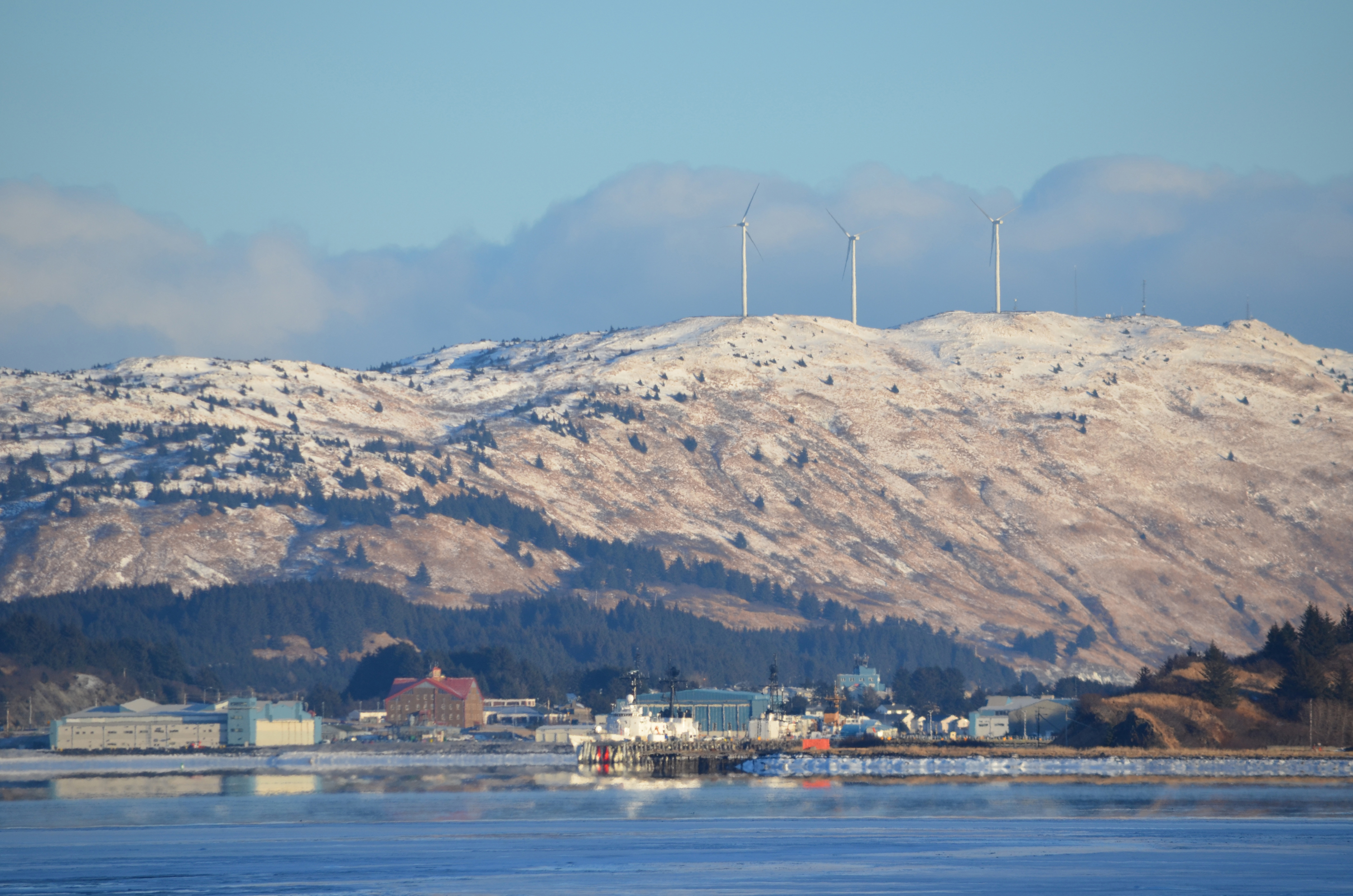
Coast Guard Base Kodiak is seen from across Women’s Bay, Dec. 31, 2011. Service members living off base have a housing allowance, which drives up local rental costs. (Creative Commons photo by James Brooks)
The Kodiak Island Borough has the highest rent in the state. That’s according to a publication from the Alaska Department of Labor & Workforce Development that looks at the cost of living in Alaska and economic trends for July 2016.
Alyssa Rodrigues, an economist with the Alaska Department of Labor and Workforce Development who works in the research and analysis section, said the Coast Guard presence may have an impact on rent in Kodiak.
“If you have a large population of people who are getting a particular allowance, it almost sets a floor. So, if someone, just for example, had a housing allowance of $2,000 a month, then most people wouldn’t want to rent for anything less than that, because they know that they can get that from someone who has that housing allowance,” she said.
She said the availability – or lack of availability – of rooms and apartments can also push up rent.
“So, if you have most of the places that are for rent already occupied, then it’s going to take more for somebody to decide that they want to open up their home or that they want to rent out that particular property, so when you have a low vacancy rate, it kind of boosts up the price as well. It just creates more competition on the demand side,” she said.
And constructing new buildings to provide more housing isn’t always the easiest solution, especially when there’s not a lot of property.
Rodrigues said that’s an area Juneau has struggled with.
“Just because of kind of the land. They have a limited amount of flat land that’s kind of easy to build on, so it’s difficult when you need additional housing to find somewhere to build it without going really far out and then perhaps people don’t really want to live so far away from the main city.”
And it’s not just rent that makes living in Kodiak expensive.
In comparison to Juneau, Fairbanks, and Anchorage, the City of Kodiak tends to be the priciest place to buy groceries. According to the publication, the U.S. average for a half gallon of whole milk is $2.25.
For the same product in Juneau, Fairbanks, and Anchorage, the half-gallon costs anywhere from $2.30 to $2.50, while for Kodiak, it’s roughly $3. Kodiak prices for other common products like bananas, orange juice, beef, and eggs are also higher on average.
Rodrigues said that’s probably in part because importation to rural Alaska is costlier than for bigger cities, like Anchorage, where there are many grocery stores and therefore more competition.
“And we just have big economies of scale, so instead of having small shipments and having to pay maybe a little bit more per pound, say, for things to come, we can load up huge barges and really capitalize on the fact that there’s just so much being shipped to one place and reduce the overall transportation cost of each individual item or per pound. That sort of thing,” she said.
It tends to drive up cost when one business holds a monopoly over a market.
Another standout statistic is that — while doctor and dentist visits are more expensive in Juneau, Fairbanks, and Anchorage than in Kodiak — the cost of veterinary exams are significantly higher.
Anchorage is the second most expensive out of the four at about $62 per visit and it costs an average of $76 per exam for Kodiak. The primary cause may be that Kodiak offers only one veterinary clinic.
In 2015, the Missouri Economic Research and Information Center rated Alaska the fourth most expensive state in the nation.
If a jet needs a little extra space landing at the Kodiak airport, the runway has just been extended — 600 feet into the ocean. But don’t expect any watery landings.
The Kodiak Daily Mirror reports airports typically extend runways for safety reasons, but geography was a challenge in Kodiak because the airport runway has a mountain on one end and the ocean on the other.
It was decided to extend the runway into the ocean, and an Engineered Material Arresting System was installed. That means if a jet does wind up using the extra 600 feet of runway, it won’t wind up in the drink.
The extended runway is made of cement blocks that will break if a plane lands on them, quickly slowing down even a large jet.
The $59 million runway project started last summer.
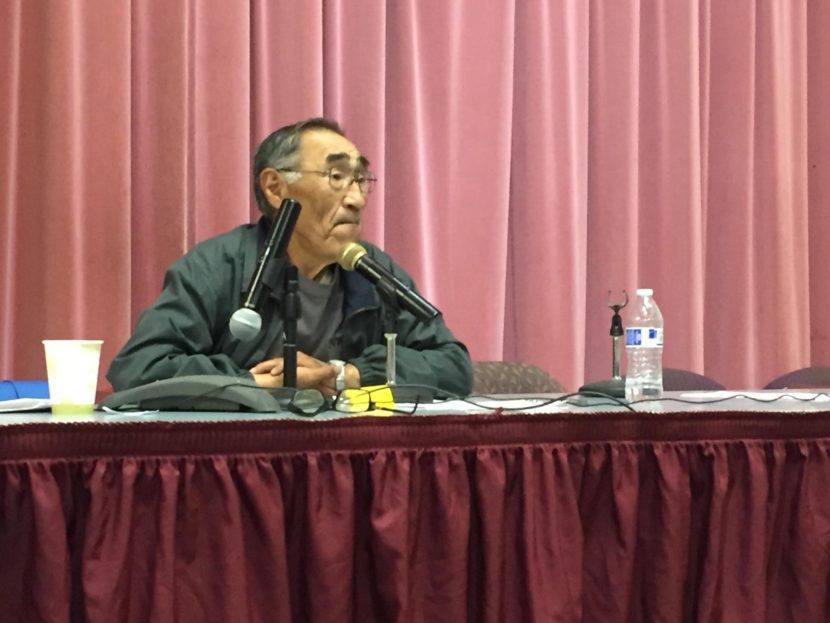
Newly appointed meeting Chair Ivan M. Ivan at the Yupiit Piciryarait Cultural Center in Bethel. (Photo by Charles Enoch/KYUK)
Tribal delegates in Bethel this week tried to hold an emergency meeting of the Association of Village Council Presidents.
They want the AVCP administration and executive board to provide answers on financial matters and respond to what some delegates see as a mismanagement of power and lack of transparency within the organization.
AVCP administration and executive board members did not attend nor sanction the meeting, which began Tuesday and ended Wednesday.
Only 13 tribes sent delegates; 38 were needed to constitute an official meeting under AVCP bylaws. For lack of quorum, the delegates are pushing their questions and demands to the October annual meeting.
AVCP acting president and legal counsel did not respond to KYUK’s emails seeking comment on the meeting.
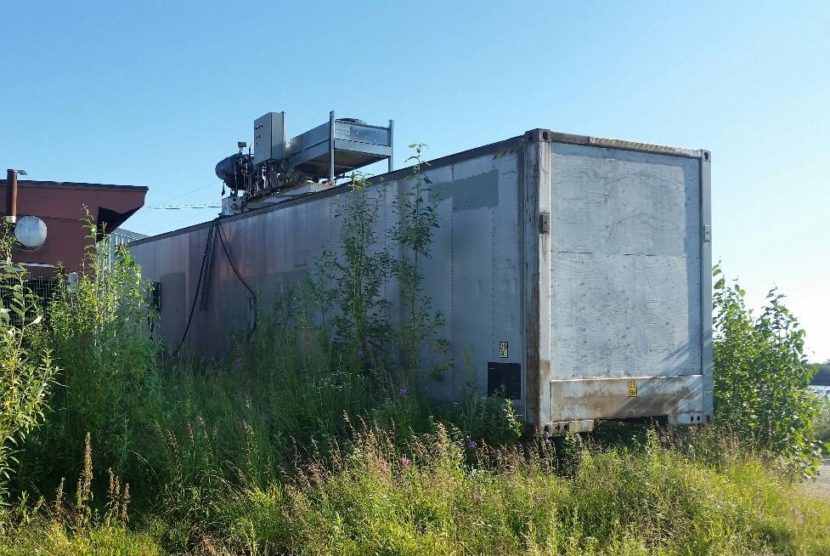
Maserculiq’s broken ice machine. (Photo by Nick P. Andrew Jr.)
The first commercial fishing opening for fall chum started Wednesday for Marshall and Russian Mission, but still no solution has been found for the villages’ broken ice machine, forcing fishermen to either stop fishing or travel 60 miles and back to the village of St. Mary’s to get ice.
Marshall’s Maserculiq Native Corp. owns the machine but has made no effort to fix it since the compressor quit working two weeks ago. Replacing the part would cost $15,000.
Ten fishermen testified at the Maserculiq monthly board meeting Tuesday, asking the corporation to replace or repair the ice maker’s compressor. One of the fishermen was Nick P. Andrew Jr.
“Majority of the fishermen stated lost fishing time, used the words ‘affecting the economy,’ and basically stating that for a lot of fishermen this is their only income opportunity,” Andrew said.
Andrew is also the Marshall tribal administrator and said he’s applying for a grant to buy a new machine that would be owned and operated by the tribe. If awarded, the grant he’s considering would deliver in fiscal year 2018.
Maserculiq board member Lena Sergie said the corporation is trying to find ways to purchase a new ice machine but haven’t solidified anything so far.
St. Mary’s-based Boreal Fisheries can buy the chum, but only with the right ice. Owners Randy and Edna Crawford won’t send a boat to pick up the fish unless it’s in flake ice, which fishermen can’t make at home and which Edna calls a necessary industry standard.
“It has to be flake ice,” Edna Crawford said, “because that’s the only way you’re going to keep the temperature of the fish down, especially with the weather we’ve had over here.”
Since the machine broke, Marshall commercial fisherman Leonard Fitka Sr. has missed two fishing openings. He’s been boating the four and a half hours to fetch ice and fears the trips are unsustainable.
“Fishermen are working harder, staying up longer, (spending) more time away from family. It’s hurting the economy,” Fitka said.
Fishermen in Russian Mission travel even further for ice. Myron Edwards, a commercial fisherman there, said with gas over $4 a gallon he won’t make a profit, and he doesn’t know when he’s going to fish next.
“We’re not too sure how we’re going to do this,” Edwards said. “Some of us don’t have enough money to pay for gas to pitch in for one boat to go all the way up to Boreal to pick up ice.”
The Crawfords, who own Boreal, have known the commercial fishermen in Marshall and Russian Mission for decades and have built a close relationship with them. Boreal has provided free labor multiple times to fix their ice machine, and last year the Crawfords donated a generator. They run a small operation and Randy Crawford said they’ve done all they can.
“Edna and I are really frustrated because we’ve put so much effort into it, and we can give no more,” he said.
Boreal pays an average of $400,000 a year to Marshall fishermen. Randy said it’s an important part of the Marshall economy and he wants Maserculiq to invest in its community.
Marshall commercial fisherman Nick Andrew Jr. had sent letters to shareholders and fishermen in Marshall and Russian Mission asking them to attend Tuesday’s meeting.
“We are imploring the village corporation for them to take ownership and invest in the ice machine,” Andrew said.
The Maserculiq CEO and board members did not respond to KYUK’s emails asking about the machine.
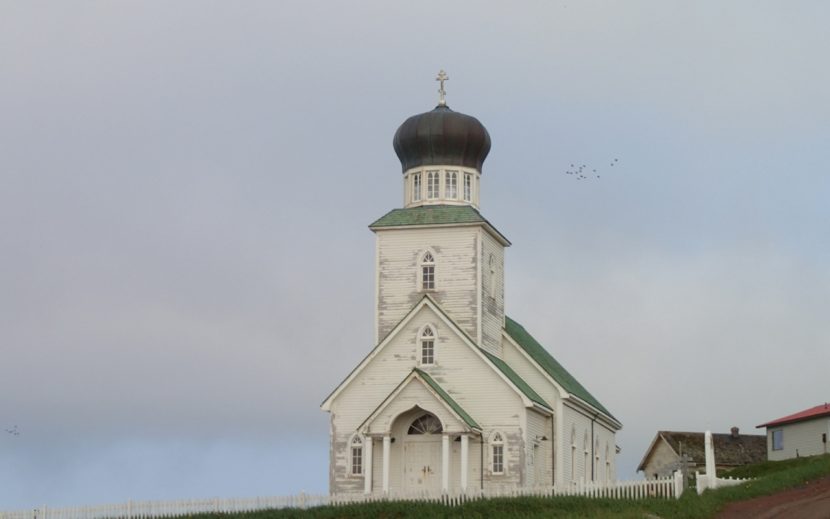
The Russian Orthodox Church on St. George Island in August 2012. (Creative Commons photo by D. Sikes)
St. George Island is taking steps to protect the marine environment in their backyard. The city council passed a resolution earlier this month that could establish a National Marine Sanctuary. Eighty people live on the island of St. George. They’re primarily Unangan and many rely on ocean resources for subsistence.
Mayor Patrick Pletnikoff says over the past five years the community has noticed a significant decline in the population of fur seals and seabirds and they need to take action now.
“There is no need to extract everything in the Bering Sea or get it down to the point where animals such as seals and seabirds can’t sustain themselves,” Pletnikoff said. “I mean, when you start seeing these kinds of die-offs you wonder if we may have allowed it to go too far without saying anything about it.”
Pletnikoff says the first step is to raise money and hire experts who will help decipher research done in the area by government agencies like the U.S. Fish and Wildlife Service and the National Marine Fisheries Service.
Then, the city will look at how best to safeguard the ocean resources. Right now, they’re considering applying for federal marine sanctuary status that would offer the area some level of protection.
“It at least makes all stakeholders have a seat at the table,” Pletnikoff said. “Everybody that has any interest in what we’re thinking about doing is welcome to that table to sit down and discuss it with us.”
The transparency of applying for marine sanctuary status appeals to Pletnikoff. Plus, he says it would protect the marine environment without automatically prohibiting fishing or reconstructing the island’s port.
Close
Update notification options
Subscribe to notifications
Subscribe
Get notifications about news related to the topics you care about. You can unsubscribe anytime.