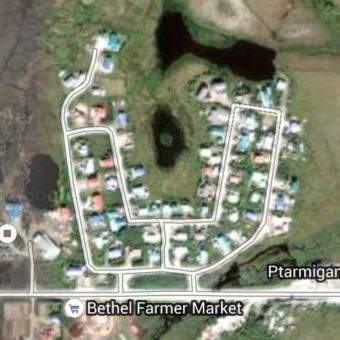
Bethel Police arrested after a 31-hour standoff with a man who barricaded himself with children inside his home.
According to a press release from the Bethel Police Department, officers received a call just after 7:40 p.m. Friday, saying a man was threatening to shoot himself with children inside his residence in Bethel’s Uivik Subdivision.
Police arrived on the scene where they found the children already outside. One of the children identified the armed male as 34-year-old Dennis Hensley Jr. The child confirmed that Hensley had been discharging his gun inside the residence.
Police allege that Hensley threatened over the phone to murder the police, his wife, family and himself. According to a news release, he started discharging a gun, saying he would shoot the police then himself if the police came to the door
Bethel Police called Alaska State Troopers for assistance. The unit responded, bringing in their negotiator.
When efforts to get Hensley to vacate his home failed, troopers flew in their Special Emergency Response Team from Fairbanks Saturday.
After 31 hours, Sunday just after 1:30 a.m., Troopers say Hensley came out of his home and was taken in by the SERT after a lengthy negotiation. He was turned over to Bethel Police and arrested without incident. Police took Hensley to the Yukon-Kuskokwim Correctional Center in Bethel on an arrest warrant of six counts of assault in the third degree and one count of coercion.
The City of Bethel is working to correct its real estate sales tax and distribute refunds after accidentally overcharging people for more than a decade.
Patty Burley, city attorney, recently discovered the problem and says the city overcharged 163 transactions, collecting $100,076.08 in excess charges since 2002.
Burley says the most the city could have overcharged someone is $1,200.
In 2002, the Bethel city council voted to reduce the portion of money the city taxes when someone buys or sells real estate in Bethel.
At the time, the city taxed 20 percent of a real estate’s selling price up to $375,000. Anything over that amount wasn’t taxed.
The revised ordinance reduced the cap to $275,000, but when the city published the tax code the change never made it to the books.
Burley says the city is working to right its wrong. Anyone overcharged will receive a refund with interest at 3.5 percent compounded annually.
Burley says those affected can start applying for refunds starting April 13 when the city posts the claim forms on their website and makes them available at the finance office in city hall. The city is also contacting title companies to distribute the claim documents.
City Council will address an ordinance at its March 22 meeting to correct the city’s typo, authorize the refund program, and modify the budget to accommodate the returns.
“I voted,” in Yugtun and English. (Screenshot courtesy of KYUK)
The City of Bethel is looking into replacing voting at the polls with voting by mail to increase voter turnout for local elections.
According to the proposal, Bethel’s turnout for local elections has remained less than 25 percent over the last four years. Councilman Chuck Herman introduced the measure at Tuesday’s city council meeting.
“The idea behind by mail elections is three weeks or a month before the election ballots are mailed to all registered voters. They need to return them to the mail or a designated spot. These are details that would be worked out,” Herman said.
Herman cited a study published in 2000 in the journal Political Behavior. The authors compared voter turnout by mail to turnout at the polls in Oregon over a 14-year period and found an almost 27 percent increase in voter participation in local elections after the state switched to mailed ballots—a jump from about 19 percent turnout at the polls to about 45 percent turnout via mail.
Herman says mailed elections could make voting in Bethel more routine, producing similar outcomes. He says the change could also lead to other benefits like increasing time voters spend researching issues and decreasing election costs through eliminating staff time at polling stations.
Councilman Leif Albertson opposed the change, saying Bethel’s current system doesn’t disenfranchise voters and that the journal article Herman cited says that voting by mail doesn’t increase the types of people voting; it just increases participation among people who would already vote but choose not to.
But Alberton’s biggest concern is that voting by mail could diminish a ballot’s integrity through voter fraud, misdelivery or coercion.
“No matter what you tell people, when you go into that booth you’re protected and can make a free decision. And I think that’s really important to preserve,” Albertson said.
Mayor Rick Robb also opposed the measure, saying the city already has a system of early voting in addition to poll voting, and he doesn’t want the clerk to spend time changing a system that he says he likes.
“I personally enjoy the great American tradition of going to the polls on Tuesdays,” Robb said. “I personally think it’s one of the great benefits of democracy, and by going to the polls, it gives interested people the opportunity to go and demonstrate their democratic rights.”
Herman countered, saying though some people enjoy going to the polls that doesn’t outweigh the fact that most people aren’t going and that going to city hall for early voting still makes voters step outside their routines.
“I think this would go a long way toward getting more involvement from our community, and I think with more community involvement we have more community buy-in; we have better governance; we have better understanding of governance; and I think we’ll have a better local government and community,” Herman said.
The council will consider the issue again in May when the city clerk is expected to present further research on the matter.
Dillingham Police hope the public will lead them to whoever fired at an officer during a brief car chase that ended near the landfill on Waskey Road early Sunday morning. Police describe the suspect as a thin male who was wearing white bunny boots, and the truck as an older model pickup, possibly a Dodge, with tinted windows. KDLG’s Dave Bendinger has more details.
Officer Leighton Cox, a transfer from Hawaii who has been with DPD for a little less than a year, was attempting to pull over a truck near the intersection of Waskey and Wood River Roads at a little past 5:00 a.m. Sunday.
“He was going to conduct a traffic stop on Waskey Road,” said Sgt. Rodney Etheridge, “and he turned on his overhead lights, and the vehicle that he was trying to stop, didn’t stop. [The truck] continued driving down Waskey Road, picked up speed, in excess of the speed limit. Eventually, it slowed down in front of the Landfill Road. Slowed down to kind of a rolling stop, two people jumped out, and one of them fired two shots at his vehicle.”
Those two shots hit the hood of the police cruiser, right in line with the driver’s side. Neither the vehicle nor Officer Cox was harmed by what appeared to be small caliber rounds fired from about 60 yards away.
The two individuals headed off through the woods to the north of Waskey, and the truck continued onto Lake Road and turned north. There was another on-duty officer who responded as backup. Police couldn’t find the two individuals on foot or the truck.
By Monday afternoon, Etheridge said DPD did not have much information yet, but he anticipates they will track down their suspects.
“I feel like the public isn’t going to stand for this to happen. This isn’t the type of the thing that we want to accept in our community,” he said. “Also, we know that there were other people involved in this incident that weren’t the shooter. If those people are listening … I’ll make sure that if you haven’t come forward by the time we find the shooter, you’re going to be in the same situation that he’s in. So, it’d be in their best interest to come forward.”
It’s been quite some time since a DPD officer came under fire though several shootings at or towards VPSOs in the region have been reported more recently (including the murder of unarmed VPSO Tom Madole in Manokotak three years ago). Dillingham police wear bulletproof vests, but the vehicles offer no added protection. Police are at a disadvantage, said Sgt. Etheridge, when they are having to react in these unpredictable situations.
“We’re all very vigilant and try to stay ready for that to happen, but you just don’t expect that people in our community are going to try to do that to us. It angers me that this happened, and we’re going to find out who this was,” he said.
DPD is working with some information about the incident it has not released publicly, but Sgt. Etheridge said it will still probably take the public’s help to track the suspect(s).
Again the shooter is suspect is described as a thin male about six feet tall, who was wearing white bunny boots, snow pants, and a dark colored jacket. The truck was described as a dark color older model full size, possibly a Dodge, with tinted windows. You can reach the Dillingham Police Dept. at 842-5354.
As legislators make cuts to the state’s budget, they’re looking to draw money from various state funds to cover costs. But changes drawing money from the fund to help rural Alaskans pay utility bills – and cutting money to local governments — are raising concerns.
The House Finance Committee is considering a budget bill that would cut state government spending $418 million more than the $100 million in cuts Gov. Bill Walker proposed.
House Bill 256 would change the source of funding for two budget items. A $76.7 million payment to the Teachers’ Retirement System would be paid from a fund for college scholarships and grants.
And $24.7 million for the University of Alaska would come from the Power Cost Equalization Fund, rather than the operating budget.
Big Lake Republican Rep. Mark Neuman said the proposal draws on available funds to meet the committee’s priority: balancing the state’s budget. Neuman is the committee’s co-chairman.
Rep. Mark Neuman, R-Big Lake, at a House Majority press availability, Jan. 22. (Photo by Skip Gray/360 North)
“We’re still in the first innings here,” Neuman said. “We’re trying to make sure we’re setting up the budget for the final decisions that we have to do.”
The Teachers’ Retirement System would receive money from the Higher Education Investment Fund, which was started four years ago with $400 million. It was launched to fund Alaska Education Grants, which are for post-secondary students with unmet financial needs and Alaska Performance Scholarships for students with high grades.
If the state draws out similar amounts annually to the proposed $76.7 million, the fund would be exhausted in a few years. Neuman said he expects all current grant and scholarship recipients to continue to receive the money.
The $24.7 million for the university is a small share of the overall $900 million Power Cost Equalization Fund.
But the proposal concerns Newhalen resident Evelynn Trefon. She’s a board member for a small regional electric co-op, whose customers benefit roughly $90 per month from cost equalization.
“Power cost equalization was set aside as a fund to help rural Alaskans and it wasn’t designed to help the University of Alaska,” Trefon said. “They need to look at the budget situation and figure out their own source of revenue funding. And power cost equalization is essential for rural Alaskans.”
Neuman said drawing money for the university this year shouldn’t have any effect on PCE payments.
“This was excess funds. It’s funds that weren’t needed to make the mandatory, statutory payment for power cost equalization,” he said. “It has no effect on paying PCE or any future payments.”
The House Finance Committee also cut a $35 million payment that Walker planned for community revenue sharing. If this change is kept, it would be the second straight year that the state didn’t add money to the revenue sharing program.
Without more money, the program fund would be so low that there could be no revenue sharing in two years.
Alaska Municipal League Executive Director Kathie Wasserman is concerned about the issue. She noted that rural areas depend on the money to provide basic services.
“The large communities – it will impact them. The small communities, it could devastate,” Wasserman said. “And then, when you look at the other cost shifting that is going on, due to the budget crunch that we have, I’m not sure how some municipalities are going to make it through.”
Neuman said he’s aware of the concern, and the committee would like to make changes that would make revenue sharing more secure.
“Everything is on the table right now,” he said. “I’m certainly cognizant of the needs of a lot of the communities in the state of Alaska, particularly the small, rural villages across Alaska, and their ability to do their governmental functions. And, yes, we’re certainly taking those under consideration.”
The committee also cut $25 million from the Public Employee Retirement System. That money could be restored in the next week based on the details of a state actuarial analysis of the pension obligations.
And it proposed a cut of roughly $25 million for the AKLNG pipeline project. Committee members want more details about how the money would be spent before budgeting it. Walker asked for the money to prepare the pipeline’s front-end engineering and design work.
This week, the committee has been hearing public testimony on the budget from residents statewide, ahead of a vote on the budget. It would then head to a vote by the full House before being considered by the Senate.
A crowd representing a variety of interests gathered in the House Finance Committee room during public testimony on the state budget, Feb, 29, 2016. (Photo by Skip Gray/360 North)
Alaskans giving public testimony this week on the House’s budget proposal oppose cuts to many areas.
The Republican-led majority released a budget proposal this week that included $145 million more in cuts than Gov. Bill Walker’s budget. It would reduce spending on everything from public libraries to senior benefits.
Roughly 100 people testified Monday and Tuesday on the budget.
The cuts include reduced grants to mental health and addiction treatment programs.
Residents also opposed cuts to prekindergarten, public libraries and the University of Alaska. And they said they want the House to avoid cuts to senior benefits and public broadcasting.
Juneau resident Kara Nelson directs Haven House, a faith-based home for women leaving prison. She opposed cuts to behavioral health grants.
“There are over 120 people today alone that died from an accidental overdose in our nation,” Nelson said. “That is an Alaska Airlines flight that died every single day, and that was in 2015. And so I urge you that we are trying to lessen the beds in our prisons, but we have no supports already to support the well-being of our people.”
Elizabeth Ripley, executive director of the Mat-Su Health Foundation, shared her concerns over behavioral health cuts.
“Cutting behavioral health grants will only reinforce the current system that drives people to seek care in the emergency room,” Ripley said. “A 2013 data analysis shows that Mat-Su Regional Emergency Department had five times the number of visits than our community mental health center. These visits to one hospital cost Alaskans $23 million in 2013, not including doctor, EMS or police costs.”
Kodiak Public Library Director Katie Baxter urged House Finance Committee members to restore funding for the Online With Libraries, or OWL, program. It funds high-speed internet connections and receives federal funds — known as E-Rate — that match state contributions.
“I am here to urge you to restore the governor’s funding of $761,800 to restore the OWL internet connectivity program,” Baxter said. “This program is an intricate system that is cost efficient that involves local and federal funding. By eliminating the OWL program as the house subcommittee has done, now we are leaving federal E-Rate dollars on the table. And I for one really don’t want to do that.”
The House Finance Committee will hear more public testimony Wednesday and Thursday.
Close
Update notification options
Subscribe to notifications
Subscribe
Get notifications about news related to the topics you care about. You can unsubscribe anytime.