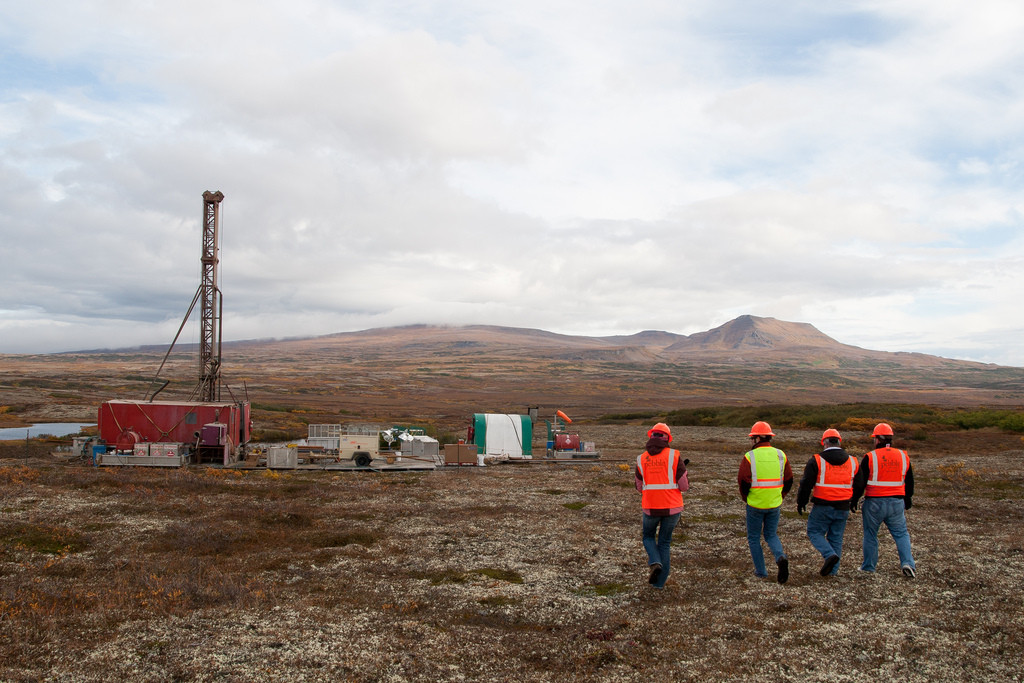
Members of the media walking to an exploratory drill rig at the Pebble Mine Exploratory site. (Photo by Jason Sear/ KDLG)
The Environmental Protection Agency’s inspector general has concluded that the agency did not treat the Pebble project unfairly when it issued a controversial document detrimental to the mine.
“Based on the information available to us, we found no evidence of bias in how the Environmental Protection Agency conducted its Bristol Bay watershed assessment, or that the Environmental Protection Agency pre-determined the assessment outcome to enable them to initiate a Clean Water Act Section 404(c) process,” Randy Holthaus, a member of the inspector general’s team, said.
But, the report does find fault with one Alaska-based Environmental Protection Agency employee.
Holthaus, from the IG’s office, says the ecologist, who retired in 2013, failed to remain impartial because he helped tribes fighting the mine craft their request to the Environmental Protection Agency.
“We found that the employee used personal, non-governmental email to provide comments on a draft Clean Water Act Section 404(c) petition from the tribes before the tribes submitted it to the Environmental Protection Agency,” Holthaus said. “This action was a possible misuse of position.”
The report says they were unable to review about two years of the employee’s emails.
The Environmental Protection Agency employee, Phil North, of Kenai, was the technical lead on the assessment. North had planned to sail around the world for two years after his 2013 retirement. Pebble wants to compel him to testify on its lawsuit against the government, but its lawyers can’t find him. He is said to be living in Australia or New Zealand.
A Pebble representative called the report a whitewash and said the scope of the IG’s investigation was too narrow.
In late December, the Association of Village Council Presidents laid off 30 employees. AVCP has made no official statement about why the layoffs occurred, but documents obtained by KYUK illustrate misappropriation of federal grant dollars spanning nearly a decade.
The week before Christmas the Association of Village Council Presidents abruptly laid off 30 employees– about seven percent of their workforce.
In a press release, AVCP cited current economic trends.
But, confidential documents obtained by KYUK through a former AVCP employee illustrate years of mishandling of grants to fund administrative salaries and workforce programs.
The money is from AVCP’s Temporary Assistance for Needy Families fund, or TANF. TANF is a federal program under the Dept. of Health and Human Services, aimed at helping economically disadvantaged families.
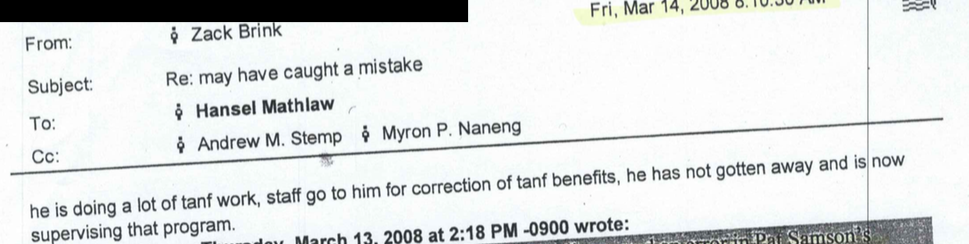
Email transcripts from 2008 show then-AVCP grants compliance officer, Hansel Mathlaw, raising concerns after a financial report revealed 25-percent of AVCP’s Social Services Director Pat Samson’s salary was being paid with TANF funds.
Samson didn’t work for the TANF program, but then-AVCP Vice President Zach Brink responded to Mathlaw’s email saying, “he [Pat Samson] has done a lot of tanf [sic] work.”
Documents indicate Samson’s salary was more than $96,000 at the time.
Email correspondence regarding Pat Samson’s salary.
Samson left AVCP a few years ago, citing exhaustion. He worked for the department for more than two decades.
“I did not work for any TANF programs,” Samson said, adding he wasn’t aware that’s how his salary was paid for.
AVCP’s Myron Naneng addresses the panel at the Chinook Symposium in Anchorage. (KYUK file photo)
Then, in 2009, AVCP President Myron Naneng and the nonprofit’s senior chairperson formally requested the organization use up to “$500,000 each year in TANF funds to sustain” the corporation’s aircraft maintenance and flight school.
Former AVCP TANF director Jolene Geerhart, says the request was denied by a federal agent.
But, between 2010 and 2011 at least three checks totaling $250,000 each went from the AVCP TANF account to fund the flight school.
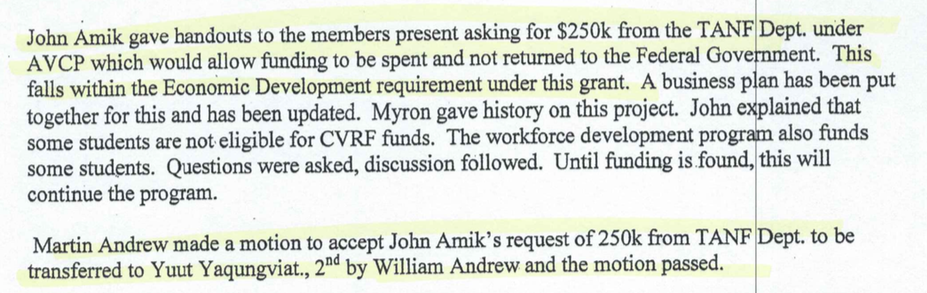
Minutes from a 2010 board meeting show that John Amik, the flight school’s director, asked the board for the funds. According to minutes, he said the money “would allow funding to be spent and not returned to the Federal Government. This falls in line with the Economic Development requirement under this grant.”
Email correspondence regarding Pat Samson’s salary.
In 2010, Larry Barnes, then-AVCP vice president of finance, wrote in an email that the “federal TANF agency has reimbursed AVCP for the funds, and that the monies will cover operational costs that student revenue won’t cover.”
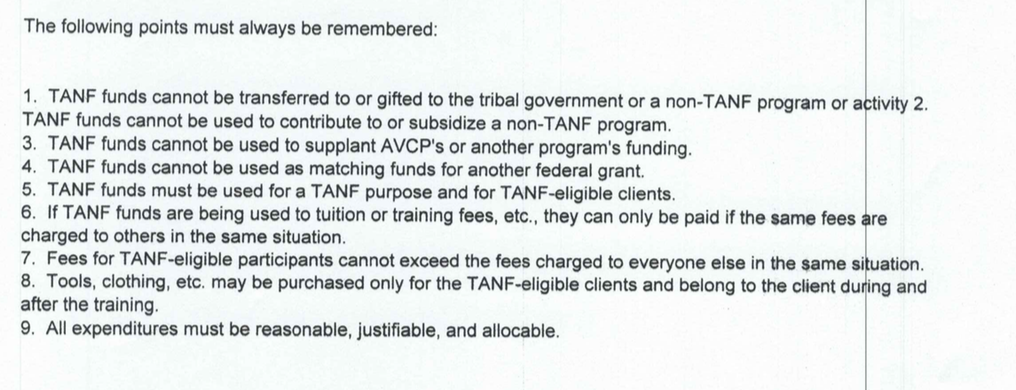
But, federal directors repeatedly told AVCP administrators that TANF monies couldn’t be used to fund the school’s operating costs.
Screenshot of email transcript regarding appropriate uses of federal TANF money, sent from former Tribal TANF Region X Program Specialist Judy Ogliore to former AVCP Director Lynn Kassman, and later forwarded to Jolene Geerhart.
Geerhart was the AVCP TANF program director from 2010-2013. She says during her time at least two of these checks were signed.
“There were checks that [were] made out, but I didn’t authorize those monies,” Geerhart said.”
Geerhart says she started digging into previous years, and estimates the amount of TANF money used to fund the flight school is much higher than $750,000.
“What I found,” she said, “it was a little more than a million dollars while I was the director. It was $500,000 total two separate times.”
In mid-2011 AVCP grants compliance officer, Hansel Mathlaw, raised concerns about the use of TANF child support money. Larry Barnes, then-AVCP Vice President of Finance, addressed Mathlaw’s concerns, writing, “unspent child support funding was deemed unrestricted funding, because there were no reporting requirements tied to prior year funds.”
It’s unclear what AVCP used the funds for, but Geerhart says unused federal TANF funds rollover; they don’t just become a free-for-all. State TANF funds don’t rollover either, and if not used, have to be returned.
Geerhart says it’s hard to misuse federal TANF grant money–there is extensive training, and even annual conferences directors can attend.
“I’m pretty sure the past director and deputy director would’ve advised them [of] the correct use of TANF monies,” Geerhart said. “The TANF program has been with AVCP since 2000, or shortly before that.”
During that same month, Naneng awarded the TANF department the, ‘Department of the Year Award.’
As the director of AVCP’s TANF program Geerhart says she repeatedly raised concerns about the use of TANF monies to her superiors, Naneng and AVCP Vice President Mike Hoffman. In one particular meeting with Naneng, Geerheart says he dismissed her concerns.
“I really didn’t appreciate that kind of response, because my concerns, to me, were really important misuse of TANF monies,” she said.
On a different occasion, she says she was asked to resubmit the letter Naneng sent to TANF in 2009. When a federal TANF representative told her the funds couldn’t be used to cover flight school operating costs, she applied for funds to cover school tuition for TANF-eligible students.
Email transcripts show that this is allowed, but Geerhart says when she looked over the paperwork, the number of TANF eligible students in the program compared to the amount of TANF funds taken didn’t match up.
Geerhart was fired from AVCP in early 2013. She says her supervisor, Hoffman, told her it was due to insubordination.
“I continued to let my supervisor know these are inappropriate uses and it needs to stop,” Geerhart said, ” and I believe I was terminated because I didn’t stop and keep my mouth quiet and walk away and let it continue to happen.”
Later that year, the flight school, which had been open for about a decade, shut down due to what Naneng described as “diminished federal funding and high operational costs.”
A spokesman from the federal TANF departments says they are currently not investigating AVCP regarding the misuse of funds and did not respond to any further questions.
After more than a dozen interview requests, Naneng declined to comment and referred all questions to Hoffman. Hoffman declined to comment as well.
Now, less than a year after Naneng’s reelection as AVCP president, leaders of four Unit 4 village tribes-Akiak, Akiakchak, Kwethluk and Tuluksak, are calling for a special meeting ahead of the annual conference, an investigation into AVCP and for the organization’s top directors to be placed on administrative leave.
Mike Williams is the leader of the Yupiit Nation, and helped draft the resolution.
“They need more explanation rather than [saying it’s] because of economic conditions,” Williams said. He says tribes just want to see the region working together.
If there’s no response from AVCP by Jan. 15, the proposed resolution calls for Naneng’s resignation.
Williams says tribal leaders who filed the resolution are still waiting to hear back.
Passengers disembark the ferry Malaspina in Skagway during its 50th anniversary sailing. Most ferry fares went up Jan. 1. (Photo by Mikko Wilson/360 North)
Ferry fares went up 5 percent for most routes Jan. 1. The hike comes on the heels of a 4.5 percent increase that began in May. The increase is for new reservations. Those made before January will not change.
Alaska Marine Highway spokesman Jeremy Woodrow says higher fares are part of a larger effort to increase earnings and decrease expenses.
“The marine highway system’s cost recovery for its revenues is much lower than it has been in the past. If you look at the fact that the fares have not been increased in the last seven to eight years, that can be one reason to point to that,” he says.
Low oil prices drove service cuts already in place for the winter. More extreme reductions listed in the governor’s budget are slated for July. The legislature could cut service further.
The Alaska Marine Highway ferry Taku sails into Wrangell Narrows off Petersburg. (Photo by Ed Schoenfeld/Coastalaska)
Not all marine highway routes are seeing price hikes.
Woodrow says those that are disproportionately higher will remain the same, at least for now.
“Once we are closer to that, the marine highway system can begin formalizing its rates based on route mileage, ridership, as well as … embarking and disembarking fees and have a more formalized system,” he says.
The increases stem in part from a rate study released a little more than a year ago.
The new fares are integrated into the marine highway’s reservations system, though no full list has been published.
The higher fares coincide with an adjustment to the system’s reservation policy. Customers must now pay a minimum $20 fee for any change made within two weeks of sailing.
Woodrow says it closes a loophole.
“That loophole allowed customers to pre-book travel and continue to move that travel back to later dates without having a cancellation fee or change fee. And it withholds that space from other customers who would otherwise use that space on the ferry,” he says.
A set of new cancellation fees ranging from 5 to 40 percent of a ticket’s value took effect Oct. 1.
Bethel Police Department Sgt. Amy Davis is leading the investigation and is says the case reopened in early June 2014. Around the same time, the Yukon-Kuskokwim Health Corporation, which oversees the treatment center, offered a $20,000 reward to anyone with information.
Fire marshals eventually ruled that the cause of fire was “undetermined.” But now, Davis says she has suspects. Davis declined to be recorded but said she’d “like to get this solved.”
The new Yup’ik Bible, ‘Tanqilriit Igat,’ as it’s displayed at the Bethel Moravian Bookstore. (Photo by Charles Enoch/KYUK)
The Holy Bible is now available in the modern Yup’ik orthography after nearly half a century of work put in by fluent Yup’ik speakers in the area and the American Bible Society.
“Psalms 119:115- Thy word is a lamp unto my feet and a light unto my path. Qaneryararpet kenuratun ciuliqagtaatnga tanqigiluku tumkaqa tamalkuan,” reads Bethel elder Elsie Jimmie.
For the last six years Jimmie, or Iingicaq in Yup’ik, was part of the team that completed the conversion of the Holy Bible, or Tanqilriit Igat, into the newer and much easier to read Yup’ik orthography that was developed by linguist Steven Jacobson in the 1980s.
Jacobson’s Yup’ik textbooks and dictionaries are in use in the Lower Kuskokwim School District schools that teach the Yup’ik language to their students. That was a primary motivator for the elders, says Moravian pastor Jones Anaver of Kwigillingok.
“We wanted the youngest of our generation to be able to read and fully appreciate the Holy Bible,” said Anaver.
Anaver says the first missionaries translated the New Testament into an early form of Yup’ik writing that had no guidelines other than how it would sound using English writing rules. At that time, they did not translate the Old Testament.
The team translated the Old Testament into Yup’ik based off the Revised Standard Version of the Bible, and they rewrote the New Testament using modern Yup’ik Orthography.
Jimmie says the early translations took more learning to read.
“My father taught me to read the bible’s early Yup’ik translations after I learned English. In my experience, the new orthography is much easier to use and learn,” said Jimmie.
Jimmie says before the new bible was available she used to bring an English bible along with her Yup’ik one for reference when going to church events in other villages, in case she had trouble understanding the old Yup’ik one, which was often the case for those who relied on the first translations.
According to a letter to the Delta Discovery by the late Reverend Peter Greene, who died earlier this year, the project started in 1971 with pastors Teddy Brink and Peter Andrews under the guidance of the American Bible Society.
The American Bible Society did not respond to inquiries at the time this story was written.
Jimmie says some elders who participated died, leaving their work unfinished.
“When people pass away, we would keep their translations and others would rise to continue the work. Most recently, Peter Green, Jones Anaver, Jacob Nelson and I made the last push to finish the project,” said Jimmie.
Green and Nelson both died this year. Jimmie says wherever they are, they and the many others who helped can now rest assured with their goals achieved.
“An elderly man who couldn’t read or write called me some time after the project was completed. He was very happy the Bible was converted into the modern Yup’ik style because his grandchildren now fluently read and teach the Old Testament to him,” said Jimmie.
The new Yup’ik Bible was celebrated at the Bethel Moravian Church last October, and it is sold at the Moravian Bookstore in Bethel.
KYUK contacted the Bethel Moravian Church for information but they declined to interview.
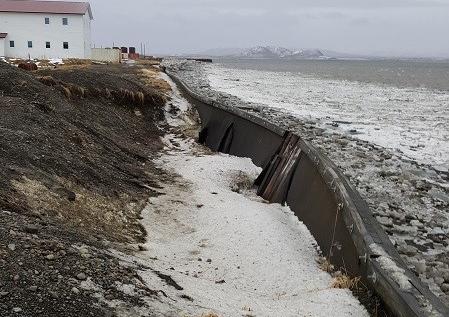
With the bay not freezing the last three winters, storms have ripped earth away from the Togiak seawall. “It’s starting to collapse,” said city administrator Darryl Thompson after two harsh storms slammed the coast in less than a week. (Photo courtesy of City of Togiak)
A pretty good blow passed through Bristol Bay Tuesday night and Wednesday morning, leaving minor damage and some power outages in its wake. Eastside communities had sustained winds around 60 to 70 mph, with gusts over 100 mph, through the overnight hours.
The system intensified as it crossed the Bay toward the northern coastline, the southeast winds arriving with the morning high tide.
The extreme winds passed through the area by early Wednesday afternoon, but gusty southwest winds of 50 to 65 mph were still in the forecast till the evening. The National Weather Service kept a high surf advisory in place until 4 p.m.
How hard did the wind blow during the storm? The National Weather Service tracked the conditions and recorded the highest gusts. KDLG News spoke with NWS Anchorage chief meteorologist Sam Albanese Wednesday morning around 8 a.m. He said the highest wind speeds were recorded at notoriously windy stations.
The Orthodox Church in Kokhanok sustained damage to the siding, roof, and cemetery. One of the steeples was missing in the morning. (Photo by Gary Nielsen)
“Coville, kind of due east of King Salmon, in the Aleutian Range up in Katmai National Park, peaked out at 108 miles an hour overnight. Another one to note was Pfaff Mine, a little higher up in elevation at 2000 feet. They were 101 miles an hour. Then there’s Fourpeaked, which is on the Shelikof side of the mountains. They’re at 1000 feet in elevation, and peaked out at 122 miles an hour.”
Those strong winds from Pfaff Mine were funneling right down through to communities on the south shore of Iliamna Lake. Kokhanok’s Gary Nielsen offered an update Wednesday morning.
“It was a wild night last night,” he said. “Conservative estimate would be 100 to 120 miles an hour out of the east. We didn’t get to bed till three or four I guess, waiting on the roof to go, but it didn’t go, thank goodness. There was a meter base or two ripped off the wall, leaving some houses without power. Several skiffs flipped over, some were damaged. Trees were knocked down. My son was down at his house last night and the top of a tree broke off and just narrowly missed him, about 20 foot of tree.”
One stack of containers at the Dillingham dock tipped as south winds pummeled Bristol Bay’s northern coast Wednesday morning. (Photo courtesy of KDLG)
As the storm blew west across the Bay, it hit the coastline just as the tide was up.
“We had a pretty good tide this morning, with the winds behind it, cause the winds came out of the south instead of the east,” said Dillingham harbor master Jean Barret, assessing the situation at sunrise. “That pushes everything up into the harbor, and I imagine all the ice has probably turned into slush.”
Around 10 a.m. several containers at the dock were blown over, and the City asked residents to steer clear of the area. Crews were working to set those up right Tuesday morning.
“I would imagine they’re all empty containers because we don’t keep anything in them in the wintertime,” said Barrett, not expecting much damage.
But in Togiak, the winds and surge of water and ice have wreaked havoc on the seawall. City administrator Darryl Thompson said while some of the problems began during last year’s similarly warm winter, this storm and the one on Christmas Day have caused major new damage.
“For about a thousand feet of our seawall, on the north end of town, the beach has eroded away and the gravel is gone. One tide, in one storm at 70 knots, took out 3 feet of gravel from in front of the seawall. Basically, it is starting to collapse,” he said.
Thompson was filling out state forms to declare a disaster situation and said the community is not safe without a functioning seawall. Repairing it will be costly.
“I’m thinking right now $2 million would be a start,” he said. “The gravel has moved from the north half of the village to the south half, and it’s buried the south seawall. That we can reclaim by bulldozing out that material and exposing the base again. But the beach that used to be on the north side of the village is basically gone. This seawall has been here 30 years, and it’s held up really well, and we were pretty proud of it.”
Power was out Wednesday morning and utilities were running on backup generators. School buses were pre-positioned to evacuate residents to higher ground if necessary. The tide Wednesday evening will be larger, and Togiak is keeping emergency resources ready.
Other communities reported minor damage with a few windows out, trees down, parts of roofing pulled off, and fluctuating power.
Close
Update notification options
Subscribe to notifications
Subscribe
Get notifications about news related to the topics you care about. You can unsubscribe anytime.