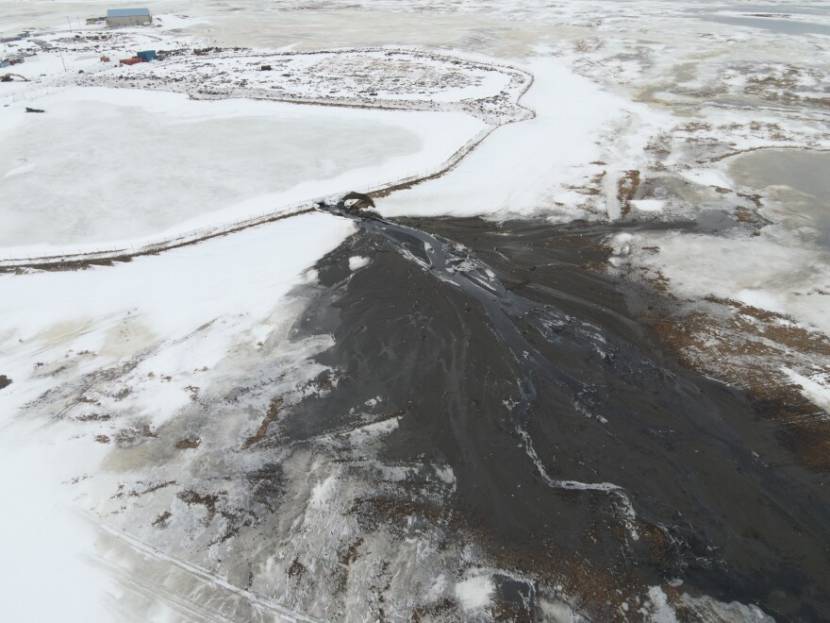
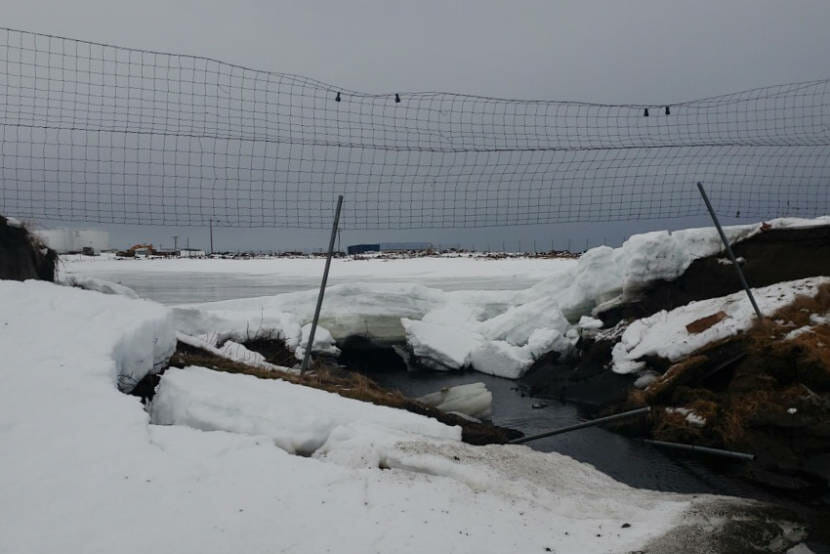
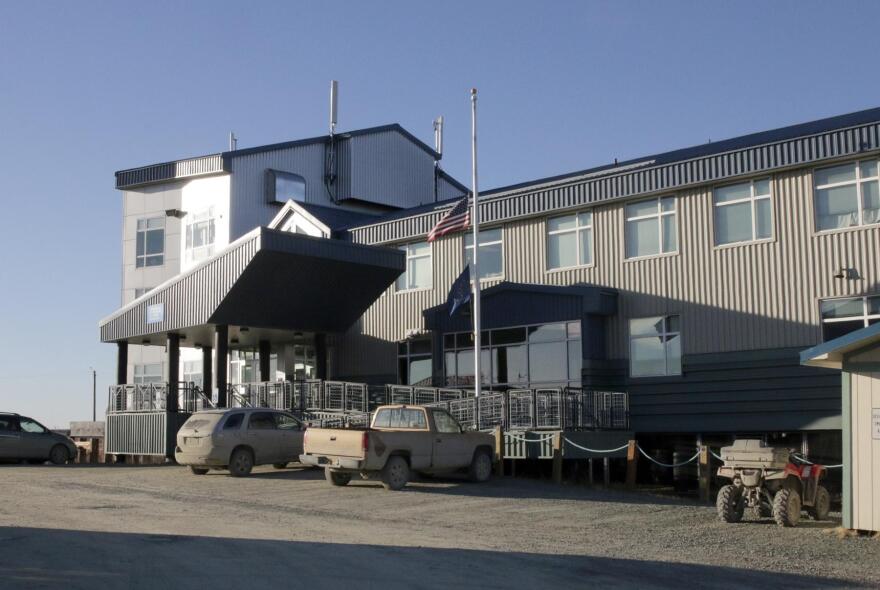
Hooper Bay’s sewage lagoon is leaking onto the surrounding tundra. (Photo courtesy of Paul Galvez/Lower Yukon School District)
Officials say they now better understand how the Hooper Bay sewage lagoon broke open on Feb. 25. The breach seems to have occurred due to an extreme shift in the weather.
A Yukon-Kuskokwim Health Corporation remote maintenance worker was in Hooper Bay this past week to help the community respond to the sewage lagoon break. According to YKHC spokesperson Mary Horgan, the worker said that extreme cold temperatures in February caused a crack in the berm that surrounds and contains the lagoon.
It was a small crack, which the remote maintenance worker said is not unusual to see. What was unusual was the weather that immediately followed the extreme cold.
Just two days after temperatures dipped below -5 degrees Fahrenheit in Hooper Bay, they shot up above freezing, and it started to rain. That caused the water level in the lagoon to rise, and water started to flow through the crack, eroding the lagoon wall.
After several days of rain, the sewage lagoon wall completely broke open.
The Y-K Delta has gotten used to sudden shifts in weather this year. After the second coldest November on record, Bethel saw two weeks of rain in December. Climate change is known to cause extreme weather events, but Alaska climate specialist Rick Thoman said that it does not explain sudden shifts in temperature like the one in Hooper Bay before the sewage lagoon broke open.
“We wouldn’t want to attribute it to a changing climate,” Thoman said.
He said that while climate change explains warmer temperatures overall, there is no evidence that the range between high and low temperatures is growing in Alaska. Instead, he said that these sudden changes in temperature are better understood as random variability in the atmosphere.
The hole in Hooper Bay’s sewage lagoon remains open. As of March 4, the community was still trying to plow through heavy snow to the beach to get sand to fill the hole.
Hooper Bay’s city administrator, Sandra Tall-Lake, said that the nearby village of Scammon Bay was in the process of sending sandbags and transmission oil for heavy equipment.
A leak in the Hooper Bay sewer lagoon caused it to spill out onto the surrounding land on Feb. 25, 2022. (Photo courtesy of Sandra Tall-Lake/City of Hooper Bay)
The sewage lagoon in Hooper Bay began leaking early on the morning of Feb. 25. By the afternoon, the entirety of the community’s sewage had poured onto the surrounding tundra, threatening an important subsistence location for the coastal village. Community leaders are worried it could spread further and are calling upon the state for help.
The spill followed a sudden rise in warm temperatures in recent days. Hooper Bay Mayor Sandra Hill said the thaw and rain had melted the previously frozen land surrounding the sewage lagoon, causing a wall of the lagoon to cave.
Hill said that the sewage spill is around 500 feet north of the nearest resident’s home, in an area that is a vital source of subsistence foods for Hooper Bay’s approximately 1,100 residents.
“North of the village sits a slough where we usually fish. We go and gather greens from north of the village back there,” Hill said. “I’m worried about food security for our village.”
City employees were busy on Feb. 26 plowing the roads leading to the sewage lagoon to allow heavy machinery to reach the spill. But Hill said the city is unsure how it will fix the lagoon or clean up the spill once the machinery gets there.
“We are not engineers. We need engineers to help us,” Hill said.
The day of the spill, the City of Hooper Bay declared a state of emergency and reached out to the Alaska State Emergency Operations Center for assistance.
The following day, Gov. Mike Dunleavy issued a state disaster declaration for the village of Hooper Bay, which Alaska Division of Homeland Security and Emergency Management spokesperson Jeremy Zidek said would allow Hooper Bay to get reimbursed for their response efforts.
Zidek said that the Yukon-Kuskokwim Health Corporation would be working with the community to fix the broken walls of the lagoon. He said cleaning up the spill could take months, and that Hooper Bay will have to try to deal with the situation locally before the community can turn to the state for help.
But Hill said it was already clear that Hooper Bay would not be able to clean up the spill on its own. And she was worried it could spread quickly with temperatures above freezing this week.
In addition to cleaning up the spill, Hooper Bay will also need to stop it from getting bigger. As of Feb. 26, Hill said that the breach in the sewage lagoon had not been fixed, and any resident that flushed their toilet or ran their faucet would likely add to the spill on the tundra.
Hill said half of Hooper Bay is connected to piped water and sewer, and she said that city officials are considering asking those residents to stop running their water and switch to using honey buckets until the breach in the lagoon is contained.
This is the second disaster declaration the governor has issued this month to aid a Yukon-Kuskokwim Delta community. In mid-February, the governor issued a disaster declaration to make state funding available to help the coastal community of Tununak after its washateria burned down.
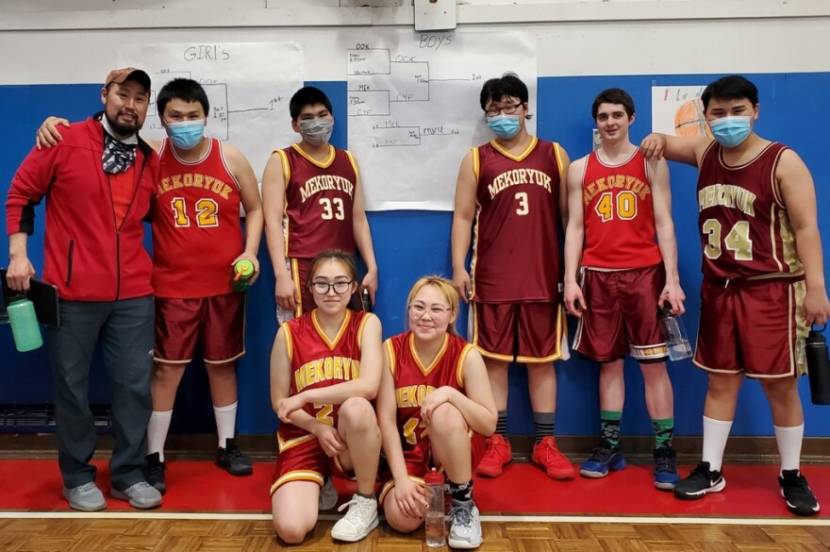
The Mekoryuk basketball team. (Courtesy of Edward Kiokun)
For the first time in nearly 20 years, the small island community of Mekoryuk has enough players to field a high school basketball team. Two girls and five boys play on a co-ed team in a season that has gone quite well.
In their first game this year, Mekoryuk played against Tununak, a nearby village. Fifteen-year-old power forward Harvey Wesley said that he had butterflies going into the game.
“I was super-very nervous,” Wesley said. “Because it was my first game, and I was nervous and I was scared.”
At the same time, he said that he was equally excited, “because every time I looked at that scoreboard I was like ‘oh my gosh I think we’re gonna win.’”
And they did. Mekoryuk won that first game and half of their games this season. That’s good enough to advance them to the small school district tournament, the 1A Coastal Conference Tournament, which begins on March 3 in Bethel. If they win that, they’ll advance to the state tournament.
Wesley said that this season hasn’t just been about winning, though. It’s also been about the relationships he’s built with his teammates.
“Me and my friends got more closer, and we’ve been talking to each other for basketball and saying ‘Hey, I think if we do this way, this would be more better,’” Wesley said.
Plus, he said that being part of the team has made him more engaged in school.
“Before I ever joined the basketball team, I always seen school as, like, ‘Oh, I got a long day at school.’ And then ever since I joined basketball, I’m like, ‘Oh, yes, I can get all my assignments done and then I can be in a basketball practice,’” Wesley said.
Wesley is one of just seven players on the team. The co-ed team plays against boys teams from other schools. Coach Edward Kiokun said that the two girls both start, which is unique to Mekoryuk.
“There’s no other co-ed team that I know of right now,” Kiokun said.
Kiokun said that the reason the girls and boys are on the same team, and the reason Mekoryuk hasn’t had a team in nearly 20 years, is that there just aren’t that many students there.
“We’re a small community. On a good day, it’s 200 people. And, you know, we have about 45 kids in the whole school, preschool through 12,” Kiokun said.
This year, there were finally enough high school students to field a basketball team. Wesley, the sophomore, said that he’d been waiting for this day for a long time.
“I was so excited, because I’ve been asking my principal ‘Hey do you think there will be a basketball season this year.’ Or ‘When can we get a basketball thing going?’” Wesley said.
Kiokun said that there are students who are from Mekoryuk attending boarding schools like Mt. Edgecumbe in Sitka this year. But he said that they’ve heard about the basketball team in Mekoryuk, and some are wanting to come back. He said that he’s hoping to have both a boys team and a girls team next year.
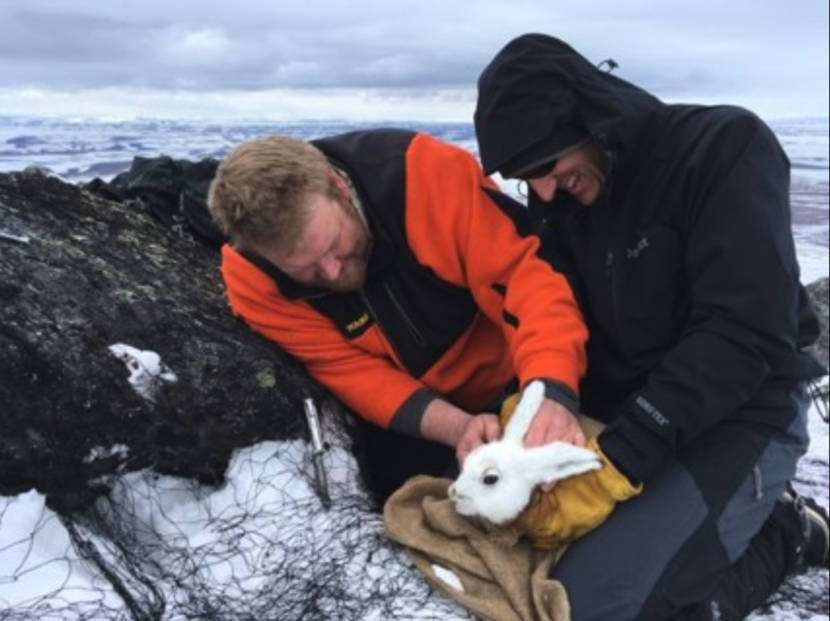
Biologists releasing an Alaska hare. (Alaska Department of Fish and Game photo)
The Alaska Department of Fish and Game is studying western Alaska’s dwindling population of Alaska hares, more commonly known as jackrabbits. Researchers don’t yet know why the population has been decreasing, and they need more information about the species to find out.
In 2013, Fish and Game started planning their first official population surveys on Alaska jackrabbits. Wildlife biologist Chris Barger took the lead on this premier project. He shared his initial findings during a Strait Science presentation hosted by University of Alaska Fairbanks’ Northwest Campus in Nome earlier this month.
“This is an understudied species that we know very little about,” Barger stated. “And historical accounts from local residents, department staff, and field experiences from across western Alaska suggest that the Alaska hare population is substantially below these historical records. However, we have never had any surveys of the species and it’s never been done until this project began.”
Barger wants to know how many jackrabbits are left in western Alaska, what they eat and where they go. But in order to answer those questions, he had to count and catch some.
“For hares and rabbits there are many different approaches, and we tried and failed at many of them. One of those methods was to try and find them, and count them with spotlights. Another idea was to try aerial surveys with a helicopter. Also we tried just track surveys and pellet counts,” Barger listed.
For counting methods, Fish and Game had the most success by using DNA analysis on the rabbits’ fecal pellets to identify individual animals in the areas they surveyed. That involved following hundreds of miles of tracks with snowmachines and transects..
Barger and his team went to seven different locations within the jackrabbits range, spanning from Bristol Bay to just north of Kotzebue. They have so far identified fewer than 100 hares in the Nome area, fewer than 20 in Ekuk near Bristol Bay, and about ten in the Kotzebue area. Alaska hares are distinct from snowshoe hares mainly because of their size. Jackrabbits are two to three times bigger than the snowshoe, according to Barger.
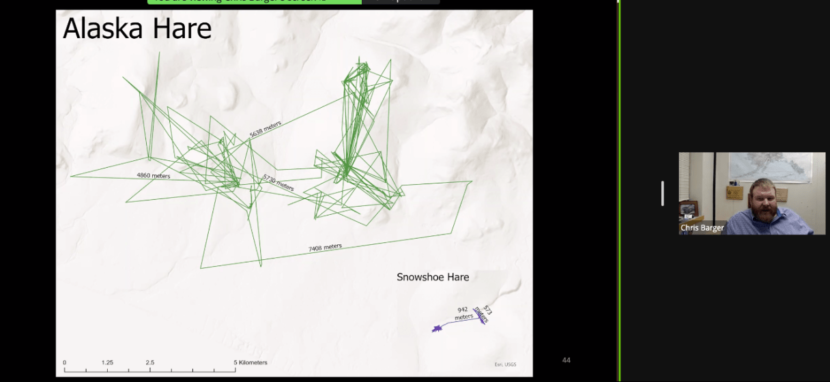
A screenshot taken during a Zoom presentation given by Chris Barger of ADF&G on jackrabbits. This graphic shows the jackrabbits’ range compared to a snowshoe hare’s. (Screenshot by Davis Hovey/KNOM)
The research team then went from counting to trapping the rabbits.
With an almost Looney Tunes approach, Barger and his colleagues tried using bow nets with a pull string, night vision googles, camouflaged blinds and all sorts of different methods to capture the elusive jackrabbits.
But what was eventually successful was a modified pen trap with a transmitter attached to notify Barger when something was caught in the trap. He explains how the team used bait in the middle of the box trap, which is set up within a bigger pen trap and includes a trip wire made of monofilament fishing line.
“Now it starts to get a little complicated,” Barger said. “A string is attached to the doors, and that string is held up by a nail that’s wrapped with some wire. The nail is then connected by a string down to the bottom of a rat trap and then a thin monofilament fishing line goes from the trigger of the rat trap and runs all the way across the bait pile at the bottom of the net.”
That method led to the capture of about ten animals, who are now being tracked with satellite collars that will last for about a year.
Those jackrabbits were tagged so Fish and Game could find out more about the animals’ movements, Barger said.
“Using this preliminary data, we have found they can have a home range upwards of 5,000 acres and they can easily move three to four linear straight line miles in a matter of hours. So these things can really book it across the tundra when they want to,” Barger said.
In western Alaska, jackrabbits tend to spend most of their time in a core area of 430 acres within the larger home range. Barger tends to see jackrabbits living in willow thickets.
Since this is the department’s first official survey of jackrabbits, preliminary data is sparse. But the team will do their final field surveys this spring in Nome, according to Barger. Then they can analyze the diets of jackrabbits and maybe begin studying what is causing Alaska hares in western Alaska to decline.
Yuut Elitnaurviat has housed the Kuskokwim Learning Academy on the second floor of its building in Bethel since a 2015 fire. (Dean Swope/KYUK)
Seven years ago, a fire displaced the Kuskokwim Learning Academy, a boarding high school in Bethel. Without classrooms or housing, students moved into the dorms at Yuut Elitnaurviat, an adult learning center, where they soon resumed classes on the second floor of the campus’ administration building.
“We had over 100 high school students up there and we realized that we were crammed for space,” said Mike Hoffman, the current executive director at Yuut. He said with the limited space, the school could only house about 45 students.
Working with the Lower Kuskokwim School District, Yuut decided to move ahead with plans to expand the administration building and add another dorm to the campus. Designs were finalized. Funding was tricky, but they were able to square that away too with a bank loan, said Hoffman.
“But then COVID came a couple years ago,” he said. “And we heard and knew that prices were going to escalate. We didn’t expect them to escalate by 20% — they did.”
Prices never really came back down. Hoffman said finally, a few months ago, Yuut and the school district decided — with the pressing need for more classroom and living space — they would have to bite the bullet and absorb the extra costs.
But then, suppliers facing huge backlogs told Hoffman they wouldn’t be able to get materials to Bethel in time for the short summer building season.
These delays and price surges are indications that COVID-19 is still playing a huge role in the global economy. Every step of the supply chain — from manufacturing to shipping to distribution — has lost any sense of a normal rhythm, said Darren Prokop, a professor of logistics at the University of Alaska Anchorage.
“If any one of those things gets jammed up due to COVID, due to a blockage at a port of entry, something like that, then you end up with bottlenecks,” Prokop said. “So you end up with too much stuff in one place and not enough in another.”
Prokop said the supply chain holdups, plus now inflation, inevitably lead to higher prices.
Supply chain difficulties add an additional layer to the already complex challenge of building in rural Alaska. Barge season in Western Alaska only runs May through October. It’s a narrow window to bring in the large shipments of lumber and other building materials that construction projects require.
That tight timeframe compounds the problem for builders trying to navigate supply blockages and the resulting price hikes.
CEO of the Alaska Village Electrical Cooperative Bill Stamm has one word for it: “grueling.”
The utility maintains power generators for 58 rural communities stretching from Old Harbor to Kivalina. Maintaining dozens of diesel power plants, wind turbines and solar arrays, plus 500 miles of distribution line, is a complicated, year-round effort — in a good year.
During the pandemic, prices and lead times for big items like power poles and cables have effectively doubled. Stamm said the delivery estimate he was quoted on a new transformer is 40 weeks.
“That’s most of the year,” he said. “We like to have a backup plan for just about everything, but the margins get thinner and thinner.”
Stamm said delays have meant communities have to rely more on smaller backup generators while they wait for materials.
“It’s a bit nip and tuck at times to make sure the lights stay on all the time,” he said. “And it doesn’t look like it’s going to improve much through this summer.”
It’s not just big projects being affected by increased prices and supply chain hang ups.
Shelby Clem is a field supervisor for RurAL CAP, a nonprofit that, among other things, helps maintain safe and affordable housing statewide. He’s in the middle of surveying homes in Bethel for weatherization improvements. The idea is to make upgrades that will ultimately help residents save on heating and maintenance costs.
Surveying happens now so that they can place all their material orders on April 1 when RurAL CAP receives its annual funding from the Alaska Housing Finance Corp. Clem said it’s difficult to make his recommendations while delivery schedules are so backed up and prices are through the roof.
“Three years ago, a piece of plywood was $17. And now, last time I checked, it was close to $58. That’s really coming into play a lot because everything we do has to have a savings investment ratio on it. And it’s really tough to get a payback when you’re paying triple times the price of plywood,” Clem said.
In Bethel, after already waiting more than five years to add on to the Yuut Elitnaurviat campus, Hoffman recently had to accept that rebuilding won’t start until the 2023 season. He said the materials weren’t going to make it in time to start this summer.
“So we have to wait. We’re ready to go. We are ordering all of our materials, but talking to our vendors, we will not have them until next year,” he said. “Not this spring but the spring after and we’ll have a lot of that coming in on that first barge in 2023.”
Pre-construction work will be done in the next few months, Hoffman said. Then the site will stay vacant and ready until 2023.
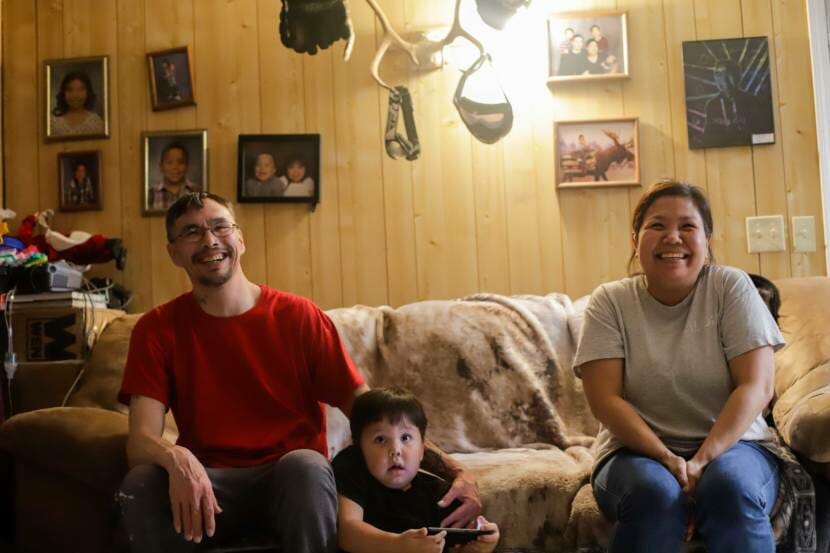
Sophia Katchatag, her husband Murphy Katchatag and their son Eric, Jr., 4, watch TV in their small, two bedroom home in Shaktoolik, Alaska, in January 2022. (Photo by Jeff Chen/Alaska Public Media)
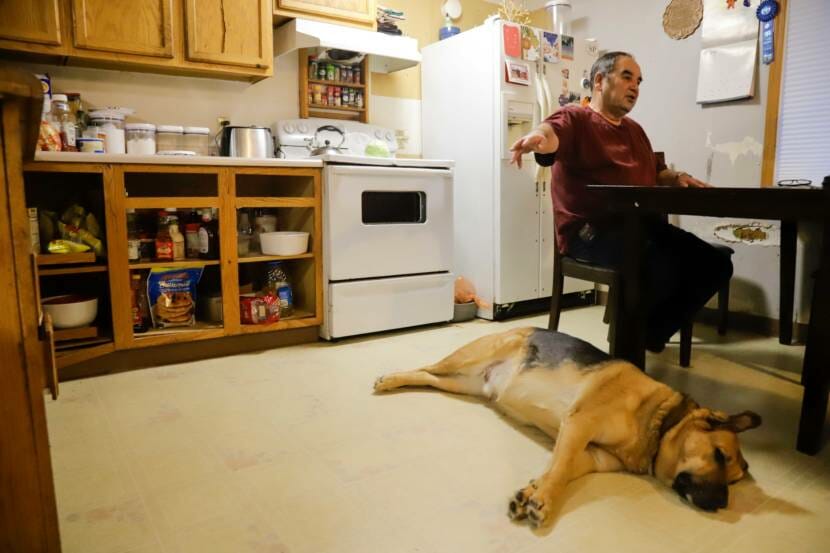
The smell of moose soup and the sounds of “Teenage Mutant Ninja Turtles” fill Sophia Katchatag’s small, two-bedroom home in the Norton Sound village of Shaktoolik. She and her husband share one room with their two younger children. Their two older kids share another room.
“I mean, I would love for me and my husband to have our own bed, but we just work with it,” she said.
Their teenage daughter wants her own room, too, but Katchatag said expanding isn’t financially feasible even with two incomes, especially with the recent spikes in lumber prices. She said she feels lucky to have her own place at all, which the family inherited in May and renovated with money from the region’s tribal housing authority. In the past, they shared a single bedroom in her mom’s house, living with extended family.
“To be honest it was hard, it was challenging,” she said. “Not having your own privacy, your own space and having to be on everyone’s schedule, do things on their time.”
Statewide, Alaskans are twice as likely to live in an overcrowded household than the national average. Rates are highest in small, off-the-road-system communities like Shaktoolik, where around 60% of residents live in overcrowded conditions. The federal Department of Housing and Urban Development defines overcrowded as more than one person to a room in the house, including the living room and kitchen, and severely overcrowded as more than 1.5 people to a room.
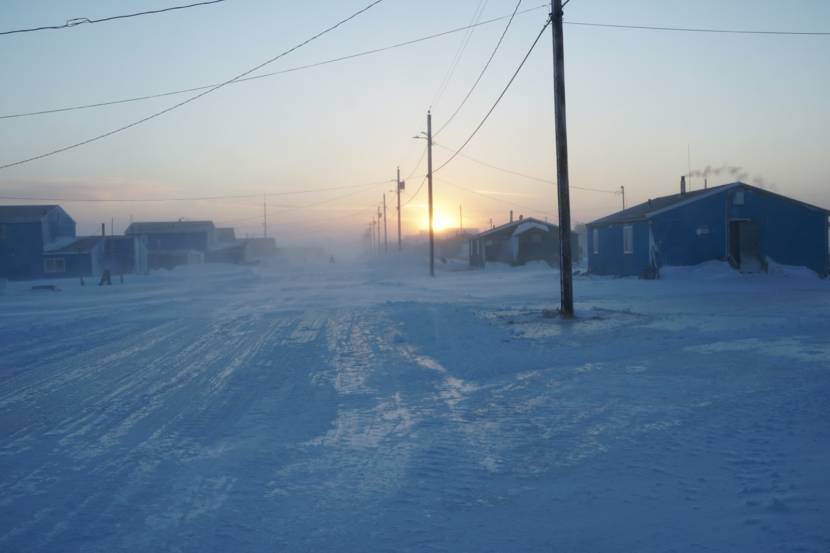
A winter storm whips through Shaktoolik in January 2022. (Photo by Erin McKinstry)
“To be honest, in some of our places, if you’re living in a house that only has 1.5 individuals per room, that’s not going to be one of the more overcrowded houses in your community,” said Brian Wilson, executive director of the Alaska Coalition on Housing and Homelessness.
The problem is perennial, but the COVID-19 pandemic has made living with it harder.
“You know if one person in that home contracts COVID-19, it is impossible to physically space out and prevent the spread of that,” Wilson said.
Thankfully, he said, the places in the state with the highest rates of overcrowding also have the highest rates of vaccination. And in Shaktoolik, the tribe used federal COVID relief funding to retrofit an old clinic as a quarantine house. But, he said, the risk is still high.
“These are primarily smaller communities where everybody knows everybody, and it’s a beautiful thing culturally to say that if I live in one of those communities and I see my uncle or my brother or my friend’s nephew in a houseless situation, that I take them in,” Wilson said. “Unfortunately, the byproduct of that is the severe overcrowding, which can also be a very dangerous.”
Not enough homes
Bering Straits Regional Housing Authority commissioner Eugene Asicksik has worked on housing issues in Shaktoolik for decades. He sees progress, but not enough. (Photo by Jeff Chen/Alaska Public Media)
Former Shaktoolik mayor and current Bering Straits Regional Housing Authority commissioner Eugene Asicksik said overcrowding leads to a host of problems in his community.
“You have too many adults living under one roof,” he said. “I think that adds to the social problems that occur when you have adults arguing or, you know, having a different opinion or fighting over the TV remote control and all that stuff.”
He’s been working to address housing issues in Shaktoolik for decades, and he does see some progress being made. But he said part of the problem is something that can’t be changed: Shaktoolik’s geography. The few vacant homes need work because of the harsh climate and substandard construction. And because the town is only accessible by barge or small plane, high construction costs keep people from building more or renovating.
“Everything has to be ordered,” Asicksik said. “One sheet of plywood can cost you over $100, $130 sometimes.”
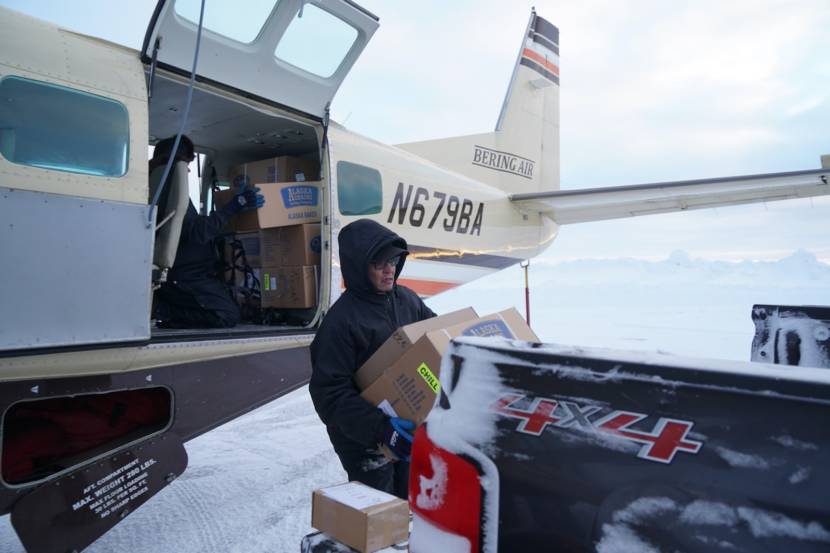
Agent Reuben Paniptchuk unloads a Bering Air flight at the Shaktoolik airstrip in January 2022. Bush planes are the village’s only lifeline in the winter months, when conditions don’t allow for barge access. (Photo by Erin McKinstry)
Financing is difficult, too, because most of the land is owned by the village corporation instead of homeowners and bank loans are often inaccessible. Asicksik said he learned that personally, when he expanded his own home to make space for his children and grandchildren, and he had a hard time accessing a loan because he didn’t own the land. He had to put everything he owned up for collateral.
And, Asicksik said, there’s a lack of awareness and resources to address the problem.
“I don’t think there’s much consideration to what goes on in the bush,” he said.
Roughly 250 people live in Shaktoolik, which is about 125 miles east of Nome. The community is around 97% Alaska Native.
The region’s federally funded tribal housing authority is responsible for the bulk of the town’s residential construction. They haven’t built here in more than a decade, but thanks in part to federal COVID relief funding, Shaktoolik is getting four new modular houses.
That’s welcome news for city clerk Isabelle Jackson. Like many other residents, she’d thought about leaving because of the high cost of living and lack of housing options. But the subsistence lifestyle and the tight-knit community have kept her here. She’s waited almost 10 years for a home of her own.
“I remember the moment when they called me, and after they said I’m one of the recipients for a three-bedroom home, I started crying. I got quiet. Tears rolled down my eyes, just for, you know, happiness,” Jackson said.
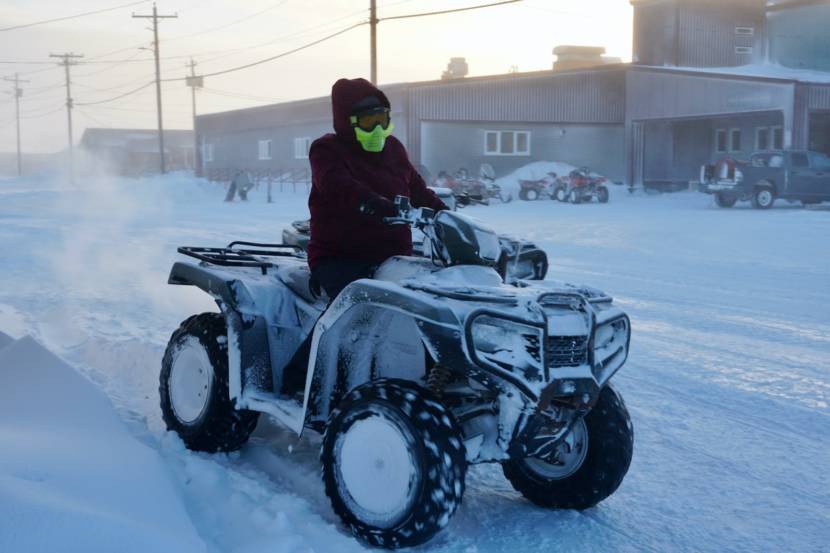
Isabelle Jackson rides her ATV between her home and the Shaktoolik city office, where she works as the city clerk. She’s been on the waitlist for a new home since 2013. (Photo by Erin McKinstry)
Jackson will pay an income-based rent for 25 years and then own the home outright. Right now, she and two of her kids share a hallway. Her father, who’s sick, sleeps on the couch. That’s been particularly difficult during the pandemic ,when they’ve worried about spreading the coronavirus.
“We’re, like, helping each other out, you know, taking care of him right now. But yeah, it’s difficult when my son wants to, you know, play and stuff, but he has to, you know, be quiet and have that respect,” she said.
Tackling a complex problem
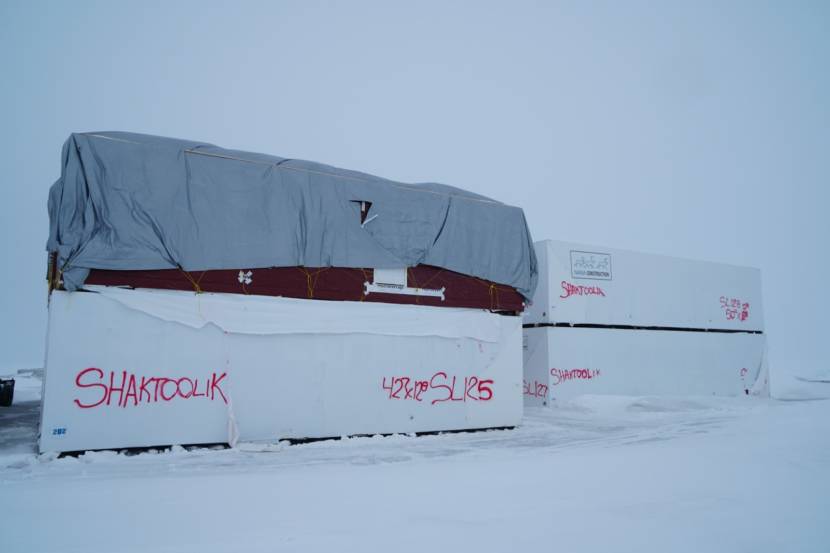
Shaktoolik’s four new modular houses, including Jackson’s, are stacked in Nome’s shipyard until the barge can access Shaktoolik in the spring. They were pre-built in Big Lake by NANA Construction last summer, but weather delayed their arrival.
Shaktoolik’s four new modular homes sit in Nome’s shipyard. Recipients were chosen based on a number of criteria, including current housing conditions, veteran status, and length of time on the waitlist. (Photo by Erin McKinstry)
Jolene Lyon, CEO and President of the Bering Straits Regional Housing Authority, said that ideally they would have built them onsite to help create job opportunities for residents. But when the extra funding from the CARES Act and American Rescue Plan came in, they wanted to act fast.
“Our main objective is to get homes up and going in these communities. And in this instance, this was the fastest way to do it,” she said from her office in Nome. “Right now, COVID is frightening too many people. Being able to have your own space alleviates a lot of that mental stress.”
The tribal housing authority serves 17 villages in the Bering Straits region, which is the third most overcrowded region in the state. Lyon said building in such a diverse and remote region isn’t easy. From different soil types to harsh winter storms to permafrost, there’s no one-size-fits-all design.
“The challenges are not just in building a home, it’s designing a home that works for the environment in the community that you’re in,” Lyon said. “And so we ask the tribe as much information as to what they want, versus what we’ll be able to provide for that build.”
Normally, federal funding allows the housing authority to bring new homes to each village every decade, but the extra funding is helping them build more homes more quickly. In addition to the modular homes, they’re also bringing three new homes to the remote island of Diomede and four to Wales on the western tip of the Seward Peninsula.
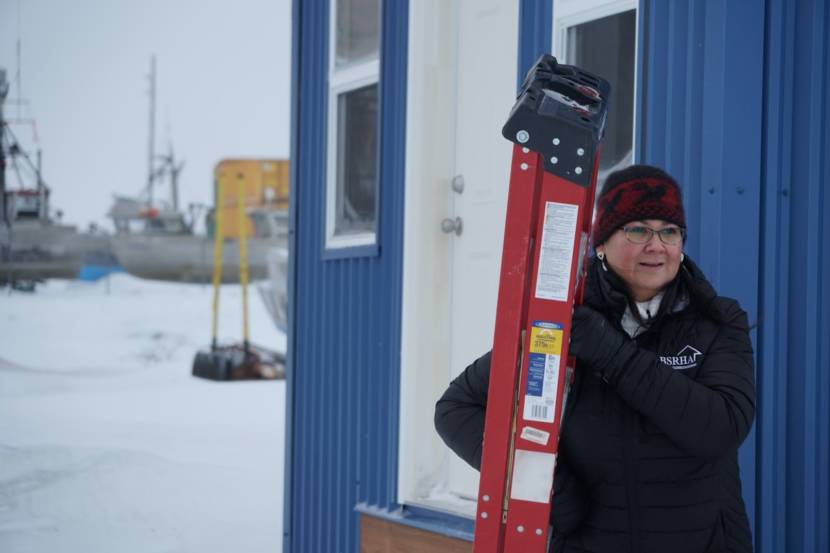
Bering Straits Regional Housing Authority President and CEO Jolene Lyon carries a ladder from the tiny home that will head to Diomede in the spring. The organization hopes to use the design as a model for future projects. (Photo by Erin McKinstry)
Still, it’s only a small dent in the problem.
“We don’t have the funding,” Lyon said. “That makes it very difficult and frustrating sometimes, when you know that the need is greater than that. And you could deliver on doing more but it’s just that’s not the reality of it.”
And even if they did have the funding, income requirements and program guidelines keep some people in the region from accessing new homes.
Lyon said the region needs an estimated 400 new homes to meet the need and alleviate overcrowding. They’ll tackle the problem one home at a time.
Close
Update notification options
Subscribe to notifications
Subscribe
Get notifications about news related to the topics you care about. You can unsubscribe anytime.