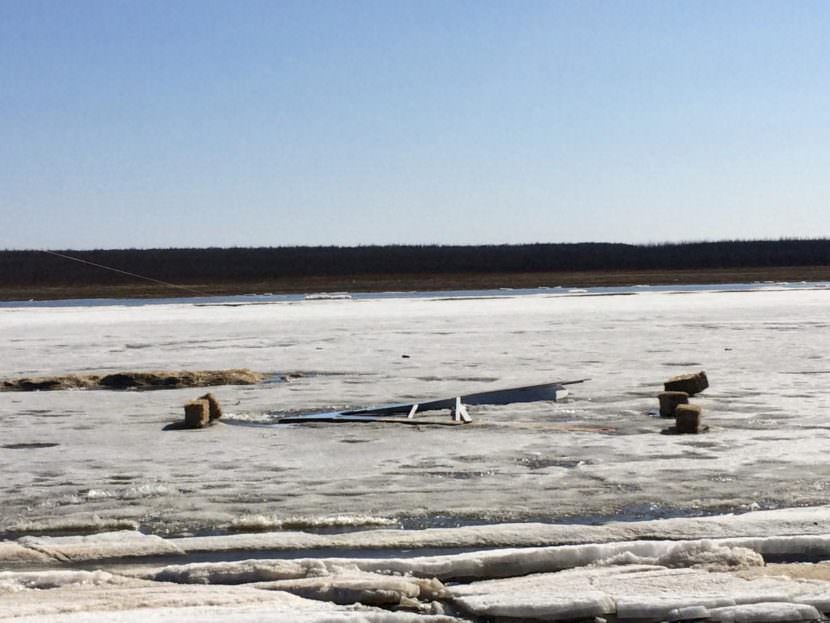
The Kuskokwim Ice Classic tripod fell at 4:40 p.m., Thursday, May 4, 2017. But the clock, counting down to break up and a $12,500 prize, continues to tick. (Photo by Anna Rose MacArthur/KYUK)
Ice Classic Manager Haley Hanson had just driven to the river when it happened.
“We were just down here, getting stuff ready in the shack, talking about the Breakup Bash, and waiting around, checking out the river, and it just fell over as we were watching it,” she said.
That was at 4:40 p.m. on Thursday. The ice around the tripod is severely rotten and dark. Open water lies a few yards away.
“We’re thinking that leg just punched right through the ice and is now underwater,” said Hanson.
That leg is painted blue and extends 28 feet. The wooden frame is now lying flat on the deteriorating ice. But the water will have to carry the tripod 100 yards downstream to trip the clock.
When it does, $12,500 awaits the lucky winner. Marsha Riley hopes it’s her. She drove to the river after her boss let her off work early to see the fallen frame.
“Ever since I was a little girl,” said Riley, “this has always been a great thing to come and watch and see all the people get excited, join together, talk stories.”
Riley has 15 tickets riding on the tripod, each one guessing a different time when the clock will stop.
If she wins, she says she’ll save for the honeymoon her and her husband of three years have yet to take. Hawaii and Ireland are on her list.
The Kuskokwim Ice Classic sold 7,381 guesses this year, raising more than $32,000. What doesn’t go to the winner goes to youth groups around the Delta who worked to sell tickets.
Members of the public spoke both for and against the petitions to recall three Homer City Council members at the regular meeting Monday night. Much of it boiled down to rifts in small town politics.
Much of the recall debate centers on small town dynamics
The petitions ask for the recall of Council Members Donna Aderhold, Catriona Reynolds, and David Lewis. They were certified by the city clerk on April 5.
Many of the comments made during the most recent council meeting focused on both togetherness and division within the community and where the council’s responsibility falls within that. It’s small town politics at its most basic.
“We will see each other at the grocery store forever. We teach each other’s kids. We hire each other’s kids. We are each other’s scout leaders and swim coaches and so forth. Our lives are intertwined. We can’t get away from that. We will see each other forever,” said Homer resident Poppy Benson.
Benson said the difference between national and local politics is how well you know the people you’re dealing with.
“And whenever there’s one of these really painful incidents that happen in town where people are yelling at each other, I always wonder, what’s going to happen if your son wants to marry their daughter. Are they going to forget what you said about them? No, they’re not,” she said. “We have this tightly woven fabric in this town and we have to protect that fabric and this recall is too much for that fabric. It’s tearing at us.”
Other speakers on both sides of the aisle echoed her words in one way or another.
Brandy Super said she’s been a Homer resident since 1996. Like a few others who spoke, she mentioned how she felt those national politics have come into play locally, dividing the town.
“Even though we all had an opportunity to go and vote behind closed doors, I, for one, I did vote for President Trump and it was a hurtful thing to hear, ‘Oh, let’s resist.’ So, when that came across, I felt that was very hateful and hurtful,” said Super.
Cassie Lawver has been live-streaming the meetings on Facebook for people who can’t attend in person.
“Though the conservative voice usually is not here due to working or childcare issues or whatever, they are watching. I just want to let you guys know that the conservative side is very involved,” Lawver said. “We’re watching. You’re probably receiving emails. We’re trying our best to communicate and be a part even though we don’t have a show here.”
The southern peninsula is an area built on waves of changing demographics. Over the last several decades, many groups have moved to the homer area following religions, opportunities, and industry. It’s created an area with a more conservative voting base, seen in statewide elections, and a vocal liberal component.
Kris Holderied said she doesn’t support the recall effort. However, she thinks increased public engagement has been a good side effect of these conversations.
“I would say the only thing that’s been encouraging to me in this is it’s brought up a lot of dialogue and there are a lot of people who may have been sitting by the sidelines of our democracy who are now coming to city council meetings. There’s more people here than I think I’ve ever seen before, so that’s not a bad thing,” Holderied said.
However, she said she is worried the recall may cause other elected officials to shy away from this type of dialogue in the future.
“I would say one of the things that I appreciate as a citizen is the ability to bring something to my council members and say, ‘Hey, I would like you to put this forward,’ and whether or not they might agree with it, they would at least put it into the public debate…that happens here with what the council is doing. So, I really appreciate that opportunity and hope we don’t lose that opportunity,” Holderied said.
While many speakers said they’d like to hear from the council their thoughts on the recall effort, Mayor Bryan Zak explained why they wouldn’t be speaking.
“Please be aware that while the city council members are free to discuss the recall petition when they are on their own time and not acting in their official capacity as council members, the city attorney has advised all council members to refrain from discussing the recall petition during council meetings, work sessions, and other official public events,” said Zak.
The recall election has been scheduled for June 13.
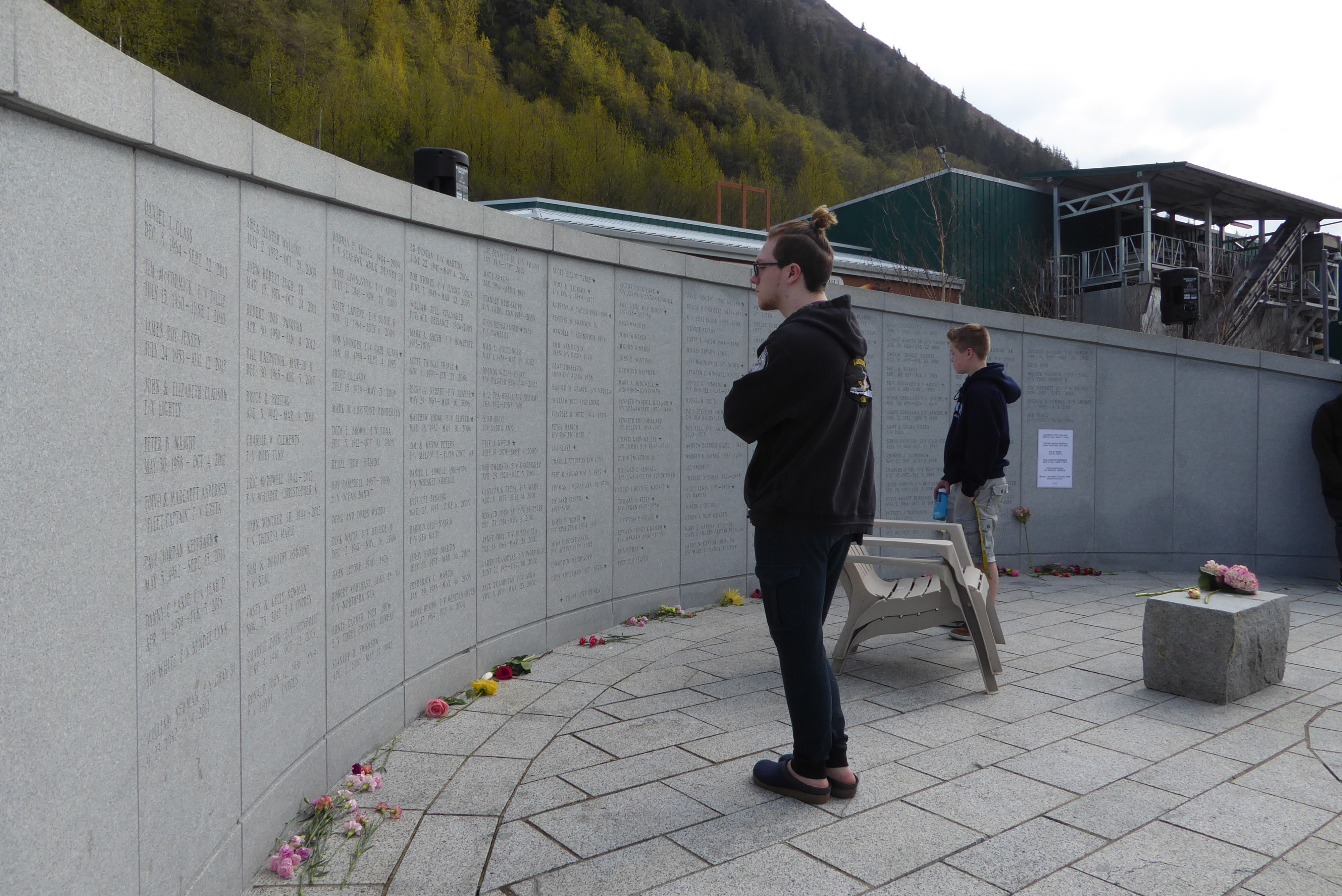
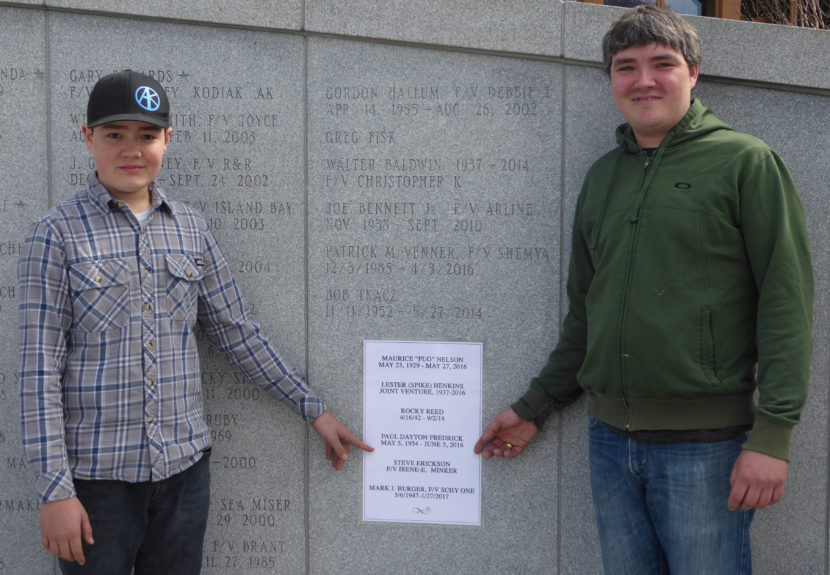
The Alaska Commercial Fishermen’s Memorial in Juneau on Saturday. (Photo by Quinton Chandler/KTOO)
It was a warm, sunny Saturday in downtown Juneau. Dozens gathered for the 27th annual Blessing of the Fleet and to honor the commercial fishing fleet and also to remember the lives of six commercial fishermen whose names will soon be engraved in the Alaska Commercial Fishermen’s Memorial.
The memorial is a curved, smooth granite wall engraved with over 200 names. Some have small stars next to them, indicating fishermen who died at sea.
Paul Dayton Fredrick’s name is one waiting to be engraved. His name will have a star next to it. Kyle Moselle is Fredrick’s son-in-law. He said Fredrick passed away last June.
Kyle Moselle
“He’s one of those Southeast commercial fishermen that (was) a one-off mold. He’s spirited and sometimes crass and sometimes hilariously funny and (a) hard worker,” Moselle said. “He went out to the ocean and provided for his family and when the fish weren’t running, he worked other jobs to provide for his family. That’s who he was and who he is.”
Moselle said Fredrick mostly fished from a 24-foot Bayliner named the Cathy Jean.
“He was never on the biggest boat. He was always on the smallest boat fishing with the big boats out in the open water too,” he said. “But, he earned the respect of other fishermen that were out there on much bigger vessels than he was and he brought in the catch.”
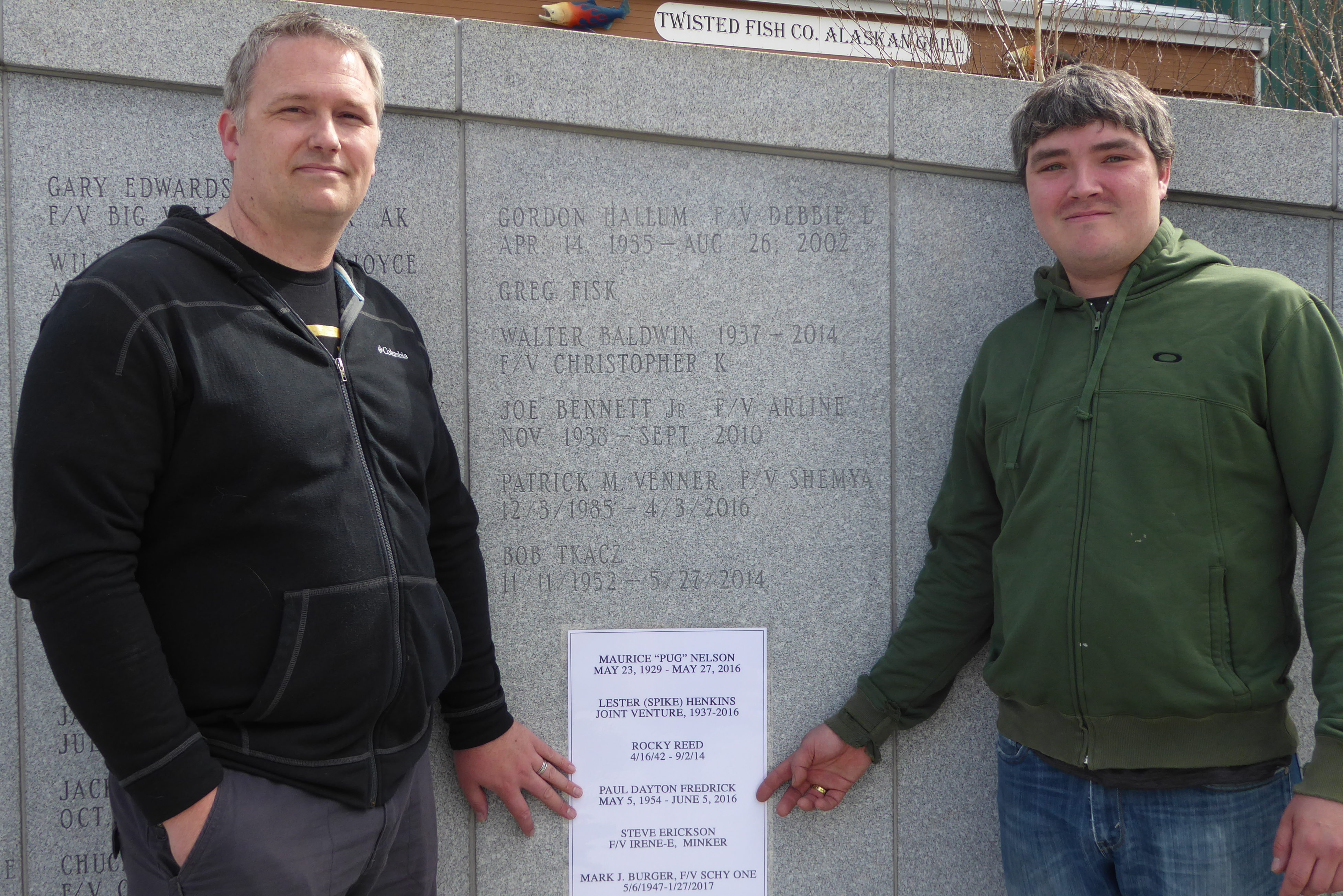
Paul Fredrick’s grandson Hunter Dayton Fredrick, left, and his son Alex Dayton Fredrick point to his name on Saturday. (Photo by Quinton Chandler/KTOO)
Moselle and Fredrick’s son, Alex, said Fredrick was a fisherman for over 30 years. Moselle said he mostly fished out of Sitka, but went all over Southeast.
Lt. Gov. Byron Mallott was invited to speak at the ceremony. He attended alongside Gov. Bill Walker.
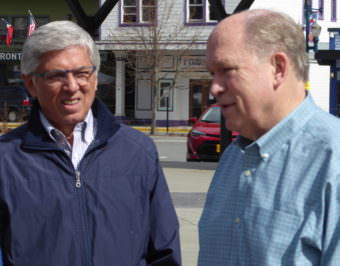
Lt. Gov. Byron Mallott, left, and Gov. Bill Walker after the Blessing of the Fleet ceremony on Saturday. (Photo by Quinton Chandler/KTOO)
Asked why the community should continue holding the remembrance, Mallott said it’s an important chance to pause from day to day business and remember fishermen who have died whether they’re on the wall or not. He said it’s especially important for families like Kyle Moselle’s.
“Well you see families come to the wall, who have loved ones placed there just in the past year and you see their grief and you see the support that is given them by the entire community, and to me that’s enough,” Mallott said.
Kyle Moselle said commercial fishing is like “the fabric of a community” because it’s an industry that benefits everyone in Southeast Alaska and the state.
“It’s our family members and other family members that put their love, blood, sweat and tears into that industry and … this memorial recognizes that perfectly,” he said.
The other five fishermen whose names will be added to the memorial wall are Maurice Nelson, Lester Henkins, Rocky Reed, Mark Burger and Steve Erickson. A board member with the nonprofit Alaska Commercial Fishermen’s Memorial in Juneau said the names will be engraved in June.
Correction: An earlier version of this story and its headline omitted one of the fishermen added to the wall. Mark Burger’s name will also be added for a total of six names.
At its finance committee meeting this evening, the Juneau Assembly removed the Augustus Brown Swimming Pool and Mt. Jumbo Gym from a list of possible cuts.
The vote was 6-3 to spare the pool and 8-1 to spare the gym.
Original story | 5:32 p.m.
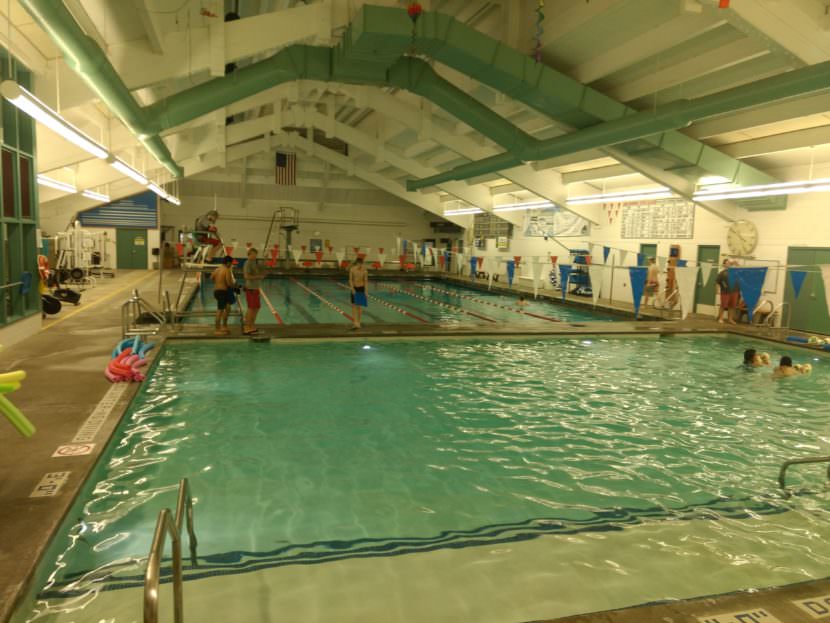
Students from Juneau-Douglas High School use the pool for an athletics program on Wednesday. (Photo by Jacob Resneck/KTOO)
Cost cutting efforts at the City and Borough of Juneau continue as the Juneau Assembly mulls closing the downtown pool and a gymnasium in Douglas.
Both are on the list of Parks and Recreation facilities facing closure. That’s because the Assembly is trying to fill a $1.9 million deficit without raising taxes. Limiting pool hours would save about $44,000. But shutting it down would save $562,100 annually.
“There’s some pretty passionate people about not wanting to close the pool,” Parks and Recreation Director Kirk Duncan said. “Quite frankly I’m really glad I’m not an Assembly member and don’t have to make those decisions. I think all of the Parks and Rec facilities are very important to the community, but also I recognize that we have some tough times.”
Even if the Assembly spares the downtown pool this year, the facility will need significant investment. The building is about 45 years old and nearing the end of its lifespan.
“Augustus Brown pool has been here for many years,” Duncan said. “We estimate that it needs about $4.5 to $5 million in repairs. So that’s the long-term issue — how are we going to fund those repairs?”
Juneau has a more modern swimming pool: The Dimond Aquatic Center in the Mendenhall Valley. But Juneau-Douglas High School students would lose a pool literally next door and downtown residents would have to travel.
In downtown Douglas, the Mount Jumbo Gym is also on the proverbial chopping block.
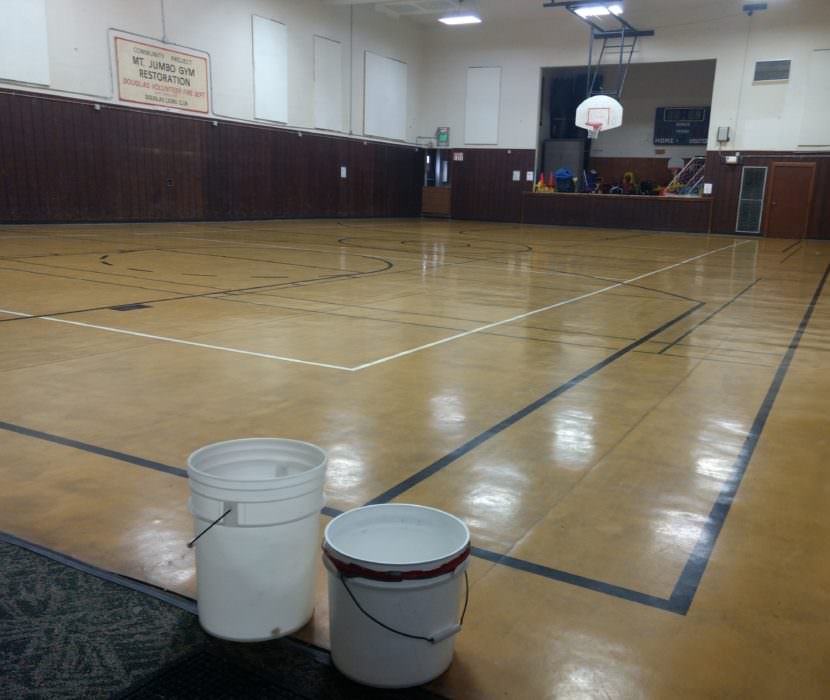
Buckets catch water from a roof leak inside the Mt. Jumbo Gym in Douglas on Wednesday. (Photo by Jacob Resneck/KTOO)
“It was built as a school,” Facilities Superintendent Brent Fischer said. “The gym was built in 1941, the school was built in 1937. It was part of the school district.”
The former Douglas High School building gym is now used as community space serving preschoolers, adults and everyone in between.
“We get a lot of adults and youth using this, so it’s a good venue for the community,” Dave Pusich, the city’s recreation manager. “It gives them another outlet because there’s not a lot of gym space available.”
Pusich grew up in Douglas and says the former high school is somewhat of a community landmark.
“We also have lots of birthday parties on the weekends — it’s real busy,” he said. “We have a bouncing house we set up, lots of toys, so it’s pretty popular and it’s affordable.”
Closing this gym would save less than $10,000 a year. But there are serious maintenance issues. The roof leaks. Patching things up would cost about $688,000. Renovations have been estimated to cost another $1.3 million. And to totally rehab the building so it’d be good for another 25 to 30 years would increase the cost to $4.8 million.
The Assembly’s budget deadline isn’t until June. With minimal publicity, public comment is already arriving by email with more than a dozen emails urging the Assembly to save these and other facilities whose futures remain uncertain.
Editor’s Note: Kirk Duncan is a member of KTOO’s board of directors.
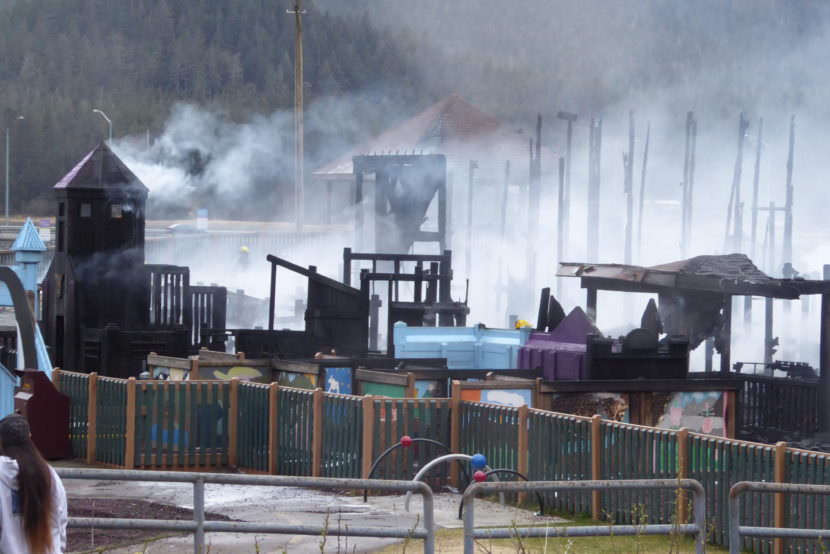
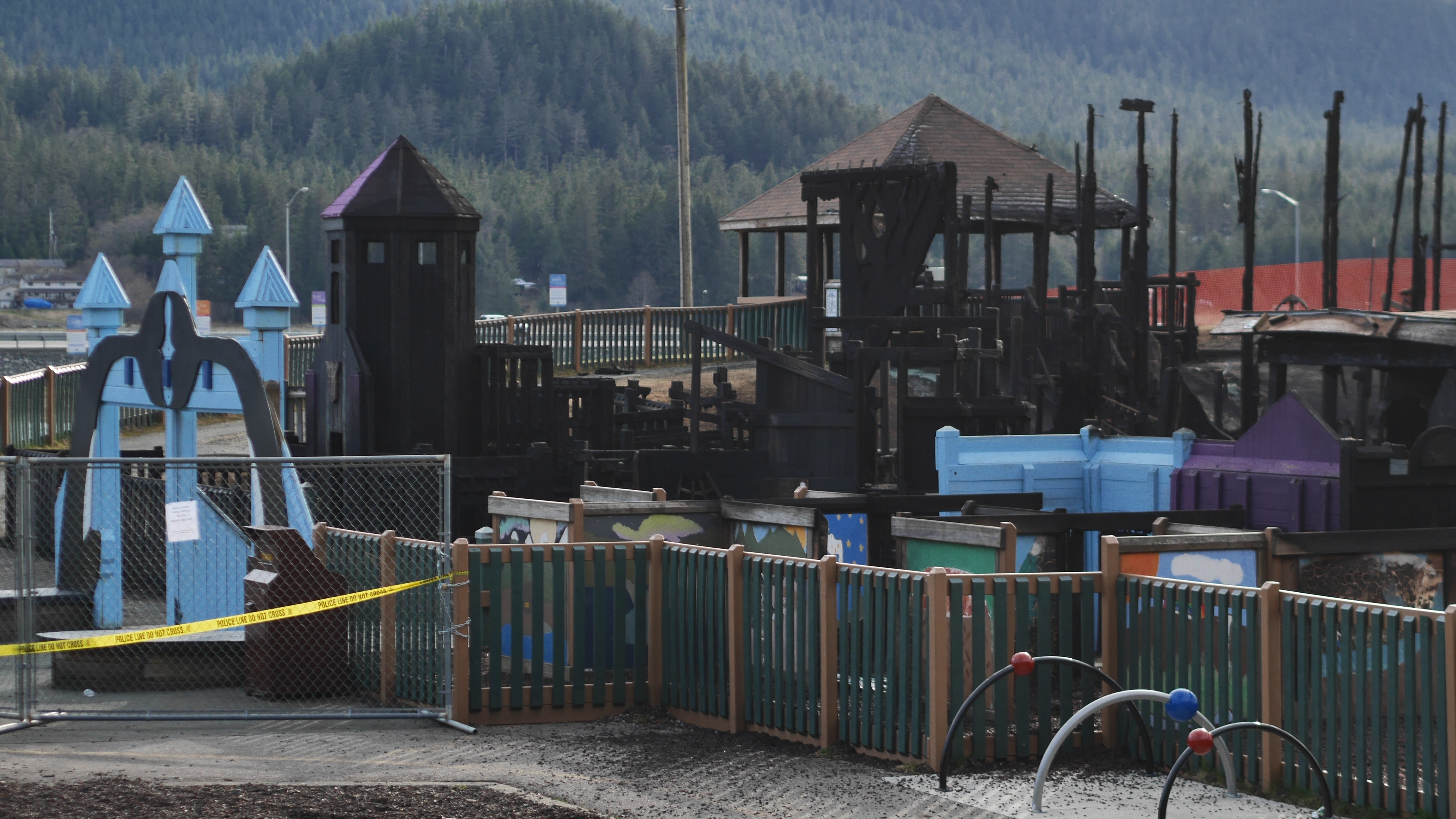
The remains of the playground at Twin Lakes steam after a fire was mostly extinguished on Monday, April 24. (Photo by Quinton Chandler/KTOO)
In what could only be described as an ironic and tragic coincidence, last week’s playground fire at Twin Lakes happened on the very first day of a statewide conference in Juneau of Alaska fire and arson investigators.
Juneau Fire Marshal Dan Jager organized the conference that drew 40 students from the North Slope Borough to Ketchikan. Half a dozen instructors from Alaska and the Lower 48 conducted the five-day training session.
After Jager finished investigating the April 24 fire at Twin Lakes, he said a few of the conference’s participants came by to check out the scene and provide another set of eyes.
“It was just basically us having a conversation with them and saying, ‘This is what we’re looking at. What do you see?’ Just kind of comparing some notes,” Jager remembered. “There were just mental notes and observations that they had noticed. The big thing was just kind of having as a peer review. This is what we’re thinking. ‘Does this make sense?’ And, ‘Do you see the patterns that we’re seeing?’”
Jager determined that two 13-year-old boys started the fire that ignited the rubber chip ground cover and eventually consumed the whole playground.
“A couple of us did go out looking at the fire scene — that team concept there, that task force concept — which basically made things a little bit easier for them to go over there and investigate that fire and gather the information that was needed,” said instructor and Salcha Fire Chief Ernie Misewicz. “So, even though it wasn’t planned as part of the seminar, it was a very informative side trip, if you would, for us to be able to see that.”
Jager said the playground fire was just the latest in a string of five fires in April.
“While it seems like it’s unusual because we had especially the first four in four days, it’s not necessarily meaning that it’s unusual,” Jager said.
The first fire in April at the Art Sutch Photography store was determined not to be intentional. But Jager said they’re still investigating three other fires as intentionally set: an outdoor storage shed on Moraine Way, a fence and gazebo on Steep Place, and a dug out bench at the Savikko ball fields.
So far, there doesn’t appear to be a connection between the fires.
“They were different parts of town, different times of day and night,” Jager said. “Typically, if there was going to be some sort of connection, there’s common source of ignition, there’s a common description of a person that people might have seen, there’s a specific time frame, usually.”
After the Twin Lakes fire, Jager credits the community for quickly coming forward with information that helped his office and Juneau police find the two boys responsible within hours.
“I really can’t emphasize enough the importance of the community’s involvement because they see things from different points of view,” Jager said. “Obviously, we can’t be everywhere at once. Just different photos brings a different perspective and helps us.”
Jager said fires usually come in waves. Spring and summer fires are usually started by unsupervised kids getting out of school and playing with fire. Winter fires are usually related to heating issues like misusing heat tape for pipes, boiler or chimney problems, or a space heater igniting a blanket or clothing.
Project Playground meeting moved to larger space in Centennnial Hall. People filing in, including multiple CBJ Assembly members. #Juneaupic.twitter.com/vTBhDXeDxI