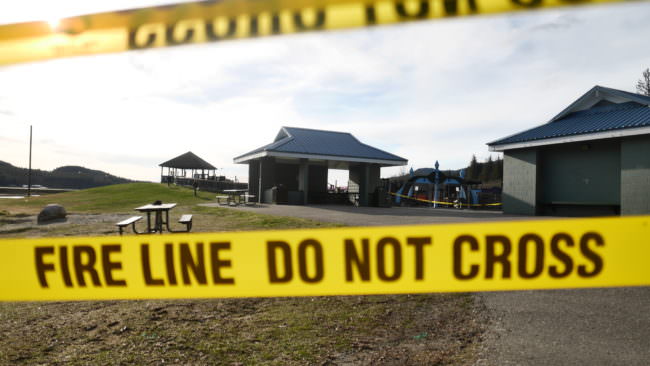
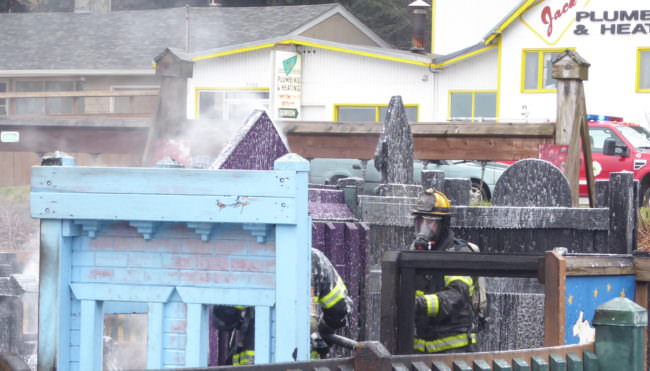
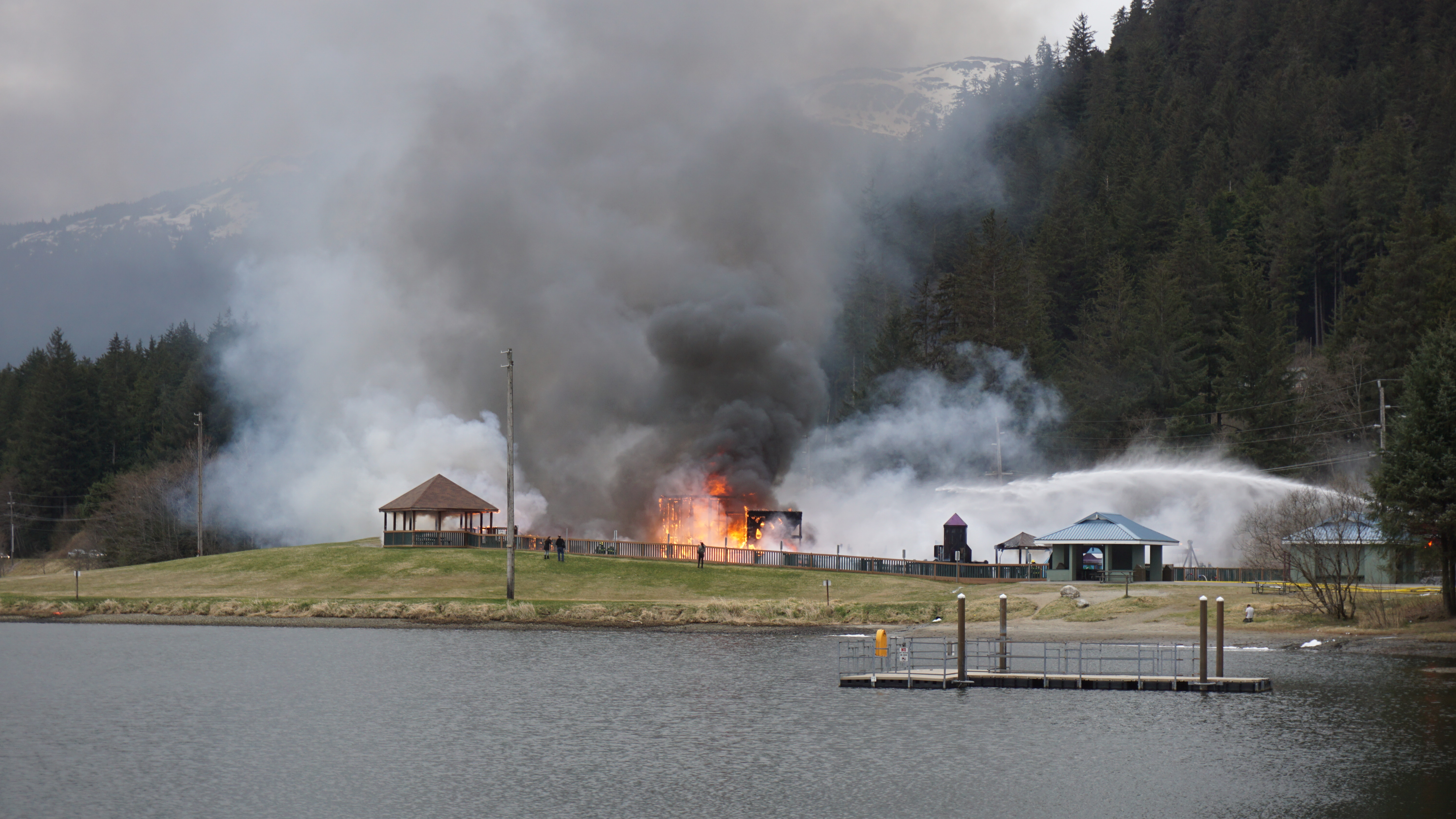
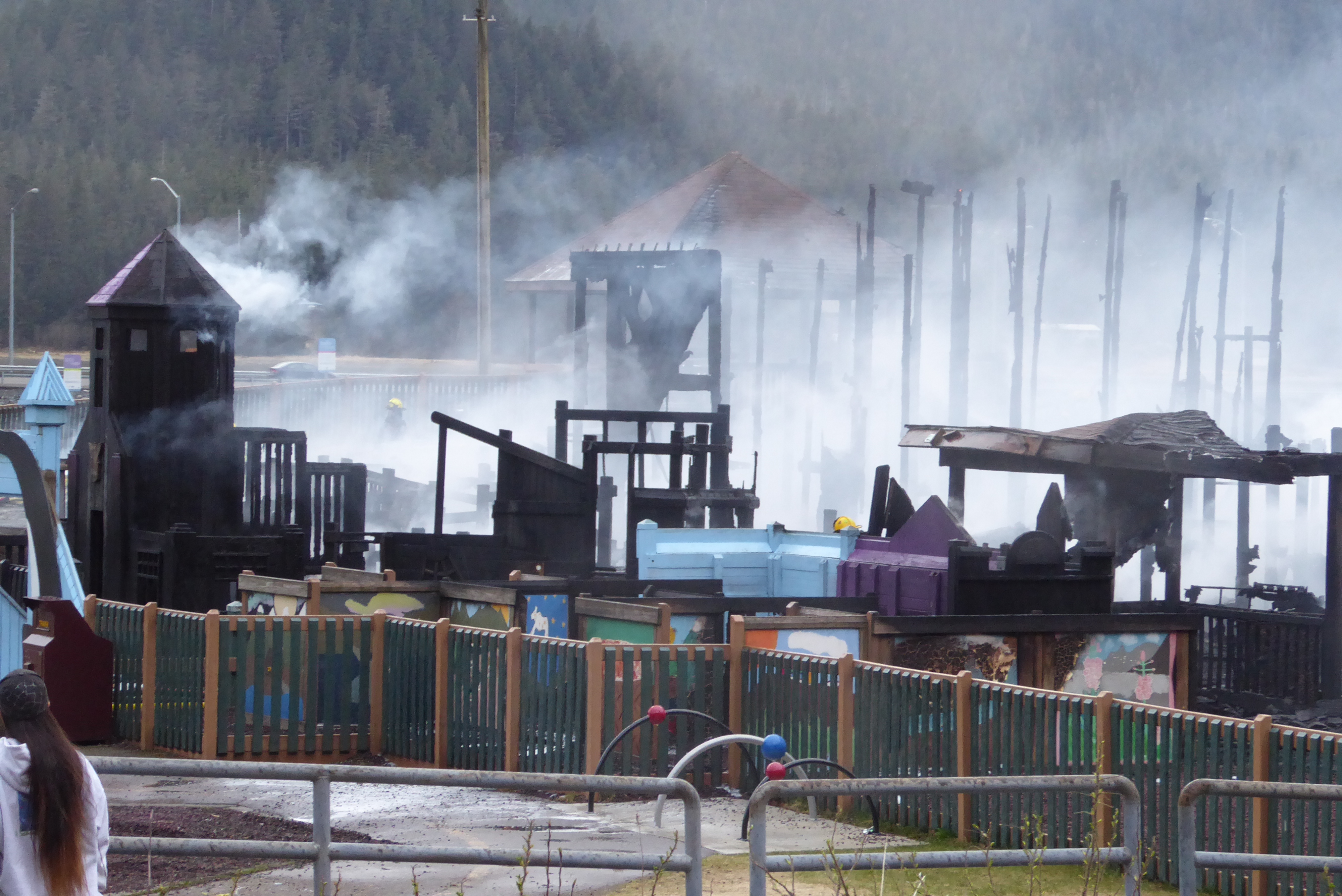
Twin Lakes Playground fire scene the day after the fire on April 24th, 2017. A wide fire line is in place around the entire Twin Lakes Playground area. (Photo by Kelli Burkinshaw/KTOO)
The Twin Lakes playground destroyed by arson will be covered by insurance — to a point.
The City and Borough of Juneau says the policy carries a $100,000 deductible that will have to be met.
The city would like to hear from the public on how to proceed, City Manager Rorie Watt said.
“I think the fundamental question really is how does the public want to be involved in the rebuild,” Watt said. “Do people want to replace what was there or are there different ideas? We’ll just have to work through that — I imagine there will be a lot of opinions.”
Donations toward the effort to replace the structure can be made in care of the Juneau Community Foundation which is managing fundraising.
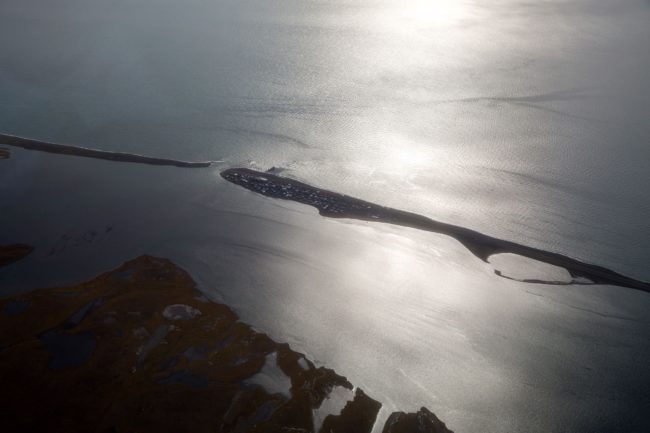
The view of Kivalina from Air Force One on Sept. 2, 2015, as President Barack Obama flew to Kotzebue. (Official White House Photo by Pete Souza)
By the end of the century, researchers predict climate change could displace millions of people across the country, as rising sea levels and erosion hit coastal communities. As policymakers start to grapple with that reality, there’s a specific phrase making the rounds: “managed retreat.” In other words, relocating whole neighborhoods or communities and retreating from the coast.
A new study looks at examples around the world — including some in Alaska.
The Netherlands is famous for its ability to make land from water. The country has a mind-boggling system of pumps and levees that drain and protect coastal areas. But in recent years, the country has been lowering some of those levees, allowing some communities to flood.
“The purpose of that was, by absorbing all of that water upstream, there are larger towns downstream that would be much safer in the case of these high river flows,” said Miyuki Hino, a researcher at Stanford University.
It’s one of 27 examples her team looked at around the world. In each case, people have moved, or tried to move, because of environmental changes. They range from the decision not to rebuild in areas hit by the 2004 tsunami in Sri Lanka to abandoning sinking land in Louisiana to eroding coastal villages in Alaska.
One of the most successful examples is the Dutch program. It’s called “Room for the River” and it’s about stepping back and retreating from flood zones.
Hino said her team found two important factors in every example they studied.
Number one: does the community in question want to move?
Number two: “Whether broader society, beyond the residents, really benefited from retreat taking place,” Hino said.
In other words, the move was most likely to happen — and most likely to satisfy most of the people involved — when the community itself wanted to move, and the broader government agreed. And that was most likely to happen when there were clear benefits to people outside the directly affected community, situations like the Dutch example.
But in Alaska, Hino said, that’s been a challenge.
Villages like Newtok, Shishmaref and Kivalina have been trying to move for years. But neither the state, nor Congress, nor federal agencies have mustered the funding to help them. In situations like those, “there’s a perception that broader society does not significantly benefit from retreat taking place,” Hino said. “And as a result, it’s a major struggle to get the necessary government support to do so.”
But Robin Bronen, of the Alaska Institute for Justice, argued that interpretation isn’t quite right. Bronen has studied efforts to relocate coastal villages in Alaska for the last decade.
“In the paper, they talk about that scenario as a lack of political will, which is not what I would say,” Bronen said.
The problem in Alaska hasn’t been a lack of political will, she argued: state and federal agencies have been trying to help villages move.
Instead, she said, the problem is that the U.S. simply doesn’t have the right laws.
“There’s this urgent need to protect populations from climate change, but we don’t have the laws in place to facilitate it,” Bronen said. “[That] means that government agencies don’t have mandates or funding to make it possible to actually implement what everybody agrees is the best long term adaptation strategy.”
For instance, U.S. disaster laws will pay to help individual families move after a major hurricane — but they can’t help a whole community relocate in the face of slow-moving erosion or sea level rise. That was proved most recently this winter, when the village of Newtok requested a presidential disaster declaration, and was turned down.
But Bronen and Hino agree on one thing: “It seems very likely that people will be on the move in a changing climate,” Hino said. “The question is how.”
“I’m not gonna lie, it might not be appropriate, but the the Eagle Brewing Company bottle that’s in here with the original Eagle Brewing Co. logo,” Probst said, gesturing to the 111-year-old exhibit. “This blue label logo it’s one of my favorites. I think it’s pretty neat for something that’s truly Juneau, Alaska, from that time period.”
It is truly Juneau; the beer bottle and its ornate label are from the beginning of the 1900s when beer was brewed for the saloons serving thirsty miners.
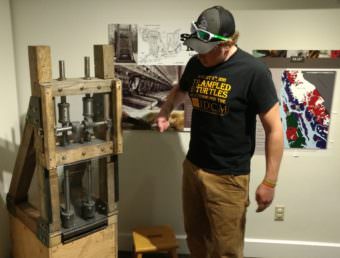
Cranking the cam of the museum’s miniature stamp mill replica, the sound of metal on metal echoes throughout the museum. The kids love this one.
“That sound here in Juneau that would have been going on for many, many years constantly,” Probst said over the din.
The camshaft is a replica of the hundreds of heavy steel stamps that crushed the ore from the mines — a sound that once echoed across the Gastineau Channel 24 hours a day, seven days a week.
“It was one of those things that you were so used to that rhythm. It reverberated through everything,” Probst said.
Joel Probst, chairman of the Friends of of the Juneau-Douglas City Museum, demonstrates a replica stamp mill on April 26, 2017. (Photo by Jacob Resneck/KTOO)
The city museum costs about $300,000 annually to operate. A report from the city manager’s office noted that closing the museum would save more than quarter-million dollars in the first year.
The museum received low ranks in a budget survey about 90 people completed to identify possible cuts.
“There will certainly be pushback on the list of possible reductions,” City Manager Rorie Watt said earlier this month, “but what we’ve given the Assembly is choice.”
But what’s not spelled out in any detail is what would become of the museum’s collection much of which came from the community.
“It’s very touching to see a family who has gone through the loss of a family member — a patriarch, matriarch in Juneau — bring us something that’s very precious,” Museum Director Jane Lindsey said. “We take that very seriously.”
It’s not the only museum in town: there’s the Alaska State Museum in downtown Juneau. Might it have interest in the collection? Could it take it over if the city zeroed out funding?
“The short answer to that is no — we don’t, we wouldn’t,” said Scott Carrlee, the state museum’s curator. The state museum is operating with a skeleton crew having already lost 30 percent of its staff. “Right now with the financial situation that the state finds itself in, we just don’t have the resources or the capacity to take over a collection of that size.”
Cuts will have to happen or taxes will rise. Even those who love the museum understand that.
“Services are going to be affected whether it’s the museum or something else,” Probst said. “We’re not the only thing that’s on the table right now — it’s citywide services.”
Deep cuts, dig deeper into savings, raise taxes and fees, or a combination thereof, are the stark choices the Juneau Assembly is grappling between now and June 5.
“We were there two weekends in a row in the sideways rain,” Suzanne Dutson said. “Shoveling the shredded tires for the flooring, pitching screwdrivers everywhere and hammering nails and just doing whatever we needed to do to try and help build the playground because it was such a wonderful opportunity for us to do that.”
Monday’s suspected arson led her to create an account on GoFundMe to help rebuild. It spread on Facebook forums and raised $4,625 in less than a day.
Now she’s shutting the page down.
“I’ve been contacted by people saying, ‘You know, we’re losing a lot of this money from fees. Let’s do something else,'” she said.
She’d read the fine print: GoFundMe takes nearly 8 percent. That adds up quickly.
“You know, a woman gave $5 and so that’s $0.40. It doesn’t sound like a lot but I have a business who donated $2,000 and, you know, 8 percent of that … $160 of that is going to GoFundMe,” Dutson said. “We can definitely do better.”
There is an alternative: The City and Borough of Juneau is steering donations toward the Juneau Community Foundation.
“What we offer is a nonprofit receiving the funds,” said Executive Director Amy Skilbred. “Any donations to the Juneau Community Foundation would be tax deductible.”
Dutson said she now plans to transfer the funds she’s raised to the Juneau Community Foundation.
“The GoFundMe was a nice foundation but it’s time to move it forward — to something that will preserve the money and the intent for the money,” she said.
It’s too soon to tell how much it will cost to rebuild and the city is talking to its insurance firm in Seattle.
“We have coverage,” Deputy City Manager Mila Cosgrove said. “We expect some level of reimbursement to cover at least design, cleanup, possible materials, etc. We’re looking to see from them what the actual amount of coverage is.”
The city is holding a meeting at 5 p.m. May 2 at Centennial Hall to discuss how to move forward.
“Let’s pause. Let’s grieve,” said Catherine Pusich, one of the playground’s original grassroots organizers. “Let’s work with the city to find out what we need to do as a community to come together to get our playground back.
Juneau Police arrested two 13-year-olds they say admit to starting the fire.
Capital City Fire/Rescue Fire Marshal Dan Jager said the two teenagers admitted they started the fire with no clear motive.
“They admitted as to how they did that,” Jager said. “Because they are juveniles and it’s still an open case, I’m not allowed to comment on that.”
Jager also noted no accelerants — such as gasoline — were used.
“The material on the playground itself, basically being shredded tires, that in itself is a fuel,” he said. “Between the wind and the fact you had basically the tire material burning, that, once it burns it turns into a liquid, so it’s kind of a petroleum product at that point. That’s really what caused the fire to intensify and spread across the playground as it did.”
The many photos of the early stages of the fire shared through social media were critical in the investigation, Jager said. The images helped narrow down where the fire began and how it spread.
Jager recommends using different materials if the playground is rebuilt.
“Granted, it’s not as soft or easy to land on, but gravel doesn’t burn,” he said. “At least not that easily. Sand, gravel, things like that, stuff that’s noncombustible is the recommendation.”
The boys, who were not identified by name because they are juveniles, are being charged with felony arson in the second degree and felony criminal mischief in the first degree.
Capital City Fire/Rescue officials said there was at least $250,000 worth of damage to the playground at Twin Lakes after the fire broke out just before 6 p.m.
It took 45 minutes to put out the fire, firefighters said. The spongy, rubber chipped ground cover and the wood and recycled materials that formed the structures billowed black smoke into the air as they burned.
It took an additional two hours for firefighters completely extinguish any remaining smoldering fire at the playground.
No one was reported injured.
Close
Update notification options
Subscribe to notifications
Subscribe
Get notifications about news related to the topics you care about. You can unsubscribe anytime.