Community

Developers wary of city-planned Pederson Hill subdivision

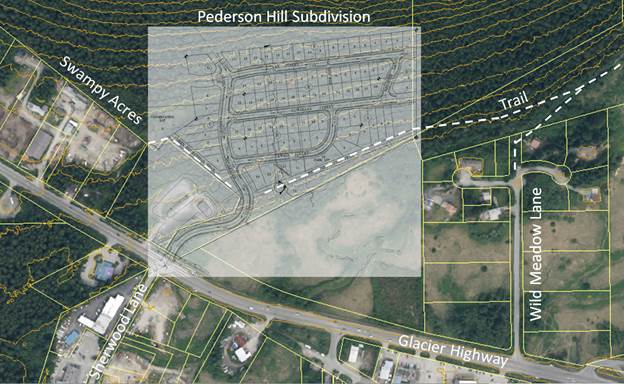
The proposed 86-lot Pederson Hill subdivision as envisioned by the City & Borough of Juneau. It goes before the Planning Commission on Tuesday, Feb. 28. (Courtesy City & Borough of Juneau)

A city-planned subdivision that aims to create dozens of buildable lots is set to go before the Juneau Planning Commission. City planners say the proposed Pederson Hill subdivision could help create relatively affordable housing for Juneau. Though some remain skeptical of the project.

About a half mile past the Brotherhood Bridge on Glacier Highway lies the entrance to what could be an 86-lot subdivision planned by the city.

“What our hope is is to make a compact neighborhood kind of in a traditional style similar to the areas of downtown Juneau or downtown Douglas,” said Greg Chaney, lands and resources manager for the City and Borough of Juneau.

This 26 acres of city-owned land has been identified as prime residential real estate for more than a decade. Mossy second growth forest lines a plateau between Auke Bay and the Mendenhall River.

Chaney sees potential here for scores of moderately priced homes. He said if the land were just sold outright there would be no guarantee that small lots would be carved out or developed at all. So what does the city have planned? Relatively small houses on dense lots: up to 10 houses per acre each not much more than 1,000 square feet. No garages and small backyards with the aim to make it affordable.

“Our magic number is $250,000 because the mortgage payment on a $250,000 home is about the same as a rental in Juneau right now,” Chaney said.

How the subdivision would be developed remains undecided. It would be up to the Juneau Assembly to determine whether shovel-ready lots would be sold off individually or in bulk to builders.

“The city is not building houses — we are only making land available. All construction will be done by the private sector,” Chaney said to allay the concerns of private developers. As one of the largest local landowners, the city and borough has to tread carefully when it offloads property onto the private sector. “Just because we build a project doesn’t mean we have to just dump them. We’ll hold onto the lots and disperse them as the land market dictates. So we’re not going to depress market.”

Still, some developers aren’t convinced and eye the project with suspicion. That’s because there is unease with the city being so closely involved with the economics of a housing project.

Earlier this month at a meeting of the Juneau Affordable Housing Commission, land developers that sit on the commission predicted pushback when it’s reviewed by the Assembly.

“There’s a bunch of players out there who pay a lot of property taxes and they got some influence on the Assembly,” said Wayne Coogan, a prominent developer. He made the remarks at a meeting Feb. 7 of the Juneau Affordable Housing Commission, which he vice chairs.

“I’m worried that if we don’t think about the political dimension of this project — that’ll come to the Assembly, they will meet head on the political dimension of it and then we will not have done our job,” Coogan said at the meeting.

He did not respond to requests for comment to clarify.

“The comment that I hear a lot is, ‘Oh you’ll be flooding the market,'” said Juneau’s Chief Housing Officer Scott Ciambor. (Ciambor is married to a Coast Alaska employee.)

He said the private sector hasn’t built moderately priced homes fast enough to meet market demand.

“And I think historically we’ve always struggled with this type of housing product. We’ll continue to have difficulties developing single-family homes, and so anything we can do to get these units on the market is important,” he said.

But those in real estate are not so sure. Much of the criticism seems based on principle.

“A free market is not something that you control. You put it out there and it becomes what it becomes based on what the market demand is,” said Juneau real estate broker Marty McKeown. He has specialized in residential real estate for more than a decade.

“It’s a great idea that the city gets involved and helps out with the infrastructure and putting that in place,” McKeown said. “But to get involved with competing with the local developers in developing a neighborhood is not the right way to go.”

He echoes developers who have called for the city to sell off larger parcels to private developers.

“Developing the lots and just asking builders and selling off lots one at a time to each contractor is not the way to do that,” he said. “They should sell off a parcel and let the developers develop the lots.”

The city would also be looking for partners. The Tlingit-Haida Regional Housing Authority has already been approached though nothing has been signed.

“The housing authority is very interested in a possible partnership with the city on the Pederson Hill subdivision,” interim CEO Joyce Niven said. “We’re supportive of the efforts of the city to meet the housing needs in Juneau, and in particular, to create affordable home ownership opportunities for moderate income, working families in Juneau.”

The Planning Commission will be asked to approve the plan on Tuesday. If it does, the Pederson Hill project gets its first hearing before the Juneau Assembly at a March 13 committee meeting.

Balancing free market principles against the currently high barrier to home ownership experienced by middle class families  is something the Assembly will have to grapple with.

Correction: A disclosure statement in an earlier version of this story misstated for whom Scott Ciambor’s spouse works. Ciambor’s spouse works for Coast Alaska, not KTOO.
Education ‘cafes’ connect communities, ideas and action

Juneau educators, students and parents met at two local libraries Saturday and discussed how to give every Alaska student a quality K-12 education. The grassroots group Great Alaska Schools organized the two Community Cafés, one in the Mendenhall Valley Public Library and one in the Juneau Downtown Library.

These meetings, or cafés, weren’t about money. The point wasn’t to recruit people to call their legislators and ask for K-12 funding. It wasn’t even about showing people a slideshow of facts and figures.

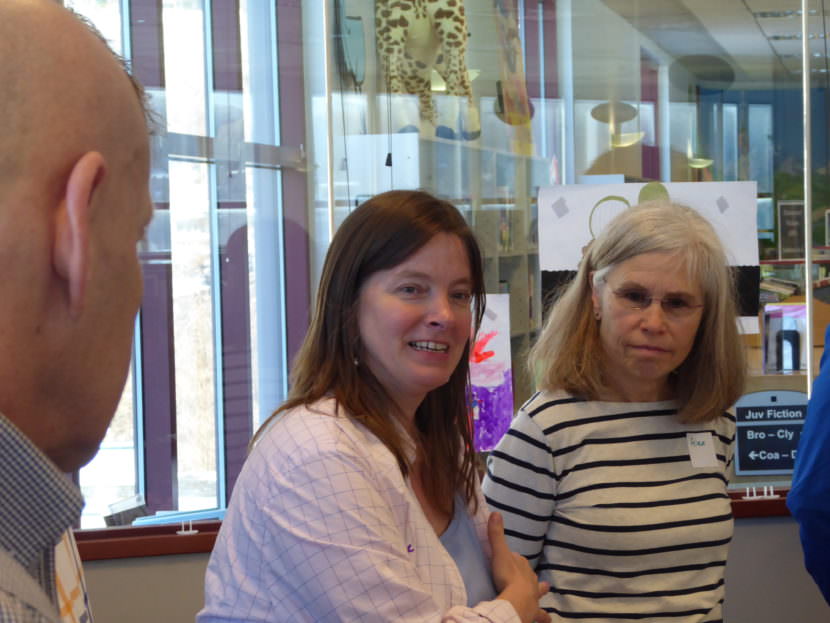
Alyse Galvin, middle, is the co-founder of Great Alaska Schools. She led the discussion.
Alyse Galvin, middle, is the co-founder of Great Alaska Schools. She led the discussion at the Juneau Downtown Library on Saturday. (Photo by Quinton Chandler/KTOO)

Alyse Galvin co-founded Great Alaska Schools and led the talks.

“Today’s conversation is about gathering the people that we talked about: the parents, the students — you noticed there are a lot of students in there — educators, community members, anyone who cares about kids being ready for life coming together and saying, ‘Well, what would that look like if public education was doing the right thing for every student?’”

The café in the downtown library was in a little room with a tiny fruit and veggie buffet and little tables dressed up in red and white checkered tablecloths. It drew about 20 people including a Department of Education official, the Juneau School Board president and a couple of Juneau principals. But, there were also former educators, students and concerned neighbors.

“And the beauty of this particular meeting, called a café – it’s really not a meeting-meeting, it’s purposely called a Community Café — is that people feel level,” Galvin said. “They’re at the same level no matter whether they have 28 years teaching experience, or they’re a student that’s a freshman in high school.”

Galvin said her group wants all these people to give the Department of Education ideas on how schools can improve for all Alaska’s students.

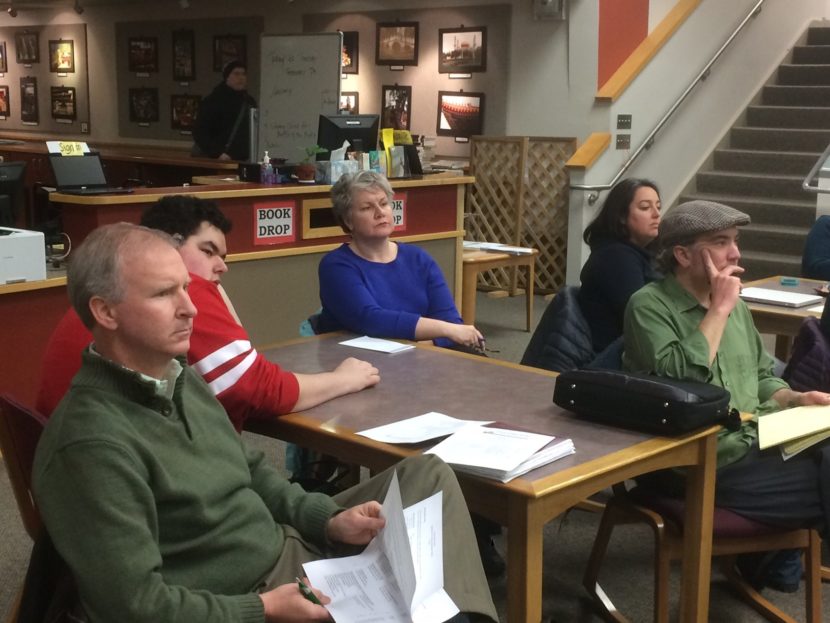
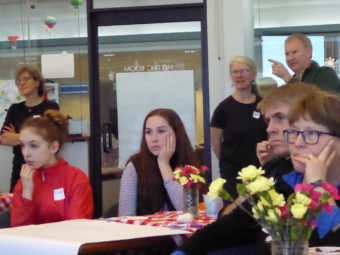
Participants listen during the Great Alaska Schools Community Cafe in the Juneau Downtown Library, Saturday.
Participants listen during the Great Alaska Schools Community Café in the Juneau Downtown Library on Saturday. (Photo by Quinton Chandler/KTOO)

One of the questions she asked the café’s patrons to think about was:

“If we’re doing the job right, how would every student look? What would they have? What would they know?” Galvin asked.

She said normally to answer that question we’d look up students’ grades in math or reading.

“But what I’ve heard this morning in our café is, ‘Actually, we also care about whether students know how to collaborate, do students know how to do simple ‘life hacks’ they called it, like changing a tire or balancing a checkbook,” Galvin said. “There’s some things that are living skills. Do students know how to have healthy relationships?”

Galvin said these are examples of measurable skills that don’t get measured.

Great Alaska Schools has held these community cafés before in communities around the state. Galvin said not only did people have great ideas, they also followed up on them. As examples, she remembered programs started in Fairbanks and Anchorage.

“And people come out with ideas I would have never thought of, things like, ‘I’m an elder, I’ll come in and share stories.’ ‘I’m a community member. I’ll help build sleds after school because I heard students say they want more hands-on learning,’” she said. “We’ve had after-school programs like Spanish club that started from two years ago — a café. We have things like parents tutoring students after school that started from a café years ago.”

Galvin isn’t sure any of that would have happened if people weren’t invited to sit down and talk about their ideas.

She also encouraged people to volunteer at their local schools and to take an online survey the state launched to identify Alaskans’ education priorities.

Mike Miller’s life, career centered on social justice, faith

Services are planned for this weekend for Mortimer Michael “Mike” Miller, the travel writer and former lawmaker who represented Juneau in the Legislature just as the new state of Alaska was getting on its feet.

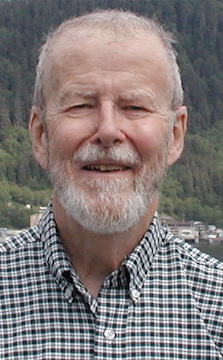
Mike Miller in a 2012 photo.
Mike Miller in a 2012 photo. (Courtesy Miller family)

Mike Miller was the first publicity director for the State Division of Tourism, served on the Juneau Assembly, served a total of 16 years in the state House, and served 10 years on the Department of Corrections’ Parole Board.

Miller was 87 years old when he passed away Feb. 11 in Vancouver, Wash., from complications due to pneumonia.

A memorial service is planned for 1 p.m. Saturday, Feb. 25, at Northern Light United Church.

“He had a real good run,” said his son, Kevin Miller of Juneau.

After Mike Miller graduated with a degree in journalism from Wichita University, he briefly worked for Coleman Company, producing the camping supply manufacturer’s in-house publication.

From the KTOO-TV program “Conversations in 1986, Miller tells Laury Roberts Scandling how getting laid off from Coleman led to he and his wife, Marilyn, moving to Alaska.

“I wrote a letter to lots of people, but including Emory Tobin who was at that time the publisher of the Alaska Sportsman which is now, of course, Alaska magazine. Everything was done in Ketchikan at that time and I came up to be on the staff. It was exciting,” Miller said.

“What a stroke of luck,” Scandling said.

“Oh, terrific luck,” Miller continued. “Yeah. And it was 1954. It was before statehood. As I look back at it now, sort of a prosperous period in a sense, nothing boomish.”

Listen to the broadcast version of the story:


Miller started out in his career writing fiction and then later focused on travel articles.

According to a profile published in the Juneau Empire in 1986, Miller’s stories appeared in publications ranging from the New York Times and Chicago Tribune to Field and Stream magazine, Argosy magazine and Alfred Hitchcock’s Mystery Magazine.

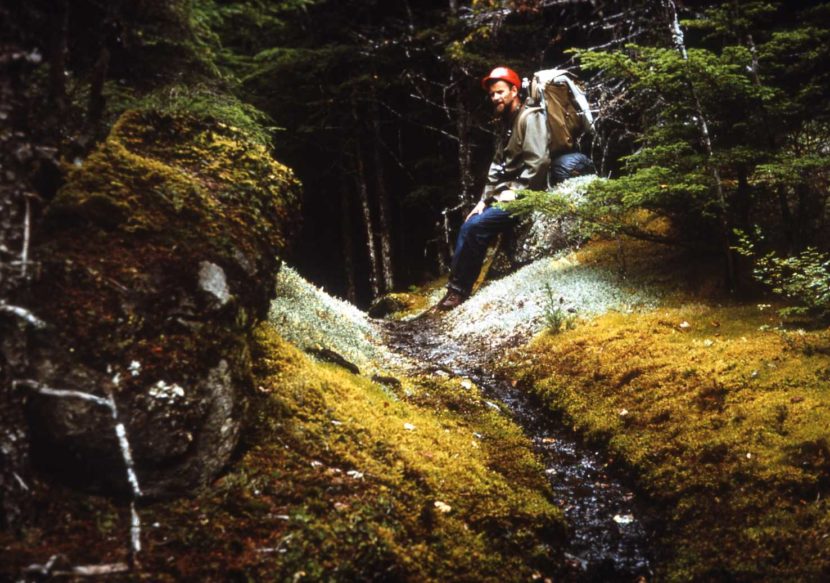
Mike Miller takes a rest while hiking the Chilkoot Trail in this 1967 photo.
Mike Miller takes a rest while hiking the Chilkoot Trail in this 1967 photo. (Courtesy Miller family)

Son Kevin said his parents eventually moved to Juneau so his dad could take the state tourism job.

“I think he just kind of fell in love of the whole idea of promote Alaska, in particular, and travel around to all these exotic places and to write about them,” Kevin Miller said. “Just the niche that he fell into, I suppose.”

Miller continued to work as a freelance writer, even while serving as an Assembly member in Juneau and after being elected to the state House.

“He was just very civic minded and always had a sense of giving to the community and being involved in making the community what he felt was a better place and doing what he could to do that, as opposed to being a passive observer,” Kevin Miller said.

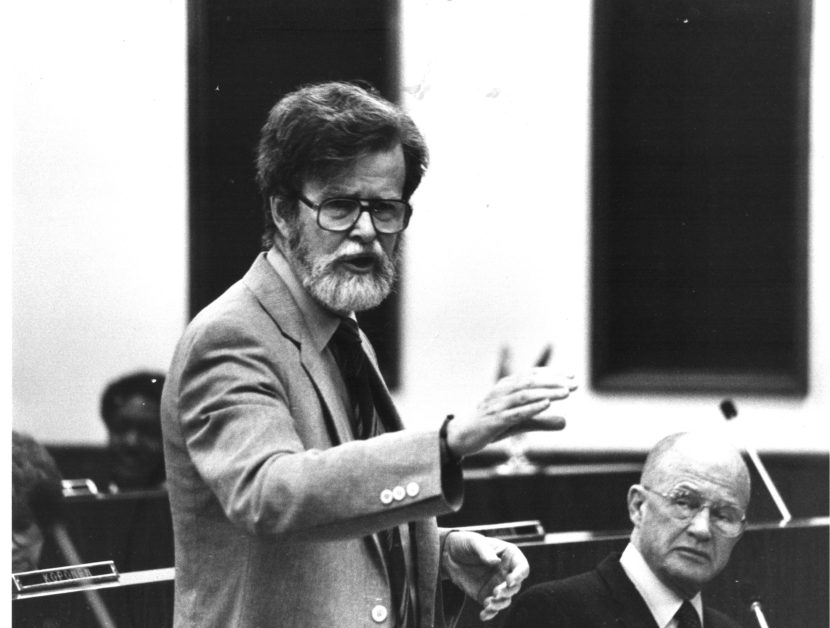
Rep. Mike Miller speaks on the floor of the Alaska House of Representatives in this undated photo.
Rep. Mike Miller speaks on the floor of the Alaska House of Representatives in this undated photo. (Courtesy Miller family)

Longtime friend John Pugh – now retired as University of Alaska Southeast Chancellor – said Miller was a diligent and detail-oriented lawmaker who worked behind the scenes in the Legislature rather than seeking the limelight.

Pugh also said Miller was a key player in the fight against the capital move.

“If he hadn’t been able to work across the aisles, it would’ve been very hard to work with people from rural Alaska as well as from Fairbanks, the Mat-Su, and even Anchorage,” Pugh said. “There were some people who opposed the capital move even in Anchorage.”

Miller twice served as Majority Leader and once as Judiciary Committee chairman while he was in the Legislature from 1971 to 1986. That was a period in which lawmakers were still crafting laws for a young state government that was barely a dozen years old.

Miller would joke with his family about writing the first seat belt law. He also helped with passage of the Public Employees Relations Act, the 1972 law that allows public employees to organize and bargain collectively for wages, hours and most benefits.

“He’d quickly became one of the experts on the Public Employees Relations Act and also just on how to move legislation,” Pugh said. “He was known for his understanding (of) the rules.”

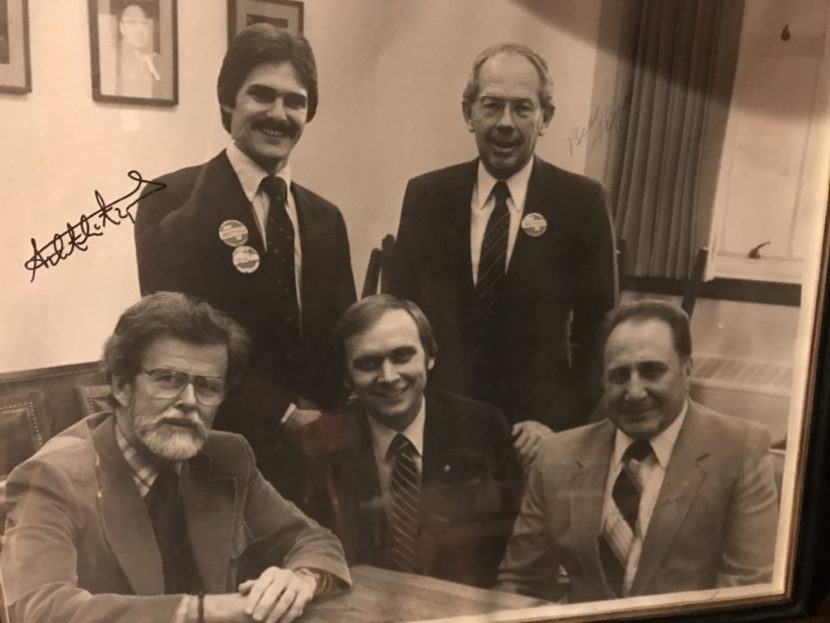
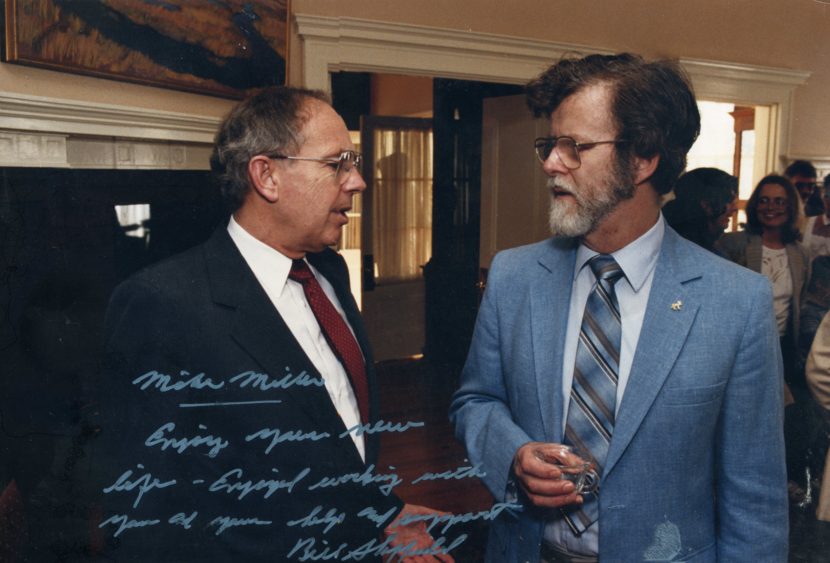
Rep. Mike Miller (counter-clockwise from bottom left) poses with Rep. Jim Duncan, Sen. Bill Ray, Gov. Bill Sheffield and an unidentified man in this photo circa 1980s.
Rep. Mike Miller (counter-clockwise from bottom left) poses with Rep. Jim Duncan, Sen. Bill Ray, Gov. Bill Sheffield and an unidentified man in this photo circa 1980s. (Courtesy Miller family)

In 1981, Juneau’s delegation to the Legislature included Sen. Bill Ray, Rep. Miller, and Rep. Jim Duncan, who was also Speaker of the House.

The legislative session dragged on into early June over budget issues.

The Democrats’ slim majority in the House fell apart during the infamous coup in which Duncan was ousted as speaker and eventually replaced by Anchorage Republican Rep. Joe Hayes.

Dipping into the KTOO-TV archives again, here’s Miller on the House floor addressing the Speaker Pro Tem at the height of the turmoil.

“The people who were supposedly excused from the call of the House were not even notified that you were going to pull this kangaroo shenanigans,” Miller said. “So, this whole session here this afternoon is nothing but a sham and a delusion, and really a very dirty trick to pull on the people of Alaska in this strictly illegal session.”

Gov. Bill Sheffield and Rep. Mike Miller in a 1986 photo.
Gov. Bill Sheffield and Rep. Mike Miller in a 1986 photo. (Courtesy Miller family)

In the 1986 program “Conversations,” Miller noted one of his major accomplishments as a lawmaker included helping establish the Mendenhall Wetlands State Game Refuge.

“If you don’t have some kind of a plan, it just gets nibbled and nibbled and nibbled and all of a sudden somebody looks around one morning and there’s no wetlands left,” Miller said. “We set those wetlands aside and said this was going to be a game refuge. It’s a terrifically productive critter factory for feeding ducks and feeding fish and things like that. It’s fantastic. I just feel real good about that 10 square miles right flat smack in the middle of the borough being set aside and protected from exploitation.”

According to Pugh, Miller had a lot of help from his wife, Marilyn, an ardent conservationist.

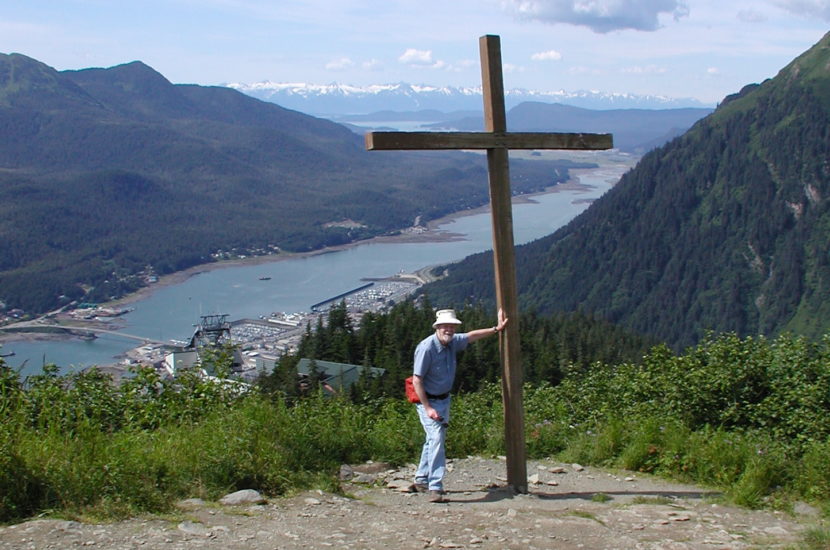
Mike Miller stands next to Father Brown's Cross in this 2001 photo.
Mike Miller stands next to Father Brown’s Cross in this 2001 photo. (Courtesy Miller family)

Pugh said Miller’s faith was also important to him and formed the basis of his guiding principles of patience, integrity, kindness and compassion.

“Mike was also very centered as a Christian and had very strong beliefs in terms of social justice,” Pugh said. “In fact, on the service thing that’s coming out, there’s a quote from (Book of) Amos about how justice will roll down like water. That’s going to be on the front because he really believed in social justice.”

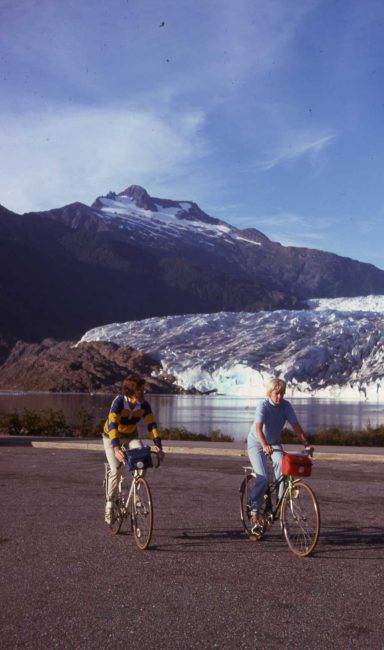
Mike and Marilyn Miller on bicycles in front of the Mendenhall Glacier in this 1975 photo.
Mike and Marilyn Miller on bicycles in front of the Mendenhall Glacier in this 1975 photo. (Courtesy Miller family)

Pugh said those beliefs and principles carried over into his work on the Parole Board.

Miller also led Bible study groups and conducted a ministry for inmates at Lemon Creek Correctional Center, and he served as a volunteer and was active in the early formation of the Glory Hole shelter and soup kitchen.

Juneau’s transitional youth home, the Miller House, is named for him.

Miller also was an avid runner and a passionate cyclist, and he was an early advocate for creation of bike trails around the state.

Kevin Miller said he has tons of pictures of his parents on bikes while traveling abroad.

“It didn’t matter where they were, there were on a bicycle in at least some of the pictures in India, in Hawaii, Badlands of North Dakota, or wherever,” said his son.

Mike Miller is survived by his wife, Marilyn, children Gail, Kevin, and Shelly, and five grandchildren.

(Editor’s note: Reporter Matt Miller is unrelated to Mike Miller and his family.)

School counselors help with things from academic support to grieving

Juneau school counselors wear multiple hats.

They help with career readiness, relationship counseling and last year some students had an unfortunate reminder that their counselors can help them grieve.

Unexpected deaths can have a ripple effect in Juneau.

Last fall, a music teacher for both Floyd Dryden Middle School and Thunder Mountain High School died from a heart attack, and a 17-year-old Thunder Mountain student died from an accidental gunshot wound.

Kelly Hansen is the counselor at Floyd Dryden Middle School.
Kelly Hansen is the counselor at Floyd Dryden Middle School, Wednesday, Feb. 15, 2017. (Photo by Quinton Chandler/KTOO)

Kelly Hansen is the school counselor at Floyd Dryden.

“I think that whenever there is a loss or some sort of situation where there is a pretty large impact, it can really impact families, so there’ll be kids at the high school that have siblings at the elementary or at the middle school that might know the family or have a connection with the teacher,” Hansen said.

After the deaths, the district’s crisis response team comprised of counselors, psychologists and administrators offered support. Hansen said some of the kids at Floyd Dryden came looking for her.

“There was a few kids that kind of needed a quiet place to talk and to listen,” Hansen said. “I didn’t feel like it disrupted my day or my week more than normal. I feel like we responded and provided support where we needed to.”

She said during a crisis other staff also let her know which kids are having a hard time and she makes a point to check up on them.

Phil Merrell is the counselor at Thunder Mountain High School. He said schools are like small communities and anytime there’s a loss, emotions run strong.

“When one of those persons is lost, everyone is affected, everybody feels it to varying degrees,” Merrell said. “So for sure, there’s a change, there’s a sense of loss, but at the same time there’s a deepening sense of community, too, in that, ‘OK, we can come together, we can support each other.’”

Now it’s a new year and Merrell was reluctant to say his kids were back to normal, but he said there’s definitely a new sense of positivity in the school.

Phil Merrell is the counselor at Thunder Mountain High School.
Phil Merrell is the counselor at Thunder Mountain High School, Thursday, Feb. 16, 2017. (Photo by Quinton Chandler/KTOO)

While the recent deaths highlighted the role school counselor’s play in a crisis, Merrell said that’s not the only part of their jobs.

“It’s not easy to be in school, it’s not easy to be a young person in our culture,” he said. “… That generation Y, this idea of when do you become an adult, what is adolescence is just stretching and stretching a whole lot.”

Merrell said he serves as a bridge for students. He said he tries to support them socially, emotionally, academically and in finding future careers.

Hansen added that counselors can serve to boost morale throughout the school.

She said that she meets with kids and parents to talk about their classes, issues at home or at school.

She helps connect families with services they might need – everything from introducing them to the right administrators to helping them find food.

She serves as a mediator, she’s a case manager for kids with disabilities, and she said counselors are just a safe place for kids.

“Kind of going back (to) kids knowing that they have someone they can talk to that will keep their confidence and that they won’t break confidentiality unless it had to do with the safety of them or someone else,” Hansen said.

In a recent budget meeting, multiple residents and school principals asked the Juneau School Board to make funding for counseling staff and social-emotional needs a priority in their budget.

Winners announced for Wearable Art ‘Renaissance’

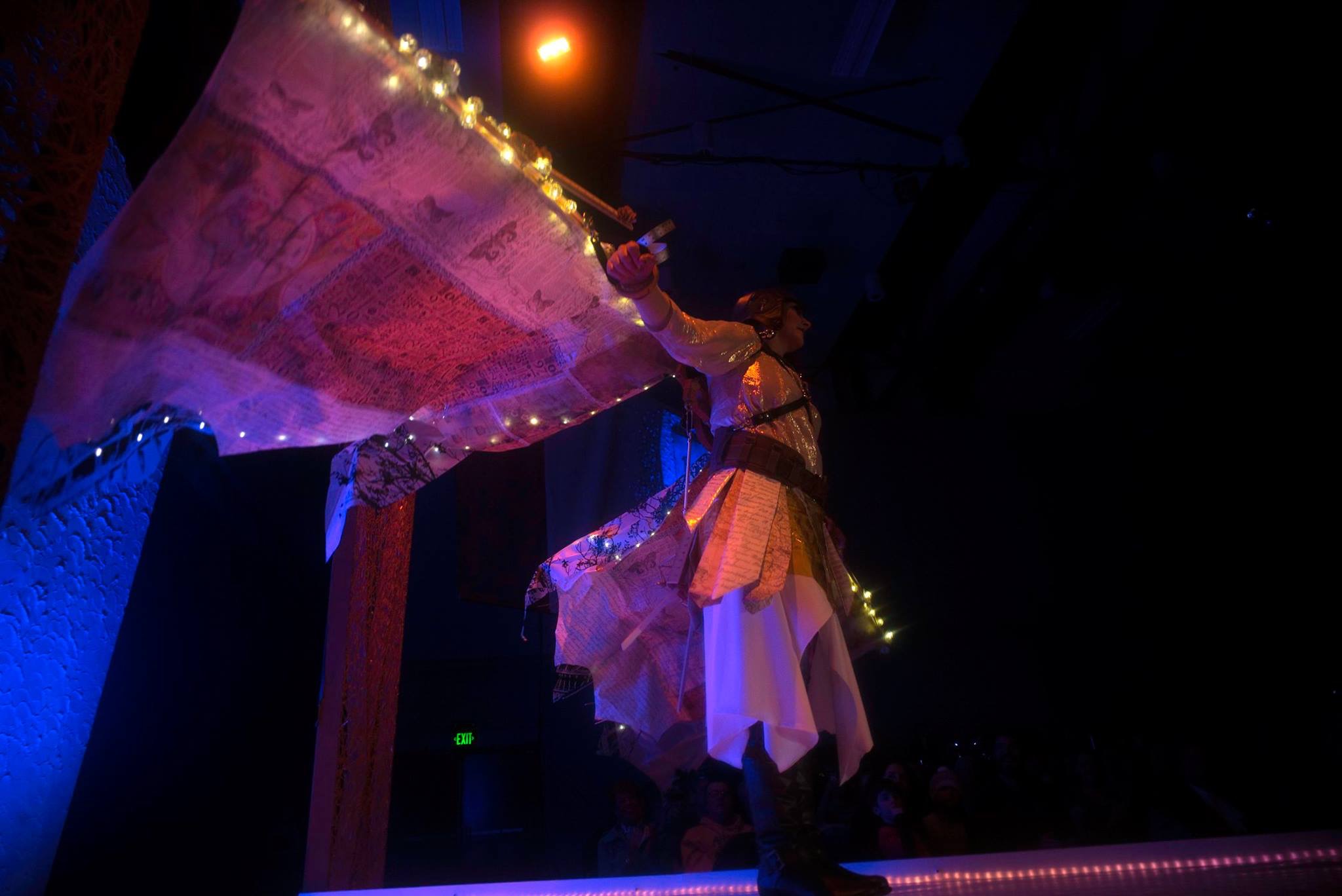
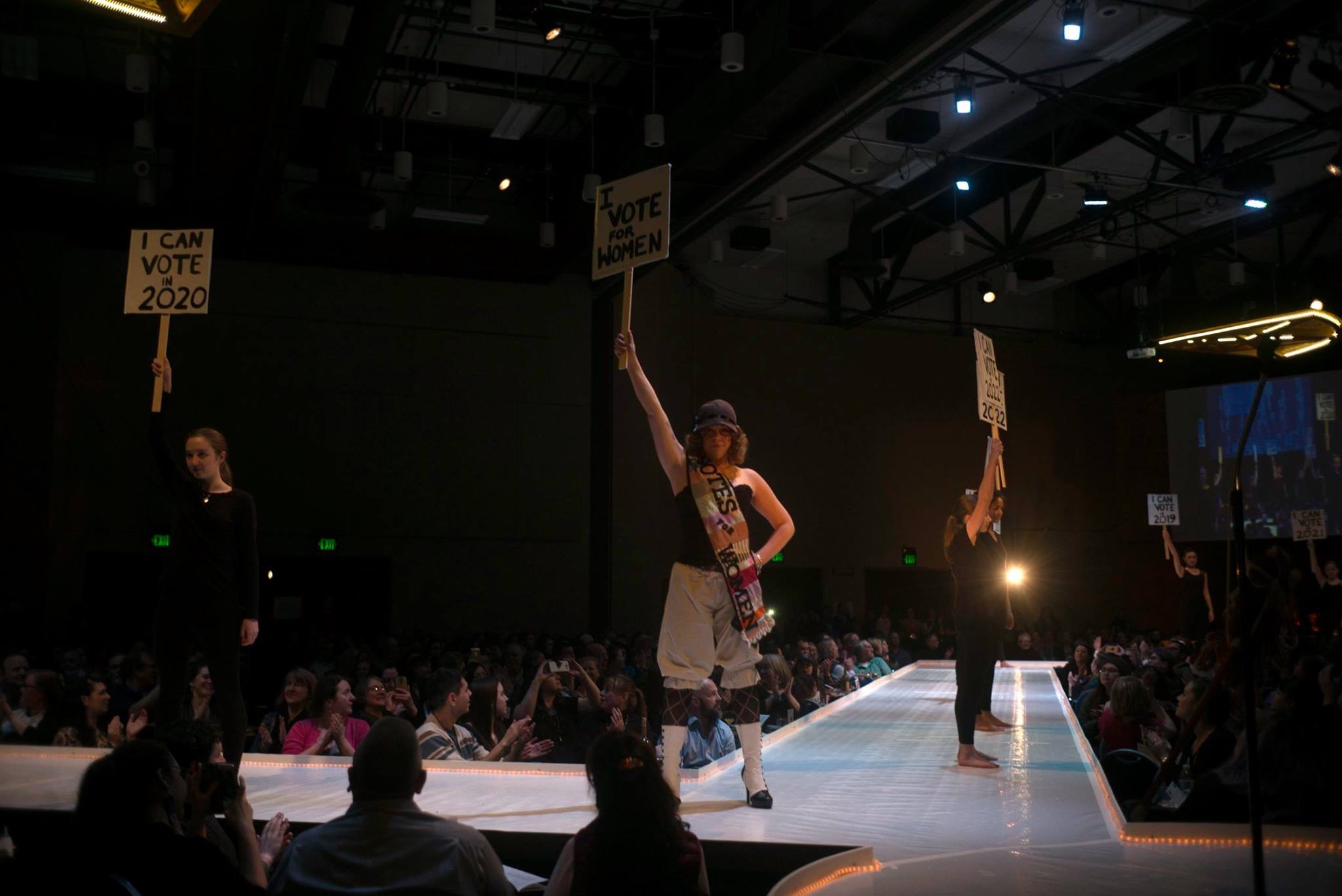
Wearable Art entrants are known for innovation, creativity, repurposing materials and for social commentary.

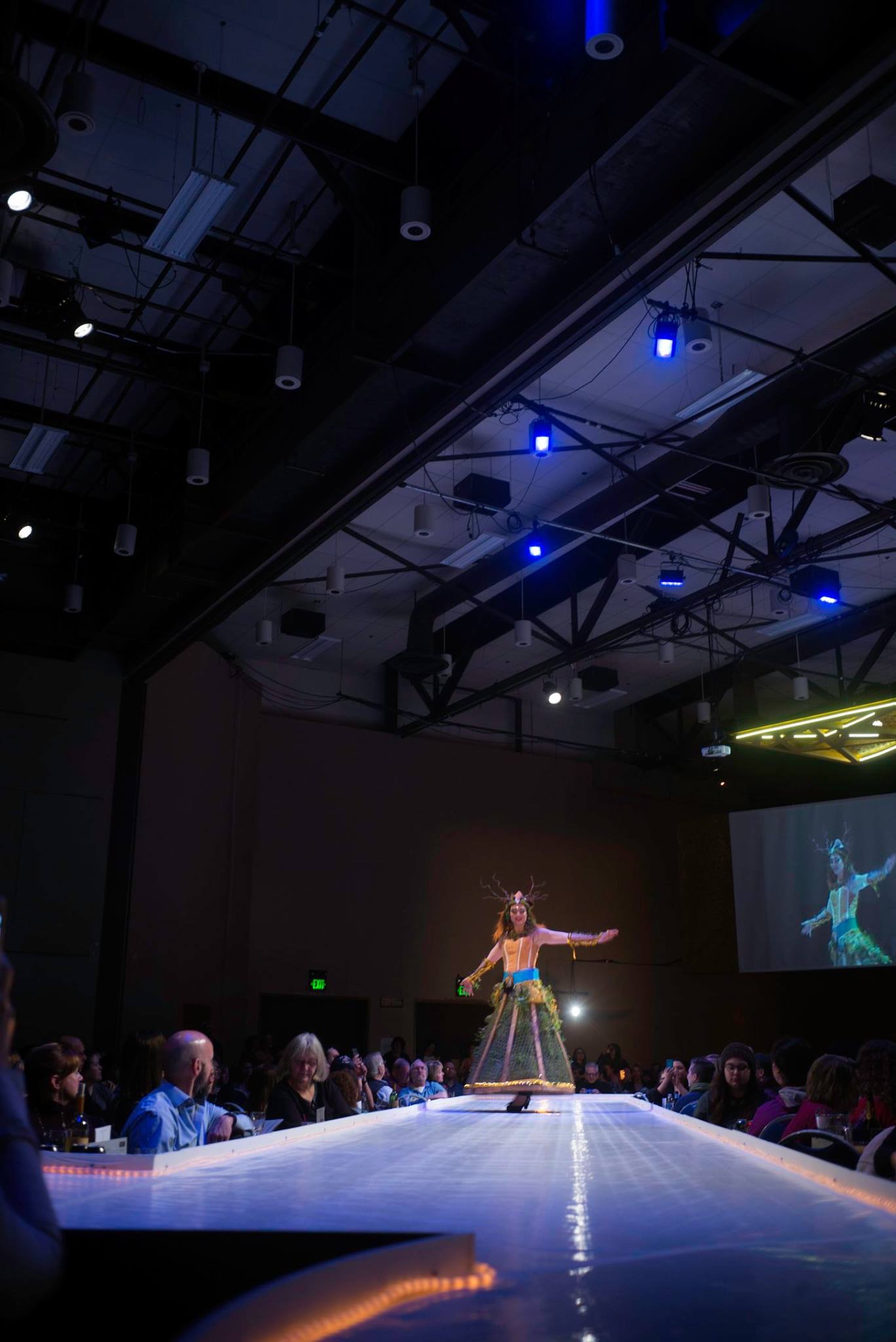
Sarah Sjostedt models “Food Security” by Deena McDougal and Jake Musslewhite at Wearable Art 2017. (Photo courtesy John Hutchins)

This year was no exception.

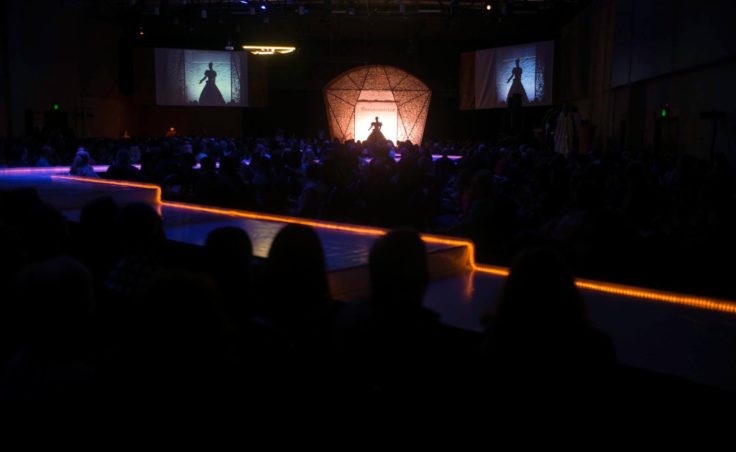
The 2017 show “Renaissance” took place Saturday and Sunday at Centennial Hall.

Models walked 29 entries down the runway as part of the annual fundraiser for the Juneau Arts and Humanities Council.

Materials included tin can lids, glass beads, duct tape, guitar and violin strings, bottle tops, flowers, chicken wire, lace, recycled copper fuel line, corn husks, fur, and vinyl records to name a few.

Emcees were actor Allison Holtkamp and actor-playwright Frank Henry Kaash Katasse.

Listen to a few audio highlights from the event here:

Amy Romme models one side of “Royal Divergence” at Wearable Art 2017. It was a two-person piece she and artist Jessica Hood collaborated on.
Amy Romme models one side of “Royal Divergence” at Wearable Art 2017. It was a two-person piece she and artist Jessica Hood collaborated on. (Photo courtesy John Hutchins)

Winners were chosen by a group of jurors who scored four categories: construction, innovation, overall presentation, and what they call the “wow” factor.

The juror’s first place award, or Best of Show, went to “Church of the Wild,” by artist Lauralye Miko and modeled by Amy George.

“A Lid-dle Un-can-ny,” by artist and model Michelle Morris, won juror’s second place and the people’s choice award.
“Battling Potted Land,” by artist and model Angela Ecklund won, the juror’s third-place award.

You can watch the broadcast of the event on 360 North at 8 p.m. Thursday.

Residents talk class sizes and other needs at school district budget meeting

Nicole Wery is really hoping class sizes and school counselors aren’t affected by the school district’s budget for next school year. She has three kids in Juneau schools: two at Juneau-Douglas High School and one at Glacier Valley Elementary.

“PTR (Pupil-Teacher Ratio) is over 30 kids in classes. It’s so hard to be able to teach because we have kids that come from all facets of the world,” Wery said. “Some people are really advanced and some people aren’t, so just the knowledge base that a teacher has to teach to is large.”

Wery said it’s also critical that the district can bring drug and alcohol counseling into schools, and keep the regular school counselors it has on duty. She believes they play a huge role in preparing kids for the future.

School Board President Brian Holst, left, and other audience members listen during the meeting.
School Board President Brian Holst, left, and other audience members listen during the meeting on Tuesday, Feb. 7, 2017. (Photo by Quinton Chandler/KTOO)

The Juneau School Board is working on a months-long budget process and board members decided to give the public a chance to comment. Almost a couple of a dozen people attended one of two school district budget meetings on Tuesday, Feb. 7.

Seven people spoke during the meeting. Nearly all of them said they were most worried about class sizes.

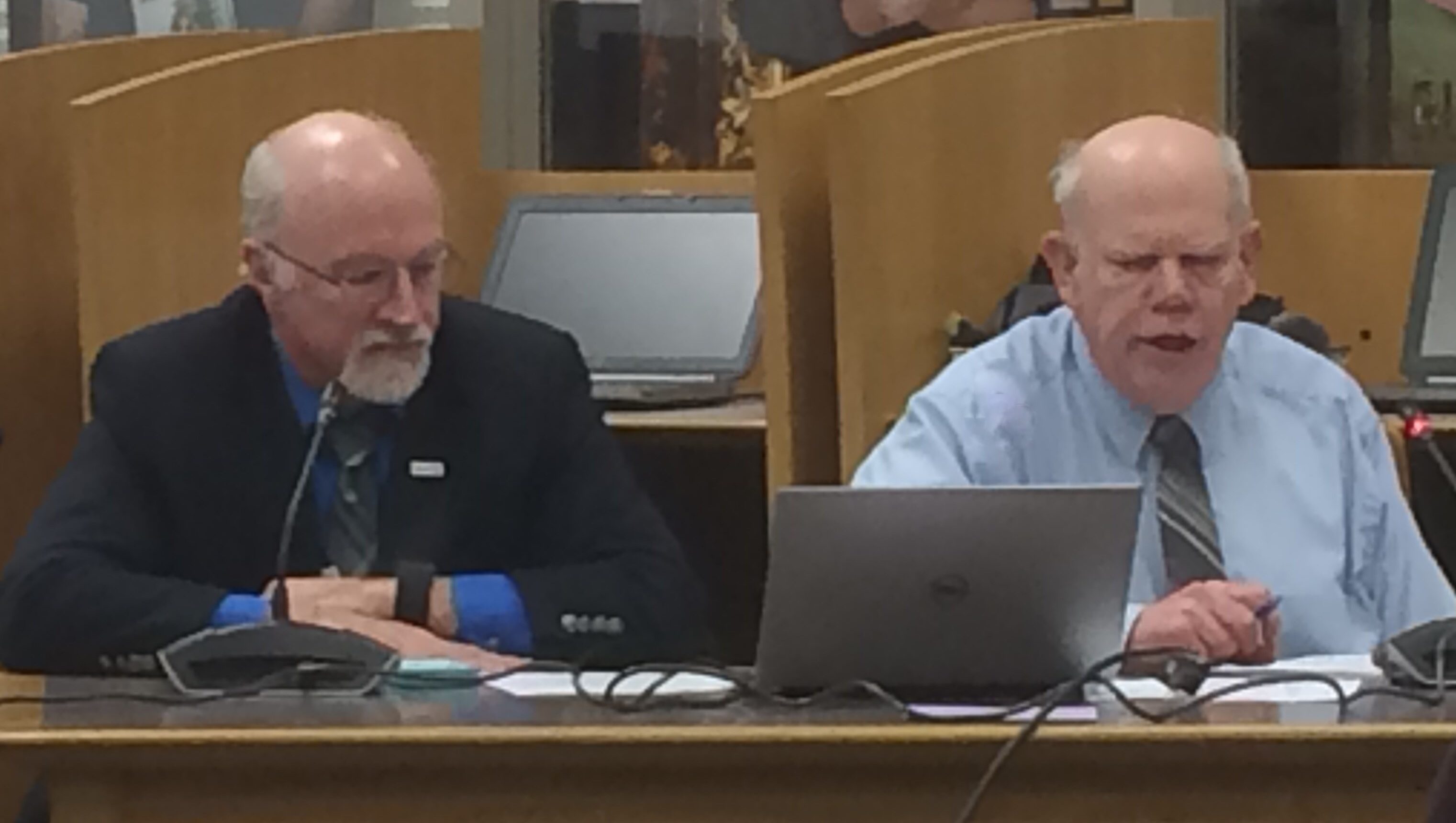
Superintendent Miller, left, and Director of Administrative Services, David Means, right, during the budget meeting on Tuesday, Feb. 7, 2016.
Superintendent Mark Miller, left, and Director of Administrative Services David Means during the budget meeting on Tuesday, Feb. 7, 2017. (Photo by Quinton Chandler/KTOO)

District Superintendent Mark Miller said he doesn’t think class sizes will grow for the 2017-2018 school year.

“Well, we’ve been financially conservative. So what I’m expecting is that we will have enough in carryover and what we get from the state to not have to make cuts for the first time in years,” Miller said.

He said in the last couple of years, cutting administrative positions and increasing class sizes were the only ways to balance the budget. But, he says it’s a balancing act.

“As I say, ‘When you find yourself at the bottom of a hole, stop digging.’ So we’re going to work really hard this year, I believe, to make sure that we don’t make the problem any worse,” Miller said.

He added that there is a little bit of money that the district might be able to use to reverse past cuts, but he stressed that compared to the overall budget, it’s a very small amount.

Some people attending the meeting also asked for more counseling staff, electives and vocational classes. Several said the district should pay for renovations at Mendenhall River Community School right away. They complained about plumbing problems and accessibility for special needs students.

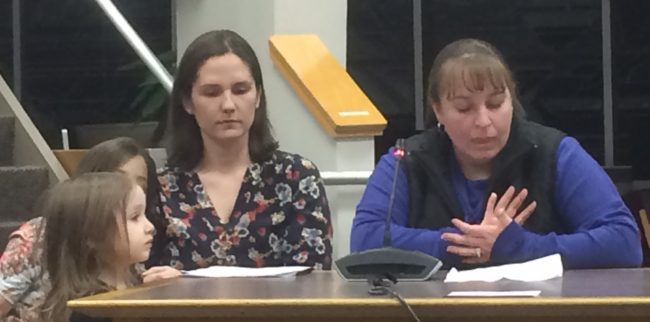
Two women with the Mendenhall River Community School Parent Teacher Organization speak to the school board during the budget meeting.
Two women with the Mendenhall River Community School Parent Teacher Organization speak during the budget meeting. (Photo by Quinton Chandler/KTOO)

While Miller doesn’t think the district will have to make cuts, he said there’s probably not going to be money for big renovations.

He said, “right now we’re in Band-Aid mode and we’re going to continue in Band-Aid mode until the state helps, comes back and helps us out with major bond debt reimbursement so we can afford major repairs.”

Last June, Gov. Bill Walker vetoed more than $30 million for school construction debt reimbursement and over $10 million for rural school construction funding from the state budget. In 2015, the Legislature also decided not to reimburse schools for any new construction debt until July 2020.

Four principals and a volunteer from local schools also spoke at the budget meeting. They all said one of their top priorities was lowering or maintaining class sizes. They asked the board for more special education specialists, pre-school programs, resources for electives, building renovations for Mendenhall River Community and Dzantik’i Heeni Middle School and counseling staff; including career counselors, drug and alcohol counselors.

And almost all of them asked for special teacher training ahead of implementation of the district’s new science curriculum.

The school board will send a budget to the City and Borough of Juneau at the end of March. Miller said a lot will depend on the solutions the state finds for its own financial dilemma.

And Nicole Wery said she’ll be watching the Legislative session to see whether the district will get the money for those counselors she’s rooting for.

Site notifications
Update notification options
Subscribe to notifications