Organizers of the Juneau Project Homeless Connect outreach event held last month have released numbers and related data on who attended. Most were in their 40s and identified as Alaska Native.
In the data released Friday, 238 people were counted, including 50 people living in a place federal housing authorities says are not meant for habitation.
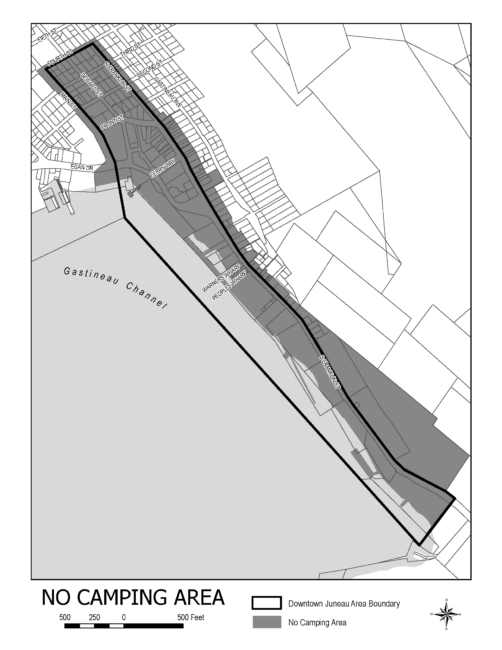
The Juneau Assembly is slated to debate an anti-camping ordinance on Monday that would ban people from camping in the downtown core. Merchants say it’s necessary to prevent homeless people from sleeping on private property and so employees feel safe.
The Alaska Coalition on Housing and Homelessness opposes the ordinance. Executive Director Brian Wilson says the latest numbers run counter to the perception that the homeless population downtown has become younger.
“There’s a narrative going around that this is a new phenomenon in Juneau,” Wilson said. “But overall if you look at the numbers, it’s primarily individuals who have been experiencing homelessness for more than a year. … Two-thirds identify as Alaska Natives and are over 43 years old on average.”
Hoonah City Schools Superintendent PJ Ford Slack, right, sits in on the Orange Frog training, Tuesday, Jan. 10, 2017. (Photo by Quinton Chandler/KTOO)
This story starts with Superintendent of Hoonah City Schools, PJ Ford Slack. Hoonah is a small village on Chichagof Island in Southeast Alaska.
Slack came here as an “emergency replacement” for the district’s last superintendent and when she got to work, she noticed something.
“The adults were really not happy. That didn’t mean they actively knew that, but they seemed to be down,” Slack said.
Hoonah’s community does feel a lot of stress.
The isolated town’s commercial fishing and processing industries dried up years ago, the school district is under heavy financial strain and drug and alcohol dependence are growing concerns.
Slack believes a teacher’s attitude has a powerful impact on the kids they teach. So she started researching something called the Happiness Advantage.
“It seems to make sense that would make a difference if the kids and the adults all learned a little bit about this and learned happiness is a choice,” Slack said.
The district used about $20,000 in grant funding to pay for a training based on the work of author and motivational speaker, Shawn Achor.
It’s called the Orange Frog Project. The project was supposed to teach Hoonah’s high school and middle school students how to choose happiness every day.
The adults went through it months ago and Slack says it has already changed some their lives.
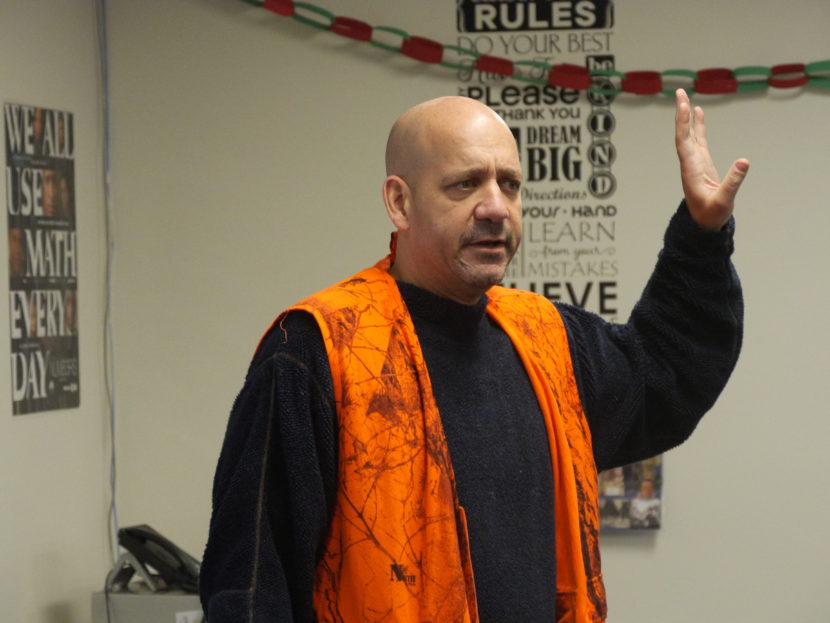
Devin Hughes at the front of the class during the Orange Frog training. (Photo by Quinton Chandler/KTOO)
“Whoo! You’re awesome, bam let (them) know, let’s go,” yelled Devin Hughes, chief inspiration officer for the International Thought Leader Network.
Hughes ordered a round of high fives as he explained that he would teach the room full of high school kids to be outwardly positive even if it means being the weird one.
He said, “my whole mission, my tenet, is to go around and inspire, motivate others to achieve happiness and joy and optimism. It’s pretty cool.”
Hughes used a comic book to jumpstart the training. It’s a story about a bunch of sad green frogs and a happy frog, who slowly turns orange.
A high school student sketches a formline frog based on the main character from the Orange Frog comic book. (Photo by Quinton Chandler/KTOO)
The more the orange frog does to make himself happy, the better he gets at catching flies, and the more orange he turns. Eventually, the other frogs copy him: they get happier, they catch more flies and they start turning orange too.
Hughes said his company travels to corporations around the world and to schools teaching people to be orange.
“So right now, I think schools are probably the fastest growing segment within our business,” Hughes said. “Because if you can get a kid, whether it’s a kid that’s 6 or 16, and start to rewire their brain and doing these things more often and feeling pretty good, behavior issues go down, test scores go up.”
But let’s walk this back. Hughes said he’s being paid to teach people to be happy. Doesn’t anybody question that?
“Oh, all the time. I mean people are like, ‘Really, really,’” Hughes said.
“Because, if you think about it when I ask you the question, ‘Did you have anyone in your life when you were a youngster teach you, give you the secret sauce to happiness, tell you something prescriptive, something actionable that you need to do to work on this, your mojo and your mindset? Universally nobody raises their hand.’”
He said after the initial skepticism, people usually jump in, because, “who doesn’t want to be happy?”
The high schoolers seemed to embrace Hughes’ message. All around the room kids wore bright synthetic orange wigs, frilly orange necklaces; they had streaks of orange marker on their faces — any kind of orange prop or clothing they found, they wore it.
Hughes told the kids to keep it positive. Throughout the day, he had them share the best things happening in their lives with other people.
“First rule (of) Orange Frog, if something good happens you have to talk about it,” he said.
He asked them to run the halls delivering what he called “joy bombs” to people all over the building so the kids gave people unexpected high fives and hugs and told them that they were awesome.
Jerry White III answers a question during the Orange Frog training. (Photo by Quinton Chandler/KTOO)
Hughes told them to think about how to stop their problems from keeping them down.
He told them to think about changing behaviors that affect everyone, things like bullying or ignoring kids they usually don’t hang out with.
At the end, Hughes asked the kids to spend time thinking about how they can remember to keep doing this after he leaves.
Some of the kids said Orange Frog definitely changed their school’s atmosphere, but will it last?
Senior Kelsey Thein isn’t sure.
“I think that only time will tell with that one. I can see that a lot more people are upbeat than normal and if it stays, it stays,” Thein said.
Other kids said optimistically that they can easily turn their school orange in the long term.
Superintendent Slack hopes so too.
“I’m hoping that this will help them as they go through their life know that they can make some choices and that those choices are tough sometimes,” Slack said.
“Life is tough. But, there are ways that we can turn the frown the other way around and make it a smile.”
She doesn’t see this as some kind of silver bullet. She hopes learning about Orange Frog will help them develop better coping skills to handle whatever life throws their way.
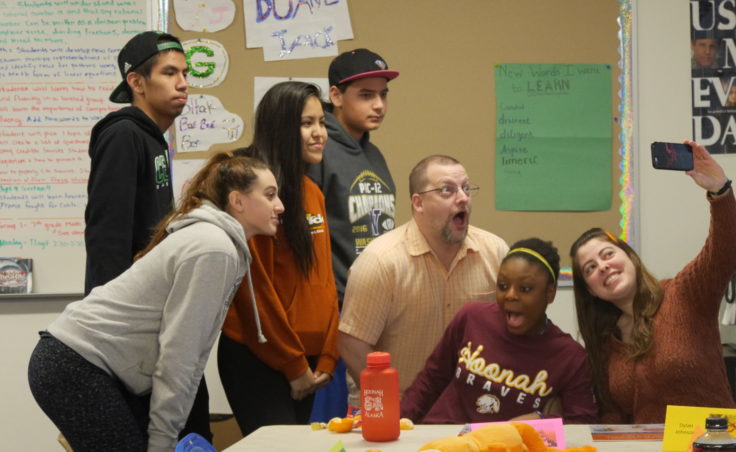
Orange Frog Project participants take a selfie. (Photo by Quinton Chandler/KTOO)
Health, P.E. and History Teacher, Adam Gretsinger, poses during the Orange Frog training. (Photo by Quinton Chandler/KTOO)
High School kids taking part in the Orange Frog Project. (Photo by Quinton Chandler/KTOO)
High School students and their teacher dance during an assigned presentation in the Orange Frog training. (Photo by Quinton Chandler/KTOO)
During the training students were given multiple assignments in small groups that included at least one teacher. (Photo by Quinton Chandler/KTOO)
Coach Adam Gretsinger encourages a middle school student to join the fun. (Photo by Quinton Chandler/KTOO)
Three boys show off the frogs they colored. (Photo by Quinton Chandler/KTOO)
Middle School kids work on a poster for their Orange Frog training. (Photo by Quinton Chandler/KTOO)
Devin Hughes holds the positive outlier graph. The orange dot reflects an unusually postive person. The green dots represent average people. (Photo by Quinton Chandler/KTOO)
The headquarters of the U.S. Department of Housing and Urban Development in Washington in December 2006.(Creative Commons photo by David)
An ordinance to ban the homeless from camping in the downtown core continues to generate controversy. Now there’s questions over whether a ban could affect the community’s access to federal housing dollars.
There’s been a lot of outcry over a proposed ordinance that would ban homeless people from camping in Juneau’s downtown core. Proponents say it’s a public safety issue. Opponents say a camping ban would just move the problem around.
“The board made the decision that we were in support of the ordinance and I personally feel that was the right decision, not everybody on the DBA feels that way,” said Eric Forst, owner and manager of the Red Dog Saloon who penned the DBA’s letter of support for the ordinance.
He said it’s a complex problem and one that needs a lot of work.
“On either side of the issue we all feel that this not the silver bullet,” Forst said. “This is a step — there’s a lot more that needs to be done.”
He’s operated downtown businesses for about 20 years. There have always been homeless people around but that in the last 18 months or so it’s changed.
“(There’s) a younger, meaner more aggressive element that does not want to be helped — and that’s what this is targeted at,” he said.
In recent weeks a number of social care organization have testified that a camping ban wouldn’t solve anything and would waste police resources.
Homeless residents have also weighed in. Mary Bailey, 46, has recently been staying at the Glory Hole downtown shelter though she said she’s had to sleep by downtown storefronts.
“I mean, that’s the only thing that can protect us from the weather so I mean what’s going to happen?” Bailey said. “I mean, we need something what about a tent city? And if that law goes through, why don’t they put a tent city first?”
The city is working behind the scenes to identify a year-round campground. But that takes time. Rezoning would be at least several months away. City staff has proposed delaying any camping ban until mid-April when the city-run Thane campground reopens. It’s in an avalanche zone, so it closes down for the fall and winter.
Juneau Mayor Ken Koelsch, ordinance’s main proponent, said pushing the effective date to April 15 as a compromise. He’d like it to take effect earlier.
“We need to deal with our homeless problem,” Koelsch said. “We need to deal with our safety problem and we need to deal with both of them right now. And that’s the perspective I’m taking on it.”
“In Juneau we have two programs that are operated by St. Vincent de Paul to a total of $130,000 that has over 30 permanent supportive housing units in place,” said coalition Executive Director Brian Wilson.
Those funds come from the federal department of Housing and Urban Development, or HUD. In addition to these two resources, the new 32-bed Housing First shelter slated to open in May will likely be applying for federal funds to further expand. These federal dollars will likely be crucial, Wilson said, and when it comes to HUD reviewing grant applications in Washington. It’s a numbers game.
“The higher your score the more funding that you receive. The lower your score, you’re at jeopardy of losing funds,” Wilson said.
But could a camping ban really imperil federal funding? HUD, as a rule, doesn’t get involved in policy debates. But HUD officials would talk freely about what approaches to tackling homelessness they encourage — and discourage.
“Most of the evidence shows and most experts would agree that homelessness is not a crime, homelessness is a condition,” said HUD spokesman Lee Jones in Seattle. Congress has appropriated $1.9 billion nationwide for grants to communities dealing with homelessness. Typically 300 to 400 communities — both public agencies and private nonprofits — vie for a slice of the funds each year.
“It’s extremely competitive. $1.9 billion sounds like a lot of money, (but) we do have a fairly considerable homeless problem across the United States, in virtually every community large, small and in between,” Jones said.
How these communities — in HUD jargon they’re called Continuum of Care Programs — decide to deal with homelessness is definitely a factor, Jones said, when ranking funding requests.
“If the continuum has made efforts to essentially address homelessness as a condition rather than a crime they can score two extra points out of the 200 ideally they would need for a perfect application score,” he said.
Juneau Mayor Ken Koelsch
This is an issue some Assembly members want answered before the ordinance goes to a vote next week and city staff are working on trying to get answers.
“I think in order to make that policy decision the Assembly needs to understand that impact,” City Manager Rorie Watt said.
As for Mayor Ken Koelsch, he’s said he’s talked to the city’s DC lobbyist and congressional staffers for clarification but hopes to get the ordinance passed regardless.
“That would disturb me greatly to find out that a city that tries to help its citizens deal with trespassers on private property would suddenly not be received in the same light and that we would definitely follow up on,” the mayor said.
The Juneau Assembly likely won’t take further oral testimony, but with a vote scheduled for Monday, a crowded house is expected.
The Auke Bay Marine Station on Tuesday, Jan. 31, 2017. Juneau Docks and Harbors is interested in the property for a potential expansion of Statter Harbor. (Photo Tripp J Crouse/KTOO)
Both the city’s Docks and Harbors division and the university have competing applications with the federal government to take possession of the former NOAA Fisheries Auke Bay Marine Station next to the city’s Statter Harbor.
Previous attempts at forging a joint application stalled last year. But speaking Monday evening at a joint meeting of the Juneau Assembly and the Docks and Harbors board, University of Alaska Southeast Chancellor Rick Caulfield said the university remains open to a joint plan.
Rick Caulfield
“We’re interested in continuing to work with the city and see if we can’t find an arrangement that would work for Juneau,” Caulfield said. “But I do want to share our vision of what we believe is possible on this property if we can keep that kind of partnership in focus.”
The city’s Docks and Harbors has its own ambitious plan to extend boat slips from Statter Harbor to serve commercial fishing vessels, tourist boats and even small cruise ships. The city had offered to lease the main laboratory building to the university on a 30-year lease.
But Caulfield says the university is hesitant to invest $15 million in a building it didn’t own.
“We have some concerns about making the investments that would be required to really utilize this property fully and not have, if you will, if not fee-simple title but good control over use of the property,” he said.
Members of the Docks and Harbors board then put the question to the chancellor directly: “If the university’s questions were answered, if all the issues were addressed, is there any scenario that the university would drop its application and combine it with the city’s?” asked board member Dave Summers.
“There could well be an arrangement where we would do that. But again I think we would need to sit down and work through some of the questions that I’ve pointed to,” Caulfield replied.
Juneau Assembly members concluded by directing the city manager’s office to resume talks with the university over the 4-acre property. That doesn’t leave a lot of time. The federal General Services Administration is expected to make a ruling on the applications before May.
This week the Juneau School Board is inviting the public to give their take on the school district’s budget for the next fiscal year.
Kristin Bartlett, the Juneau School District chief of staff, said the district adds items to its budget one piece at a time.
Juneau School District Chief of Staff Kristin Bartlett at the Jul. 9 School Board Meeting. (Photo by Quinton Chandler/KTOO)
“Rather than cutting, which is a process that was used in the past,” Bartlett said. “So, what the school board starts with is prioritizing programs and spending lists so that they can build this budget in an organized fashion.”
There will be two budget meetings – one at 6 p.m. Tuesday in the Juneau-Douglas High School library and one at 6 p.m. Wednesday in the Thunder Mountain High School library.
A Juneau School District news release said the board wants to hear the community’s opinions on funding priorities and on what works in local schools.
Principals from district schools will share their recommendations at both meetings.
“On Tuesday, the school board will be hearing from Auke Bay, Mendenhall River, Gastineau, Harborview, Dzantik’i Heeni and Juneau-Douglas High School,” Bartlett said.
On Wednesday, she said principals from Montessori Borealis, Yakoosge Daakahidi, Riverbend, Glacier Valley, Floyd Dryden and Thunder Mountain will speak.
Bartlett said the school district will submit its budget to the City and Borough of Juneau at the end of March.
She said the district doesn’t expect revenue from local, state and federal governments to increase, but it does expect an increase in operating costs and a slight enrollment increase.
The district’s budget documents are on its website.
If you can’t make it to the meetings, you can email your thoughts to budgetinput@juneauschools.org.
Hospital Foundation Director Matt Eisenhower and Surgery Manager Kimm Schwartz at the PeaceHealth Ketchikan Medical Center during an open house last summer. (Photo by Leila Kheiry/KRBD)
The Ketchikan City Council agreed Thursday to move forward with some recommended modifications to the new hospital surgery suite, at a cost of about a million dollars.
The modifications are the result of code changes that happened after the design work had been completed. City Manager Karl Amylon told the Council that even with the modifications; the project will be within budget.
Some Council members questioned why the design wasn’t modified before the surgery suite was constructed. Here’s Council Member Mark Flora, who started out quoting a memo from Amylon on the topic.
“‘The modifications agreed to by PeaceHealth and city staff are the result of various factors, including code revisions that occurred after the design was completed; improvements in technology making what was designed and installed out of date in terms of best practices,’” he read. “This is something that the public should know going forward as we vote on this. How do we build a new hospital and put obsolete stuff in it before we occupy it?”
Amylon says he understands the concerns of the Council, but at this point, the building needs to be completed so PeaceHealth can move into the surgery suite.
The hospital is owned by the City of Ketchikan; PeaceHealth is the service provider. In his memo, Amylon writes that PeaceHealth will pay for some other identified modifications to the surgery suite.
The motion passed 5-1 with Council Member Janalee Gage voting no. The new total cost to the city of the Phase 1 hospital expansion is about $53 million.
Also, Thursday, the Council chose to send the issue of community agency grants back to the committee, rather than increase the appropriation as recommended by that committee.
The original appropriation was $380,000. The committee wanted about $20,000 more to fully fund grants to 17 local nonprofit groups.
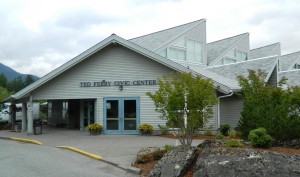
The Ted Ferry Civic Center is owned and operated by the City of Ketchikan. (Photo courtesy KRBD)
While it wasn’t on the agenda for this meeting, the topic of shuttles for events at the Ted Ferry Civic Center came up. Council Member Dave Kiffer, who was absent during the last meeting, says he was disappointed with the Council’s Jan. 19th decision to not fund a shuttle for this weekend’s Wearable Art Show.
Kiffer said the Council seems to “suffer from a severe case of institutional amnesia.”
He said the city chose to build its civic center at the top of a steep hill, on a site that has inadequate parking. The funicular, or tram, that is owned and operated by Cape Fox Lodge, helped alleviate the parking issues. But, Kiffer said, now the tram is old and needs repairs.
“So, the way I see it, we have three options here, folks: We can tear down the building and put it somewhere else. We don’t want to do that – that’s tens of millions of dollars we don’t want to spend. We can do what the company that runs the funicular wants us to do and give them a huge chunk of money to fix the thing or build a new one for several hundred thousand dollars plus. Or we can provide a couple thousand dollars now and again so the buses run up there. It doesn’t seem like it’s that hard of a decision,” he said.
Council Member Judy Zenge, who voted at the last against funding a shuttle bus to the Wearable Art Show, responded that Kiffer made some good points. She asked that the issue come back to the Council for discussion.
Close
Update notification options
Subscribe to notifications
Subscribe
Get notifications about news related to the topics you care about. You can unsubscribe anytime.
















 The
The