The Department of the Interior announced approval of Craig Tribal Association’s land-into-trust application on January 13. This is the first application from Alaska to be approved since the Interior Department issued a revised rule in 2014 expelling the “Alaska exception.”
Craig Tribal Association’s application places a 1.08-acre parcel into federal Indian trust status. Tribal president Clinton Cook Sr. says the association applied for the status change to protect CTA’s government and homeland.
“Signing the land over to the government protects us from taxes. If (there were) any future losses, our building and our land would never be taken away from us.”
The land cannot be sold, alienated or transferred without federal approval. Status also expands eligibility for federal programs and services. Development is subject to federal regulations. Offices and a town hall are located on the site. Cook says there are no plans at this time to make any changes, now that the land is in trust.
“The building will remain the same. It will house our tribal headquarters. We do rent space out to businesses in the Craig area.”
The federal government gave notice of the application in October of last year, and comments were accepted through December. One respondent was the City of Craig. Among other requests, the city asked for more time to research land-to-trust issues, and for a written agreement between the city and CTA regarding municipal and tribal authorities. Craig City Manager Jon Bolling says with the new status, some city powers may still apply, and others may not.
“I met with the tribal president and administrator to talk about coming up with a document that eliminates any ambiguity about how the city’s authority might apply to the property, and how the tribe’s authority might apply now that the property is in trust – which does change how some of those authorities do apply to the property.”
CTA’s application for land-into-trust is the first approved in the state since the “Alaska exception” was removed. Richard Peterson, president of Central Council Tlingit and Haida Indian Tribes of Alaska says he’s pleased the application was approved.
“As a federally-recognized tribe, we also have applications in. We’ve been strong advocates of getting this through and seeing the benefit for all tribes in Alaska. Really we need to commend the Craig Tribal Association for their leadership and determination in seeing their application through the process.”
Peterson says he’s hopeful that with the first application approved, more land-to-trust applications throughout the state will be successful.
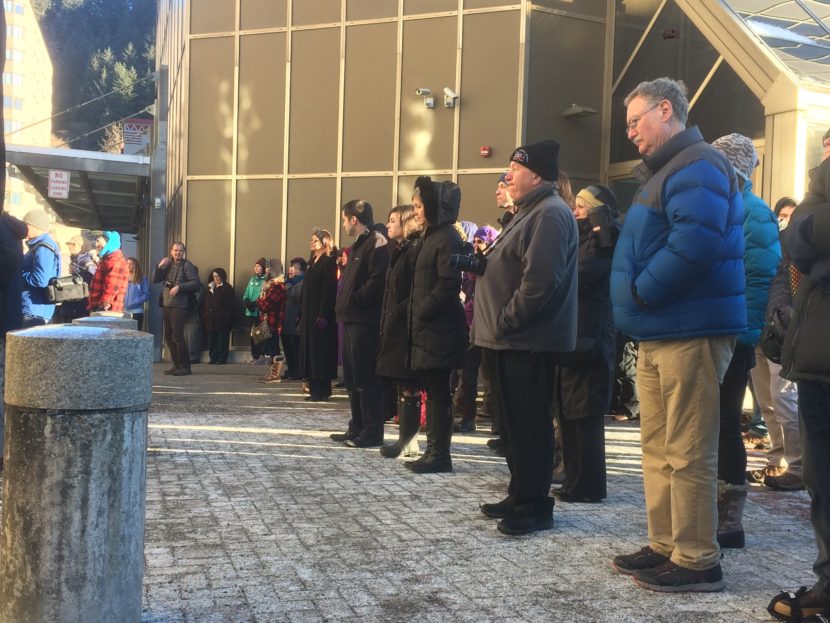
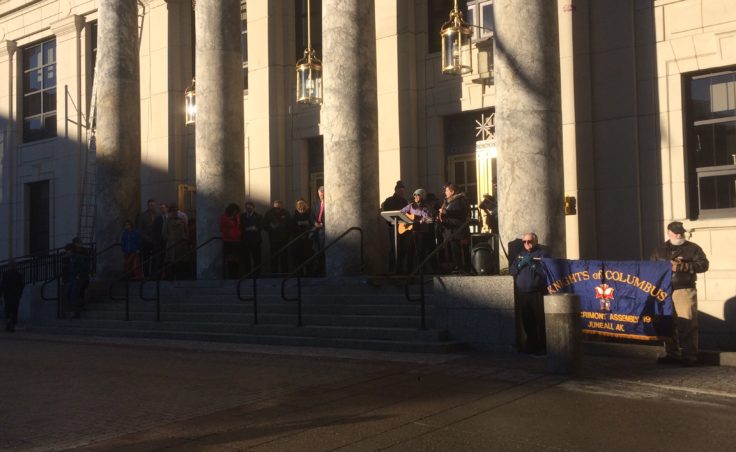
An anti-abortion crowd listened to a series of speeches against abortion on Friday. (Photo by Quinton Chandler/KTOO)
Two protests were held on the steps of the state capitol this weekend. The first on Friday, called for an end to abortion. Then Saturday, hundreds came out for the “Women’s March on Juneau” to show support for women’s rights.
The two protests were different in tone, message and especially in size.
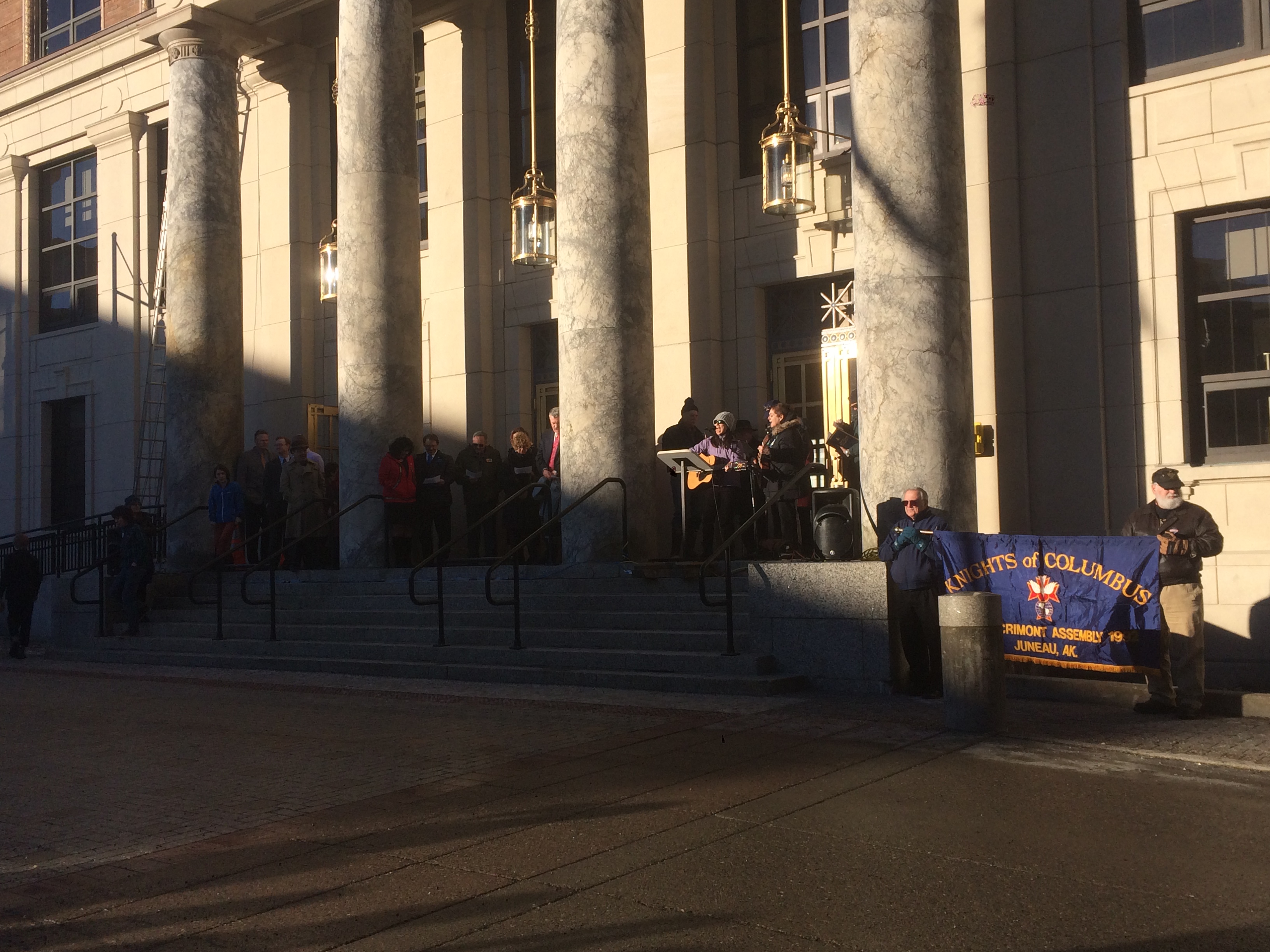
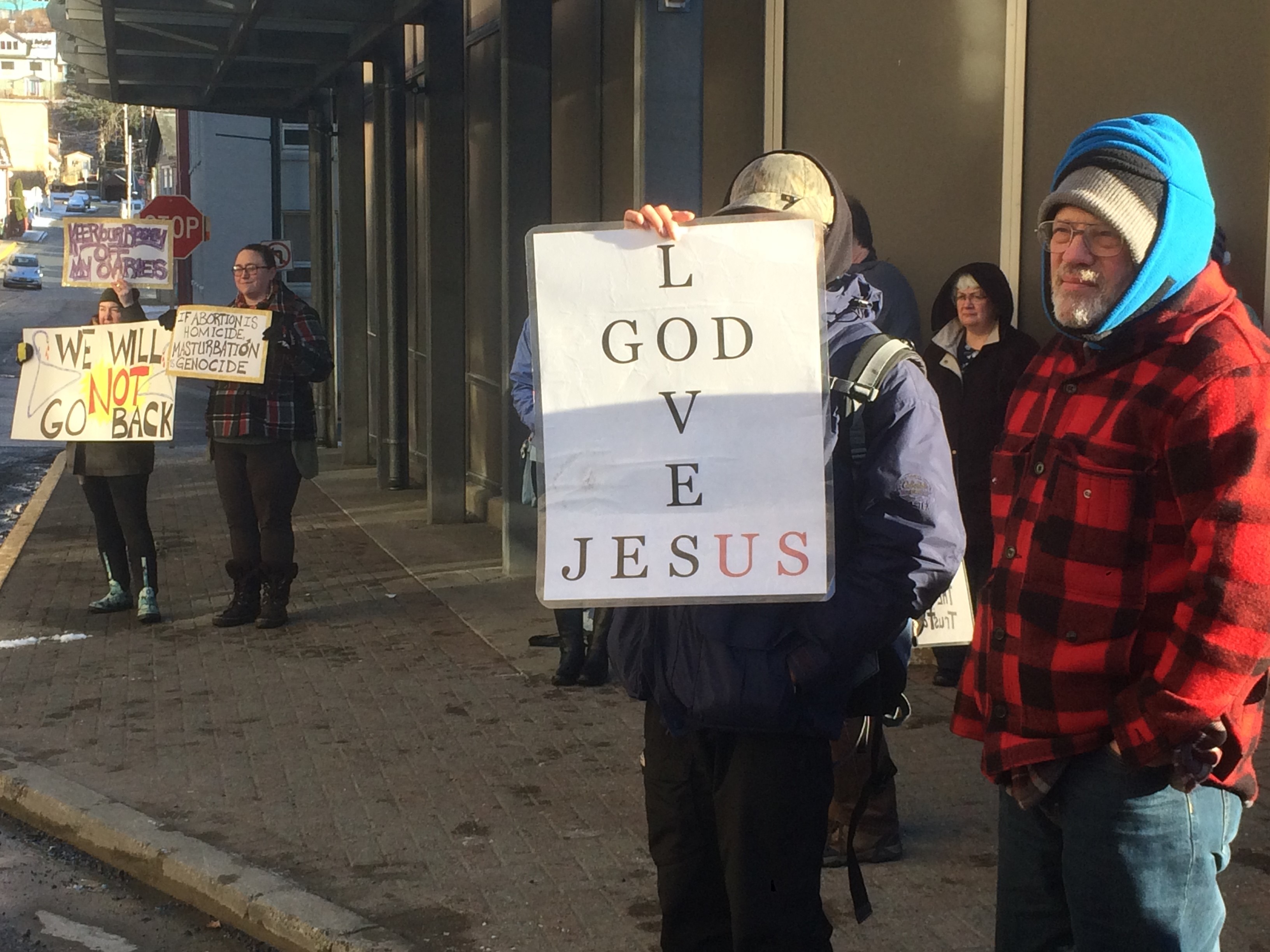
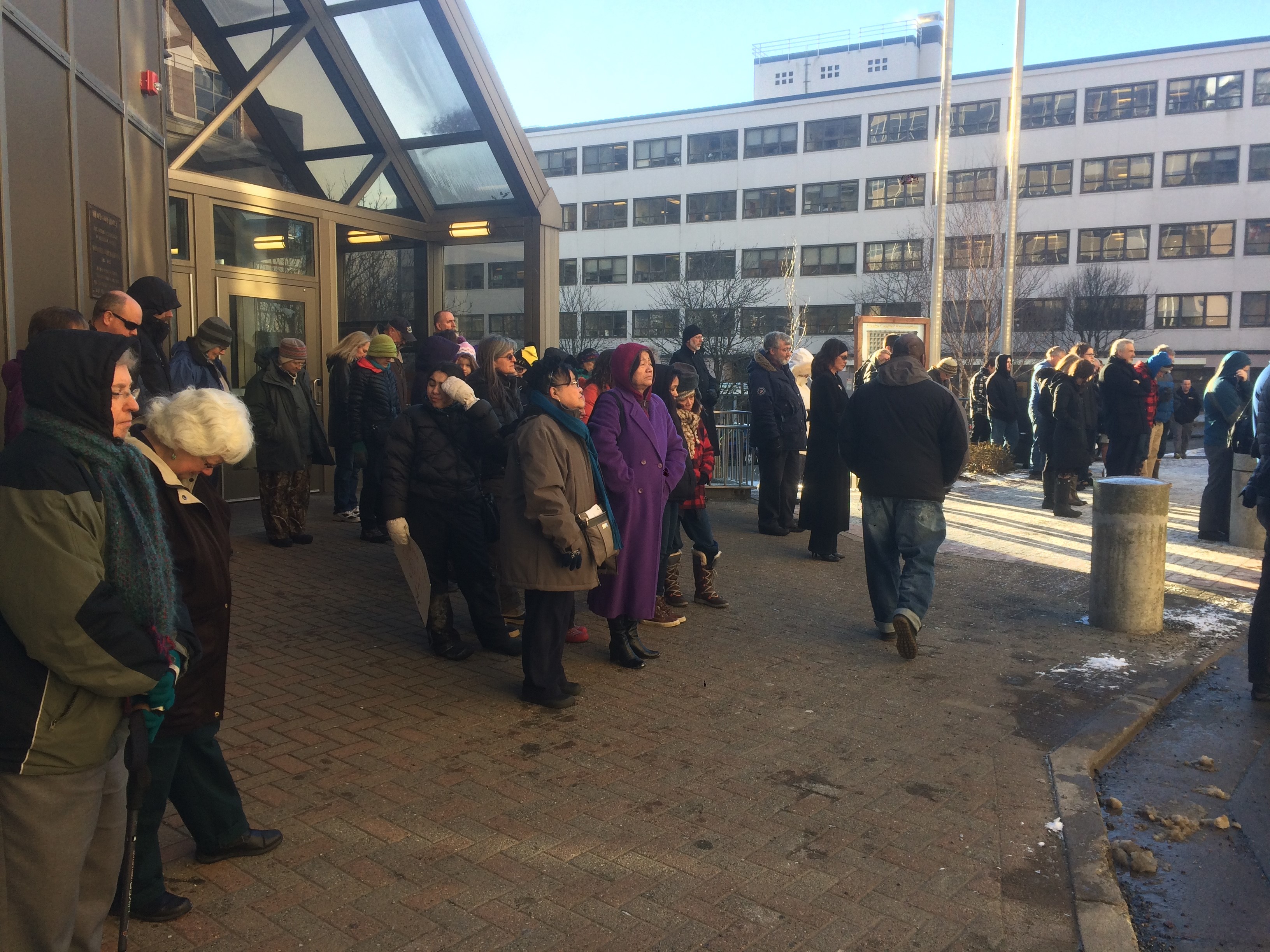
On Friday, a little more than a few dozen anti-abortion supporters – including a number of state legislators – lined the Fourth Street sidewalk in front of the Alaska Capitol building.
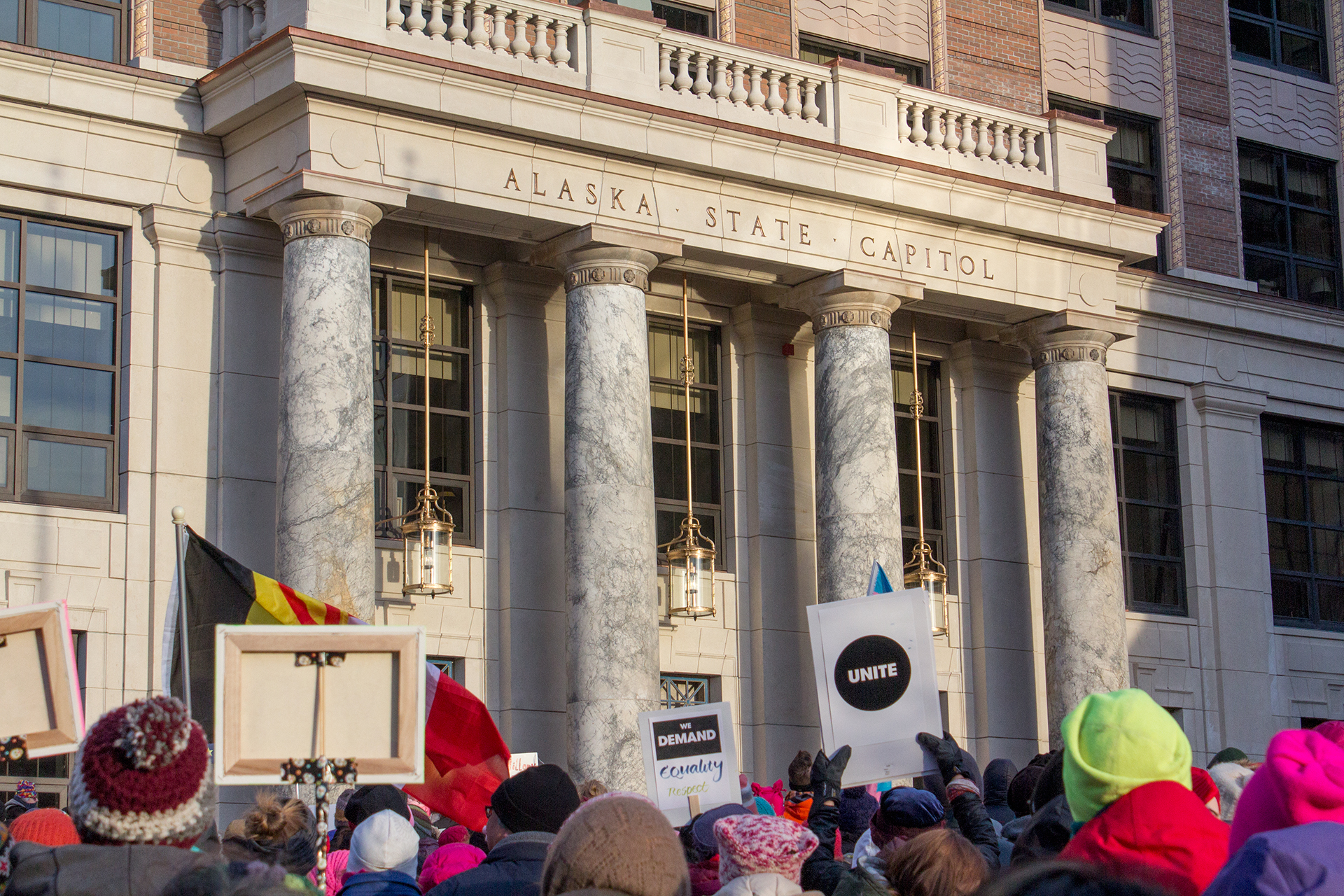
Then on Saturday, hundreds filled the same street to demand equality for women.
The two protests had very little in common other than it was cold.
“I was worried that it was going to be a lot colder when we came,” said Sid Heidersdorf, president of Alaskans for Life. “It was windy when we first came. That’d be one of the worst things, that cold wind.”
Protest organizers, speakers and state legislators stood on the capitol steps to address the crowd in opposition to abortion on Friday, Jan. 20, 2017. (Photo by Quinton Chandler/KTOO)
Protesters and counter-protesters hold signs at the Alaskans for Life protest, Friday, Jan. 20, 2017. (Photo by Quinton Chandler/KTOO)
A crowd bows their heads in prayer during a protest against abortion, Friday, Jan. 20, 2017. (Photo by Quinton Chandler/KTOO)
His group and its supporters rallied at noon Friday for their annual protest of the Roe v. Wade Supreme Court decision. Sunday is the anniversary of the case that largely legalized abortion in the U.S.
“We’re basically trying to show that we object to that and that’s wrong, and we’d like to see it changed,” Heidersdorf said.
The event’s handful of speakers echoed Heidersdorf’s feelings. The keynote speaker, Camille Pauley, is president of Healing the Culture, a Washington state anti-abortion nonprofit.
Pauley said anti-abortion advocates would stand up for what is right no matter what, that all human beings are valuable and that abortion can never lead people to happiness.
Ted Deats attended the protest and said he’s been coming with his wife since she was pregnant with their son 30 years ago. He hopes the results of this last election year will mean serious change for U.S. abortion law.
“I think the change we would count on would be Supreme Court justices that believe in the equality of all men — born and unborn, and whatever they are,” Deats said.
Deats and Heidersdorf also hope the state Legislature will pass more anti-abortion laws. Heidersdorf said the courts struck down or severely weakened anti-abortion laws from the past.
On Saturday, the location was the same but the scene had changed completely.
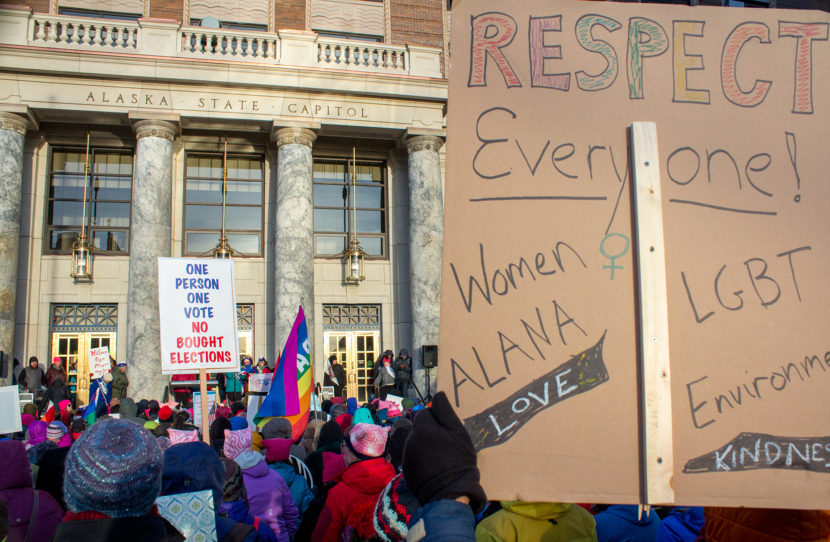
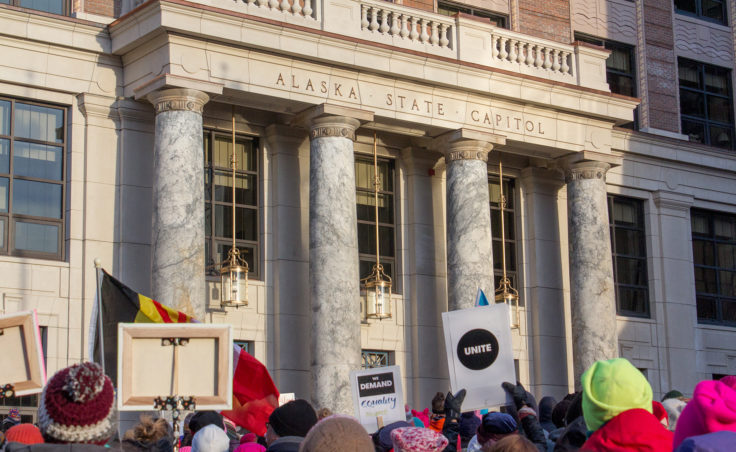
Protesters wave signs at the Alaska State Capitol for the Women’s March on Saturday in Juneau. (Photo by Mikko Wilson/KTOO)
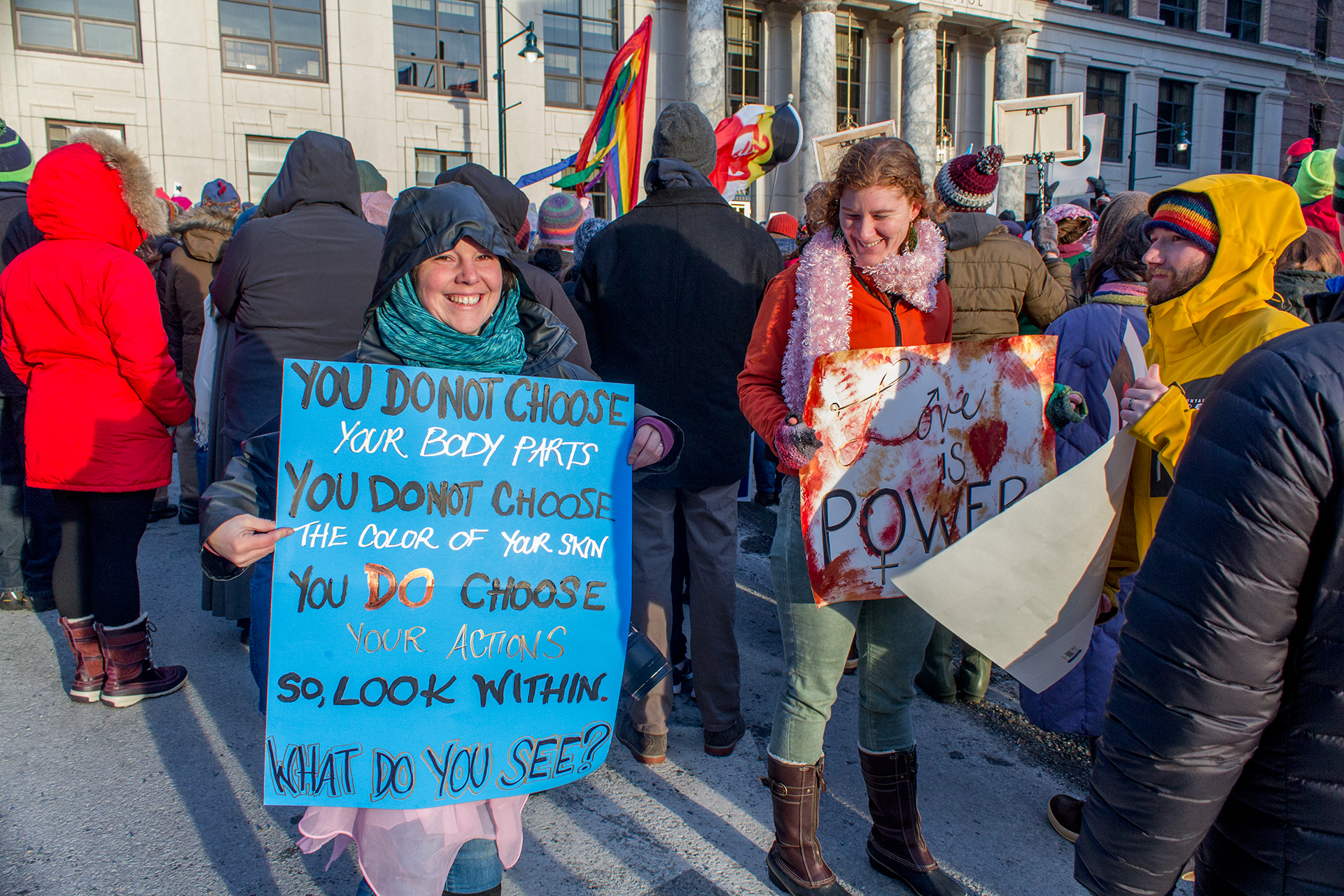
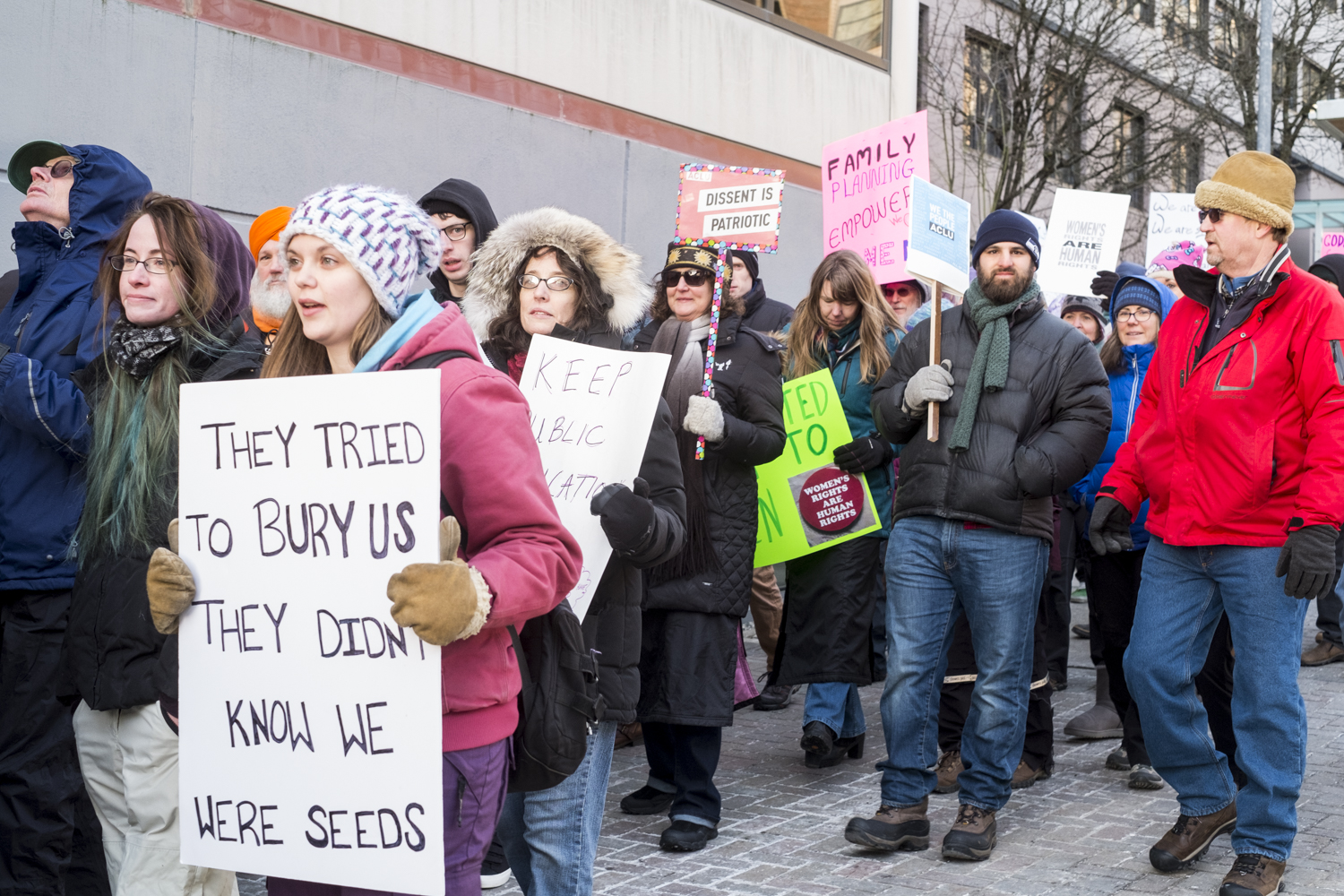
Hundreds of protesters carried signs calling for goals like the fair treatment of women, the protection of abortion rights, the protection of the disenfranchised and an end to gender violence.
Mandy Cole, deputy director of AWARE in Juneau, said the idea for the March on Juneau started with an AWARE employee and eventually the entire organization pitched in to help launch it.
AWARE is a women’s advocacy group. Cole said the march was a show of solidarity with other women’s marches around the country and the world.
“Well part of it is just capturing the energy of people who want to do well and want to help all of us live together peacefully and with care for our neighbors,” Cole said.
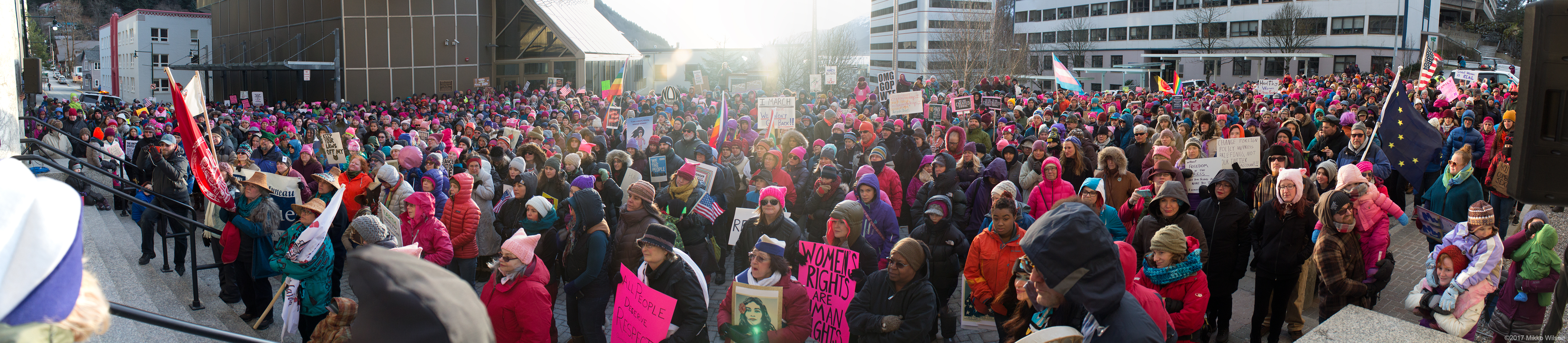
She was “incredibly pleased” with the turnout, but wasn’t sure how many people showed up.
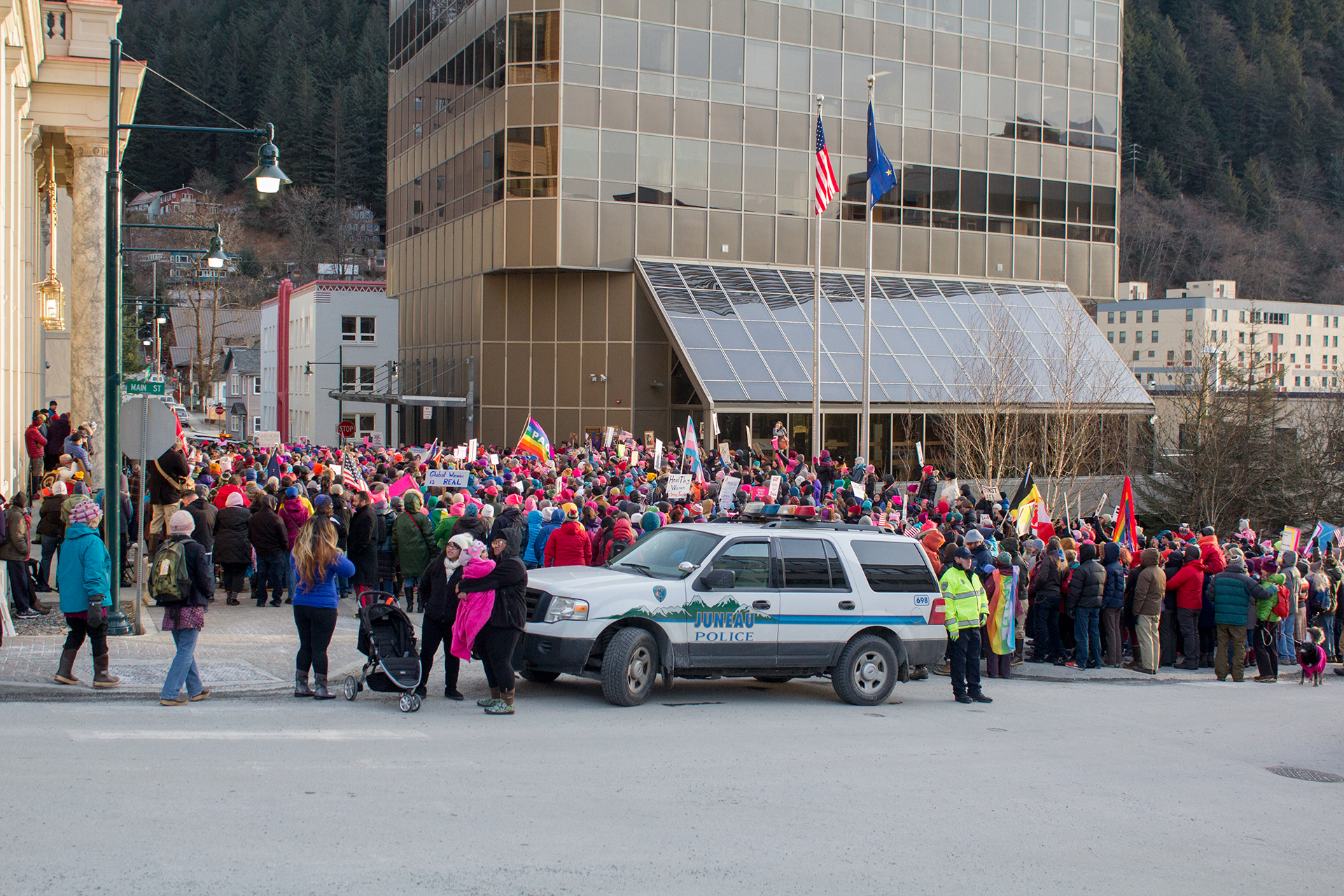
A panoramic composite image of protesters gathered at the Alaska State Capitol for the Women’s March on Saturday in Juneau. The image contains some distortions from combining multiple exposures. (Image by Mikko Wilson/KTOO)
“Maybe 500, 600, I’m not sure.” (I’m) bad with gauging crowd sizes, I think,” Cole said.
According to the march’s Facebook event page, about 840 people said they went, but that number hasn’t been confirmed.
A Juneau police officer said he didn’t know how many people attended either protest. He said organizers for the women’s march estimated 400 people would attend and he guessed they probably met that mark easily.
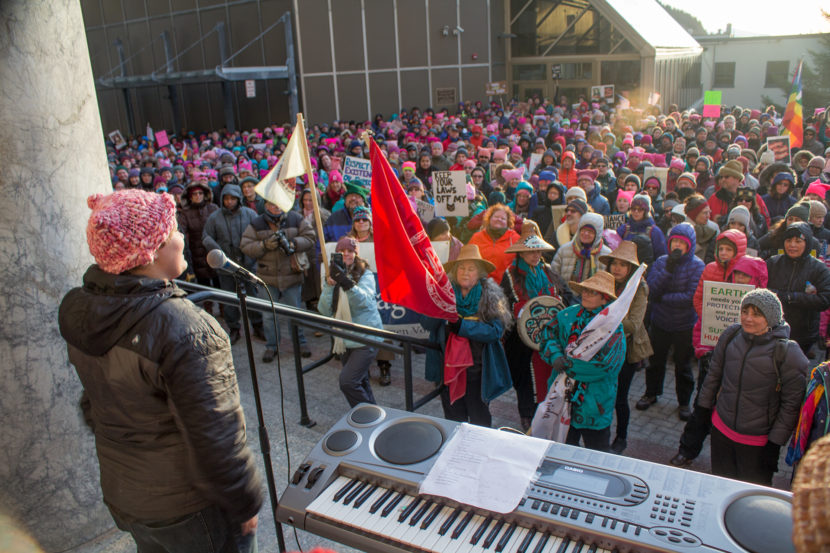
Theo Houck addresses protesters at the Alaska State Capitol for the Women’s March on Saturday. (Photo by Mikko Wilson/KTOO)
Before the actual march, a handful of supporters gave speeches and one recited a poem about the societal problems they wanted to change and their own visions for the future.
Afterward, the crowd hauled their signs to the Juneau Arts and Humanities Council building where community organizers were waiting.
Cole said they were “community agencies and organizers that are looking for volunteers to help give services, to help recruit others, to continue this type of energy of women’s rights are human rights.”
Marlowe Dunker followed the crowd. She carried a sign that said “Love trumps all” on one side. On the other, she had a list.
“‘Women’s rights, black lives matter, Planned Parenthood, the Muslim community, climate change, equality, our children’s future and not my president.’ And that is why I march,” said Dunker.
She said her sign had a lot on it, but she felt like there was a lot at stake.
That feeling might be the number one thing Friday and Saturday’s protesters had in common.
Protesters gather at the Alaska State Capitol for the Women's March on Saturday, Jan. 21, 2017, in Juneau. (Photo by Mikko Wilson/KTOO)
Protesters display signs at the Alaska State Capitol for the Women's March on Saturday, Jan. 21, 2017, in Juneau. (Photo by Mikko Wilson/KTOO)
A protester displays a sign along Egan Drive as part of the Women's March on Saturday, Jan. 21, 2017, in Juneau. (Photo by Mikko Wilson/KTOO)
Protesters display signs at the Alaska State Capitol for the Women's March on Saturday, Jan. 21, 2017, in Juneau. (Photo by Mikko Wilson/KTOO)
Protesters walk along Egan Drive as part of the Women's March on Saturday, Jan. 21, 2017, in Juneau. (Photo by Mikko Wilson/KTOO)
Protesters walk down Main Street during the Women's March on Juneau on Saturday, Jan. 21, 2017. (Photo by Annie Bartholomew/KTOO)
Protesters walk down Main Street as part of the Women's March on Saturday, Jan. 21, 2017, in Juneau. (Photo by Mikko Wilson/KTOO)
Protesters walk down Main Street in during the Women's March on Juneau on Saturday, Jan. 21, 2017. (Photo by Annie Bartholomew/KTOO)
Protesters display signs at the Alaska State Capitol for the Women's March on Saturday, Jan. 21, 2017, in Juneau. (Photo by Mikko Wilson/KTOO)
Protesters gather at the Alaska State Capitol for the Women's March on Saturday, Jan. 21, 2017, in Juneau. (Photo by Mikko Wilson/KTOO)
Protesters display signs at the Alaska State Capitol for the Women's March on Saturday, Jan. 21, 2017, in Juneau. (Photo by Mikko Wilson/KTOO)
Protesters walk down Main Street as part of the Women's March on Saturday, Jan. 21, 2017, in Juneau. (Photo by Mikko Wilson/KTOO)
Protesters display signs at the Alaska State Capitol for the Women's March on Saturday, Jan. 21, 2017, in Juneau. (Photo by Mikko Wilson/KTOO)
Protesters display signs at the Alaska State Capitol for the Women's March on Saturday, Jan. 21, 2017, in Juneau. (Photo by Mikko Wilson/KTOO)
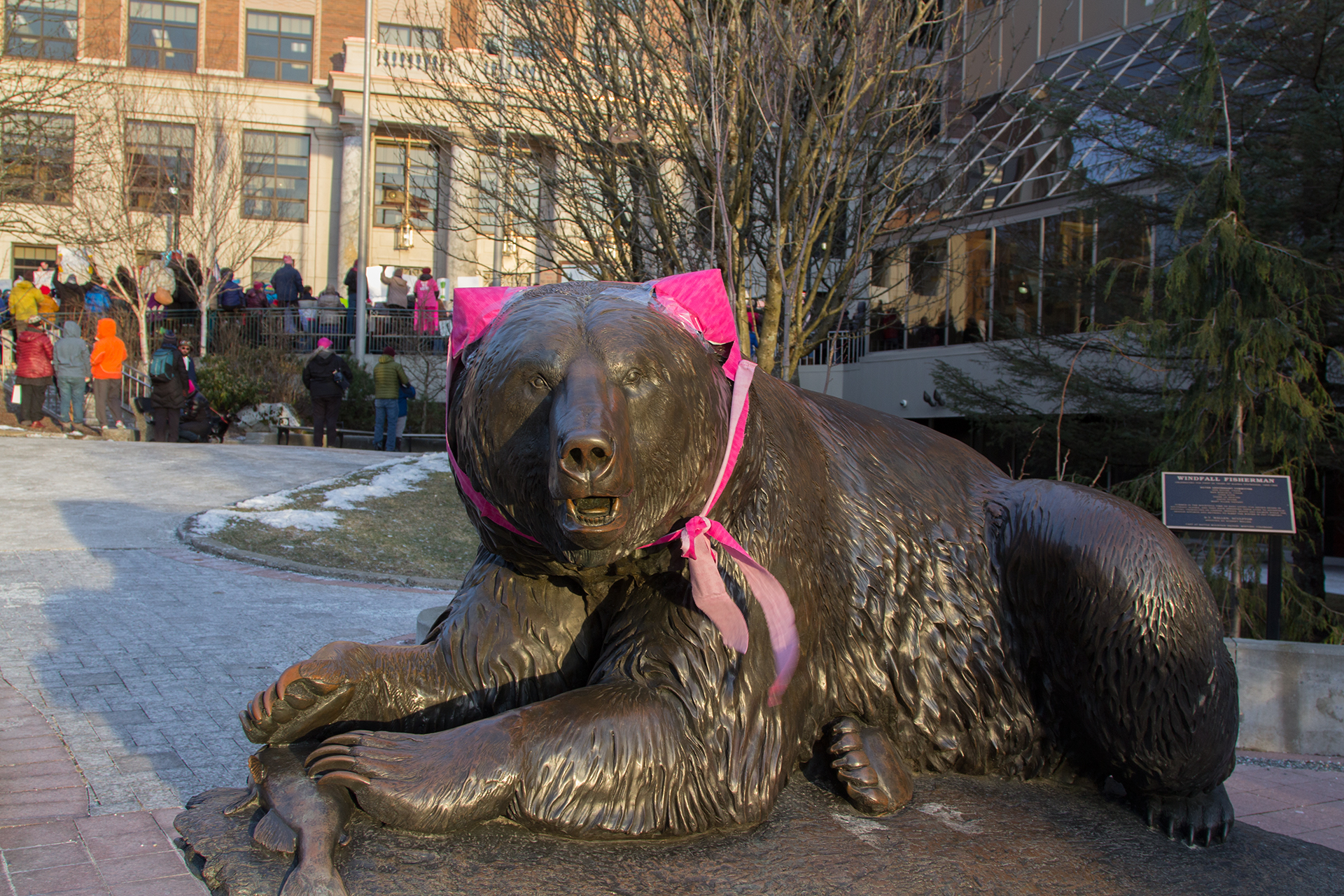
The Windfall Fisherman is decorated with pink cat ears while protesters gather at the Alaska State Capitol for the Women's March on Saturday, Jan. 21, 2017, in Juneau. (Photo by Mikko Wilson/KTOO)
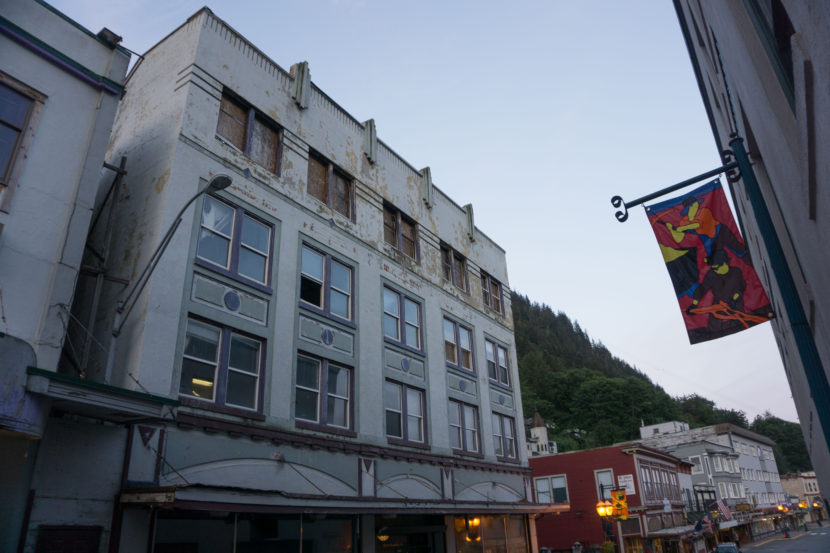
The former Gastineau Apartments on July 21, 2015. The City and Borough of Juneau spent about $1.4 million to have it torn down in February 2016. (Photo by Jeremy Hsieh/KTOO)
It’s been nearly a year since the City and Borough of Juneau demolished the Gastineau Apartments. Now the city is taking the owners to court to recoup some of the $1.4 million spent tearing it down. The apartment building caught fire in 2012, was neglected for years then caught fire again in 2015. The city condemned and demolished it.
The land is vacant while a lawsuit is pending against owners Camilla and James Barrett, who missed several deadlines to repair the property or demolish it themselves.
City Attorney Amy Mead said Wednesday that the Barretts should be held personally liable for repaying the city.
“The cost of the demolition far exceeds the current value of the property,” she said in an interview. “So in order for the CBJ to recover the funds that were spent in abating the public nuisance it would have to look outside the property.”
At issue before Juneau Superior Court Judge Philip Pallenberg is the legal concept of “piercing the corporate veil.” It would allow legal action against the Barretts, who controlled Gastineau Apartments LLC.
Defense Attorney Robert Spitzfaden had argued that the Barretts should remain shielded from liability. But the judge noted that the defendants had allowed their limited liability corporation to be dissolved after missing filing deadlines with the state.
“It’s clear that the Barretts were not always clear to observe the formal legal requirements of their LLC,” Judge Pallenberg said from the bench.
The judge rejected the defense’s motion for summary judgment. The lawsuit is headed for trial scheduled for June.
Two people and a dog curl up near a boiler room on Shattuck Way on Friday morning, Jan. 20, 2017, in downtown Juneau, Alaska. (Photo by Rashah McChesney/Alaska’s Energy Desk)
I rode along with a Juneau police officer recently to see how the police deal with the community’s most visible residents right now.
It’s an hour before dawn and Juneau Police Officer Alexander Smith is making his usual rounds. In front of the downtown cruise ship terminals, a man is tucked deep into a sleeping bag against a building to keep out of the rain. It’s a similar scene on South Franklin Street. A couple is covered in blankets in front of a shuttered storefront. Officer Smith knows most of these people’s names. And they know his. He radios in to check for arrest warrants. But first, he confiscates an open can of malt liquor, pours it out and moves on.
Homelessness in downtown Juneau has became an increasingly visible issue. Merchants have complained to the police department, but downtown beat officers like Smith say their hands are tied.
“Doorways like these easements here are private property. So it’s the responsibility of the business owner to contact us if there’s trespassing issues, vandalism and that kind of thing,” Smith said. “So if we see someone sleeping in the doorway we can contact them and make sure they’re alive and breathing, but we don’t have any legal authority to remove somebody from the doorway simply for them standing there.”
But a proposed anti-camping ordinance sets out to change that. If adopted, the ordinance would let officers ticket people camping on private property within the downtown core.
Juneau’s police chief has come out in support of the initiative, though Officer Smith admits enforcement with tickets could be challenging.
“It kind of goes along with the open container tickets and that kind of thing, where a lot times the people who have been here long enough they don’t care,” Smith said. “They’ll take 20 tickets and be like, ‘Whatever.’ Now whether or not a new citation will actually change your behavior is debatable. But it’s one of those things that hopefully will be an incentive.”
The Juneau Police Department later clarified that under the ordinance anyone caught camping downtown who refuses to move could be arrested for disorderly conduct – a jailable offense.
Joshua Donald Smith (no relation) found himself sleeping outdoors. The 45-year-old says he’s dealing with substance abuse issues, and that he’s aware why some downtown merchants are upset.
“I understand the businesses. A lot of the homeless people kind of wreck it for other folks by defecating on the street, throwing their trash everywhere, just basic disrespect for the community,” he said. “But there’s some of them on the other side that go sweep up — voluntarily.”
Juneau has homeless shelters including the 40-bed Glory Hole downtown. But the shelter won’t take drunk people — for understandable reasons. And that, Joshua Smith says, doesn’t work for some people struggling with addiction and in crisis.
“This guy lost his mother the other day,” he recalled. “He had a bad night and he was drinking and wasn’t dealing with his emotions and he got kicked out for six months the next day. The guy lost his mom and now he’s in the rain. It’s a sad situation. I don’t want to say let’s make it easy for these people get drunk and wasted all the time, but there’s got to be a happy medium where they can have a roof.”
At the Glory Hole, Juneau’s 40-bed downtown shelter, it’s just after sun up and about two dozen people are drinking hot coffee and tea. Some spent the night here others have just come in from the cold. Steven Lythgoe, 43, says he’s been homeless on and off for about seven years. He says he’s working to his driving license reinstated and getting back to work but he’s running up against the shelter’s 90-day limit and isn’t where he’ll go.
“There are some services and they take quite a while to actually get done. There is quite an extensive waiting list, you’ll be waiting up to six months in some cases and you can’t stay here for that long,” Lythgoe said. “And that’s what it makes it really hard. And so you’re having to try and find somewhere to go. And they do, I think, they need to make a place where people can put tents and be safe in their tent.”
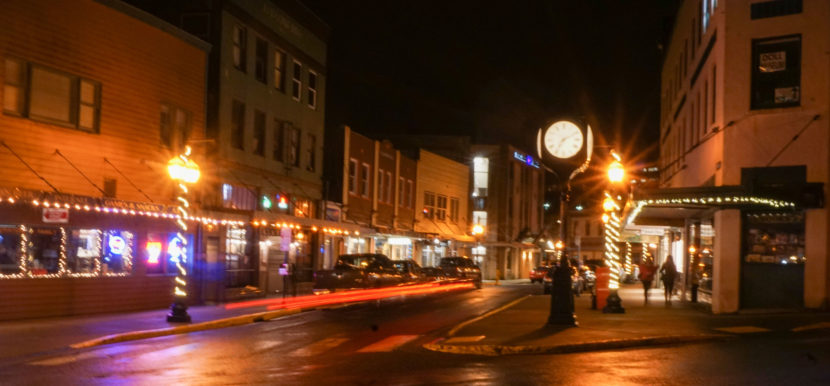
A car and pedestrians make their way past Front Street storefronts in downtown Juneau on Thursday, Jan. 19, 2017. Moving objects appear blurred because of an extended exposure. (Photo by Jeremy Hsieh/KTOO)
Juneau’s proposed ordinance isn’t without controversy. In a letter Thursday, four Juneau-based Alaska Native institutions urged the Assembly to abandon the proposal. The city attorney’s office has cautioned that federal courts have struck down city laws that effectively criminalize homelessness. That’s why the ordinance targets illegal camping rather than just sleeping or vaguely defined loitering or vagrancy.
Officer Smith says that the anti-camping ordinance would allow him to focus on the type of sleepers who are attracting the most complaints but not everyone sleeping downtown.
“It probably won’t have too much of an actual impact on people who are just kinda slumped over in the doors,” the officer said. “Because, you know, if they don’t have any money or any means to provide for themselves, giving them a ticket or kicking them to the next doorway is not going to change a whole lot. But for people that are building legitimate tents and camps it might create an incentive for them not to do that.”
That may or may not satisfy downtown merchants but it will allow police to take a more aggressive approach in dealing with some of Juneau’s most vulnerable residents.
The public hearing — and a possible vote — will be held Jan. 23 in the Juneau Assembly’s chambers.
Clarification: This story has been updated to reflect that under the proposed ordinance, failure to comply with a police order to move on could also lead to a criminal charge.
In a letter to the Juneau Assembly, the leaders say removing campers from downtown district can be done in “a humane and compassionate” way by establishing a campsite elsewhere.
The letter of opposition was signed by Rosita Worl of Sealaska Heritage Institute, Richard Peterson of the Central Council of Tlingit and Haida Indian Tribes of Alaska, Anthony Mallott of Sealaska Corp., and Charles Clement of SEARHC.
Bartlett Regional Hospital is a major employer in the Juneau community. (Photo by Jennifer Canfield/KTOO)
The Juneau Assembly will be asked next week to approve $3.06 million in pay increases for employees at Bartlett Regional Hospital.
That’s after the city-owned hospital’s board of directors approved a tentative agreement with its unionized workforce after more than a year of negotiations that ended with the help of federal mediators.
Hospital employees have been without a labor contract since the end of 2015.
The International Longshore and Warehouse Union represents about 385 hospital workers that includes nurses, therapists and technicians. The new contract will also expand the union’s bargaining unit to include many workers employed on an “as needed basis.”
The wage increase would also cover all non-management employees at the hospital not in the union.
The tentative contract ratified by the union would include a retroactive pay increase that runs through the end of the year when the new contract would expire. It envisions a cumulative pay increase equivalent to 2.3 percent overall. A second increase of 1 percent would go in effect in July.
The contract will go before the Juneau Assembly for ratification at its Jan. 23 meeting.
Clarification: This story has been updated to note that the wage increase — not the entire contract — covers all non-management, non-union employees at the hospital. Additional details have also been added.
Close
Update notification options
Subscribe to notifications
Subscribe
Get notifications about news related to the topics you care about. You can unsubscribe anytime.