Community

Police chief: Crime bill flaws and budget cuts fueling local burglaries

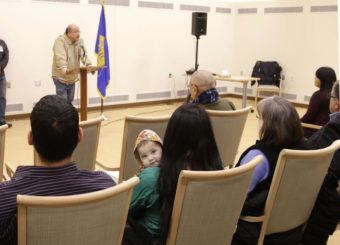
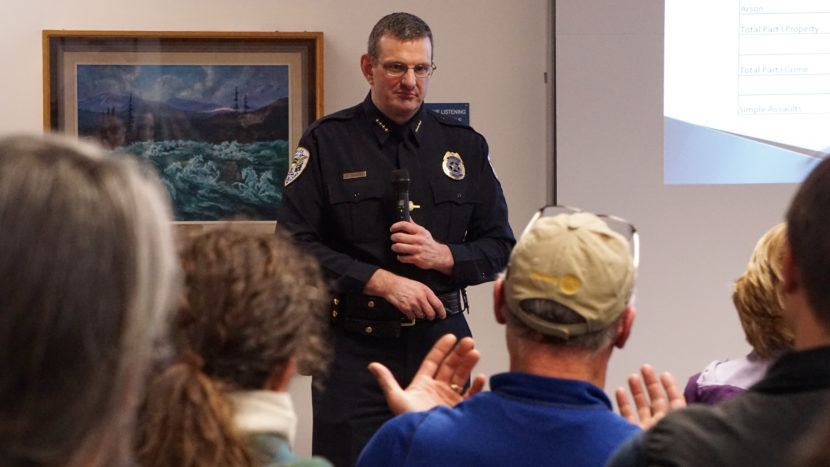
Fritz Moser asks JPD Chief Bryce Johnson a question.
Downtown restaurateur Fritz Moser asks Juneau Police Chief Bryce Johnson a question about crime. The police department held a public meeting on the topic at City Hall for residents Tuesday. (Photo by Jeremy Hsieh/KTOO)

Property crime is up across the board in Juneau, but according to Juneau Police Chief Bryce Johnson, the biggest increases are in burglaries.

“So in 2015 we saw a significant increase in burglaries. We have seen that continue,” he said. “So during 2016 up until November, which is the last month I have numbers for, there’s been a 75 percent increase in burglaries over the 2015 numbers.”

Johnson believes the city’s property crime spike is a result of flaws in a criminal justice reform law passed by the Legislature last year and steep budget cuts.

He was sipping a Diet Coke Tuesday night, after leading a discussion on crime for about 40 people at City Hall.

He explained that last year’s Senate Bill 91 reduced the punishments for nonviolent crimes like burglary with hopes of putting more people in treatment and fewer people in prison.

State officials envisioned the law would help people struggling with drug addiction and mental illness, so fewer would break the law again after their release.

Johnson took a swig of Coke and said the problem is those rehabilitation tools haven’t been developed yet.

“Our traditional tools for working on this problem, they’ve been taken away by law,” he said. “The new tools that are supposed to come are not here yet, so we’re kind of in a limbo stage.”

On top of that, he said state prosecutors were hit with budget cuts, and the court system adopted new guidelines that made more arrestees eligible for release without a cash bail.

“Even if Senate Bill 91 said we could incarcerate someone, the bail schedule has them incarcerated for less time pre-trial,” Johnson said. “You layer on top of that the reductions in the District Attorney’s office where they’re declining more and more cases and cases that are perfectly good cases they just can’t take.”

Simply put, Johnson said thieves’ risk of punishment has gone down and as a result, police are seeing a “cascading effect” of increased property crime.
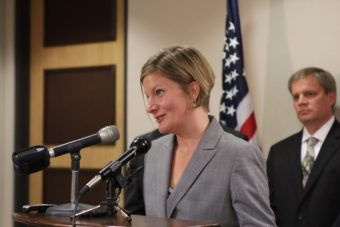
Jahna Lindemuth was named Alaska's attorney general by Gov. Bill Walker. (Photo by Graelyn Brashear/Alaska Public Media)
Jahna Lindemuth was named Alaska’s attorney general by Gov. Bill Walker in June. (Photo by Graelyn Brashear/Alaska Public Media)

Attorney General Jahna Lindemuth raised some of those same concerns in a December news release. She called the problem facing the criminal justice system a “perfect storm.”

Johnson is part of the Alaska Association of Chiefs of Police and based on what he has learned from other law enforcement agencies, he believes crime is increasing around the state.

He was careful to say he doesn’t believe SB91 was a bad idea.

“Getting people diverted out of jail into treatment is a sound principle,” Johnson said. “I think you need to have the treatment available before you do that and I think you need to have a sanction in place if people choose not to go to that treatment as well.”

In other words, he said the criminal justice system needs its “sticks” and its “carrots.”

Johnson said Juneau has seen about a 5 percent drop in violent crime and he predicted that property crime will continue to go up until there are some structural changes.

He told the audience that he believes the Legislature will reevaluate some of SB91’s provisions this year.

Clarification: An earlier version of this story suggested changes in the bail schedule were a result of Senate Bill 91. While SB 91 does revise the bail statutes, those changes don’t go into effect until Jan. 1, 2018. The Alaska Court System independently promulgated a new statewide bail schedule last year. The bail changes in SB91 were the result of the Alaska Criminal Justice Commission’s work studying and recommending reforms; the court’s changes were also related to the commission’s research and the legislature’s adoption of SB91. 
New alcohol healing center opens in Bethel, renewing hope for recovery

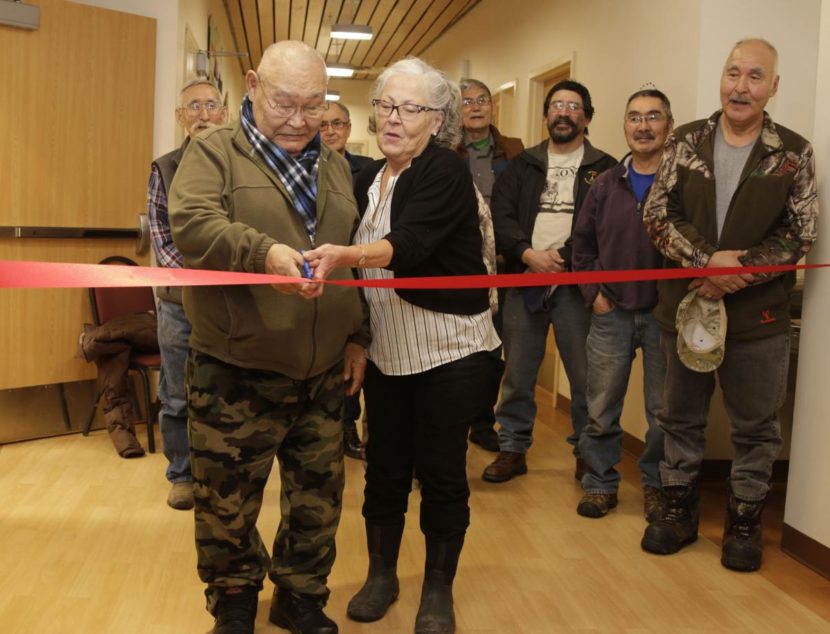
James Charlie Sr., YKHC Honorary Board Member, and Gloria Simeon, YKHC Board Vice Chair, perform the ribbon cutting ceremony at the opening of the Yukon Kuskokwim Ayagnirvik Healing Center on January 11, 2017, surrounded by YKHC board members.
James Charlie Sr., YKHC Honorary Board Member, and Gloria Simeon, YKHC Board Vice Chair, perform the ribbon cutting ceremony at the opening of the Yukon Kuskokwim Ayagnirvik Healing Center on January 11, 2017, surrounded by YKHC board members. (Photo by Dean Swope/KYUK)

Between the two open blades of a pair of scissors stretches a thick red ribbon across the hallway of the new Yukon-Kuskokwim Ayagnirvik Healing Center. Holding the scissors are Gloria Simeon, YKHC Board vice chair, and James Charlie Sr., honorary board member.

The ribbon falls in half with one cut, and the two ends flutter to the new wooden floor of the approximately $12.8 million facility as the crowd applauds and cheers. At one end of the hallway are 16 beds for inpatient alcohol treatment as well as an exercise room, craft rooms, and a kitchen. Down the other end are rooms for outpatient counseling for both alcohol and opioid addiction.

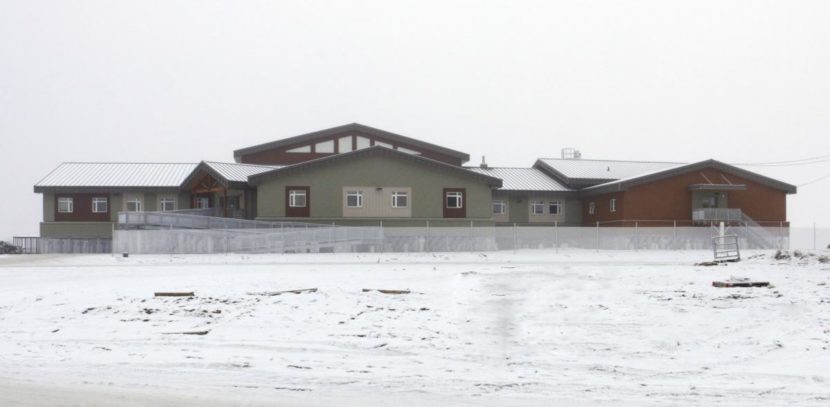
People in the Yukon-Kuskokwim Delta seeking treatment for alcohol addiction now have a newer, more spacious facility to help them. And with the new building, there is renewed hope for treating a disease that has long affected many lives in the region. The Yukon-Kuskokwim Health Corporation celebrated the opening of the Yukon-Kuskokwim Ayagnirvik Healing Center on Wednesday.

The Yukon Kuskokwim Ayagnirvik Healing Center celebrated its opening on January 11, 2017.
The Yukon-Kuskokwim Ayagnirvik Healing Center celebrated its opening on January 11, 2017.
(Photo by Dean Swope/KYUK)

In the middle sits a small gym with a single basketball hoop. Here, dozens of community members and YKHC board members and employees are gathering to commemorate the building’s opening.

Honorary Board Member James Charlie Sr. begins the ceremony with a prayer of thanksgiving.

“Quyana for this opportunity to get together to open this building,” he prayed, “which will help our people who need help in getting rid of alcoholism or other drugs.”

Gratitude and hope for a better future echoes throughout the morning’s speeches. Board members thank those who first began offering alcohol treatment in Bethel in the 1970s. Administrators thank the funders and construction workers who made the building possible. Ray Watson, Director of the Healing Center, thanks the employees filling the room, who every day guide patients toward recovery.

Ray Watson, Director of the Yukon Kuskokwim Ayagnirvik Healing Center, thanks all the employees who help guide patients toward recovery.
Ray Watson, Director of the Yukon Kuskokwim Ayagnirvik Healing Center, thanks all the employees who help guide patients toward recovery. (Photo by Dean Swope/KYUK)

“I always say,” Watson told the crowd, “I have a deep respect for those kind of people who choose this kind of work because it takes a lot of humility and love towards their fellow human beings to help them heal.”

Watson knows this work well: first as a patient in the 1980s, then as a counselor, and now as the center’s director.

“I always say the people who enter into counseling are the lucky ones because there are so many out there who don’t have that, or at this point in time, they’re not there yet,” Watson said.

Many speakers noted that everyone in the Delta knows someone in the region who struggles with alcohol or drugs. They might even one day seek treatment themselves.

The facility actually opened six weeks ago. Watson said the patients were sent on an ‘outing’ for the ribbon cutting to protect their confidentiality. But after the ribbon is thrown away, the cake eaten, and the balloons taken out, those patients will return. They may have to come back repeatedly if they relapse.

This new center, located behind the Bethel post office, was set to open a couple years ago. But in October of 2014, the partially constructed building caught fire and burned to the ground. Construction began again.

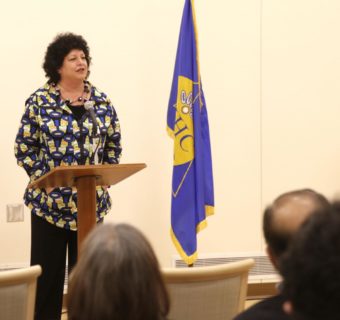
Diane Kaplan is the President and CEO of the Rasmuson Foundation, one of the building’s funders. She said that the fire and rebuilding can be seen as a metaphor for recovery.

Diane Kaplan, President and CEO of the Rasmuson Foundation, addresses the crowd at the ribbon cutting ceremony at the Yukon Kuskokwim Ayagnirvik Healing Center on January 11, 2017.
(Photo by Dean Swope/KYUK)

“People who don’t understand a lot about this disease will say, ‘Well how many people went into this facility and got sober?’ Well very often it doesn’t happen the first time,” Kaplan said. “So I think we can look at what happened to this building as there was a great effort to build it, and then something happened, and it fell down, and now it’s been picked up again. And that really is the message for people who struggle with alcohol.”

But as Director Watson said and can attest, recovery, like the new building, is possible.

Police chief to give update on local crime

Local crime and crime prevention are the subjects of a meeting city officials are hosting for the public Tuesday night.

At the meeting, Juneau Police Chief Bryce Johnson will discuss some of the driving forces behind crime in the community, and how the police are responding.

Residents and business owners will also get advice on how to protect their property.

The meeting is at 7 p.m. Tuesday in Assembly Chambers at City Hall. Contact the City Manager’s Office at 586-5240 for more information.

Haines School enrollment down, while Skagway keeps growing

Enrollment at Skagway School surpassed 100 in 2015, and kept growing this year.
Enrollment at Skagway School surpassed 100 in 2015 and kept growing this year. (Photo by Emily Files/KHNS)

After an unexpected boost in enrollment last year, student numbers at the Haines School have dropped to some of the lowest the district has ever seen. That’s in stark contrast to Skagway, where the school continues to see growth in the student population.

There was good news for the two schools last year, when Skagway and Haines both saw increases in enrollment.

Skagway had nearly 101 students. That was the first time since the 2007-2008 school year that the number surpassed 100.

That number was a turning point for the school district, which moved to single-grade classrooms in the elementary school because of increased state funding and student numbers.

That same year – the 2007-2008 school year – marked the beginning of a downward trend in enrollment for the Haines School. Numbers continued to dwindle until last year, when the enrollment went up from 268 in 2014-2015, to 277 students.

But this year, only Skagway that saw a positive enrollment change.

“We’re really happy to see those continue to go up. And we are just excited to be moving in that direction,” says Skagway Superintendent Josh Coughran.

He says during the official enrollment count in the fall, the school counted 113.5 students.

According to state standards, some students are tallied as less than a full point, because of homeschooling and other factors.

“So it’s an increase of roughly 13 students,” says Coughran.

Coughran says they’re seeing the biggest boost in one age group in particular.

“It was primarily in younger grades,” says Coughran. “We’re seeing some pretty significant increases in our K-5 classes.”

More students means more funding. That’s because schools receive a per-student allocation from the state.

“It means increased funding for sure,” says Coughran. “Obviously the more students that you have in the building, based on the base student allocation, the higher the level of the funding coming from the state.”

In Haines, this year’s enrollment was down about 15 students from last year. The official count tallied 261.7 students. That includes the district’s 21 home-schooled students.

The school board predicted a drop in enrollment and budgeted for the loss.

Even though it was expected, enrollment at Haines School hasn’t been this low since the 1950s.

According to Haines Superintendent Tony Habra, who is new to the district this school year, it’s hard to pin down a specific reason for the drop in numbers.

Juneau Assembly pushes sales tax exemption for cruise ships

Three cruise ships dock in downtown Juneau on July 14, at the height of the tourist season (Photo by Ed Schoenfeld/ CoastAlaska News)
Three cruise ships dock in downtown Juneau on July 14, 2016, at the height of the tourist season. (Photo by Ed Schoenfeld/CoastAlaska News)

The Juneau Assembly is moving ahead with a proposal to exempt the cruise industry from sales tax for goods and services sold on board while ships are in port.

The finance committee voted 8-1 Wednesday evening to approve a motion by Mayor Ken Koelsch to amend the tax code and formalize the exemption.

The tax exemption isn’t a done deal.

The proposed ordinance will have to be drafted and brought to a public hearing before it can be enacted.

Deputy Mayor Jerry Nankervis said he strongly supported the mayor’s initiative.

“Having the cruise industry in Juneau has been very beneficial for this community,” Nankervis said. “I think with the potential job loss of state employees looming in the very near future it behooves us to try and be good neighbors with the folks that like to come here and do business and try to continue to keep them coming here and doing business.”

A long-standing agreement requires third-party tour operators aboard cruise ships to pay sales tax and that would not change, the city’s Finance Director Bob Bartholomew told the committee.

The mayor’s initiative will certainly be welcomed by the cruise line industry, which says its passengers pay nearly $8 million in sales tax while onshore in Juneau, but has historically not paid sales tax for goods and services sold aboard its vessels.

“The cruise lines believe the practices for the last 15 years have been correct; that incidental sales on board the vessels, while in port, are exempt from sales tax,” John Binkley, Cruise Lines International Association Alaska president, said in a written statement before the meeting.

He noted a similar exemption exists in Ketchikan and claimed it created an incentive for cruise ships to dock longer in a community.

Cruise ships close their shops while ships are in port, Binkley added.

The lone dissenting voice came from Assembly member Jesse Kiehl, who argued that it was a question of fairness.

“My barber has to collect and remit sales tax and bars around here have to collect and remit sales tax,” Kiehl said. “It’s only fair to ask others who provide those goods and services in the borough to do the same thing.”

Meanwhile, a lawsuit brought against the borough by the cruise ship industry over the spending of a $5 per head tax remains pending in federal court.

Juneau Assembly considers downtown ‘camping’ ban

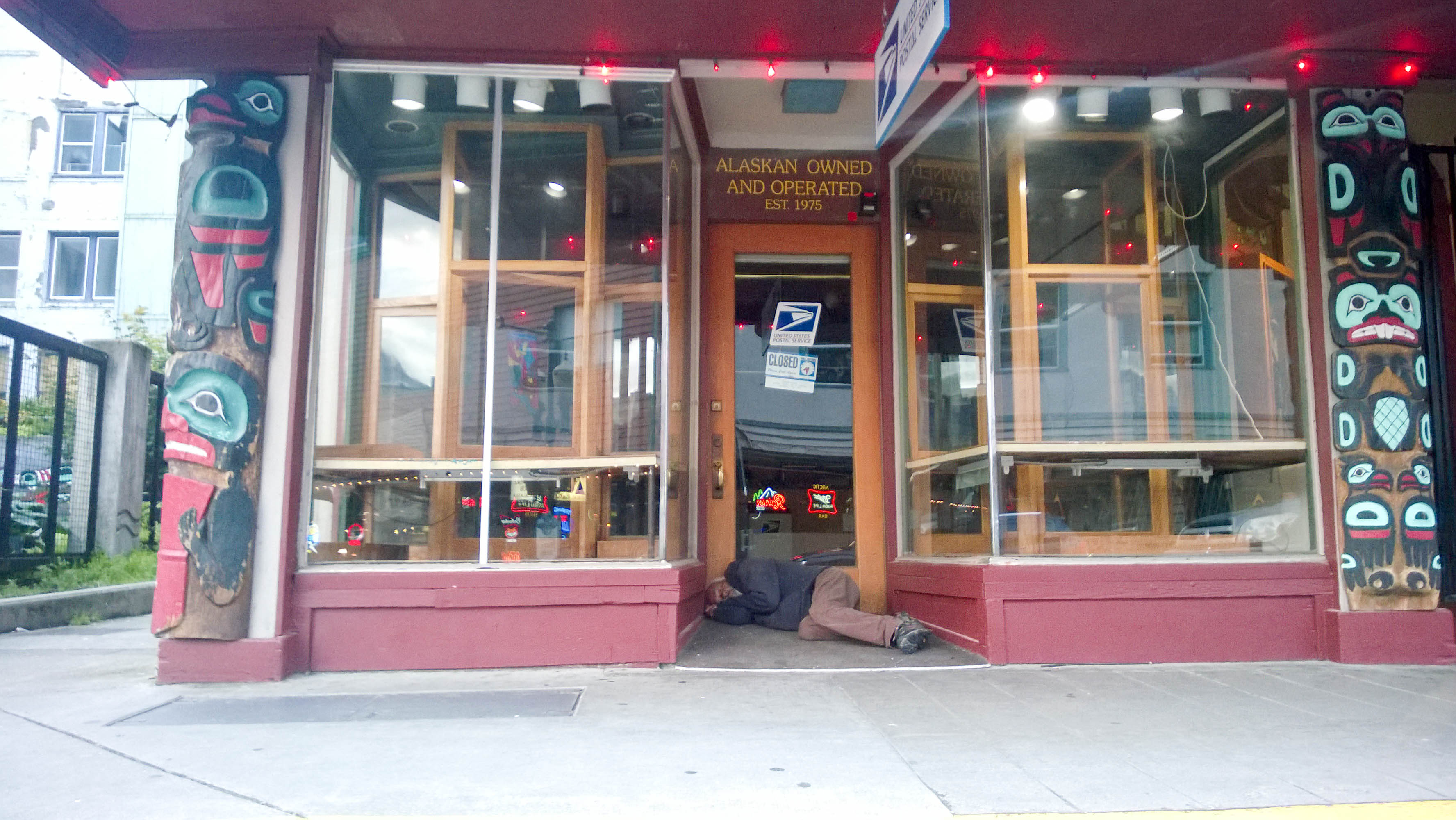
man sleeping downtown
A man sleeps in the doorway of a shop on South Franklin Street in July 2014. The location is now Kindred Post, which opened in September 2014. (Photo by Jeremy Hsieh/KTOO)

Juneau Assembly members asked pointed questions but didn’t indicate whether they would support amending Juneau’s camping ordinance to empower police officers to cite people sleeping in front of downtown businesses and move them on.

Police Chief Bryce Johnson told the Assembly on Monday night that current law only allows officers to move people sleeping on private property if the owner complains to police.

“We as a department have felt a little frustrated to provide a level of service because we haven’t felt that there is much we can do,” Johnson told the Assembly.

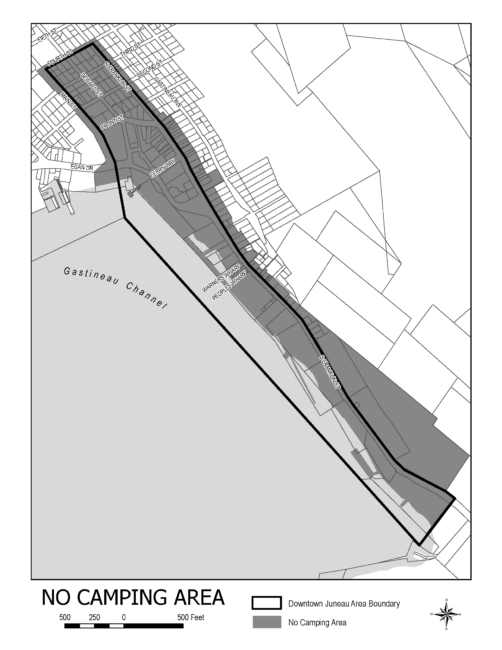
The proposed ordinance would make it an infraction to sleep on the street between midnight and 7 a.m. in the downtown waterfront between Fourth Street and the cruise ship terminal. The city attorney said a broader law likely could be struck down as unconstitutional.

Some downtown business owners have complained of makeshift camps in their alcoves, which are warmer and shielded from the wind. The police chief told the Assembly that a permissive atmosphere was preventing people from seeking long-term help. Juneau’s downtown homeless shelter screens for inebriation and doesn’t allow anyone inside with more than a 0.1 blood-alcohol level.

“I just think that enabling people to take that alcove right there in the business front and bypass all the services, we’re making it very easy for them to not take advantage of a very compassionate community that provides a lot of services to people,” Johnson said.

Much of the impetus comes from downtown business owners who say the problem has reached crisis proportions.

Juneau’s Downtown Business Association supports the ordinance as a necessity, said DBA chairwoman Jill Ramiel.

“Homelessness is an unfortunate issue but the DBA has one very small job, which is to protect our member businesses,” she said in an interview. “This camping ordinance would help them conduct business better, it would protect their employees and it would make all of downtown a more inviting place for our customers to come and spend money which is what is important to our membership.”

The ordinance as proposed would make it an infraction to sleep on the street between midnight and 7 a.m. in the downtown waterfront between Fourth Street and the cruise ship terminal. (Map courtesy of City and Borough of Juneau)

But advocates for the homeless disagree that an anti-camping ordinance is part of the solution to a wider problem.

Mandy Cole, chairwoman of the Juneau Coalition on Housing and Homelessness, told the Assembly that existing laws already criminalize vandalism, public intoxication and other nuisances that are drawing the bulk of complaints.

“Our public safety obligation is not to criminalize the behavior that is the very last refuge of somebody that doesn’t have any other options,” Cole said. “Adding tickets or adding fines to someone who is already at the end of their rope is, you know, it’s not something that is going to benefit any of us. We’re still going to have the essential problem.”

The overwhelming testimony Monday night was in opposition to the ordinance. Some of this came from the homeless community. One of those was Mary Bailey, who stays in the downtown shelter but said she herself had been forced to sleep outdoors.

“I ended up sleeping on the cement in a doorway and that’s very dangerous for a woman to be like that and scary,” she said. “I’m not a vandalous person, I’m not trying to mess up someone’s place. I’m just trying to survive.”

The ordinance is scheduled to go to a full vote on Jan. 23 after the Assembly holds a public hearing.

Editor’s note: This story has been expanded.

Site notifications
Update notification options
Subscribe to notifications