Community

Letter from Kodiak’s past found in wall during kitchen remodel

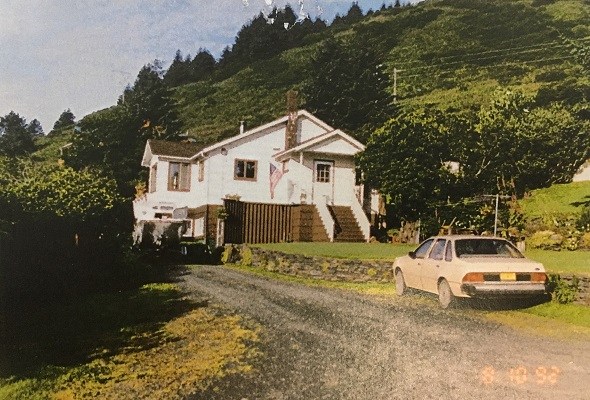
The Sundberg house in 1992. (Photo courtesy of Kodiak Island Borough Assessing Department)

Houses can be historic in many senses – for instance, the history that families create.

Recently, the owner of one house on a hill found a little of that family history while renovating.
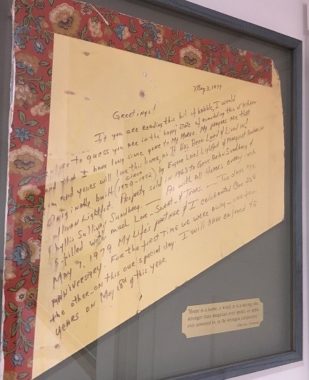
Letter written on the wall by Phyllis Sundberg, framed in the house in which it was found. (Photo by Kayla Desroches/KMXT)
A letter written on the wall by Phyllis Sundberg, framed in the house in which it was found. (Photo by Kayla Desroches/KMXT)

Dave Wilmot and his girlfriend, Ella, live in the house at the house on a steep side street near McDonalds with Ella’s sons, Leo and Zeke, and their cat, Stewart. Stewart is an old cat, the kind of old cat who can’t wait for an interview to end before demanding to be let outside.

Wilmot said his girlfriend bought the house in 2012 and they began renovation in April 2016.

Wilmot, who’s a firefighter on the Coast Guard base, said he came home from his shift and their contractor had left a sheet of sheetrock on a work bench.

It’d been cut from the wall behind a cabinet in the kitchen, and there was a letter on that yellow surface.

The words slant down to the left and although smudged, are still legible. The letter is dated to May 3, 1979. Here’s an excerpt:

Greetings,

If you are reading this bit of babble, I would venture to guess you are in the happy state of remodeling this old kitchen, and that I have long since gone to my maker. My prayers are that you and yours will love this home as it has been loved and lived in.

As with all homes, every inch is filled with much love, sweat, and tears. Two days ago, May 1, 1979, my life’s partner and I celebrated our 25th anniversary. For the first time we were away from the other on this special day. I have enjoyed 45 years on May 10 of this year.

Those are the words of Phyllis Sundberg, who passed away in 2012 a couple of years after her husband Gene.

Her close friend and neighbor, Ruth Dawson was in the kitchen that day in 1979 when the Sundbergs were replacing their cabinets with newer models.

“Phyllis gets out a marker and writes this beautiful story on the wall. She said, ‘Oh, won’t that be grand someday when new people in the house read this?’ And I said, ‘Oh, we’re gonna always be here, you know.’ And she says, ‘No, this will be fun.’ Well, it was put there and we forgot about it and went on with life.”

And just as the letter started with Sundberg, the wall she wrote it on started with her family.

Dawson said Phyllis Sundberg was originally from Idaho and moved to Kodiak was she was a pre-teen and her stepfather, Eugene Lightfoot, built the house.

“Phyllis’s stepdad and her mother lived in the basement when they came here,” she said. “They lived in the basement while he built the rest of the house, so that house meant a lot to her, and then she had the row named after him.”

Phyllis spent most of her life there, and it’s where she raised her three sons with her husband, Gene, who she met in high school.

Gene, who was born in Kodiak, held a few jobs throughout his lifetime, including land manager for the Koniag Incorporated and purchasing supervisor for Kodiak Island Borough School District.

Phyllis worked in a bank and was a stay-at-home mom.

While their sons have since moved from the house, the Sundberg era has had an impact in the community’s history.

Wilmot found as much when speaking with contractors who might do their home renovation.

“I want to say just about every single one had a story about this house,” he said. “Like, they either played with the Sundberg kids, or they hung out in the neighborhood here. The old city reservoir is just up through the canyon there. They’d go swimming up there and come walking through the yard. So, everything reiterated the story of the house.”

Wilmot has since framed the sheetrock with the letter, and included a plaque with a quote by Charles Dickens.

“Home is a name, a word, it is a strong one; stronger than magician ever spoke, or spirit ever answered to, in the strongest conjuration.”

Haines and Skagway participate in annual Christmas bird count

Two birders use a scope to search Yakutat's Monti Bay for terns.
Two birders use a scope to search Yakutat’s Monti Bay for terns in June 2013.

Despite snowy weather, Skagway and Haines participated in the National Audubon Society’s annual Christmas Bird Count this month. Organizers say that, among the usual suspects, there were some surprises.

“The weather was pretty yucky with sort of constant snowfall and not great viewing conditions,” says Furbish. “A little fog mixed in with the snow.”

In Haines, count organizer Pam Randles says the conditions were not ideal.

“It was snowing fairly hard,” says Furbish. “Not complete whiteout. But the visibility was poor. Under those conditions first of all it’s difficult to see the birds. And secondly, the birds tend to want to hide out until the weather is nicer.”

Still, both communities were able to get out and count. In Skagway, 19 people participated, 5 of which came down from Canada for the annual citizen science event. There, Furbish says the number of species identified was about average.

“We usually have somewhere in the low 30s for number of species for our count,” says Furbish. “But the actual species themselves tend to vary year-to-year. There are some that are regulars and we know we’ll have them every year like the raven and the bald eagle. And then there’s some that maybe we see every four or five years.”

The number of species was about average in Haines as well, where 30 people participated in two separate counting areas. One is near town, where the number of birds counted was below average. The other counting area is out by Mosquito Lake, where the number of birds counted was higher than average.

Both Haines and Skagway had a number of unusual sightings. Here’s Furbish in Skagway.

“This year we had some robins and two sparrows,” says Furbish. “A song sparrow and a white crown sparrow who at least so far have been able to make it through the winter.”

Furbish says they also saw good numbers of common redpolls and white wing cross bills.

“We had a family of Eurasian collared doves,” says Furbish. “Six of them recorded. And this past year was the first time that they were recorded as breeding in Skagway so it looks like they’re going to be a regular for us from here on out.”

They also had a large turnout of bohemian waxwings.

“I’m still counting them up but there will be over a thousand of them,” says Furbish. “These are birds that sometimes show up in large numbers, sometimes there are only a few. But this is a year that we had quite a nice turnout of them.”

That’s a species that Randles says Haines also saw in large numbers for the area, with just over 100. She says the area also saw an above-average number of mallards and several species that are normally not around this time of year. These are just some of several species that stood out this
year. But Randles says strange sightings are not necessarily so strange anymore.

“We’ve been experiencing changes every year so yes there was some oddball things but that’s been sort of the norm in recent years,” says Randles.

Randles says in recent years the area has been seeing new birds.

“We’ve gotten some new species besides the Eurasian collared dove,” says Randles. “In the spring we’re getting blue birds going through. The hooded mergansers that were sighted this time, usually they’ve gone south long before this. So we’re getting some changes that, not surprising with climate change, but it sort of has made it difficult to say what’s normal.”

Randles says another way to get involved, especially if the weather is not ideal, is to do feeder counts at your own home.

In participating in the bird count, Haines and Skagway join thousands of communities tallying birds in their circles this season each year.

Ketchikan High School club donates pie proceeds to Pioneers

Every November, just before Thanksgiving, Ketchikan High School’s Rotary Interact club – the high school version of Rotary – organizes a pie auction. Money from the auction goes to the Ketchikan Pioneers Home, and usually the students are able to raise a couple thousand dollars.

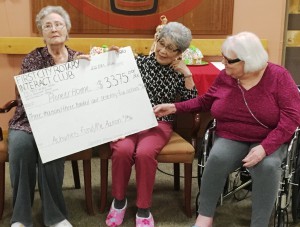
This year, they raised the most money ever. In a special ceremony on Thursday, three graduating seniors from Interact handed over a check for Pioneers Home seniors.

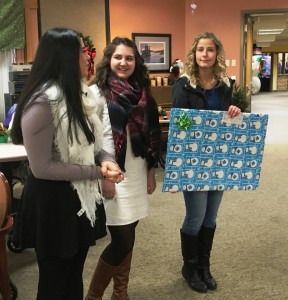
Kayhi Rotary Interact members Angie Gomez, Alison Blair and McKenzie Harrison are ready to present a big check to the Ketchikan Pioneers Home. (Photo by Leila Kheiry)

Kayhi Interact co-presidents Angie Gomez and McKenzie Harrison, and past-president Alison Blair were all smiles as they presented a gift-wrapped big check – suitable for photos – to members of Ketchikan Pioneers Home’s resident council.

The residents, too, smiled as they unwrapped the early Christmas present. The big check – and the normal-sized official check – was for $3,375. Gomez said they raised that much because they had so many pies donated to the auction by Ketchikan’s generous bakers.

“I don’t even know how many pies we had – there was a lot,” she said. “We had more than we’ve ever had this year, which was great.”

The money will go into the resident council’s activities fund. Pioneers Home activities director Hilary Koch said that helps pay for all kinds of things that aren’t funded through the ever-shrinking state budget: Holiday decorations, for example, and bingo prizes.

“All kinds of supplies,” she said. “Newspaper and coffee supplies – a newspaper subscription. Cat food – we do have a cat, we have two birds, we have probably seven fish – nail polish and spa supplies,” and arts and craft supplies, even furniture.

Koch said the pie sale and the annual Pioneers Home garage sale are two big sources for that fund, along with individual donations from people in the community.

After the brief ceremony, Gomez, Harrison and Blair gave a few more details on the pie auction. They said Marna Cessnun’s pies raised the most money, as they do most years.

“I think it went $200 – almost $300,” Gomez said of the most expensive pie. “That was a cherry pie or an apple pie? (She made both) Her pies both went for a lot, but that cherry (or) apple pie – we don’t know – it definitely went for the highest.”

Harrison said Dick Miller’s pies also went for more than $200 apiece. Those also were classic cherry and apple. In fact, there were a lot of apple pies, and they sold well. But, she said, “We also had some rhubarb pies, cherry, pecan.”

Pioneers Home residents with the big check, representing the proceeds of this year’s Rotary Interact pie sale. (Photo by Leila Kheiry)

“Lots of apple, though,” Gomez said.

“There was a freezer one – a s’mores pie,” Harrison added.

Gomez said, “We had some cheesecakes too.”

“Another surprising seller, you could call her and ask her to make a certain type of pie, so it was an empty pie dish,” Harrison said. “That was a good seller. It ended up being an apple, though.”

Getting hungry? Let’s talk about something else, then. Like TAFCOM. That’s a non-profit organization in Tanzania. Here’s Gomez, explaining how Kayhi’s Interact helps that group: “There’s different groups in TAFCOM – there’s the education one and we mostly fundraise for the education: Schools and supplies and whatever they need for their schools.”

To do that, Gomez said, women in the Tanzanian villages make various items, such as scarves and bags. Interact sells those items here in Ketchikan, and then sends that money to TAFCOM for specific projects.

“We just recently sent them $1,500 because they need to furnish a school that they haven’t furnished yet, so that’s going to desks and school supplies and whatever else they need,” she said.

Blair said helping others is part of why she has enjoyed her four years with Interact.

“I like giving back to both the community I’ve grown up in and also our global projects we do, especially in Tanzania,” she said. “It’s just an amazing feeling you get when you help others.”

Gomez said she especially enjoys the various opportunities for community interaction.

“The activities that we do – the pie auction is one of my favorites – the Winter Arts Faire just gets you in the feeling for the holidays, TAFCOM is an amazing organization,” she said. “Just being able to say what we do and how it affects people; it’s really just great.”

Harrison said she feels blessed to be able to help others, and she appreciates the ongoing community support of Interact’s efforts.

“I would like to thank everyone who donates money, time and pies, also with buying the items,” she said. “I know sometimes it’s kinda the same items every year but people still tend to support us and we’re very grateful for our community’s help.”

This is the last year of Interact for the three seniors, which made the pie auction’s success somewhat bittersweet.

There is a college version of Rotary called Rotaract, which they say they might try to organize if their colleges of choice don’t have one already.

Meteorologist: It’s probably going to snow on Christmas

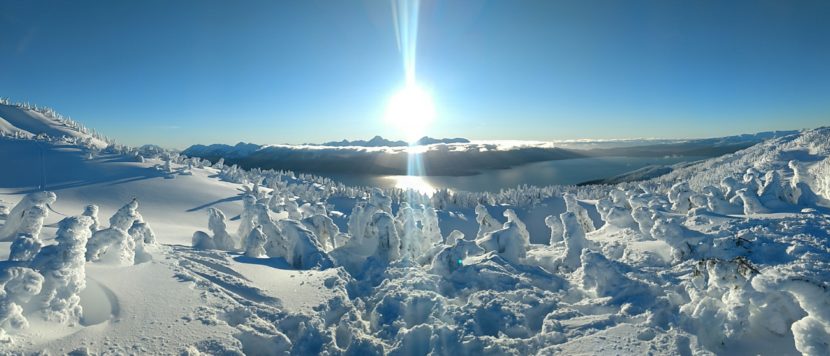
The view from Pittman's Ridge on Douglas Island looking southwest toward Admiralty Island on Dec. 23, 2016. (Photo by Mikko Wilson)
The view from Pittman’s Ridge on Douglas Island looking southwest toward Admiralty Island on Dec. 23, 2016. (Photo by Mikko Wilson)

A storm system is expected to reach Juneau on Christmas, with snow beginning that afternoon. Through Monday morning, Juneau could see up to 7 inches.

“Probably the greatest snowfall totals will be Christmas evening,” National Weather Service meteorologist Wes Adkins said.

Adkins said the storm system is over the eastern Aleutians moving east and it could affect travel plans this weekend.

“So we’re looking for snowfall to spread eastward and northward through Christmas afternoon and we’re looking at the potential for a significant snow event at the tail end of (the) holiday weekend,” Adkins said.

He said he’s very confident it will snow, he just isn’t sure how much. There’s also a possibility the snow could give way to rain, which could make surfaces even more slippery.

He said this season seems to be much more typical for Juneau.

“So at this point, we’re in a La Niña pattern, which promotes normal snowfall conditions with maybe cooler and somewhat drier climate for us through about February and then things start to change for us and go the other direction,” he said.

Adkins said the weather service releases a new climate forecast every month. So long-term predictions could change, but he says it looks like after winter Juneau will see a warmer than normal summer and then another warm winter next season.

He stressed that people should keep a sharp eye on this weekend’s weather. The National Weather Service will release more information on the storm as it comes in.

In Southeast Alaska, the holiday spirit is diesel-powered

Photo courtesy of Nancy Bean.
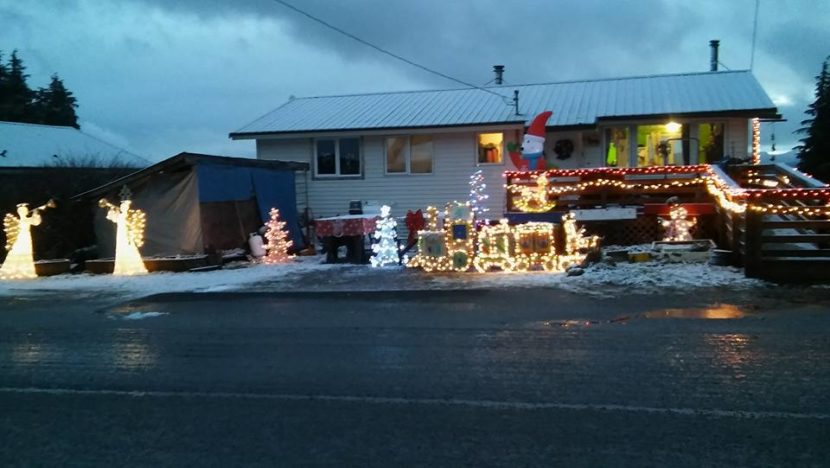
Nancy Bean’s home in Kake. Her holiday lights display is powered by diesel. (Photo courtesy of Nancy Bean.)

Diesel is running about $2.71 per gallon in Southeast Alaska, but in places that depend on diesel for electricity, there are still households that won’t let the cost dampen the holiday spirit.

For Nancy Bean, a Kake resident, it started off small — with a couple of light-up reindeer. But every year, she’s added something new.

“We have lights everywhere. Some houses have a little bit and some houses have a lot. I have more than a lot,” she said with a laugh.

Outside, Bean’s yard has a decorative train, two angels with trumpets, a waving Santa, strings and strings of multicolored lights and more.

“One thing we bought, and I don’t think we’ll do this again, is we bought a 10-foot Christmas tree. A blowup. And it is beautiful when the wind’s not blowing,” Bean said.

Kake is a small community of about 600 people. And Bean estimates there are nearly 20 homes decked out for the holidays.

What’s powering those festive displays is diesel, which can be expensive.

Bean qualifies for power cost equalization, a state funded program that helps lower electric rates in remote places. Still, she says on average, the lights add up to an extra $200 on her electric bill.

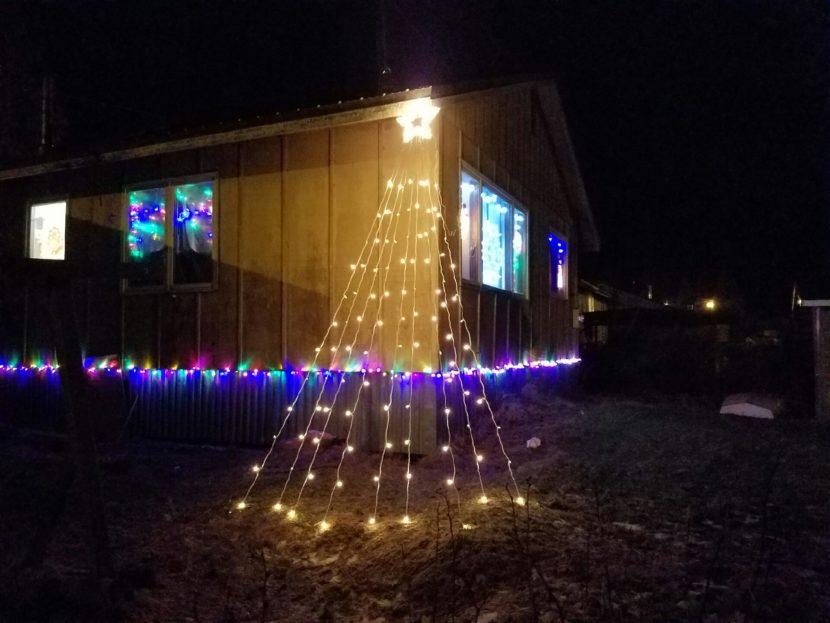
Frank Willis says, so far, it's cost him about $20 extra dollars on his electric bill to keep up the lights. (Photo courtesy of Frank Willis)
Frank Willis says, so far, it’s cost him about $20 extra dollars on his electric bill to keep the lights up. (Photo courtesy of Frank Willis)

North of Kake, in Angoon, Frank Willis says his is one of only three or four houses decorated for the holidays. And his display was hard fought.

“The first one we put up the dogs chewed through it,” Willis said.

Angoon is another village with less than 500 people. And, like Kake, it also runs off diesel.

“Putting up Christmas lights used to be a big thing around here. And it’s just kind of, like, going downhill the past few years,” Willis said. “[I’m] just hoping to get everyone back in the spirit.”

Nancy Bean says that’s what motivates her. When pressed, she’s modest about having a house that looks like a snow globe, one of the most decorated in Kake. She says both adults and children stop to admire the twinkling lights and the waving Santa.

There’s this one girl, she says:

“Her mother passed away, and she’s staying with her uncle. And he brings her up every single night, and he lets her run around in the yard. I can sit in my living room, and I can hear her laugh,” Bean said. “And that’s what it’s all about.”

I ask Bean if she’ll buy more holiday displays next year and she answers “yes” — without hesitation. She says it’s not just the decorations that light up, it’s the faces of the people, too.

Fate of North Carolina’s HB2 law unclear; vote expected later today

The North Carolina Legislature began a special session on Wednesday morning to vote on the repeal of a controversial state law — but it’s unclear which way the vote will go.

The vote was part of a deal between state lawmakers and Charlotte officials. But some Republican state leaders are furious about the way they say Charlotte handled its side of the agreement. Charlotte officials, meanwhile, are denying allegations that they misrepresented their actions.

The state law in question is known as HB2 — also called the “bathroom bill” because, among other things, it required trans people to use bathrooms that match the sex on their birth certificate. It was passed in March, in direct response to an expansion of a local anti-discrimination measure in Charlotte the previous month.

Republican state lawmakers and Democratic leaders in Charlotte had apparently struck a deal under which the city would repeal the local ordinance, and in return, state lawmakers would repeal HB2.

Charlotte said it has carried out its side of the deal — but there are disputes about how the process worked, with Charlotte officials saying the City Council acted in good faith, and Republicans accusing them of lying.

Here’s what happened:

On Monday, the Charlotte City Council announced it had “voted to remove the Non-Discrimination Ordinance from the City Code.”

People on both sides indicated an understanding had been reached — with Republican Gov. Pat McCrory calling Charlotte’s repeal “all about politics,” but agreeing to call a special session “as promised.” Democratic Gov.-elect Roy Cooper called on legislators to “keep their word” and repeal HB2.

But according to The Charlotte Observer, the City Council didn’t actually repeal the full ordinance on Monday:

“Council members did remove the part of its ordinance that dealt with public accommodations, prohibiting business such as stores and restaurants from discriminating against people based on categories such as race and religion — and also sexual orientation and gender identity. That part of the ordinance included the provision that related to transgender people being allowed to use the bathroom that matches their gender identity.

“However, council members left some parts of the ordinance intact.

“The city’s ordinance still prohibits the city from hiring contractors who have been found to discriminate against a subcontractor because of an employee’s race or religion — as well as because of sexual orientation or gender identity.

“That means the city ordinance still offers some legal protections, though small ones, to people who are gay or transgender.”

Around 1 a.m. ET on Wednesday, the executive director of the North Carolina Republican Party released a statement blasting Democrats in Charlotte, saying they “lied directly to the people.”

The City Council and Cooper “have now seriously harmed HB2 repeal efforts,” the statement reads. “The HB2 blood is now stain soaked on their hands and theirs alone. What a dishonest, disgraceful shame by Roy Cooper and Charlotte Democrats.”

Charlotte City Attorney Bob Hagemann says those allegations are false, reports David Boraks of member station WFAE.

Boraks adds that Hagemann says the city did fully repeal the changes made to its anti-discrimination laws — with a vote that took the city “back to 1968,” the first year Charlotte had any sort of anti-discrimination measure.

But to assuage concerns about how wholeheartedly Charlotte acted to reverse the measure, the City Council is now re-repealing the anti-discrimination protection, with a new vote to put the city back exactly where it was before the expansion passed in February.

The Charlotte City Council scheduled an emergency session Wednesday morning and did just that, WFAE reports.

Now all eyes are turning to the state Legislature, to see what happens next.

“Repealing [HB2] would require only a handful of GOP support — perhaps 10 members in the Senate or 15 in the House — if all Democrats voted for it,” The Associated Press writes. “The session that McCrory called is scheduled several days before Christmas, with some legislators out of town.”

Copyright 2016 NPR. To see more, visit http://www.npr.org/.
Site notifications
Update notification options
Subscribe to notifications