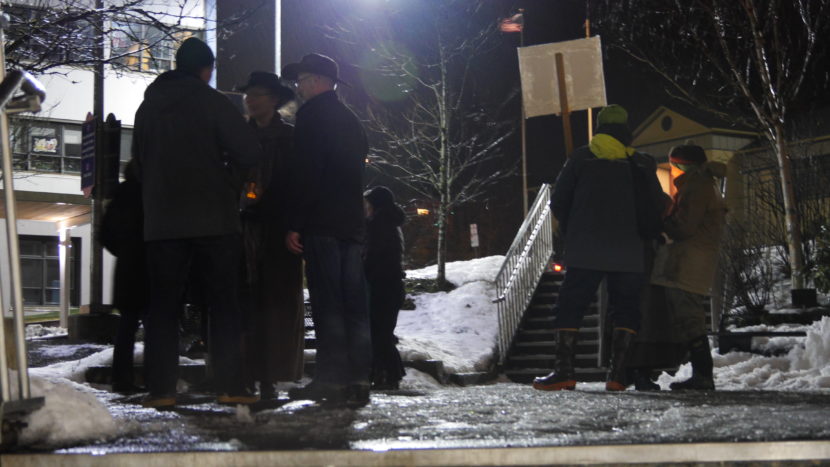
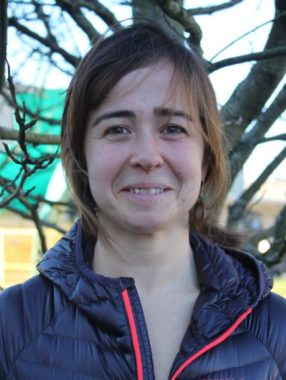
A few participants mill in front of the state Capitol building on Sunday, after a vigil asking Alaska’s electors not to vote for Donald Trump. (Photo by Quinton Chandler/KTOO)
It was cold and dark in Juneau when protesters met on the slippery pavement in front of the empty state capitol Sunday to ask this year’s Electoral College not to vote for Donald Trump.
Evelyn Bass counted between 50 and 60 people in the crowd. She helped organize the vigil to sway electors away from Trump.
“Some probably want to vote for Donald Trump, but some, I’m going to imagine there’s a lot of them that didn’t expect Donald Trump to win the Republican endorsement, and didn’t expect him to win the presidency, and are debating right now what they want to do,” Bass said.
Bass said the Electoral College was created to make sure unqualified candidates aren’t voted into the presidency.
She said similar vigils are being held across the country, but she doesn’t know if they will affect any electors’ votes. If they don’t, she thinks it’s still important to send a message.
Bass said she doesn’t know if it would hurt U.S. democracy if electors ignored the majority vote in their states. She said it’s an important question to consider.
She hopes Sunday’s vigil and a second one planned for Monday, when electors are scheduled to cast their votes, will make people ask whether they want to keep deciding presidential races through the Electoral College.
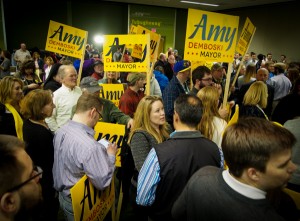
Amy Demboski surrounded by supporters after the 2015 mayoral election. (Photo by Zachariah Hughes/Alaska Public Media)
It’s been a little over a week since an article posted to Facebook by Anchorage Assembly member Amy Demboski spilled into a controversy during a public meeting.
In a written op-ed and over the air during the conservative talk-radio show she hosts, Demboski has denied she owes an apology to an Alaska resident implicated as being part of a militant Islamic group in materials she’s shared. Now she is receiving a swell of violent and sometimes sexist threats.
Demboski is no stranger to controversy. But she’s been alarmed by the surge of messages directed at her.
“Over the last week, the level of vitriol has absolutely intensified,” Demboski said in an interview earlier this week.
The second-term Assembly member believes dealing with criticism and negative attention is part of holding public office, but says this has gone a step beyond normal critiques.
She tried poking fun about the comments on a recent show.
“It’s time for fan-mail Friday here on the Amy Demboski Show,” said her producer, reading aloud messages posted on Facebook. “Dearest Amy, you are a pathetic racist, take out your gun and put it in your mouth and blow your worthless brains out.”
Demboski shared screen-grabs and texts of more explicit messages, some of which are overtly misogynistic. Most of those she’s received are from men.
Since November, Demboski has filed two police reports about harassing behavior and perceived threats to her safety. Both were received prior to last week’s controversy. According to the Anchorage Police Department, because the messages lacked specific threats they’ll remain on file without any further action taken.
Altogether, it has caused Demboski to modify her behavior and she has “altered some security measures,” but she is not letting the threatening messages take over her life.
“I take them very seriously, especially when people are saying I should blow my brains out, and they’re saying they’re going to come to my house and burn flags,” Demboski said.
Two other members of the Assembly, Patrick Flynn and Elvi Gray-Jackson, as well as senior members of the mayor’s administration, Chief of Staff Susanne Fleek-Green and Communications Director Myer Hutchinson, said this week that while they’ve gotten plenty of negative comments in the past, they’ve never received serious threats.
According to Demboski, when conservative callers or commenters begin crossing lines online or over-the-air, she urges restraint and would like to see folks on the other side of the political spectrum do the same thing.
“Whether you’re a Republican, whether you’re a Democrat, or anywhere in between: when you can police people that think like you,” Demboski said, “I think it’s more effective.”
Demboski believes the national political climate is playing a role in local events, with some messages referencing her support for president-elect Donald Trump.
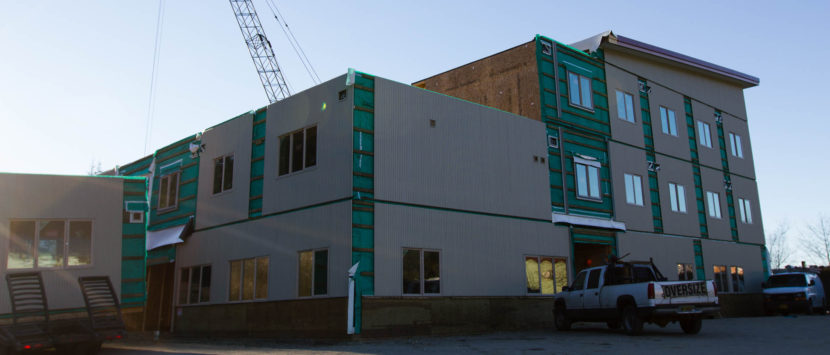
The Housing First Project under construction on November 17, 2016. (Photo by David Purdy/KTOO)
The Juneau community is being asked to come up with $100,000 in donations toward the $7.3 million Housing First project under construction in the Lemon Creek area.
Mariya Lovishchuk heads the Glory Hole, downtown’s emergency shelter. The shelter is managing the new project to provide permanent housing and support services for 32 of the most vulnerable people in Juneau’s homeless community.
“They will have medical attention. They will have mental health care assistance if they want it,” Lovischuk said. “And yes, definitely, they will be permanently housed. It won’t be a shelter like the Glory Hole.”
She said the 32 people who’ll be housed have been homeless for an average of 9-and-a-half years. The facility is slated to open in late spring.
“We have walls and we have rough framing done for rooms. We have the majority of the roof done, which is great, because it’s definitely snowing outside,” Lovishchuk said.
Amy Skilbred heads the Juneau Community Foundation, one of many nonprofits helping out. She’s working on raising the money for the community’s portion of the project.
Skilbred said the Benito and Frances C. Gaguine Foundation helped out with a $45,000 matching grant.
“It’s great to have that so that we can spur on community donations to help meet the cost of the — the sort of the final cost for this project,” Skilbred said.
Skilbred hopes to hit the $100,000 goal in January, ahead of the May opening. As of Tuesday, they’re about 3.5 percent of the way there.
Skilbred and Lovishchuk were speaking as guests on “A Juneau Afternoon” last week.
The Juneau Community Foundation is taking donations for the project directly, and through the crowdsourcing site YouCaring.com. You can find out more about the project at JuneauCF.org.
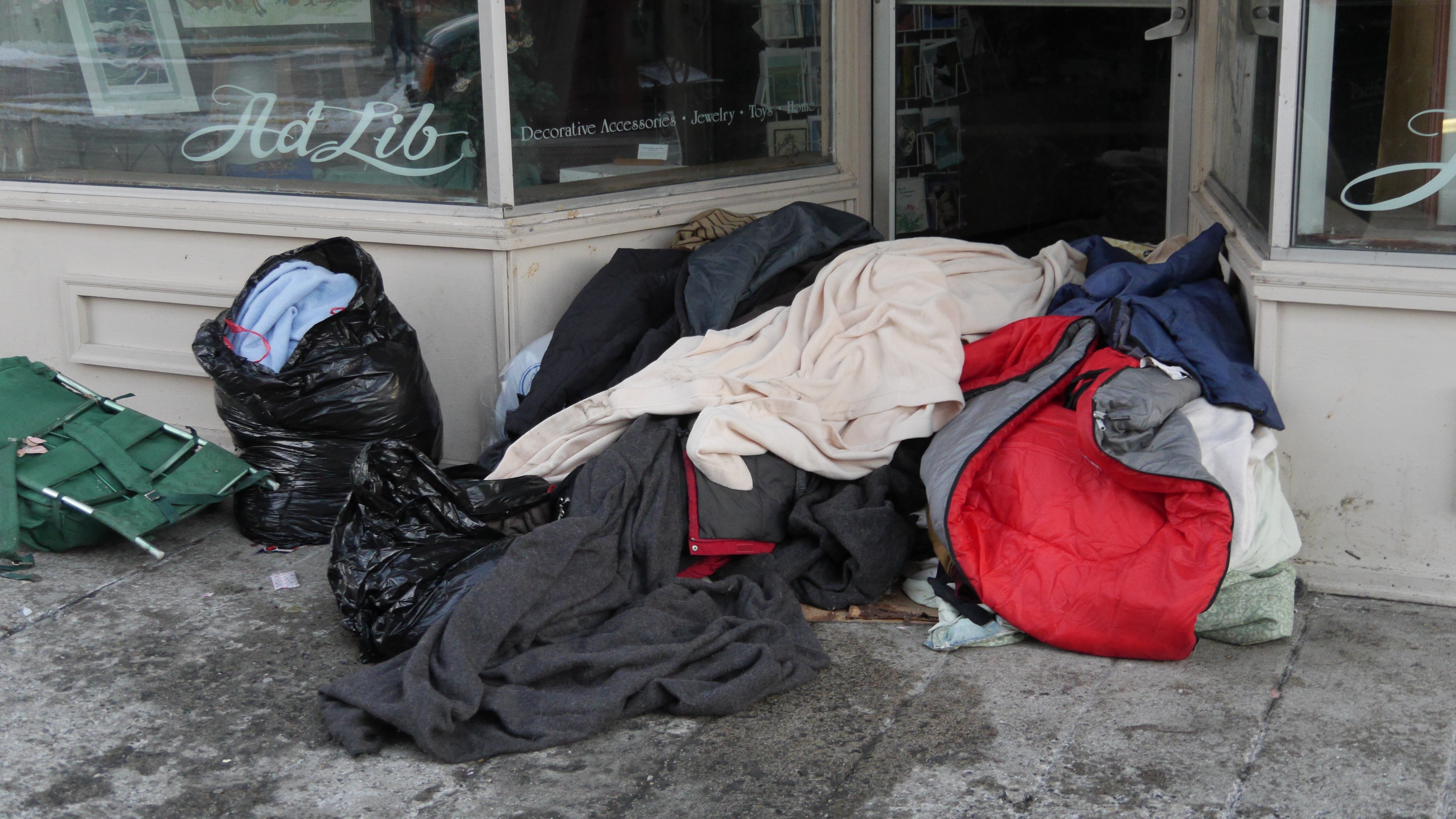
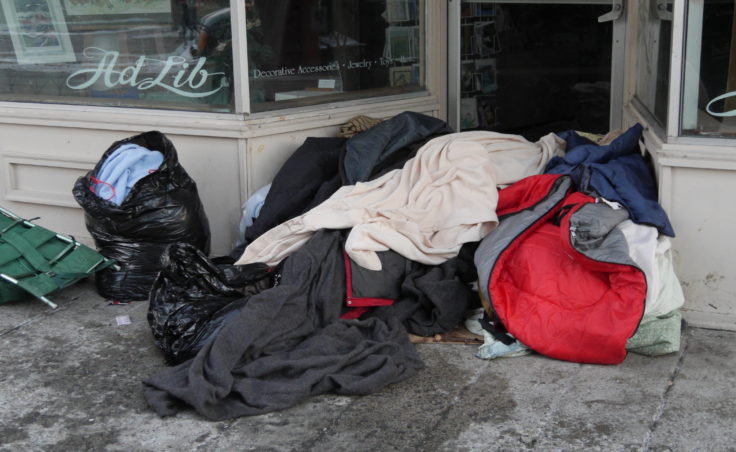
A pile of blankets in the doorway of a business on Franklin Street in downtown Juneau. (Photo by Quinton Chandler/KTOO)
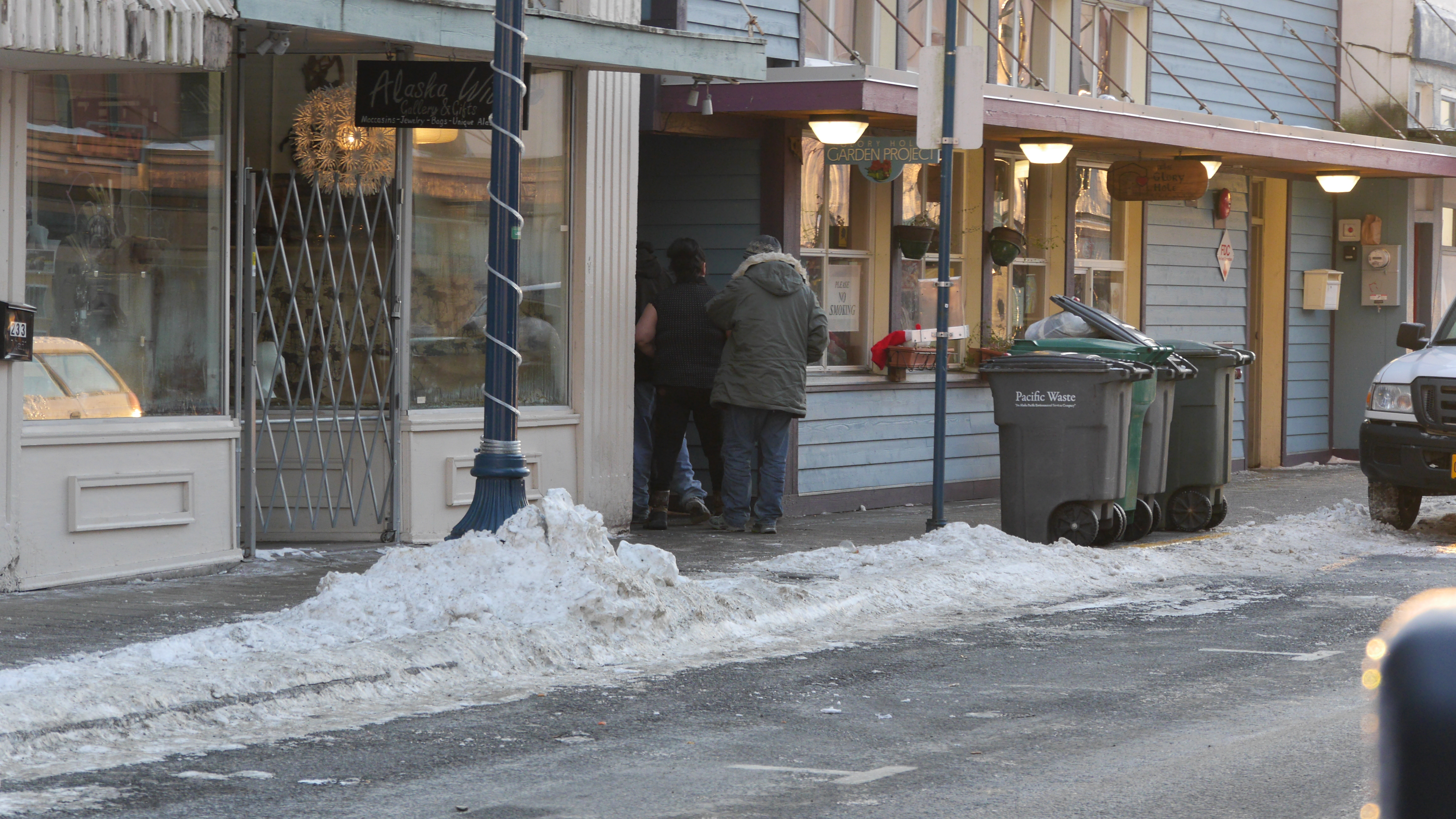
Three people walk into the Glory Hole on Monday. (Photo by Quinton Chandler/KTOO)
Meal preparation at the Glory Hole. (Photo by Quinton Chandler/KTOO)
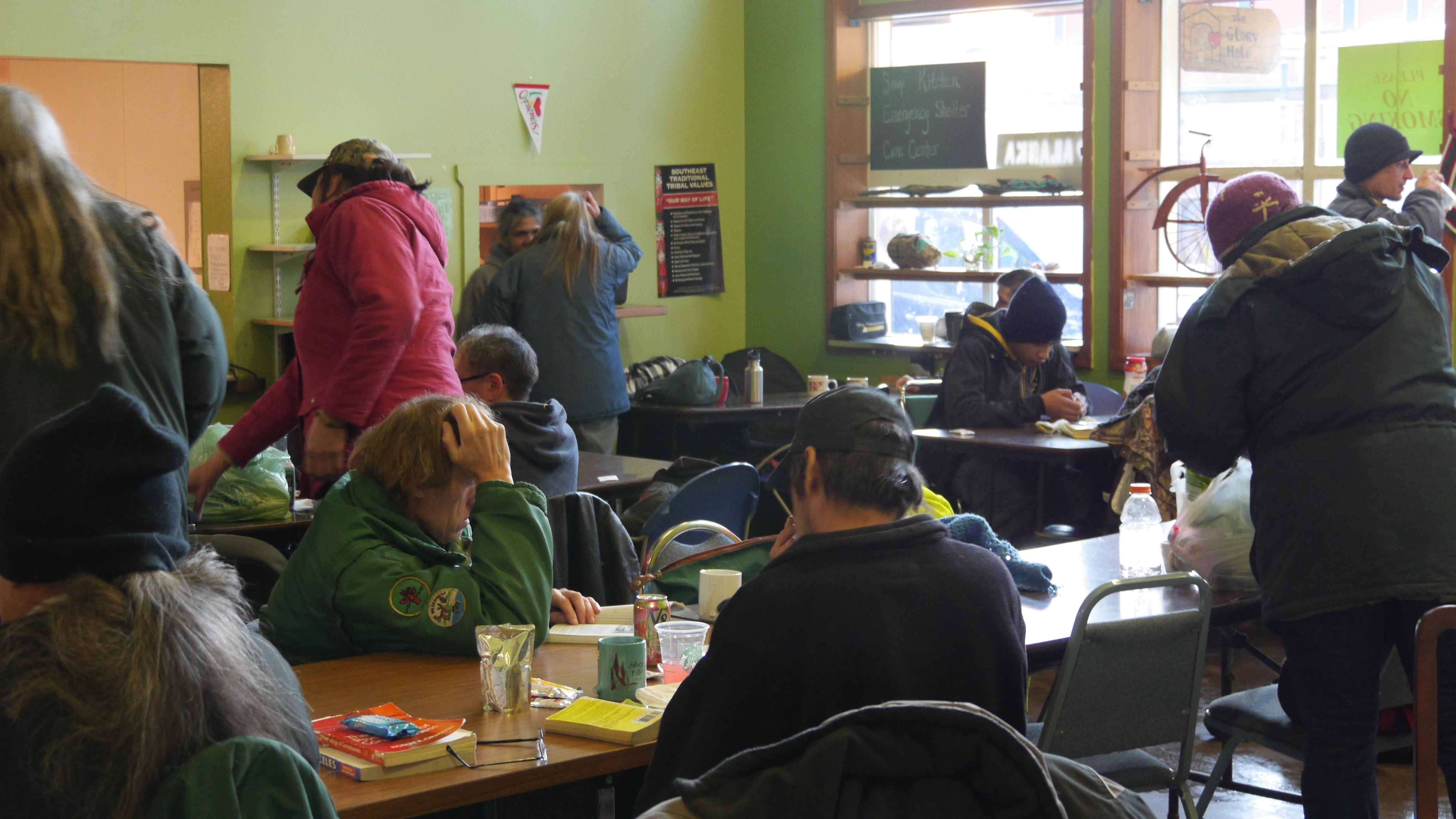
Patrons at the Glory Hole on Sunday. (Photo by Quinton Chandler/KTOO)
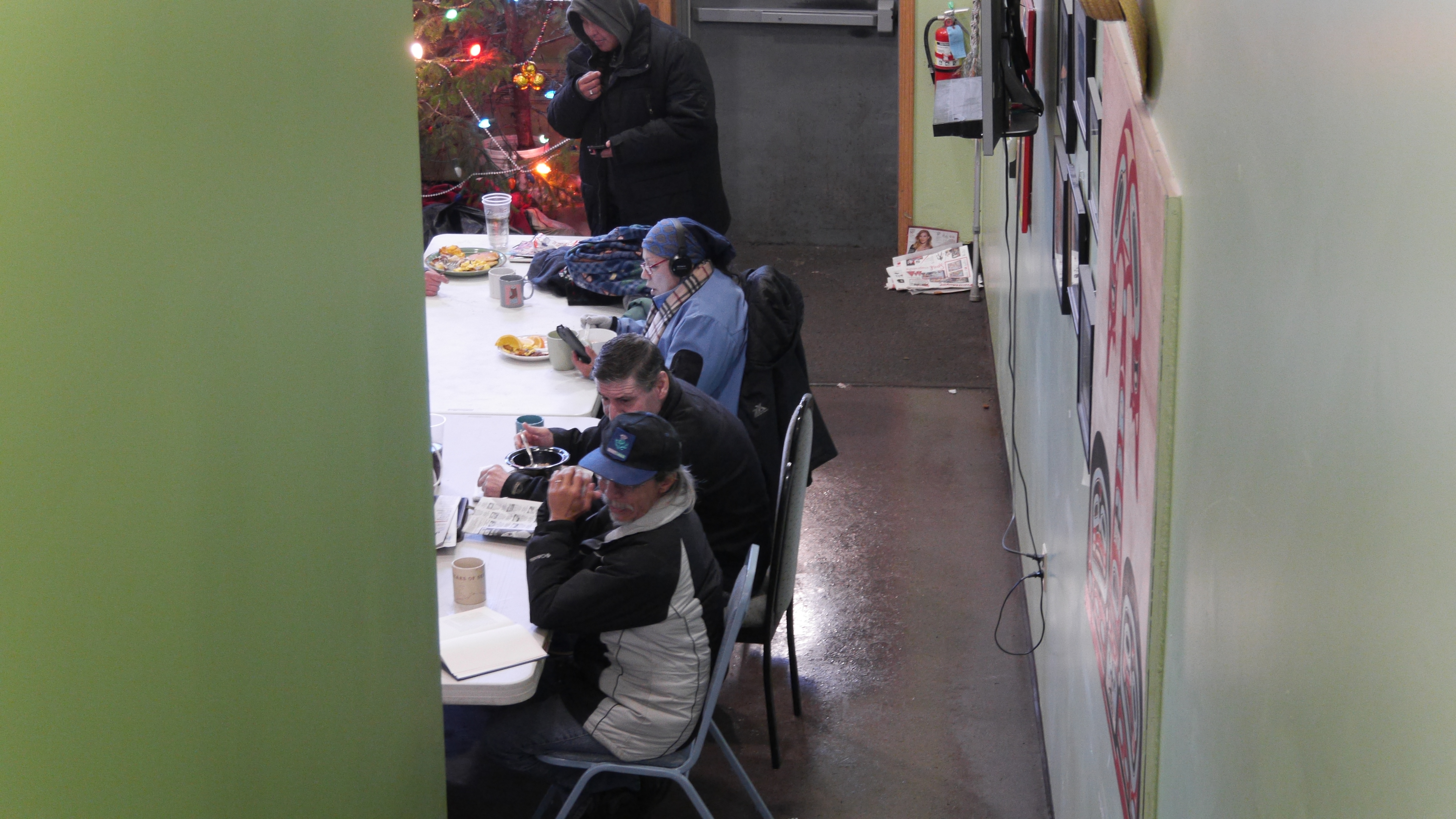
Glory Hole visitors eating breakfast on Monday. (Photo by Quinton Chandler/KTOO)
It’s cold in Juneau. Earlier this month, the city saw one its heaviest snowfalls in at least a couple of years and, according to the National Weather Service, temperatures ranged between the teens and the mid-20s.
Karli Phillips was sleeping outside.
“Oh my gosh, so that storm, we were actually sleeping way under a dock and it just got drenched,” Phillips said. “This is like 3, 4 o’clock in the morning. We’re soaking wet, shivering and everything (was) just gushing water.”
Phillips is homeless and she regularly comes to the Glory Hole, one of Juneau’s few homeless shelters, for food and to get warm. She said that night she didn’t even go to sleep.
“So, I ended up just shivering in a doorway under some sheets I found,” she said. “I feel bad because I think I took them from somebody but, I didn’t sleep that night because I was afraid I would die.”
Winter months are an especially dangerous time for Juneau’s homeless population.
Rose Lawhorne said if you’re sleeping outside on a night like Phillips just described, dying isn’t far-fetched.
“Weather and temperatures down around zero or in the teens like we’ve had them, or with lots of snow, or wind … even damp clothes really contributes to life-threatening hypothermia,” Lawhorne explained.
She is a nurse and supervisor in the Emergency Department at Bartlett Regional Hospital.
She said during winter, homeless people can get hit hard.
“More affected, colder, more illness during the winter months,” Lawhorne said. “We’ll start seeing them multiple times in a day, hungry and cold just looking for a way to get out – out of the elements.”
Rose Lawhorne is an registered nurse and supervisor in the Bartlett Regional Hospital Emergency Department. (Photo by Quinton Chandler/KTOO)
Lawhorne doesn’t know how many people come into the ER for exposure because those cases aren’t always captured in the hospital’s records.
“But what I can tell you is we get many patients every day who are brought to us by either Rainforest Recovery,” she said. “They walk in themselves, they’re brought by friends or family who are concerned, or JPD brings them to us and that is multiple times per day,”
Lawhorne said the range in conditions is huge. Some people are just cold and hungry and some are literally freezing to death.
At the Glory Hole, Executive Director Mariya Lovishchuk said the shelter has 40 beds for overnighters and during the winter they’re usually over capacity.
“We don’t turn anybody away for the lack of beds,” she said. “So last night we had 46 people sleeping here, so if we don’t have beds we put people on the floor.”
Glory Hole Executive Director Mariya Lovishchuk in November 2013. (Photo by Lisa Phu/KTOO)
Lovishchuk said they give breathalyzer tests every night so people who have a blood alcohol level over 0.1 aren’t allowed in that night. People can also be suspended for longer periods.
“When people commit violent offenses or exhibit behavior that is really frightening toward other patrons or staff, they do get suspended from here,” Lovishchuk said. “I think we have two or three people who cannot get any services here.”
She said the Glory Hole is the only short-term shelter that takes men, women and children in Juneau, so unless suspended people and people who choose not to sleep in the dorms have somewhere else to go, they’ll end up outside. Phillips chooses not to sleep in the shelter.
“I actually haven’t gotten sick from sleeping outside. I’ve gotten sick from sleeping in here,” Phillips said.
She claimed the dorms’ air quality is poor and they get overcrowded.
“People don’t regularly bathe or wash themselves,” she said.
Another person said they didn’t sleep in the shelter because they kept getting into fights and being outside was easier even though it’s clearly dangerous. Phillips and others said when they’re outside, they have to wear a lot of layers and sleep under multiple blankets, sleeping bags and comforters – anything to stay warm.
Recently there was a rumor that a homeless man died sleeping on the street. An officer in the Juneau Police Department has said it’s just a rumor. Lovishchuk said she spent three hours trying to confirm it and now also thinks it’s just a rumor, but she said it definitely could happen.
A 32-year-old Juneau man was shot near Lemon Creek on Saturday night.
In a news release, the Juneau Police Department said it received several reports of multiple shots fired in the 5200 block of Glacier Highway at about 9:50 p.m.
Police said a preliminary investigation indicates that the victim and shooter are friends who “got into an altercation.”
Police said the 21-year-old shot the victim three times.
Both men were taken to Bartlett Regional Hospital. Later, the man who was shot was medevaced to Anchorage.
The alleged shooter was treated for minor injuries and then released.
The news release said alcohol was a factor. The investigation is ongoing.
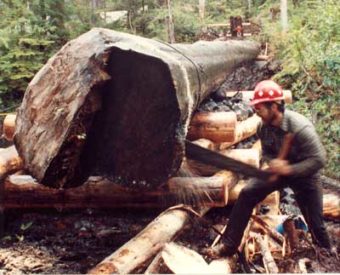
Bucking a 44–inch–diameter Sitka spruce on the Tongass National Forest in 1991. (Courtesy U.S. Forest Service)
This first real cold snap in several years around Kodiak has got a local tree expert raising an alarm over tree cutting and log splitting. Dennis Symmons, a tree surgeon when he’s not tending to borough business as an assemblyman, says when the local Sitka Spruce tree freezes, it can become dangerous to handle.
“When it turns to plastic and peanut brittle from the cold, and it’s the one thing that even a professional forgets. And I was reminded yesterday, ‘Oh yeah, they’re not trees anymore.’ They’re giant sticks of celery. And when I attach my body to that, 60-feet off the ground, it takes on a whole different persona. Now, throw into the mix of these frozen sticks of celery, rotten cores, cancered bases, and they’re not trees anymore.”
He said the tree is more like “a sweaty stick of dynamite” at that stage, and the scenario could turn ugly quickly when topping or felling a tree.
“So here’s the novice and the professional putting that deep face, like he would into a green tree. Now that person’s coming through the back cut, and already making the first mistake, because all of that weight is getting smaller and smaller concentrated on one spot. The mistake’s realized, too late. Now that all that weight’s shifting on that little teeny stick, if a climber’s off the ground, that little stick is right in his face and he’s got nowhere to go.”
Symmons said that very thing happened to him some years ago when he was working on a tree.
“It looked like a really simple job … about a 90-foot spruce tree on its root wad. I just walked up it. I’m about 14-feet off the ground, with my sharpest, fastest-running chainsaw. And I zipped the top off really quick. And I step back, and without even computing what I just did, you know, leaving the frozen top, I slowly started cutting on that. And theoretically, the elasticity would just peel me to the ground. You now, kind of a show off mood,” he said.
“Well, I got three-quarters through that, seven-eighths through that, and realized – by that time it was too late – that it hadn’t moved. And then it exploded and it launched me upside down, into the air, feet-first. My experienced ground-man logger from Oregon thought I was showing off, doing some kind of stunt.”
He said the outside couple of inches have the most moisture and freeze the hardest. He says the dangers with cutting Sitka Spruce are present even when bucking up logs for firewood.
“(You) go to sink that saw and, ‘Wow, this is really weird, I know I just sharpened this thing, and it seems really dull.’ And about the time I punches through that inch-and-a-half frozen layer and grabs that soft wood, by then a person has already backed off and relaxed. Now the saw’s kicking back, coming at them, and the log’s trailing it,” Symmons said. “I’m trying to draw a real ugly scenario because that’s what it is – it’s an accident waiting to happen.”
And when the next windstorm hits and temperatures plummet to the single digits, what does Symmons recommend homeowners do if a tree in their yard starts to look threatening?
“I think the best thing to do is to get it secured. No matter what the conditions are, get the thing tied down. That’s a big deal. That’s why a tree gets topped, it stops its momentum,” he said. “Step one, if they’re in doubt, tie the thing down.”
Temperatures are expected to hover around the freezing point all week, but even when it thaws, Symmons cautions that the frozen ring around the Sitka Spruce could stay frozen for weeks afterward.
Close
Update notification options
Subscribe to notifications
Subscribe
Get notifications about news related to the topics you care about. You can unsubscribe anytime.