Goldbelt Inc. CEO Elliot “Chuck” Wimberly on July 9, 2016. (Photo by Mary Uyanik)
Elliot “Chuck” Wimberly will serve as Goldbelt’s new president and CEO.
The announcement came during Goldbelt’s 42nd annual shareholders meeting Saturday. Goldbelt Board Member Ben Coronell confirmed the news.
Wimberley was named interim CEO by Goldbelt in a January press release after Richard Irwin left the position at the end of last year.
According to the press release, Wimberly has 10 years experience as an executive with Alaska Native corporations and over 20 years experience in “government service.”
Goldbelt said Wimberly previously served as a top executive for the Southern Ute Tribe in Durango, Colorado, and he is retired from the U.S. intelligence community. According to the Juneau Empire, Wimberly was also CEO of Shee Atika, Sitka’s urban Native corporation.
Journeyman carver Mick Beasley is the newest Sealaska board member. He’s the only independent candidate among four winners in a field of nine candidates. (Photo courtesy Mick Beasley)
Sealaska’s newest board member says he’ll continue to push for election and management changes. And at least some on the Juneau-based regional Native corporation’s governing body say they’re willing to listen.
Juneau’s Mick Beasley has spent years as an outsider, criticizing Sealaska’s leaders and business practices.
Now, he’s an insider, one of four candidates who won board seats in this year’s shareholders’ elections.
So, what’s next?
“Got to learn to get along. Hopefully introduce a little bit of a different mindset,” he said.
Beasley, a journeyman carver, won his seat by coming in fourth, behind three incumbents who ran as the board slate.
Coming in first was Juneau’s Jodi Mitchell, who’s been on the board since 2006. She’s CEO of the Inside Passage Electric Cooperative, which provides power to several small Southeast communities.
Mitchell, the board’s new vice chairwoman, said Beasley will find a group of people with similar values.
“I look forward to welcoming him into the fold and hearing his ideas about how we can make a better company,” she said.
Beasley has authored several measures in the past calling for board term limits, including a resolution on this year’s ballot. It won the majority of votes cast, but not a majority of those that could have been cast. That’s the standard for a policy change.
He’s also campaigned against discretionary voting. That’s where shareholders turn their ballot decisions over to the board, which helps keep incumbents in office.
He said next time, he’ll try a different approach.
“I would like to introduce a measure to reduce the board members from 13 to 9. I think that it’s just too expensive and too chaotic having a large board,” he said.
Jodi Mitchell is the new vice chairwoman of Sealaska’s Board of Directors. (Photo courtesy Sealaska)
Mitchell said she’s not ready to address that proposal.
But she points to the failure of past term-limits and discretionary-voting measures.
“Shareholders have addressed these issues on numerous occasions and they haven’t passed. However, I do think the board is very interested in reviewing our government practices and succession planning. And so I expect there might be changes coming,” she said.
Mitchell said it’s up to the full board and she doesn’t want to predict any specific action. But she says “it’s pretty obvious” this year’s strong showing for term limits shows growing shareholder support.
Board election results were made public following Sealaska’s annual meeting June 25 in Ketchikan.
Also winning re-election were Tlingit and Haida Business Corporation CEO Richard Rinehart and National Congress of American Indians Executive Director Jackie Johnson Pata.
Five other independent candidates also ran for board seats.
At the Ketchikan meeting, Sealaska CEO Anthony Mallott said the corporation would continue to invest in businesses in Southeast Alaska and the Pacific Northwest. That’s where most of Sealaska’s approximately 22,000 shareholders live.
Mitchell said a recent Seattle business purchase, announced in May, is a step in the right direction.
“I’m really excited in our new investment in IPC, the seafood-packaging company. But I do know that we have a lot of work to do to grow shareholder jobs and to bring more meaningful benefits to our shareholders,” she said.
New board member Beasley supports such efforts. But he said the seafood processor investment should have been more than a minority purchase.
“If we don’t own 51 percent of a company and we’re an investor, that’s all we are, is an investor. There’ll be capital calls and I think all we are going to end up being is deep pockets for this,” he said.
Sealaska Chief Operating Officer Terry Downes has said the purchase created a partnership that will deliver profits while giving the corporation a voice in management decisions.
The Central Council of Tlingit and Haida Indian Tribes of Alaska is doing something few tribal organizations do.
Earlier this month, June 15, the tribe acquired KIRA, Inc., an international maintenance contracting company. The Colorado-based entity has scored more than $1 billion in federal contracts, according to its documents.
Southeast Alaska’s largest tribal organization wants to boost revenue with its acquisition. Central Council President Richard Peterson said the ultimate goal is to serve all of their tribal members, and not just those in Southeast.
“It feels somewhat disingenuous to repeatedly say, ‘I’m sorry you live outside of service area, but hey you’re a citizen, thank you,’” Peterson said.
Grant money that CCTHITA receives mostly limits its services to Southeast. The tribe provides educational, employment, elderly and financial assistance for its tribal members.
Central Council of Tlingit and Haida Indian Tribes of Alaska President Richard Peterson. (Photo courtesy CCTHITA)
Peterson said half of the tribe’s more than 33,000 members live elsewhere in the state or Seattle.
“There’s a misconception out there that we generate funds based on our general enrollment, and we don’t,” he said. “We only generate funds based on the service area enrollment.”
In recent years, CCTHITA has made an active push to generate unrestricted funds by creating a separate company, Tlingit Haida Tribal Business Corp., or THTBC.
Last year, the Small Business Administration certified the company for special government contracting status under its 8(a) program.
Alaska Native corporations have long used the program to win federal contracts, but it’s unusual for tribes.
Congress created the 8(a) certification decades ago to help small and minority-owned businesses win federal contracts. Special provisions were added in 1986 for federally recognized Native American and Alaska Native corporations — they can outgrow “small” status but continue to enjoy the program’s benefits.
Carlos Garcia is KIRA’s founder and president. It was once 8(a) certified, too, but outgrew the program. KIRA will now have those small business contracting opportunities again.
“We were only allowed to bid on a small percentage of them,” Garcia said. “We wanted to bid and the only thing that was missing was the certifications that the tribe enjoys.”
The acquisition of KIRA became official after about a year of negotiations. KIRA was actually looking for an Alaska Native corporation partner, according to company documents from 2014.
Garcia said he decided to sell to CCTHITA instead of an Alaska Native corporation to ensure the profits directly benefited shareholders.
“The money that we make is going to go straight to their tribal members. Many of these large ANCs have enormous bureaucracy in Anchorage and the money goes to those executives,” he said. “And there doesn’t seem to be a lot of profit put forth to the Native programs.”
Richard Rinehart, CEO of Tlingit Haida Tribal Business Corporation. (Photo courtesy of Sealaska)
THTBC’s CEO Richard Rinehart wouldn’t disclose the acquisition price or the projected revenue from the purchase. But he did say one of the goals is to have KIRA compete in Alaska’s market.
“KIRA has not competed a lot in Alaska because there’s so many Alaska-based corporations that have an advantage,” Rinehart said. “Well now they’ll be able to.”
In the coming weeks, Garcia said KIRA will add on multiple new contracts.
He believes that if everyone works hard, the company — and its profits — will multiply quickly.
Sealaska shareholder Michael Lee Beasley won election to the corporation’s board of directors. (Photo courtesy of Michael Lee Beasley)
One of Sealaska’s most vocal critics is now a member of the Southeast regional Native corporation’s board of directors.
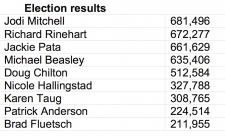
Shareholders chose Michael Beasley, also known as Mick, as one of four winning candidates, according to results announced at Sealaska’s annual meeting Saturday in Ketchikan.
He came in behind three incumbents, each of who ran as the board slate. They are Inside Passage Electric Cooperative CEO Jodi Mitchell, Tlingit and Haida Business Corporation CEO Richard Rinehart and National Congress of American Indians Executive Director Jackie Johnson Pata.
A fourth incumbent, Patrick Anderson, ran as an independent and lost.
Beasley, a carver, authored a term-limits measure on this year’s ballot. It received a majority of the votes cast, but not the majority of all possible ballots. As a result, it will not take effect.
Beasley has put similar measures on Sealaska’s ballot in the past, along with several to eliminate discretionary voting. That allows shareholders to turn their ballot decisions over to the board.
Other approaches would change the board’s makeup and likely its policies.
Four other independent candidates also ran for the 13-member board.
They were, in order of votes received, carver Doug Chilton, former Sealaska Corporate Secretary Nicole Hallingstad, Bartlett Regional Hospital Controller Karen Taug and financial adviser Brad Fluetsch.
Sealaska has 22,000 shareholders who mostly live in Southeast, other parts of Alaska and the Pacific Northwest.
Sealaska headquarters in Juneau. The regional Native corporation will hold its annual meeting Saturday. (Photo by Casey Kelly/KTOO)
Sealaska shareholders will learn Saturday which of nine candidates will fill four seats on the Southeast regional Native corporation’s board of directors. They’ll also find out whether a term-limits measure will go into place.
Most of Sealaska’s 22,000 shareholders who will vote already have. Results will be announced during Sealaska’s annual meeting, Saturday at the Ketchikan High School gymnasium.
The board usually endorses a full slate of incumbents. But this year, the panel rejected one, attorney Patrick Anderson. He’s running again independently, as are well-known artists, business people, nonprofit administrators and a former high-level staffer.
The other independents are term-limits author and carver Mick Beasley, carver Doug Chilton, financial adviser Brad Fluetsch, Bartlett Regional Hospital Controller Karen Taug and former Sealaska Corporate Secretary Nicole Hallingstad, now operations director for the National Congress of American Indians.
The three board-endorsed members are Inside Passage Electric Cooperative CEO Jodi Mitchell, National Congress of American Indians Executive Director Jackie Johnson Pata and Tlingit and Haida Business Corp. CEO Richard Rinehart.
The term-limits measure would make incumbent board members step down after three, three-year terms. They would not be allowed to run again.
It’s supported by critics who say Sealaska has lost too much money and needs top-level changes. It’s opposed by the board, which says the corporation would lose important knowledge and history.
Similar term limit measures have failed in past years.
Russell Dick will take over as Huna Totem CEO this fall. The Native corporation for Hoonah operates the Icy Strait Point tourist attraction. (Photo by Ed Schoenfeld/CoastAlaska News)
The Native corporation for the Southeast village of Hoonah is changing leaders.
Huna Totem CEO and President Larry Gaffaney will leave this fall after seven years on the job. He’ll be replaced by Russell Dick, current chairman of the corporation’s board of directors.
Gaffaney, who is not a shareholder, said he’s hoped for years to turn the reigns over to a tribal member.
“We’ve got a solid corporation and we’ve got an absolutely qualified, energetic and enthusiastic guy to take the helm. So the time’s absolutely right to do it,” he said.
Huna Totem has about 1,350 Tlingit shareholders with ties to Glacier Bay and Hoonah, about 40 miles southwest of Juneau. It employed about 110 shareholders last year.
It’s best known for its Icy Strait Point cruise-ship attraction, which was built around a renovated cannery.
Dick has been CEO of Sitka-based Alaskan Dream Cruises for about two and a half years. Before that, he ran Sealaska’s Haa Aaní subsidiary, which focused on regional business development. He’s also been vice chairman of the Alaska Industrial Development and Export Authority board since 2013.
Dick wasn’t available for immediate comment. Gaffaney said Dick grew up with Huna Totem.
“He certainly understands this corporation and its people and its mission down to his bones. He’s also got the requisite business experience to take it forward and he’s got the full support of the board,” he said.
Dick will be based at Huna Totem’s corporate headquarters in Juneau. Gaffaney said he will move on to another business opportunity after leaving the corporation, though he wouldn’t discuss details.
Huna Totem also runs Alaska Native Voices, a business providing cultural interpreters on cruise ships in Glacier Bay and other parts of Southeast.
A relatively new business is Dear North, which produces and distributes smoked and dried salmon treats.
Huna Totem does not release details of earnings. Its most recent shareholder dividend, in February, paid out $1.65 per share.
Close
Update notification options
Subscribe to notifications
Subscribe
Get notifications about news related to the topics you care about. You can unsubscribe anytime.