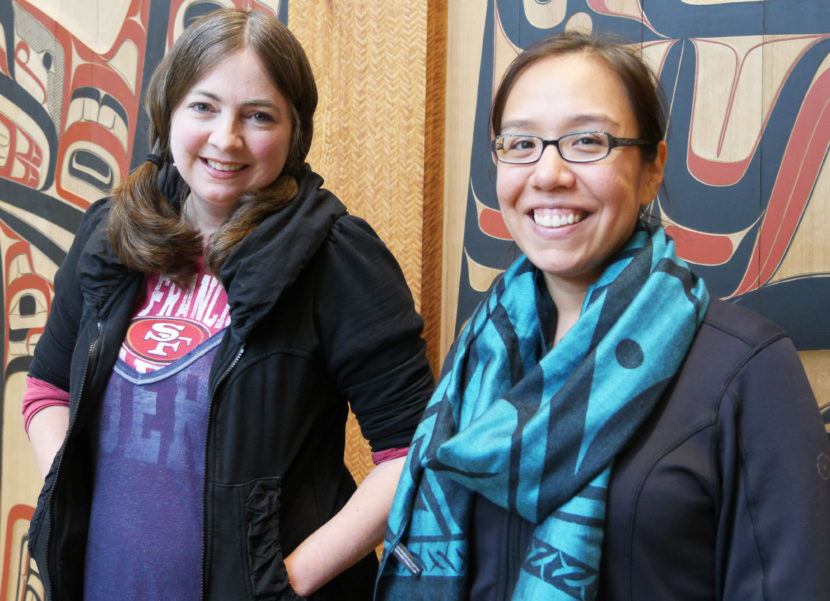
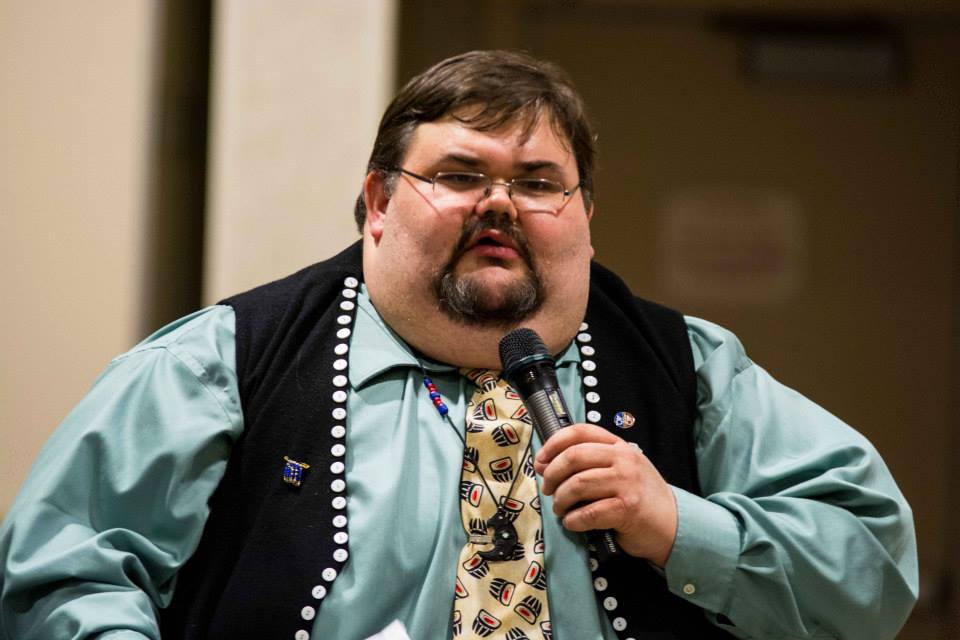
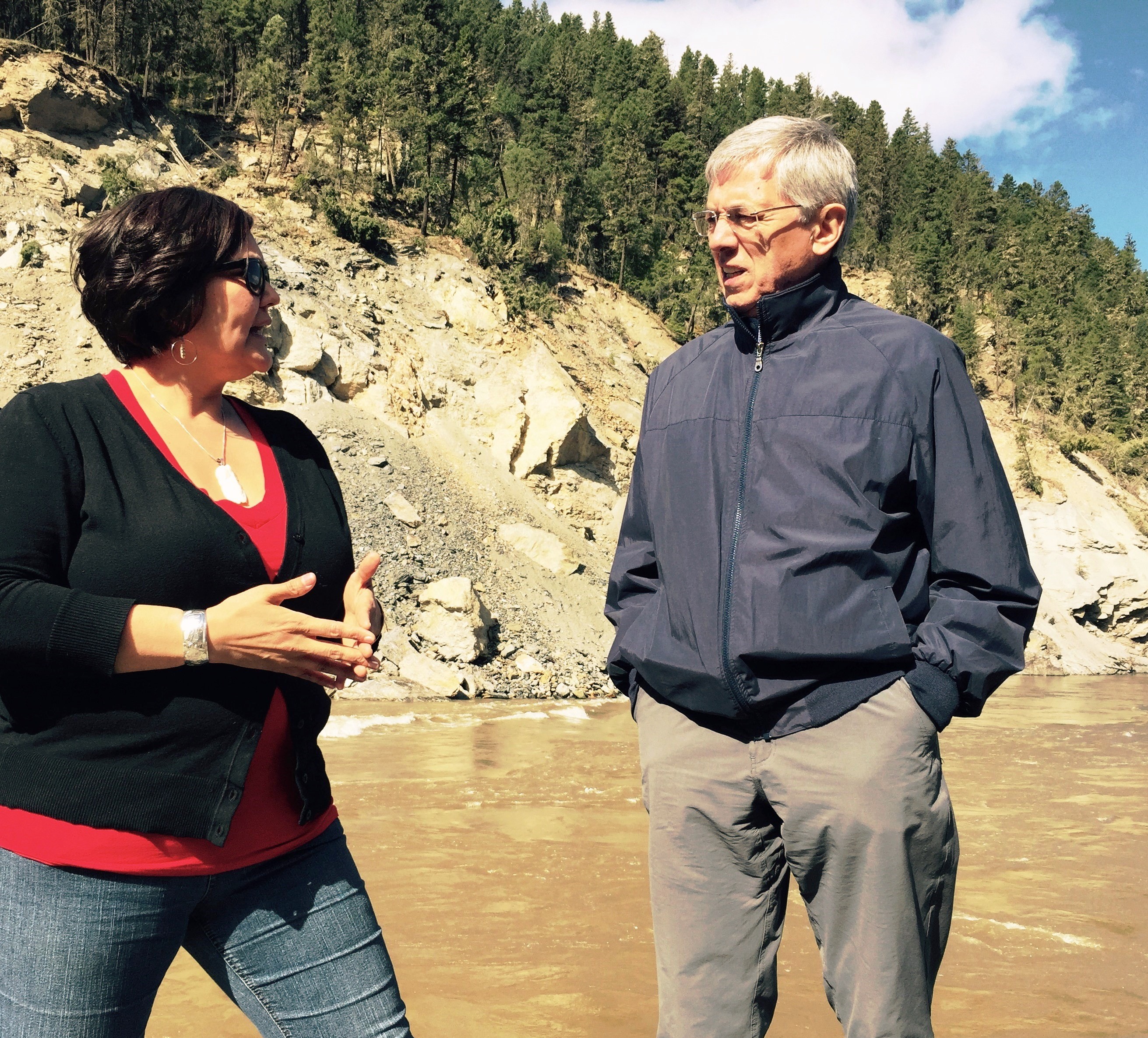
Sealaska Heritage Institute’s Kathy Dye, left and Katrina Hotch both worked on the recently released Tlingit Language and Tlingit Games apps. (Photo by Lakeidra Chavis/KTOO)
There are only a few hundred Tlingit speakers in the world, according to linguists and researchers.
In a world where English is considered the dominant language, Tlingit is endangered, linguistically speaking.
The Sealaska Heritage Institute hopes to combat that.
The organization announced the release of two free apps Monday, aimed at making learning the language more accessible.
Katrina Hotch is behind two recently released apps to help people learn Tlingit.
Earlier this week, I sat down with Hotch and Kathy Dye. Dye walked me through the Tlingit Games app, which has two naming games in it.
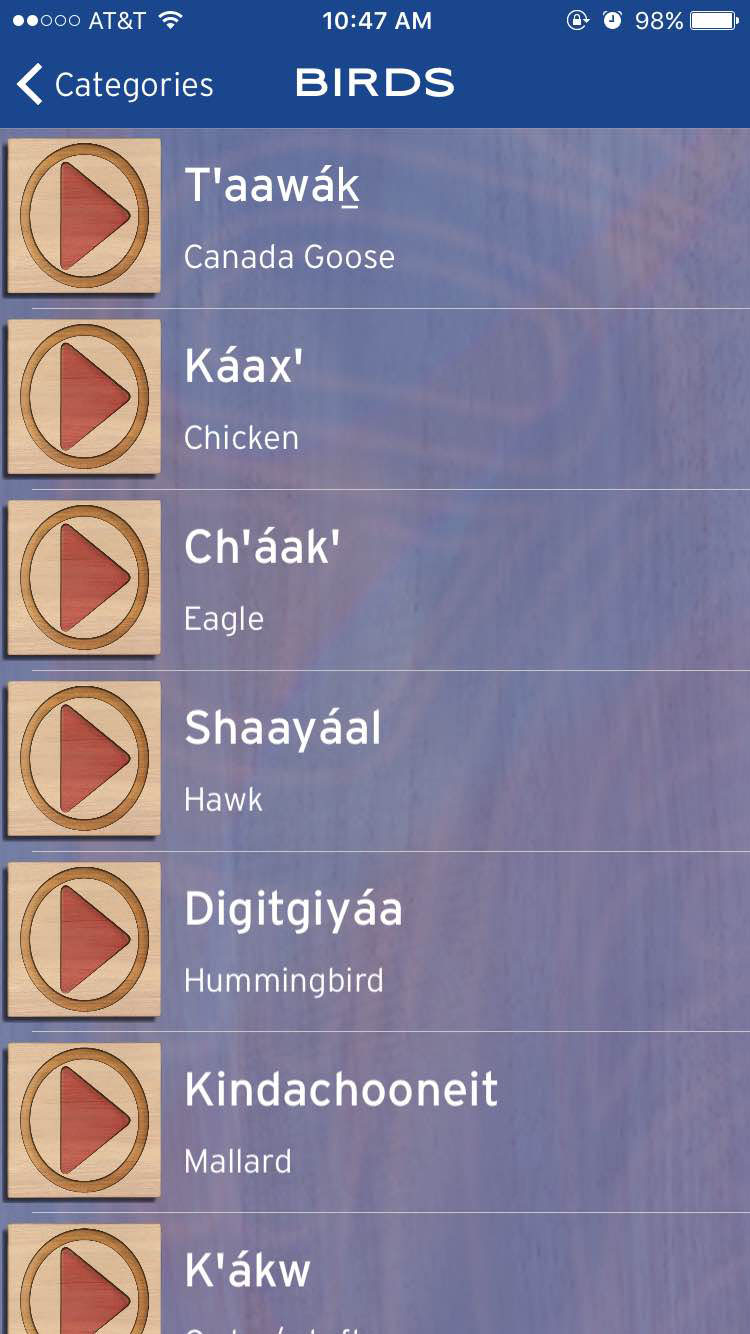
The game features a colorful array of about a dozen birds common throughout Southeast, there’s even a hummingbird that flies in and out of your screen.
Screenshot of the Tlingit Games app, during the Birds game. (Screenshot by Lakeidra Chavis/ KTOO)
A screenshot of the Tlingit Language app from the Sealaska Heritage Institute. (Screenshot by Lakeidra Chavis/ KTOO)
Screenshot of the Tlingit Games app, during the Ocean game. (Screenshot by Lakeidra Chavis/ KTOO)
Dye designed the birds herself; each one took about a day, with the goal is to match what someone might see in our actual world with their Tlingit names.
Hotch has been working on the language app since the year began — editing and gathering audio, some that’s decades old, from Sealaska Heritage Institute’s archives.
“There’s also years and years of work of collecting the audio,” Dye said, “that a lot of current and past employees have been working on, and that’s been going on for many years.
“Yeah, there’s so many people that have done a lot of work in the language and it’s exciting to make it more accessible to everyone,” Hotch said.
The other app, Learning Tlingit, has about 300 entries in three main categories—alphabet, vocabulary, and phrases.
“One of the more difficult but super useful phrases for a beginning learner is ‘I don’t know,’” Hotch said.
Hotch says she’s not a fluent speaker, so she tried to pick entries that would be helpful for someone who’s learning.
“What’s probably going to be some really popular category phrases is introductions and learning Tlingit and probably meal time,” she said, “everyone eats, yeah?”
She says the goal was to create a game that exemplifies the organization’s mission.
“Especially Haa Shuká ,” Hotch said, “that’s the concept of, you’re connected to the past, present, and future. We have audio of all of these speakers, and some of them have gone on, but we’re making it available for present and future generations to help perpetuate the language and culture.”
The institute hopes apps like this will give people the tools they need to learn and maintain the language.
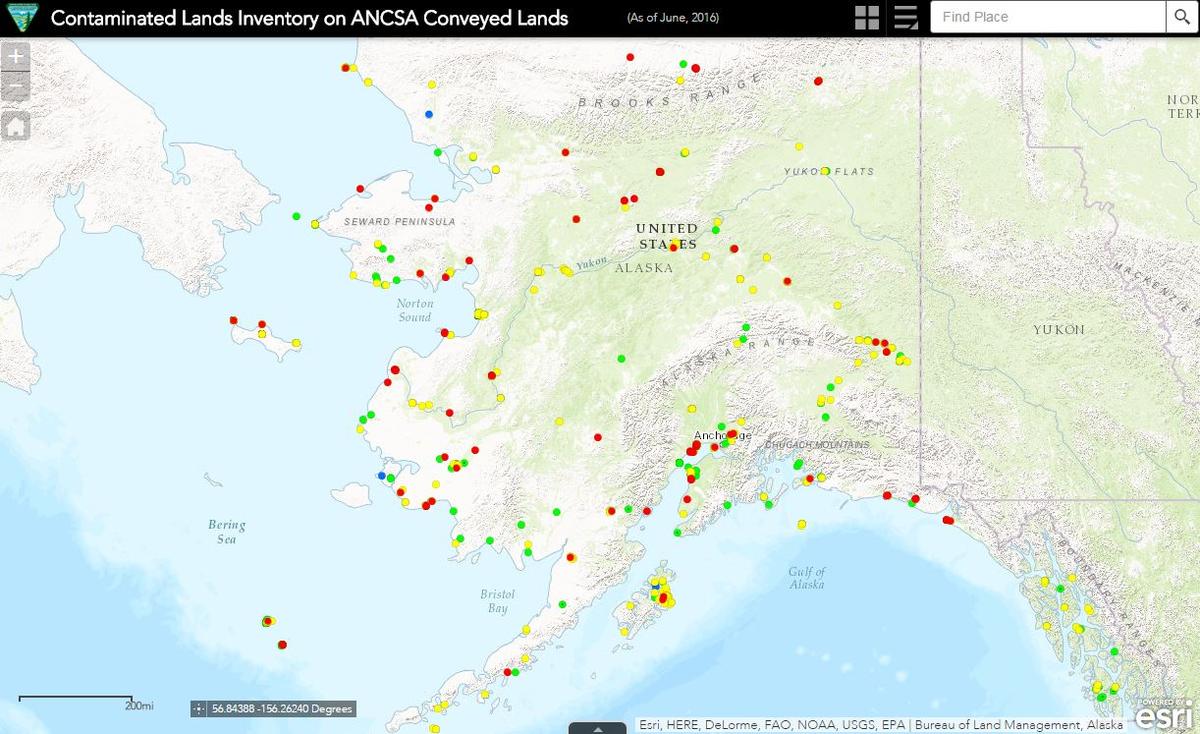
The BLM put together an inventory of 920 contaminated sites conveyed to Alaska Native Corporations, color-coded to indicate sites that have already been cleaned up, and those with work still to be done.
Scattered throughout Alaska are hundreds of pieces of land that have been transferred to Alaska Native Corporations by the federal government.
Some of it is the land of Alaska dreams: forests, tundra, river banks – largely untouched. Other parcels are less picturesque, but chosen for an economic development purpose.
And some, for whatever reason they were chosen, came with contamination: old schools, tank farms, other structures and even some spills.
About 1,000 sites considered contaminated were transferred from federal entities to Alaska Native Corporations, including storage tanks at the post office site in Iliamna; soil issues at the Katmai National Park Headquarters; a tank farm in Newhalen; and the former school in Pedro Bay.
Since the Alaska Native Claims Settlement Act was signed in 1971 as part of the effort to extinguish aboriginal title to lands, the Bureau of Land Management has acted as the government’s real estate agent, and been responsible for transferring each parcel to corporations.
At Congress’ direction, the agency published its report on where those conveyances stand this summer, including an inventory of the sites with a map available and searchable online to discover where the parcels are and what is happening on them – or needs to happen in the future.
The BLM looked at each of 6,000 sites thought to be conveyed under the settlement act, and determined who the landowner was before transfer, to whom it was transferred and when that happened.
Doing so drew on databases and information from several agencies, both state and federal, and BLM deputy state director Erika Reed said it was the first effort of its kind.
“It took dozens of people, literally going through every one of those sites, all 6,000 of them, overlaid against our land status records and the survey records,” she said. “Since we are the ones that dispose of the lands, we conveyed them out of federal ownership, we have the legal descriptions for all the lands that are conveyed, everything that was issued in a conveyance document, in a survey record.”
Much of the push for the report came from an ongoing concern over whether land was being cleaned up.
The preliminary inventory offers information about the land’s current status, though it makes no promises as to future work.
Bristol Bay Native Corporation Associate General Counsel Daniel Cheyette said that the process, which stakeholders see as slow, has been frustrating.
“As the landowners, as participants in ANCSA who believed that their land claims, that the land grants were in satisfaction of their land claims, it’s really frustrating that decades later we still have contaminated sites, and that the federal government is really moving very slowly in terms of correcting problems they created,” he said. “It’s a step, it’s a start, but it’s taking way too long and it’s very frustrating for the landowner.”
It’s also frustrating that the BLM does not have ownership over the next steps beyond the report, Cheyette said.
“It’s a great start, but we’re taking baby steps, and this is baby steps on a problem that has persisted for decades,” he said. “It is both a source of optimism and continued frustration that the main recommendation is a working group. We need concrete steps at this point.”
The Alaska Native Village Corporation Association has worked on the issue for decades, and spokesman Brennan Cain, who is vice president and general counsel for The Eyak Corporation, said the slow process has been frustrating to stakeholders.
“It is unacceptable that 45 years after the passage of ANCSA to settle aboriginal land claims, Alaska Native Corporations continue to face legal exposure for contaminated lands conveyed to them by the Federal government,” he said, adding that the corporations want to see a clear path to cleanup.
“We urge the federal government to acknowledge its responsibility to remediate the contaminated sites and to facilitate the remediation of the sites.”
While the BLM can do an inventory, it has said it doesn’t have the authority to do the cleanup, said Maureen Clark, a BLM public affairs official.
“Once lands are no longer owned by the United States, the Department of Interior doesn’t have the authority to expend appropriated funds to cleanup private land,” Clark said. “It’s the entity that made the mess, if you will, that’s responsible for actually cleaning it up.”
The BLM transferred some of the parcels from its own lands, but those are not thought to be contaminated.
Instead, the U.S. Army Corps of Engineers, the U.S. Air Force, the Federal Aviation Administration and other entities all played a role in causing the contamination, and are likely to be responsible for some sites. But the BLM can’t make them clean them up, said project manager Paul Krabacher.
“We don’t have the authority to compel action for any of this from here on,” he said. “These are not federal lands anymore, they’re private lands. Obviously corporation lands in this case.”
Instead, the BLM report makes some recommendations: finalize the inventory, so that there is a complete picture of the lands’ status right now, and put together a working group to develop the next steps. And, it hands over much of the responsibility for coordinating the work that is left to the Alaska Department of Environmental Conservation.
DEC contaminated sites manager John Halverson said his agency can do some of the work outlined in the recommendations, but not necessarily all of it.
“There hasn’t really been final decisions made on specifically what’s going to happen in response to the report, but DEC’s mission does include making sure that contaminated sites are investigated and managed properly and cleaned up appropriately,” he said.
For instance, the state’s on-going budget concerns might make it particularly difficult for the agency to manage the new inventory database that the BLM put together, or take on other new work, Halverson said.
“We are taking a look at the orphan sites in this report and trying to figure out if any of those are high priority sites to make sure we can move those along as soon as possible, but trying to work out agreements between multiple parties that may be responsible or liable for contamination can take quite a bit of time,” he said.
The agency is looking at funding sources, such as state and Tribal brownfields program resources and other federal programs, to help with the work, Halverson said.
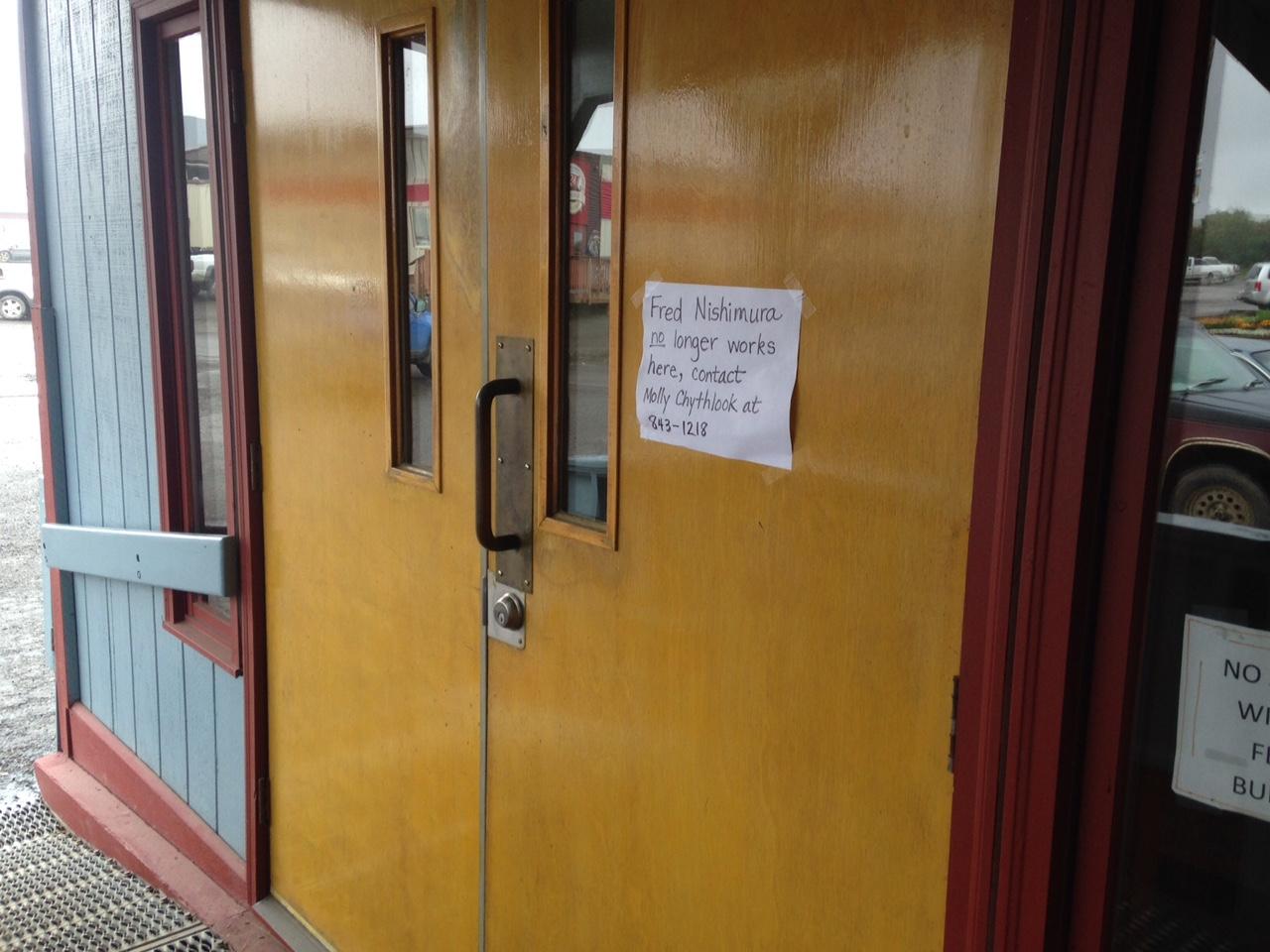
A sign posted on the door of the Aleknagik building in downtown Dillingham, where the ANL office is located. (Photo by KDLG)
The business manager for three different corporations has been fired and an independent investigation is underway amid accusations the employee had embezzled money.
Aleknagik Natives Ltd. board president Molly Chythlook confirmed Tuesday that Fred Nishimura had been fired.
Leadership for Ekwok Natives Ltd. said Nishiumura’s contract as business manager had been “terminated” and said an independent investigation was underway.
Panarqukuk Inc., a subsidiary of Stuyahok Ltd. better known as the “P Store”, also has cut ties with Nishimura following a civil lawsuit judgment awarding the corporation $56,682.
Court documents from a lawsuit filed against Nishimura this year show a judgment for Panarqukuk Inc. in the amount of $56,682, which includes $52,900 from 39 checks the corporation said Nishimura wrote to himself over the course of 10 months in 2014.
Chythlook and Jim Vollintine, an attorney representing all three for-profit corporations, said an internal review of records is underway.
Other details of embezzled funds may be made public when that is complete, they said.
The lawsuit said Nishimura was an “independent contractor who performed bookkeeping services … under an oral contract.”
Nishimura denied accusations that he had taken any money beyond what he was owed for services reached by phone Wednesday morning.
He said he may seek legal help to clear up the matters he described as misunderstandings.
Nishiumura has been the business manager for Aleknagik Native Ltd. since “the early ’80s,” according to Chythlook.
Southeast Alaska’s largest tribal organization said this month’s meetings with the U.S. State Department and Environmental Protection Agency were productive.
Among other things, the agencies could help expand water-monitoring efforts along transboundary rivers.
Central Council of Tlingit and Haida Indian Tribes of Alaska President Richard Peterson. (Photo courtesy CCTHITA)
President Richard Peterson said representatives heard about potential and existing pollution from British Columbia mines near rivers that flow into Alaska.
“I think we gave them some of our concerns and questions and whatnot,” he said. “That gives them a chance to go back and now have that next conversation that’s more action-based and promissory in nature.”
The federal officials met with tribal government and Native corporation leaders from Juneau, Ketchikan, Saxman, Douglas and Kasaan on Aug. 9-Aug. 11.
They talked about water-quality monitoring along fish-and-wildlife-rich transboundary rivers, Peterson said. Federal officials were interested in supporting the effort.
“And we were able to use that as an opportunity to push for more funding for activities regionwide, so that other communities can do that baseline analysis that needs to take place,” he said.
State Department and EPA public-affairs staff offered no comment on the meetings or any commitments made.
Peterson said they agreed to hold further meetings, which will happen this fall in Washington, D.C.
Lt. Gov. Byron Mallott discusses mine pollution concerns with Xat’sull tribal official Jacinda Mack on May 6, 2015. (Photo courtesy Office of the Governor)
Lt. Gov. Byron Mallott and other state officials presented their concerns at the meetings.
They brought up a U.S. Canada boundary-waters treaty that includes a commission tasked with resolving such conflicts,” he said.
“We emphasized that if, when, how, in what manner, that the IJC, the International Joint Commission, might be engaged that we would No. 1, welcome it and No. 2, be part of it to the degree that that was appropriate,” he said.
Mallott heads up a state task force on transboundary mine concerns.
He and his team also brought up the need for more federal support.
“To put it mildly, Alaska is resource-constrained, at least fiscal resource-constrained, right now,” Mallott said. “These collaborations and network-building is very important.”
Alaska and British Columbia officials have been discussing the state’s concerns for more than a year.
A statement of cooperation detailing ways Alaska can provide more input into mine decisions is nearing a final draft.
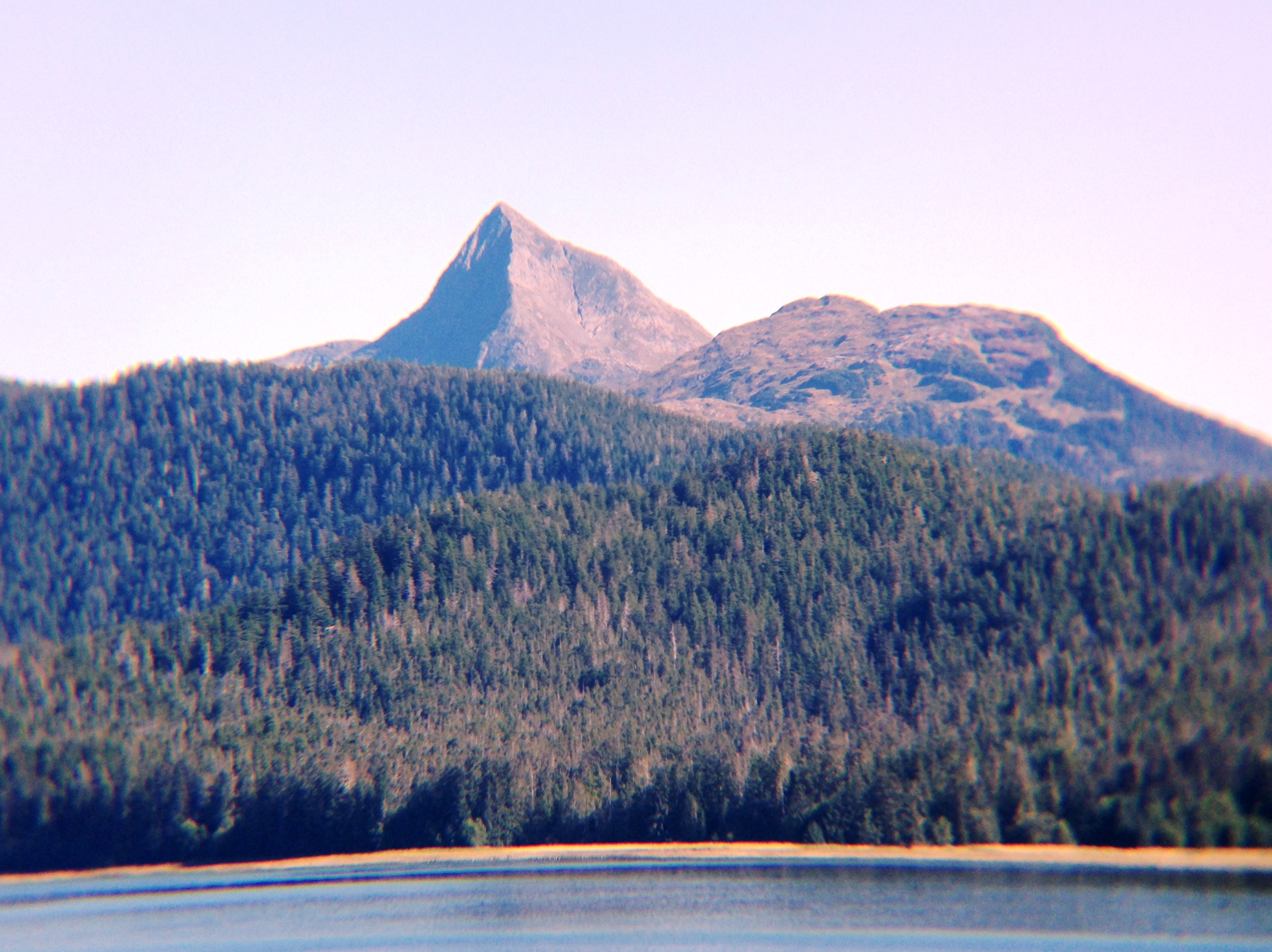
A mountain peak rises above the Tongass National Forest northeast of Sitka Aug. 3, 2016. (Photo by Ed Schoenfeld/CoastAlaska News)
A bill before Congress would speed a timberland trade between the federal government and the Alaska Mental Health Trust. It’s part of a larger legislative effort to increase logging in the Tongass National Forest.
Grants go toward counseling, housing, employment and other assistance to those with mental illnesses, developmental disabilities, chronic substance abuse and dementia.
It owns a million acres, about a quarter of it in Southeast.
Wyn Menefee of the trust lands office said it wants to exchange a little more than 18,000 of those acres that face opposition to development.
“Certain lands that we own next to the communities would be given to the Forest Service. In exchange, the trust [would be] receiving some lands that are more removed from the communities, that would allow development,” he said.
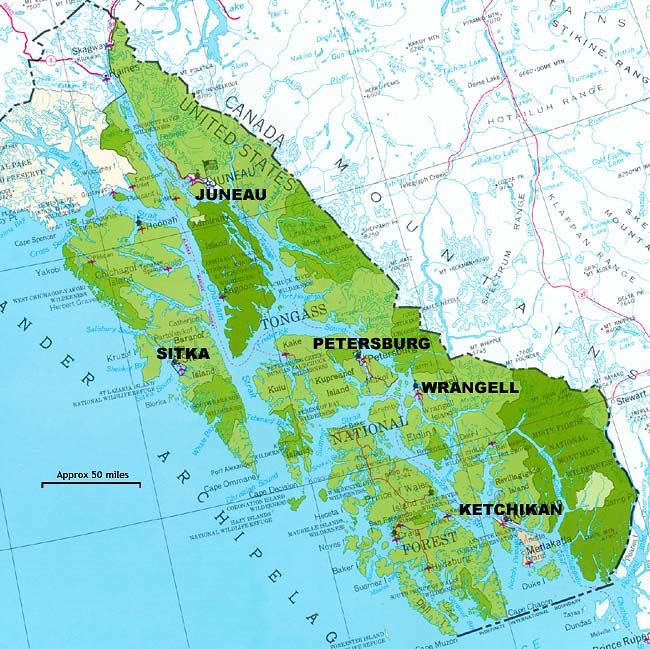
The land is in or near Ketchikan, Juneau, Petersburg, Wrangell, Sitka and Meyers Chuck, on the mainland between Wrangell and Ketchikan.
“Some of the parcels that the trust has already received — above Mitkof Highway near Petersburg and Deer Mountain in Ketchikan — are very high-value public-use areas. And there’s been a lot of concern about their development,” he said.
In return, the trust would get about 21,000 acres of timberlands of equal value elsewhere in the Tongass.
Menefee of the trust lands office said the acreage would be near a different part of Ketchikan, and on Prince of Wales Island.
The Tongass National Forest includes most of Southeast Alaska. (Image courtesy U.S. Forest Service.)
“By making land that we can actually use for timber harvest or for some other purpose available to us where we don’t have conflicts with cutting behind a community or something like that, that does make the asset available or the land available and the resources available for us to use for financial benefit,” he said.
SEACC’s Lindekugel said some listed parcels on or near Prince of Wales should not be part of the trade.
He calls one a wild and scenic river corridor near the El Capitan Lodge, off the northwest part of the island. Another is a cave-rich parcel near the small town of Naukati that includes a cavern that may have cultural value.
But he said he’s optimistic those will be replaced.
“So far the trust has been willing to work with folks to avoid those areas of high conflict and we’re hoping that we’re able to continue and resolve those issues,” he said.
The mental health trust and the Forest Service negotiated the land swap about a year ago. It’s already working its way through the bureaucracy.
The trust’s Menefee said the trade, and subsequent timber sales, would allow more than income for the trust. He said it will provide logs for the region’s mills, which owners say don’t have enough to continue operations much longer.
“In order to make this exchange happen in a reasonable time frame, it needs legislation. Because if you do it through the normal administrative process, it could be seven years or something like that before we get an exchange completed,” he said.
U.S. Sen. Lisa Murkowski filed the Alaska Mental Health Trust Land Exchange Act in late May.
“It was not a question of whether or not the exchange should move forward, but simply to the point of how are we going to assess the value,” she said.
The measure is one of a group of recent Murkowski bills meant to increase Tongass logging.
Another would create five new Alaska Native corporations, each with 23,000 acres of forest land to develop. Other provisions would allow two existing Native corporations to sell or swap property that’s been logged.
Sitka Conservation Society executive director Andrew Thoms said Murkowski’s bills will hurt the Tongass.
“If you look at all these pieces of legislation, there’s a huge potential for a lot of impacts to the remaining forests on Prince of Wales Island. And the potential for a lot of impacts to the high-value, salmon-producing watersheds around the Tongass that are in a state of protection that could be opened up by this legislation,” he said.
He’s particularly concerned about a provision allowing Sitka’s local Native corporation to sell 23,000 acres of land to the Forest Service. It’s in Admiralty Island’s Cube Cove.
“And now, in this situation, the government would buy back the lands that were logged? And Shee Atiká made a profit on them? It’s a strange situation,” he said.
Shee Atiká President, CEO and board chairman Ken Cameron said the Forest Service wants the acreage because it’s an inholding surrounded by a national monument.
“Congress has appropriated $4 million for the first phase of the acquisition, and the appropriation of the rest of the purchase price will be as government funds are available,” said a corporate press release. “The government’s reacquisition of Cube Cove is anticipated to proceed in installments as Congress appropriates funds for the purchase.”
The Forest Service isn’t commenting on the legislation, other than to say it will do Congress’s will.
“The bottom line is our actions will be guided by the legal mandates resulting from legislation,” said Tongass spokesperson Kent Cummins in an email.
SEACC has said proceeds from the sale would allow the corporation to purchase other federal land, possibly on Prince of Wales Island. But Cameron, who would not speak on tape, said its board has not decided what it would do with the proceeds.
The Sealaska regional Native corporation owns subsurface mineral rights at the Cube Cove property. Murkowski’s legislation would swap it for about 14,000 acres of forest on Prince of Wales Island.
“Sealaska identified potential lands to exchange at Lancaster Cove on Prince of Wales Island that are adjacent to other Native-owned lands. Some of these lands were originally considered in the Sealaska land entitlement bill,” said a prepared statement from the corporation.
“It said such a trade remains subject to negotiation with federal agencies.
A bill transferring about 70,000 acres of the Tongass National Forest to Sealaska passed Congress in 2014. It was described as completing the corporation’s land selections, but did not exclude further trades.
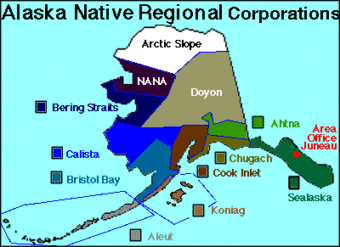
Alaska Native Regional Corporations Map. (Courtesy of the Department of Natural Resources)
Alaska’s delegation to Congress writes bills every year to transfer or sell federal land to local governments and Native corporations. In late May, Sen. Lisa Murkowski sponsored one public land bill for Native corporations that’s particularly far-reaching — apparently more expansive than the senator intended.
Congress, in 1971 promised Cook Inlet Region Inc. more than a million acres of land. CIRI Senior Vice President for Land Ethan Schutt says the corporation is still trying to get its final 43,000 acres but all of the good, income-producing land in the region is spoken for.
“So we’re kind of fighting and scratching and clawing to find something that is reasonable and has economic potential to fulfill the 45-year-old promise made to our shareholders,” he said.
Schutt says CIRI has its eye on some federal acreage outside the region, but it needs a new law to make the government hand it over.
To help CIRI, Sen. Lisa Murkowski filed the ANCSA Improvement Act in May. The bill does a lot of things, but one section would open up vast amounts of land all over the state for CIRI to choose from. CIRI would be allowed to select land from National Wildlife Refuges and the National Petroleum Reserve-Alaska. National Parks, monuments and the Arctic Refuge would be off-limits.
Asked if there are other limitations in her bill, Murkowski thought there were. She said her bill would not allow CIRI to select from areas designated as “wilderness,” the federal category that receives the highest level of protection.
Sen. Lisa Murkowski (Photo by Skip Gray/360 North)
After further questions to her staff, a Murkowski spokesman later said nothing in the bill now would prevent CIRI from selecting wilderness, but he said the senator intends to add such limits later.
The CIRI legislation is just one part of a 12-part bill that would open up federal land for Native corporations to select, and in some cases, requires the government to convey it. One paragraph likely to attract attention would require the Interior secretary to give a small piece of the Arctic Refuge, near Kaktovik, to the Native corporation for that village.
Andy Moderow, state director of the Alaska Wilderness League, says the bill is a concern for conservation groups.
“Because of how broad the legislation is, many places that have earned protections over the years would be up for grabs,” he said.
Schutt, the CIRI vice president, doesn’t want to say yet what land they hope to obtain, but he says they are aiming for selections near other Native corporation land.
“Are we trying to engender additional controversy? Absolutely not,” Schutt said. “And we’re trying to look at areas that are potentially within wildlife refuges or NPR-A but not brand new holdings that are deep within the heart of some conservation unit.”
This isn’t the first time CIRI has tried to expand its land pool beyond the low-value land it says it was left with, which corporate lore describes as “mountain tops and glaciers.” In 1976 it won the right to select half its acreage from elsewhere in the state. Schutt, though, says that legislation has conditions that make it impractical for getting the final 43,000 acres. The 1976 law, for instance, says the secretary of the Interior must agree to give up the land CIRI selects. Murkowski’s new bill says the secretary can’t stand in CIRI’s way.
Murkowski’s committee, Senate Energy and Natural Resources, hasn’t had a hearing on the bill yet. Environmental groups are on the lookout for pieces of it that might be added as riders to other bills.
Close
Update notification options
Subscribe to notifications
Subscribe
Get notifications about news related to the topics you care about. You can unsubscribe anytime.