Housing

Housing identified as top problem for Southeast Alaska businesses

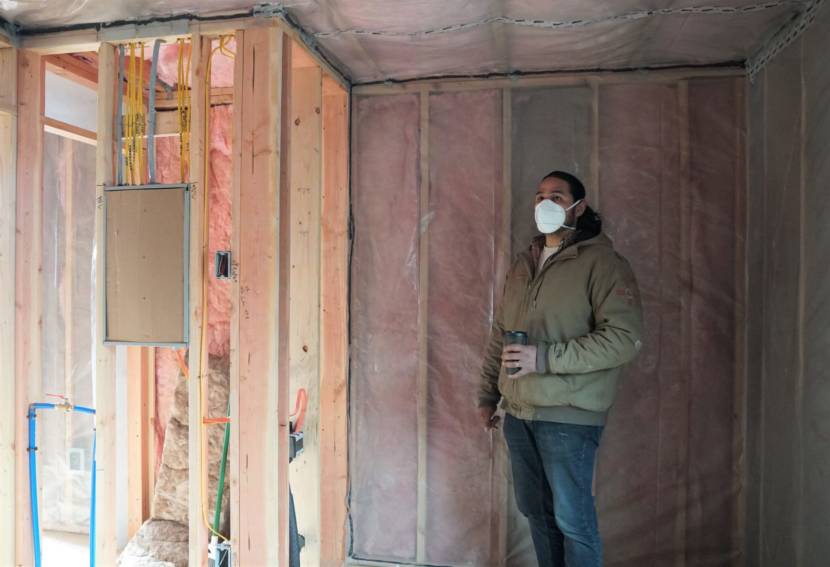
Co-owner of Sitka Construction Solutions, Derek James, points out the future bathroom in an unfinished “mini home.” (KCAW/Erin McKinstry)
Derek James, co-owner of Sitka Construction Solutions, points out the future bathroom in an unfinished “mini home.” (Photo by Erin McKinstry/KCAW)

Most businesses in Southeast Alaska say a lack of workforce housing is hurting their economic outlook. For some, it’s a major barrier to success. That’s according to a recent survey of 440 businesses in the region.

The annual survey looks at how businesses are faring in the region. And while they’re generally optimistic after two pandemic years, the region still faces economic headwinds. In this year’s survey, 72% of respondents indicated that housing is one of their top problems.

“We’ve just been struggling,” said Jaylene Owen, human resources and payroll director for the Hames Corporation in Sitka, where a region-high 88% of businesses say a lack of workforce housing is weighing on profits. The family-owned company has several stores from groceries to gas and employs 150 people. Many are renters, and that’s a big challenge.

“There’s just no place to rent,” Owen said. “My employees were leaving me and telling me things like, ‘I can’t afford to live here.’”

At the worst point last year, Hames had 40 open jobs it couldn’t fill. Owen says the corporation has tried to sweeten the deal for workers. They’ve given three raises in the last year and half, and they might offer a fourth. They’ve also beefed up the employee discount, taking a hit on their own profits. But they are still stretched thin.

“I have employees that are pulling 120 hours a payroll because they put in 40 hours of overtime on top of their 80 because there are no workers here,” Owen said.

“I don’t see a solution in the short term,” said Scott Wagner, manager of the Northern Southeast Regional Aquaculture Association. It’s a Sitka-based nonprofit that runs salmon hatcheries that supplement stocks in Southeast.

“We have two different housing issues I guess,” he said. “One is, we have this peak need in the summer, which is hard to find short-term housing in the summertime in Sitka. It’s really hard. But then the long term housing issue is employees, especially entry level employees, being able to find affordable housing for the year.”
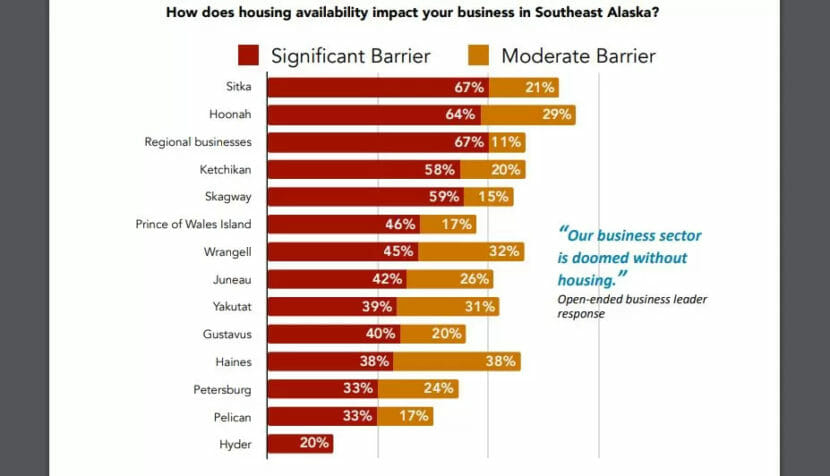
A bar graph showing responses to a question about whether housing poses a barrier to one's business. Results show large majorities saying it was either a significant or moderate barrier.
This graph is part of annual business climate study commissioned by the SoutheastConference.

NSRAA employs 30 to 55 people depending on the season, and they provide bunk housing for some of them. Wagner says he’s running into the same issue as a lot of regional employers.

“I’m trying to think how many times we’ve had a position come open and offer [it to] somebody, and then they tell us a week later, ‘You know what, I just looked into it, I can’t afford to move there,’” Wagner said.

Housing isn’t the only economic problem affecting the workforce. Affordable childcare is another one. The pandemic and inflation have also been a big hit to economic prospects.

But housing should be a solvable problem, says Robert Venables. He’s the executive director for the regional economic development organization Southeast Conference, which commissioned the survey.

“The housing shortage and challenges is so pervasive that it’s impacting almost every single economic sector,” Venables said. “It doesn’t matter if you’re in tourism or construction, or healthcare, or retail, everybody is struggling, not only for the workers but for a place to put them if you can find them.”

It’s a complicated issue. Most towns in Southeast are on rocky, mountainous islands with limited road systems. There are only so many places to build. The region also relies heavily on summer tourism, which means more housing is needed for seasonal workers — but short-term rentals also get taken up by tourists themselves.

Still, an answer to the housing problem is needed, says Venables.

“That is definitely a challenge that has to be addressed if we’re going to thrive as a region,” he said.

But so far, solutions are elusive.
Flat out of hell: One Sitkan has lived with batty housemates for nearly two years

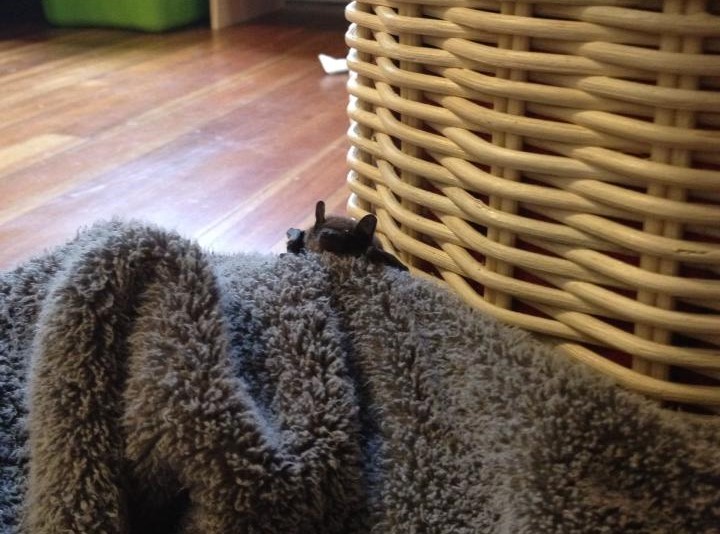
A crumpled towel on the floor with a bat peeking up over one of the folds
A bat hiding in the folds of this reporter’s bath towel in the summer of 2013. (Photo by Katherine Rose/KCAW)

Carrie Fenton first learned about bats back in Long Island, through local bat revitalization programs. Then she went to college in New Orleans, the definitive vampire capital of the United States. She lived in Montana for a year, where she became accustomed to all kinds of wildlife — rattlesnakes, mountain lions, bears.

She even found a colony of bats in her home there.

“I had a very relaxed attitude about them, coming to Sitka, because I had lived for a year with bats, and we could hear them kind of crawling around in the ceiling and crawling around in the walls,” Fenton said. “And we would see them all the time outside at night, you know, swooping around.”

But in Montana, the bats never came in the house.

One September morning in 2020, around five o’clock, Fenton discovered the first bat in her house in Sitka, when it landed on her face.

“I had brushed this furry thing off of my face. And I was like, ‘Oh, there’s a mouse in the house,” Fenton recalled. “And I rolled over and it was flying. I was like, ‘Oh, my gosh, no! It’s a bat!”

She called the nurse help line at SEARHC. They told her she needed to come to the hospital right away.

“And I got to the hospital and the nurses, they were like, ‘Are you sure it was a bat? I don’t think we have bats in Sitka,’” Fenton recalled. “We spent like 15 minutes kind of going back and forth. And they were like, ‘Oh, yes, we do actually have bats, we need to have you come in. So I had to go through the rabies shots, which was not fun.”

I must disclose, here, that I too have lived among the bats. A colony inhabited my home in Alabama a decade ago. I remember them lurking in the folds of my bath towels and swooping at me in the kitchen as I cooked spaghetti. I once picked one up, thinking it was a magnolia leaf I’d tracked indoors, and it screamed at me. I’ve dined out on that story for a long time.

I thought it was unusual to discover a bat colony in your chimney. But it turns out that it’s pretty common, including in Southeast Alaska, where there are several types of bats.

Karen Blejwas is a wildlife biologist with the Alaska Department of Fish and Game, working in their threatened, endangered and diversity program. For the last 10 years, her work has focused primarily on the bat populations in Southeast Alaska.

“We have six resident species. And then we have a seventh that we’ve recorded acoustically, but we’ve never captured or had any further documentation of,” said Blejwas. So yeah, quite a few.”

Each fall, bats swarm, mate and go into hibernation. On the East Coast, bats will gather in large groups to hibernate in caves. That’s typically when bats spread white nose syndrome, a fungus that has been devastating to bat populations around the world in the last 15 years or so. The fungus has made it as far north as Washington. But Southeast’s topography has worked against the disease, forcing unique hibernation patterns that reduce the spread.

“So here in Southeast, where we’ve found the bats hibernating around these steep, forested hillsides with a rocky surface underneath,” Blejwas said, “it’s essentially just a jumble of rocks, and the bats are crawling into those spaces between the rocks.”

Because the bats are hibernating in much smaller, dispersed groups, they’re less likely to spread the fungus during their hibernation period.

After mating, females actually store sperm over the winter. They emerge in the spring from their hibernation sites and form maternity colonies, settling in warm environments where their pups will develop more quickly and have the greatest chance to thrive.

That’s what Fenton was most likely experiencing in the spring of 2021, around half a year after she spotted the first bat.

“We started seeing them more on the porch, flying around at night,” Fenton recalled. “We started finding poop in the house on the porch all the time.”

Once there’s a maternity colony nesting in your house, the real journey begins. It is illegal to kill bats, and Blejwas said extermination is not an effective way to deal with them, anyway. The bats present in a home on any given night are just a fraction of the total number of bats using the space — the females even switch roosts periodically during the summer, so there’s constant turnover.

“So really, the only way, if you don’t want them in your house, is to physically exclude them, and that can be challenging depending on how the house was constructed because bats need only need three-eighths of an inch gap to crawl in,” Blejwas said.

What about other relocation strategies, like bat houses? Blejwas added that while they’re successful in other parts of the country, they historically haven’t worked in Southeast Alaska.

Last summer, Fenton tried to start the exclusion process with a pest removal company in Ketchikan, but at the time they weren’t traveling due to the pandemic. That left Fenton with one option — seal up the house herself after the bats left to hibernate and hope they wouldn’t come back the following spring.

But as this summer’s warmth returned, the bats moved back in. Now she’s couch surfing.

“It’s definitely frustrating,” Fenton said. “My landlord has been pretty supportive, though. And she’s waived my rent, which has been really helpful.”

Fenton said she would have moved out of the house a while ago, but she’s had trouble finding a new apartment, and now she has a seasonal job and is unsure of whether she’ll stay in Sitka long-term, which makes it difficult to commit to a new lease.

She said the pest control crew and the Alaska Department of Fish and Game have been very helpful. In June, the pest removers came to Sitka, and surveyed her house  with plans to seal up more potential entry points. She said she’s glad that protections exist to keep bats safe, but she wishes there were more resources to support renters and homeowners in her situation.

“Bats are really incredible creatures,” Fenton said. “But I’m looking forward to the day I don’t live with them and they’re not my roommates.”

4 bears killed at Anchorage campground abruptly opened to homeless

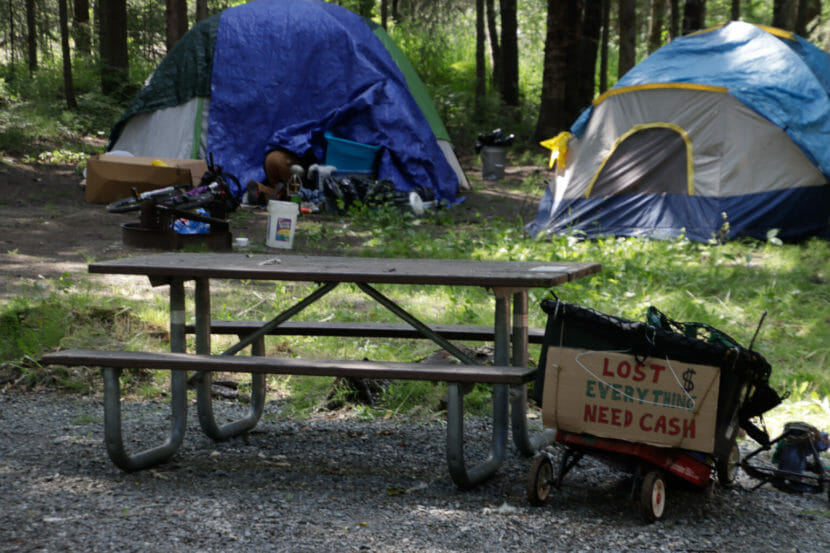
Tents at a campground and a sign that says "lost everything need cash"
Tents at Centennial Campground last week, soon after the area was repurposed into a place for people who are homeless to camp legally and for free. (Photo by Lex Treinen/Alaska Public Media)

Four bears have been killed at an Anchorage campground, recently opened to people who are homeless, after the bears entered tents to get food and other items.

Anchorage police reported the problem bears at Centennial Campground — a sow black bear with two cubs and a separate male black bear — and two state biologists killed them Tuesday, according to the Alaska Department of Fish and Game.

In late June, the administration of Anchorage Mayor Dave Bronson abruptly canceled pre-existing reservations at Centennial Campground and opened it to city residents who’d been living outside, including some who’d been staying at a camp the city cleared out. The city also bused dozens of people to the campground last week when it closed the shelter at Sullivan Arena.

Within days of the first people arriving, there were reports of bears getting into tents at the campground, which is northeast of Anchorage’s downtown core and sits adjacent to large areas of wooded military and state park land.

Centennial Campground has had human-bear conflicts in the past, said Cyndi Wardlow, a Fish and Game regional supervisor.

“So we always expect that there will be bears potentially going through there,” she said.

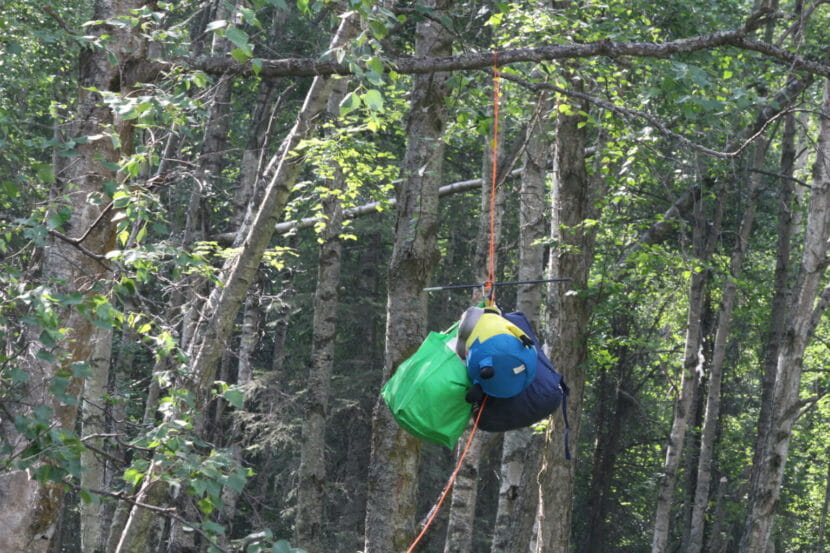
Bags of food hung from a tree branch
As a precaution for bears in the area, some campers at Centennial Park campground suspended some of their belongings in trees. (Photo by Wesley Early/Alaska Public Media)

Fish and Game got little warning about the plan to allow homeless residents to camp at Centennial and found out at the same time as the general public, Wardlow said.

“It was a surprise for us at the agency,” she said. “We try to work closely with the municipality and with APD, especially if there’s a situation that could create a public safety concern, and we’re looking for ways to help them come up with solutions any way we can to keep people safe.”

The city has purchased and distributed bear-resistant food containers to the campers at Centennial, and staff are checking each campsite on an hourly basis to make sure food isn’t left out, said Mike Braniff, the city’s Parks and Trails General Safety Foreman, who’s been appointed to lead the city’s Department of Parks and Recreation.

Whether campers use the containers or keep food in their tents is a compliance issue, Braniff said.

“We’re not searching the tents,” he said. “We ask for their cooperation. We ask them to comply. Not everybody will, I suppose.”

Braniff estimated there were more than 200 people camping at Centennial recently.

In a statement, Bronson spokesman Corey Allen Young said the campground is an option for people to use as high fire danger persists in the city. In addition to bear-resistant storage containers and regular clean-ups, he said, the city is talking to campers about bear safety.

“The priority will always be to protect humans and mitigate risks to bears which includes the efforts I mentioned,” he said. “The Administration looks forward to collaboratively working with the Assembly to navigate this high fire danger period in the safest way possible for our residents and the houseless citizens in our community.”

He said that includes exploring alternate locations and potential code changes.

Juneau group says it has enough signatures to get real estate disclosure repeal on ballot

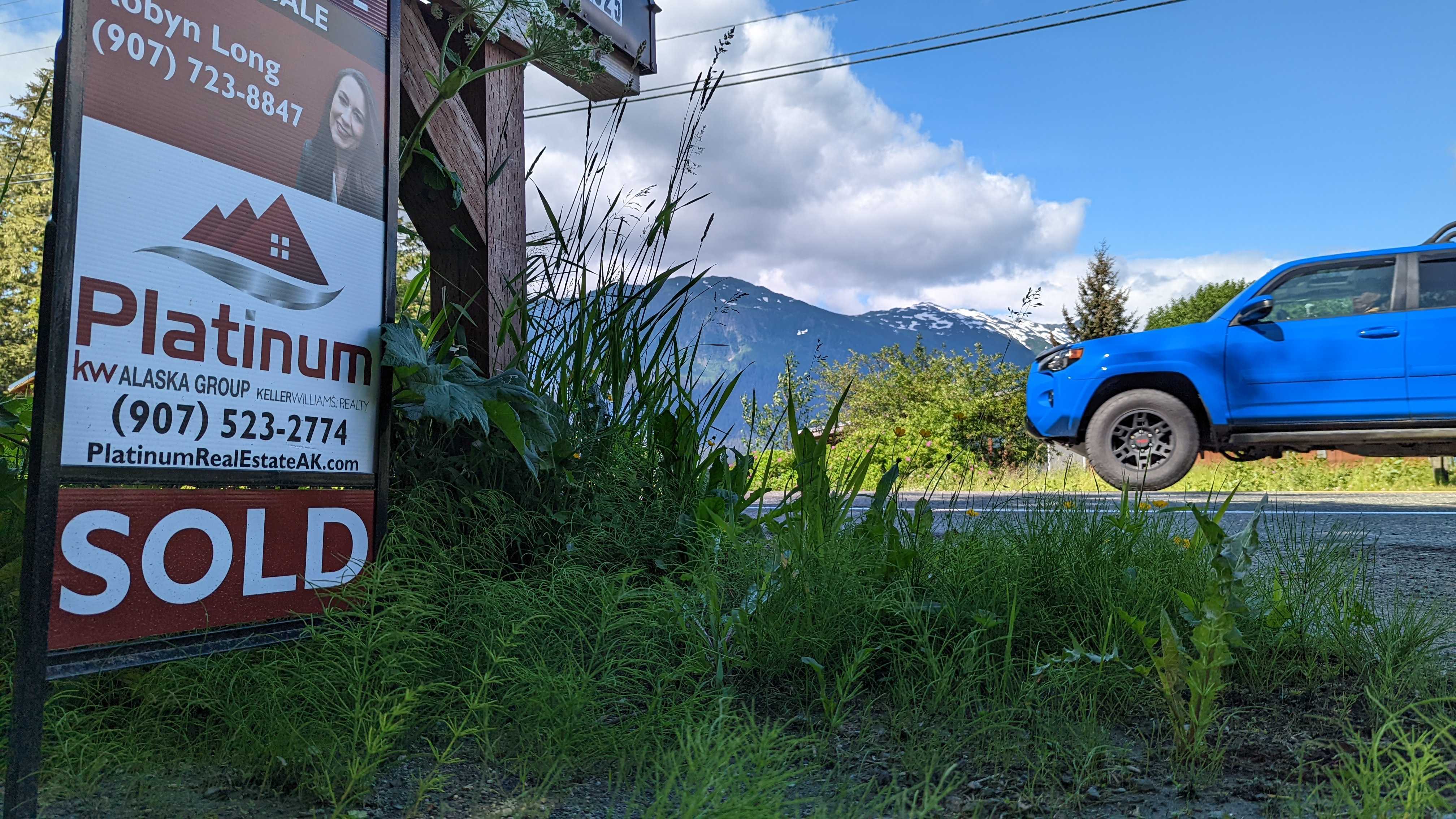
Sold sign at home along North Douglas Highway 2022 06 30
A sign marks a home that sold recently along North Douglas Highway in Juneau on June 30, 2022. City ordinances mandate the buyer disclose the sale price to city assessor’s office, though a group supported by the real estate industry wants to repeal those ordinances. (Photo by Jeremy Hsieh/KTOO)

The group that wants to do away with Juneau’s mandate to share real estate sale prices says it has turned in enough signatures to get the question in front of local voters in the fall.

The group needed 2,130 signatures from qualified voters. By the initial deadline, the group turned in 2,501, but city election officials disqualified several hundred because of incomplete forms or other reasons. The group came up 107 signatures short but were given 10 extra days to collect more.

Ann Sparks, a local real estate agent working on the repeal effort, said the group turned in more than 500 additional signatures on Monday.

“We feel really confident that we will definitely have enough signatures,” she said. “Now it’s just a wait and see what the city decides — if they’re going to let it go to ballot, or if they want to go ahead and repeal it.”

City election officials have until next Thursday to review the additional signatures and to certify or reject the petition.

If it’s certified, the Juneau Assembly then has 30 days to either preempt the ballot question and repeal the ordinances itself or forward the repeal question to the October local election ballot.

Group seeking to repeal Juneau real estate disclosure ordinances may be short of signatures

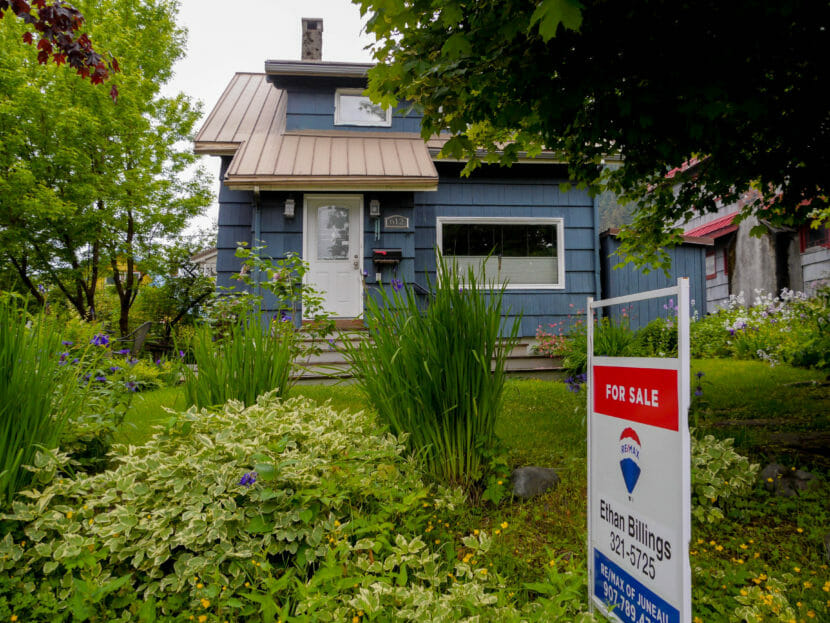
for sale sign Juneau 2022 06
A sign marks a home for sale in the Flats neighborhood of Juneau on June 14, 2022. Real estate buyers have been required to disclose the price to the city assessor’s office since October 2020. (Photo by Paige Sparks/KTOO)

Juneau officials say the group seeking to repeal the mandatory disclosure of real estate sale prices doesn’t appear to have enough signatures for their question to reach the October ballot. But they’re not done validating them.

“As of right now, they have not given us a total number, as they’re still certifying half the books,” said Ann Sparks, a local real estate agent working on the repeal effort, on Wednesday afternoon. “So they’ve only made it halfway through. And so we don’t have an exact number to tell anyone.”

She said it sounded like the group was behind by “a small margin.”

The group initially submitted 2,501 signatures to the city. That was more than they needed. But the signature validation process is still ongoing, and so far, the city says they’re coming up short. The group will get 10 extra days to collect more signatures.

The signature validation process isn’t going according to schedule. The group submitted the signatures on June 4. The city clerk’s office intended to complete its review by Tuesday to meet a 10-day deadline in the city charter.

City Clerk Beth McEwen said Tuesday her office has been working extra hours to get through the process. McEwen said she didn’t have an estimate for when they would finish and would not be providing public status updates.

City Attorney Rob Palmer would not concede that the deadline had passed.

“So the timing is a little squirrelly,” he said. He declined to comment further on the issue.

The deadline language does appear to have some ambiguity when there are too few signatures.

The referendum group wants to repeal a pair of ordinances the Juneau Assembly adopted in 2020 and this past February that made it mandatory to share the sales price of real estate and other related information with the city assessor’s office.

Real estate professionals say mandatory disclosures are an invasion of privacy that will lead to higher tax bills and pave the way for city officials to enact a real estate transfer tax, which is common in states with mandatory disclosure laws.

The Assembly has not discussed creating such a tax in its public meetings.

City finance officials and government assessors say that mandatory disclosure leads to more accurate assessments and a more fair distribution of the property tax burden.

The Alaska Legislature’s nonpartisan research service examined the issue in 2014. In a report, the researcher said that without mandatory disclosures, the highest value properties tend to be under-assessed compared to more typical homes, which means the owners of large custom homes and commercial properties tend to benefit from nondisclosure.

To date, Juneau Assessor Mary Hammond said no one has been fined for failing to disclose. But the city assessor’s office intends to begin levying fines at the end of June.

The last petition process that led to a question reaching the local ballot was in 2011. Voters were asked to create a tax of 15 cents per plastic shopping bag used at major retailers. Voters rejected it by more than 2-1.

The city’s election rules give the group an extra 10 days to collect more signatures to meet the threshold of 2,130. Sparks and the city attorney said they expect that clock will start running on Friday, when additional signature gathering books are ready. Sparks said her group’s goal is to collect 500 more.

Rapid rent hikes in Anchorage mirror national trends, experts say

A view of downtown Anchorage
Downtown Anchorage, as seen from the Tony Knowles Coastal Trail in April, 2020. (Abbey Collins/Alaska Public Media)

For renters like Ann Dougherty, finding an affordable place to live has been difficult.

“One bed, one bath, $1525. Let’s see if it’s got the square footage,” Dougherty said as she scrolled through Craigslist, looking for an apartment in Anchorage. “It does not have the square footage, but a lot of times, I feel like, a lot of times they’re like 600 square feet.”

She’s a massage therapist who currently lives in Eagle River, but she wants to move closer to her work in Anchorage to cut down on car time and counter rising gas prices. Right now, including utilities, Dougherty and her roommate pay about $1,200 to rent an entire house in Eagle River.

“But that’s like a 2,000 square-ft home, versus a little box,” Dougherty said.

She says she’s looking for a modern 1-bedroom apartment that won’t cost her more than $1400. But she’s having a tough time finding anything in that price range.

Kassandra Taggart says Dougherty is not alone. Taggart tracks rental trends in the area. She’s a real estate broker with Real Property Management Last Frontier. She says rental prices declined in 2019 and stayed flat in 2020.

“Then in ‘21 and ‘22, it started going up,” Taggart said. “And in the last six months, it has been going up between 20, 30, 40 percent depending on what kind of rental it is.”

Taggart says that tracks pretty closely to the national trend in rising rents. She attributes the Anchorage price hike to a shortage of available rentals, and lists several reasons.

The first is that the COVID-19 pandemic caused a lot of people to stay in their homes instead of moving to a new place.

“So they held up real estate that normally they would be moving,” Taggart said. “Whether they’d be adding more units, downsizing, moving out of the state, making transitions — which gives opportunities to other people to move into Anchorage or shop to upgrade or downgrade.”

Taggart says that impacted more than a third of available rentals. She says another thing driving the rental shortage is a higher number of people looking to buy property rather than rent, which in turn takes more rentals off the market.

“In addition to everybody wanting to own property for the first time, like the millennials are now buying properties to own for the first time, now what we’re having is the boomer generation.” Taggart said. “For example, they’re buying two, three houses, holding it because they’re going to be hopping around for their retirement.”

During the pandemic, construction of new housing slowed significantly, adding another layer to the problem. Taggart says vacancy rates in Anchorage are now close to zero and any solutions will take a while.

“Find a way to build more housing, or find a way to squeeze and condense more housing in spaces,” Taggart said. “Because that would be a big hit, but we’re talking three, four years before any of that can happen.”

Other than that, Taggart says “the only way it’ll miraculously fix overnight is if half of Anchorage decides to move.”

Anchorage Real Estate Director Adam Trombley says the city is doing two main things to boost available housing: working to reduce building fees, and allowing more tax breaks for things like accessory dwelling units, or ADUs — commonly called mother-in-law apartments.

He says that earlier this year, the assembly and mayor approved changes to city code that will help.

“What can we do to make it easier for the developers, for the builders, for the average person who just wants to go out and maybe remodel a bathroom or build an accessory dwelling unit?” Trombley said.

The Assembly has several ordinances in front of them, including one that would reduce development and permitting fees and another that would give a ten-year property tax break for building an accessory dwelling unit. Assembly members have said they’re hoping to modify the ADU ordinance to ensure the units would be built for long-term housing, as opposed to short-term rentals like Airbnbs.

Trombley says another goal is taking public lands and putting them into private hands. He hopes that can foster new private housing developments in the future.

""
Anchorage massage therapist Ann Dougherty. (Photo by Wesley Early/Alaska Public Media)

In the meantime, Dougherty, the massage therapist, says that because she’s self-employed, she can afford to pay a little more in rent. She might have to temporarily raise the price she charges for massages though.

“So I can kind of adjust for that with my income because I have a bit more control over it,” Dougherty said. “But someone that’s making $15 an hour, they don’t have the ability to change that.”

It’s a little tougher to adjust for hourly workers like Ryn Vinkowski, who works at Best Buy. She and her partner moved into a studio apartment about a year ago advertised for $800 a month, hoping they’d be able to save up for a house.

“They were like, ‘Well, everything but your electricity and your internet is included.’ Only when they say included, it means you’re paying that on top of your rent to us,” Vinkowski said. “So rent became actually about $900. And then we’ve both been out due to COVID. And then it was just…well, it’s been a year, and we’ve saved nothing”

Vinkowski says her landlord initially said her rent was going to jump to roughly $1200, but she was able to get it down to about $870 — a 9% increase. Vinkowski says she recently got a raise of about a dollar an hour, and moved to full-time.

“But it also kind of sucks,” Vinkoswki said, “because… hey, I just got a raise. We can’t celebrate because that’s now officially going to rent.”

While she still won’t be able to save much, Vinkowski’s hopeful that her new raise will at least allow her to stay afloat as rents continue to rise.

Site notifications
Update notification options
Subscribe to notifications