Housing

‘We have nowhere to go’: Many face eviction during a crisis in affordable housing

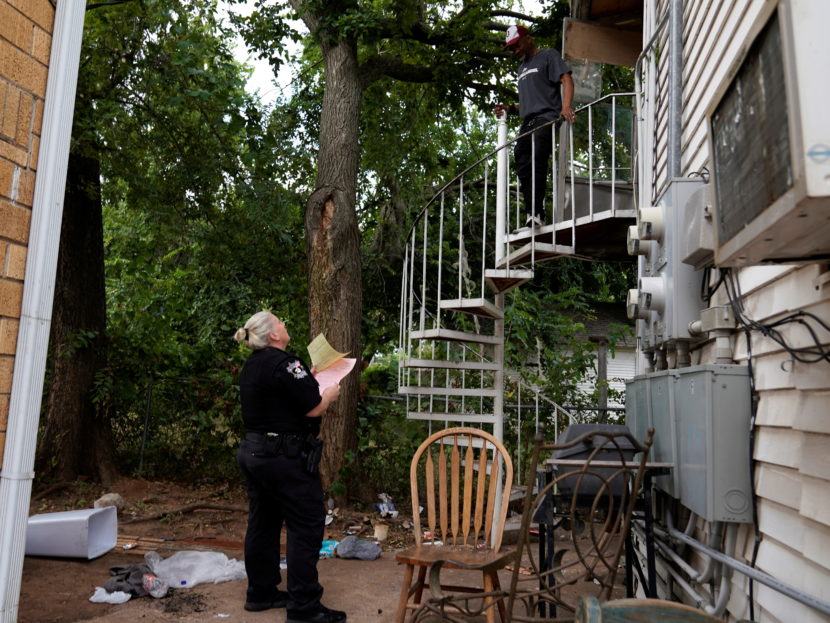
A police officer stands at the base of a spiral staircase talking to someone standing above.
An Oklahoma County deputy serves a renter with a court summons notifying him of an eviction order in Oklahoma City, Okla., on Sept. 15, 2021. (Photo by Nick Oxford/Reuters)

Even before she lost her job this past spring, things were tight for Nikki Cox. She worked as a service representative at an insurance company in North Carolina and had been making $20 an hour. Half of her income went to rent.

“If I did have something left over, it might be about a hundred [dollars], maybe,” she says. But even that “would buy my groceries and my necessities.”

It left Cox in trouble when her company’s business dropped and her hours were cut. She took a temp job elsewhere, but that paid $15 an hour, a substantial hit on her income. The hours also conflicted with her other job, which she left because she figured she would be laid off soon.

Then in May she got COVID and had to stay out of the office for three weeks, unpaid. At one point, Cox says she relied on customer points at convenience stores to get free dinners. Her nephew also helped.

""
Nikki Cox faced possible eviction this summer after her work hours were cut, and then she lost three weeks of pay after getting COVID-19. (Photo via Nikki Cox)

“If he knew that I didn’t have anything, he would send me like $10, $15,” she says.

But that didn’t go very far with the price of food up 8% or more because of inflation.

Cox is among a majority of Black and also Latino households that say they don’t have enough savings to cover one month of expenses. That’s according to a survey by NPR, the Robert Wood Johnson Foundation, and the Harvard T.H. Chan School of Public Health.

The poll finds a majority of Americans across racial and ethnic groups say affordable housing is a serious problem where they live, and eviction rates are basically back to pre-pandemic levels, with 3% of Black renters and 2% of Latino, Asian and white renters saying they’ve been evicted in the past year. Many more say they’ve faced the threat of eviction, with the share among Black renters (13%) nearly double that of white renters.

Cox says her landlord was understanding but eventually set a deadline.

“She said if you can’t get me at least $1,600, I’m going to have to go ahead and start the eviction process.”

Since then, Cox has had good news. She found a local nonprofit to help with rent and a new job at her old pay. She’s grateful she can stay put and not face a market where monthly rents have risen by double-digit percentages during the past year.

Despite pandemic aid, the racial disparity in evictions has persisted

The racial disparity in housing struggles is chronic and longstanding, since Black households have lower income and less wealth than white ones. On one hand, Peter Hepburn of Princeton University’s Eviction Lab says, it’s good that it’s not gotten worse during the pandemic. But he says it’s also disappointing it didn’t shrink, given the sweeping array of emergency aid and eviction protections.

“A lot has changed in the last two plus years,” he says. “And there was, I think, the real possibility that some of those dynamics would have shifted.”

Hepburn says one reason they have not is that — as his research has found — state pandemic policies to prevent evictions were wildly uneven and did not create a blanket moratorium.

“Where you lived had a really profound impact on how well you were protected from eviction,” he says. “That was true well before the pandemic. And that divide seems to be getting wider.”

Some of the tenants’ protections were unimaginable before the pandemic, and Hepburn thinks their success will boost a push for more lasting policies. More cities and states have embraced the right to counsel for tenants facing evictions, for example. But he says it has happened largely in places that were already fairly favorable toward tenants, while some states with more landlord friendly laws have resisted.

It’s harder than ever to find affordable housing

The United States has a massive shortage of affordable housing: 14% of all households — and nearly a quarter of renters — are considered severely burdened, meaning they pay more than 50% of their income toward housing. The country also chronically underfunds housing subsidies. Only 1 in 4 who qualify for a Section 8 voucher actually get one.

Cox, the tenant in North Carolina who lost her job, says she applied to the program several years ago but never heard back. Now, for those fortunate enough to have such vouchers, skyrocketing rent and home prices are making it even harder to use them.

""
Davita Gatewood has a federal housing voucher, but she and her children faced eviction after her landlord decided to renovate and sell the property. (Photo via Davita Gatewood)

In Lexington, Ky., Davita Gatewood is a single mother of six and the caretaker of one of them, who’s disabled. She was doing fine paying her share of the rent, with Section 8 picking up the rest. Then her landlord said he would not renew the lease.

“He wants to renovate and sell the property, which is happening to a lot of people right now, just landlords wanting to go on and take advantage of the housing market. But the problem is, you know, we have nowhere to go.”

After the lease wasn’t renewed, her Section 8 payments stopped, leading the landlord to file for eviction. Gatewood has been fighting that while looking for another place for seven months.

It’s a terrible time to move. Rental prices have skyrocketed by double-digit percentages in the past couple of years, and the places Gatewood sees are hundreds of dollars more a month than what she’s currently paying. Vacancies are also at a historic low, and Gatewood often finds five or six other people looking at the same place.

“By the time the person is done showing it, somebody is already about to sign a lease,” she says. “Most properties don’t last but a day or two.”

Other times she’s gotten excited about a listing “and then at the bottom it says in bold, ‘No Section 8.’ That’s extremely discouraging,” she says.

President Biden had proposed major funding for affordable housing in his “Build Back Better” plan, but that’s gone nowhere. More recently, the administration took steps to encourage communities to build more — and more densely — to help bring down rents.

That’s not enough, says Tara Raghuveer, a tenant rights advocate with People’s Action.

“At best, a supply side intervention is going to build housing that shows up in our communities in a couple of years,” she says. “That doesn’t do anything for the millions of tenants who can’t afford rent next month.”

Wherever there’s federal funding for housing, she wants the administration to make it harder to evict people without cause and harder to raise rents beyond inflation to prices more and more people simply can’t pay.

Copyright 2022 NPR. To see more, visit https://www.npr.org.

Ketchikan Borough Assembly passes reforms aimed at boosting housing supply

A view of Ketchikan from the top of the Edmonds Street stairs.
A view of Ketchikan from the top of the Edmonds Street stairs. In support of the plan, developer Bruce Hattrick said Ketchikan’s steep, rocky terrain makes it difficult and expensive to develop new lots.(KRBD File Photo)

The Ketchikan Borough Assembly passed a four-pronged measure Monday aimed at alleviating the area’s housing crunch.

Starting in mid-August, Ketchikan’s borough will allow four-plexes to be built in medium- or high-density residential zones without a public Planning Commission hearing as long as there’s at least one parking space available for each unit. That includes most residential lots within Ketchikan city limits, with the exception of the Shoreline Drive neighborhood and some undeveloped lots near Ketchikan Lakes.

Applications for triplexes in low-density zones, largely outside city limits, will also bypass a public hearing as long as they adhere to the same parking requirement.

Residents will also be allowed to build so-called “detached accessory dwelling units,” which are small homes that share a lot with a larger home without a public hearing.

The measure also shrinks the necessary lot size for a custom residential zoning system known as a “planned unit development” from two acres to 10,000 square feet, or about a quarter of an acre. Borough officials say that could allow for the development of tiny home parks within the borough.

Developer Bruce Hattrick welcomed the plan during the Aug. 1 assembly meeting. He said Ketchikan’s steep, rocky terrain makes it difficult and expensive to develop new lots.

“I think it would help you a lot in the city of Ketchikan or even the whole borough, if you could be able to put more housing on the lot you already have. I mean, you’ve got to do something to alleviate the housing crisis,” he said.

Assembly member David Landis said he’d heard no pushback on the plan.

“This is what we asked for. And this is what we got and I haven’t heard anyone that doesn’t think this is a good idea,” he said.

The housing reforms passed unanimously.

Affordable housing concerns prompt Juneau Assembly to take stock of short-term rental market

Airbnb sign
(Public domain photo courtesy of Open Grid Scheduler)

If you browse websites like Airbnb and Vrbo for overnight rentals in Juneau, there are dozens and dozens of listings. Many have only a handful of reviews or none at all, suggesting they only recently went on the market as vacation rentals.

City officials are concerned these listings may be eating into Juneau’s already very limited housing stock.

On Monday, the Juneau Assembly approved spending $20,000 to hire a third-party firm to collect data about this market.

“We think of those third-party services principally as reconnaissance,” City Finance Director Jeff Rogers said during an Assembly Finance Committee meeting last month. “They’re snooping, crawling the web, looking at rentals, trying to see how often those rentals are rented, what the approximate rates are. There’s some work that most of those companies do on the backend to line up a rental listing with a parcel and potentially with an owner.”

In the latest business climate survey commissioned by the Southeast Conference, business leaders in the region identified a lack of affordable housing as the top barrier to economic growth. It directly contributes to labor shortages.

The Assembly has also been considering mandating that operators of short-term rentals register their properties with the city. Together, these may be early steps the Assembly is taking toward limiting Airbnbs and similar rentals.

Assembly member Wade Bryson thinks the flurry of new short-term rental listings may be a temporary blip, caused by this weekend’s Ironman Alaska event.

“I think waiting till after Ironman will give us a better understanding of what the community is really going to be like,” he said. “Do people like this? Is it going to be a true problem that just continues to grow? Or do people really be like, ‘Oh my God, that wasn’t as great as I thought. It’s not awesome to bring a stranger into your personal home and let them use your stuff for a week.’”

Bryson urged patience.

Outdoor deaths in Anchorage spiked in June

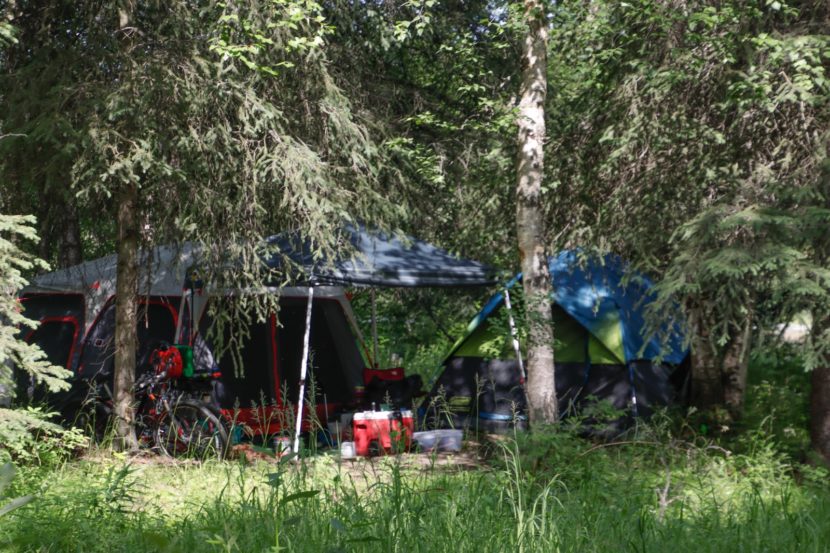
A tent half-hidden in woods
A homeless camp in Mountain View (Photo by Lex Treinen/Alaska Public Media)

Six people died outside in Anchorage in June, their bodies found in city parks or just off city streets.

The recent deaths include a woman who was found outside of the abandoned Sam’s Club building in South Anchorage, 30-year-old Allan Dahl, whose body was found at Russian Jack park, and 47-year-old John Prunes, who was found in the woods by a church on the east side of town.

“He was an angel,” said Rita Prunes, his sister-in-law. “He would do anything in the world for you. He’d give you the shirt off his back.”

Prunes said she doesn’t know how her brother-in-law died. But he’d been homeless in Anchorage for years, bouncing between shelters and outdoor camps.

His death on June 26 is part of what homeless advocates and service providers fear is a trend. This June, the city saw its highest monthly outdoor death count in at least the past two years, according to data from the Anchorage Police Department.

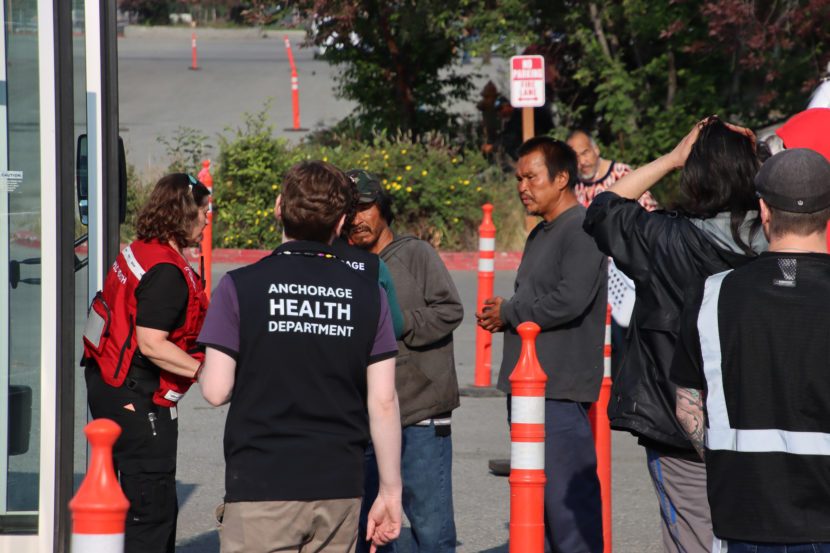
It’s not clear exactly what caused the higher number of outdoor deaths because the police data doesn’t list causes. But some advocates and homeless service providers say they’re worried the increase was caused by a rise in the number of homeless people who started camping outdoors in June as the city wound down its largest shelter at the Sullivan Arena.

“Some of it’s just math,” said Jessica Parks, who oversees housing at RurAL CAP, a nonprofit that helps find housing for homeless people. “If there are more people who are unsheltered, there are going to be more unsheltered deaths.”

Six outdoor deaths in one month is about four times higher than the average monthly number of people found dead outside in the city over the past two years. Outdoor deaths dropped to three in July, but it’s still about twice the average monthly total.

Homeless service providers and advocates say maxed-out shelter capacity and high numbers of campers is likely to continue. A new planned shelter won’t be ready until winter, according to the most recent reports by Mayor Dave Bronson’s administration.

At the same time, federal rental relief programs are ending, pushing more people into homelessness.

Rev. Michael Burke of St. Mary’s Episcopal Church in East Anchorage said he’s especially worried about what’s to come as temperatures drop. He said in his two decades working with unsheltered homeless people, most outdoor deaths in Anchorage typically occur in shoulder seasons.

“We’re 60 days out from an incredible humanitarian crisis in our city,” said Burke.

Tyler Sachtleben, a city health department spokesperson, said in an email that the department didn’t want to speculate about what caused the deaths in June. He did not respond to questions about whether the department was tracking the increase in outdoor deaths and would make any changes to address it. He also disputed claims by the Anchorage Coalition to End Homelessness that outdoor camping increased this summer, saying it’s hard to measure.

The Anchorage coalition declined an interview request for this story but sent a statement emphasizing the need to find housing solutions in time for winter.

The city opened Centennial Campground in mid-June to homeless campers. It brought in dozens of people by bus who had stayed at the Sullivan Arena shelter and who had nowhere else to go to Centennial. At one point in July, the city said more than 200 people were staying at the campground.

""
Sullivan guests wait on a bus to take them to Centennial Campground on June 30 (Photo by Lex Treinen/Alaska Public Media)

Advocates point to a host of risks to camping outdoors, even at sanctioned sites like Centennial. Campers might not have reliable phones to call 911 for medical emergencies like heart attacks, strokes or epileptic seizures. It’s harder for them to access warm meals, especially during a citywide burn ban throughout most of June. There’s added stress from hot or rainy weather. And campers often don’t have as easy of access to Narcan, a medicine that can reduce opioid overdoses.

One person reportedly overdosed at Centennial in July.

“It’s a very different situation when you have people in an emergency shelter where you can kind of lay eyes on everybody, and have staff doing patrols and doing bed checks,” said Lisa Sauder, director of Bean’s Cafe, the city’s main soup kitchen.

Sauder said when Bean’s Cafe operated the shelter at the Sullivan Arena, staff carried Narcan and administered it “numerous times a week” to clients. About 250 people died of opioid overdoses in Alaska in 2021, more than 70% increase from the year before, according to the state health department, which attributes the increase to the ongoing fentanyl crisis.

The state medical examiner said two of the six people who died in June died of drug overdoses from multiple drugs. One of the three people who died in July had “pneumonia due to the toxic effects of methamphetamine.”

It’s not clear how many of the people were homeless at the time of their deaths because police data doesn’t specify housing status.

Advocates say it’s hard to know the true death toll of unsheltered homelessness because many die after being taken to the hospital. They say not having housing can lead to self-destructive behaviors like suicide or drug and alcohol use.

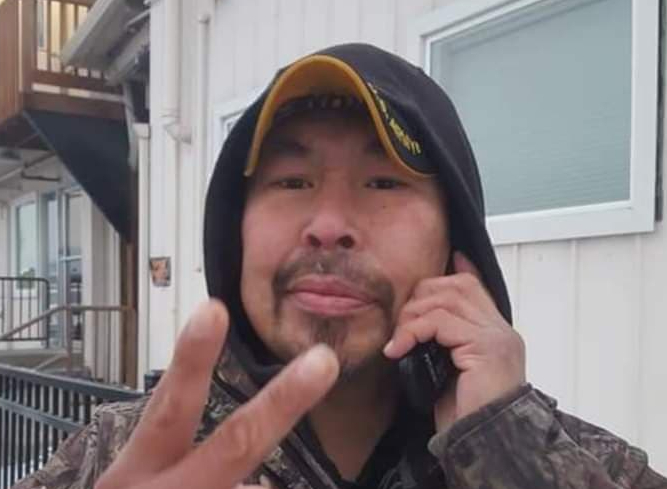
A man in a baseball cap talking on a phone
John Prunes was originally from Mountain Village and bounced around homeless camps and shelters throughout the past few years, family said. (Photo courtesy Jamie Chiklak)

Family of John Prunes said they still don’t know the cause of his death. Prunes worked as a commercial fisherman during the summers in Bristol Bay and stayed at homeless shelters and outdoor camps in Anchorage when his money ran out, family members said.

“He would go to Brother Francis, he would go to the Sullivan and he would camp out,” said Rita Prunes, his sister-in-law.

Prunes said she worries about the city’s resources for homeless people.

“I think the city should be able to open more places. There’s places out there that standing empty, they can open it up for them people for the homeless people,” she said.

Service providers agree. They say building more housing or shelter capacity is likely the only way to reduce the rate of outdoor deaths.

“Ultimately, we need to have shelter available for everyone seeking it,” said Sauder of Bean’s Cafe.

Anchorage police officer and suspect shot at Centennial Campground

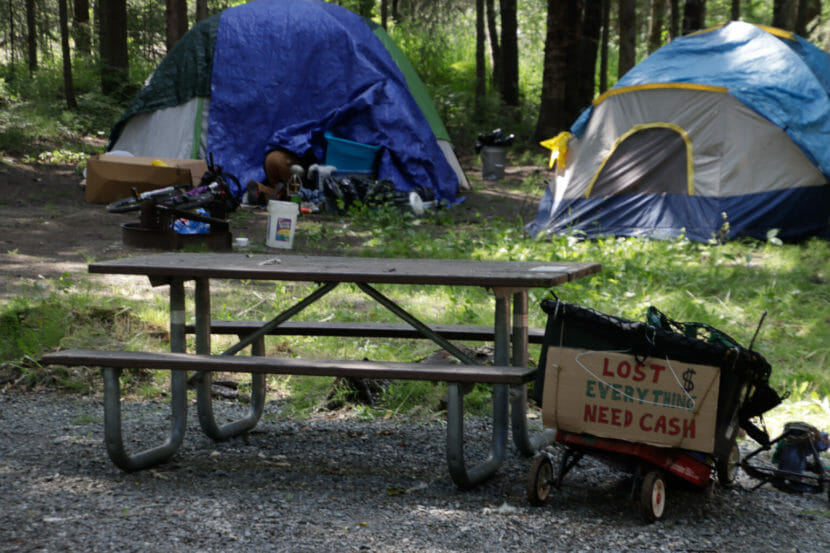
Tents at a campground and a sign that says "lost everything need cash"
Tents at Centennial Campground last week, soon after the area was repurposed into a place for people who are homeless to camp legally and for free. (Photo by Lex Treinen/Alaska Public Media)

Anchorage police say two officers exchanged gunfire late Wednesday night with a man at an East Anchorage campground where hundreds of homeless people are camping, sending the man and one officer to a hospital.

Both are expected to survive, police said in a written statement.

The two officers were conducting what police described as a “security check” Wednesday night at Centennial Campground prior to the shooting, police said. More than 200 houseless people have been staying there since the city closed a mass shelter, cleared homeless camps and directed campers to Centennial.

It was about 8 p.m. when the officers encountered a man they suspected of having eluded police earlier, police said. The police statement says the man produced a handgun and “gunfire was exchanged” between the officers and the man.

The officers shot the man multiple times, and one of the officers was shot. Both the officer and the suspect were taken to a hospital and are expected to survive.

Police Chief Michael Kerle said police investigating the shooting do not yet have information about who shot first and are still conducting a preliminary investigation.

The police statement says charges are expected to be filed against the man, who has not been publicly identified.

Per department policy, Kerle said the names of the officers involved in the shooting will be withheld for 72 hours, and they will be on administrative leave for four days.

The state Office of Special Prosecutions will review the officers’ use of force to determine whether it was justified.

Mayor Dave Bronson’s administration opened Centennial Campground for homeless campers and bused some there around the same time it shut down the city’s Sullivan Arena, which had served as an emergency mass shelter since the beginning of the COVID-19 pandemic in 2020. Since then, the administration has drawn criticism from advocates for what they say is a lack of oversight and supplies, and unsafe conditions.

Last weekend, a fight at the campground drew a large police response and resulted in multiple officers being assaulted, the Anchorage Daily News reported. The campground has also been the site of dozens of police calls since the city started waiving fees and directed people experiencing homelessness there a few weeks ago. State biologists and wildlife troopers have also killed five bears that have come into the campground looking for food, in campers’ tents in some cases.

As Anchorage campground continues as homeless camp, advocates worry about resources and safety

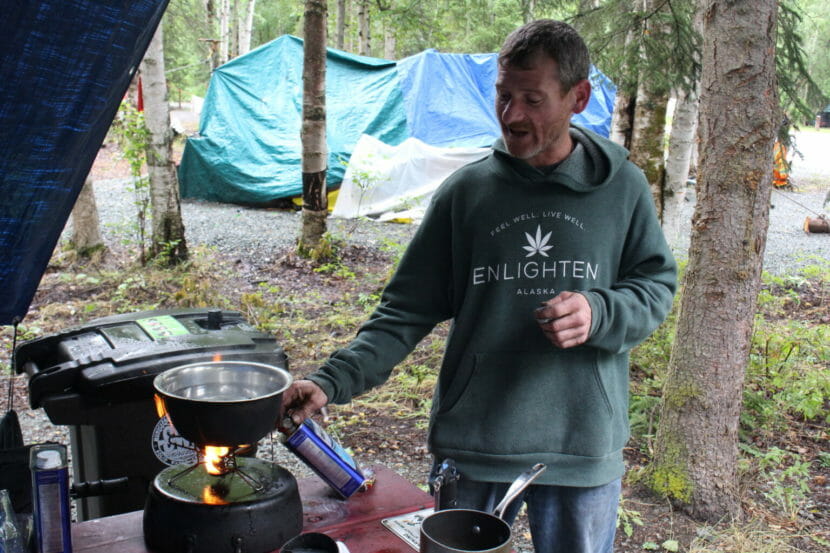
A man cooking in a campground
ames Keele starts a fire using a makeshift burner at Centennial Campground. (Photo by Wesley Early/Alaska Public Media)

Roughly 200 houseless people are staying at Anchorage’s Centennial Park, and advocates are worried about whether they’re receiving the resources and care they need.

At the end of June, the city closed the mass shelter at the Sullivan Arena and began moving the people who were staying there to various locations, including the campground. But the mayor’s office insists that the campground is not a part of the city’s response to homelessness.

Roger Branson chairs the Anchorage Houseless Resources Advocacy Council. The group has been staffing a tent at the campground with food, water and other resources. Last week, Branson said campers found conditions to be “deplorable.” He said conditions have improved since then.

“A very positive conversation that I had with the mayor was the explanation that it’s not what I perceive or what he perceives,” Branson said. “It’s what the people in the camp perceive and how they’re viewing life.”

One immediate change Branson noted over the weekend was the lifting of the city’s burn ban. He said Parks and Recreation officials began distributing firewood to campers.

“So for the campers themselves, psychologically, that was a huge deal,” Branson said. “To be able to have fires to gather around socially and to dry out.”

Campers James Keele and Jimmy Hartley made use of the rescinding of the ban, working to boil some water for coffee using a makeshift burner and some kerosene.

“There she goes,” Keele exclaimed as water bubbled in what looked like a metal dog bowl.

As officials work to organize resources for homeless people, safety has been a concern for both volunteers and the campers using the area. Anchorage police were called to the campground Sunday night due to a fight between two men. A police spokeswoman said officers ended up using a stun gun multiple times on one of the men after he attacked police. The man was taken into custody.

Branson said he’s happy things didn’t escalate beyond that.

“I was really concerned because the campers themselves were looking to defend themselves with what they could,” Branson said. “The clubs and knives and stuff like that were getting brandished. We were able to nip that in the bud and it was a community effort, so I’m really pleased about that.”

Branson said a camp resident died Thursday night from an overdose. Anchorage police say the woman was found unresponsive and had been given Narcan.

Branson said several other people overdosed the same day, but they recovered after receiving Narcan. Corey Allen Young, a spokesman with the mayor’s office, said the city is working to address safety concerns with 24/7 security at the campground.

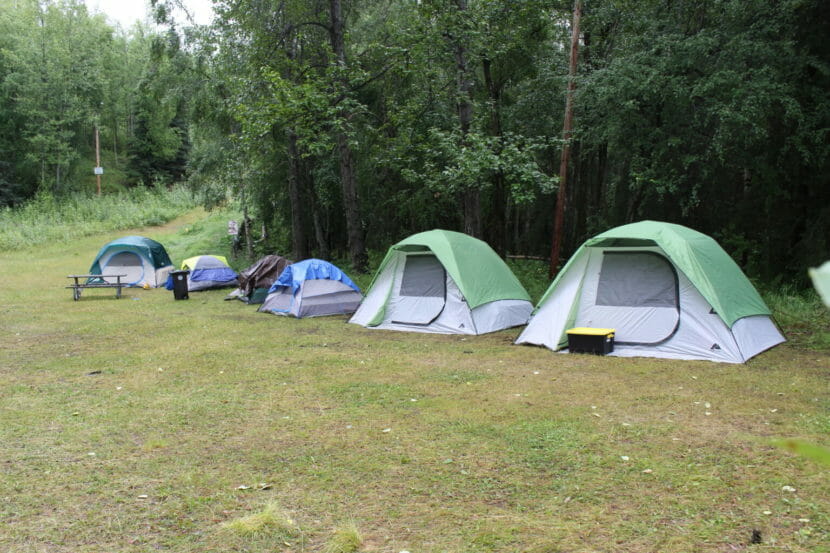
A row of tents neatly lined up in a clearing
Outside of Centennial Park’s designated campsites, many tents are scattered around the area. (Photo by Wesley Early/Alaska Public Media)

Ensuring that campers have enough basic supplies is another issue. Branson said his group has received a bunch of individual donations, from tents to bulk food.

“If the need arises for us to start cooking onsite, it appears we will have that capacity, which greatly alleviates the concerns of Bean’s possibly pulling out,” Branson said.

Bean’s Cafe was handing out food, but the future availability for basic services is up in the air because the mayor’s administration hasn’t said how long homeless people will stay at the campground. Bean’s Cafe Executive Director Lisa Sauder said funding to serve food has all come from donations.

“We can continue to seek support from the general community and from businesses, and that’s something we’re doing right now,” Sauder said. “But at some point, to sustain it, if it is going to be a longer term effort, we would certainly welcome some additional funding from another source.”

Mayor Dave Bronson announced Tuesday that the Salvation Army would be handling on-site client care at the campground. That includes connecting people with various resources, including food, case management, supplies and donations. That’s after the city’s Homeless Prevention Response System Advisory Council said it wouldn’t make those connections anymore, citing safety concerns and the fact that the campground isn’t part of the official city homelessness response.

Sauder said she’s excited to see the Salvation Army taking that role.

“Parks and Rec has done a great job. They’re on site, trying to keep the camp clean, keep things orderly,” Sauder said. “But that’s not their normal occupation, so to speak. So I think having another service provider that has the capacity to do that and willing to do the work is wonderful.”

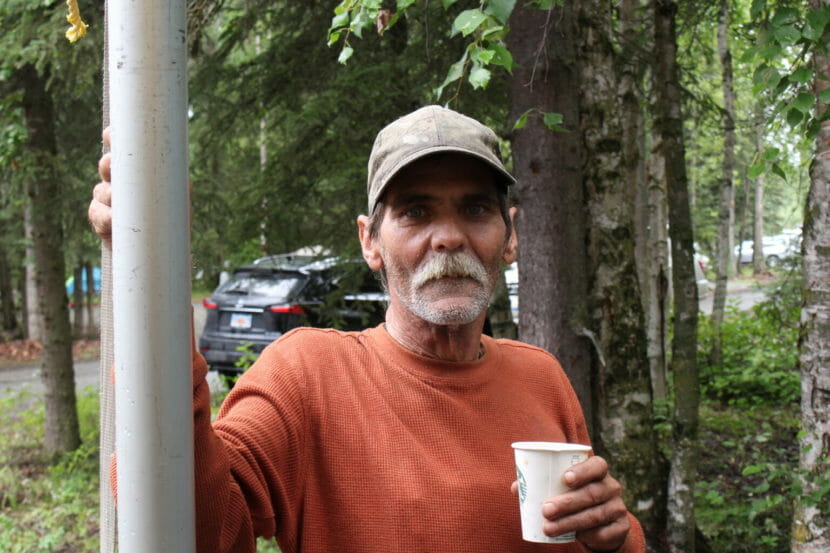
A man leans against a tree holding a cup of coffee
Rodney Reeves is one of more than 200 houseless people using the Centennial Campground. (Photo by Wesley Early/Alaska Public Media)

While safety continues to be an issue, overall, campers have mixed results when it comes to getting basic needs met. Keele, the camper from earlier, said assistance from the city has been hit-or-miss. On the one hand, he said Bronson personally helped him get supplies.

“The mayor was like, ‘do you need something?’ And I said I needed some rope,” Keele recalled. “He was like, hold on,’ and he went in there and looked for it. Couldn’t find it and went to the store and personally bought me some and had it brought back to me.”

On the other hand, he feels that sometimes security is very strict. Keele has been a regular at the camp for a month and said when he tried to enter the camp four minutes past the closing time Sunday night, he was refused.

Keele ended up spending the night in his car. He said he’s hoping to leave soon and has plans to meet with local housing agencies so he can get surgery for his back that he’s put off.

But other campers say they’re concerned for people who want to stay long term.

“What’s going to happen in November?” camper Rodney Reeves asked. “I mean there’s a lot of people that’re going to be stuck out here. Do they have arrangements? You know, last year, the Sullivan knew that they were going to be closing. But why weren’t arrangements made then?”

The city currently has a plan for a navigation center and shelter to open on Tudor Road. Young said it will be open in the fall, but couldn’t give a more specific timeline.

Site notifications
Update notification options
Subscribe to notifications