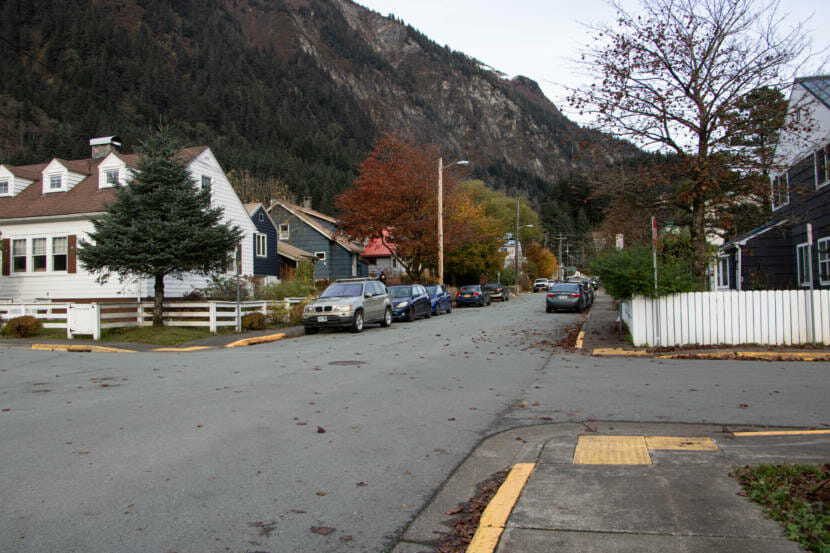
The Glory Hall appealed that denial successfully at the end of May. The Juneau Planning Commission sent the permit back to the city’s Community Development Department and gave it 30 days to reconsider its decision.
The city filed an objection to the Planning Commission’s decision on Wednesday. That means the case will go back to the Planning Commission for its reconsideration, according to city officials.
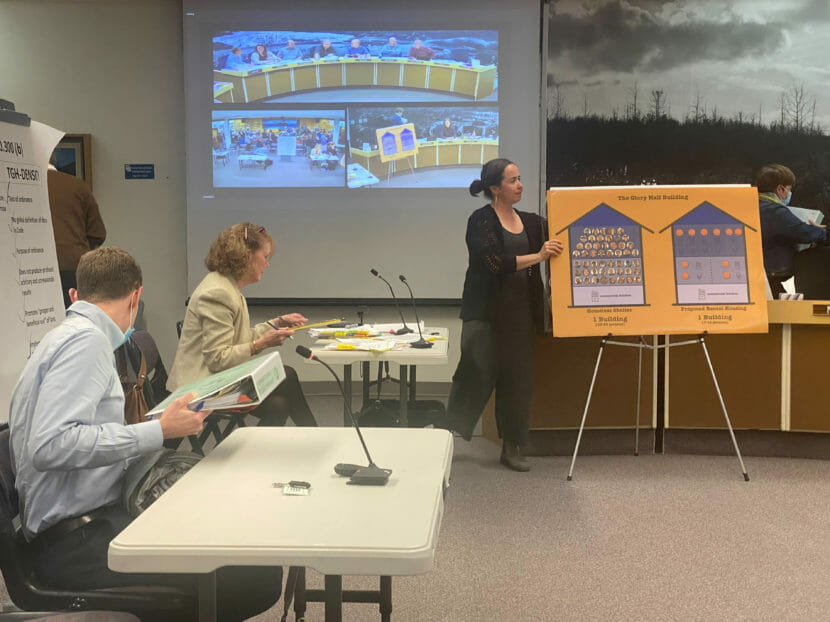
The Glory Hall demonstrated its understanding for density for Juneau’s planning commission at its appeal hearing. May 24, 2022. (Stremple/KTOO)
The Glory Hall’s affordable housing project in Juneau got a boost Tuesday night when it successfully appealed a city permit denial.
In a unanimous vote, the Juneau Planning Commission sent the permit back to the city’s Community Development Department and gave it 30 days to reconsider its decision.
“Their position is we could have 50 homeless people living on this parcel, but we can’t have 14 renters,” argued Mary Alice McKeen, the Glory Hall’s attorney.
The city’s development department interpreted density to mean number of units, while the Glory Hall argued that the number of occupants should be used when determining density.
Ken Alper sits on the Planning Commission. He said that since density is not specifically defined in the relevant piece of code, the commission would now define it as the total number of people. This has implications for future projects.
The Planning Commission also directed the development department to accept an engineering study provided by the Glory Hall that it had previously not used in its permit decision. That study found that the building is not in a severe hazard zone.
The development department and the Glory Hall have 20 days to contest the decision to the Assembly if they wish to do so.
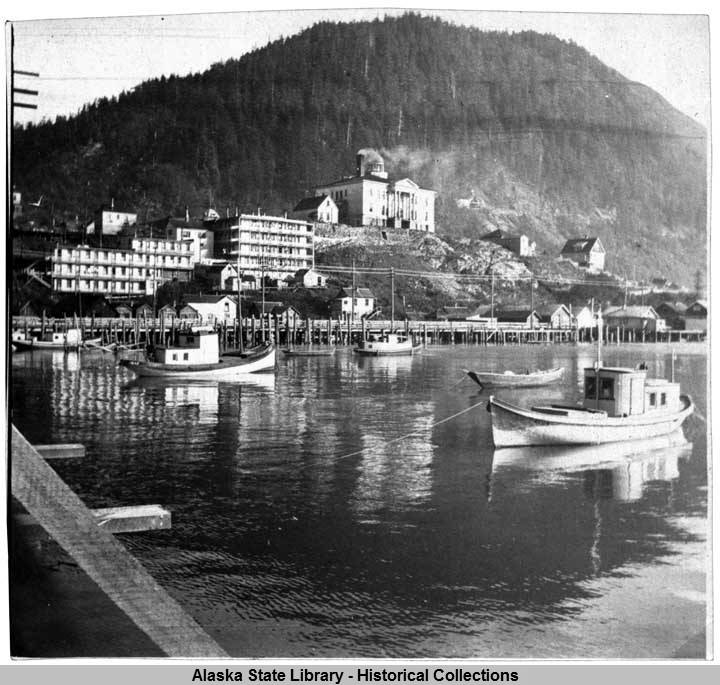
Telephone Hill in Juneau, circa 1920, as viewed from Gastineau Channel near Willoughby Avenue. Before a telephone company set up shop on the hill, it was known as Courthouse Hill. (Photo courtesy of Alaska State Library Place File, ASL-Juneau-Views-Areas-Willoughby-Ave-06)
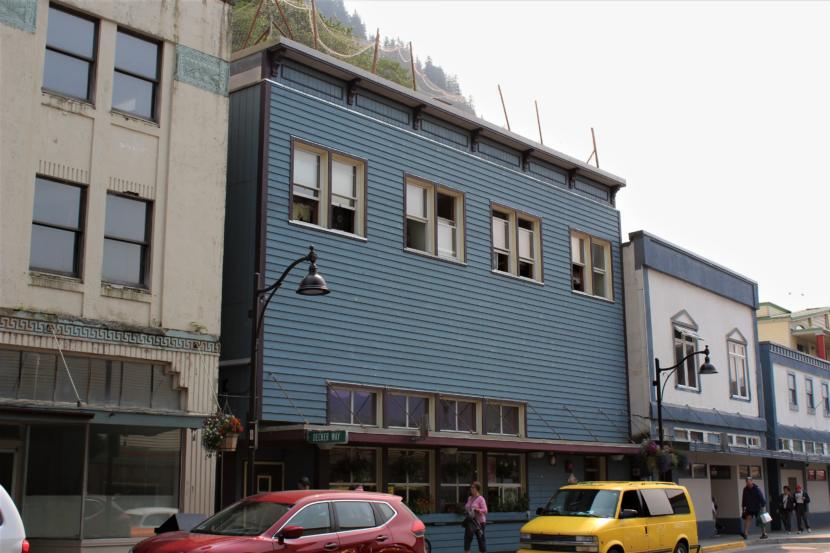
On a sunny afternoon, Maureen Conerton was lounging in a camp chair with her husband outside the home they lease on Telephone Hill. A plaque on the door claims it’s Juneau’s oldest home, built in the early 1880s.
Telephone Hill is a rocky ridge that juts out toward Gastineau Channel in downtown Juneau. The massive State Office Building straddles it. The Telephone Hill name stuck after a telephone company set up shop there in the early 1900s.
Conerton said she’s lived on Telephone Hill since 1989, calling it “the last little piece of old-time, rural Juneau” in the downtown area. She reminisced about epic, Alaska Folk Festival afterparties that the neighborhood used to host.
“It was wild. We had to take everything off the walls, all — everything, mirrors, pictures, everything,” Conerton said. “Moved the furniture into this side room back there because there were so many people in the — and every room was a different band. You know, the dining room was the Celtic band.”
One year, the festival’s headliner played harmonica — in the pantry.
“The walk-in pantry!” she said. “It was just like, ‘Wow, this is so amazing.'”
Those afterparties are long gone. And, according to a 1984 agreement between the city and state, her home and six others on Telephone Hill are also supposed to be long gone. The state and city intended to build a new Capitol complex on the hill and presumably raze the homes in the process.
Conerton and her neighbors don’t own their homes; the state does. Back in 1984, the state spent $4.6 million purchasing them. Some of them were just taken through a process known as eminent domain. The city pitched in $2 million.
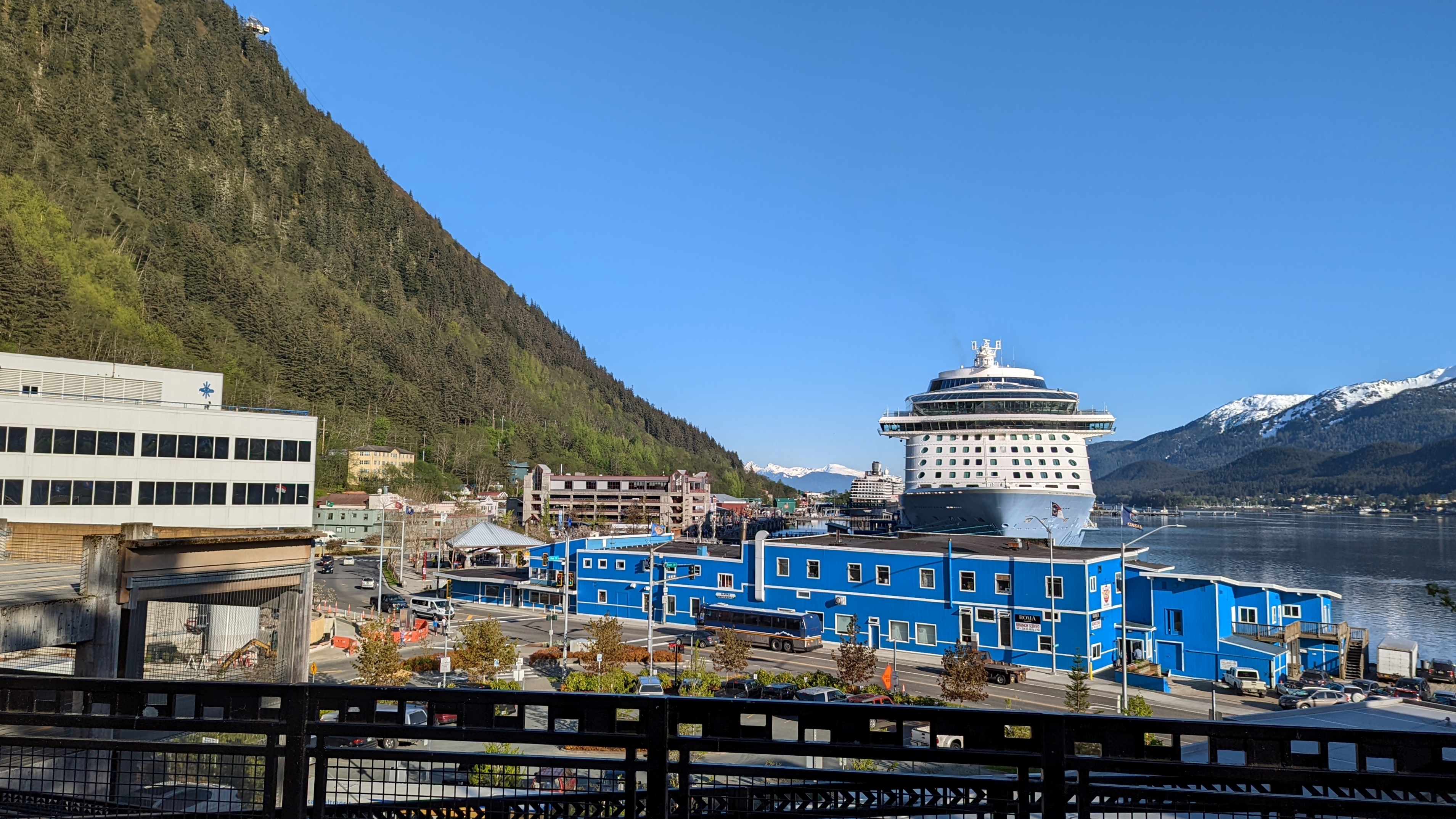
When the City and Borough of Juneau built the Downtown Transit Center, it also built a small park on top of Telephone Hill that features this view of downtown Juneau, as pictured on May 21, 2022. (Photo by Jeremy Hsieh/KTOO)
Telephone Hill is one of the most prominent natural features of the downtown area, which is part of why experts and locals back in the day thought it would be the ideal place to eventually build a new Capitol complex. That plan never came together, and the state became the landlord indefinitely for residents of the historic homes there.
The 1984 agreement says that if the state had not redeveloped Telephone Hill by 1994, it was supposed to compensate the city with cash and land. That also hasn’t happened.
Now there’s a renewed push for the state to transfer Telephone Hill to the city for redevelopment.
In a 2019 report, state officials flagged Telephone Hill as an asset it should consider selling. The city applied to get the land and settle the debt. It’s a slow process.
The city doesn’t have a concrete plan for Telephone Hill. But according to the city’s application, it intends to develop it “to support the Capitol campus, state government, and private development.”
“Since we just a few years back, put, oh, I think it was $37 million in seismic and other upgrades into the state Capitol building, it seems pretty clear that we’re not pursuing a new state Capitol building anywhere in the next generation or so,” Kiehl said.
The bill with Kiehl’s amendment is bound for the governor’s desk.
“I believe that this land transfer would have happened eventually. So I think this just cuts some time and some uncertainty out of the process,” Kiehl said.
Conerton said uncertainty is ingrained into life on Telephone Hill. Over the decades, it’s discouraged the residents from investing in significant repair projects. Things like roof replacements and fresh paint.
She said it feels like every time they’re ready to start working on something, there are new rumblings that they’ll finally be put out of their homes.
“Where they’ve said, you know, ‘This is the end. We’re going to do something,'” Conerton said. “And then they don’t. We’ve been lucky that way, because it’s a great place. And everybody, you know, we get along. It’s a real neighborhood.”
Ironically, the less-than-ideal condition of the homes is one reason the city and state say it’s ripe for redevelopment.
For now, city officials are waiting for the governor’s signature on the bill. After that, the Juneau Assembly will have some decisions to make about what to do with Telephone Hill.
An earlier version of this story was published with a historical photo taken from Telephone Hill. It’s been replaced with one of Telephone Hill.
The Glory Hall homeless shelter in downtown Juneau. (Photo by Adelyn Baxter/KTOO)
An affordable housing project in Juneau has been stalled by decades-old hazard maps and city permit woes.
The Glory Hall runs Juneau’s homeless shelter and plans to convert its former building into seven housing units downtown. The city denied construction permits for the job because it says the renovation would increase density in an avalanche hazard zone.
Mary Alice McKeen is an attorney representing the non-profit group in its appeal. She says the city’s density argument hinges on the number of units rather than the number of people.
“This is an irrational, arbitrary and unreasonable basis to deny a building permit for this project. It doesn’t show it increases density because the prior use was one large dwelling with a lot of people,” she said.
The building housed around 50 people a night as a shelter. As apartments, it will house up to 14 people.
The city’s development department refused to comment while the permits are in the appeals process.
“It’s really a black-and-white issue to me. Juneau has a housing crisis, and we’re trying to add more housing units. And it’s critical; every single unit counts,” said Mariya Lovischuk, The Glory Hall’s executive director.
She says people across the socioeconomic spectrum need housing in Juneau.
“I personally know people who are moving out of this community because they can’t find housing,” Lovischuk said. “And I know people who are not moving into this community because they can’t find housing. Healthy communities just need a healthy housing stock. ”
The city has acknowledged housing as a top priority in its comprehensive plan. McKeen says that’s legally relevant because the city’s development department can choose to interpret city ordinance in favor of housing.
The planning commission will hear The Glory Hall’s appeal next Tuesday, May 24 at 7 pm in Assembly chambers.
The Flats neighborhood in downtown Juneau. (Lyndsey Brollini/KTOO)
There are around 1,500 participants signed up for the Ironman Alaska race in Juneau this August. Racers usually bring a few three to five support people, and so for about a week this summer, there will be few thousand people in need of housing.
The city has about 1,300 rooms in its hotels, inns and bed & breakfasts. So, to add capacity, TravelJuneau, the destination marketing organization for the city, came up with a plan to incentivize Juneau residents to go on vacation and rent their homes to athletes for a week.
One athlete, Michael Bissell, says that he was late to the game when looking for a place to stay, but he got something arranged fairly painlessly.
“I was looking at hotels for about two weeks,” Bissell said. “And after no luck there — like, seriously, none — I started on a Facebook page.”
The Facebook page for Ironman Alaska has an accommodation thread with over 700 comments.
“And then within 30 seconds, 30 minutes, I had two people who have messaged me already,” Bissell said. “It just took a couple of days to see what was best for me and my crew that was coming out.”
His crew is his mom, his brother and a friend. They’re paying $1,000 a night for four nights, and he’s still hoping his crew will help him with that.
The comments on the Facebook thread started back in October, with people mostly looking for housing in Juneau during the race.
In January, there were a lot of discouraged commenters saying that they were really struggling to find a place to stay. Shortly after, more and more renters began commenting on those comments, offering places to stay.
Since then, there have been more comments posting places to stay than those seeking. However, there are still some complaining about prices.
One comment reads: “Very frustrated that the only places I’ve found so far are 5 to 6 times more expensive than they are the week before or after… Figures people would cash in, but I can’t afford to pay $5,000 a week for an Airbnb studio…”
One of the Ironman Alaska Facebook page’s admins replied: “There’s making the most of a situation and then basically ripping people off. Sounds like that falls into the latter.”
Kara Tetley, with Travel Juneau, said that Ironman considered a lot of variables before settling on Juneau as its first Alaska race location, including hotel capacity.
“They came and they visited a couple of times,” Tetley said. “Different members of the Ironman staff would come in and kind of look at things.”
Travel Juneau has a page on their Ironman site telling Juneau residents how to register their businesses and how to qualify for a discount with Alaska Airlines for that week if they do.
Tetley said that the demand for housing during the event seems to have been quelled.
“From what we can understand, there was some concern in the beginning, just because they kind of wanted to get everything settled right away,” Tetley said. “But it’s really quieted down, and it seems like a lot of athletes are set up or not as concerned about that anymore.”
City and Borough of Juneau finance director Jeff Rogers says the city doesn’t track the number of rental units. They only have the number of businesses registered in the short-term rentals category, which is 170.
“I’m not even sure I’d have a good way to know how many of those are people who may just be registering for, you know, the sole purpose of a week for Ironman,” Rogers said. “Even if we had seen, and I mean, I would guess we’ve seen a lot of new registrations this spring. But they may or may not have anything to do with Iron Man.”
Neither Tetley nor Rogers have any way to tell if some of the people who are registering businesses as short-term rentals will continue to rent out their places after the Ironman.
It’s also still uncertain that everyone coming into town will have a place to stay, though the accommodation thread bodes well for those still looking.
In the meantime, Bissell will be training and preparing for some of the race obstacles that are more unique to Alaska.
“Yeah, I guess I’ll be running with some bear spray,” Bissell said.
The first paragraph of this story has been modified to clarify how many people are coming to Juneau for the race. The number of hotel rooms available in Juneau has been corrected. And finally, a previous version of this story had Kara Tetley’s name misspelled.
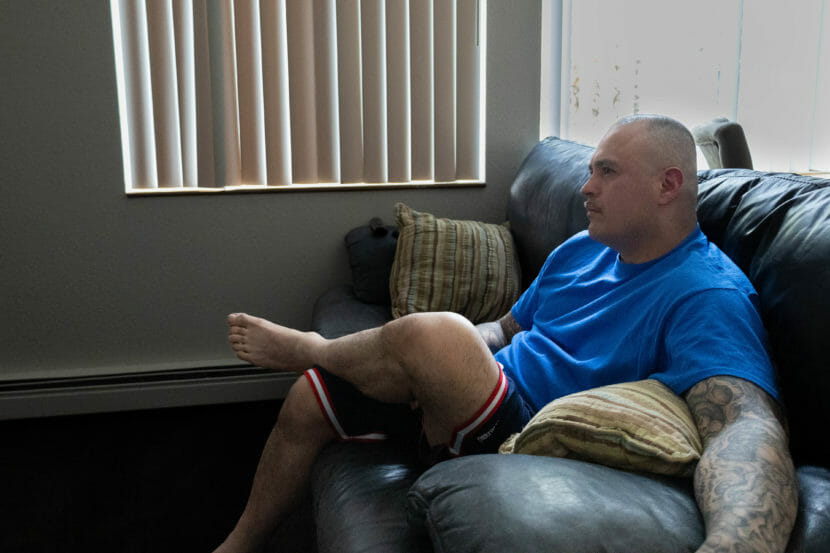
Angel Muñoz sits in his apartment in Juneau, Alaska on April 28, 2022. He was able to secure the apartment through a reentry program run by JAMHI Health & Wellness. (Photo by Lyndsey Brollini/KTOO)
A Juneau mental health organization is helping people formerly involved in the justice system get housing, and the program is working.
Nathan Block is a reentry case manager with JAMHI Health & Wellness. He works with people before they are released from incarceration to develop a plan once they are out so they can reenter society successfully.
One of the big challenges is housing. People don’t want to rent to them because of their background.
One way to increase housing for justice-involved people is to create housing specifically for them. And there are currently some places in Juneau that do that.
But Block said that also has its problems sometimes. Some former inmates have a stigma with those houses and don’t want to stay in a place where they think people aren’t trying to work on themselves.
When it comes to employment, there are fidelity bonds available — those lower the risks and financial burden on employers. Block would like to see a similar program for housing too.
“So then landlords who in the past haven’t wanted to be a part of the voucher programs will see that they’re insured,” Block said. “So that if there ever is a situation, they don’t have to spend a lot of their own personal money updating the facility or the apartment, etcetera for the next person.”
When people are released, Block said that sometimes a person will have a big family in town who they can rely on, but that’s not common. Sometimes they are put up in hotels, which he said doesn’t really solve anything.
And they can’t just look on Facebook or Craigslist for a place; it’s next to impossible for them to find housing that way.
Block said that solving the housing problem for justice-involved people is going to require effort not just from those people, but from the community too.
“Most people who are involved in the justice system don’t just wake up in the morning and say, ‘Oh, what crimes can I commit today?’” Block said. “It’s a result of untreated trauma. It’s a result of a history of colonialism. And it’s also really a result of a community who doesn’t want to help them.”
Block has personal experience with incarceration, mental health and substance use. But he went through a program that helps people in his situation go to college, and it changed his life.
He got his bachelor’s and master’s, and now he’s helping other justice-involved people better their own lives, like Angel Muñoz.
After doing 7 1/2 years at Lemon Creek Correctional Center in Juneau, Muñoz was living in a situation he didn’t want to be in. He heard about the reentry program when he was going to see his parole officer and decided to check it out.
At first, progress felt slow, like nothing was happening.
“But you gotta want to help yourself before they can help you, you know what I mean?” Muñoz said. “So they’re not going to do all the work for you, they want you to do some of the work.”
And he did the work; going to counseling, AA and working two jobs.
And then they secured him a spot at the Breakwater Inn. But the funding for it ran out, and Muñoz started panicking.
“I didn’t know what to do. I felt like I was hopeless. I didn’t have control of my life,” Muñoz said. “And I go, ‘What?’ I’m doing this just to get to back where I was starting? I go, ‘No.’”
Eventually, he got housing at St. Vincent de Paul. The reentry program paid for a few months there so he could save his paychecks up for a deposit on an apartment. And now he has an apartment he’s been in for about four months now.
He did the work to make life better for his son, so he could start fresh and have a place for him.
“Because I do love him, and I need to show him I love him by doing all this,” Muñoz said. “Because, you know, if I tell him I love him, and I’m going back to jail, that’s not showing him I love him. That’s telling him I really don’t care, you know.”
Muñoz said that people who were in his position should all go through the reentry program. He said it isn’t easy, but if they put the work in and do everything honestly, something will work out.
He said he’s grateful for all the people who helped him get where he is today and didn’t give up on him – people who saw him as a person who deserved a second chance.
Close
Update notification options
Subscribe to notifications
Subscribe
Get notifications about news related to the topics you care about. You can unsubscribe anytime.