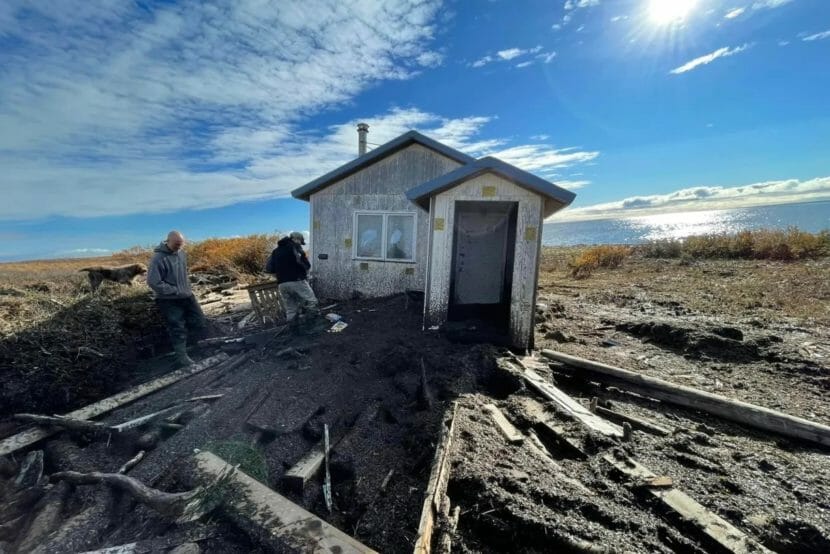
A subsistence camp in the Nome area after the historic September storm hit Western Alaska. FEMA says it cannot cover damaged or destroyed fish camps, but State of Alaska assistance can. (Courtesy Bridie Trainor)
The Federal Emergency Management Agency has disbursed more than $3.3 million to help Western Alaskans rebuild after ex-typhoon Merbok struck the coast a month ago.
According to a recent email update from FEMA, 422 Alaskans have been approved to receive individual assistance thus far. A third of the awarded funds — $1.12 million — has gone to housing assistance while over $2.1 million has been disbursed to cover other needs, such as subsistence equipment and replace furniture.
FEMA notes it cannot cover damaged or destroyed fish camps, but State of Alaska assistance can go towards rebuilding those structures.
During last week’s Alaska Federation of Natives convention, some attendees told KNBA radio that the individual assistance being awarded by FEMA is just a drop in the bucket. It isn’t enough to cover a four-wheeler or snowmachine, let alone the cost of building materials.
Officials with FEMA are also in the process of doing home inspections and helping residents register for assistance across the region. They were in Hooper Bay and Chevak over the weekend and currently have officials in Golovin.
Those seeking disaster funds as a result of Merbok should apply for both the State of Alaska assistance and FEMA assistance. The deadline to apply for federal assistance with FEMA is Nov. 22, while the State of Alaska deadline is Nov. 17.
According to the agency, storm survivors without a physical street address may have challenges applying via the FEMA online application. These survivors are advised to apply by calling FEMA’s Alaska disaster assistance hotline listed above.
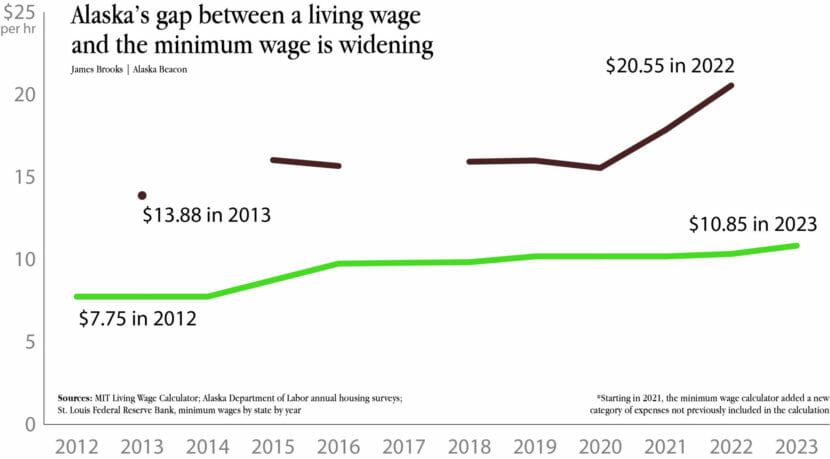
This chart shows the change in Alaska’s minimum wage and the estimated living wage in Anchorage between 2012 and 2023. Data for the living wage is drawn from the MIT Living Wage Calculator, annual rental estimates published by the Alaska Department of Labor, and is based on 12% tax withholding. (Graphic by James Brooks/Alaska Beacon)
Alaska’s minimum wage will rise 51 cents, to $10.85 per hour, starting next year.
The adjustment, announced Friday by the Alaska Department of Labor and Workforce Development, is intended to compensate for a 5% rise in the cost of living in Anchorage. Alaska law requires the minimum wage to be adjusted each year for inflation. Despite the increase, the minimum wage remains well below a widely used measure of a living wage in Alaska.
In Anchorage, the median apartment rental price is $1,339 per month, according to a survey conducted this year by the Alaska Housing Finance Corp. and the Department of Labor. That figure includes rent and utilities and rose 14% from last year.
Taking into account 12% withheld for taxes, someone earning minimum wage would have to work 35 hours per week in a four-week month to cover the cost of housing.
The MIT living wage calculator identifies $1,554 in other costs per month, including food, transportation and other expenses. That figure is based on estimates from various federal sources.
At minimum wage, an individual adult would have to work another 41 hours per week to cover those costs.
Altogether, estimates indicate someone earning minimum wage would have to work 71 hours per week to meet their basic needs in Anchorage.
If that person had one child, they would have to work an additional 20 hours per week at minimum wage to cover the cost of child care, according to the MIT estimate. Each additional child is estimated to cost another 20 hours of work per week.
A living wage is defined as the minimum amount needed to pay for basic needs while working a standard 40-hour workweek. In all of Alaska’s cities and boroughs, the minimum wage is significantly below the living wage amount.
In the Matanuska-Susitna Borough, someone would have to work 69 hours per week at minimum wage to meet basic needs. In Fairbanks, it’s 75 hours. In Juneau, it’s 74 hours.
Based on current estimated costs, the minimum wage would need to be above $18.08 per hour in order to be a living wage in Anchorage.
No state’s current minimum wage is at or above the statewide living wage.
Shelter Supervisor Forrest Clough, Youth Services Manager Jorden Nigro, and Youth Action Board Member Tiana at Shéiyi X̱aat Hít Youth Shelter. Oct. 14, 2022. (Photo by Yvonne Krumrey/KTOO)
For two long years, there was no dedicated shelter for young people in Juneau who needed a safe place to sleep. But last July, Shéiyi X̱aat Hít, or Spruce Root House, opened. In partnership with Tlingit and Haida Regional Housing Authority, the city designed the shelter with input from youth who had direct experience with homelessness.
In the fifteen months since the shelter opened, Jorden Nigro says dozens of individuals have been helped. If you multiply the number of individuals by the number of nights spent at Shéiyi X̱aat Hít, it’s around 1,600.
Nigro is the youth services manager for Juneau Parks and Recreation, and she runs the Zach Gordon Youth Center and Shéiyi X̱aat Hít Youth Shelter.
“I’ve known kids who have traded, you know, sexual favors for places to stay, who have been exposed to things that they really should not have been exposed to, in order to have a place to stay,” Nigro said. “So yeah, there’s some real sad stuff that will happen when there aren’t places like this for kids to go.”
The kids use the shelter for a few different reasons, Nigro said.
“For the most part, our youth who are coming into the shelter have either run away from home or threatened to run away from home, or they are living at home in an unsafe situation,” she said. “And they come in because of abuse or neglect.”
The average time spent per youth at the shelter is about 13 days.
A large part of the role of the staff of Shéiyi X̱aat Hít is to work on family mediation, Nigro said. So far, more than 90% of the youth who have used the shelter have gone on to a safe and stable place.
“And we do these exit surveys when kids leave and ask them a bunch of questions, but one of the things is like, ‘Would you recommend this to a friend?’” she said. “And 100% of the youth have said ‘yes.’”
Before Shéiyi X̱aat Hít opened, Tiana struggled to find a safe place to stay, when her family home wasn’t safe. KTOO isn’t using her last name due to the stigma attached to homelessness.
She’s 19 now and has her own apartment. She joined the city’s Youth Action Board in 2020, where she has been sharing her ideas about what would help kids who are in situations similar to hers growing up.
The board meets weekly and is open to any youth who want to give input.
One thing that was important to her when designing the youth shelter was that each person should have their own room.
“Maybe if I was in this situation, which I was,” Tiana said. “I wouldn’t want to do that with somebody else, I would want to have the privacy of being able to be alone and sit in my room.”
Another project she pushed for on the Youth Action Board was a place for people aged 18 to 20. So the shelter also hosts transitional housing, a four-room apartment, which is currently rent-free.
Eleven people have used the apartment since the shelter opened. Usually, people stay there for about two or three months, says Nigro.
Shéiyi X̱aat Hít Youth Shelter is more than a place to stay for a while. Nigro said the staff work to foster community with youth by cooking and eating together, encouraging “normal” daily routines, and having downtime when youth can watch TV and play games together.
Nigro said about half of the youth at Shéiyi X̱aat Hít are LGBTQ+ identifying, and a quarter of them are transgender.
This is consistent with national trends: 28% of LGBTQ+ youth experience housing insecurity or homelessness. But having at least one supportive adult in their life decreases their chance of attempting suicide by 40%.
Tiana says that the adults at Shéiyi X̱aat Hít and Zach Gorden were a lifesaver for her, too.
“I know there’s a lot of kids out there who grew up, or is growing up right now that don’t have a safe place to go and don’t have people to turn to. And that was me,” Tiana said. “And these people are the people that I learned how to turn to, so being involved in this has changed my life for the better.”
Nigro says she wants more people to know about Shéiyi X̱aat Hít, so any youth who find themselves in an unstable housing situation know where they can go.
Correction: An earlier version of this story gave an incorrect age range for people eligible to stay in the apartment. It serves ages 18-20.
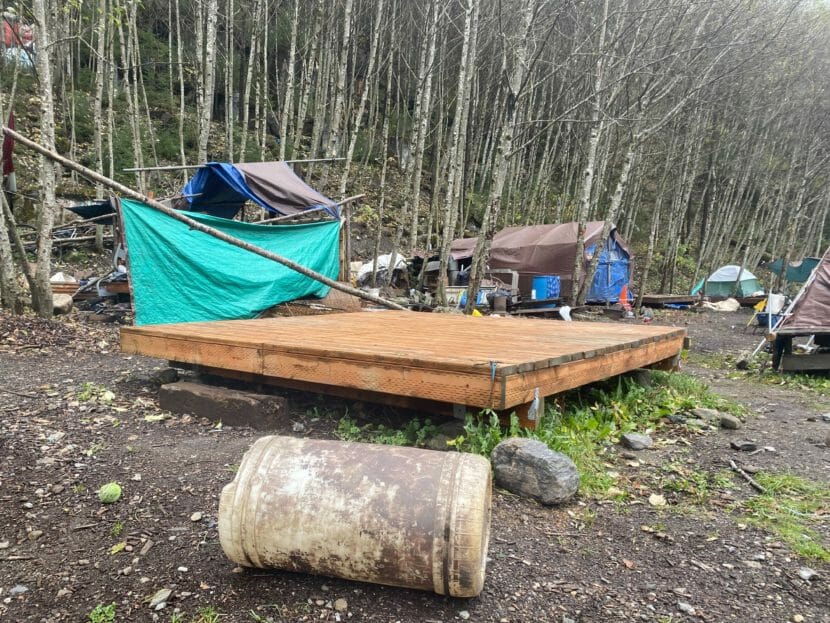
Juneau’s Mill Campground on October 14, 2022. (Photo by Claire Stremple/KTOO)
The City and Borough of Juneau closed the Mill Campground on Saturday.
The campground above the cruise ship docks is not for recreation. It’s for people experiencing homelessness in Juneau. It closes for winter every year.
David lived at the campground with his girlfriend. KTOO isn’t using his last name because of the stigma attached to homelessness. He said up to 40 people lived there this summer.
“It’s got its problems,” David said. “But overall, I really do like it.”
He said he knew the closure was coming, but he doesn’t have a plan for where to stay next. Other housing solutions like Juneau’s shelter, The Glory Hall, and the Housing First complex in Lemon Creek don’t work for him — too crowded, he said.
“I stayed in the woods last year,” he said. “For eight months.”
He said last winter the snow got pretty high around their tent and it was really hard to keep things dry.
“We survived. It would have been easy to do if I had a stove and water,” he said.
That’s part of the reason the camp closes. The road up to the Mill Campground isn’t serviced over the winter, so it’s not possible to haul water and service the toilets up there.
“It’s not a park and it’s not recreation,” said Dale Gosnell, a ranger for the city’s Parks and Recreation Department, which maintains the campground.
On Monday, he was on site cleaning up leftover tarps and other belongings that people didn’t take along when they moved out. He said the city only leases the campground for the summer because the rest of the year it’s too difficult to manage. Plus, he said, it’s dangerous.
“Even camping out in the summer in Southeast Alaska is challenging with all the rain we get,” Gosnell said. “In the winter, it becomes life threatening, potentially, with cold weather and snow. Tents would collapse under snow weight, potentially.”
The Glory Hall is getting ready for some people from the camp to relocate there.
“We’ve already had a few people come and ask about space here,” said Luke Vroman, the Glory Hall’s deputy director. “And what we tell them is we’re very full, but we’ll do what we can.”
There’s high demand for beds and sleeping spaces in the winter months.
Juneau also has an overnight warming shelter, run by Resurrection Lutheran Church. Its doors don’t open until the temperature starts to dip below freezing.
Brad Perkins helps manage the warming shelter. He said the church is still hiring staff.
The city increased the church’s funding for the program this year, but Perkins said his expenses are going up, too. He has to buy more food at Costco this year because of shortages at local food banks.
The weather should stay in the 40s through next week. Perkins said they will likely open when the weather starts to dip into the mid-30s.
There were nine people still at the Mill Campground on Monday. The Glory Hall picked them up for lunch.
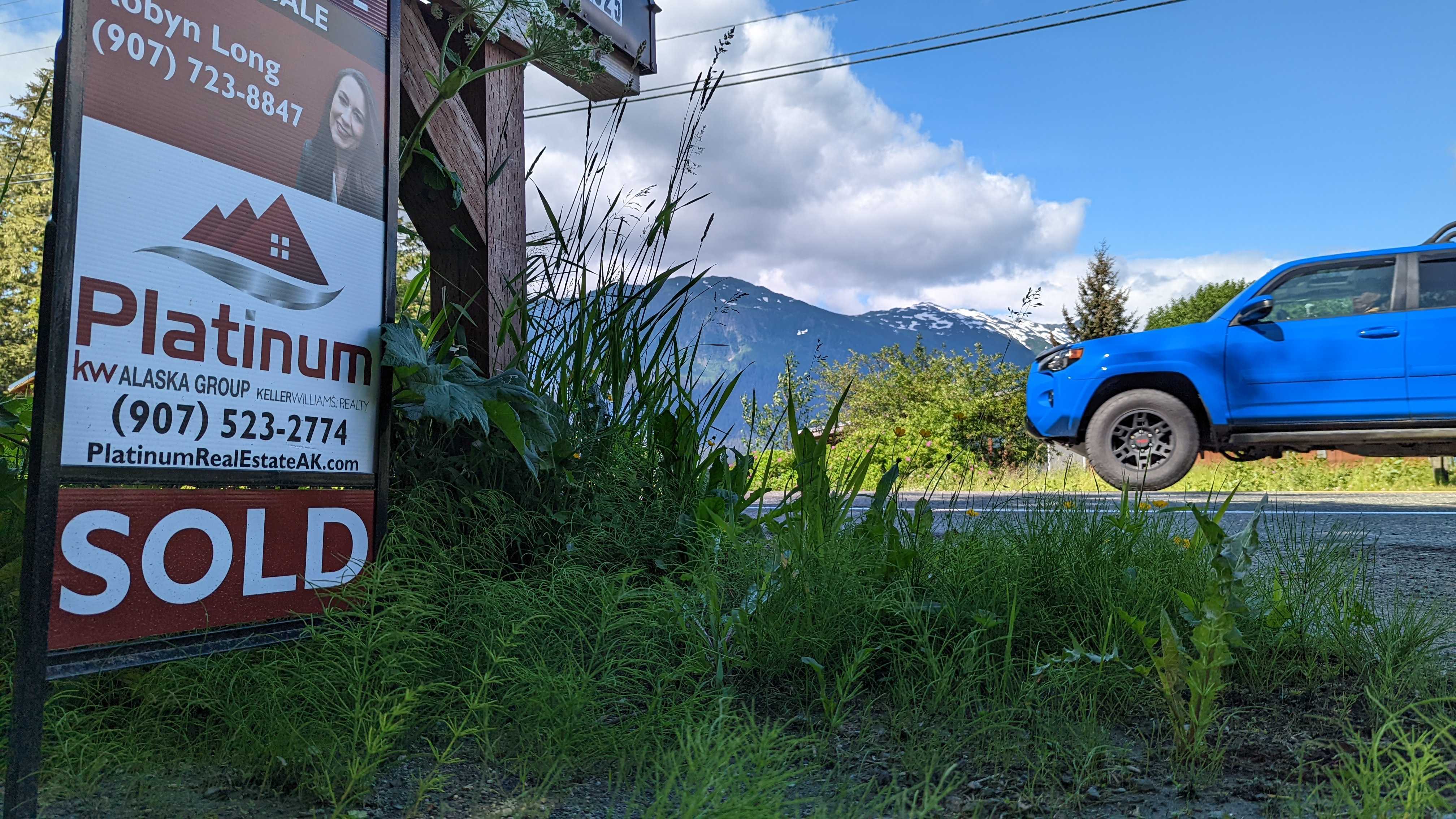
A sign marks a home that sold recently along North Douglas Highway in Juneau on June 30, 2022. City ordinances mandate the buyer disclose the sale price to city assessor’s office, though a group supported by the real estate industry wants to repeal those ordinances. (Photo by Jeremy Hsieh/KTOO)
This question asks voters to repeal measures the Juneau Assembly adopted in 2020 and this past February that mandate sharing real estate sales prices with the city assessor’s office.
The assessor’s job is to determine the fair market value of every parcel of property in Juneau, every year. These values directly affect property tax bills and the balance of who pays for city services.
Supporters of the repeal say the mandate is an invasion of privacy and expect it to lead to higher property taxes. Most Assembly members oppose the repeal. They say disclosing sales prices will lead to more fair and accurate assessments, particularly for higher-end properties, which tend to get undervalued when assessed.
Real estate professionals and developers are leading the repeal effort, which began with the citizen petition process. They often point out how common it is for jurisdictions with mandatory disclosure laws to enact real estate transfer taxes that they say add to the cost of housing.
Here’s how the group leading the repeal effort, Protect Juneau Homeowners’ Privacy, boiled it down into a 30-second Facebook video:
That’s Gary Stephens. He runs a car repair shop in Juneau.
Assembly members say the mandate is not about boosting tax revenue.
Mayor Beth Weldon voted against the original mandate, and didn’t want to share how she’ll vote on the repeal question. But she said she was disappointed with some of the messaging from repeal supporters.
“We have never said that we were going to do a transfer tax,” Weldon said. “In fact, we didn’t even know what a transfer tax was until they brought it up. Quite frankly, we’re spending millions, and I mean millions of dollars, on trying to make housing affordable in Juneau. And why would we make housing more expensive in one hand and then spend millions on the other hand to make it cheaper? … It just does not make any sense.”
No Assembly members have taken any steps or indicated that they want to create a real estate transfer tax.
Realtor Kimmi Ott hosts a podcast called “What Juneau About Real Estate?” In a May episode, she said she just doesn’t buy that.
“The city has been saying, too, ‘Oh, no, we’re never going to implement a transfer tax,’” she said. “I am calling bulls— because you guys have not kept your word. You changed the game on everyone!”
She was referring to the update the Assembly made in February to the disclosure mandate. At first, the information had to be kept confidential. But after property owners fighting their assessments demanded more transparency, the Assembly ditched confidentiality.
The February update also added the possibility of fines for failing to disclose. Juneau Assessor Mary Hammond said Wednesday that so far, no one has been fined for this.
The main argument from supporters of real estate disclosure is more nuanced. During a forum last week, Assembly member and unopposed candidate Carole Triem said she’s voting against the repeal and wants to keep the mandate in place.
“I think there’s a lot of misinformation out there,” she said. “Mandatory disclosure will help lower the property taxes of middle- and low-income homeowners, because we’ll even that out with the higher income properties that don’t come on the market quite as frequently.”
Let’s unpack that. Why would mandatory disclosures lead to lower property tax bills for middle- and low-income property owners? And why aren’t higher income property owners already “evened out?”
Without the mandate, the assessor’s office already had a lot of publicly available market information for common types of real estate sales, like for tract homes. The more market data it has, the more confident it is about its assessments being accurate and fair.
But for extraordinary properties, say for custom homes or commercial buildings, the market is much smaller, sales are less frequent, and they tend to be more private. So the assessor’s office has to make more guesses about Juneau’s most valuable properties.
The city finance director has said in a memo that the assessor’s office tends to under value properties they have limited information about. The Alaska Legislature’s nonpartisan research service examined the issue in 2014, and its researcher came to the same conclusion on a statewide level.
Basically, Triem thinks the mandate will raise assessments of Juneau’s most expensive, but generally under-assessed properties, and have little effect on the assessments of more common properties.
“Having that information out there in the housing market, this crazy housing market that we’ve seen, will only help buyers and sellers when they have a full transparent, you know, view of the housing market,” Triem said. “They’ll be able to make the best decisions based on that and not have that kind of be secretive and kept, you know, by the experts who will dole that information out when they feel that it will benefit them. So, I would urge people to vote against that, to vote no on the mandatory disclosure.”
A property’s assessed value is only one piece of its annual tax bill. The property tax rate, also known as the mill rate, is the other main factor. And every year as part of its budget process, the Juneau Assembly revisits it.
For most property, the tax bill is calculated by simply multiplying its assessed value with the mill rate. For most of Juneau, that rate is 1.056%.
We asked several Assembly members what they would do if there were an abrupt increase in overall property assessments. Answers varied, but lowering the property tax rate was on the table.
For more reporting and resources on Juneau’s local election, visit KTOO’s local elections page.
Science teacher Dan Bonser holds his cat, Nix, in the classroom he and his family have stayed in since they arrived in Dillingham in August. (Photo by Izzy Ross/KDLG)
One afternoon in early September, Dan Bonser walked up the stairs in Dillingham’s middle-high school to Room 200. It’s the middle school science room — where his family sleeps.
“Some of our bedding is over there. And then the first two totes over there — food,” he said pointing across the classroom.
There was a lot of turnover in the Dillingham City School District last spring. The district hired 22 new staff members for this year — a quarter of the entire staff. Unable to find homes in town, some are living at the school.
Bonser moved from Oklahoma to Dillingham last month with his wife, Lisa. Their daughter, CJ, also moved with them and is an instructional aide for the special education program. The family lives in Room 200 with their two cats, sleeping on air mattresses.
Bonser said the first few weeks have been tough.
“I’ve done a lot of different jobs in my life. And I’ve never been this exhausted,” he said. “It’s a lot.”
Dillingham’s housing shortage is acute, but it’s not unique. Across the country, people are struggling to find places they can afford to rent or buy. In Alaska, the average home sales price jumped almost 9% last year. And in rural communities, the problems are compounded by the costs of shipping in building materials and the lack of construction workers and contractors.
“The common thread is — tight housing market, rising sales prices and limited availability. And that’s home buying,” said Rob Kreiger, an economist with the Alaska Department of Labor. “On the rental side of things, broadly speaking, rent’s way up, vacancy rate’s way down, which suggests a tight rental market, as well as a tight home buying market. And that’s pretty much consistent throughout most of the areas that we have data for.”
Kreiger said the state doesn’t have a good handle on what the rental market is like in rural parts of Alaska. But in general, housing prices are high, and there are few homes for sale in rural areas.
“I think you have those two factors,” Kreiger said. “I think that would probably sum it up for most of the kind of larger rural hubs as well.”
Bonser said when they were offered the teaching jobs, the school district said it would help them navigate the search.
“We have a bead on one house, but it needs to be connected to the sewer, and there’s not enough plumbers to get that done and the homeowner’s been waiting a long time for that to happen anyways,” he said.
The school district’s new human resources director, Lindsay Henry, was able to find a place for herself and her dog.She said other new staff were able to find housing, too. But it’s tricky when newcomers aren’t familiar with the state.
“I think what is difficult for people who are coming who don’t have a familiarity with Alaska, is that they hear about people working in the bush. And in most of those bush communities, they do provide housing, and Dillingham is kind of unique in that it’s a Class A city and we don’t have to provide housing for teachers,” she said.
Henry said the district tells staff that housing is a challenge and tries to help them find something. Officials can send teachers phone numbers and the names of landlords in town.
“But we can’t take on that liability or responsibility of actually negotiating housing for them. So it’s a challenge in many ways,” she said.
It’s also competitive. Henry points out that a lot of organizations in Dillingham hire people from out of town and need housing for them. That includes the hospital, Fish and Game and the university.
The housing shortage in Dillingham is intertwined with a national shortage of teachers. Other schools have turned to teachers from other countries through the J-1 visa program. But that program also requires a plan for housing.
Dillingham’s new superintendent, Amy Brower, spent five weeks staying at the school before she found a place to live. At a recent school board work session, Brower said there were several candidates who turned down job offers because they couldn’t find anywhere to stay.
“We had some really good, high-quality candidates that wouldn’t come because of housing,” she said. “So we’re at a point where, with the number of teachers that are not out there — and I said not — and the quality of teacher that we’re looking for, we’re going to have to find some way to do something to help get them here.”
The administration is working with the fish processor OBI Seafoods to rent out crew quarters during the year. Brower said the school is working with the City of Dillingham to find long-term solutions as well. The district has discussed applying for grants to build new housing units or renovate existing ones. That could include an Alaska Housing Finance Corporation grant, which would allow a company to build housing teachers could then rent out.
Until then, some teachers will continue to search for a place to sleep — outside of the classroom.
Close
Update notification options
Subscribe to notifications
Subscribe
Get notifications about news related to the topics you care about. You can unsubscribe anytime.