The Skagway Borough Assembly will hold its first reading of an ordinance to put a senior center bond question on the October ballot on Thursday.
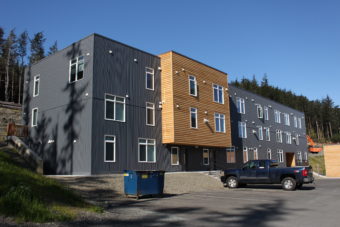
The up to $7 million bond would fund construction of a senior center and housing facility that proponents say is needed to better serve the town’s aging population. A property tax increase may be implemented to pay for the bond.
The assembly will also hold a first reading on an ordinance prohibiting parking within 20 feet of any street intersection.
There is a discussion set for a letter to bus companies regarding ‘numerous reports’ of large tour buses driving unsafely. The letter asks for companies to address road safety with drivers.
Mayor Mark Schaefer requested the assembly discuss issues related to graffiti in Skagway. A recent graffiti incident at Smuggler’s Cove was publicized by the Skagway Police on Facebook.
The assembly will hear an update on the August 8 meeting between the Alaska Department of Environmental Conservation and ore terminal stakeholders, including the municipality.
The DEC meeting will also be discussed behind closed doors. An executive session is scheduled with the borough attorney.
The meeting convenes at 7 p.m. Thursday in assembly chambers.
After almost two weeks, the boil water notice has been lifted from Bethel’s Trailer Court neighborhood. Last month a routine sample revealed E. coli present in the pipes of one home. Cliff Lindroth is the manager at the neighborhood’s water processing plant.
“We got the green light from the Department of Environmental Conservation. They came out here on Tuesday, we got the results back from the YK lab, all tests came back negative,” Lindroth said.
The tests confirm what Lindroth has said for the last week – the containment was isolated to one home and not a system wide problem.
“I apologize to people for the concern and inconvenience they’ve had during this period of reacting to what was kind of a false turd in the punch bowl,” said Lindroth.
Lindroth blames unorthodox piping systems inside the contaminated home for the scare.
“It’s not uncommon for somebody to just put a piece of hose in there and clamp it on with some hose clamps. And maybe that was the same hose that was lying out in the yard. The same hose that’s been lying in the bottom of somebody’s boat,” he said.
City workers volunteered their time to help identify the problem. The Trailer Court water system is independent from the city’s system.
Lindroth says that as a result of the scare, the plant will be doing more regular testing to make sure everything is normal moving forward.
More than 160 firefighters and emergency medical personnel responded to the incident reported just after midnight at the Flower Branch Apartments in Silver Spring, Md. (Montgomery County Fire & Rescue Service, Associated Press)
As many as seven people were missing and dozens injured after a massive explosion and fire overnight gutted a Maryland apartment building. Firefighters reported dramatic scenes of children being tossed to safety from windows.
Approximately 30 residents and three firefighters were rushed to emergency rooms with non-life threatening injuries, Montgomery County Fire & Rescue Service Capt. Oscar Garcia said in a recorded message. Five to seven residents remained unaccounted for, he said.
“People were dropping children and jumping out of other windows,” Fire Chief Scott Goldstein told The Washington Post at the scene. “Everybody was getting out of the building as rapidly as possible.”
More than 160 firefighters and emergency medical personnel responded to the incident. It was reported just after midnight at the Flower Branch Apartments, a four-level apartment building in Silver Spring, Garcia said. Silver Spring is located just north of Washington, D.C.
A video posted by Montgomery County fire spokesman Pete Piringer showed debris from the blast scattered through the street in front of the damaged building, with items of clothing visible high in the branches of a tree.
ATF & MCFRS Fire & Explosive Investigators have a large debris field to search & document, some items >300 away pic.twitter.com/fcAr5FDlKr
Investigators were working to determine what caused the explosion, which “could be felt a mile away,” according to the Post.
Goldstein told reporters that the injuries “ranged from minor to serious,” the Post reported. He added that “some had respiratory injuries from smoke, and others had burns and fractures from jumping out of windows.”
Resident Willie Morales told the newspaper that he was walking across the street when the blast struck. “It was one big boom, like nothing I’d ever heard,” he said. “I tried to knock on the door and windows. … I’ve never seen a fire like this in my life.”
Water diverted from the Tanana River main channel by an ice dam in January blew away vegetation, gouged out the slough and washed away much of the bank at the foot of a ridge where Tom Gorman built his home. (Photo courtesy of Tom Gorman)
An aerial view showing how ice diverted much of the Tanana River into the small slough at the foot of the ridge on which Gorman built his home. (Photo courtesy of Tom Gorman)
Gorman says he knows “the Tanana moves all the time,” which is why he sought advice on where to build his home from longtime area residents familiar with the river. (Tim Ellis, KUAC – Fairbanks)
The 8-foot-tall dam that Gorman built earlier this year across the slough was submerged after recent rains raised the Tanana River level. Gorman laid a course of sandbags over the top of the structure to slow the river current and the erosion it causes. “It’s holding,” Gorman says. (Tim Ellis, KUAC – Fairbanks)
Big Delta resident Tom Gorman said a small dam he built earlier this year to protect his home from the meandering Tanana River held steady over the past couple of weeks as the river rose to near-flood level, due to recent rains.
Gorman now hopes the river falls quickly enough to allow him to finish work on the dam before snow flies.
Gorman stands at the edge of a 20-foot-wide slough off the Tanana River that runs along the foot of a ridge on which he built his house about seven years ago and said this isn’t how it looked back then.
“Last year, it was dry!” Gorman said.
A couple dozen trees used to grow in and around the area, Gorman said, which served as a sort of buffer between his big three-story house and the Tanana River some 45 feet away. Until January, that is, when an ice dam on the Tanana diverted a torrent of water into the area that tore out the trees and gouged into the riverbank, threatening to undercut the ridge where his house sits.
“And that just came in and just took ’em out, one at a time – pow! Two hours later, another one – bam!” he said. “It just got behind ’em, the erosion behind ’em, and just ripped ’em up.”
That was near the beginning of an ordeal that lasted for several weeks, as Gorman and a small army of friends, neighbors, contractors and others tried to bust up the pile of thick ice slabs.
They attempted to melt it with a de-icing solution; they tried to bust it up with a 5,000-pound weight dropped from a helicopter; they even detonated explosives to blast it open. Nothing worked.
“No – well, not on 3-, 4-foot (thick) ice,” Gorman said. “That’s what you had over here, all the way across.”
Gorman said state and federal officials for the most part supported his effort to save the house. He didn’t get any help from his homeowner’s insurance company, he said, but he got lots from dozens of volunteers from all around the area.
“The community’s helped me out,” Gorman said, “And they really pulled together.”
Gorman, a retiree from Texas, said the cost of trying to break the ice jam further strained his finances, which he’d already deeply tapped to buy the land and, in 2009, build a house for his family, which includes his wife and elderly mom, disabled son and daughter with kids.
Why did he build his dream house so close to the river? Gorman said he’s been asked many times:
“We were safe,” he said, “we were really safe when we built this house.”
Gorman followed advice on where to build given by his contractor and two neighbors, both of whom have lived along that stretch of the river for more than 40 years. But the ice-jam backup surprised everyone, he said as he shows photos of river water tearing through the slough and frantic efforts to slow its destruction.
“It came around this way, and it starts cutting in here,” he said. “It cut in here and fell down. It cut and just headed right toward the house.”
When the ice jam finally gave way, he and his had crew a chance to bring in equipment to shore up 150 feet of riverbank with big rocks, Gorman said, and to build an 8-foot-tall dam across the slough.
“What this dam did here was to really stop the current,” Gorman said. “Once the current was stopped, then I could get in here and do something.”
When the river rose a couple of weeks ago, he saw that the dam, which is built of interlocking concrete barriers, wasn’t quite high enough. So he laid a course of sandbags on top it to slow the flow to trickle.
“It’s holding,” Gorman said, “but it’s not done. It has to be completed.”
But he can’t bring equipment back in until the river drops and the area dries out.
“The water has got to go down, because what happens is you put the equipment down there and it’s so soft that it’s going to push the dam away,” Gorman said.
Gorman said that may not happen before the first snow flies two or three months from now. He said he’d prefer to do the work before winter sets in, but if he runs out of time, he’ll pay the extra cost of doing the work in the winter to save his home.
A sign advertising a public meeting marks the location of a planned senior housing building at Vintage Park in the Mendenhall Valley . (Photo by Ed Schoenfeld/CoastAlaska News)
A Seattle-based company is one step closer to building a 49-unit senior housing facility in Juneau. If successful, it would cater to a region’s housing market that’s been historically difficult for everyone, especially Southeast’s aging population.
Earlier this week, the Juneau Planning Commission approved a conditional use permit for GMD Development, LLC. The majority of the beds in the proposed housing unit will be low-income affordable housing.
Assemblyman Loren Jones thinks it’s a positive step for the community.
A page from GWD Development’s proposal for senior housing, which would include a four-story building with 49 living units. (Image from Regular Commission Meeting Agenda)
“Where it’s at, it’s going to be next to the assisted-living facility,” Jones said, “so there’d be a senior complex there in the valley, and I think it’s very important for Juneau for that to take place.”
The location of the site is off Clinton Drive, near Safeway. The non-profit Senior Citizens Support Services Inc. plans to build a 90-apartment, assisted-living facility in the same area.
Jones said the proposed housing project would help a market that really needs it.
“I have every anticipation there may yet be some construction work this fall, but I would suspect construction would hopefully start next spring,” he said.
Earlier this year, KTOO reported on the shortage of senior housing in for Southeast’s aging community. A 2014 market study estimated that over the next 30 years, Juneau will need more than 300 additional beds to meet demand, given the city’s limited space.
The city of Bethel received an extension on a regional general permit to allow city to review citizens building permits in wetlands. (Adrian Wagner/KYUK)
The city of Bethel has gotten an extension on its regional general permit from the Army Corps of Engineers that will allow the city to review permits for citizens building in a wetland, a designation which encompasses much of Bethel.
Mayor Rick Robb addressed corps representatives at a city council meeting Tuesday with a clear message.
“It is definitely the intention of this community and the intention of this council that we want to work and extend this general permit and have it authorized for another five year period, and we want to make sure the corps of engineers understands that,” he said.
The permit, set to expire at the end of August, will be extended for six months as per the council’s request. In that time, city administration will work with the corps to renew the city’s permit on a long-term basis, but the renewal is not guaranteed. State and federal authorities still have to weigh in on the process, and will have the option to veto its passage.
Sheila Newman, one of the corps representatives, pointed out that despite public concern for widespread construction holdups, the permit was used just a handful of times last year and affected only six out of 75 total projects in Bethel.
Close
Update notification options
Subscribe to notifications
Subscribe
Get notifications about news related to the topics you care about. You can unsubscribe anytime.