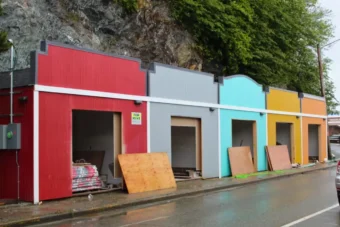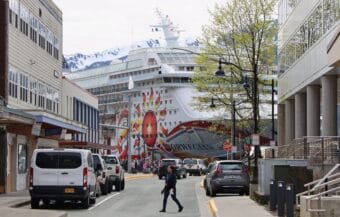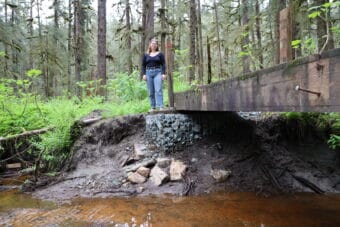
Mendenhall Glacier Visitor Center in July, 2023. (Clarise Larson for the Juneau Empire)
This summer, there will be a new type of guide at the Mendenhall Glacier, one whose job it is to educate visitors about how Lingít history is intertwined with the glacierʼs.
The role is part of the new co-management strategybetween the U.S. Forest Service and the Central Council of the Tlingit and Haida Indian Tribes of Alaska.
Tlingit and Haida President Chalyee Éesh Richard Peterson says that, in the past, staff at the glacier wouldnʼt know what to say when visitors asked them about the Indigenous history of the area.
“The feds at the time out there at Mendenhall said ʼWell, they didnʼt have anything to do with glaciers.ʼ And that was kind of dumbfounding to us,” he said. “Iʼm Kaagwaantaan, we have migration stories about the glacier. I think everyone does. We have songs and stories about the glacier.”
Now, Peterson said, this position will allow for the hundreds of thousands of annual visitors to the glacier to understand the history and original language of the area more deeply.
“I think if you want them to have an authentic experience — a more inclusive experience — then the voice of our people need to be out there in that representation, and so weʼre moving towards more opportunities for co-stewardship and make sure that our voices are represented out there.”
Itʼs not just for the benefit of tourists, he said. Roles like these reinforce the Lingít communityʼs place on the land and in its caretaking.
“That weʼre still here and that our language should be valued and our placenames should be valued, and as all people, we should be valued,” Peterson said.
The Tribe plans to hire up to four people for the job. It’s a seasonal position, from March to September, with a training period before the cruise ships start arriving. Ambassadors will be paid $20 an hour.
U.S. Forest Service worker Sam Wynsma walks around a pond during a visual survey. (Photo by Katie Anastas/KFSK)
The workforce in the Tongass National Forest has grown a lot over the last couple of years, thanks to some major infusions of federal money.
In a presentation at the Juneau Economic Development Council’s Innovation Summit in Juneau this week, U.S. Forest Service recreation specialist Jason Anderson said new staff will help the agency catch up on a backlog of maintenance projects and keep up with the tourism boom in Southeast Alaska.
Anderson said that since the early 2000s, federal funding to support recreation in national forests had been shrinking.
“We were losing our spending power, we were seeing very diminished budgets and the inability to do work,” Anderson said. “It also translated in the inability to hire people to do that work, whether you’re hiring contractors, Forest Service workforce or partnering. That decline is significant.”
But recent federal legislation has reversed that trend. The Great American Outdoors Act in 2020 brought $62 million to the region for long-deferred maintenance of things like trails, cabins and roads.
And the Bipartisan Infrastructure Law in 2021 added another $36 million for other recreation projects, like the construction of 25 new public use cabins across the Tongass.
“It’s huge. It’s time to celebrate,” Anderson said.
Since 2020, the new funding has supported a boom in workforce development for the Tongass. In his presentation, Anderson said the U.S. Forest Service has doubled the number of jobs for recreation operations, which includes a range of positions from custodial staff to people focused on trail and cabin maintenance.
The agency has also nearly doubled the number of positions for their Heritage Program, which focuses on preserving historic and cultural resources on public lands.
And they’ve introduced 8 new staff positions for the special uses program, which mainly does permitting.
“There are a variety of activities that we permit in the national forests,” Anderson said. “Research, guided recreation, things that are incredibly important to our communities and our economy.”
Lately, there’s been a major permitting backlog, and that’s been especially frustrating for people trying to start new recreation businesses to take advantage of the growing number of tourists.
Anderson said that traditionally, the small staff in district offices had to process dozens of permit requests on their own, which caused major delays.
“They might have an administrator, right? A single permit administrator, doing all of the permit activities,” Anderson said. “If that person became overloaded, if they retired, if they went on maternity leave – whatever the reasons are — we might have a hard time meeting expectations.”
Now, they’re introducing a Tongass region-wide team of permit administrators dedicated to working through the backlog and keeping up with new permit requests.
The team will include people with specific expertise on some of the particularly complex types of special use permits, like the ones needed for large hydropower installations.
It will also include a staff member who works directly with the Juneau Economic Development Council’s visitor products cluster working group. That group, formed with federal funding from the Southeast Alaska Sustainability Strategy, focuses on boosting regenerative tourism opportunities and integrating Alaska Native heritage into tourist attractions, among other things.
According to Anderson, filling and maintaining all the Forest Service new positions will be the next challenge. Thirty percent of the jobs on the new permitting team are still vacant, and the Forest Service has struggled with up to 20% staff turnover in recent years.
Correction: A previous version of this article misstated the number of new positions for the special uses program.
Influencer Danielle Marie Lister during a recent trip to Haines paid for by the Visitor Center. (Photo courtesy of Danielle Marie Lister/Haines Tourism Department)
“Let me take you to one of my favorite places in Alaska that you’ve probably never heard of,” says Danielle Marie Lister in a recent Instagram video.
Lister wears black bibs, a purple down jacket, and thick white boots as she skips along the Haines Highway below the snow-covered Three Guardsmen Mountain along with soft guitar music.
The one-minute long video includes shots of bald eagles on the Chilkat River, the slow waves of Portage Cove, and steam rising from a hot tub outside a yurt pressed against the Takshanuk Mountains.
“I always love the contrast of the small quiet town and its epic landscape,” Lister tells her 198,000 followers. “There’s something poetic about it. We are so lucky to have Haines as our Alaska neighbors and look forward to coming back in the summer.”
Lister’s enthusiasm for Haines may be real, but it’s also part of her job. Lister was recently hired by the Haines tourism office to produce photos and videos to promote Haines at a cost of about $3,000, according to tourism director Reba Hylton.
In other words, the borough hired a social media influencer.
“It’s a huge and relatively inexpensive and effective way to meet our target audience,” said Hylton.
Social media influencers have become prominent ways brands promote their products over the past decade or more as more users have flocked to platforms like Facebook, TikTok and Instagram. The market for influencers was valued at $16.5 billion in 2022, according to a report from Allied Market Research.
Haines’ efforts represent just a sliver of that. Since taking over as tourism director in the spring, Hylton has paid three influencers to come to Haines — for a total of about $7,000 out of a discretionary advertising budget of $154,000. Hylton said Lister’s audience fit in well with the tourism office’s goals of attracting more wintertime travelers, as well as targeting Yukoners.
Lister brought snowmachines, her partner (a professional photographer) and two friends to Haines with her. The visitor center paid for her accommodations as well as direct payments in exchange for at least three stories, a carousel image, and two reels.
Aside from being able to share the content over social media, the tourism office also gets rights to 50 photos and more than 10 videos that will help with future marketing campaigns.
Jillian Simpson, director of the Alaska Travel Industry Association, said Hylton’s strategy seems promising.
“It’s definitely standard and considered even best practice to use influencer marketing as part of its overall marketing strategy,” said Simpson. “Particularly it’s really helpful when it comes to travel.”
Despite that, few communities appear to be actively reaching out to influencers. The Alaska Travel Industry Association sometimes coordinates with visitor centers in places like Juneau, Soldotna, and Sitka if a vetted influencer is coming through. Those offices will sometimes compensate influencers for a meal or some local activities, but not at the same level that Haines has done.
The Alaska Travel Industry Association has used influencers since 2017, including six last year. This year, it hired an influencer for the upcoming Arctic Winter Games in the Matanuska-Susitna Borough. The association helps coordinate trips to regions around the state.
“We definitely want to be spreading the wealth to make sure each region gets represented,” said Simpson.
Hylton said she’s okay being a pioneer in the market, especially considering Haines’ unique status on the road system, but off the well-beaten cruise ship path of other Southeast Alaska communities. She said there’s fierce competition to attract independent travelers, and influencers are one way to get a leg up.
“I feel like we’re leading the charge on this,” said Hylton. “I do feel confident we’re headed in the right direction.”
Still, Simpson and Hylton acknowledged that it’s hard to measure the exact impact of influencers. Hylton said posts from Lister and the two others she’s hired have had a wide reach based on engagement data, but it’s unclear how many of those have transferred to actual increased visits.
“That’s the golden question out there that nobody can answer,” Hylton said.
Hylton said her office receives dozens of solicitations from influencers looking for freebies from the borough, but very few are worth pursuing.
“I won’t hire just anyone. I need to make sure it’s the right demographic for our audience,” she said.
Hylton pointed to encouraging signs her strategy is working. During the Bald Eagle Festival in November, Hylton said hotels and rental cars were booked out. Winterfest events also reported strong turnout during a year of rebuilding events that had been canceled during the COVID pandemic. Hylton said community feedback about the content, which is posted on the Visit Haines social media channels, has been positive.
Still, some are skeptical of the idea. Social media influencers speak to a narrow audience: their followers, who tend to be younger and connected online.
“I have no data for this but I can only think that politically and socially, individuals reach a specific narrow group, even if it’s millions of people, and I would like to see us work more to get more families,” said Carol Tuynman, a member of the Tourism Advisory Board.
Tuynman said she’d like to see more focus on hiring local PR experts to promote the community.
Influencers’ specific audience can also work to their advantage. Aside from Lister, Hylton has also hired Christine Kesteloo, a cruise ship traveler. Under the handle DutchWorld_Americangirl, Kesteloo has 887,000 followers on TikTok.
Hylton said Kesteloo’s audience was ideal for targeting cruise ship passengers who stop over in Skagway and are considering a day trip to Haines. Hylton said she’s known Kesteloo for years and got a “bargain deal” of about $1,000. Kesteloo jet-boated up the Chilkat River and saw bears along the Chilkoot.
Kesteloo, who has spent most of her last 12 years on cruise ships traveling around the world, said her videos of Haines have drawn positive responses.
“A lot of people enjoyed seeing there are other options once you get to Skagway,” she said.
Kesteloo pointed to a group trip of 120 people she had planned to accompany her on a special cruise tour in Alaska this summer. Already, three participants have sent her direct messages asking if they can come along with her on a private day trip from Skagway to Haines.
“It really made an impact on people,” said Kesteloo.
People walk the docks as the sun sets in downtown Juneau in August 2022. (Clarise Larson for the Juneau Empire)
Free public Wi-Fi downtown, increased bus service to the Mendenhall Valley and studying Juneau’s humpback whales are among the projects that could be funded by the fees paid by cruise ship passengers each year.
City Tourism manager Alix Pierce said residents have until March 25 to give feedback on those proposals.
“That helps the Assembly make their final decision on this budget and how we ensure that these funds that are designed to be used for improvements for visitor services and passengers can be leveraged to benefit the community as a whole,” she said.
The city collects a $5 fee from each cruise ship passenger that comes to Juneau. Those fees can go toward funding projects that serve visitors and ease tourism impacts on locals.
With 1.65 million passengers expected to visit Juneau this summer, city leaders expect the fees will generate $21.5 million in revenue.
Every year, the city asks Juneau residents to submit proposals on what projects they want to see funded.
Other proposed projects include funding boosts for police and ambulance support along with bigger infrastructure investments — like Marine Park improvements and putting $5 million toward offering more shore power for cruise ships.
Most projects that are funded by marine passenger fees are downtown, near the waterfront area. Other parts of town are eligible — like the Mendenhall Valley near the glacier — but they need to be popular with visitors.
In a 2019 settlement agreement with Cruise Lines International Association Alaska, limits on how the city uses the funds were put into place, and some projects require approval by the tourism industry.
“We can do activities that serve the visitor industry, within mapped zones — and then outside of those zones, we need to negotiate with the industry on how we use these fees,” Pierce said.
The public comment period on the proposed projects closes March 25. After that, the Assembly Finance Committee will review the proposals, public comments and the city manager’s recommended list. Then, the Assembly will decide which projects to fund during the spring budget cycle.
On Valentine’s Day, the new cruise dock float was scheduled to be delivered to Skagway’s Ore Dock redevelopment project. Measuring 500-by-50 feet, the float traveled from Anacortes, Washington. But disaster struck near Ketchikan when the float broke into three pieces.
Skagway’s assembly chamber was more crowded than usual at the Feb. 15 meeting and double the number of people watched on Facebook, as news broke that day of the cruise dock float mishap. Traveling from the manufacturer, Transpac Marinas Inc. in Anacortes, the crucial piece of infrastructure for the Ore Dock Redevelopment Project suffered damage near the end of its journey.
Borough Manager Brad Ryan described what happened.
“The barge was being held in the Ketchikan area, doing circles, waiting for the weather to calm down,” Ryan said. “And then it took off Monday morning to come up to Skagway. And sometime shortly after it took off Monday morning, I got a phone call that the dock had broken into two to three pieces and barges out there were wrangling the pieces. It turns out it was three pieces, which left one large intersection and two end pieces.”
According to Ryan, who immediately flew out to survey the damage, barges were able to tow all three pieces back to Ketchikan.
Ryan described the setback as a surprise. He had been following the float’s progress on his phone.
“Very unexpected in the sense we thought they’d made most of the big crossings, the big wider crossings,” said Ryan. “Surely by the time you get to Ketchikan, we were all feeling pretty good about it.”
But Ryan said the float is “fixable.”
“If we can source the metal plate for the new flanges and the pipe, they believe they can get these pieces manufactured and up to Ketchikan and installed in time to still have the dock come into Skagway before that mid-May ship,” Ryan said. “There’s always some caveats to that, you know, supply chain and those kinds of things. But they’re working on that already. And so, we’re working under that timeframe that we think we can still get it on before the first cruise ship.”
It’s not clear how much the dock breakup will cost the municipality. Ryan said the insurance companies are communicating. A special assembly meeting is scheduled for Feb. 22, after press deadline. Part of that meeting will be an executive session.
Mayor Sam Bass said while he is also hopeful Ore Dock will be ready to receive cruise passengers on time this spring, he and all necessary partners “will work to develop alternative options if that becomes necessary.”
Two whales surfaces near Juneau in early September 2023. (Clarise Larson/KTOO)
By some estimates, Juneau is the world’s largest and most lucrative whale watching port.
“We are about double the size of some of the other busy whale watching ports worldwide,” said Heidi Pearson, a professor of marine biology at the University of Alaska Southeast. “And it’s because of the cruise ship industry.”
Each year, hundreds of thousands of visitors — including at least 367,000 cruise ship passengers — take a boat tour hoping to catch a glimpse of a fin or a fluke of humpbacks that come to Juneau to feed every summer.
The resident whales are beloved by visitors and locals alike. Many are even known by name, but scientists say there’s a lot we don’t know about their health.
A research team led by Pearson and her collaborators at the National Oceanic and Atmospheric Administration and University of Alaska Fairbanks hopes to change that with a proposed whale monitoring project, which would be funded by money from cruise ship passengers.
Whales in Juneau face all kinds of health stressors, but overcrowding from cruise ships tourists may be one of them. There are at least 72 active whale watching tour boats operating out of Juneau, and the fleet has been growing steadily over the past three decades.
But the population of humpbacks remains relatively small. Pearson says there are usually fewer than a dozen feeding in the area at any given time. All those tour boats could stress them out.
“We know that in the presence of whale watching vessels, they travel more quickly. They have shorter dives, and they have a faster respiration rate,” Pearson said. “We know there’s behavioral impacts, but what we don’t know is, you know, are they just short term impacts? Does it have any effect on the physiology or health of the whale?”
A whale surfaces near an Alaska Tales Whale Watching boat in early September 2023. (Clarise Larson/KTOO)
The proposed monitoring project will build on previous studies of whale stress and health, which took blubber samples from local whales to measure levels of the stress hormone cortisol. More long-term monitoring could shed some light on how whales are reacting to tourism pressure.
The project proposed budget is $160,000 to sustain regular blubber sampling and photographic surveys and to hire an additional researcher to analyze the data.
The funding would be generated by cruise ship passengers. The city of Juneau takes a $5 tax per person. But city Tourism Manager Alexandra Pierce said that money can’t be used for just anything.
“Passenger fee projects are pretty highly restricted,” Pierce said.
Back in 2016, the city was sued by Cruise Lines International Association Alaska, or CLIAA, the trade association for the cruise industry, for using passenger fees to construct the park that houses “Tahku,” Juneau’s iconic life-sized humpback whale sculpture.
The lawsuit was settled in 2019. But according to the settlement agreement, CLIAA has more of a say in how the city spends cruise passenger fees. Often, approved projects are concentrated in the downtown waterfront area.
The money can hypothetically be used for other things. But the cruise industry would have to approve it.
Pierce says that whale monitoring makes sense, because whale watching is one of the city’s most popular and lucrative tourist attractions, bringing in at least $60 million dollars annually. But she also says that Juneau’s whales are more than just money-makers.
“They hold a really important emotional place in the community,” Pierce said. “Both for visitors who were thrilled to be able to see them, and for residents who want to see them protected and not feel like they’re being harassed or bothered.”
In recent years, the health and happiness of the local whales has been the subject of public scrutiny. Some local whale watching companies have been looking for ways to minimize their potential disturbance to whales, but there’s not a lot of science to help them figure out the best way to do that.
With the monitoring project, researchers could learn more about disease, reproductive health, pregnancy, diet and other factors that affect whale’s health. Pearson says taking that holistic approach is important, because tourism is not the only stressor for Juneau’s whales.