Tourism

Juneau looks to increase bus service to Mendenhall Valley during tourist season

Tourists get off a city bus at the Capital Transit Center on Thursday, July 20, 2023. More than a dozen tourists had taken the bus from the Dredge Lake Road bus stop back to downtown. (Katie Anastas/KTOO)

With 1.6 million passengers coming off cruise ships in Juneau last summer, private tours to popular attractions like the Mendenhall Glacier sold out halfway through the season. 

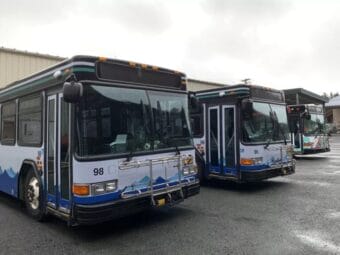
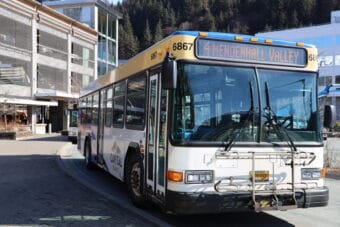
That meant many visitors opted to ride city buses instead. Juneau residents felt the impact of that — when buses were too full, drivers had to pass people by.

Deputy Mayor Michelle Bonnet Hale said she rode a city bus last summer during a busy day to understand the gravity of the situation. 

“It was really, really bad, and the drivers felt horrible having to leave locals behind, who are then missing their jobs and coming in late because they couldn’t catch a bus,” she said. 

According to data compiled by bus drivers, between early May and late July last year, nearly 400 passengers were left behind at bus stops, seven of which were people in wheelchairs. And that usually happened on days with more ships in town. 

At an Assembly committee meeting on Monday, members voted to move forward with a plan to implement a “tripper bus” service for the 2024 summer season. It’s essentially an extra bus that would follow the buses that already go from downtown to the Mendenhall Valley near the glacier.

Juneau tourism manager Alix Pierce says the trippers would run on peak summer days when regular buses are overloaded with visitor passengers. She says the extra service is meant to ensure local passengers aren’t left behind at stops.

“The tripper service is an attempt to solve the problem that is before us. We have too many people riding the city bus in the summer and we’re skipping people at bus stops,” she said. 

Pierce said the tripper service would run between May 1 and Oct. 1.

It’s anticipated to cost the city about $900,000 to run it fully, or it can be scaled down. Pierce said the city hopes to pay for it with the money collected annually from cruise ship passengers. That will be up to the Assembly to decide. 

Pierce says a more descriptive plan for the service will appear at an upcoming regular Assembly meeting and will be open for public comment before approval.

The Assembly also discussed implementing a circulator bus to distribute visitors more evenly across downtown, but ultimately decided against it after learning about the city’s  Ride Free Zone.” It’s a route for locals and visitors that hits four stops downtown and doesn’t require bus fare. Most Assembly members didn’t know it existed.

Cruise ships dumped 90% less trash in Juneau last year

Tourists walk the docks in Juneau in July 2023. (Clarise Larson/KTOO)

Recent data shows about 250,000 pounds of trash made its way from cruise ships to Juneau’s landfill last summer. That might sound like a lot – especially considering that the landfill is only projected to last another 20 years.

But that amount is down from over 3.3 million pounds dumped in 2019

Juneau Tourism Manager Alix Pierce said the reduction — which came despite record numbers of cruise passengers — is groundbreaking. It follows an agreement made by the city and cruise lines in 2022 to reduce those numbers. 

“It’s over a 90% reduction, which is what we were going for with the agreements,” she said. “What we’re doing is exciting, and it takes a lot of collaboration and coordination, but we’re making real change in our community.”

Waste Management, the company that operates the landfill, said it takes in about 100 tons of trash daily — which means all of the cruise ship trash in 2023 amounted to just over a day’s worth of normal trash in Juneau. 

In 2019, cruise ships dumped about 16 days’ worth of trash.

Pierce said the agreement is one step the city has taken in recent years to better manage tourism impacts. Reducing waste was one of the commitments the city’s Visitor Industry Task Force recommended back in 2020.

The agreement asks cruise lines to eliminate offloading bulky and oversized items into the landfill.

“We’ve been hearing for years that cruise ships have been dumping things like mattresses and furniture in our landfill — and that’s really problematic,” Pierce said. “We don’t want to see that in an islanded community, from a waste perspective like we have.”

According to the city’s data, the trash from cruise lines this past season came almost exclusively from two ships that continued to offload regularly. A small portion of trash came from a third ship, but Pierce said it was a “one-off” issue.

She said the city was aware of the third ship because it was ported at a public dock. But the other two ships were at a private dock. 

“In a port where we have four docks, and two of them are public and two of them are private, we don’t have any real control over the private docks,” she said. “We don’t have any regulatory control, and I think that this has taught me that we need better coordination with our partners just so that we know.”

Next season, Pierce says she wants to improve communication with the private docks so the city knows of any offloading as it happens. 

According to Renée Reeve, a spokesperson for Cruise Lines International Association Alaska, the organization has wanted to reduce trash left in Juneau since 2019, when it became aware of how much cruise ships were contributing to the dying landfill. She said the agency is pleased with the results. 

“This is something that isn’t done in necessarily other places in the world. And it was kind of a first of its kind and I think the ability of the industry and the community to work together is extremely important as we address, you know, tough issues together,” she said. 

Reeve said the trash that used to get left in Juneau is likely now going to the ports where the cruises started: Seattle, Vancouver and Victoria. 

This year, Juneau’s first cruise ship will come on April 9. It will be Juneau’s first season with a limit of five large ships per day — another agreement the city negotiated with cruise lines.

Alaska tourism industry expecting another strong year, led by cruise passengers

The Norwegian Bliss, a 4,000 passenger cruise ship, kicked off Juneau’s 2023 cruise season when it docked on April 17, 2023. (Photo by Anna Canny/KTOO)

Alaska’s tourism industry has been rebounding in the years since it was hit hard by the coronavirus pandemic.

Visitors to the state during the 2022 season had an economic impact of $5.6 billion, according to a recent report from the Alaska Travel Industry Association with the most recent available data.

And while the association doesn’t have hard numbers yet for 2023, ATIA President and CEO Jillian Simpson expects a detailed look will show it was another strong year for tourism in the state.

What’s already clear is that Alaska welcomed a record number of cruise passengers last summer, accounting for the majority of the state’s tourists, and about a third of the cruise ships carrying them crossed the Gulf of Alaska, Simpson said, bringing visitors into Southcentral and Interior.

Listen:

This interview has been lightly edited for clarity. 

Jillian Simpson: We still are working off of indicators. We should have better final numbers in the coming month, but we also, statewide, like Juneau, the state did see a record number of cruise passengers arriving, which was very good. And then we also saw probably an increase in border crossings of highway traffic. Ferry travel was, we believe, probably pretty flat. And air traffic was pretty consistent with the previous year, but we think the independent traveler, which was really strong in 2022, probably went down just a little bit in 2023. However, the cruise traffic makes up about 60% of summer visitation to Alaska, so we feel like we had a good summer season in 2023.

Michael Fanelli: How about looking at the past several years, or decade, even. I mean, clearly the cruise industry trajectory is going up. Would you say Southcentral and Interior tourism is generally increasing, too?

Jillian Simpson: Yeah, pre-COVID, I mean, we were definitely seeing a trajectory of growth across all sectors. And then, obviously, COVID was the huge disrupter. And we’re still recalibrating after that. But I think that we’re back on that growth trajectory. So definitely cruising has gone up.

The other place that we have seen a lot of growth, especially when you’re looking at over the past 10 years, has been in winter tourism. So the increase in the number of visitors that come in the winter time has definitely been growing. Sometimes at a faster clip than our summer visitation. Definitely not more volume, but just the percentage of increase year over year has been higher each winter. So Alaska is becoming more and more of a year-round visitor destination.

Michael Fanelli: When it comes to the cruise tourism specifically, I know there’s been a lot of local pushback in some Southeast communities that the numbers maybe are now starting to get too high. And I realize you’re an advocate for the tourism industry, but I’m curious if you think that the idea of limitations in certain cities might be a reasonable thing to pursue.

Jillian Simpson: Yeah, I mean, I think every community has to decide what is, you know, best for them. Certainly, the tourism economy and the cruise ship sector that brings so many visitors is really good for communities and for the economies. And I know that there are a lot of great conversations that are happening with stakeholders in each community about disbursement and ways to alleviate some of the strains that some people may be feeling. But I think overall, tourism is good for communities. It’s good for the economy, and it’s good for Alaska.

Michael Fanelli: I realize that 2024 just started, but do you have an outlook yet for the coming year? What are your expectations at this point?

Jillian Simpson: Yeah, I mean, it’s still early to tell, certainly for summertime. The booking windows have been shrinking. So we’re still a little far out to be able to have really good predictions, but early indicators are positive. Like I said, the winter tourism right now is going strong, so that’s a good sign. The global demand for travel has not diminished at all and probably will continue to increase. Airlines are predicting that there will be even higher demand in 2024 than there was in 2023. We talked about cruise travel being flat for the coming year. And international travel is definitely back. So the United States is experiencing more international arrivals. But also that means that, all of those things are all good indicators for Alaska, but they’re also good indicators for other destinations. So the competition will be strong, but we are cautiously optimistic. [We will] continue to promote ourselves in the marketplace as a quality visitor destination, and hope to get more people here.

Washington man pleads guilty to selling fake Alaska Native art in Ketchikan

Alaska Stone Arts, one of the Rodrigo family’s stores, on Front Street (KRBD File Photo)

A Washington man has pleaded guilty to a federal charge of misrepresentation of Indian-produced goods and products. The charge stems from his involvement in a larger conspiracy to sell over $1 million of fake Alaska Native art in Ketchikan.

According to a plea agreement filed in the District Court of Alaska, Jessie Halili Reginio was charged with violating the federal Indian Arts and Crafts Act by passing off stone carvings and wood totem poles as traditional art made by local Lingít and Haida artisans. They were actually produced in the Philippines. The products were sold out of two storefronts in Ketchikan: Alaska Stone Art and Rail Creek.

The stores were owned and operated by Cristobal Magno Rodrigo and his family members.

Reginio was an employee of the family’s stores and received commissions on the Filipino products they sold.  His plea agreement lists his involvement beginning in 2019. Reginio portrayed himself as an Alaska Native carver named “Sonny.”

In May of 2019, Reginio received commission on a stone-carved bear with a fish in its mouth which sold for almost $1,500. In July of that year, he sold a stone eagle for almost $6,500. Then, a month before his involvement with the scheme allegedly ended, he sold a Philippine-made humpback whale to an undercover law enforcement agent. The whale was signed with a false name: “Kilit.”

Federal authorities say that Reginio would lie to customers that he learned to carve by watching his brother and his uncle “Kilit,” both Lingit master carvers. In a later conversation with a customer, he misrepresented his employer Cristobal Rodrigo as his nonexistent uncle, “Kilit.”

Rodrigo was sentenced to two years in prison for his part in the crime in August of this year. It is currently the longest sentence ever given for an Indian Arts and Crafts Act violation in the United States.

In a statement at the time, Alaska District Attorney S. Lane Tucker said that Rodrigo’s monumental sentence was a testament to the feds dedication to protecting indigenous cultural heritage and that the family’s actions were “a cultural affront to Alaska Native artisans.”

Big changes are coming to the Mendenhall Glacier area

Mendenhall Glacier on Friday, Dec. 15, 2023. (Clarise Larson/KTOO)

After nearly a decade, the U.S. Forest Service has finalized its plan to overhaul Juneau’s Mendenhall Glacier Recreation Area. 

The project has provoked hundreds — if not thousands — of public comments from the Juneau community over the years. 

“I like to see a plan that’s well managed and that listens to residents’ concerns,” said Alexandra Pierce, the city’s tourism manager. “People didn’t want to see motorized boats on the lake and additional visitor center facilities and the Forest Service listens to the public on that, which is a positive thing.”

The finalized plan includes a new welcome center and improvements to the old one. The plan also increases parking, expands trail systems, and adds an amphitheater and new public-use cabins.

The glacier is one of Alaska’s most-visited tourist attractions. Forest Service officials say the improvements will help manage the pressure from Juneau’s rapid growth in cruise ship tourism in recent years. 

When the visitor center was built in the 1960s, the area saw about 23,000 visitors annually. Today, about 700,000 come to the glacier each year. The Forest Service estimates that by 2050, that number could grow to nearly a million.   

Mendenhall Glacier Visitor Center on Friday, Dec. 15, 2023. (Clarise Larson/KTOO)

But as more and more visitors have been coming to the glacier, the glacier has been moving farther away — a process that’s accelerating due to climate change. Researchers from the University of Alaska Southeast estimate that between 2007 and 2021, the glacier has receded the equivalent of eight football fields. 

In a few decades, it likely won’t be visible from the current visitor center at all. As the Forest Service plan took shape, suggestions for dealing with that included building the new center closer to the glacier’s face or allowing motorized boats on Mendenhall Lake to get people closer. Neither made it into the final plan. 

Pierce said that listening to residents’ concerns about overcrowding while knowing that tourism will keep growing makes managing the area a constant balancing act. 

“I do think that’s a difficult puzzle for the Forest Service to try to solve,” she said. “I think we’re all concerned about the receding glacier and what that means for the visitor experience in our community.” 

According to Tongass National Forest Supervisor Frank Sherman, rather than make drastic changes to get people closer to the glacier, the USFS opted to address more pressing needs like overcrowding, restrooms and the aging visitor center.

City leaders are considering whether – and how – to limit cruise ship visitors in Juneau

Juneau City Manager Katie Koester writes a list of ways the city could limit cruise ship tourism at a Juneau Assembly retreat on Saturday, Dec. 2, 2023. (Clarise Larson/KTOO)

A record number of cruise ship passengers visited Juneau this year. Now, city leaders are considering whether — and how — to set a future limit.

At a Juneau Assembly retreat on Saturday, Juneau Tourism Manager Alexandra Pierce said this season’s busiest days made the strongest impression on locals.

“When people are concerned about their experience as it relates to the visitor industry, they’re concerned about the daily impacts – what they see day in, day out,” she said.

Pierce shared initial results from a resident survey the city conducts each year. This time, 56% said the city isn’t doing enough to manage tourism — up from 45% last year. And when asked about future cruise passenger volume, half said it should be lower.

Pierce said there are three kinds of limits she thinks the cruise industry might agree to.

One is a daily passenger limit. Pierce said the industry doesn’t “love any sort of limits, but they’re comfortable with that discussion.” 

The city and the cruise industry have already agreed to a maximum of five large ships in Juneau per day starting next year, but the overall volume of passengers will remain about the same.

Assembly member Alicia Hughes-Skandijs said she liked the daily passenger limit idea, but that she’d also support negotiating a seasonal limit. 

“I do think the overall number in a season matters,” she said. “Our slow days are less slow than they used to be.”

Another option Pierce said the industry might agree to is a limit on ship size. The Spanish city of Palma de Mallorca has both: just three cruise ships can visit each day, and only one of those can have 5,000 passengers or more.

“We don’t have the infrastructure in Alaska to get those massive ships like you see in the Caribbean and Mediterranean, but that’s something that we could consider,” Pierce said.

A third option is to schedule ship-free days. Pierce said the industry seems to like that option the least because of how it might affect trip itineraries.

Assembly member Christine Woll said she’d want to consult local business owners.

“I want to hear from the local tourism industry which of these works for them,” she said. “If we have no-ship days, does everybody close? Do people want to come downtown?”

Pierce said that plan A would be negotiating an agreement with the cruise industry. Regulation from the city government is plan B.

Other communities have tried regulating the industry and wound up in court. Local business owners in Bar Harbor, Maine, sued the town after its citizens voted to approve a 1,000-passenger daily limit. 

City officials in Sitka denied a citizen’s petition to put a visitor cap on the ballot. In a letter explaining his recommendation to deny it, Municipal Attorney Brian Hanson wrote that it was “an impermissible appropriation under the Alaska constitution and contains enforcement provisions that are confusing, misleading, and incomplete.” The city denied it for a second time last week.

“Are there regulatory options that could exist? I think the answer is yes,” Juneau Municipal Attorney Robert Palmer said. “But the question is what type of option are we looking at, and what combination of options are we looking at, and how much risk are we willing to take if we have to fight it?”

In 2021, Juneau resident Karla Hart proposed a ballot initiative to set a ship size limit, no-ship days and no-ship hours. It didn’t get enough signatures to go to voters.

This story has been updated with information about why the City of Sitka denied the ballot proposition.

Site notifications
Update notification options
Subscribe to notifications