Tourism

Summer crowds can slow down Juneau’s cell service. More public Wi-Fi could help.

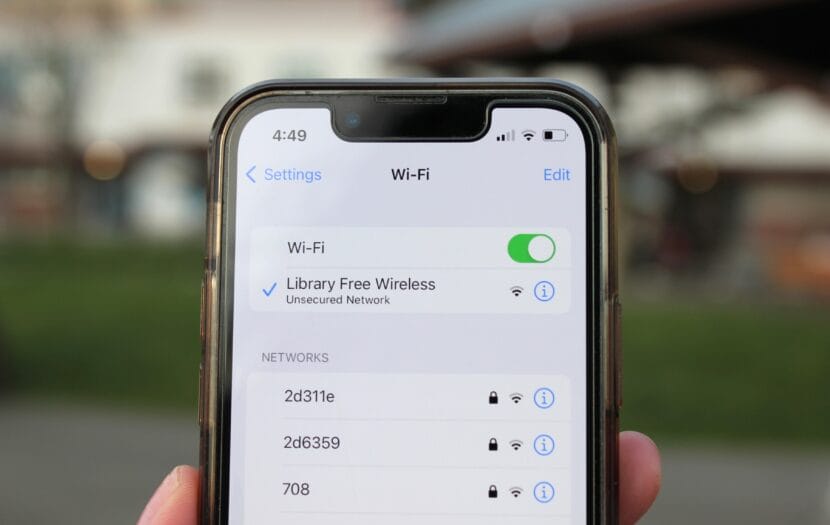
The Juneau Public Library provides free wi-fi in Marine Park during the tourist season. (Photo by Katie Anastas/KTOO)

On the busiest summer days in downtown Juneau, it’s easy to notice the crowded sidewalks, packed city buses and longer waits at restaurants. In recent years, residents and visitors alike have struggled with another sign of the season: slower cell service.  

“On a low ship day, it works just fine,” said Chris Murray, the City and Borough of Juneau’s IT director. “But when you have more people, it’s congested and nobody’s happy.”

Tourism Manager Alexandra Pierce said complaints have increased since the 2022 tourist season, which saw more than 1 million cruise ship passengers in Juneau for the first time in three years.

“Since the industry returned last year, we’ve had a fairly large volume of questions and complaints about whether or not the cruise ships are contributing to this issue,” she said. “And they absolutely are.”

Now, in an effort to free up space on cell service networks, city officials are considering expanding public Wi-Fi service in the busiest parts of downtown during the tourist season.

“The cellular networks only have a certain amount of capacity,” Murray said. “If we can slice off a chunk of passengers onto public Wi-Fi, that frees up space on the cell networks.”

Wi-Fi reduces physical and virtual congestion

City leaders have used public Wi-Fi to reduce physical congestion at the Juneau Public Library.

Before the library added Wi-Fi to Marine Park in 2018, tourists and crew members would often go to the downtown branch to use the internet. City officials reported more than 100 people used the Wi-Fi there on any given summer day, taking up the armchairs and spots at the desks.

“It was creating some congestion issues for them,” Pierce said. 

Yellow signs in the library and near the elevator advertise the free Wi-Fi in Marine Park, which is available from 7 a.m. to 9 p.m. during the tourist season. While Wi-Fi connections in the library last up to one hour, those in Marine Park last up to 24 hours.

“I think it’s taken the pressure off the library to some extent,” Pierce said. “Especially when the weather is nice.”

Along with reducing physical crowding in the library, the Marine Park Wi-Fi helps reduce congestion in Juneau’s cell phone networks. When visitors use that Wi-Fi, they’re freeing up space in networks run by cell service providers like AT&T and GCI. Those networks can slow down when there’s a big influx of visitors. 

“If you’re in Marine Park and you’re on Wi-Fi, then you’re using the city’s Wi-Fi and you’re kind of not part of the problem,” Pierce said. “All your iMessages and WhatsApp and your Instagram story about Juneau is all happening over Wi-Fi, as opposed to over the 4G or 5G network.”

Expanding the city’s seasonal Wi-Fi would give more visitors a chance to get off the 4G and 5G networks and free up capacity for locals trying to use their phones. 
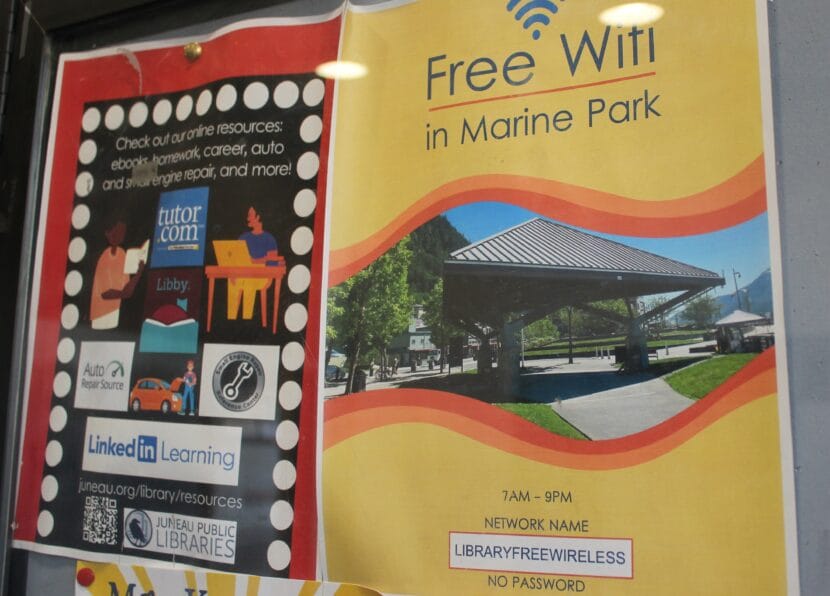
A sign on the bulletin board near the elevator to the library advertises wi-fi in Marine Park. (Katie Anastas/KTOO)

What it takes to expand

The city’s IT department is gauging internet providers’ interest in installing and managing Wi-Fi in a three-square-mile area downtown. The city has put out a request for information, which gives providers a chance to ask questions about the potential project and helps city leaders get a sense of costs and technical requirements. 

According to the request, the new Wi-Fi would only run during the daytime from April to September, and work on the project likely wouldn’t start until at least July 2024. Providers can respond to the city’s request until Nov. 8.

Murray said that the three-mile stretch would start at the whale statue and go south along the waterfront. 

“We would have to connect various access points all the way from the whale statue south, which means bouncing it off light poles and putting in a lot of infrastructure,” he said.
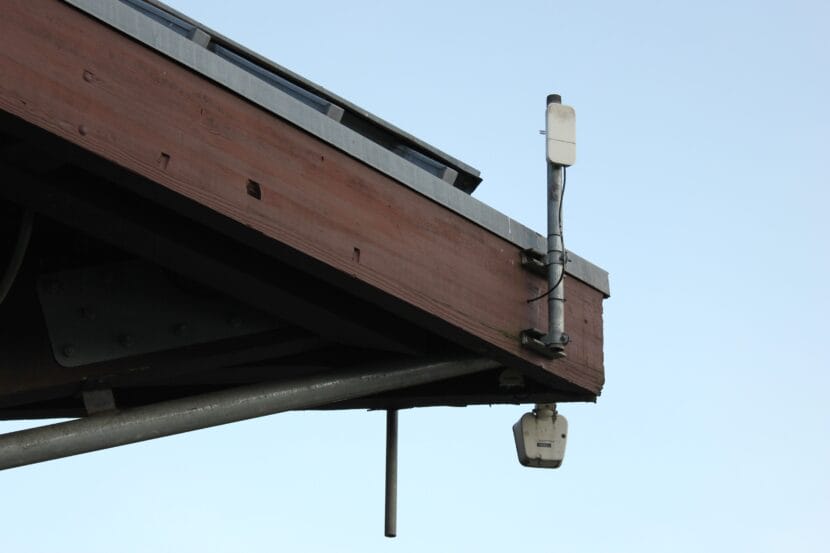
The millimeter wave wireless backhaul on top of the Marine Park pavilion connects a wireless hotspot to the internet. (Katie Anastas/KTOO)

Murray said the request for information will help determine whether that’s even feasible, given factors like the heights of buildings and distances between light poles.

Murray said many of the light poles along that stretch are owned by Alaska Electric Light & Power. Nearby buildings are owned by the state, the city and private owners. A provider would have to work with all of them to make the new Wi-Fi happen.

“We’re really looking for a vendor that has experience working with multiple entities in a tight location,” he said.

If city leaders decide to pursue the project, Murray said the next step is to identify a funding source. After that, the city could issue a request for proposals and contract with a provider.

That source could be marine passenger fees. The Juneau Assembly and Cruise Lines International Association Alaska would have to approve spending those fees on the project.

Marine passenger fees pay for the Wi-Fi in Marine Park, which is provided by local company SnowCloud Services. The city spent $7,800 to set it up, and it costs about $1,900 per season to run it.

Internet providers have set up temporary Wi-Fi hot spots before. In May 2020, Alaska Communications set up public Wi-Fi hot spots at school parking lots in Anchorage and Fairbanks to help students access the internet when schools went remote. 

Other communities provide public Wi-Fi year-round. In Seattle, the city offers free public Wi-Fi at public libraries and several community centers. And throughout Hawaii, state-designated hot spots offer an hour of free Wi-Fi service per device each day.

If Juneau’s project moves forward, it could be the latest way the city adapts to record-breaking visitor numbers during tourism season.
Sitka denies petition to put cruise passenger limits to voters

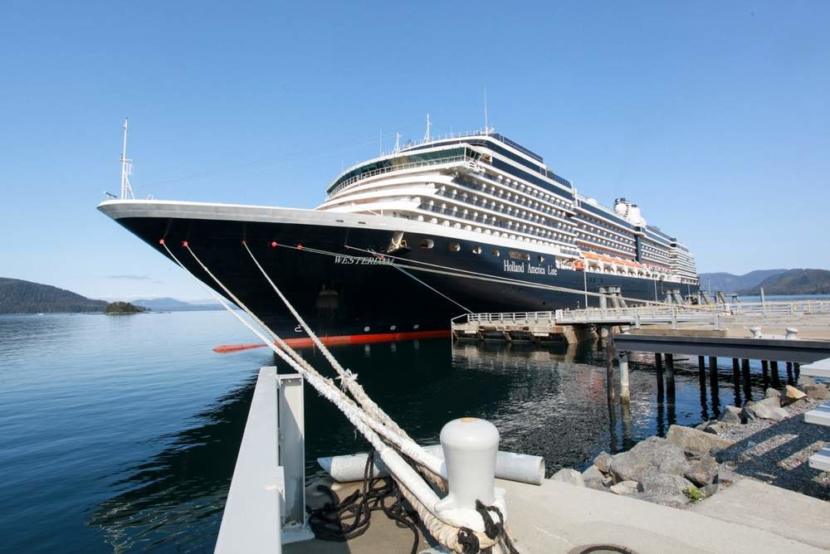
A Holland America cruise ship at the Halibut Point Marine Services dock in Sitka in 2016.
A Holland America cruise ship at the Halibut Point Marine Services dock in Sitka in 2016. (Photo courtesy Chris McGraw)

The City of Sitka has denied a citizen’s petition to put cruise limitations to voters in a special election this winter.

Larry Edwards received notice from the city on Sept. 29 that a petition he sponsored with more than 40 other Sitkans was denied. A letter from municipal clerk Sara Peterson said the proposed legislation would be unenforceable under the Alaska state constitution.

Edwards sought to limit the number of visitors arriving in Sitka by cruise ship next summer to 240,000 total, with weekly and daily limits. It also would have established a Sitka port district. In his recommendation to reject the petition, municipal attorney Brian Hanson wrote that the section describing how the limits would be enforced was “confusing, misleading and incomplete.” Hanson wrote that establishing a port district through a voter referendum would be “an inadmissible appropriation of a public asset,” since the assembly has authority over allocating public assets, including land. Hanson also said that the ordinance would usurp the assembly and planning commission’s authority over city zoning code.

In the letter, Hanson cautions that the ordinance could be unconstitutional at a federal level. In Bar Harbor Maine, citizens recently established a daily cruise passenger limit through a voter referendum, prompting a lawsuit against the city. A ruling in that case will likely come later this year.

In an email to KCAW, Edwards responded to the city’s denial, writing, “Sitkans need relief in 2024 from the excessive cruise tourism of 2022 and 2023. Not pursuing deep cuts for next year is not an option. A next step for that is being developed.”

For the past two summers, the number of cruise passengers visiting Sitka has far exceeded previous records. This summer the city hosted an estimated 560,000 visitors.

And for disclosure, the rejection letter from the city is co-addressed to Larry Edwards and John C. Stein, is a member of the KCAW board of directors. However,  Stein’s name is on the letter only as a alternate addressee to receive mail in the event Edwards were unavailable to receive it. Stein did not participate in drafting the ordinance language or circulating the petition.

Tlingit and Haida, Forest Service plans to expand cultural education at Mendenhall Glacier

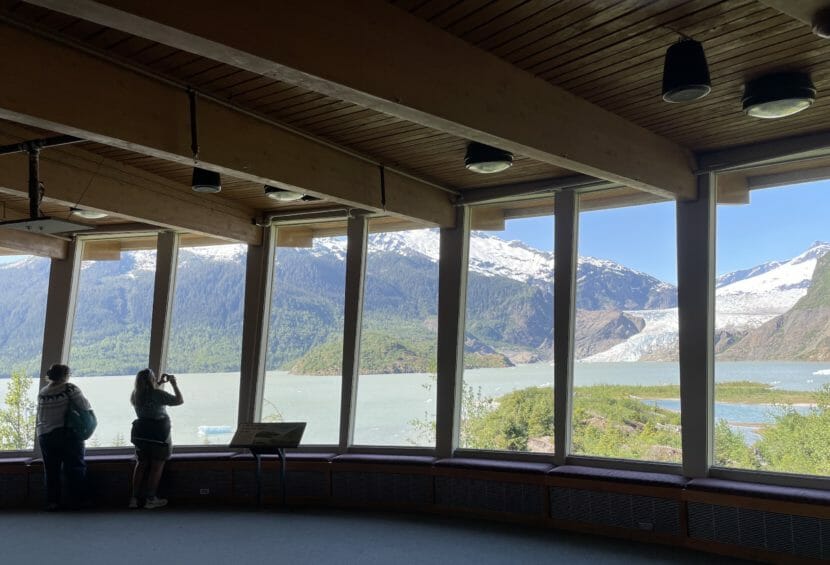
Visitors take images of Mendenhall Glacier near Juneau in summer 2022 from inside the Mendenhall Glacier Visitor Center. (Photo by Ned Rozell.)

The Central Council of the Tlingit and Haida Indian Tribes of Alaska and the U.S. Forest Service will collaborate on managing the Mendenhall Glacier Recreation Area going forward, with plans to better educate visitors on Alaska Native culture. 

Tlingit and Haida President Richard Chalyee Éesh Peterson said the Tribe is excited to share more cultural history with the nearly one million tourists who pass through the Mendenhall Glacier Visitor Center each year. 

“The people who go there want to learn about the glacier. They also want to learn about the people,” Peterson said. “And if you know anything about Lingít culture, we have songs, stories, history about migrating over, under and through the glaciers.”

The Forest Service and Tlingit & Haida signed a memorandum of understanding last week, which outlines a mutual commitment to collaborating on resource management and planning in the recreation area. 

Kevin Hood, the regional tribal relations programs manager for the Forest Service, said the agreement builds on the agency’s commitment to strengthening federal and tribal cooperation across the region

“We are overdue for having better representation of the Alaskan Native perspective,” Hood said. “It’s part of upholding our nation to nation relationship with these sovereign Tribal nations.”

At the glacier, the first priority will be including more Lingít culture, history and language in the recreation area’s programming. That will likely include updating signs and displays on trails and in the visitor center. But according to Hood, the memorandum of understanding could also pave the way for collaboration on trail maintenance, watershed restoration and caring for the fish and wildlife in the area. 

In the short term, the agreement calls for the Forest Service to hire Tribal citizens to work as educators and guides.

“Who better to tell our stories than us?” Peterson said. “Aak’w Kwáan people talking about Aak’w Kwáan, you know?”

Sitkans push for vote on cruise visitor limits

Sitka’s Lincoln Street on June 21, 2023. (Rich McClear/KCAW)

As a record-breaking cruise season in Sitka comes to a close with the promise of another equally busy summer on the horizon in 2024, some are wondering how Sitka can sustain its tourist boom. Now a group of Sitkans is calling for a cap on the number of cruise passengers next year. They want to put that question out to the voters in a special election this winter.

Sitkan Larry Edwards has drafted a ballot initiative before. In 1995, the former pulp mill employee organized an effort to limit clear cutting.

“It was to establish a zone within 35 miles of downtown that would be clear-cut free,” Edwards says. “It lost by four votes.”

He hopes his newest initiative doesn’t meet the same fate. When asked whether cruise tourism is more or less extractive than logging, he smiles and says he’ll have to think about that. Either way, he thinks it too should be limited.

“It’s just absolute chaos. I feel that the cruise industry thinks it’s the planning director of the city and that we have to march to its orders,” Edwards says. “I think we need to take control back.”

This summer, cruise ships brought around 560,000 people to Sitka. That broke last year’s new record, and more than doubled any year before that in Sitka’s history. Edwards thinks it’s time to ask Sitkans where the bar should be.

“There have been a number of surveys done that have shown that about two-thirds of people in town think it’s way over the top, and has been for quite a while. It’s been controversial since the 1990s,” Edwards says. “And nobody’s really ever asked…the people of the city of Sitka what they want, and asked them to vote on some number. This is the first, and someone had to stick their neck out to do it.”

For the last few months, Edwards has been quietly drafting an ordinance that would ask voters to decide whether Sitka should establish a “port district” on its road system and limit cruise visitation to 240,000 people next year.

He’s using Bar Harbor Maine as a template. Like Sitka, Bar Harbor’s cruise ship dock is privately owned. Last November, voters approved an initiative to cap cruise traffic, which could take effect next summer, pending litigation.

“The initiative set a flat limit of 1000 persons per day, crew plus passengers, that would be allowed to get off of any number of cruise ships that came to town. That past two-to-one,” Edwards says. “It’s very stringent. And what I have in this initiative is much more relaxed than that, and rather than just having a flat number, there’s some logic to the numbers that are in it.”

Edwards took the last 20 pre-pandemic years of cruise traffic with passenger counts over 200,000, and made the average the cap. The ordinance also includes a weekly cap of just over 13,000 as well as daily limits. It also would require the cruise companies to secure permits with the city and provide the city with daily updated data on passenger and crew counts.

Edwards turned the ordinance into city hall on Friday morning (9-15-23) with the signatures of 44 other sponsors. As of press time, Municipal Administrator John Leach hadn’t seen the initiative, so he couldn’t comment on its specifics, but he’d anticipated that a ballot proposition was coming down the pike. On Friday, Leach published a letter addressing the city’s response to tourism, warning that a ballot initiative to limit tourism comes with economic, constitutional and legal concerns.

“My hope was that…we as the city, we would get more of an opportunity to continue working with the stakeholders,” Leach says. “We had hoped that our tourism taskforce and the great work that we’re doing there would have an opportunity to take hold and produce something. Because I think an agreement with stakeholders that’s not so restrictive is the better path forward.”

“So knowing that that conversation was taking place, I felt like this was the appropriate time to get the information out there and kind of let everybody know what the risks are, and what the concerns are with with more restrictive measures.”

He worries that any ballot initiative to limit cruise traffic could lead to litigation. That’s been the case in Bar Harbor where local business owners sued the city. A federal judge is expected to issue a ruling in the case soon.

“There is a big litigation risk, and the way we’re going to have to pay for that litigation, when and if it comes this way, is right out of our general fund. And our general fund is what pays for our public schools, it pays for our infrastructure, and it pays for our public safety,” Leach says. “So the litigation costs are going to have to come from somewhere…if we get to a place where stakeholders decide to pursue this in a legal matter.”

Leach feels that the city is doing what it can to respond to the influx. In addition to the work of the tourism task force the assembly established last year, he’s collaborating with other Southeast communities with plans to develop an agreement with the cruise industry, similar to the recent “memorandum of understanding” Juneau struck.

But Edwards thinks Sitka needs to respond faster. He believes the ordinance is pro-tourism, pro-Sitka, just trying to find the right size for it. And it’s meant to be a stopgap.

“So the idea is to give Sitka the relief it needs for 2024 and then, win or lose, it’s going to get some good discussion going. If it wins, it’ll be in place for a year,” Edwards says. “In the interim, we can be working as a community towards what we want to do more longer term for 2025 and beyond.”

Whether Edwards’ initiative will make it on the ballot yet remains unclear. First, he has to collect just over 800 signatures- a third of the voters in the last municipal election. He has three months to do that, but he hopes to knock it out in three weeks. Then the ballot prop must be vetted by the city. If it gets the green light, Sitkans could be voting on cruise limits in a special election by early December.

Juneau short-term rental operators must register with city by Oct. 8

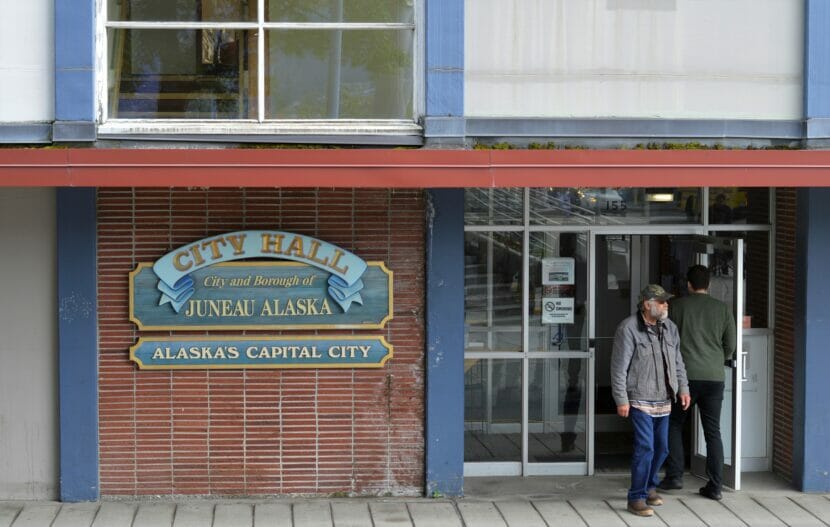
People enter and exit Juneau’s city hall on Friday, Sept. 15, 2023. (Katie Anastas/KTOO)

The City and Borough of Juneau’s short-term rental registration form is now available online.

Rental operators must register by Oct. 8 or face a $25 fine per day.

The form asks for an operator’s Alaska business license number and city sales tax account number, along with the rental’s location and capacity. Operators can fill out the form online, or print it out and submit it by mail or in person. Property managers can register on behalf of their clients, but owners are still ultimately responsible for the registration.

The city considers short-term rentals to be less than 30 consecutive days. There is no fee to register a rental with the city. Registrations will renew annually.

The Juneau Assembly approved the program in July. City leaders say it will help ensure operators are paying sales tax and provide data on the growing short-term rental market.

Short-term rentals are subject to both the city’s 5% sales tax and 9% hotel tax.

NTSB investigates mid-air collision over Katmai National Park

Katmai National Park is famous for bear watching and because it’s off the road system, most people get to the park via planes. (Brian Venua/KMXT)

A de Havilland Beaver operated by Alaska’s Enchanted Lake Lodge Inc. and a Bell 206L-4 LongRanger helicopter operated by Maritime Helicopters collided in mid-air over Katmai National Park during Labor Day Weekend. The plane’s pilot and passengers reported no injuries, but the helicopter’s pilot was injured in the crash.

The accident took place at about 4:30 p.m. on Monday, near Lake Coville in a northern area of Katmai National Park and Preserve.

“It was struck in the tail rotor section over there, the back of the helicopter basically was damaged,” said Clint Johnson, the National Transportation Safety Board’s Alaska region chief. “The airplane was able to make an emergency landing in a nearby creek and the helicopter descended uncontrollably into an area of tundra and tree covered terrain.”

The helicopter pilot was able to walk away from the incident, but he was still brought to Anchorage for further medical examination.

Katmai National Park doesn’t have an air traffic control tower to coordinate take-offs and landings. Mark Sturm is the park’s superintendent; he said pilots usually communicate over radios to prevent collisions like this one.

“Pilots that come into the park essentially are in touch with each other and try to manage the traffic locally by talking to each other about how they’re approaching, what they’re doing, and being in contact with planes on the ground,” Sturm said. “But obviously, in this case, these two aircraft were not in communication and the accident happened as a consequence.”

The aircraft were about 1,000 feet above ground when they collided, according to preliminary information. Johnson, with the NTSB, says investigators are still talking to both pilots.

“What we’re trying to do now is trying to figure out how these two airplanes came together – ultimately determine if each one of the pilots were able to see each other and the circumstances that led up to it,” he said.

Johnson says a preliminary report is expected later this month.

In July, a different Bell 206L-4 operated by Maritime Helicopters crashed on the North Slope, killing the pilot and three state scientists.

Site notifications
Update notification options
Subscribe to notifications