Tourism

Juneau residents have 1 month to submit proposals for using cruise ship passenger fees

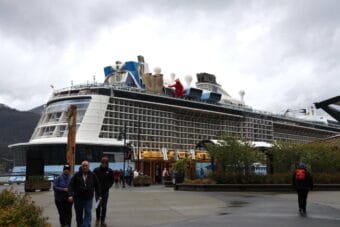
Cruise ships docked in Juneau on Aug. 28, 2023. (Katie Anastas/KTOO)

Juneau residents can submit proposals for how the city should spend marine passenger fees next year.

The city has collected a $5 fee per cruise ship passenger since 2000. Those fees, which usually total around $20 million, help fund projects that both serve visitors and lessen tourism’s impact on locals.

“If there are things that can benefit everybody, residents and visitors, and we can use the visitor industry funding stream to do it, then that’s a great thing for the community,” said Tourism Manager Alexandra Pierce.

City departments, business owners and the public can submit proposals for projects until Jan. 3. Pierce said proposals should include a description of the project and a cost estimate. They can be sent by mail to the city manager’s office or by email to Pierce.

Projects funded with marine passenger fees generally need to be in the downtown waterfront area, Pierce said. Other areas of town are eligible, but they need to be popular with visitors. For example, marine passenger fees are paying for improvements to Homestead Park on Douglas.

“We always like good ideas from residents,” Pierce said. “If we can make it work somehow, we try to do it.”

Last year, Capital Transit proposed adding signs at the Downtown Transit Center with information about getting to the Mendenhall Glacier. Other funded projects included Marine Park construction and restroom maintenance at the docks.

Pierce said she plans to recommend funding a circulator bus to spread visitors out throughout downtown, expanding public wi-fi and extending the seawalk from the Franklin Street Dock to the AJ Dock.

“The seawalk is a great community asset, so I’m excited for the opportunity to fund that,” she said.

Once Pierce receives proposals, a draft list of recommended projects will be open for public comment. The Assembly Finance Committee will review the proposed projects, public comments and the city manager’s recommended list. Then, the Assembly will consider which projects to fund during the spring budget cycle.

This 3-year cruise around the world is called off, leaving passengers in the lurch

When the Life at Sea cruise line failed to purchase the German cruise ship AIDAaura, seen here in 2020, its plans for a worldwide cruise embarking in November began to unravel. (Marit Hommedal/NTB Scanpix/AFP via Getty Images)

They were promised the world. But cruise company Life at Sea recently told customers who bought passage on a three-year voyage that rather than visiting 140 countries, their trip was called off.

Those customers are now scrambling to make new plans for where they will live for the next three years — and to extract refunds from the cruise line. The intense fallout is drawing comparisons to infamous debacles such as the Fyre Festival — the “luxury” music festival that was more like a “disaster relief area.”

Here’s what to know about the cruise around the world that was called off

What was promised? The world.

The original itinerary mapped 1,095 days of travel, heading from Istanbul to Europe and then to South America and the Caribbean. Passengers would then pass through the Panama Canal before seeing the U.S. West Coast, Hawaii and Alaska — including Juneau — and then head west across the Pacific.

“We are going to be following summer the entire time that we go around the world,” then-Life at Sea CEO Kendra Holmes told prospective passengers in a Zoom webinar in September.

Voyagers were to see seven continents, visiting 140 countries. They would spend roughly 300 days at sea, 795 days at port and have 413 overnight port stays, Chief Operating Officer Ethem Bayramoglu of Miray Cruises, the Turkish parent company of Life at Sea, said in that online session.

Along the way, they would explore wonders of the world, visit UNESCO World Heritage sites and have plentiful chances to go diving and snorkeling, the company said.

The three-year voyage was to begin on Nov. 1, departing from Istanbul. Some passengers reportedly only learned of the cancellation after arriving in Turkey.

What are customers saying?

“Some people read the headlines and think, ‘Oh, that was a scam,’ but I really did my homework before I put a deposit down,” Keri Witman of Cincinnati told NPR. She had attorneys check the company’s background, for instance.

Witman, who owns a marketing agency named Clever Lucy, was planning to work remotely aboard the ship, using its Starlink internet service. And as a single woman, she had been looking forward to exploring the world with a group.

“Having a like-minded community of people that all were interested in travel at the ready was really appealing to me,” she said.

When the cruise missed its planned departure date, the company promised to resolve lingering issues. But after further delays, the trip was canceled.

Witman says the company has begun the refund process, accepting her requests for other expenses to be paid, from airfare to the costs of foreign visas. But some of her fellow customers seem more frustrated.

“Still waiting for my refund. And now you’ve gone belly up?” a woman who identified herself as a Life at Sea customer said recently on the company’s Instagram account. The woman, a retired educator, did not respond to NPR’s message seeking further comment.

Former flight attendant Meredith Shay was looking forward to the trip as a centerpiece of her retirement.

“How did I feel about it?” Shay said in an interview on ABC’s Good Morning America. “Devastated, disappointed, sad. I packed up my belongings, put them in storage, sent four boxes to Miray Cruises.”

Witman says she also shipped boxes to have on the cruise, back in early October.

“I’m following them along on my AirTags today,” she said. “They’re on their way back.”

How much did the Life at Sea cruise cost?

The cheapest packages started at $196,000 for a single traveler, and $231,000 for couples, according to the company’s website. Costs ranged much higher for guests staying in premium rooms.

In exchange, passengers — or residents, as the company called them — were promised a long list of amenities, including an onboard hospital and doctor. Some cabins could host cats; travelers were also promised high-speed internet, free dining, alcohol and laundry service, and “enrichment seminars.”

Terms of the deal help illuminate the would-be passengers’ financial and logistical plight. Life at Sea set initial deposits at 30% of the overall cost. Under its 12-month payment plan, the first draw came due one month ahead of the sail date.

And rather than portioning the cruise for sale in smaller stages, the company required customers to commit to the full three years.

“Our residents are changing their lives for this opportunity, and we are honored to be a part of their personal journeys,” Holmes said in June.

A wide range of passengers had booked cabins.

“The age group is split pretty much between 35 and 85” years old, and the passengers included a large number of Americans, Holmes said.

Did the cruise line actually have a ship?

“In two days’ time, we own this vessel,” Life at Sea itinerary planner Robert Dixon said in late September, speaking in a promotional video from the bridge of a ship he called the “MV Lara.”

But the company wasn’t able to close that deal, and the ship in question — the 20-year-old AIDAaurawas instead sold in November to Celestyal, which specializes in Mediterranean cruises.

Miray’s attempts to purchase the ship dragged on for weeks, and it eventually stalled after investors balked, according to a company message obtained by CNN and other outlets.

“If you’re focused on the ship, this is not the journey for you,” Holmes said in the September webinar. But two months later, she would leave her leadership post at Life at Sea and Miray, as plans for the ambitious cruise unraveled.

Holmes was trying to allay concerns about the quality of the vessel. But it seems that it was the company’s focus, not the public’s, that was the problem.

Warning flags went up earlier this year, when the company changed course from its initial plan to refit one of its ships, the MV Gemini. For the lengthy worldwide voyage, it planned to deploy the larger “MV Lara” — a ship that never materialized.

What does the cruise company say now?

It’s complicated. On Sunday, Miray Cruises issued a statement in Turkish, denying that the cruise is canceled. Instead, the company said the voyage is postponed — and it blamed a lack of enough passenger bookings, rather than problems finding an appropriate ship.

But responding to a social media comment about that same statement, the company sought to clarify that its other operations are unaffected — and in doing so, it stated, “The cancellation in question is related to our 3-year world tour project.”

The company said that anyone requesting a refund will get one, and that it will reimburse travel expenses related to the cruise. Miray also says it plans to mount a similar trip next year.

Witman, for one, says she’s still interested in a worldwide cruise.

“There are two other companies that have been working on a similar concept” that have also run into delays, she said.

“I think one of them will make it happen in 2024,” Witman said. “And I’m hopeful that it will, because I’d like to be on it. I still believe in the concept. I think it’s a really perfect opportunity for me.”

Despite the setback, Witman says she’s been able to form connections with other would-be passengers, who have been keeping in touch via apps and group texts. Some of them are even making plans to travel together this winter.

“I don’t regret at all going down this path,” Witman said. “It moved me forward in a way that I wouldn’t have done without this instigation. And I’m really thankful for it. I’m disappointed, but I’m ready to go for whatever opportunity comes up next.”

Copyright 2023 NPR. To see more, visit https://www.npr.org.

Tourism, aging population create ‘a lot of challenges’ for Ketchikan’s first responders

An ambulance crew unloads the first “victims” during an emergency preparedness drill. (KRBD photo by Leila Kheiry)

More ambulance calls. It’s something Rick Hines, Ketchikan’s fire chief, is grappling with.

“So, there’s a lot of challenges with the increased call volume and limited personnel,” he said.

The calls are for any number of things. The day before, the crew responded to a cat that was stuck in the dash of a car. The cat is fine. But Hines says the increase in callouts has a few causes.

Ketchikan’s aging population is one of the big ones. According to the U.S. Census Bureau, the number of people in Ketchikan above the age of 65 increased by a little over 75% over the last decade. That’s more than any other population group, and it’s above the state average.

Pair that with more tourists, and Hines says it puts a real strain on the fire department.

“The struggle for us is to provide the best service possible to our year-round residents, the people that live here, while also being able to service those coming in to enjoy our city,” he said. “I think there was a couple of times last year that we had seven emergency calls occurring at the same time.”

When that happens, the fire department pages off-duty crew members to respond to those additional calls. He said the guys need those days off to catch up on sleep and do the things we all need to do on our days off.

“So, I think that it’s a system that’s very challenged,” Hines said. “If you think about it – I’m just giving an example – yesterday, our off-duty crew responded to 17 calls. And we sent out a page for off-duty members to come in. Today, they’re already, I think 10 or 11 calls in one day already.”

Ketchikan is expected to have many days of more than 19,000 visitors next season. Hines believes that number is pretty conservative. For one thing, he said they don’t account for all of the crew members that are getting off the boats and heading into town.

“Some of the lessons we learned is – when a cruise ship, they’ll dock and they’ll call us and say, Hey, we got we have three patients that need go to the hospital, instead of utilizing three ambulances, we’ll send one ambulance crew, and they’ll make an assessment on the criticality of all three of those patients,” Hines said.

The fire department is working with the South Tongass Fire Department and the emergency planning commission to put these lessons into action. They are also trying hard to increase their volunteer ranks ahead of the first cruise ship expected to be making port in April.

Juneau’s record cruise season meant a busier downtown — and more complaints from locals

Cruise ships docked in Juneau on Aug. 28, 2023. (Katie Anastas/KTOO)

A record 1.64 million cruise ship passengers visited Juneau this year, according to city officials.

“That is about 40% growth from last season, and about 30% growth from our previous busiest year ever, which was 2019,” said Juneau Tourism Manager Alexandra Pierce.

In 2019, 1.33 million cruise ship tourists visited Juneau. Last year, 1.15 million did.

All of those passengers led to more complaints from Juneau residents. The city’s most popular destination, the Mendenhall Glacier, reached its tour capacity. And even some business owners say it was hard to keep up.   

Pierce said that while this year’s number may have felt surprising, it’s in keeping with pre-pandemic predictions. In 2019, when Mayor Beth Weldon established the Visitor Industry Task Force, Juneau expected passenger numbers to continue growing steadily in the coming years.

“Then the pandemic hit,” Pierce said. “We took a few years off, and all of the people that were projected to be here for 2023 came. But we didn’t ramp up into that.”

‘Shoulder to shoulder’

Pierce said more tourists meant more complaints from residents this year — to her, to the Juneau Assembly and to the city’s Tourism Best Management Practices hotline. 

The hotline got nearly twice as many complaints this year as last year. Most were about buses and shuttles, but there were also many more comments in the “other” category, which Pierce said includes things like internet speed and overall busyness.

Comments to the Tourism Best Management Practices hotline were up significantly this year. (Screenshot from memo to the Juneau Assembly Committee of the Whole from Tourism Manager Alexandra Pierce)

Downtown Juneau felt busier than ever, and not just because the sheer number of visitors was up. Another reason was the lack of tour bus trips to the Mendenhall Glacier. Tour operators sold out halfway through the season, which meant more tourists stayed downtown.

Pierce said business owners had mixed feelings about the increased foot traffic.

“We heard from business owners that they were doing well financially,” she said. “We also heard from some business owners and people who have been in the industry for a long time that this kind of feels like Juneau’s capacity.”

Drums with hand-painted formline art hang on the wall in Mt. Juneau Trading Post, a store in downtown Juneau. (Katie Anastas/KTOO)

Kyle Sage, who works at Mt. Juneau Trading Post, called this season “intense.”

“At times, it was shoulder to shoulder in the shop,” he said. “Sometimes I just ran out of stuff.”

Mt. Juneau Trading Post sells handmade drums and ivory carvings along with souvenir jewelry and keychains. 

Sage said he usually reorders merchandise once each season. This year was different.

“Normally I do one reorder,” he said. “This summer I was calling reps — I think I called them two or three times at least to try and stay ahead of the game. Sometimes it worked, sometimes it didn’t. I think I’m still waiting on orders I ordered in August, September.”

Sage is already thinking about next year. He usually orders the bulk of his merchandise in January or February, so it can arrive in April.

“But they’re moving the boats forward, so I’ll be looking to get a March delivery,” he said.

Tuncay Esener owns Pandora’s Box, a shop in downtown Juneau that sells Turkish jewelry, lamps, leather goods and more. (Katie Anastas/KTOO)

Tuncay Esener, who owns another shop downtown called Pandora’s Box, has also adjusted to the earlier season. His first summer in Juneau was in 2022, and he opened up shop on June 15. This time around, he knew to open the store earlier.

He also changed his merchandise, offering more handmade Turkish goods. He said the colorful, stained glass lamps hanging throughout the store were his most popular product.

He’s looking forward to having more local customers now that the tourist season is over.

“Local people don’t want to come in the summertime because it’s so busy,” he said. “I will be very happy to see local people in my shop.”

Staffing is still a challenge

Research firm Rain Coast Data reports on Southeast Alaska’s visitor industry each year. In this year’s report, they said that despite the record-breaking number of visitors, the tourism workforce was still below 2019 levels.

Gary Totwani and his wife opened their jewelry store, Gary’s Fine Jewelry, in 2020. They’d had high hopes for a record season, before the pandemic hit.

“We were supposed to open in March, but there was nobody in town,” Totwani said. “It didn’t make sense to go into more debt.”

They ended up waiting to open until November 2020. While they’ve built a steady local customer base by offering repairs and custom jewelry, Totwani said hiring remained a challenge this year. They ended up relying on a family member to help out.

“The staffing is a real issue in Juneau,” Totwani said. “We’d try to contact somebody, and then they didn’t have enough experience. And then if they had experience, we’d try to call them and they say, ‘I will come,’ and nobody shows up.”

In an April 2023 survey, business owners in Southeast said the lack of housing and childcare were the biggest challenges to hiring and retaining workers.

A sign outside Juneau’s Red Dog Saloon lets customers know they’ll be closed for a month. (Katie Anastas/KTOO)

Next season will be longer

Next year’s season will be Juneau’s first with a limit of five large ships per day. Pierce thinks Tuesdays in particular will feel less hectic next year.

“Our busiest Tuesdays this summer were about 21,000 passengers, which is a shocking number of people,” she said. “Our busiest Tuesdays next summer will be about 17,000. Still heavy days, but it’ll reduce the maybe fever pitch that we saw in some of the busiest days this year.”

Overall, though, the total number of visitors in the season will remain about the same.

“The 2024 season will be similar in volume, but slightly longer,” Rain Coast Data analysts wrote in their report. “The cruise ship season is expected to run a full seven months.”

Juneau’s first ship of the 2024 season is scheduled for April 8, and the last is scheduled for Oct. 24. But Pierce says bigger ships — and ships with fewer empty beds — have contributed more to growth than longer shoulder seasons have. 

“Our steady numbers for 2025 tell me that they’re keeping the same ships in the market, more or less, and that things are kind of leveling off,” she said. “That allows us to have the conversations we need to have for 2026.”

In the meantime, city leaders will soon start deciding how to spend this year’s marine passenger fees — the $5 per cruise ship passenger fee meant to fund projects that both improve the tourist experience and offset the industry’s impacts on locals. 

Pierce has a few projects meant to reduce congestion that she’d like to see funded. One is a downtown circulator bus, which would help tourists get to attractions outside the core of downtown, like the Alaska State Museum and the Governor’s Mansion.

She’d also like to see funding put toward extending the Seawalk to the AJ dock.

“It will take a lot of shuttle buses off the road,” she said. “Right now, they shuttle a lot of people because it’s not really an attractive walk. If you get off your ship and it’s a nice walk down the dock into town, that’s a really different proposition.”

The city will also spend the next few weeks surveying Juneau residents about the season. Pierce said those results, along with results of a visitor survey, will be ready for review by the Juneau Assembly in early December.

Alaska breaks cruise ship passenger record as tourism rebounds from the COVID-19 pandemic

Cruise passengers stroll the waterfront in Juneau on May 9. (Photo by Yereth Rosen/Alaska Beacon)

The state of Alaska broke its 2019 record for cruise ship tourism this summer, with Alaska’s capital city recording 1.65 million passengers this year, according to figures released Thursday at a meeting of the Juneau Chamber of Commerce.

Most Alaska tourists arrive via cruise ship, and Juneau sees all but a handful of the cruise ships that visit Alaska each summer, making the city’s figures a proxy for the industry as a whole.

The newly published figures mark a rebound — and then some — from the COVID-19 pandemic emergency.

Juneau recorded 1.2 million cruise ship tourists in 2022, 124,600 in 2021, 48 in 2020, and 1.33 million in 2019. The 2019 figure was the previous record.

“This is a 23% increase from our best season ever before,” said Meilani Schijvens, director of Rain Coast Data, the economics firm that published the numbers.

“It ended up being a really, really strong season here in Southeast Alaska,” Schijvens said.

The figures, based on per-passenger head tax figures calculated by the City and Borough of Juneau, were released as part of an annual report commissioned by Southeast Conference, the regional economic development organization for Southeast Alaska.

They include only “manifested passenger numbers,” said Juneau Port Director Carl Uchytil, so they don’t include the thousands of crew aboard ship. The figures also don’t differentiate between passengers who disembark in the city and those who stay aboard ship.

Brian Holst, director of the Juneau Economic Development Council, said the figures are “absolutely” good news for his community “because economic sectors like tourism have come back solid” since the pandemic emergency.

“Businesses are reporting either a good year or a great year,” he said.

An annual panel survey of 370 Southeast Alaska business owners found 73% had a positive view of the region’s economy, the highest mark since the survey began in 2010.

Almost 80% of survey participants said they have positive expectations for 2024 as well.

Tourism accounts for 15% of Southeast Alaska’s jobs but only 9% of its wages; most tourism jobs are seasonal, occurring during the cruise ship season that runs from April through October.

Government work — state, federal, local and tribal — accounts for more than a third of the region’s jobs and wages and is the leading economic sector.

While the number of visiting tourists is above what it was in 2019, the number of tourism-related jobs in Southeast Alaska remains below what it was in the prior record year, as do wages. Tourism-related employment accounted for 12% of all wages in Southeast Alaska in 2019 before declining during the pandemic.

Employers across the region continue to report a workforce shortage, with construction workers in particular being hard to come by.

“Really, we could use a lot more foreign workers coming into the United States and coming into Alaska to bolster our economy,” Schijvens said.

According to her firm’s survey, more than half of the region’s business leaders said a lack of housing has cost them employees.

Survey respondents also said the cost and availability of child care was a major factor in their inability to hire and retain workers.

Over the past 12 years, the price of an average single family home in Juneau has risen 52%, 22 percentage points above inflation during that period, Schjivens said. Average wages in the city rose 38%, 8 points above inflation, during the same period.

Juneau Mayor Beth Weldon said of the 2023 cruise ship season, “We are happy with the numbers for the tourism numbers, but at the same time, we understand that the community has felt a little tension this year.”

Concerns about traffic and overcrowding have risen along with passenger volume, and the city has reached a voluntary agreement with the cruise industry to cap the number of ships per day.

No more than five large ships will be permitted on any given day, starting next year. According to preliminary data shared by Schjivens, 50 ships have planned a combined 660 voyages to Southeast Alaska in 2024, with the first ship due in Juneau April 8, and the last on Oct. 26.

That’s an extension of this year’s record-long cruise ship season, which began in mid-April, and Schjivens expects 1.7 million tourists in the capital city next year, another record.

Problems plaguing small outdoor recreation businesses explored at U.S. Senate hearing

In Iowa, tourists can catch boat rides on Lake Okoboji from Arnolds Park, one of the area’s busiest shopping and dining spots. (Photo by Kathie Obradovich/Iowa Capital Dispatch)

WASHINGTON — Operators and promoters of outdoor recreation companies said at a U.S. Senate hearing that small tourist businesses like theirs are a critical part of the rural U.S. economy facing multiple challenges.

Witnesses before the Senate Committee on Small Business and Entrepreneurship on Wednesday listed climate change, inflation, high gas prices and a potential government shutdown as areas of concern for the future of their businesses. They also emphasized the significance of conservation practices that make the outdoor recreation industry thrive.

Sen. Jeanne Shaheen, a New Hampshire Democrat who chairs the committee, said outdoor recreation is one of the fastest growing sectors of the economy, generating $862 billion in total economic output last year.

“The outdoor economy is outpacing the rest of the American economy,” Shaheen said.

She said that in 2021, gross domestic product for the outdoor recreation economy increased by 18.9%, compared to the overall economy’s 5.9% GDP increase.

“The outdoor recreation industry is built by small businesses and entrepreneurs,” she said. “Now because the outdoor recreation industry is driven by small businesses, it is a foundational part of many rural communities and is critical to their economic well-being.”

Ranking member Joni Ernst, an Iowa Republican, said a small business can be found “operating in every sector of the outdoor economy.”

Shaheen said such small businesses face “magnified” challenges, including limited broadband access, workforce shortages and problems accessing capital.

She said maintaining a healthy environment is key for the survival of outdoor recreation small businesses.

Outdoor recreation bill

Jessica Wahl Turner, president of Outdoor Recreation Roundtable, advocated for America’s Outdoor Recreation Act. Outdoor Recreation Roundtable is a coalition of outdoor recreation trade associations and organizations — most of which are small businesses, Wahl Turner said.

U.S. Senate Energy and Natural Resources Committee Chairman Joe Manchin III, a West Virginia Democrat, and ranking member John Barrasso, a Wyoming Republican, re-introduced America’s Outdoor Recreation Act in March.

The legislation aims to “increase and improve outdoor recreation opportunities across the nation while improving infrastructure and driving economic growth in rural communities,” according to a committee press release.

“While our cumulative economic power is mighty, unlike other industries with similar economic impact, we are a mile wide and an inch deep, so our small businesses do need support,” Wahl Turner said.

To better support small businesses, Wahl Turner’s written statement urged Congress “to focus on providing stability for businesses, increasing access to and improving infrastructure on healthy public lands and waters, and growing workforce pipeline opportunities and rural economic development tools for communities utilizing recreation to revitalize their economies.”

Other witnesses included Chris Fox, the chairman of Iowa Ducks Unlimited, which pushes for wetlands conservation, and Andrew Drummond, the owner of Ski The Whites, LLC. Ski The Whites is a backcountry ski store in Jackson, New Hampshire.

To strengthen conservation efforts, Fox called on Congress to cut back on regulatory “green tape” for conservation programs, enhance conservation on working farm and ranch land and expand conservation programs on tribal lands.

“These efforts will result in more waterfowl and more wildlife, and stimulate greater economic activity in our tourism industry,” Fox said. “They will also make our air and water cleaner, recharge precious groundwater systems and fortify our communities against the threats of extreme weather.”

Small business loans

Drummond, who said this is his eighth year of business, advocated for the SBA 504 Loan program, to which he said he owes his success.

For the first few years of running his business, he grappled with anxieties about failure and “trying to make this whole thing work.”

“As soon as I got that loan, that anxiety disappeared and I could really focus on my business,” Drummond said.

U.S. Sen. Ben Cardin, a Maryland Democrat, said one of his major concerns was to try to make financing more available.

“We’ve tried to provide greater opportunities within the SBA program for smaller small business loans,” Cardin said.

Okoboji tourism

Rebecca Peters, the Okoboji tourism director at Vacation Okoboji in Arnolds Park, Iowa also testified at the hearing.

“Okoboji” refers to the Iowa Great Lakes area in the northwest region of the state. These lakes include Spirit Lake, West Lake Okoboji, East Lake Okoboji, Upper Gar, Lower Gar and Minnewashta.

The area is one of Iowa’s largest tourist destinations, according to the Vacation Okoboji website.

Peters said that while Dickinson County has fewer than 18,000 permanent residents, 40,000 to 60,000 people visit the area on any given summertime weekend.

Many of the nearby lodging properties are run by small businesses, Peters said. Small businesses in Okoboji also offer boat sales and rentals, sell fishing gear and bait, serve as guides and run restaurants.

“It’s the small businesses who enhance our visitor experience and make up the majority of our local economy,” Peters said.

She said that water conservation efforts in Okoboji have helped improve water clarity in the last 25 years from 10 inches of visibility to 20 inches of visibility. She said the high water quality draws visitors to Okoboji each year.

“A healthy watershed and clean water are a key aspect of outdoor recreation in Okoboji,” Peters said.

Threat of natural disasters

Wahl Turner said the seasonal nature and “narrow operating margins” of small businesses in the outdoor recreation industry make them more vulnerable to natural disasters.

“Wildfires, smoke or even the threat of wildfire closures can leave small businesses with no insight into when we will be open or when infrastructure will be rebuilt,” Wahl Turner said.

Wahl Turner said it is important to build more climate resilient infrastructure.

Peters said inflation is another area of concern for Okoboji small businesses, which face “rising input costs.” Visitors are less likely to vacation with lower disposable incomes, she said.

“In the past year, many guests have had to shorten their stay or cancel their trip altogether,” Peters said.

Gas prices also affect Okoboji’s visitor economy, she said, since the area has fewer visitors when there is an increase in gas prices.

Drummond said there’s a “significant” decrease in customer visits to his store during winters with less snow. He said that if cities like New York or Boston have less snowfall, people are less likely to turn to winter activities.

He said that his store’s sales decrease by 50% during weekends with inclement weather. This year saw New Hampshire’s wettest summer on record, Drummond said, “with many of the rain events occurring on the weekends.”

He said this caused a spike in gear rental cancellations, and contributed to “significantly less” day-of rentals.

The increased reliability on man-made snow has also been costly for small businesses, Drummond said, as it requires a “ton of money to create.”

Impact of a government shutdown

With two weeks remaining until federal government funding expires on Nov. 17, a looming partial shutdown could have serious consequences for small businesses, Wahl Turner said.

“As we near another possible government shutdown there is no greater priority for small business certainty in the outdoor sector than keeping the federal government open,” Wahl Turner said in her written statement.

Wahl Turner said businesses operating in parks or forests may close down, and those in nearby communities may have to cut hours and staffing. Small businesses sometimes don’t get those workers back once they’ve been laid off, Wahl Turner said.

While federal employees are paid back after shutdowns, small businesses are not, she said.

Wahl Turner called on Congress to keep the government open.

“Small businesses are scrambling again for the second time in two months,” Wahl Turner said.

Site notifications
Update notification options
Subscribe to notifications