Brian Brettschneider is a climatologist in Anchorage who closely tracks Alaska climate data and trends. Alaska’s Energy Desk is checking in with him regularly as part of a new segment- Ask a Climatologist.
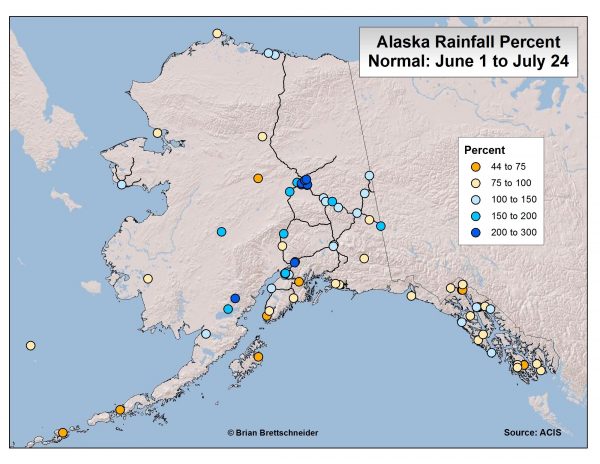
Brettschneider told Energy Desk editor Annie Feidt that some parts of the state, especially near Fairbanks, have had double their normal rainfall since June. That has been good for tamping down wildfires, but it has its own ties to a warmer world.
Interview transcript:
Annie: Why has it been so wet?
Brian: Well, there’s been a couple of reasons. First and foremost, the ocean temperatures around Alaska have been quite warm, near record warm, and those warm waters provide a nearly endless supply of moisture, much more moisture than is typical for the summer. So when we’ve been having rain showers, all that additional moisture is fuel for these storms and it turns a light to moderate storm into a moderate to heavy rain event.
Annie: At least in Southcentral Alaska, in Anchorage, we haven’t thought of this as a rainy summer. What accounts for that?
Brian: Sometimes the perception can be a little bit different than the reality. So here in Anchorage we had a big rain event in June, over an inch in one day. But even if you back that out, it’s been an above normal rainfall summer. So it’s not just the last few days, it’s not just that one storm, there have been a number of events that have contributed rain and those all add up.
Annie: What about Southeast Alaska, are they in the same boat?
Brian: The switch has been flipped a little bit from the first half of the year. The southern Alaska coast and Southeast were quite wet from January though May. But this summer so far, they’re all below normal for precipitation.
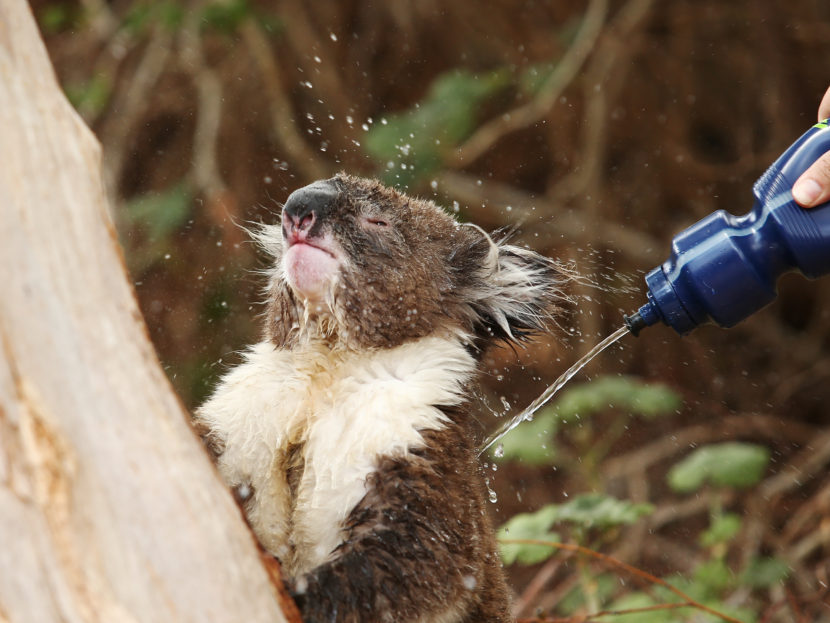
A heat-stressed koala is doused with water in December 2015 during an extreme heat wave in Adelaide, Australia. Last year was the hottest on record, but 2016 is on pace to supplant it at the top of the list. Every month of this year has set heat records. (Photo by Morne de Klerk/Getty Images)
If you think it’s been hot this year, you’re right. The latest temperature numbers from NASA and the National Oceanic and Atmospheric Administration say the first six months of 2016 were the hottest on record around the planet.
Let’s look at June. Scientists took temperatures from around the world and got a June average. What they found was a world that was 1.62 degrees Fahrenheit hotter than the average June in the 20th Century. How about January? Hottest ever. Same with February, March, April and May. Every month in 2016 has been warmer than ever, at least since people started keeping reliable records — that was 1880.
How much warmer is 2016 so far? Overall, this year has been almost two degrees warmer than what people experienced in the 20th Century.
Now, you may remember, last year broke the record for the hottest year ever globally. But Gavin Schmidt, climate scientist and director of NASA’s Goddard Institute for Space Studies, says that “2016 has really has blown that out of the water.”
Schmidt has calculated the chance that the rest of this year will continue on its record pace, based on the first six months. “It indicates that we have roughly a 99 percent chance of a new record in 2016,” he says.
Now, a couple of degrees warmer overall may not sound like much; it changes more than that in a day. But Schmidt points out that it’s persistent warming over decades that alters the atmosphere, the oceans and most everything else. An average eliminates the temperature extremes and variations and renders a number that indicates a persistent trend. And while a temporary increase in temperature won’t affect sea level, a long-term one will.
“Sea level rise is a cumulative effect of persistent warming for decade and decades and decades,” Schmidt explains, “that is warming up the interior of the ocean.”
Eventually, a warmer ocean expands, just as heated water does in a kettle. A warmer ocean also causes more evaporation to rise from the surface, which leads to more rainfall in some places.
Another effect of prolonged warming is melting of sea ice in the Arctic. NASA scientists say this year it’s melted down to its lowest extent since the late 1970s, when satellite measurements began.
“We’ve had the lowest sea ice extent average over the first six months by a fair amount in our satellite record going back to 1979,” says Walt Meier, a NASA sea ice scientist.
Schmidt says the warming trend has been pretty steady for decades, with a few wobbles now and then. Part of the reason this year was so warm was because of El Nino, a weather pattern that arises every few years that brings extra-warm Pacific water — and air — eastward. “With the El Nino … what we had was an upwiggle on top of a long-term trend,” Schmidt says.
The NASA team says El Nino’s warming influence will disappear by the end of the year, which should mean 2017 might be a bit cooler. But they point out that the long-term underlying trend over the past several decades — and into the foreseeable future — is continued warming.
Copyright 2016 NPR. To see more, visit http://www.npr.org/.
Esau Sinnok, second from the left, talked at the White House about climate equity. (Photo courtesy Department of Interior)
A 19-year-old from western Alaska was honored last week at the White House for his work advocating on behalf of communities experiencing climate change first hand. Esau Sinnok spoke to me from his cousin’s house in Nome on his way back home to Shishmaref. He was in Washington advocating for climate equity.
ESAU: Climate equity, to me, means we’ll have available resources so that Shishmaref will have the available resources to either relocate or adapt to climate change so that our future generations can have fun and experience the lifestyle that I had the privilege. So that our future generations can live the traditional lifestyle that ancestors have been living for the past 4,000 years on Shishmaref.
HUGHES: In your own life, have you seen changes to the climate?
ESAU: Yeah, ever since I was born in 1997, we had to move about three dozen houses from one side of the island to the other because of big storm surges that happened in Shishmaref so that they don’t topple over and go into the ocean. It affects me personally because I lost a loved one. He fell through the ice when him and my dad and a few others went out to the mainland on their snowmachines on the ice to go duck hunting. And on their way back, he fell through the ice and he thought that the ice would be frozen like in previous years, but for some reason it wasn’t frozen all the way so he fell through and lost his life.
HUGHES: What’s one of the messages from Alaska that you’ve tried to bring to the attention of other influencers and other leaders?
ESAU: I always tell other people, wherever I go and whoever I meet, that the youth voice is very powerful. That they are the future leaders of tomorrow. It’s very important for us youth to have a voice in all these types of movements and all these types of issues. Because the future that we’re going to inherit is being decided right now and affecting my hometown of Shishmaref greatly, affecting 223 communities all across Alaska greatly. And not just in Alaska but in the Gulf Coast, in the Lower 48 like in Louisiana and Florida, those states.
HUGHES: And can you tell me what it was like at the White House?
ESAU: It was like a once in a lifetime opportunity at the White House. I had my goosebumps and my heart was beating every time I was there. It was like I couldn’t believe I was there. I’m just a rural village Native kid, and to experience that … it felt like a once in a lifetime opportunity for me. And I would love to get other youth involved to share the same experience. To share what I felt when I was there.
HUGHES: My last question for you is, what your next step is?
ESAU: I’m currently studying at the University of Alaska Fairbanks in tribal management and hopefully continue with a rural development degree so that I can go back to Shishmaref and run as city mayor and to experience how to lead our community. Hopefully one day I could run for governor of Alaska by the year 2030 to represent, not only the big cities like Anchorage and Fairbanks and Juneau, but also the rural communities. I wanna make a change and try to make a positive and better future so that our future generations can live in a safe environment and don’t have the problems that I’m seeing every time I’m back at the community.
A group that is fasting as part of a protest against Gov. Jay Inslee’s Clean Air Rule to cap carbon emissions says the proposed rule doesn’t go far enough. (Photo by Austin Jenkins/Northwest News Network)
A group of climate activists is fasting on the steps of the Washington state Capitol this week as part of a protest against Gov. Jay Inslee’s proposed cap on carbon emissions. The activists say the cap doesn’t go far enough.
The group is small — just 15 or so. At one point they stood together holding a banner that read: “Fasting For Their Future.” The banner included photographs of children with their families.
The group says Inslee’s so called Clean Air Rule is inadequate when it comes to capping industrial carbon emissions in Washington.
“This draft ruling is basically business as usual,” said Deborah Woolley who’s participating in the fast.
“It allows the fossil fuel industries to basically continue as they have been doing and we’re seeing the effects of that,” she added.
The fast is timed to coincide with a public hearing on the Clean Air Rule later this week. A spokeswoman for Inslee called the proposed rule “a strong first step” to address carbon pollution in Washington.
The Association of Washington Business said the proposed cap “sends the wrong signal” to businesses in Washington and those that might want to relocate to the state.
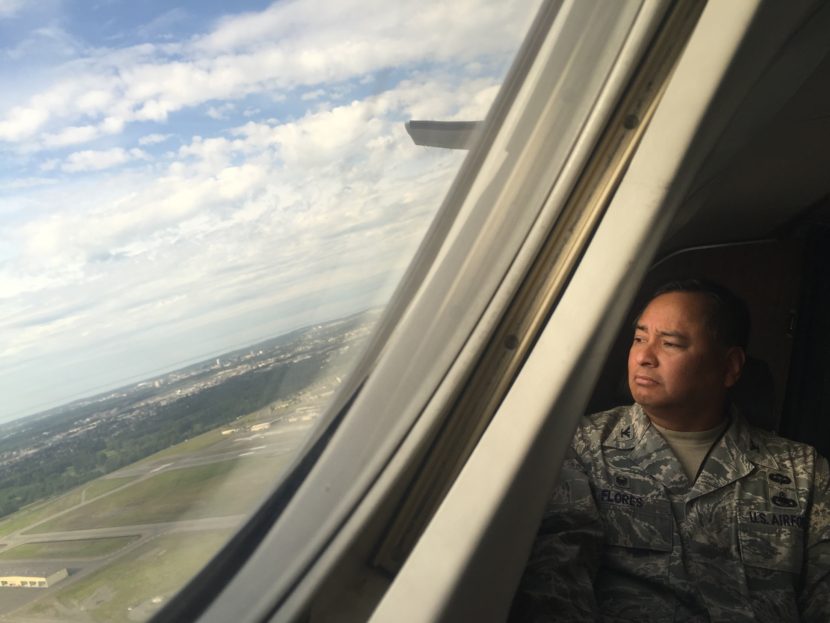
Col. Frank Flores is commands the PACAF Regional Support Center based at JBER. As part of his work, he visits the Air Force’s remote radar sites, and has been to 17 of the 21 so far, including a recent visit to Cape Romanzof. (Photo by Zachariah Hughes/Alaska Public Media)
A group of strategic Air Force radar facilities along the North Slope are at an accelerated risk of degradation. Erosion driven by climate change is happening decades sooner than the military predicted, and the plan now is to spend tens of millions of dollars to fortify in place.
The 15 sites within the Long Range Radar program are designed to spot foreign aircraft heading into U.S. airspace or civilian planes that have gone off course.
It is an expensive state of preparedness to maintain, with billions of taxpayer dollars sunk into the equipment and infrastructure.
“That $7.1 billion is the overall portfolio, so those are just government-owned assets,” said Col. Frank Flores, who oversees the Long Range Radar sites in Alaska, along with several other similar sites in the Pacific that all feed signals back to Joint Base Elmendorf-Richardson.
The $7.1 billion figure doesn’t include the contract with a private company to staff and take care of the facilities, worth $345 million over the next 10 years.
“That’s primarily the cost to operate the sites,” Flores explained in his office at JBER. “What it doesn’t include are the additional costs to maintain, to support infrastructure, additional projects that might come up because of the wear and tear of the Arctic environment.”
Those costs are rising for sites in the North Slope, because coastal erosion is encroaching on the airstrips, roads and residential structures that support the actual radar equipment.
“For example, at the Oliktok Long Range Radar Site we anticipated that erosion was going to be at a certain point in 2040, but we’re already, as of about a year and a half ago, at that point today,” Flores said. “So it’s happening at a quicker rate than we anticipated.”
At Oliktok, midway between Prudhoe Bay and Nuiqsut, the erosion mitigation work has to happen within the next three years, according to Flores.
Along the Chukchi coast, spending to fortify the radar site north of Point Hope is already underway.
“At the Cape Lisburne Long range Radar Site we’ve seen a significant amount of erosion because the sea ice isn’t coming in as soon as it used to, and it’s not staying as long as it used to,” Flores said.
The site’s runway is around 25 meters from the coast.
“It’s the only place we can put a runway out of the site, and we’re having to execute a $47 million project to protect that runway and keep that radar site viable,” Flores said.
Construction projects are extremely expensive at the remote Arctic locations, but Flores sees the infrastructure improvements today as an investment that could save billions in the future to protect the radar sites.
Though there’s no immediate threat to sites near Kaktovik and Barrow, the Air Force has observed land erosion there, as well.
Less than a decade ago, the Pentagon closed three early warning radar sites on the North Slope due in part to erosion problems.
Though Flores said radar sites further below Alaska’s Arctic don’t have any imminent threats, it remains to be seen whether they’ll soon be dealing with the same hazards to basic infrastructure faced by many of the communities in western Alaska, caused by diminishing permafrost and less predictable weather systems.
It’s not just the Alaska sites seeing new problems related to climate. South of Anchorage 3,500 miles, the Air Force site at Wake Island in the Pacific under Flores’s command is seeing irregular wave activity flood parts of the island, prompting the military to study what would happen if a major tidal event happens.
The Pentagon is aware that climate change is putting many of its strategic assets under threat. A 2014 report by the Government Accountability Office looked at where the Department of Defense faced the greatest hazards adapting to changing environmental conditions, repeatedly mentioning Alaska’s radar sites. The report concluded that more coordination was necessary among DOD and its partners.
There are no plans to close sites down. Flores said they’re a vital asset the Pentagon plans on maintaining in perpetuity.
“The long range radar sites in Alaska allow us to maintain national sovereignty for the air,” he said.
The radars allow military officials to see when military or civilian craft are transiting airspace, and find out why.
But with environmental changes rapidly outpacing predictions, it’s unclear how and if spending and strategic planning will be able to keep up.
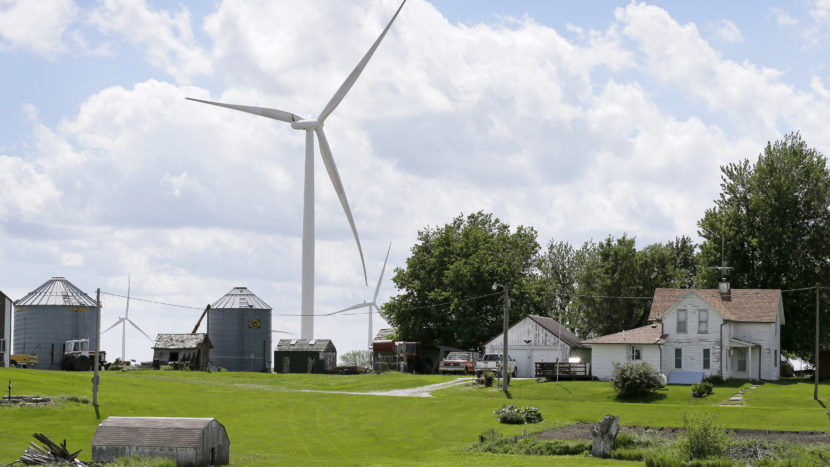
A wind turbine stands over a farmhouse in Adair, Iowa. Charlie Neibergall/AP
President Obama and his counterparts from Canada and Mexico are preparing to unveil an ambitious new goal for generating carbon-free power when they meet this week in Ottawa.
The three leaders are expected to set a target for North America to get 50 percent of its electricity from nonpolluting sources by 2025. That’s up from about 37 percent last year.
Aides acknowledge that’s a “stretch goal,” requiring commitments over and above what the three countries agreed to as part of the Paris climate agreement.
“We do ambitious well here at the White House,” said spokesman Eric Schultz.
Environmental advocates praised the new target.
“Shifting half of America’s electricity to clean energy sources is not only achievable — it’s essential,” said Rhea Suh, president of the Natural Resources Defense Council. “Avoiding the worst effects of climate change demands nothing less. But we must do it the right way, and that means ramping up our reliance on cost-effective renewable wind and solar power, energy efficiency and other 21st century technologies.”
Collectively, coal-fired power plants are the largest single source of carbon pollution in the U.S. A decade ago, nearly half the nation’s electricity was produced by burning coal. Coal-fired plants have been losing market share, though, as a result of competition from cheaper natural gas and increasingly strict environmental regulations. Last year, about a third of the United States’ electricity came from coal, another third came from natural gas, and the balance came from nuclear (20 percent), hydro (6 percent), wind (5 percent) and other renewables.
Canada already gets a larger share of its electricity from carbon-free sources, while Mexico currently gets less. While meeting the goal will require cooperation from all three countries, the United States will carry the largest load. The U.S. uses far more electricity than its North American neighbors combined.
Copyright 2016 NPR. To see more, visit http://www.npr.org/.
Close
Update notification options
Subscribe to notifications
Subscribe
Get notifications about news related to the topics you care about. You can unsubscribe anytime.

9(MDEwMjQ0ODM1MDEzNDk4MTEzNjU3NTRhYg004))

9(MDEwMjQ0ODM1MDEzNDk4MTEzNjU3NTRhYg004))