Climate Change

How Mendenhall Glacier staff explain climate change

Mendenhall Glacier
About 80 percent of the people who come to the Mendenhall Glacier in the summer are tourists. (Photo by Elizabeth Jenkins/KTOO)

On a busy summer day, thousands of people — mostly cruise ship passengers — visit Juneau’s Mendenhall Glacier. The U.S. Forest Service wants those tourists to take in the dramatic views, but also consider why the glacier is shrinking. Visitor center director John Neary is making it his personal mission.

That means trying to make the message stick — long after the tourists are gone. 

In a wing of the Mendenhall Glacier Visitor Center a small crowd of onlookers is watching a debate between a man and an employee about climate change. The tourist is wearing a floppy hat and red shirt. He’s leaning on a silver tipped cane as he listens, waiting for a chance to respond.

Kat Pratt, a ranger and interpreter, was delivering talking points on sea level rise when the man — who didn’t want to give his name — challenged her. He thought rising temperatures are cyclical, not caused by people. And the climate change scientists are paid off by environmental groups.

It goes on like this for about 15 minutes. Until they move onto something they both agree on: The glacier looks blue. Pratt seems unfazed.

“I get it about once a day usually and some of them get more confrontational. Maybe some not educated as that last gentleman, and there’s a lot to learn,” she said.

She said it encourages her to do more research, and she learns how to talk to visitors from different backgrounds. Many have never seen a glacier before and haven’t been confronted with the effects of climate change. Aside, from say, experiencing a hot summer.

Kat Pratt talks to people inside the Mendenhall Glacier Visitor Center about climate change. (Photo by Elizabeth Jenkins/KTOO)
Kat Pratt talks about the effects of climate change inside the Mendenhall Glacier Visitor Center. (Photo by Elizabeth Jenkins/KTOO)

“It became our central topic really just in the last few years,” said Neary.

He’s not afraid to admit he’s on a mission. He wants the more than 500,000 people who visit the glacier each year to know that it’s rapidly retreating due to climate change, and the 18 interpreters who work for him are prepared to talk about it. He said initially, not everyone was game.

“There was resistance, and I think people viewed it as a negative thing. And uh, you know people on vacation. They don’t want to hear about negative things,” Neary said. “They want to think about the positive (things) — watch the whales, see the eagles. That sort of thing. I get that. That’s understandable.”

But he said it’s all connected. Compounds from glacial silt wash down and feed the plankton that whales and other species depend on. Salmon spawn in nearby waters.

In the past 30 years, Neary’s noticed an extreme visible difference in the glacier. He started at the Forest Service around that time. And at first, for him, Mendenhall wasn’t a big deal.

“It didn’t seem very special to me to be honest. It was just a glacier,” he said. “You appreciate things as they become diminished in your life, you look at them differently when they are disappearing.”

Now, Neary uses that when talking to visitors. He tells them about the time he was out hiking on a steep trail beside the glacier and his dog fell 90 feet onto the ice. Don’t worry, the dog survived.

“But the story comes back to me when I go back out there and realize that spot which I climbed is now more than a half mile away,” Neary said. “And there’s no glacier, there’s dense alder thicket there. So there’s big changes.”

To address those changes, Neary wants to make changes to the visitor center, too. He wants the building to be LEED certified in the next few years. That means it will be energy efficient and produce less greenhouse gas.

John Neary Mendenhall Glacier
At first, John Neary says the Mendenhall Glacier “didn’t seem very special.” But as it’s diminished, he’s made it a point to explain to visitors why it’s shrinking. (Photo by Elizabeth Jenkins/KTOO)

This approach has captured the attention of other countries. Eleven delegates from Norway are visiting in June. Neary said they’re interested in seeing what the visitor center is doing and also sharing ideas. Chilean park officials are planning a trip in the fall. Neary wonders if parks around the world are trying to figure out what their role should be when it comes to climate change.

“I think we are one in a million in the setting that we have. But I’d like to think that the conversation is happening everywhere,” Neary said.

Inside the visitor center, an interpreter lures a crowd over to touch a slick hunk of glacial ice. People stop to take selfies with it and snap pictures.

“Would you like to see some photos of the glacier in the past?” the interpreter asks.

The photos start in the 1950s and show the progression of how much the glacier has changed.

“You can’t replace it right?” a man asks. The interpreter tells him, “No, we can’t.” 

Anna Laing — one of the people who watched the presentation — traveled all the way from Glasgow, Scotland, to be here.

She said being on vacation, she had no idea she’d learn so much about climate change.

“It’s just a statement that’s just out there, normally,” Laing said. “And it doesn’t really mean much to you until you really see the physical evidence of it. Especially, since we’re able to touch the glacier there and know what we’re losing.”

Some scientists say the Mendenhall Glacier won’t be visible from the visitor center by the end of this century. John Neary hopes tourists have that in mind when they return back home.

As Arctic Ocean Gets Spicier, Hunting May Be More Dangerous

A bearded seal, or ugruk, on the sea ice.
A bearded seal, or ugruk, on the sea ice. (Courtesy of Kawerak Subsistence Program)

The Arctic Ocean is getting spicier. A new study published in the Journal of Physical Oceanography suggests that rising temperatures in the far north could result in spicier water, or warmer water whose density is more affected by temperature than salinity.

This could make marine mammal hunting off Alaska’s coast more dangerous.

Mary-Louise Timmermans is a professor and oceanographer at Yale University. She studies how ocean circulation affects sea ice in the Arctic.

“For it to get ‘spicier’ means it’s going to get warmer, and changes in temperature will affect density to the same measure that changes in salinity affect density,” Timmermans explained.

The deeper you go in the ocean, the colder it gets. That’s because cold water is denser than warm water, so naturally it sinks to the ocean floor. But the dynamics are different in the Arctic.

“At low temperatures, the water doesn’t really care whether it’s warm or cold,” Timmermans said.

Seawater in the Arctic Ocean is so cold that temperature isn’t the deciding factor in its density. Instead, Timmermans said, salinity, or how salty the water is, makes more of a difference.

But that’s about to change as the climate changes.

“As you warm up the ocean, it turns out temperature changes can have a bigger impact on density than in a cooler ocean,” explained Timmermans.

Timmermans teamed up with Steven Jayne of the Woods Hole Oceanographic Institution. The two found that a spicier Arctic will likely be able to store more heat.

“This means that the way that the Arctic Ocean works will be somewhat different,” Timmermans said.

It’s tough to predict just how different the Arctic will be, but she said warmer seawater may speed up sea ice melt. That’s bad news for marine mammal hunters like Brandon Ahmasuk.

“The sea ice, it offers a protective barrier,” Ahmasuk explained. “It keeps the ripples and waves down, it keeps them from forming.”

Ahmasuk is Kawerak’s Subsistence Director based in Nome. He grew up out on the water hunting with his dad. He now takes his own kids with him to hunt for bearded seal, or ugruk, and walrus.

“When you have that larger open water, it’s more susceptible to large waves (and) bad weather,” Ahmasuk added.

He says if warmer, saltier seawater makes for thinner, sparser sea ice, most hunters won’t fare too well in their standard, 18-foot Lund boats.

“Your side height on a Lund boat is only 28 inches, but if you have four or six-foot rollers coming at you, you’re probably not going to want to be out there.”

But some villages, especially the ones without grocery stores to rely on, might not have any other choice. Despite the potentially more dangerous conditions to hunters like Ahmasuk, a spicier ocean is still the best grocery store around.


Newtok Awaits Relocation Funding, More Than 30 Years After Flood Risk was Documented

A steel storage container slid into the water after erosion chewed away at this bank in Newtok.
(Public Domain, Courtesy State of Alaska)

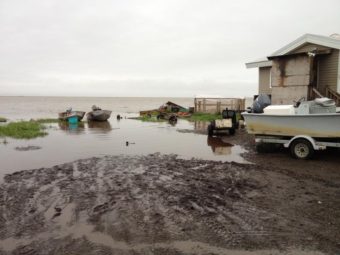
“I was scared, cause it looked so close … And you could just see these huge waves just come at you,” says Sabrina Warner, describing her fear of floodwaters sweeping over her home in the Alaskan coastal village of Newtok.

Warner says the Ninglick River had eroded so much land around her village of Newtok three years ago that she now fears powerful storms that hit Alaska’s western coast in the fall will flood the community. That’s why many say the people of Newtok could become Alaska’s first climate-change refugees. And it’s why Warner’s partner, Nathan Tom, told a reporter in 2013 he’s anxious to move his family to higher ground, up and out of the flood zone.

Nathan Tom talks with a reporter while his partner, Sabrina Warner, plays with a dog.
Nathan Tom talks with a reporter while his partner, Sabrina Warner, plays with a dog. (Courtesy NPR)

“I just can’t wait to move the houses or build our house,” she said.

Three years later, Warner, Tom and most of the other 350 people of Newtok are still waiting for federal and state help move the villagers to nearby Mertarvik – more than 30 years after the problem was first outlined in a 1984 study.

“I believe that within four years, Newtok will no longer be a viable community,” says Joel Niemayer the federal co-chair of the Denali Commission, the agency President Obama tapped to coordinate a response to the threat that climate change-driven flooding poses to Newtok and several other villages along Alaska’s coasts and rivers.

“Within four years, the river will be right next to the school,” Niemeyer said. “It’ll have already have gobbled up the community water source. And then not far behind, it’s the airport.”

He couldn’t say whether the agencies will be able to pull off this funding in time to build a new community before the river claims the land on which Newtok was built in 1958. That’s when the U.S. Bureau of Indian Affairs established the community on that site because it was as far up the Newtok River as the barge carrying materials to build a new school could go.

A 2007 map shows the steady erosion of land around Newtok, based on U.S. Geological Survey data, and projects the progression of the erosion toward the village. Credit State of Alaska

A 2007 map shows the steady erosion of land around Newtok, based on U.S. Geological Survey data, and projects the progression of the erosion toward the village.
(Public Domain, Courtesy State of Alaska)

“Relocation is very involved,” said Sally Cox, a planner with the state Division of Community and Regional Affairs. “And there are a lot of different things that have to happen.”

Cox has been involved in the Newtok relocation effort for years. She, like Niemeyer, both described a lengthy process that begins with a community deciding whether to move and if so where; then proceeds through years of planning, public interaction – and finally, getting funding.

“It’s a very slow process,” Cox said, “and government is very slow about responding to that need, especially because it costs so much money.”

How much money, neither Cox nor Niemeyer could say. Some estimate each relocation could cost hundreds of millions of dollars.


First Alaska ibis sighting excites Southeast birders

A white-faced ibis.
A white-faced ibis. (Creative Commons photo by Joyce Cory

An unusual bird was spotted in two separate Southeast towns on the same day last week. The ibises were a rare treat that has left bird experts scratching their heads, wondering why these southern birds have landed in Alaska.

Words like “flabbergasted” and “astonishing” came up when birders described hearing about the Ibis sightings last week. The large long-legged, wading bird is not native to Alaska. According to bird experts its northernmost boundary is the southern Canadian border. There has never been a recorded sighting in Alaska before now.

Andy Piston is a biologist with the Alaska Department of Fish and Game in Ketchikan. And while his professional focus is fish, he’s been studying birds in Southeast for two decades. He said if you saw an ibis you’d know it.

“It’s distinctive. It’s a heron-sized bird with a big, long, down-curved bill and in the right light, their plumage can look glossy and iridescent,” he said.

The first glimpses happened May 19 – one in Haines and one in Klawock, on Prince of Wales Island.

Bird enthusiast Jason Colon snapped a photo and posted a description of the encounter online. He wrote that he saw it in the early evening feeding in a grassy mudflat. He said its body shape and long, curved beak were dead giveaways that it was an ibis. After a little research, he deduced that it was a white-faced ibis.

Colon’s friend Amy Courtney runs Icy Straight Birding Tours out of Hoonah. She said when he sent her a photo of the bird she knew what it was right away.

“It was definitely an ibis and I was really flipping out inside,” she said. “I didn’t realize that it would be the first Alaska record, but I knew it was going to be really rare.”

Biologist Piston said the overlapping sightings are indeed the first recorded in the state.

“I guess the bottom line is trying to say what caused it is pretty difficult. People want to say it’s related to the warm winter and spring, but it could be something unrelated down south that just caused more ibis to be in the Pacific Northwest, and a couple to stray up here.”

Haines bird expert Pam Randles said an ibis was also spotted Friday and again Sunday in Haines. She said she’s been fielding calls from interested parties across the state that want to come to Haines to see it. But, alas, it hasn’t been spotted since Sunday.

Randles said big changes have been happening in the bird community over the last five years or so, and “vagrants” and oddities are becoming more common. Longtime Juneau birder Gus Van Vliet agrees that perhaps something is “afoot” with the species, but he said it might also be that more people are paying attention to feathered friends around them.

“It’s hard to know whether the pace has picked up over the last five, 10, 15 years, or whether there’s just more observers, more birders, more interested people and just more coverage,” he said. “It’s sort of like rod hours when fishing for salmon – the more hours you spend, the higher the probability of catching something. That might be the case for these vagrants as well.”

Van Vliet said there are two main kinds of ibises in North America; the glossy ibis in the east and the white-faced ibis in the west.

“This could be a one-off event never to be duplicated for the next century, or it could be shades of things to come.”

According to the Audubon Field Guide, they breed mostly in California, Nevada and Southern Oregon, and dabble in the Midwest. It said they are “climate-endangered” and that their northernmost range is indeed along the Canadian border. There have been recorded sightings in British Columbia, though not many.

One account posted on the Haines Birders Facebook page said a group of three ibises was seen at Picture Point last week. But whether these birds will stick around, or even be seen again, is anybody’s guess.

Barrow experiences earliest snowmelt on record

NOAA’s Barrow Observatory recorded the earliest snowmelt on record this year. (Public Domain photo by NOAA)

Snow in the northernmost town in the nation is melting earlier than ever before on record.

The National Oceanic and Atmospheric Administration’s Observatory in Barrow reported a snowmelt starting May 13. That’s 10 days earlier than the previous record set in 2002. NOAA has been recording snowmelt from its Barrow Observatory for over 70 years.

The record melt follows a winter of record-setting temperatures. Alaska was more than 11 degrees warmer than usual this winter.

This winter didn’t just see an early melt on land. According to the National Snow and Ice Data Center, 2016 also saw the lowest winter sea ice extent in satellite history.

David Douglas, a research biologist with the U.S. Geological Survey, said in a NOAA press release that conditions in the Arctic are looking more like they would in late June or early July right now.

The early thaw is already taking a toll on wildlife in the far north.

“Polar bears are having to make their decisions about how to move and where to go on thinner ice pack that’s mostly first-year ice,” Douglas said. Douglas also expects walrus to struggle this summer with the thinner sea ice and warmer temperatures.

Biomass boost: Haines and Hydaburg win renewable heating grants

Thorne Bay has been using its biomass system since XX.
The Thorne Bay School installed its biomass system 2012. It heats the school, gym and a greenhouse. (Photo courtesy U.S. Forest Service)

Two Alaska communities are receiving a federal grant to jump-start renewable energy projects. Haines and the village of Hydaburg were selected from 77 applicants nationwide.

Over the past 10 years, about 36 biomass systems have been installed in Alaska. The term sounds pretty technical, but it’s used to describe a prehistoric way to stay warm: a wood burning fire.

“You know, we’re not talking about some smoky, old wood stove here. We’re talking about high-tech equipment,” said Daniel Parrent, a program manager at the U.S. Forest Service.

He said the Wood Innovation Grants were awarded to projects that maximize energy efficiency. Typically, the wood comes from second growth or byproducts. It also mitigates the threat of wildfire.

In the village of Hydaburg, the grant is funding the heat system for the school, which also includes a greenhouse. Cordwood will keep the buildings warm, displacing over 24,000 gallons of heating fuel a year. The total cost is about $900,000, with the bulk of the funding coming from the Alaska Energy Authority.

In the past decade, Parrent said he’s seen more cities consider biomass as a viable option.

“You know, several years ago, oil prices were through the roof, and that’s when a lot of these projects got started and got funded,” Parrent said.

Although the price of oil has dropped, that interest has remained.

A $1.5 million biomass system is in the works that could heat the Haines Borough’s schools, some public facilities and a swimming pool with wood chips. Darsie Culbeck, a biomass consultant to the borough, said the project will lessen dependency on fuel shipped in from Seattle, helping the community become more sustainable.

In turn, he said the wood chips could come from the Haines State Forest and stimulate the local economy.

“(If a) budget crisis happens and we lose our art teacher, … can we keep that art teacher because we saved enough money on fuel? That would be awesome,” Culbeck said.

In 2010, the village of Tok fired up its biomass boiler and three years later they were saving enough money to add a music teacher and school counselor.

Hydaburg and Haines’ biomass systems are expected to be completed next year.

Site notifications
Update notification options
Subscribe to notifications