Alaska Native Government & Policy

White House rep announces domestic violence, sexual assault helpline

A new resource for Alaska Native and American Indian victims of domestic violence and sexual assault will be available in January.

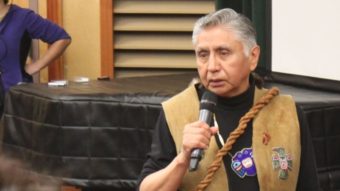
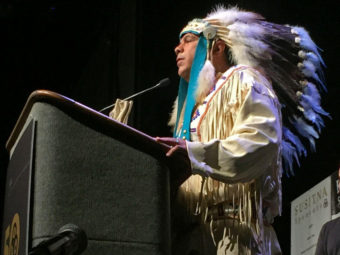
Tracy Goodluck from the Office of Intergovernmental Affairs at the White House announced the Strong Hearts Helpline on Thursday at the Alaska Federation of Natives convention in Fairbanks.

“The new helpline will provide culturally and linguistically appropriate services by and for Native women and will assist American Indian and Alaska Native survivors of domestic violence and sexual assault with safety planning, emotional support and referrals to local resources,” Goodluck said.

The helpline is a collaboration between the National Indigenous Women’s Resource Center and the National Domestic Violence Hotline. It’s scheduled to launch Jan. 4.

UAS vice chancellor, Sealaska board member nominated for AFN co-chair

Sealaska Board Chairman Joe Nelson
Joe Nelson was nominated for co-chair of the Alaska Federation of Natives. (Photo by Ed Schoenfeld/Coast Alaska News)

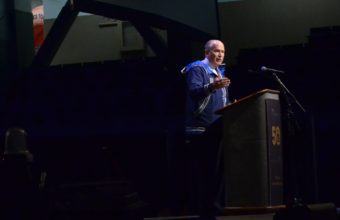
Joe Nelson, Sealaska Corp. board member and vice chancellor of University of Alaska Southeast, was nominated by the Southeast regional Native corporation for a leadership position on the Alaska Federation of Natives board.

Co-chair Jerry Isaac announced early on the first day of the 2016 Alaska Federation of Natives convention in Fairbanks that he would not seek another term. AFN delegates are expected to elect a new board co-chair Saturday.

Listen: Tlingit translation of ‘Moment in AFN History’ Part 1

Before the canoes can come ashore, they must get permission from the Auke Kwan Tlingits of Juneau. Fran Houston of the Auke Kwan was joined by Paul Marks of the Douglas Indian Association to carry out the tradition. (Photo by Emily Kwong/KCAW)
Paul Marks of the Douglas Indian Association waits for Celebration canoes to come ashore at Sandy Beach on June 8, 2016. (Photo by Emily Kwong/KCAW)

A “Moment in AFN History” celebrates the 50th anniversary of the Alaska Federation of Natives.

Listen to Paul Marks’ Tlingit translation of part one of three in this series.

Alaska Natives have owned and occupied our homelands since time immemorial. AFN was formed to deal with Native lands being taken.

The United States gave little attention to Native rights when it bought Alaska from Russia in 1867. No one cared about Native rights as fishing, mining, and logging started, and as military bases were being built.

Congress made Alaska a state in 1958. It said the state could select 100 million acres of land. Some of the land the state wanted was right under Native homes and villages.

“Our leaders had a very strong belief and conviction that this is ours,” said Edward Itta, former mayor of the North Slope Borough.

Natives organized. The president of Tlingit and Haida Central Council, John Borbridge, attended the first AFN meeting, as well as William Paul, Sr., President Emeritus of the Alaska Native Brotherhood. 400 people with 17 Native organizations met in 1966 in Anchorage to talk about protecting their land rights. That was the start of the Alaska Federation of Natives, and of a land claims settlement.

50th AFN convention begins today in Fairbanks

The 50th Alaska Federation of Natives convention in Fairbanks will open with a healing ceremony from the Alaska Suicide Prevention Council. The observance acknowledges a suicide that took place at the Dena’ina Center in Anchorage during the final hour of the convention last year.

After the ceremony, the agenda for the three-day conference has many of the same elements it features every year. AFN President Julie Kitka will deliver her annual report. Shortly after, Gov. Bill Walker will address the convention, as will Lt. Gov. Byron Mallott.

This year’s keynote address will be given by Emil Notti and Megan Alvanna-Stimpfle. Notti was the first president of AFN when it was created in 1966 and was active in the effort to pass the 1971 Alaska Native Claims Settlement Act. Alvanna-Stimpfle is a former legislative assistant for U.S. Sen. Lisa Murkowski, an elected member of the King Island Traditional Council and was recently named executive director of the Iñuit Arctic Business Alliance.

Items on the convention’s agenda include panels on rethinking indigenous education, land into trust, criminal justice reform and safety for Alaska Native women and families.

Murkowski is scheduled to address the convention Friday, as is Sen. Dan Sullivan, and Rep. Don Young will make his speech Saturday. Murkowski and Young are both up for re-election this year, so they will also participate in the AFN candidates forum Friday afternoon. Candidates for U.S. Senate Margaret Stock, Joe Miller and Ray Metcalfe are scheduled to participate, as is Young opponent Steve Lindbeck.

Delegates will consider convention resolutions Friday morning.

Live convention coverage is available at 360north.org and on 360 North television.

Central Council endorses Murkowski for U.S. Senate

Lisa Murkowski at AFN 2015
Sen. Lisa Murkowski addresses the Alaska Federation of Natives Convention, Oct. 16, 2015. (Photo by Mikko Wilson/KTOO)

The Central Council of Tlingit and Haida Indian Tribes of Alaska has endorsed Sen. Lisa Murkowski for U.S. Senate.

Central Council spokesperson Raeanne Holmes says the organization doesn’t often endorse candidates for political office, though they did endorse Sen. Mark Begich against Dan Sullivan in 2014. Sullivan won. And they supported the so-called Unity Ticket that brought together Bill Walker as candidate for governor and Byron Mallott for lieutenant governor.

Murkowski is running against Margaret Stock, Joe Miller and Ray Metcalfe to keep her seat. She was appointed to the U.S. Senate in 2002 by her father, then-Gov. Frank Murkowski.

The incumbent senator chairs a subcommittee that funds the Bureau of Indian Affairs and the Indian Health Service and serves on the Senate Committee on Indian Affairs.

Murkowski also chairs the Senate Energy and Natural Resources Committee.

The committee has jurisdiction over federal public lands law, including the implementation of the Alaska Native Claims Settlement Act and the Alaska National Interest Lands Conservation Act, two laws that are paramount when considering Alaska Native policy issues.

When asked if the tribal organization would be making other endorsements in the November election, Holmes said she hadn’t heard of any but added, “I could tell you very clearly we’re not going to support Trump.”

Alaska’s largest Native organization endorses Clinton for president

Former Secretary of State Hillary Clinton speaking with supporters at a "Get Out the Caucus" rally at Valley Southwoods Freshman High School in West Des Moines, Iowa. (Creative Commons photo by George Skidmore)
Former Secretary of State Hillary Clinton speaking with supporters at a “Get Out the Caucus” rally at Valley Southwoods Freshman High School in West Des Moines, Iowa, Jan. 24, 2016. (Creative Commons photo by Gage Skidmore)

For the first time in its 50-year history, the Alaska Federation of Natives has endorsed a candidate for president — Hillary Clinton.

The organization laid out the contrast between Clinton and Donald Trump in its news release:

“With only 20 days until the Presidential election on November 8th, the choice we have is this: 1) to elect a president who will continue working with us to achieve further self-determination and legal empowerment as sovereign, self-governing Indigenous peoples, with a firm foothold in the larger economy and strong Native institutions, full of hope and confidence for our children and grandchildren; OR  2) to elect a president who will lead our federal government down the path of marginalizing Native Americans and dramatically weakening the special trust relationship between Native Americans and the federal government, putting at risk all the gains we have achieved in our lifetime.”

The AFN board hasn’t typically issued endorsements in the past. They bucked tradition at the 2014 conference, endorsing Bill Walker for governor over incumbent Sean Parnell, and Mark Begich for U.S. Senate over Dan Sullivan. Walker and Sullivan prevailed in those elections.

In addition to endorsing Parnell’s opponent, AFN President Julie Kitka gave a scathing critique of Parnell’s track record on Native issues while in office.

Getting into the habit of endorsing political candidates is not something all AFN board members are keen on. Some board members abstained from voting on the Clinton endorsement, as did some in 2014.

AFN spokesperson Ben Mallott says the board may make additional endorsements this year after candidate forums Friday afternoon. U.S. Senate candidates Lisa Murkowski, Margaret Stock, Joe Miller and Ray Metcalfe are scheduled to appear at the forum, as are U.S. House candidates Don Young and Steve Lindbeck.

Site notifications
Update notification options
Subscribe to notifications