Alaska Native Government & Policy

Petersburg Indian Association pursues new one-mile trail near town

The proposed trail is just in the initial stages and would likely take years to complete.

According to the proposal, the trail would link the south part of town to the airport area without going through downtown Petersburg. The proposal would open up opportunities for the area residences of Severson Subdivision.

“In Petersburg we have beautiful scenery, a ton of space that is unused at this point that people would love to take advantage of,” said Barry Morrison is the Council President for Petersburg Indian Association, “and the trails are a perfect example.”

The proposed trail would be about a mile long running from Odin Street at Severson Subdivision on the south part of town to the existing bike trail by the Fire Hall. It would skirt by Lumber Street with an intersecting trail, continue across various muskeg and forested areas of the airport lands to end at the existing trail system along Haugen Drive.

The trail would be about 6-feet wide, made of crushed rock and have several foot bridges along the way.

The idea for the project was first introduced by a former Borough’s Parks and Recreation Department. Now it’s on PIA’s Long Range Transportation Plan.

The two entities would pool funding resources and PIA has an experienced trail crew to do the work.

For the time being, Morrison said, it’s still basically an idea on paper.

“We need the go ahead from the borough and the Planning and Zoning Commission, I believe, is where it goes to. We need an okay from them to get started on this project,” Morrison said. “Once that happens then it can go on to the design phase. And then it can go out for funding and be started.”

If the borough agrees to a partnership, then PIA will commit funds to the preliminary engineering and design for 2017.

PIA is working with the borough to upgrade a few other trails in town, the Hungry Point trail and the City Creek trail.

PIA employs eight people seasonally to work on trails.

The proposed Severson trail will be considered at the next Planning and Zoning Commission meeting at 2:30 p.m. Oct. 25.

AVCP selects first woman CEO

Vivian Korthius, AVCP's newest CEO.
Vivian Korthius, AVCP’s newest CEO. (Photo by Dean Swope/KYUK

The Association of Village Council Presidents has selected its first female CEO: Vivian Johnson Korthuis. The decision comes on the third day of the regional nonprofit corporation’s annual convention, after a year fraught with challenges. Some see this convention, and the change it has brought, as the light at the end of the tunnel.

Vivian Korthuis, AVCP’s first female CEO, said at the end of Thursday’s meeting that she was overwhelmed but confident.

“I think the opportunity exists now to really take AVCP to the next step,”  Korthuis said.

When asked how she would grow AVCP, she pointed to changes in the bylaws that led to her appointment.

“Well I think the board of directors has created a path for the company, and my job is to help them do that,”  Korthuis  said.

Korthuis grew up in the Village of Emmonak and eventually attended Dartmouth College in New Hampshire. She is the first female CEO of a major tribal organization, and also the first to be hired – not elected.

This came about when the executive board asked delegates for control over the process and, in a three-quarters vote, it was granted. Marcy Sherer, vice president of the Native Village of Napaimute approves of the change.

“CEO really should be a hired position so that the executive board has oversight control and can manage the company through the CEO. In that aspect, it’s a very positive move,” Sherer said.

Sherer agrees with her new CEO that this could be a new start for AVCP.

“I think that this is a turn in history, a turn of the page in history,” Sherer said.

But not everyone agrees.

“It’s kind of a strange feeling,” said Mike Williams Sr., who is the alternate delegate for the village of Akiak. He didn’t like the way the vote went down, though he does think Korthuis has strong credentials.

“What we lost is having that direct voice and involvement cut off from the rest of the member tribes,” Williams said.

In the months leading up to the meeting, AVCP’s legal counsel Liz Pederson circulated a letter to the tribes informing them of the proposed changes. Williams and others responded with their own letter, calling the actions illegal under the bylaws. The final voting on the issue, done in a closed meeting on Wednesday, supported AVCP’s recommendations.

The same group raised questions earlier this year about the state of AVCP’s financial health, a topic that took up most of the first day’s meeting. Questions about whether grant funds were spent in compliance with federal regulations went without explanation for some time, and during that period former AVCP president Myron Naneng abruptly resigned.

Regardless of the dissent at this point, the AVCP Executive Board appears to have received the nod from its members to proceed with the recovery plan it laid out during the first day of the meeting.


Native brotherhood leader calls for more youth involvement

Yakutat ANB Camp President Devlin Anderstrom delivers the keynote speech Wednesday at the Alaska State Brotherhood and Sisterhood Grand Camp Convention in Juneau. (Photo by Ed Schoenfeld/CoastAlaska News)

A 19-year-old Yakutat man says the state’s oldest Native organizations are taking important steps to reach out to young people.

But they need to do more, he says.

Devlin Anderstrom was the keynote speaker at this year’s Alaska Native Sisterhood and Brotherhood Grand Camp Convention.

He spoke Wednesday to leaders and delegates gathered in Juneau.

“I’m just a young man, but even though I’m young, you still wanted to hear my voice,” he said. “And that shows that you really care what your children and your grandchildren think and how they feel in the present situation, and what we think about how we can improve our situation.”

Anderstrom is president of his hometown’s Alaska Native Brotherhood chapter and teaches Tlingit language and art at Yakutat High School.

He praised efforts to support and expand Native rights and culture.

But he said those efforts need to grow.

“It’s … important that we get all of our youth involved in not only furthering their education in the Western sense, but also in the cultural sense,” he said. “Because it’s that base, that identity, that I have that is my drive and my motivation to do well and to succeed and to help the Tlingit people.”

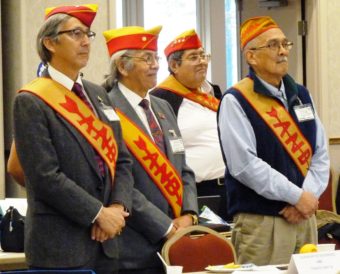
Alaska Native Sisterhood Grand Camp President Johanna Dybdahl, lleft, and Alaska Native Brotherhood Grand Camp President Sasha Soboleff listen during convention proceedings Wednesday. (Photo by Ed Schoenfeld, CoastAlaska News
Alaska Native Sisterhood Grand Camp President Johanna Dybdahl, left, and Alaska Native Brotherhood Grand Camp President Sasha Soboleff listen during convention proceedings Wednesday. (Photo by Ed Schoenfeld, CoastAlaska News

The Alaska Native Sisterhood and Brotherhood are each more than 100 years old.

And most attending the convention are in their 50s, 60s or 70s.

But this year, Anderstrom was joined by other, younger delegates.

He said that’s important.

“When our children know who they are, then they’ll have something to fight for and they’ll fight for it. They’re going to want to further their education. They’re going to want to do everything they can to help the Tlingit people,” he said.

The ANB-ANS convention continues in Juneau through Saturday. The convention’s theme is, “Bridging the Past, Present and Future with Our Youth.”

Hear Anderstrom’s full speech:


Brotherhood, Sisterhood prep for convention

ANB-ANS members march in a parade during the 2015 Grand Camp Convention in Wrangell.-(Photo courtesy Peter Naoroz/ANB)
ANB and ANS members and leaders prepare to march in a parade during the 2015 Grand Camp Convention in Wrangell. (Photo courtesy Peter Naoroz/ANB)

Alaska’s oldest Native organizations are working to attract younger members.

That, subsistence and other issues are on the table at the Alaska Native Brotherhood and Sisterhood’s Grand Camp Convention Oct. 5-8 in Juneau.

The Grand Camp Convention attracts 80 to 100 delegates and members from local chapters, also called camps.

Most are from Southeast, but camps are also in Washington, Oregon and Southcentral Alaska.

ANB and ANS Camp 70 in Juneau host this year’s event.

ANB chapter President Marcelo Quinto said the convention sets the regional, or Grand Camp’s, agendas.

“We are a civil rights organization, but we concentrate on our Native people both in Southeast and we try to assist whenever we can with the rest of our brothers and sisters throughout the state,” he said.

The Alaska Native Brotherhood and Sisterhood are each more than a hundred years old. And in recent decades, many of their programs have been taken over by tribal governments, Native corporations and other organizations.

That means the organizations are smaller than they once were. And their membership is older.

But ANB Grand Camp President Sasha Soboleff said that’s starting to change.

“The youth wave is coming and so we dedicated last year’s convention and this year’s convention to having a focused effort on the young people and how this organization can best respond with their leadership,” he said.

Alaska Native Sisterhood members march in Wrangell during the Grand Camp's 2015 Convention in Wrangell. (Photo Courtesy Peter Naoroz/ANB)
Alaska Native Sisterhood members march in Wrangell during the Grand Camp’s 2015 Convention in Wrangell. (Photo courtesy Peter Naoroz/ANB)

One is Yakutat youth leader Devlin Anderstrom, who will deliver the keynote address.

And Soboleff said in the past year, he’s installed 19 sets of local camp officers who were in their mid-20s or early 30s.

Convention delegates spend the four-day event hearing reports from other Native organizations.

They include the Southeast Alaska Regional Health Consortium, the Central Council of Tlingit and Haida Indian Tribes of Alaska, and the Sealaska regional Native corporation.

They also elect officers and debate and vote on resolutions.

“We come together and talk over all of the ways the local camps are being affected by subsistence, by the economic decline that’s happening, by the impact of what (fisheries) have been going on in terms of subsistence and whether the commercialized part is doing any good, and putting the land that we occupy, whether or not it can be put into trust,” he said.

The Brotherhood and Sisterhood are also considering changes to their constitution.

They address membership, committee structure and other issues. One would create a new, joint executive committee with equal numbers of ANB and ANS members.

Quinto said the camps are trying to modernize.

“We are taking a look at our constitution this year to determine if it needs to be revised so it’s appropriate for this day and age,” he said.

Despite the names, the organizations don’t restrict their membership by race.

Soboleff said many camps have members who are not Alaska Natives.

“So there are lots of people who are welcome to come and who are actually active in our local camps and feel welcome to come down and witness and participate and see how this slice of the world works,” he said.

The convention also includes a culture night and a memorial service.

Prince William and Kate Middleton visit Yukon communities

Prince William and Kate Middleton visited Carcross after a trip to Whitehorse. (Photo by Abbey Collins/KHNS)

Alaska got as close as it could to a royal visit this week.

The Duke and Duchess of Cambridge, Prince William and Kate Middleton, were met by a large crowd, music and dancing in Carcross this week.

They event was part of a larger tour around the Yukon after traveling through British Columbia. The visit focused on First Nations issues and culture.

“We as a people have struggled for generations and for years and years and we’re finally coming out of the other side of it so to speak,” said Andy Carvill, Chief of the Yukon’s Carcross Tagish First Nation. “We’re rebuilding our culture through songs and performances.”

He spoke at a traditional ceremony welcoming Prince William and Kate Middleton to the small Yukon community of about 300 people on a crisp, sunny day.

“The majority of the First Nations in the Yukon have settled,” Carvill said. “We are a government. And we’re asking that you assist us and help us to continue to build that relationship with the crown.”

The royal couple was greeted with joyful dancing and singing, a performance by the Dakhka Khwaan Dancers and another by a children’s dance group.

Carvill was joined by First Nations chiefs from across the territory, the Grand Chief, and the Premier, among other local dignitaries. Visitors came from around the Yukon, and some from Alaska. Amidst the merriment, Carvill spoke about serious issues affecting First Nations people.

“We still have obstacles before us that we continue to battle on behalf of our people for the protection of our land, protection of our waters, the clean air that we breathe,” Carvill said.

He says he’s optimistic that the Carcross Tagish First Nation that has been established for 10 years will have the support to work through those obstacles.

“For those like the children that are dancing, carrying on our songs and our cultures,” Carvill said. “And those yet unborn, it’s very important to us to continue to work together to get that recognition as a government.”

Ryan McDougall, who was part of the dance group that greeted the royal couple, said this visit is about education.

“It means about educating people who, like the royals about our cultural ways and who we are as a sovereign people,” he said. “How we need to share our cultural ways. Our songs, our histories and our dance so that we can view each other as being equal.”

There was a serious message at the core of the royal visit, but for many it was just plain fun to see royalty so close to home.

“This is an epic trip,” said Nancy Spear, of Juneau.

She came to Carcross with her friends Nan Saldi from Skagway and Kathy Madson from Haines, where the three started their journey.

“And left the boat harbor at 4:30 to get to Skagway by seven so we could hit the border right when it opened.”

Spear said it’s really exciting to see the Duke and Duchess in the Yukon.

“That they would come to such a small place and that they value the beauty of our area,” says Spear.

Cathy Sheardown is from Whitehorse and carries with her a photo album with pictures of previous generations of the royal family visiting the Yukon.

“I think it’s great they always include the North within their visits,” Sheardown said. “Because quite often we are, we feel left out or separate from the rest of Canada but this proves we’re not, I guess.”

The royal day in Carcross included a visit with a master carver, a trip to Montana Mountain to cheer on mountain bikers and a meeting with members of a program that employs young people to build trails.

William and Kate also stepped on board the White Pass and Yukon Route Railroad.

While the royal couple was only in Carcross for a short time, it’s clear those few hours had a meaningful impact on the community, as people young and old came out to celebrate and welcome the regal guests to their home.

U.S. Government To Pay $492 Million To 17 American Indian Tribes

The U.S. government has agreed to pay a total of $492 million to 17 American Indian tribes for mismanaging natural resources and other tribal assets, according to an attorney who filed most of the suits.

In a joint press release by the Departments of Interior and Justice, Secretary of the Interior Sally Jewel said, “Settling these long-standing disputes reflects the Obama Administration’s continued commitment to reconciliation and empowerment for Indian Country.”

The settlements mark the end of a push by the Obama administration to resolve what the U.S. says is more than 100 lawsuits totaling more than $3.3 billion brought by American Indian individuals and tribal governments against the federal government. The policy of reaching settlements on the disputes, some of which date back more than a century, is part of a campaign promise the president made to American Indians before he took office.

“Few have been ignored by Washington as long as Native Americans, the first Americans. Too often, Washington has paid lip-service to working with tribes,” then-candidate Obama said in a speech at the Crow Nation Reservation in Montana in May 2008. “My Indian policy starts with honoring the unique government to government relationship, and ensuring treaty responsibilities are met.”

Those treaty responsibilities include agreements dating back to the 1800s that made the U.S. government the trustee for huge swaths of tribal land. The Department of the Interior says it manages almost 56 million acres of land on behalf of tribes, and handles at least 100,000 leases on that land for a wide variety of uses including housing, timber harvest, farming, livestock grazing, oil and gas extraction. More than 250 tribes have some assets held in trust by the federal government.

Under those trust agreements, the U.S. government must make sure tribes receive “just compensation” for the use of their land or resources. “The government bought the land from Indians, but it didn’t pay the Indians,” says Melody McCoy, a staff attorney with the Native American Rights Fund who has spent 20 years handling lawsuits against the federal government over alleged trust mismanagement and underpayment.

“The U.S. government would say it held the assets in trusts benevolently, for the protection of Indian lands and money,” says McCoy, who handled 13 of the 17 newly announced settlements. “The flip side of that is that in exchange, the government was supposed to be a good trustee, and it wasn’t. Land was not managed well. Money and resources were not managed well.”

The result was decades of allegedly lost income for Native Americans across the country.

Before the Obama administration could turn to the business of settling the 100-plus lawsuits by tribes, it had to resolve a 13-year class-action lawsuit alleging the government failed to pay individual people billions of dollars in profits from land that had been seized from American Indians. A $3.4 billion deal was reached in 2009.

The tribal lawsuits proved more difficult to settle, because they often concerned payments the tribes alleged should have been made over the course of decades. “There were substantial litigation risks and problems to both sides,” which drove both sides to the bargaining table, McCoy says. By 2012, the administration had reached settlements with dozens of tribes.

The settlements announced Monday are the second round of agreements. McCoy says that since Obama took office, there have been 95 total settlements with tribes, and that 11 more, some of which she handles, are in active negotiation. “It is quite an accomplishment,” she says.

Although most of the 17 settlements are still awaiting final court approval, a handful of documents have been released, naming the Muscogee Creek Nation of Oklahoma, The Colorado River Indian Tribes and the Gila River Indian Community. The settlements range from $25,000 up to $45 million, says McCoy, who has seen documents for 15 of the 17 settlements announced.

She says the money from the tribal settlements will be transferred directly from the U.S. Treasury to tribal governments, and that there are no stipulations about how it will be spent. In a departure from more than a century of policy, the U.S. government now insists that tribal governments take the payments, refusing to hold the settlement assets in trusts.

“Going forward, the U.S. certainly has an opportunity to treat tribes more fairly,” McCoy says. As for the tribes she has personally represented against the federal government, she says they are pleased.

“My clients feel like they had an extraordinary opportunity to engage with the U.S. government to government at the political level,” she says.

Copyright 2016 NPR. To see more, visit http://www.npr.org/.
Site notifications
Update notification options
Subscribe to notifications