Alaska Native Government & Policy

Listen: Tlingit translation of ‘Moment in AFN History’ Part 3

Listen to Paul Marks’ Tlingit translation of part three of three in this series.


AFN got its start in 1966. It focused on land claims for many years.

Today, it also works in areas such subsistence, health, education, jobs and governance.

Natives have for-profit corporations, like Sealaska. Tribes and non-profit organizations provide services to Natives. During the annual AFN Convention delegates of those organizations meet. They hear speeches on issues, and adopt resolutions on challenges Alaska Natives face. AFN sends the approve resolutions to agencies and politicians. AFN uses them as guides for their own work.

“I would like to see our Alaska Native people standing proud for their culture, all of us feeling love of who we are, standing together and not apart,” said Jori Paoli of the First Alaskans Institute.

The AFN Convention is also a fun, exciting time. People shop for school clothes and supplies. They buy gifts at the AFN Arts and Crafts fair. The AFN convention is the state’s largest gathering. That makes it a good place to visit with relatives and old friends, and to make new friends.

Yakama chief accepts thanks from Alaska’s largest tribal organization

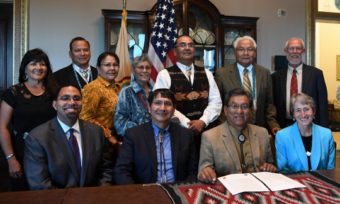
Alaska’s largest statewide native organization honored the Yakama Nation on Thursday during their annual convention in Fairbanks.

The Yakama Nation loaned the Alaska Federation of Natives $225,000 to establish itself 50 years ago.

AFN started in 1966 with loans from one Alaskan tribe and from the Yakama Nation. AFN leadership believes it’s a “sacred obligation” to honor the Yakama Nation for their help.

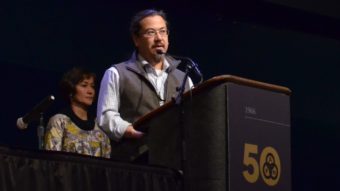
Yakama Chairman JoDe Goudy told a crowd of hundreds that he came to Alaska to advocate for collective understanding.

“Who are you? Where do you come from?” Goudy asked the crowd. “It is only in the pursuit of these answers that we will understand where we are going collectively as peoples, as nations.”

AFN advocates for 185 tribes across Alaska. Their convention has drawn national dignitaries, including the National Congress of American Indians president, of Washington’s Swinomish tribe.

Listen: Tlingit translation of ‘Moment in AFN History’ Part 2

Paul Marks
Paul Marks discusses the Raven story at the UAS Egan Lecture Hall in March 2015. (Photo by Lisa Phu/KTOO)
Listen to Paul Marks’ Tlingit translation of part two of three in this series.


AFN got its start at a meeting in 1966 when 400 Alaska Natives met in Anchorage to talk about how to stop the state, and others, from taking their land.

For the next five years, AFN focused on talks that led to the Alaska Native Claims Settlement Act of 1971, or ANCSA. ANCSA didn’t transfer money and title to lands to tribes but to for-profit Native corporations.

“What ANCSA did was to provide a vehicle for Alaska Natives first of all to become economic powers,” said Janie Leask, a president of AFN.

Former Cook Inlet Region, Inc. president Roy Huhndorf, says tribes can provide important services too. A few years ago, he urged the state to work with tribes.

“If more recognition was given to the tribes who can do certain things that the state otherwise would have to do there is a lot of mutual benefit to doing this in my view.  Other states have done this and they’re very happy about it.”

Since then AFN has continued to fight for Native interests such as subsistence in Congress.

Troopers discuss rural opioid and heroin addiction with AFN

Representatives of the Alaska Federation of Natives and the National Congress of American Indians met Wednesday in Fairbanks to discuss a range of topics, including opioid and heroin addiction in rural Alaska.

Alaska State Trooper Sgt. Kevin Blanchette with the western Alaska Drug Enforcement unit was among several presenters on the issue.

Blanchette said prescription pain killers and heroin have become a top priority for the unit.

“Right now, the opioid addiction problem is just as prevalent as the alcohol use and abuse problem,” Blanchette said. “And what we’re seeing now is a lot of these are overlapping. A lot of people are prescribed these medications.”

“They’re not only drinking an excess amounts of alcohol every day,” he said. “They also take in an excess amount of pain pills. And when you fix this high level of alcohol with these opiates, you have a very real chance of death or overdose.”

Addiction to prescription pain killers often leads to heroin use.

This summer, an especially potent batch of heroin that caused several overdoses and a death in the village of Quinhagah resulted in a village dealer turning himself in, Blanchette said.

”The people, let’s say in Quinhagak or in Bethel who are maybe low level dealers, what needs to happen to get the ball rolling in their treatment is sometimes an arrest or to be charged with crimes,” Blanchette said.

Drug interdiction efforts generally focus on opioids coming into Alaska from outside and through hub communities, but Blanchette highlights the need for information from village residents to help piece together the drug trafficking puzzle.

He also points to a new public outreach effort in villages to educate kids about the dangers of opioids.

“And if we can get the message to them, so they grew up to not be users and the medical field can change their practices, maybe we can stop this new generation from becoming addicted to this drug,” Blanchette said.

Dr. Joshua Sonkiss, medical director at Fairbanks Community Mental Health said opioids were increasingly prescribed in recent decades as regulations required more aggressive treatment of pain.

Over-prescribing resulted in the current addiction problem, he said.

Walker describes ‘painful’ PFD decision, highlights new education commissioner

Gov. Bill Walker addresses the 2016 Alaska Federation of Natives convention. (Photo by Jennifer Canfield)
Gov. Bill Walker addresses the 2016 Alaska Federation of Natives convention on Thursday in Fairbanks. (Photo by Jennifer Canfield)

The Alaska Federation of Natives convention is scheduled to take place each year shortly after Permanent Fund Dividends are distributed. And plenty of that money gets spent in Anchorage or Fairbanks, depending on where the convention is held.  

Gov. Bill Walker addressed the convention Thursday morning in Fairbanks. He focused his comments mostly on the State of Alaska’s budget deficit and his decision to cut this year’s dividend by about half. He told the crowd that the state is drawing on its reserves at a rate of $12 million per day.

“I cannot tell you, I cannot describe to you adequately how difficult of time this has been to be serving as governor,” Walker said. “The decisions I have had to make have been so painful, have been so painful, that I cannot adequately describe.”

Walker also made a brief reference to the state’s 10-student threshold for full school funding and pointed to new education commissioner Michael Johnson who was in the audience.

“Most important number in education is one, one student. Every one student deserves the best education in Alaska. Not based upon a number. We’ve got the commissioner of education (who) is going to do that. You’re going to love what he’s going to do in that position,” Walker said.

Walker did not elaborate on what changes may be on the horizon for the Department of Education. More information from the department was not immediately available.

Fairbanks mayor calls for compensation to Fairbanks Four, Alaska Innocence Project director honored

A Fairbanks 4 banner at the Alaska Federation of Natives Conference, Oct. 15, 2015. (Photo by Mikko Wilson/KTOO)
A Fairbanks Four banner at the 2015 Alaska Federation of Natives Conference. (Photo by Mikko Wilson/KTOO)

The Alaska Federation of Natives board and convention attendees made an impassioned plea to Gov. Bill Walker last year for the release of the Fairbanks Four — four men who were imprisoned for 18 years for a murder they say they did not commit. Two months later in December, the three men who were still in jail were released.

In comments to the AFN convention Thursday, Fairbanks Mayor John Eberhart called on the City of Fairbanks and the State of Alaska to compensate the men for wrongful imprisonment.

“There’s serious questions about the case and the truth and I urge the state and the city to consider an ex gratia or voluntary payment to the Fairbanks Four,” Eberhart said.

Eberhart, who previously worked for the Tanana Chiefs Conference, said the city was working with the organization on a Department of Justice process called collaborative reform. The DOJ touts the process as a “holistic strategy that identifies issues within an agency that may affect public trust.”

Bill Oberly is the director of the Alaska Innocence Project and was active in efforts to free the Fairbanks Four. Oberly was one of the recipients of the Denali Award, the highest award given by AFN to a non-Native.

Site notifications
Update notification options
Subscribe to notifications