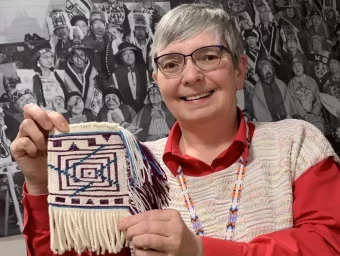
Rep. Mary Peltola (D-Alaska) addresses the AFN convention wearing the bolo tie gifted to her by the daughters of late Alaska Congressman Don Young. (Photo by Wesley Early/Alaska Public Media)
U.S. Rep. Mary Peltola took the stage at the Alaska Federation of Natives convention in Anchorage Thursday, pitching herself as a regular Alaskan who happens to be their congresswoman.
Her theme, and the theme of the conference, was the power of unity.
“This is what democracy is built on: Unity. Coming together. Compromising. Building consensus, building coalitions, working together. Seeing each other as humans,” she said. “Just all of the things that help us jell and work through our problems.”
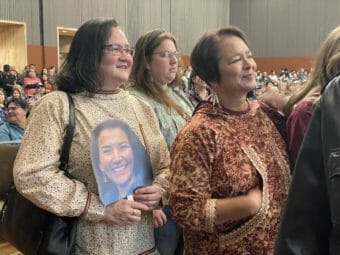
The daughters of the late Congressman Don Young say they support Mary Peltola’s re-election. Joni Nelson, left, holds Peltola’s photo. Her sister, Dawn Vallely, is on her right. (Photo by Liz Ruskin/Alaska Public Media)
Peltola has been a congresswoman for just 38 days, and she’s running for re-election. AFN is traditionally the largest convention in the state, and this was the keynote speech. This year, for the first time ever, delegates are hearing from a member of Congress who is, like them, an Alaska Native. To say it was a warm reception would be an understatement.
The crowd treated her like a rock star. They cheered at the mention of Peltola’s name and waved photos of her face that were made into hand fans.
“I’m uplifted in this moment because of you,” Peltola said. “After years of COVID and through economic and political storms, we’re together again, celebrating our unity. And I stand before you very humbled. And I’m only able to stand before you in this way because of our unity and because of the faith and hope and love and courage and wisdom in this room.”
Peltola mixed loftiness with down-to-Earth anecdotes about driving kids on the school run, texting with family members and fishing.
Emotional moments that weren’t on the agenda competed with the power of her speech.
Peltola, who frequently pays tribute to her Republican predecessor, invited the late Congressman Don Young’s family to the stage. His daughter Joni bestowed on her his signature accessory: His beaded Alaska flag bolo tie. He wore it for decades.
“It’s a symbol of being the congresswoman for all Alaska. So it’s kind of like passing the mantle,” said Joni Nelson, who made the tie for her father. “I felt it was a nice thing to do. The right thing to do.”
The late Rep. Don Young’s beaded bolo tie, seen in a close-up of a portrait. (Wesley Early/Alaska Public Media)
She and Young’s other daughter, Dawn Vallely, both said they support Peltola’s re-election and aren’t bothered that she’s a Democrat.
“Like my father, she’s focused on the needs of Alaska, and of Alaskans. And that’s the most important thing, regardless of party,” Vallely said.
When Peltola finished speaking but before she left the stage, one corner of the hall at the Dena’ina Center broke into song. The attendees traditionally sit according to region, and this corner was designated for Peltola’s home area, the Yukon-Kuskokwim Delta. The song was an Orthodox blessing, wishing her many years.
Then, from the Northwest region, a hymn in Inupiaq. One elder led the way, reading the verse from her cell phone screen. When they finished, a “Hallelujah” hymn broke out from the Interior section.
Peltola stood at the front of the stage, looking over the immense hall, her eyes brimming with tears.
U.S. Sen Dan Sullivan addresses the Alaska Federation of Natives Convention on Oct. 15, 2016. (Photo by Mikko Wilson/KTOO)
The theme of this year’s Alaska Federation of Natives convention, “Celebrating our Unity,” will hit home for many.
As the gathering gets underway at Anchorage’s Dena’ina Center Thursday morning, AFN will return to its role as Alaska’s largest convention.
It will be the first time in two years that delegates have been able to meet in person, due to the COVID-19 pandemic. AFN normally draws thousands of people from across the state.
AFN is also known for its memorable speeches, and many are anticipating Rep. Mary Peltola’s keynote address.It’ll be the first time in AFN history that the gathering has heard from an Alaska Native member of Congress.
After Congressman Don Young died, Peltola won the seat in a special election in August — but must win a second race against Republicans Sarah Palin and Nick Begich, as well as Libertarian Chris Bye, to keep her job.
Election-year politics always play a big role at AFN, both on and off the main stage.
Several Native corporations, as well as one tribal group, have introduced a resolution to endorse Peltola and Sen. Lisa Murkowski.
The full convention will vote on these resolutions on Saturday, the final day of AFN. This will follow a statewide-candidates forum.
AFN’s agenda also carves out time for economic development, including a session on post-pandemic investment, tribal broadband and Arctic security.
Forums on Native boarding schools and missing and murdered Indigenous women are also on the schedule.
Joel Isaak, the Alaska Department of Education and Early Development’s tribal liaison, speaks about SB34 at the Elders and Youth Conference in Anchorage on Oct. 17, 2022. (Screenshot from First Alaskans Institute livestream.)
Alaska Native tribes have until Dec. 30 to apply for one of five spots in a pilot program meant to encourage more tribal control of local schools.
It’s part of a new law, Senate Bill 34, which Gov. Mike Dunleavy signed in July. The bill kicks off a multi-year process of creating state-tribal compact schools. Compact agreements would allow tribes to develop their own K-12 curriculum, independent of an existing school district.
Joel Isaak, the Alaska Department of Education and Early Development’s tribal liaison, spoke about the law at the Elders and Youth Conference in Anchorage on Monday.
“Compacting is a mechanism that is government to government,” he said. “It’s a partnership. It’s a tool for communicating, and it’s really about recognizing government to government agreements.”
That process will start with a pilot program where tribes will receive grants to establish new schools and offer input on future legislation that could make state-tribal schools more widespread. Isaak said that makes this process unique.
“Generally, it’s difficult to be able to get all the tribes in the state to sit down, like, ‘How are we going to draft this?,’” he said. “What Senate Bill 34 does is it provides a framework for tribes to be able to help draft the legislative report for what needs to be in a bill to make compacting a reality.”
Isaak asked attendees to share how they would measure a school’s success. Isha Twitchell heads the academic policy committee for the Knik Cultural Charter School, which opened in Wasilla this year. She said enthusiasm from both students and parents was valuable.
“We’re measuring our success right now by kids being happy, wanting to be in school, and parents giving nothing but positive feedback,” Twitchell said.
Attendees also discussed the importance of language preservation at future schools.
The Alaska Federation of Natives convention will also include a panel discussion on Alaska Native education moderated by Isaak. It’s scheduled for Friday at 2:55 p.m.
The Donlin Gold mine site is located about 70 miles up the Kuskokwim River from Aniak. (Photo by Katie Basile/KYUK)
The Aniak Traditional Council unanimously voted to rescind its support for the proposed Donlin Gold mine over concerns about increased barge traffic on the Kuskokwim River. The tribe’s withdrawal removes a longtime pillar of support for the project. The mine’s landowners say they see the repeal as an opportunity to better understand and address community concerns.
The council’s repeal vote on Aug. 30 revokes its 2016 resolution to support the mine. But council Chief Wayne Morgan said that the body had unofficially supported the project for over a decade before that, since 1995. It wanted the potential jobs and economic benefits that the mine could bring. Now, Morgan says, that desire is overridden by concerns over the mine’s barge traffic.
“I really believe our river, Kuskokwim River, it’s a scenic river. It’s a wild river. And with the increased traffic on the river, I’d call it industrializing the river, it’s going to take away the wild and scenic part of that,” Morgan said.
Aniak is the largest community in the middle Kuskokwim. The town of about 500 people sits about 70 miles downstream from the proposed mine. To operate, Donlin would need a steady stream of materials, equipment, supplies, and diesel fuel.
From early June to early October, when the river is ice-free, much of those resources would arrive by barge, traveling 190 miles of river. Donlin plans to send one to two barges per day along the Kuskokwim River between Bethel and the mine, increasing summer barge trips by almost 200%. The traffic would last the length of the mine’s lifespan, projected at about 30 years, but it could run longer if more gold is found and as mining technology advances.
For Morgan, age 57, that’s longer than he expects to be alive.
“That’s too much to give and sacrifice on our end,” Morgan said.
Morgan predicts that the barge traffic will disrupt subsistence activities, jeopardizing people’s abilities to feed their families. For example, it’s currently moose hunting season, and Morgan said that the barge traffic could spook off moose before hunters can see them. Fishing is also a concern. The river narrows upstream, and to catch salmon, most people use gillnets stretched across the water.
“We’d have to wait until a barge passes and then try and fish. It’s going to put a burden on fishermen trying to get their subsistence foods in a limited amount of time,” Morgan said.
Also, he said, the wake caused by barges makes the river more difficult and more dangerous to navigate in small skiffs. Another concern for Morgan is any contamination the barges could cause if an accident, like a fuel spill, occurs. If the mine begins operations, he expects the barges to become many people’s main experience of it.
“Some people will never get to see the mine, but they’ll see it every day for 30 plus years on the river with the barges,” Morgan said.
The mine would be built on Native corporation land. The Kuskokwim Corporation owns the surface rights. Aniak is one of 10 middle and upper Kuskokwim River village corporations that compose The Kuskokwim Corporation and the first to take this type of action. The Kuskokwim Corporation President and CEO Andrea Gusty is an Aniak tribal member and said that she welcomes her tribal council’s concerns.
“It’s concerns that make the project better. It’s being skeptical, and diving into the details, and doing due diligence, and doing research,” Gusty said. “I mean, there’s a reason that development like this takes years and years and decades and decades.”
Calista Corporation is the other land owner. It owns the sub-surface rights. Vice President of Corporate Affairs Thom Leonard also framed Aniak’s concerns as a positive.
“If everyone was in support of the project, then I would be more worried, because then we wouldn’t be getting the feedback we need to make improvements and support our people,” he said.
Donlin External Affairs Manager Kristina Woolston pointed out how Donlin has adapted to address concerns about barge traffic in the past.
When an Aniak resident shared concerns over the traffic impacting smelt, Donlin began researching the fish and its habitat. When residents shared concerns over the number of daily barges transporting diesel fuel, Donlin proposed a plan to reduce the number by constructing an over 300-mile natural gas pipeline from Cook Inlet to the mine. Also, Donlin formed a Subsistence Community Advisory Committee and is accepting applications for the group.
Woolston sees Aniak’s repeal as another way the mining project can adapt while continuing to move forward.
“We appreciate the feedback, and we feel this is an ongoing opportunity to continue our robust discussion with the community of Aniak and its leaders, and throughout the region,” she said.
Though the Aniak Traditional Council rescinded its support for the Donlin Gold mine, it did not vote to oppose it. Fourteen tribes in the Yukon-Kuskokwim Delta have issued resolutions of opposition, along with tribal organizations that include the Yukon-Kuskokwim Health Corporation, the Association of Village Council Presidents, and the National Congress of American Indians.
Mother Kuskokwim Tribal Coalition is a new organization that formed this summer to advance tribal opposition to Donlin. When Director Sophie Swope heard that the project landowners were characterizing Aniak’s repeal as an opportunity to address concerns, she pushed back on that framing.
“Them talking about how it’s going to bring more robust and clear conversations, I don’t believe that is what it will bring. I just think it makes it more clear that they do not have the social license,” Swope said.
Morgan said that he could not predict if the Aniak Traditional Council would again support the mining project if it reduced its projected barge traffic.
A view down a pier to a Metlakatla harbor in October 2020. (Photo by Eric Stone/KRBD)
A federal appeals court has ruled that Metlakatla tribal members shouldn’t need state permits to fish in waters they’ve traditionally relied on — even outside their reservation’s boundaries. The decision is a major victory in the tribe’s decades-long fight for fishing rights.
The Ninth Circuit’s 28-page opinion is broad and unambiguous: the 1891 law that created Metlakatla’s reservation gives tribal members the right to fish in areas near Ketchikan and Prince of Wales Island, outside the boundaries of the Annette Islands Reserve.
“We hold that the 1891 Act reserves for the Metlakatlan Indian Community an implied right to non-exclusive off-reservation fishing in the areas where they have fished since time immemorial and where they continued to fish in 1891 when their reservation was established,” writes Senior U.S. Circuit Judge William Fletcher.
Metlakatla Mayor Albert Smith called the decision “a very well-reasoned and strongly worded opinion.”
“Today is an important day for the Community,” Smith said in a statement. “It is the right we all knew existed but a right that we unfortunately have had to fight to protect. With this opinion, we are an important step closer to preserving this right for our future generations. It has been a long, long road, and we need to acknowledge the contributions of many past Council members, mayors, community elders and historians. Thank you to all.”
The ancestors of Metlakatla’s Tsimshian people relocated from their former home in British Columbia in the late 19th century at the invitation of the U.S. government. In 1891, Congress passed a 101-word statute creating the Annette Islands Reserve “for the use of the Metlakahtla Indians.”
That law doesn’t specifically mention fishing rights. But the tribe argued in its 2020 lawsuit that Congress intended the Annette Islands to be a permanent, self-sustaining home for the tribe — and that that wasn’t possible without the ability to fish outside the reservation’s marine boundaries. They pointed to past court precedents and 19th-century historical records of Metlakatla residents fishing in places like Naha Bay near Ketchikan and Karta Bay on Prince of Wales Island.
U.S. District Court Judge John Sedwick sided with the state of Alaska and dismissed the case in February of last year, saying the 1891 law and the historical context didn’t imply that Congress granted the tribe off-reservation fishing rights.
But the Ninth Circuit disagreed.
“The key question that the Ninth Circuit resolved in Metlakatla’s favor was whether Congress in 1891 granted, when they established the reservation, also granted the community the right to fish on a non-exclusive basis in waters outside the reservation,” attorney Christopher Lundberg, who’s part of the team representing Metlakatla Indian Community, said in a phone interview.
The appeals court sent the case back to the district court for further consideration, but Lundberg says the major legal question has been resolved.
Alaska Department of Law Communications Director Patty Sullivan called the decision “perplexing and disappointing” in a written statement.
“The panel went out of its way to decide legal issues that were not before it, misconstrued facts, and misapplied the law. We expect more from our courts, especially when dealing with important decisions that affect the livelihoods of many Alaskans. Allocating our fishing resources to ensure we are meeting our constitutional obligations under Article 8 is a delicate balance. This decision upends that balance without giving the State a chance to present its case. We cannot let this decision stand and we hope the court will see the errors in its decision,” Sullivan said by email.
She said the state is evaluating whether to appeal the case.
Sunrise over Thomsen Harbor in Alaska. Mt. Edgecumbe, Sitka Ranger District, Tongass National Forest, Alaska. (Forest Service photo by Jeffrey Wickett)
The U.S. Department of Agriculture has made its final funding decisions in a $25 million program to support local organizations in Southeast Alaska, officials said on Tuesday
The Southeast Alaska Sustainability Strategy, announced last year, has now made commitments to over 30 local and regional partners for 70 locally driven projects, Agriculture Secretary Tom Vilsack said in an online announcement event.
“These projects and investments, I think, reflect our common commitment to acknowledging, respecting and honoring Indigenous ownership and stewardship, the knowledge, the values, the priorities,” Vilsack said. “I think it also reflects our commitment to a community-driven investment strategy that reflects the input from local folks. It reflects the local knowledge and priorities and certainly puts a premium on collaborative relationships.”
The strategy is being undertaken by two agencies of the Department of Agriculture — the U.S. Forest Service’s Rural Development division and Natural Resources Conservation Services. It is intended to help the region transition from past reliance on large-scale timber harvests in the 16.7 million-acre Tongass National Forest, which encompasses most of Southeast Alaska.
Of the $25 million in project funding, about half will be managed by tribal and Indigenous organizations, for purposes that include arts and cultural support, enhancement of food security and support for cultural use of forest products.
“This is the first time in my 27 years as an elected person that I’ve actually seen this level of local decision-making,” Peterson said in the online event. “So often, we see decisions made at a national level that really don’t fit. We’ve got to shoehorn them in. And this is happening at the local level. It’s really refreshing.”
The other half of the funding is for projects aimed at boosting infrastructure, community economic development and natural resource management.
That includes workforce development projects to help young commercial fishermen and to enhance mariculture operations, said Robert Venables, executive director of the Southeast Conference, a regional economic development organization. Many of the opportunities “will help the next generation not just find a job but be the job-makers,” Venables said.
The Southeast Alaska strategy is a new way of doing federal government business that can be replicated in other regions of the nation, Vilsack said.
“It’s a model that creates a real powerful partnership where the resources of the federal government are directed in a way that local folks understand and can help to direct,” Vilsack said. “I’m excited about the potential for this model to be expanded, to continue to be expanded in other mission areas of the USDA.”
Related to the sustainability projects is the Forest Service’s decision, announced last year, to restore the federal protections to the Tongass under what is known as the Roadless Rule. The 2001 Roadless Rule largely bans timber harvesting in areas currently without roads, thus preserving old-growth stands. Under the Trump administration, Alaska was exempted from the Roadless Rule.
The decision to reinstate the protections in Alaska has attracted over 110,000 public comments, which must be fully reviewed before the Biden administration completes its final rulemaking, Vilsack said at the news conference.
The final rule is expected by the end of the year, he said.
“I recognize that this may not have happened as quickly as some would like. But I am committed to getting this done to conserve this important resource,” he said. “I hope folks understand that we do have to follow through the process. We have to be respectful of the people who took time and energy to provide comments so that the record is as complete and as strong as it possibly could be in order to defend the decision that we’ve made to restore the protections of the 2001 Roadless Rule.”
Close
Update notification options
Subscribe to notifications
Subscribe
Get notifications about news related to the topics you care about. You can unsubscribe anytime.