Alaska Native Government & Policy

Gov. Dunleavy says he hasn’t decided if he’ll sign the tribal recognition bill

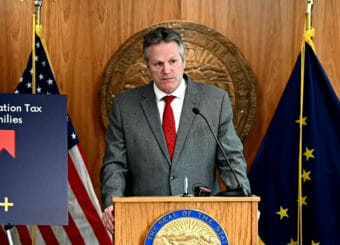
Gov. Dunleavy stands behind a lectern
Gov. Mike Dunleavy speaks to reporters on April 28, 2022. (Screenshot of Gov. Dunleavy’s Facebook page.)

Gov. Mike Dunleavy says he plans to decide soon whether to sign a bill that would provide state recognition for Alaska’s 229 federally recognized tribes.

“We’re in the process of making a decision, and we’ll have that answer next week,” Dunleavy said in an interview on Friday.

The bill passed the state House and Senate last month.

The legislation is a priority for Native leaders in the state. It would acknowledge Alaska tribes’ “unique role in the state’s past, present, and future,” though it would not change the way the state engages with them. But Dunleavy was noncommittal when asked whether he thought the state should offer recognition.

But Dunleavy was noncommittal when asked whether he thought the state should recognize Alaska’s tribes.

“Well, we know the feds recognize the sovereignty of the tribes. And the state has relationships with our tribes. You know, the only reservation concept is Metlakatla in the state of Alaska, and so — again, the state, we deal with tribes all the time, and the tribal government all the time, we have compacts with the tribal government,” Dunleavy said.

Advocates for the tribal recognition bill say the measure would allow for continuity between governors’ administrations and allow tribes to make longer-term plans with state officials.

Tribal leaders, including Gloria Burns of Ketchikan and Marina Anderson of Kasaan, are pursuing a similar ballot initiative that may go before voters this fall.

Dunleavy’s comments came in an interview with KRBD’s Raegan Miller on Friday during a stop in Ketchikan.

Correction: This story has been updated to reflect that the tribal recognition bill would not change the way the state engages with tribes. The bill would instead simply acknowledge tribes’ role in the state’s past, present and future.

St. Paul toddler laid to rest with his mother after long fight to bring him home

Joshua John Rukovishnikoff, 2, died in December. His sister, Jaylene Philemonoff, started a petition to bring his body home. (Photo courtesy of Jaylene Philemonoff)

A 2-year-old allegedly killed by his foster parents has been laid to rest on St. Paul Island. The child, Joshua John Rukovishnikoff, was buried on top of his mother’s grave during a memorial service Saturday.

Jeremy Philemonoff is from the Pribilof community of about 350 people and used to be married to the toddler’s mother, Nadesda “Lynnette” Rukovishnikoff, who was killed in September 2021.

Philemonoff said they laid John to rest right on top of her casket and placed a small cross in front of hers.

When you’re born, the doctor usually puts the baby on the chest of the mother,” he said. “And that’s kind of what we were doing. It’s just kind of a beautiful ending to such a tragic death.”

Jaylene worked for months getting 6,000 signatures from across the globe on the petition that brought him home, according to her father. (Photo courtesy of Jeremy Philemonoff)

Several community members gathered for the memorial service at the St. Peter and Paul Russian Orthodox Church. There was a wake after the burial.

In mid-December, while in the care of his foster parents, John was medevaced to a hospital in Anchorage where he died of a serious head injury, according to a report from the Alaska State Troopers. His foster parents now face felony murder charges in his death.

His mother was killed just months before him. Joshua Rukovishnikoff — her husband at the time and John’s father — faces charges for her murder.

John had family in Anchorage and on the island. His half-sister, 17-year-old Jaylene Philemonoff, said she planned for him to be returned to St. Paul to be buried. But John’s paternal aunt had power of attorney. That side of the family had pushed for him to be buried in Anchorage, where he died.

After petitioning and battling for months to have John returned to the island, a tribal court in Anchorage appointed Jaylene as the executor of the boy’s estate in February.

Jaylene and her brother are enrolled citizens of the Aleut Community of St. Paul Island tribal government. The court said the tribe has inherent jurisdiction in this case.

That also means Philemonoff finally got to bring her brother home.

“At the end of the day, he’s with my mom now,” Jaylene said. “I guess that’s all that really matters.”

Jaylene worked for months getting 6,000 signatures from across the globe on the petition that helped bring John home, according to her father.

After all that work, she’s still somber, but glad that John was returned to their mother.

I still don’t really know how I feel about it all because I did all this work and he’s still not here,” she said. “He’s still gone. So I’m very numb, but I know I did the right thing.”

A memorial service was also held in January at the Saint Tikhon Orthodox Church in Anchorage.

John’s death is still under investigation. His father’s next court hearing in the death of his mother is set for July.

Alaska Senate approves bill formally recognizing Native tribes

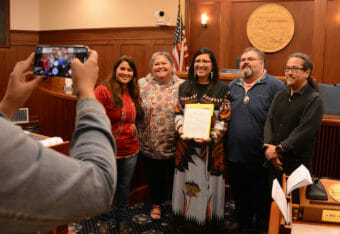
Supporters of House Bill 123, the tribal-recognition bill, pose for a group photo after the Alaska Senate approved the bill on Friday, May 13, 2022. (Photo by James Brooks/Alaska Beacon)

Alaska’s state government would formally recognize all of Alaska’s 229 federally recognized tribes under legislation passed Friday by the state Senate in a 15-0 vote.

If signed into law by Gov. Mike Dunleavy, the measure will be mostly ceremonial. Lawmakers said it nonetheless represents an opportunity to respect Alaska Natives and tribal organizations that have historically been discriminated against by the state.

“I think the fundamental issue is a little bit of respect and recognition,” said Sen. Bert Stedman, R-Sitka.

Some lawmakers said the measure, formally known as House Bill 123, could lead to further agreements between state and tribal organizations on a variety of topics.

“Now the work begins on defining what real government-to-government relationships should look like,” said La quen náay Liz Medicine Crow, who supported the bill and watched it pass the Senate.

“And that’s the next part, that we’re looking forward to seeing how that actually happens,” she said.

The bill must return to the House for a procedural vote before it goes to Dunleavy. A spokesman for the governor said Dunleavy will review the bill when it reaches him.

Effect on ballot measure

The bill is almost identical to a tribal-recognition ballot measure headed to voters this fall. 

If Dunleavy signs the bill or allows the bill to become law without his signature, the ballot measure will be canceled under a provision of the Alaska Constitution that nullifies ballot measures if the Legislature passes a substantially similar law.

Legal analysis conducted by legislative attorneys concluded that the bill is similar enough. Lt. Gov. Kevin Meyer would make the final determination.

Richard Chalyee Éesh Peterson was one of the prime sponsors of the ballot measure and watched as the Senate voted.

He said organizers would be meeting later Friday and that the initiative “is now unnecessary.”

“The ballot initiative never should have happened. It was (because of) a lack of Legislature actions for the last few years,” he said.

Former Rep. Chuck Kopp, R-Anchorage, introduced a similar measure in 2020, but it failed to become law. Rep. Tiffany Zulkosky, D-Bethel, reintroduced it in 2021. 

Members of the Legislature, particularly Republicans, had previously worried that recognizing tribes could create a patchwork of land laws. Sen. Mike Shower, R-Wasilla, said the fear was that the bill would create “230 individual nation-states” scattered across Alaska.

Shower, chair of the Senate State Affairs Committee, heard testimony on the bill and amended it slightly to meet non-Natives’ concerns about the issue.

Ultimately, he joined 14 other senators in support.

Though symbolic, said Sen. Tom Begich, D-Anchorage, recognition “does a whole lot because it provides dignity and respect.”

Sen. Gary Stevens, R-Kodiak, said recognition, “will lead to further conversations” between the state and tribes. 

One example: Legislation near final passage in the House that would have the state partner with tribes through compacts in order to operate schools.

US boarding school investigative report released

Interior Secretary Deb Haaland at the Interior Department’s press conference on its federal boarding school investigation in Washington, D.C. on Wednesday, May 11, 2022. (Photo by Jourdan Bennett-Begaye, Indian Country Today)

The U.S. Department of Interior released its investigative report Wednesday on the Federal Indian Boarding School Initiative. It’s being called the first volume of the report and comes nearly a year after the department announced a “comprehensive” review.

Interior Secretary Deb Haaland, Bryan Newland, assistant secretary for Indian Affairs, Deborah Parker who is the chief executive officer of the National Native American Boarding School Healing Coalition and James LaBelle Sr., a boarding school survivor and the first vice president of the coalition’s board, spoke at a news conference in Washington announcing the report’s findings.

“The consequences of federal Indian boarding school policies — including the intergenerational trauma caused by the family separation and cultural eradication inflicted upon generations of children as young as 4 years old — are heartbreaking and undeniable,” Haaland said in a statement. “We continue to see the evidence of this attempt to forcibly assimilate Indigenous people in the disparities that communities face. It is my priority to not only give voice to the survivors and descendants of federal Indian boarding school policies, but also to address the lasting legacies of these policies so Indigenous Peoples can continue to grow and heal.”

Newland led the over 100-page report, which includes historical records of boarding school locations and their names, and the first official list of burial sites.

The findings show from 1819 to 1969, the federal Indian boarding school system consisted of 408 federal schools across 37 states, some territories at that time, including 21 schools in Alaska and seven schools in Hawai’i. Some of these schools operated across multiple sites. The list includes religious mission schools that received federal support, however, government funding streams were complex therefore, all religious schools receiving federal, Indian trust and treaty funds are likely not included. The final list of Indian boarding schools will surely grow as the investigation continues. For instance, the number of Catholic Indian boarding schools receiving direct funding alone is at least 113 according to records at the Bureau of Catholic Indian Missions.

About 50% of federal Indian boarding schools may have received support or involvement from religious institutions or organizations including funding, infrastructure and personnel, Newland said.

The federal government, at times, paid them on a per capita basis for the children to enter into the schools.

Approximately 53 different schools had been identified with marked or unmarked burial sites. Specific locations of the burial sites will not be released to protect against grave robbing, vandalism and other desecration. The department expects the number to increase as the investigation continues.

In June 2021, Haaland announced an Interior investigation in federal Indian boarding schools to make “a comprehensive review of the troubled legacy of federal boarding school policies” from as early as the 19th century.

She said the initiative was created after the discovery of 215 unmarked graves of Indigenous children by Canada’s Tk’emlúps te Secwépemc First Nation at the Kamloops Indian Residential School in May 2021.

The first volume of the report highlights some of the harsh conditions children endured at the schools. Children’s Indigenous names were changed to English names; children’s hair were cut; the use of their Native languages, religions and cultural practices were discouraged or prevented; and the children were organized into units to perform military drills.

The report cites findings from the 1928 Meriam report in which the Interior acknowledged “frankly and unequivocally that the provisions for the care of Indian children in boarding schools are grossly inadequate.”

A map of boarding school sites provided by the Interior Department

Click here to see other maps

Examples included descriptions of accommodations at select boarding schools such as the White Earth Boarding School in Minnesota where two children slept in one bed, the Kickapoo Boarding School in Kansas where three children shared a bed and the Rainy Mountain Boarding School in Oklahoma where, “single beds pushed together so closely to preclude passage between them and each bed has two or more occupants.”

The 1969 Kennedy Report, cited in the Department investigation, noted that rampant physical, sexual and emotional abuse: disease; malnourishment; overcrowding and lack of health care at Indian boarding schools are well-documented.

It also found schools focused on “manual labor and vocational skills that left American Indian, Alaska Native, and Native Hawaiian graduates with employment options often irrelevant to the industrial U.S. economy, further disrupting Tribal economies.”

Federal boarding schools first started with the Indian Civilization Act of 1819 when the government enacted laws and policies to establish and support Indian boarding schools. For more than 150 years, Indigenous children were taken from their communities and forced into boarding schools that focused on assimilation. An unknown number of religious Indian boarding schools, funded by private and government funds, predate the Civilization Act by at least 100 years.

Native land and wealth diminished

In a major finding, the report documents the use of tribal trust and treaty funds for the federal boarding school system as well as mission schools operated by religious institutions and organizations. Although the total amount of these funds used to directly fund schools is unknown, according to an investigation by Indian Country Today, more than $30 million in today’s dollars were siphoned away during a nine year period by Catholic schools alone.

The U.S. also set apart tracts of Native lands for use by religious institutions and organizations. According to an ongoing investigation by Indian Country Today, a large portion of this land may still be held by churches.

Indeed, the relationship between major religious denominations and the federal government regarding Indian mission schools is described as “an unprecedented delegation of power to church bodies that were given the right to nominate new agents, direct educational and other activities on the reservations.

Members of the Sicangu Youth Council help provide a formal burial at the Rosebud Indian Reservation on July 17, 2021, for some of the nine Rosebud students who died at Carlisle Indian Industrial School in the 1880s. The children’s remains were finally returned to their homelands after 140 years, wrapped in a buffalo robe bundle and placed in a cedar box. Earth collected at the Carlisle graves were added to the children’s final resting places. (Photo by Vi Waln for Indian Country Today)

Although the report makes little mention of accountability for religious organizations that operated boarding schools, it does indicate that non-federal entities will be given support in releasing their records associated with the schools.

Parker said the organization’s collaboration with the Interior found an additional 89 boarding schools that did not receive any federal funding.

As part of the initiative and in response to recommendations from the report, Haaland announced the launch of “The Road to Healing” year-long tour. It’ll consist of a tour across the country to allow boarding school survivors to share their stories, help connect communities with trauma-informed support and to gather a permanent oral history.

The report also points to the 2019 watershed Running Bear studies, funded by the National Institute of Health. This research contains the first medical studies to systematically and quantitatively show that the Indian boarding school system experience continues to impact the present day health of adult boarding school survivors.

Newland cited the need for more investigation because of the COVID-19 pandemic and its resulting closures of federal facilities that affected obtaining and reviewing documents and the department’s limited funds at that time.

The second volume will be aided by a $7 million investment from Congress through fiscal year 2022. Newland recommended for it to include a list of marked and unmarked burial sites at federal Indian boarding schools — with names, ages, tribal affiliations of the children at those locations — an approximation of the total amount of federal funding used to support the boarding school system and to further probe the impacts on Indigenous communities. Additionally, the department wants to approximate the total number of children who attended the boarding schools.

“This report presents the opportunity for us to reorient federal policies to support the revitalization of Tribal languages and cultural practices to counteract nearly two centuries of federal policies aimed at their destruction,” Newland said in a statement. “Together, we can help begin a healing process for Indian Country, the Native Hawaiian Community and across the United States, from the Alaskan tundra to the Florida everglades, and everywhere in between.”

Opportunity to submit stories

On Thursday, members of Congress held a hearing at 1 p.m. ET, for the bill “Truth and Healing Commission on Indian Boarding School Policies in the US.” Rep. Sharice Davids, Ho-Chunk, is the lead sponsor of the bill.

The National Boarding School Healing Coalition is requesting people who attended a boarding school or are a descendent of a boarding school attendee to submit their written testimonies to the House of Natural Resources Committee by May 26. Email submissions to HNRCDocs@mail.house.gov and CC NABS at info@nabshc.org.

The National Boarding School Healing Coalition has an available template to use here.

ICT’s Mary Annette Pember contributed to this report.

This story was originally published by Indian Country Today and is republished here with permission.

Former Tlingit & Haida chief justice appointed to national commission on missing and murdered Indigenous people

A group gathers at the steps of the Alaska State Capitol in Juneau on May 5, a national day of awareness for missing and murdered Indigenous People. (Photo by Paige Sparks/KTOO)

Central Council of Tlingit and Haida Indian Tribes of Alaska former chief justice Michelle Jaagal Aat Demmert has been appointed to the Not Invisible Act Commission. 

According to the Department of Justice, the commission was created to “combat the epidemic” of missing and murdered Indigenous people. Secretary of the Interior Deb Haaland announced the commission on May 5, Missing and Murdered Indigenous Peoples Day.

“This is not an easy commission to be part of, we will have to take testimony we will have to hear stories,” Demmert said.

She anticipates that these testimonies from victims’ families will make her eager to see change enacted quicker.

“And of course, you know, as a problem solver, what I want to do is help find solutions,” Demmert said. “And I may not be able to immediately respond in that way.”

She said she expects she will need support from elders, which the commission lacks right now. 

“Missing from the commission, I think, is a named tribal elder who could really hold space for us in, send us off in a good way,” Demmert said. “And also, you know, just help us. Because this is going to be really, this is going to be really hard.”

When the commission meets for the first time in two weeks, Demmert says they plan to start broadly in their look at communities impacted by high rates of missing and murdered Indigenous people. She says they will look into systemic issues and why those led to the crisis.

“And of course, it’s not an easy ‘why’ to answer because it’s a historical factor. And so we have to acknowledge the issues that led us to this situation,” she said.

From there, the commission plans to look at using research to influence and shape policies, and improve communication between tribal, state and federal resources.

The commission has 37 members that include tribal leaders, survivors, families of those who have been missing and murdered, and law enforcement.

Native organizations win $35M grant to bring broadband home

An engineer installs an antenna receiver in Lena Foss’ home on October 19, 2021 in Akiak, Alaska. Akiak used coronavirus relief funding to pay for its broadband project — the new Tribal Broadband Connectivity Program grant is aimed at equipping homes and rural health facilities with the devices needed to take advantage of broadband. (Photo by Katie Basile/KYUK)

A group of Alaska Native tribes, communities and village corporations has won a $35 million infrastructure grant to provide broadband to their constituents.

Unlike traditional infrastructure projects involving steel or concrete, this federal grant is aimed at equipping homes and rural health facilities with the devices needed to take advantage of broadband.

A professional headshot of a woman wearing glasses
(Courtesy of Nicole Borromeo)

Nicole Borromeo is executive vice president of the Alaska Federation of Natives, which organized the consortium to apply for the grant. She said the first step is a needs assessment of the participating organizations, which include tribal housing authorities and regional non-profits.

“After that, we are going to start to supply their tribal citizens, Native shareholders, low-income housing families, what have you, with bundled computer packages,” she said. “And they’ll be able to choose from a traditional desktop or maybe a laptop or, finally, a tablet, which is probably going to be more popular for school-aged students.”

Borromeo said the grant will also fund traveling IT technicians and a training program so that the technicians can come from the communities they serve.

The grant is part of the first wave of infrastructure projects coming to Alaska from the $1 trillion infrastructure bill President Biden signed into law last year. It is the largest grant awarded by the new Tribal Broadband Connectivity Program, which is part of the U.S. Department of Commerce.

Site notifications
Update notification options
Subscribe to notifications