Alaska Native Government & Policy

More than 50 Alaska Native tribes support Jackson for Supreme Court

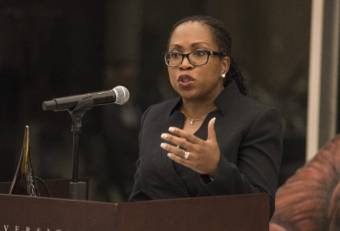
Ketanji Brown Jackson 2020
Judge Ketanji Brown Jackson speaks as an honoree at the Third Annual Judge James B. Parsons Legacy Dinner on Feb. 24, 2020, at the University of Chicago Law School. (Creative Commons photo by Lloyd DeGrane)

Many Alaska Native tribes are getting behind U.S. Supreme Court nominee Ketanji Brown Jackson. 

One tribe supporting Jackson is Central Council of the Tlingit and Haida Indian Tribes of Alaska. 

President Chalyee Éesh Richard Peterson said that, while Jackson doesn’t have the most experience in Indian Country law, she is the most qualified candidate nominated to the Supreme Court in recent years. 

“I think her given aptitude for it is a plus for us,” Peterson said. “You know, we want people to adjudicate on the letter of the law, and we think the letter of the law favors a lot of the tribal cases.”

Other tribes and tribal organizations across the state have sent letters of support to the U.S. Senate Judiciary Committee this month, including the Association of Village Council Presidents, which represents 56 tribes in Western Alaska.

The letter from AVCP stated that her record of fairness makes her a good choice for the Supreme Court. 

“AVCP recognizes the importance of a U.S. Supreme Court appointee who understands and is committed to protecting the rights of all Americans, including those who have historically received inequitable and unfair treatment,” the letter said. 

Jackson also has support from Kawerak, Inc., Hydaburg Cooperative Association, Craig Tribal Association, Native Village of Eyak, Akiak Native Community, Noorvik Native Community and Tanana Chiefs Conference.

Democrats on the Senate Judiciary Committee are pushing for a vote tonight on moving her nomination to the full Senate and hope get Jackson confirmed before they go on Easter recess this weekend.

Earlier today, Sen. Lisa Murkowski announced that she would support Jackson’s nomination.

If confirmed, Jackson would be the first Black woman to serve in the nation’s highest court.

The Curyung Tribe is gathering input for changing a Dillingham creek’s derogatory name

""
Sunset over a creek in Dillingham on Sept. 29, 2020. The creek will be renamed in the federal registry as part of a push to remove a word that disparages Indigenous women from the names of geographic features across the country. (Photo by Brian Venua/KDLG)

More than two dozen places in Alaska are named using a racist and sexist word that disparages Indigenous women.

Last spring, months before the federal government began steps to change those names, three elementary students wanted to rename a Dillingham creek that uses that slur, as well as a road that bears the creek’s name.

Now, members of the Curyung Tribal Council in Dillingham are working to gather ideas for new names from the community.

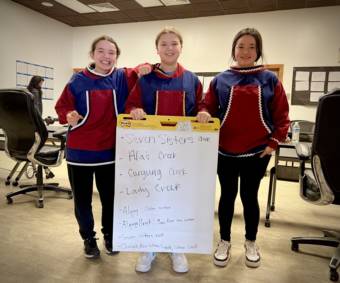
The students — Alora Wassily, Trista Wassily and Harmony Larson — wanted to change the name to Seven Sisters Creek to reflect the community’s connection to sisters who traveled about six miles from Nushagak Point to live along the creek generations ago.

In November, Interior Secretary Deb Haaland moved to ban the slur from the names of places on federal lands. And last month the Interior Department opened a public comment period on name changes for over 660 geographic features across the country.

The federal Derogatory Geographic Names Task Force, unlike the girls, based its suggestions on other geographic locations in the area.

In Alaska, the task force will give priority to tribes’ suggestions for name changes, but those suggestions have to adhere to existing policies — like restrictions on naming things after people.

First Chief JJ Larson said the Curyung Tribal Council took part in a March 22 consultation with the U.S. Board on Geographic Names, but the Tribe also requested an independent session with the board, which is scheduled for April 19.

“The three girls that have worked on this for over a year now have done a lot of the groundwork, and really pushed for this to happen,” he said. “We felt that as a tribe, if the federal government was going to come in here and change the name on our tribal lands, that we should be consulted individually.”

In February, the task force released more than 3,300 alternatives for locations across the country. In Dillingham, the names it suggested were Bradford Point, Snag Point, Grassy Island, Sheep Island and Picnic Point.

A creek in the Lake and Peninsula Borough will also receive a new name. Suggested changes for that include Sea Gull Flat, Telephone Point, Svoger Slough, Graveyard Point and Cape Horn.

On April 2, the Curyung Tribe plans to hold a community meeting open to everyone in Dillingham to discuss ideas and gather feedback. The Tribe also invited the U.S. Geological Survey to attend.

Larson said a few names have been brought forward since the students first presented Seven Sisters Creek.

“The girls actually came to our Tribal Council meeting and gave us another name as another option: Al’a’s Creek,” Larson said. “Al’a is big sister, and so it’s a really good name, I think, that that really ties well with our community and our culture.”

Elder Dora Andrew-Ihrke worked with the students on the name change project. She taught for decades at the Dillingham school before she retired. She is from Aleknagik — Alaqnaqiq — which she said means “wrong way” in Yup’ik.

Her aunt told her that the first people who resided in Aleknagik set up a camp at what became the mission school.

“They settled there, and it became a permanent place. And once it becomes a place to live, then you give it a name,” she said. “When people come around, they ask, ‘Who are you guys?’ And they’d say, ‘Igyararmiunguukut.’ We’re people from the throat. Throat of the area, meaning the lake was like the head of a person. And the throat is right between the river, and the river would be like going down into your stomach area, and so forth. So land was sometimes named after the human body. And so Aleknagik, which was Alarneq — somebody went up the wrong river with the kayak, instead of going up the Nushagak River, and settled there. And then the rest of the group, the Natives that first settled there called themselves the Igyararmiut.”

As for renaming the creek in Dillingham, Andrew-Ihrke thinks it should reflect the women who lived there.

“For my Yup’ik culture, I would show respect by just calling it Alqaqellriit Kuigat, the Sisters Creek. Alqaqellritt, Alqaq Al’a is the oldest sister, so Alqaqellriit implies there are more than one sister,” she said. “So it doesn’t say how many, but the Sisters Creek in English would be proper, and to me that’s showing respect on how you name places.”

Efforts to restore Native place names aren’t new. In 2015, then-President Barack Obama used his executive power to rename Mount McKinley as Denali after a more than quarter-century push to do so.

In Bristol Bay, the Bristol Bay Native Corporation has led a place names project for years. Francisca Demoski worked on the project since the early 2000s. She’s from Togiak, where many people call her by her Yup’ik name, Mall’u.

Demoski said the program began with the goal to preserve place names. Early on, they gathered information on names in a database. She then worked with Tim Troll, of the Nature Conservancy, to conduct local interviews.

Demoski said it’s imperative to consult with the Native people of an area when renaming a place.

“For thousands of years, our people have lived on this land, they’ve known this land and they’ve named this land. So the efforts that the Dillingham school kids are doing I think is so important, and so respectful,” she said. “Because you’re learning more today as people are realizing, you know, and they’re reclaiming back to their original name, and realizing how important it is to be using their local names versus somebody who came from outside to give, you know, the place the name.”

Mayor Alice Ruby said the city council has not yet taken a position on renaming the Dillingham road which shares the creek’s name. Part of what makes it complicated, she said, is that it’s always been a private road.

“The council has been very sensitive about first of all, acknowledging private property and private owners and stuff,” Ruby said. “But they’re also pretty sensitive about things that might be offensive to the public. The property owners on the road are going to be pretty key to whether there’s interest in changing the name.”

Curyung First Chief JJ Larson said that through this effort, he’s started to think about the potential for changing the names of other places in the area.

“I think that as the new first chief — I’m pretty new to it — one of the things that I would like to work on is working with the city and seeing if there would be any interest in changing the name of the city to Curyung,” he said.

Larson hasn’t taken any action on that yet. But he pointed to other cities throughout the state that have changed their names, like Utqiaġvik.

“It was Barrow before, but now it’s Utqiaġvik. And just saying that out loud, you have to think about like, ‘Oh, this is Native land.’ Right? And so that’s something to think about,” he said. “And that’s something that I would like to work with the city on.”

The Derogatory Names Task Force’s current effort will change geographic names in the federal registry, but not local or state building, park or road names or those of federal land units, like national parks.

Mike Tischler, with the Derogatory Names Task Force, said that this renaming effort will end with recommendations to the Board on Geographic Names in late summer or early fall. People can submit comments on the process or name suggestions of their own to the Federal Register. The deadline to do so is April 25th.

New provision of Violence Against Women Act empowers tribal governments to exercise jurisdiction on tribal land

A man in a small group of people holds a sign that says "Include Alaska Native women in VAWA)
Ishmael Hope, left, and other Alaska Native representatives at the 2013 Choose Respect rally in Juneau, Alaska, asking legislators to address issues with the Violence Against Women Act. (Photo by Heather Bryant/KTOO)

A new provision introduced with the reinstated federal Violence Against Women Act allocates funds to empower tribal governments to exercise jurisdiction on tribal land.

On March 15, President Biden signed into law a $1.5 trillion omnibus spending package that included the reauthorization of the Violence Against Women Act. The law makes it clear that Alaska tribes can act to protect women at risk in their communities.

“Alaska tribes deserve the same kind of protections and resources that other communities in Alaska and the lower 48 receive and don’t even think about it,” said Association of Village Council Presidents spokesperson Joy Anderson. “So this is really pretty historic.”

With the strong backing of Alaska Sen. Lisa Murkowski, the reauthorization made it through the Senate long after it was passed by the House. She said that there is plenty of evidence that the current system is not doing the job of protecting rural Alaska women and children.

“One out of five Native young people has suffered from PTSD due to childhood exposure to violence; we know that the status quo is not working,” said Murkowski. “And when one in three Native villages lacks any law enforcement presence, we know that something has to change.”

Nationally, the act would allocate $5 million for the Bureau of Indian Affairs to address missing and murdered Indigenous women. But an additional $3 million was provided for some states, including Alaska, to provide for training and the needs of tribal courts. Alaska will receive the bulk of this funding through the Alaska Tribal Public Safety Empowerment Subtitle.

The provision includes two sections with significant changes to tribal jurisdiction. The first part offers clarification.

“Pprior to VAWA passing, if you had asked, ‘Do Alaska tribes have criminal jurisdiction over Alaska Natives or American Indians within village boundaries?’ you probably would have gotten a variety of answers,” said Anderson of the Association of Village Council Presidents.

Congress has now provided that answer.

“What this part of the bill does is clarify that tribes do have criminal authority over Natives within their village boundaries,” Anderson said. “And that’s not dependent on whether or not there’s Indian Country.”

The bill also establishes a pilot program for tribes to exercise what’s called special domestic violence criminal jurisdiction. This recognizes the authority of tribes to exercise criminal jurisdiction over non-Native people who commit certain crimes against a Native victim on tribal land. These crimes include stalking, domestic violence, and sexual assault.

The tribes now await the details on how to apply, according to Winter Montgomery, Tribal Justice Attorney for the Association of Village Council Presidents.

“We’re in the beginning process,” said Montgomery. “So when the U.S. Attorney gives us the full criteria, we’ll provide that to the tribes.”

But the pilot program does have stipulations.

“The pilot would be for five tribes. And that would include a group of tribes that could apply as a consortium,” said Anderson. “So five would initially be able to begin exercising that special criminal jurisdiction. And then each year, while VAWA is authorized, an additional five could be added each year.”

According to Murkowski’s deputy communications director, Hannah Ray, the U.S. Department of Justice is required to prioritize tribes that occupy villages where the population is predominantly American Indian/Alaska Native and that lack a permanent law enforcement presence. They must also make a determination that the tribe has adequate safeguards in place to protect the rights of defendants.

Chilkoot Indian Association launches traditional arts apprenticeship program

Two women weaving a blanket
Mentor Lily Hope (right) and apprentice Karen Taug begin the first two rows of her Chilkat blanket (Photo courtesy of Scott Burton)

The Chilkoot Indian Association has launched a traditional Lingít arts apprenticeship program. The year-long initiative will pair mentors with apprentices to develop traditional skills — and to foster vital cultural and traditional knowledge of the Chilkat Valley.

The first cohort of the Chilkoot Indian Association’s traditional arts apprenticeship program, focused on Chilkat weaving and silver carving, began earlier this month.

Tribal administrator Harriet Brouillette says the apprenticeship program is part of a wider initiative to support tribal members developing their art.

“Our apprenticeship program is a way to develop master artists. What we have been seeing in our community is that we’re losing our master artists,” Brouillette said. “Thanks to AIA (Alaska Indian Arts), we do have some master artists, but they’re reaching retirement age. And we don’t have the capacity or have not had the capacity to build master artists to step up in their place.”

Three mentors will work with four apprentices over the next year to build skills and creativity while expanding intergenerational cultural and traditional knowledge.

Mentors include weaver Lily Hope, who will work with Karen Taug on dying and weaving techniques, versions of the Chilkat braid and how to weave a perfect circle.

Master weaver and fluent Lingít speaker Marsha Hotch will work with Cara Gilbert and Gwen Sauser on weaving techniques, language connections, clan stories, goat wool processing and dying, thigh spinning and incorporating cedar bark.

Apprentices Gilbert and Sauser are the great-granddaughters of renowned Chilkat weaver Jenny Thlunaut.

Silver carver Greg Horner will work with apprentice Rob Martin on soldering, making rings, inlaying gems and stones and silver working skills.

Brouillette says it’s vital to support artists, who then will pass down their craft to future generations.

“We have a really strong base of new artists who are dedicated to their art. They just need a little extra help,” Brouillette said.

A federal grant from the Department of Health and Human Services will support the program. Apprentices and mentors will give workshops and write blog posts about their processes. At the end of the year, their work will be showcased in a community exhibit.

The Chilkoot Indian Association is accepting applications for the second cohort, which will begin Oct. 1.

Tlingit and Haida president attends signing of Violence Against Women Act in Washington, DC

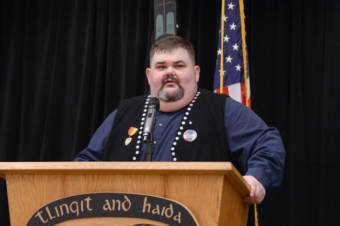
Richard Chalyee Éesh Peterson, President of Central Council of Tlingit and Haida. (Photo courtesy of Central Council of Tlingit and Haida)

Central Council of Tlingit and Haida President Richard Chalyee Éesh Peterson was in Washington, D.C. for the reauthorization of the Violence Against Women Act, or VAWA. The legislation is part of the funding act for this fiscal year.

U.S. President Joe Biden helped write the original piece of legislation that supports responses to sexual assault and domestic violence. Peterson says he was impressed with the president’s remarks on Wednesday.

“It was exciting,” Peterson said. “It was pretty emotional. You know, it is a needed law and Alaska inclusion is so important. It was really great to be able to share that with friends. You know, who had been champions on VAWA. Like Michelle Demmert, former chief justice for our tribal courts.


View this post on Instagram


A post shared by Tlingit & Haida (@tlingithaida)

Peterson said the legislation recognizes tribal sovereignty by upholding tribal courts.

He expressed gratitude to Sen. Lisa Murkowski and staff member Amber Ebarb for their work towards passing the legislation.


Biden reauthorizes Violence Against Women Act empowering tribes to prosecute non-Native perpetrators

President Joe Biden delivers remarks on Wednesday, March 16, 2022, on the reauthorization of the Violence Against Women Act. (Image from C-SPAN)

On Tuesday, President Joe Biden signed an omnibus spending package for fiscal year 2022 into law. The nearly 3,000-page bill includes a reauthorization of the Violence Against Women Act, or VAWA.

As a Delaware senator, Biden helped write the original piece of legislation nearly 30 years ago and has long championed the law. As president, he spoke about the measure on Wednesday.

“Even in 1994, we knew there was much more we had to do,” he said. “That was only the beginning. That’s why because of all of you in this room, every time we’ve reauthorized this law its been improved. It’s not like we didn’t know we wanted to do all these things in the beginning. We did as much as we could do and keep trying to add to it.”

The law focuses on domestic violence and sexual assault survivor programs. The reauthorization includes language that empowers tribes to prosecute non-Native perpetrators of child violence, sexual violence, sex trafficking, stalking and other crimes.

The tribal provisions of VAWA also create an Alaska pilot project that will allow a small number of Native villages to exercise special tribal criminal and civil jurisdiction over non-Native perpetrators in some cases.

Akiak Native Community Chief Mike Williams is also the Alaska region vice president for the National Congress of American Indians.

“This reauthorization of VAWA empowers us to take the necessary steps to build healthier and safer tribal communities in Alaska and across Indian Country for generations to come,” Williams said in a news release from the national Indigenous rights organization.

Site notifications
Update notification options
Subscribe to notifications