Alaska Native Government & Policy

Mayor: Part of Skagway RV park where boarding school stood should go to tribal government

An old, blurry aerial photo of Skagway showing the Pious X Mission School
View of Skagway’s valley looking south at the Pius Mission X School. The four long buildings were the barracks. The square building was the main school building. (Photo courtesy of Andrew Beierly.)

Skagway’s mayor has proposed giving half of the land that was once a Native boarding school to the local tribal government. Mayor Andrew Cremata made the proposal on Monday night during a special assembly meeting to discuss the long-term future of the five acres that’s now a municipal-owned RV park.

What’s now the Garden City RV park was once the site of the Pius X Mission School, where Native children were indoctrinated into Western culture in the mid-1900s.

Cremata started the Feb. 28 meeting with a proposal that appeared to take many in the room by surprise.

“There is a scar at Garden City, and it covers a wound that was created when the Pius X Mission was operational,” Cremata said. “I would recommend seriously entertaining taking half of that property, recognizing the scar exists and in an effort to heal that scar, generously give that property to the Skagway Traditional Council, half of it, where the mission is buried. And then we agree as part of an agreement between the Skagway Traditional Council and the municipality of Skagway to erect a monument that spans both pieces of property.”

The RV park was purchased in 2013 from the Catholic Church and is currently awaiting an archeological study. The bodies of hundreds of Native schoolchildren have been found buried at similar schools in Canada.

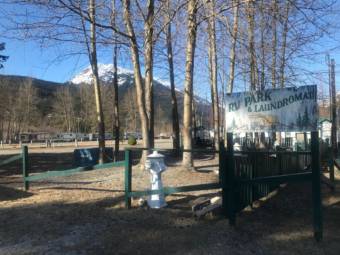
The Garden City RV Park in Skagway in April, 2021. (Photo by Mike Swasey/KHNS)

The Skagway Traditional Council has stated that it wants to see the results of the archeological study before determining how much of the land they think is appropriate to receive.

Monday’s meeting was also about developing a long-term plan for the park’s future. Some residents want it to remain a viable option for low-cost employee housing. Others want the revenue and economic diversity it offers as an RV park. Still others want the land to be sectioned off and sold for development.

Assemblyperson Dustin Stone argued that creating lots for sale won’t solve Skagway’s longstanding seasonal housing shortage.

“There is, I guess for lack of a better term, a crisis for people who are looking to buy their first home who’ve been here year-round. But the real housing crisis in this town is we don’t have anywhere to house people that come here to work and support our economy all summer,” said Stone.

Assemblyperson Orion Hanson argued against making the park accessible for seasonal housing.

“I don’t think an RV park ever should have been our band-aid for employee housing. What’s far more appropriate is we develop a trailer court if you’re looking for cheap, affordable housing, and the only place really to do that properly is across the bridge,” he said.

The municipality does own about five acres of land near the intersection of the Dyea Road and the Klondike Highway north of downtown that is set aside for the development of either a trailer park or an RV park.

Borough Manager Brad Ryan said the municipality has received an estimate for the cost of extending utilities to that area.

“We have a pretty recent estimate it’s about $10 million. We actually have a grant application in for it as well,” he said.

Assemblyperson Reba Hylton says she wants to keep a portion of Garden City as an RV park as a way to diversify Skagway’s tourism-based economy instead of strictly relying on cruise ships.

“I do support RV traffic. I think it’s an important part of our economy, and we really need to invest all we can. And I would love to see half of Garden City RV park continue to be an RV park. I think having green space and having nice facilities, especially close to a school is really, really important. I think the minimum we should give back is half of it,” she said.

She also wants the Catholic Church to take some responsibility for the mission school, which it sold to Skagway’s local government for $1.5 million.

“I think we should ask the Catholic Church to give us half of that money back too. They should be paying for that. We wrote them a $25,000 check in the last check run. Give that back, please. We want to do what’s right, they should do what’s right as well,” Hylton said.

After the nearly two-hour meeting, the mayor asked for the discussion to continue at the committee level.

Supreme Court to hear challenge to Indian Child Welfare Act

The U.S. Supreme Court building in Washington, D.C. (Photo by Liz Ruskin/Alaska Public Media)

The U.S. Supreme Court announced Monday that it will hear several cases challenging the constitutionality of the Indian Child Welfare Act, or ICWA. The law was passed in 1978 in response to the disproportionate removal of Native children from their homes, families and communities.

The Indian Child Welfare Act is a federal law that is used in Native child adoption cases.

ICWA provides Tribes with an opportunity to intervene when state child welfare and adoption agencies consider whether to remove a Native child from a home. The children can be enrolled citizens of the Tribe or be eligible for membership status.

Some states passed their own ICWA laws, but those laws must offer additional benefits — not change or remove the application of federal law.

Many of the arguments opposing ICWA say that law illegally discriminates against non-Native families based on race when placing Native children in homes.

That’s the argument at the core of Brackeen v. Haaland. The case began as a lawsuit in 2018 in Texas. It challenges ICWA as a race-based law and says it should be struck down based on equal protection grounds.

In April, the U.S. Fifth Circuit Court of Appeals split on Brackeen v. Haaland and ruled that parts of ICWA were constitutional, while others were not.

Because of the split decision, the ruling applies only to the judicial district which includes Louisiana, Mississippi and Texas.

In September, four Tribes, the state of Texas and several parents filed petitions to ask the Supreme Court to review the decision.

The Supreme Court has consolidated all of those petitions but has not yet set a date to hear them.

Also Monday, the Supreme Court declined to hear arguments in a case between Little Traverse Bay Bands of Odawa Indians and Michigan Gov. Gretchen Whitmer.

The federally recognized Tribe, which includes more than 4,000 Tribal citizens, appealed a decision against them in which they argued the 1855 Treaties of Detroit established a federal reservation for the Tribe.

The Tribe filed its petition for the Supreme Court to hear the case in November.

After more than a decade, overcrowded Shaktoolik is finally getting new homes

A couple and child sitting on a couch
Sophia Katchatag, her husband Murphy Katchatag and their son Eric, Jr., 4, watch TV in their small, two bedroom home in Shaktoolik, Alaska, in January 2022. (Photo by Jeff Chen/Alaska Public Media)

The smell of moose soup and the sounds of “Teenage Mutant Ninja Turtles” fill Sophia Katchatag’s small, two-bedroom home in the Norton Sound village of Shaktoolik. She and her husband share one room with their two younger children. Their two older kids share another room.

“I mean, I would love for me and my husband to have our own bed, but we just work with it,” she said.

Their teenage daughter wants her own room, too, but Katchatag said expanding isn’t financially feasible even with two incomes, especially with the recent spikes in lumber prices. She said she feels lucky to have her own place at all, which the family inherited in May and renovated with money from the region’s tribal housing authority. In the past, they shared a single bedroom in her mom’s house, living with extended family.

“To be honest it was hard, it was challenging,” she said. “Not having your own privacy, your own space and having to be on everyone’s schedule, do things on their time.”

Statewide, Alaskans are twice as likely to live in an overcrowded household than the national average. Rates are highest in small, off-the-road-system communities like Shaktoolik, where around 60% of residents live in overcrowded conditions. The federal Department of Housing and Urban Development defines overcrowded as more than one person to a room in the house, including the living room and kitchen, and severely overcrowded as more than 1.5 people to a room.

A wind-whipped village street in winter
A winter storm whips through Shaktoolik in January 2022. (Photo by Erin McKinstry)

“To be honest, in some of our places, if you’re living in a house that only has 1.5 individuals per room, that’s not going to be one of the more overcrowded houses in your community,” said Brian Wilson, executive director of the Alaska Coalition on Housing and Homelessness.

The problem is perennial, but the COVID-19 pandemic has made living with it harder.

Cramped conditions offer little space to work from home, conduct virtual schooling or quarantine, and they put multigenerational households at increased risk of infection, especially in communities with limited access to water and sewer.

“You know if one person in that home contracts COVID-19, it is impossible to physically space out and prevent the spread of that,” Wilson said.

Thankfully, he said, the places in the state with the highest rates of overcrowding also have the highest rates of vaccination. And in Shaktoolik, the tribe used federal COVID relief funding to retrofit an old clinic as a quarantine house. But, he said, the risk is still high.

“These are primarily smaller communities where everybody knows everybody, and it’s a beautiful thing culturally to say that if I live in one of those communities and I see my uncle or my brother or my friend’s nephew in a houseless situation, that I take them in,” Wilson said. “Unfortunately, the byproduct of that is the severe overcrowding, which can also be a very dangerous.”

Not enough homes

A man sitting at a kitchen table with a large dog lying on the floor next to him
Bering Straits Regional Housing Authority commissioner Eugene Asicksik has worked on housing issues in Shaktoolik for decades. He sees progress, but not enough. (Photo by Jeff Chen/Alaska Public Media)

Former Shaktoolik mayor and current Bering Straits Regional Housing Authority commissioner Eugene Asicksik said overcrowding leads to a host of problems in his community.

“You have too many adults living under one roof,” he said. “I think that adds to the social problems that occur when you have adults arguing or, you know, having a different opinion or fighting over the TV remote control and all that stuff.”

He’s been working to address housing issues in Shaktoolik for decades, and he does see some progress being made. But he said part of the problem is something that can’t be changed: Shaktoolik’s geography. The few vacant homes need work because of the harsh climate and substandard construction. And because the town is only accessible by barge or small plane, high construction costs keep people from building more or renovating.

“Everything has to be ordered,” Asicksik said. “One sheet of plywood can cost you over $100, $130 sometimes.”

A man unloading boxes from an airplane into the bed of a pickup
Agent Reuben Paniptchuk unloads a Bering Air flight at the Shaktoolik airstrip in January 2022. Bush planes are the village’s only lifeline in the winter months, when conditions don’t allow for barge access. (Photo by Erin McKinstry)

Financing is difficult, too, because most of the land is owned by the village corporation instead of homeowners and bank loans are often inaccessible. Asicksik said he learned that personally, when he expanded his own home to make space for his children and grandchildren, and he had a hard time accessing a loan because he didn’t own the land. He had to put everything he owned up for collateral.

Climate change is also eroding buildable land and slowing down economic activities like crab fishing, which used to provide more jobs in the village.

And, Asicksik said, there’s a lack of awareness and resources to address the problem.

“I don’t think there’s much consideration to what goes on in the bush,” he said.

Roughly 250 people live in Shaktoolik, which is about 125 miles east of Nome. The community is around 97% Alaska Native.

The region’s federally funded tribal housing authority is responsible for the bulk of the town’s residential construction. They haven’t built here in more than a decade, but thanks in part to federal COVID relief funding, Shaktoolik is getting four new modular houses.

That’s welcome news for city clerk Isabelle Jackson. Like many other residents, she’d thought about leaving because of the high cost of living and lack of housing options. But the subsistence lifestyle and the tight-knit community have kept her here. She’s waited almost 10 years for a home of her own.

“I remember the moment when they called me, and after they said I’m one of the recipients for a three-bedroom home, I started crying. I got quiet. Tears rolled down my eyes, just for, you know, happiness,” Jackson said.

A woman driving and ATV on a snowy street
Isabelle Jackson rides her ATV between her home and the Shaktoolik city office, where she works as the city clerk. She’s been on the waitlist for a new home since 2013. (Photo by Erin McKinstry)

Jackson will pay an income-based rent for 25 years and then own the home outright. Right now, she and two of her kids share a hallway. Her father, who’s sick, sleeps on the couch. That’s been particularly difficult during the pandemic ,when they’ve worried about spreading the coronavirus.

“We’re, like, helping each other out, you know, taking care of him right now. But yeah, it’s difficult when my son wants to, you know, play and stuff, but he has to, you know, be quiet and have that respect,” she said.

Tackling a complex problem

Shaktoolik’s four new modular houses, including Jackson’s, are stacked in Nome’s shipyard until the barge can access Shaktoolik in the spring. They were pre-built in Big Lake by NANA Construction last summer, but weather delayed their arrival.

Shipping containers stacked up in the snow
Shaktoolik’s four new modular homes sit in Nome’s shipyard. Recipients were chosen based on a number of criteria, including current housing conditions, veteran status, and length of time on the waitlist. (Photo by Erin McKinstry)

Jolene Lyon, CEO and President of the Bering Straits Regional Housing Authority, said that ideally they would have built them onsite to help create job opportunities for residents. But when the extra funding from the CARES Act and American Rescue Plan came in, they wanted to act fast.

“Our main objective is to get homes up and going in these communities. And in this instance, this was the fastest way to do it,” she said from her office in Nome. “Right now, COVID is frightening too many people. Being able to have your own space alleviates a lot of that mental stress.”

The tribal housing authority serves 17 villages in the Bering Straits region, which is the third most overcrowded region in the state. Lyon said building in such a diverse and remote region isn’t easy. From different soil types to harsh winter storms to permafrost, there’s no one-size-fits-all design.

“The challenges are not just in building a home, it’s designing a home that works for the environment in the community that you’re in,” Lyon said. “And so we ask the tribe as much information as to what they want, versus what we’ll be able to provide for that build.”

Normally, federal funding allows the housing authority to bring new homes to each village every decade, but the extra funding is helping them build more homes more quickly. In addition to the modular homes, they’re also bringing three new homes to the remote island of Diomede and four to Wales on the western tip of the Seward Peninsula.

A woman carrying a stepladder outside in the snow
Bering Straits Regional Housing Authority President and CEO Jolene Lyon carries a ladder from the tiny home that will head to Diomede in the spring. The organization hopes to use the design as a model for future projects. (Photo by Erin McKinstry)

Still, it’s only a small dent in the problem.

“We don’t have the funding,” Lyon said. “That makes it very difficult and frustrating sometimes, when you know that the need is greater than that. And you could deliver on doing more but it’s just that’s not the reality of it.”

And even if they did have the funding, income requirements and program guidelines keep some people in the region from accessing new homes.

Lyon said the region needs an estimated 400 new homes to meet the need and alleviate overcrowding. They’ll tackle the problem one home at a time.

The first answer for food insecurity: data sovereignty

Native American Agriculture Fund’s CEO, Toni Stanger-McLaughlin (Colville). (Courtesy image)

For two years now, the COVID-19 pandemic has exacerbated almost every structural inequity in Indian Country. Food insecurity is high on that list.

Like other inequities, it’s an intergenerational product of dispossession and congressional underfunding — nothing new for Native communities. What is new, however, is the ability of Native organizations and sovereign nations to collectively study and understand the needs of the many communities facing the issue. The age of data sovereignty has (finally) arrived.

To that end, the Native American Agriculture Fund (NAAF) partnered with the Indigenous Food and Agricultural Initiative (INAI) and the Food Research and Action Center (FRAC) to produce a special report, Reimagining Hunger Responses in Times of Crisis, which was released in January.

According to the report, 48% of the more than 500 Native respondents surveyed across the country agreed that “sometimes or often during the pandemic the food their household bought just didn’t last, and they didn’t have money to get more.” Food security and access were especially low among Natives with young children or elders at home, people in fair to poor health and those whose employment was disrupted by the pandemic. “Native households experience food insecurity at shockingly higher rates than the general public and white households,” the report noted.

It also detailed how, throughout the pandemic, Natives overwhelmingly turned to their tribal governments and communities — as opposed to state or federal programs — for help. State and federal programs, like the Supplement Nutrition Assistance Program, or SNAP, don’t always mesh with the needs of rural reservations. A benefits card is useless if there’s no food store in your community. In response, tribes and communities came together and worked to get their people fed.

Understanding how and why will help pave the way for legislation that empowers tribes to provide for their own people, by using federal funding to build local agricultural infrastructure, for instance, instead of relying on assistance programs that don’t always work. HCN spoke with the Native American Agriculture Fund’s CEO, Toni Stanger-McLaughlin (Colville), to find out more.

This conversation has been edited for length and clarity.

High Country News: The big number from this report is that 48% of Native people surveyed experienced food insecurity during the pandemic. Was this a failure of infrastructure, like supply chain issues and trucks not getting to reservations?

Toni Stanger-McLaughlin: It was a perfect storm of all of those things during the height of the pandemic. Reservations are the rural of rural — they’re oftentimes so far removed from access to transportation, or any type of processing or storage plant, that they fully rely on those systems operating in a timely manner. When they don’t, it means that those communities go without.

HCN: According to this report, Natives changed where they got their food during the pandemic. They stopped going to farmers markets and community gardens because of social distancing and did more home gardening, foraging and collecting of seeds, as well as sharing food. But, surprisingly, they hunted and fished less. Do you know why?

TSM: A lot of the communities were on strict lockdown. You weren’t supposed to leave your home. Going on a couple years now, these communities are still reeling and still having to figure out what to do. We also saw a real big uptake in direct farm-to-family. You could buy a cow in your neighborhood, or in your community, where before you couldn’t. Those farmers were selling to stockyards, who were then selling to big processing plants. Your meat could go three states before it would return to your community. Instead, we saw more direct sales. And the federal government allowed that. It hasn’t happened at that scale in a long time.

HCN: The gap in food security seems to have most impacted medium-income households as opposed to the poorest households. Is that correct?

TSM: Yeah. … When we receive this data, and we look at the income level of the respondents, that doesn’t correlate to the requirements to participate in some of the food assistance programs that exist in the federal government, and then trickle down to state and tribal governments. So, for instance, to qualify for what used to be called the food stamp program, SNAP, or WIC (the Special Supplemental Nutrition Program for Women, Infants, and Children) or free school meals, all those programs are income-contingent. And they get continued servicing.

For those that could qualify, income-wise, those programs weren’t obstructed in a way that the general food access (was) — getting a food distribution box versus going to a grocery store where everything is gone, everyone has purchased the goods from that grocery store. We saw it with toilet paper, but we saw it with food, too. There was a huge shortage of meat, or the meat was so expensive that it disabled people from being able to get the full nutritional value of each of their meals. They had to pick and choose. Those are, in our respondents in our survey, largely the ones that identified as being food insecure and lacking nutrition.

HCN: FRAC — the Food Research and Action Center — talks about opportunities to address food insecurity with the Build Back Better plan, or through Congress. But your organization seems more focused on tribal efforts, saying that instead of increasing benefits, the federal government should increase support and empowerment of tribal governments. Why is that distinction important?

TSM: Well, unfortunately, we have to do both. When we saw in the report that people were turning to their tribal governments, not their state governments, for assistance, it’s just another indication of the ability of tribes to administer those program dollars and keep an alignment with the requirements and mandates that come from receiving federal funding.

IFAI — the Indigenous Food and Ag Initiative — and FRAC and NAAF came together to provide the data that will help educate Congress when they’re making decisions about food implementation and agricultural production across the country, in particular Indian Country.

HCN: Why is self-sufficiency so much more effective?

TSM: Because they intimately know their neighbors. They know culturally how their communities function. And they know how to get to their membership in the best possible manner. So, in one community, it might be working through mobile slaughter (units). In another community, it might be distribution of food boxes. In another community that’s not so far removed from a town or city, it might be working with food banks. And so those community members, the tribal governing authority — they know that better than an outside entity, better than a state entity.

A lot of our tribes have economic arms of their tribal government that have some type of food- or agricultural-based business. They utilize those businesses to get that food to their community members. And that’s the model we want to see. Those producers within those communities can sell their food locally. It reduces transportation and storage costs, it reduces or works toward eliminating issues that you would see in long transportation. In the end, they will save money, because these communities will have additional dollars, so the value of their dollar will remain stronger, won’t be chipped away by having to go through multiple states or processing plants or transportation companies. And again, if we have natural disasters, we have a pandemic, then the communities can stand up and serve their citizens, as opposed to waiting for Washington, D.C., or even the state capital to try to get to them.

If you look at eastern Washington, the Yakama Nation and the Colville Confederated Tribes, collectively, we have close to 10 million acres. The export industry in cherries and apples alone is in the billions — and yet our tribes are not billionaires. So there’s an opportunity there to pivot and diversify away from, say, gaming, and work towards making agriculture not only a food-security issue, but an economic development opportunity.

HCN: Are you optimistic that Congress is going to take this data into account and begin to more deeply or meaningfully empower tribal communities to support themselves through their own agricultural infrastructure?

TSM: We hope so. Our overall vision document is, through this regional agricultural infrastructure, about standing up everything that these communities or regions will need in order to feed themselves. That’s grain elevators, it’s rail transportation, it’s kitchens and processing plants. But it’s also marketing, packaging and distribution. And so having access to all of those in a regionalized manner will unburden the individual tribe or individual farmer or producer from having to stand up that infrastructure themselves. it would all be done in a regenerative, climate smart manner. And again, reducing the amount of transportation, all of those things moving towards helping the environment and helping these rural tribal communities at the same time. We’re asking tribes to reach out and engage with us if they’re applying for federal funding, to use our work as a model of how we can all come together and actually leverage private and federal funding and expand and unify our mission, which is to feed our communities, but do so in a manner that supports those community members and not necessarily a corporation.

This is just the beginning. We’re going to continue to do more data-related research. For the first time, we’re going to take ownership of our data, and also the messaging and how that data is going to be interpreted. A lot of this generation has benefited from the work of our ancestors. And we’re in a place where a lot of tribal communities are working toward large scale, either cultural development, gaming, you name it, government contracting. These tribes are moving into spaces they’ve never been before, they’re able to support their communities better. We have higher rates of participation in higher education and vocational education. And we want to continue that upward trajectory and supply the celebration of our traditional ecological knowledge. So this is just an opportunity. And it’s our first step going after and providing this type of data.

And we’re not just working with tribal entities; we’re working across the spectrum. We’re working with other large-scale agricultural industry groups, and nonprofits and federal agencies. And our hope is that we can do some focus work, to stand up agricultural infrastructure in rural communities and show the world that it can work and that these communities can have ownership over their food and food security.

This story was originally published by High Country News and is republished here with permission.

Senate bill would expand power of up to 30 Alaska tribal courts

The East Plaza of the U.S. Capitol. (Photo by Liz Ruskin/Alaska Public Media)

To help tackle the high rates of violence in Alaska Native villages, a bill in Congress would expand tribal court jurisdiction for up to 30 Alaska tribes.

Tribes in the pilot program would be able to try and sentence anyone who commits domestic violence, rape or related crimes in their villages, even if the offender is non-Native.

“Perpetrators are really smart. They know where they can get away with abuse,” said Michelle Demmert, law and policy director at the Alaska Native Women’s Resource Center. “And they’ve taken advantage of villages forever. This is an issue from first contact, where they’ve known that they can do things with impunity … . This is our chance to say, ‘No more.’”

Sen. Lisa Murkowski added the Alaska pilot program to a bill that would renew the Violence Against Women Act.

The last time the Violence Against Women Act was renewed, in 2013, it allowed Lower 48 tribes the power to prosecute all cases of domestic violence on their reservations, regardless of the defendant’s race or tribal membership. Murkowski said she remembers the the passionate arguments against the idea.

“There was a great deal of concern that this was going to change administration of justice, (that) they were not going to be courts that were serious,” Murkowski recalled. “It was a matter that was very hotly contested and debated.”

Now, more than two dozen tribes exercise those powers, with grants and technical assistance from the Justice Department. The predictions of terrible injustice have not come to pass, Murkowski said. The change the bill would make in Alaska is limited, she said.

“We’re not creating Indian Country through this,” she said. “It is just a recognition, that in order to provide for a level of safety in our communities, we had to look to some alternatives.”

Demmert said the bill also has important technical and administrative assistance to bolster tribal courts.

Defining the boundaries of tribal jurisdiction is a little trickier in Alaska than in other states. Of Alaska’s 229 tribes, only one, Metlakatla, has a reservation. Tribes throughout the state have courts that decide child protection and adoption cases, bootlegging and interpersonal violence. But their power over non-members is limited. And some argue it’s non-existent.

The House and Senate versions of the Violence Against Women Act reauthorization bill would change that for participating tribes. The Senate bill relies on census tracts to define the territory of jurisdiction, and it leaves it up to the U.S. Justice Department to decide whether a tribe meets all the criteria to be eligible.

Alaska Congressman Don Young is responsible for adding a similar Alaska pilot program to a similar Violence Against Women Act renewal bill. It passed the House last year.

“Alaska Natives comprise about 19% of the state’s population, yet are 47% of the reported rape survivors,” Young said on the House floor, explaining the need for the program. “Yet Native villages currently lack any efficient tools to criminally prosecute the offenders.”

Murkowski’s decision to champion the issue strikes some as a reversal. A section she contributed to the 2013 bill seemed to purposely exclude Alaska tribes. Murkowski later said she was trying to recognize Metlakatla’s unique status. But many of her constituents were furious.

Demmert, from the Alaska Native Women’s Resource Center, commended Murkowski for listening, and for acting quickly to get the “Alaska exception” repealed.

“She’s been a great partner,” Demmert said, “and she’s really taken on educating herself and surrounding herself with quality staff who understand the situation in rural Alaska.”

The bill has enough Republican support to pass the Senate, and President Joe Biden said he’s looking forward to signing it.

Alaska Gov. Mike Dunleavy did not take a position on the expansion of tribal criminal jurisdiction when asked about it at a news conference last week where he announced his own anti-crime bills. He said his staff is still reviewing the federal bills.

“We’re going to make sure that everybody’s constitutional rights are protected,” he said. “At the same time, we’re determined to work with any and all groups in the state of Alaska — to protect victims, to protect individual Alaskans, regardless of whether in urban Alaska, rural Alaska, Native, non-Native, and tribal, non tribal.”

Tlingit and Haida will have tribal assembly online again

Chalyee Éesh Richard Peterson, president of Central Council of the Tlingit and Haida Indian Tribes of Alaska, speaks at the 82nd Annual Tribal Assembly in Juneau, Alaska. (Photo courtesy of the Central Council of the Tlingit and Haida Indian Tribes of Alaska)

Southeast Alaska’s largest tribal organization is holding its tribal assembly virtually once more. 

It’s the third time the Central Council of the Tlingit and Haida Indian Tribes of Alaska will hold the event online. It’s scheduled for April 20-22.

Last year, the assembly was delayed until October in the hopes of COVID-19 case rates slowing down enough to meet in person. But it ended up going virtual.

With the current wave of COVID-19 cases in Alaska due to the omicron variant, the tribe’s executive council opted to go virtual again. 

During the tribal assembly, delegates will vote for the tribe’s president, officers in the tribe’s executive council, tribal court judges and an emerging leader. 

Delegates will also submit resolutions to the tribe that establish what the tribe’s priorities are and the tribe’s position on issues affecting tribal citizens.

The tribe’s efforts to build a tribal campus came from one of those resolutions last year. This year’s resolutions are not in yet. Delegates and Tlingit and Haida community councils have until April 1 to send them to the tribe

Site notifications
Update notification options
Subscribe to notifications