Alaska Native Government & Policy

Ketchikan Indian Community’s new president says she’ll push for greater access to traditional foods

""
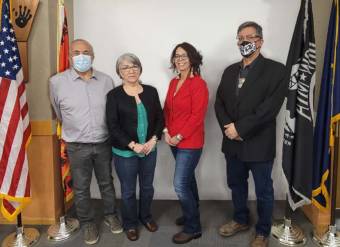
Ketchikan Indian Community’s newly-elected 2022 Tribal Council executives. From left to right, Vice President Norm Skan, Secretary Judy Leask Guthrie, President Trixie Bennett and Treasurer Chas Edwardson. (Photo courtesy of Ketchikan Indian Community)

Ketchikan Indian Community’s Tribal Council elected a new president this week. Trixie Bennett says she plans to lead the community’s advocacy to preserve Indigenous ways of life.

Ketchikan Indian Community’s new president says ensuring tribal members have access to traditional foods and medicines is among her highest priorities.

“File it under sovereignty if you want, but right up there with sovereignty is our food,” Bennett said in a phone interview.

Trixie Bennett, Lingít from Wrangell, is the new president of Ketchikan’s 6,000-member federally recognized tribe. She’d previously served as the council’s vice president.

In her new role, Bennett says she plans to continue pushing for stricter environmental standards for mines near rivers that flow from Canada into Southeast Alaska. Conservationists and tribes say mine waste threatens salmon runs in the region. Bennett says she plans to continue working with groups like Salmon Beyond Borders and the Southeast Alaska Indigenous Transboundary Commission to push for a ban on tailings dams that hold back mine waste along cross-border rivers.

“Part of my priority is to keep putting some attention on that because salmon is our way of life,” she said. “It’s our canary in the mine for the environment.”

She says she’s planning trips to Washington D.C. and Ottawa in the coming months to keep the pressure on.

Closer to home, Bennett says she plans to continue a push to have Ketchikan designated as a rural area under a federal law that governs who can participate in certain subsistence hunts and fisheries.

“Access to the land is equals access to our foods. It’s been that way — my great grandfather was Chief Shakes in Wrangell in … the 1890s, and he was fighting for the same thing: access to our lands and our foods. So that will continue to be a focus for me and this tribe,” Bennett said.

As it stands, the Federal Subsistence Board considers most of Ketchikan, with the exception of Saxman, to be a non-rural area. And that means most people in Ketchikan can’t hunt or fish under subsistence rules on federal lands.

“We fought for the fishery to open for subsistence users on the Unuk (River) for eulachon every spring, and we actually won — people could go out and get five gallons each. But we didn’t get to go ourselves as a community, and our tribal people weren’t allowed because of that rural designation,” she said. “It’s just not right.”

Bennett says another area of focus is addiction, mental health and homelessness.

“It all goes together,” she said. “We have a lot of amazing programs and services and a treatment center in the works that we’re working on plans for. We’ve gotten through a feasibility study, so that’s coming down the pike, and (we’re) looking forward to collaborating with the rest of the community. We know it’s a real need here.”

Beyond that, Bennett says she plans to put her new business and management degree and her experience on staff to use making KIC a better place to work and get health care.

Before assuming the presidency, Bennett worked for the tribe’s clinic for more than a decade before winning a seat on the tribal council in 2018. These days, she runs a small online traditional medicine store called Tongass Tonics and says she’s in talks to purchase another downtown business.

“Our traditional foods, a lot of our people never have had to this day because they get shipped out to the highest bidder. I’d like to see more of those things offered by businesses in town,” she said.

Bennett replaces Gloria Burns as president. Norm Skan, who preceded Burns, will return to council leadership as vice president. Treasurer Chas Edwardson and Secretary Judy Leask Guthrie round out the 2022 executive committee.

Tribal groups petition federal government to eliminate or limit Bering Sea salmon bycatch

(U.S. Fish and Wildlife photo)

In their latest bid to halt or limit chinook and chum salmon bycatch in the Bering Sea, tribal organizations in Western Alaska have signed onto a petition calling on the federal government to take action.

The petition asks the U.S. Department of Commerce to eliminate chinook salmon bycatch in the Bering Sea completely and to put a cap on chum salmon bycatch. It does not specify an acceptable limit for chum bycatch.

The tribal groups signing the petition mostly represent areas of Alaska where salmon runs have crashed or declined dramatically in recent years. They include the Kuskokwim River Inter-tribal Fish Commission, the Yukon River Inter-Tribal Fish Commission, the Association of Village Council Presidents, Kawerak, Inc., the Bering Sea Elders Group and the Aleut Community of St. Paul Island.

“The recent crashes of Chinook. And now the chum on the Kuskokwim River is pretty evident that we need to take emergency action on this issue,” said Mike Williams Sr., chair of the Kuskokwim River Inter-Tribal Fish Commission. “I think we need to begin to take drastic measures.”

A spokesperson for the National Oceanic and Atmospheric Administration inside the U.S. Department of Commerce wrote in an email to KYUK that the agency does not comment on petitions. He did not answer whether the department was even aware of the petition.

The National Marine Fisheries Service estimates that more than 13,000 chinook salmon and more than 500,000 chum salmon were caught as bycatch in the Bering Sea in 2021. The groups petitioning the federal government to bring these numbers down say at least some portion of those fish would end up in Western Alaska rivers, where subsistence fishermen have not been able to meet their needs for quite some time now.

Subsistence fishermen and organizations from Western Alaska have intensified their pressure on both the state and federal government in the past year to reduce or eliminate salmon bycatch in the Bering Sea. This petition is the latest effort in that campaign.

More tiny homes are coming to the Y-K Delta, thanks to pandemic relief funds. But are they a good idea?

Coastal Villages Region Fund constructing a tiny home in Eek in 2018. (Coastal Villages Region Fund photo)

A surge of new housing is coming to the Yukon-Kuskokwim Delta. Most of those new units are slated to be of the trendy, tiny home variety. But with households in the Yukon-Kuskokwim Delta generally much larger than the national average, some tribes are questioning whether tiny homes are a good fit for their communities.

The U.S. Department of Housing and Urban Development recently announced almost $7 million in funding for Aniak, Atmautluak, Napaimute, Newtok, Quinhagak, Toksook Bay, and Tununak to begin construction on 25 new homes this year. The funding stems from federal coronavirus relief funding, which has brought a huge influx of money into Alaska for tribes to build homes.

“An explosion is a good term for how much that has increased,” said Greg Stuckey, administrator for the Alaska Office of Native American Programs of HUD.

Because these grants are tied to coronavirus relief funding, tribes must use the homes as isolation or quarantine units, at least at first.

“And then, you know, later, when COVID is eventually over, that you can use those to lower overcrowding in your communities, because that is a major issue in rural Alaska,” Stuckey said.

About 40% of homes in the Y-K Delta are either overcrowded or severely overcrowded. According to a statewide housing assessment, over 2,400 homes need to be built to fix that.

Nearly all of the homes that will be built in the Y-K Delta using these HUD grants will be tiny homes. They will be smaller than 500 square feet, with the kitchen, bed, and living space all in the same room. There will be a separate bathroom, but no separate bedrooms.

Tiny homes have been all the rage in recent years, often billed as an answer to affordable housing. But are they a good fit for a region where households are, on average, 50-80% larger than the national average?

The Yukon-Kuskokwim Delta has experimented with tiny homes before. The non-profit organization, Coastal Villages Region Fund, built one in Eek in 2018. The organization says that it would not do it again.

“We found that people need more space than a tiny home with the number of people in the family,” said Oscar Evon, Regional Affairs Director at CVRF.

Evon said that there were other issues with tiny homes, such as how banks wouldn’t finance mortgages for them. CVRF had originally planned for homeowners to purchase tiny homes through mortgages, which would have opened another pathway to homeownership in Y-K Delta villages. Most are currently built and paid for by the regional housing authority or through grants. After pivoting away from tiny homes, CVRF now builds more traditional three- to four-bedroom homes, which Evon says banks finance mortgages for and fit families’ needs better.

“A bigger home gives a family more space to raise their families and sometimes even their extended families,” Evon said.

Some of the tribes that recently received a HUD grant to build tiny homes have come to the same conclusion. Toksook Bay was awarded $1,035,000 to build five tiny homes, but Tribal Administrator Robert Pitka Sr. said that Toksook Bay would rather build bigger homes.

“We would choose two-bedroom home instead of tiny home,” Pitka Sr. said.

However, Toksook Bay submitted a grant application and received funds to build tiny homes. Pitka Sr. said that he thought the grant was specifically for tiny homes.

“The ICDBG [Indian Community Development Block] grant already had wording in there where it’s for tiny homes,” Pitka Sr. said.

HUD’s ICDBG grant requirements suggest building tiny homes as one way to use grant funds, which may have been enough to convince tribes to include tiny homes in their grant application. Tununak, which also received a grant to build tiny homes, also said it would prefer to build homes with bedrooms.

Stuckey said that HUD does not require applicants to build tiny homes or any particular type of housing and did not favor applications that included tiny homes. For example, Newtok received the same grant award to build three three-bedroom homes.

“It’s self determination. The tribes decide, the tribes are going to tell me what they’re going to build,” Stuckey said.

If tribes like Toksook Bay decide that they would rather build larger homes, they will be able to do so. HUD spokesperson Vanessa Krueger said that tribes can submit an amendment to their grant application.

In Toksook Bay, Pitka Sr. said that the new homes, whether they’re tiny or not, will make a big difference to the families currently living in old, unsuitable homes.

“They’re moldy. They’re cold. They’re rotten. They don’t have water and sewer system. Some are even tinier than tiny homes. And at least a brand new tiny house would make it 100% better,” Pitka Sr. said.

Pitka Sr. said that those families could move into their new homes later this year.

Alaska tribal recognition initiative surpasses signature goal

Bethel citizens vote at the Yupiit Piciryarait Cultural Center in Bethel, Alaska on Nov. 3, 2020. (Photo by Katie Basile/KYUK)

After a legislative effort stalled in the state House this year, Alaska’s tribes are working on a ballot initiative that would ask voters whether they should receive state recognition.

The group leading the effort, Alaskans for Better Government, says they’ve collected more than 53,000 supporting signatures — surpassing the required 36,140 signatures to get on the ballot later this year.

The group plans to submit the names to the state’s Division of Elections in mid-January for it to verify.

To reach the signature requirement, canvassers have been posted at city hotspots over the last few months like the Loussac Library, plus various grocery stores and shopping centers in Anchorage, Fairbanks, Juneau and throughout the state.

Tabitha Aliralria is one of those canvassers. Aliralria, who is Alaska Native, said she was struggling to find work a few months ago when she bumped into someone collecting signatures.

“I was out shopping with one of my friends and I came across one of the canvassers, and that’s when it caught me off guard. And I was like, ‘Are you guys hiring?’” she said. She got the job the next day.

Adam Wool and Tabitha Aliralria canvassed for signatures outside the Loussac Library in Anchorage in December. (Adam Nicely/Alaska Public Media)

The signature effort pressed forward after the Alaska Tribal Recognition Act stalled in the state Senate last year. It passed in the state House. Rep. Tiffany Zulkosky, D-Bethel, introduced the bill. Its supporters say the recognition of the state’s 229 federally recognized tribes would establish a symbolic government-to-government relationship.

“Right now, the way things are status quo between tribes and the state of Alaska, when we enter into some sort of discussion, it’s almost starting at a deficit level,” said La quen náay Elizabeth Medicine Crow, president and CEO of  First Alaskans Institute.

She said Indigenous people in Alaska have waited long enough to be viewed as equal in the eyes of the state government

“I mean, it’s 2021, it’s almost 2022. We’re at a different place in our understanding and relationship with one another,” she said. “It’s kind of like latent old school thinking that there’s going to be some sort of divestiture of something.”

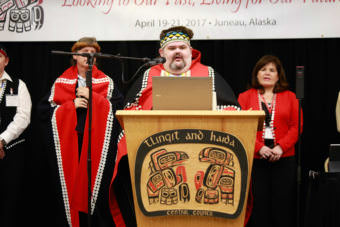
Medicine Crow is a co-sponsor of the ballot initiative that would ask voters whether the state should officially recognize all of Alaska’s federally recognized tribes. The other co-sponsor is Chaylee Éesh Richard Peterson, the president of the Central Council of the Tlingit and Haida Indian Tribes of Alaska. Together with other tribal leadership in the state, they formed Alaskans for Better Government. Peterson said state recognition wouldn’t cost anything. Instead, it could clear a path for more federal funds for the state and tribes.

“You know, I think right now there’s millions of dollars that fall off the table because there’s not formal tribal recognition, especially in the areas of education and public safety,” he said.

At least four federal agencies including the Departments of Education and Health and Human Services have the authority to provide additional funding to tribes that have state recognition.

“We could bring more Department of Justice funding into our rural communities where there’s some real inequities in public safety,” said Peterson. “But we can’t even get off the ground if we don’t have a formal relationship. If we can’t say to each other, ‘We respect each other and that we can work from a common place,’” he said.

After an application for the initiative was approved by the state Division of Elections and the Department of Law in October, canvassers started collecting signatures to get state tribal recognition on the 2022 ballot.

Aliralria said she’s gotten all kinds of feedback from people she encounters in downtown Anchorage.

“I’ve gotten good responses like, ‘Yeah, we’ll do this. We’ll support you. I’ve got Native people in my family. Yeah, this is a good thing. We need it.’ And I’ve had people, you know, tell me, ‘F- off, this isn’t a good thing. Go die.’ So it’s been a variety pack of, you know, hearing a lot of things,” she said.

She said some of the more unsavory comments seem to be in keeping with racial tension and a fierce political climate that’s playing out in communities across the U.S.

Nearly half of all tribes recognized by the federal government are based in Alaska. According to the National Commission on State Legislatures, roughly 10% of federally recognized tribes across the U.S. also have state recognition.

In Alaska, Peterson said, it’s impossible to ignore the Indigenous population.

“It’s fundamentally wrong that we’re not even recognized by the state government. Yet they talk about us all the time, we’re in every bit of [legislation], anything to do with especially rural Alaska,” he said. “But go to Anchorage, our biggest metropolitan city, and everywhere you turn, our presence is there.”

‘Tidal Network’, Tlingit & Haida’s new broadband internet service, coming to Wrangell

Wrangell in June 2018 (Photo by David Purdy/KTOO)

Southeast Alaska’s regional Tribal government will pilot its new broadband internet program in Wrangell, which it says will, eventually, be available to everyone on the island.

Last year, the Federal Communications Commission opened up a special program to allow rural Tribes to secure broadband licenses to improve connectivity. Hundreds of Tribes applied, more than a third in Alaska.

The Central Council of Tlingit and Haida Indian Tribes of Alaska announced on December 17 that it got its license. The FCC has granted the regional Tribe exclusive use of a mid-band broadband spectrum in a number of Southeast Alaska communities.

Chris Cropley, one of the Tribal council’s network architects, says the license is for the 2.5 gigahertz spectrum: the same tech used by cell phone LTE networks.

“We’re starting in Wrangell,” Cropley said. “It’s perfect – it’s the Goldilocks, as they say. It’s got everything going for it. We’ve got a lot of people there, relatively, we own the 2.5 [GHz spectrum] there, and we have funding for it.”

The Tribe is calling its broadband service Tidal Network. It will just be home internet, not mobile data service. But it will still need to build its own towers, so that wireless internet can be broadcast directly to homes and businesses that don’t already have reliable internet access.

“Anywhere that’s already served, we’re not interested in serving,” Cropley said. “So if you have a cable modem to your house, fiber optic to your house, if you’ve got good service to your home or are downtown, we’re not really super interested in replacing that with something else. We’re not looking to displace GCI or ACS or AT&T or anybody.”

Wrangell is ideal because there are people with spotty service, but it’s not such a remote community that the Tribe would struggle to get people and equipment to town. Cropley said residents living towards the southern end of the 14-mile stretch of Zimovia Highway would be good candidates for Tidal Network.

Once the service is in place, Tlingit & Haida will be required to “defend” it – meaning they have to offer internet service to 80% of the area’s population within the first two years of holding the license, and full-coverage after five years. But that doesn’t mean people have to take the new provider up on the offer.

Central Council of Tlingit and Haida Indian Tribes of Alaska began working on getting its license back in 2019. And federal pandemic relief it has received since will help pay for the project.

“We are buying two what we call COWs – cell on wheels,” he said. “They are towers on a trailer with a generator and a little cabinet underneath, and they extend out. We’re able to stand them up, and they have radio microwave on them and they accept fiber optic and we’re able to wire them up or wireless them and begin to provide service on those towers.”

Permanent towers can cost $500,000 to $600,000 each and come with miles of red tape.

The pieces are already in place to get started now, though. Cropley said he has a multi-million dollar budget headed to Wrangell for the pilot broadband project, but declined to say precisely how much.

Once the details are worked out, Tidal Network will operate in Wrangell as a subscription service with different plans, like any other internet provider. The goal is to provide the best possible internet at the lowest possible price.

“We’re just looking at finding the most people with the least internet or no internet, ideally, and providing them with internet where they didn’t have before, where they had to use a satellite,” he said.

The pilot project in Wrangell is just that: a test. It’ll help flesh out the program – from the tech itself to collaboration with other vendors, policies and provide training to Tidal Network employees.

The process will take time, and investment.

“There’s a reason that somebody isn’t already doing this, right?” Cropley said. “There’s no gold mine at the end of the road here. It is a service.”

Cropley says they hope to have the Tidal Network up and running by spring 2022. And after piloting the program in Wrangell, the service could expand to more than 20 other Southeast Alaska communities in the coming years.

Profits eluded Sealaska for decades. Now it’s ditching timber and plastics, and investing in kelp.

Sealaska Board Chair Joe Nelson pulls bull kelp from Saginaw Channel on Sept. 14, 2021 near Juneau. (Photo by Loren Holmes / ADN)

Joe Nelson floated his boat along a reef just outside Juneau on a drizzly September day.

With his rifle onboard, he eyed the shore for deer as he steered with the tide. But this was a business trip: He was also looking for a new product that could boost the fortunes of the Alaska Native corporation whose board Nelson chairs.

The boat drifted past dark curls in the water. Nelson reached over and grabbed a greenish tendril, hauling it into the boat: bull kelp.

The species is found up and down the Pacific Coast and can grow as long as 100 feet.

It’s also edible, in products like salsa and hot sauce. And Nelson’s corporation, Sealaska, recently bought a stake in a locally grown company, Barnacle Foods, that sells kelp products across the country.

Barnacle Foods co-owner Max Stanley boxes bottles of Bullwhip Kelp and Serrano Hot Sauce at the Barnacle Foods production facility on Tuesday, Sept. 14, 2021 in Juneau. (Photo by Loren Holmes / ADN)

Nelson, who is Lingít, grew up hunting and fishing in the remote Southeast community of Yakutat. He’d harvested seaweed. But not kelp — this was a foreign object to him.

“Like, literally from ‘Aliens,’ the movie,” Nelson said, pondering the kelp’s fronds and rubbery, tubular stalks. “I wouldn’t have thought to eat it.”

While Nelson was new to kelp harvesting, he’s been eating it for years, as an early and avid buyer of Barnacle’s salsa.

Barnacle was founded in 2016 by a Juneau couple with a shared love for Southeast Alaska lands and waters, and their bountiful harvests. The company has grown spectacularly, and is on track this year to sell more than $1 million of its largely kelp-based foods.

Sealaska and its more than 20,000 Indigenous shareholders are now helping to fuel that growth.

The company’s investment in the relatively climate-friendly kelp industry highlights a shift in its business philosophy that’s played out over the past eight years.

Bull kelp bobs near Favorite Reef in Saginaw Channel west of Shelter Island on Sept. 14, 2021 near Juneau. (Photo by Loren Holmes / ADN)

For decades, the Native-owned regional corporation sustained its business with profits from logging old-growth timber from lands it received through the 1971 Alaska Native Claims Settlement Act, which turns 50 years old this month. It also invested in other, far-flung businesses with little relevance to Sealaska shareholders.

The vast majority of Sealaska’s hundreds of millions of dollars in yearly revenue still comes from its comparatively unglamorous holdings in seafood processing and environmental services like maritime drilling and construction.

But its investment in Barnacle, while small, is a potent symbol of the corporation’s new vision. In the past few years, Sealaska has announced that it’s selling its old-growth logging business. It has sold carbon credits on its remaining uncut timber. And it has narrowed the focus of its other businesses around the theme of “ocean health,” an acknowledgment of global warming’s growing impact on Sealaska’s ancestral lands and around the world.

Sealaska is not the only Native corporation to take similar steps into conservation and sustainability. At least two others have gotten into the carbon credits business, and another, in the Bristol Bay region, has struck a nearly $20 million deal with a conservation group to place Native corporate lands out of reach of the proposed Pebble mine.

Sealaska officials are careful not to tout their new ideas as a prescription for other corporations, some of which remain heavily invested in extractive industries like oil and gas and mining.

But Sealaska leaders seem to agree that, after nearly a half-century of struggle to meld Indigenous values with their for-profit business, the corporation has finally hit on a formula that works for them. The corporation, Nelson says, has moved away from what he describes as “false paradigms” embedded in the land settlement — that, as Natives, “we’re going to be Indigenous culture bearers on the weekends, but from Monday to Friday, we’re going to be in the boardroom doing business, capitalists.”

Native people, Nelson said, are “not here all for pure resource extraction or pure conservation. Sustainability is built into our thinking.”

“You really shouldn’t separate those things,” he added. “You get to better outcomes, the world is realizing now, by having some of your groundedness and Indigenous thinking embedded in what you’re doing.”

Barnacle Foods co-owners Matt Kern and Lia Heifetz look over a checklist at their production facility on Tuesday, Sept. 14, 2021 in Juneau. (Loren Holmes / ADN) ONE TIME USE

Polarizing timber harvests

Sealaska was born out of the 1971 Native claims settlement act, which granted the corporation what it says is less than 2% of shareholders’ traditional homelands: 360,000 acres, a tiny slice amid the 17 million-acre Tongass National Forest that stretches across much of Southeast Alaska.

After the act’s passage, Sealaska and Southeast Alaska Native village corporations got into the timber business. Old-growth logging helped fuel their expansions and programs and, in some cases, generated dividend payments for shareholders that topped $50,000.

Indigenous Alaskans outside the region also benefited, as the land claims settlement requires each regional Native corporation to redistribute 70% of their natural resource revenues to the other corporations.

The harvests were polarizing, pitting the Native corporations against conservationists and tribal groups, and even family members against each other. Critics objected to the damaged salmon streams and threatened deer populations that clear cuts could sometimes leave behind.

But even as some Sealaska officials said they felt conflicted about the harvests, they also said their surveys showed shareholders in support.

A cutter stands back as he fells a Sitka spruce tree inside the Tongass National Forest on Etolin Island in Alaska, Sept. 3, 1993. (Photo by Bill Roth/ADN archive)

Timber cutting “looks like hell,” a former Sealaska chief executive, the late Byron Mallott, told the Anchorage Daily News in 2001. But, he argued, leaving the trees standing would be ”ludicrous” for the business, and the profits bettered shareholders’ lives.

”We can make some harsh judgments now,” Mallott, the father of current Sealaska chief executive Anthony Mallott, said at the time. “But it was done under the existing regulations.”

With a finite amount of timber to cut, Sealaska looked to diversify its business, with investments in industries like limestone mining, gaming and wireless communications. But those efforts produced mixed results.

Anthony Mallott said that in their early decades, Sealaska and other Native corporations had a “heavy mantra” that Indigenous values should be kept at arm’s length from business decisions.

“Your fiduciary duty was just to make money — don’t let the community stuff or the value stuff get in the way,” Mallott said in an interview. “We called it hiding behind the fiduciary shield.”

Sealaska CEO Anthony Mallott sits in the Sealaska boardroom on Monday, Sept. 13, 2021 in Juneau. Two docked cruise ships are visible behind Mallott. (Photo by Loren Holmes/ADN)

Nelson, Sealaska’s chair, arrived on the board in 2003, after Sealaska had invested in a plastics business. The manufacturing enterprise had facilities in Mexico, Alabama and Iowa, making products like Brita water containers and laundry detergent caps.

Nelson grew up spending a month at a time off the grid at fish camp. He lived in Southern California during college and law school, going to the beach and eating organic food. He said he arrived back in Alaska with a “different level of consciousness” that gave him other ideas about Sealaska’s direction.

“All my life, I saw plastic washing up on the beaches, and it didn’t work for me personally. Philosophically, it didn’t fit,” he said. “But I never won any arguments based on my philosophy, really, in the boardroom.”

Ultimately, business imperatives forced Sealaska into a restructuring. In 2013, it reported $35 million in losses, largely attributable to a heavy construction subsidiary in Hawaii that underbid a major project. The plastics investment and others had underperformed, and Sealaska had cut down almost all of its easily accessible timber, said Anthony Mallott.

Sealaska Board Chair Joe Nelson drives his boat through Saginaw Channel on Tuesday, Sept. 14, 2021 near Juneau. (Photo by Loren Holmes/ADN)

Current Sealaska leaders say the corporation’s early decisions are understandable when seen as artifacts of colonization and assimilation.

Some of Sealaska’s original leaders attended government-run boarding schools that U.S. Interior Secretary Deb Haaland, who is Native American, describe as “an effort to eradicate our culture and erase us as a people.” Those early corporate leaders were also testing a capitalist business model with little basis in Native culture.

“They were living an assimilated life, and attempting to uplift that the best that they could,” said Barbara Blake, a Sealaska board member. “This current leadership is more in tune with who we are as Indigenous people, because we’re in a privileged space to be able to reawaken that without fear of being harmed, or being seen as less than.”

A changing model

The financial crisis, Mallott said, gave Sealaska leaders a “full mandate” to change the corporation’s business model.

Mallott said nearby all of the corporation’s other lines of business — roughly a dozen — were sold off, with logging a notable exception.

The board began developing a new vision around Haa Aaní, their ancestral homelands. The “ocean health” theme for Sealaska’s businesses emerged from the threats posed by climate change, and the corporation expanded into seafood, an industry that Mallott describes as “relevant and meaningful” to board members and shareholders — many of whom are fishermen themselves.

The timber business, however, gradually became less viable amid a decline in Southeast Alaska’s logging industry, Mallott said. Instead, over the past few years, Sealaska has been paid more than $100 million to keep its timber unharvested, for use as carbon offsets.

By 2019, a few years into Sealaska’s pivot, the owners of Barnacle, the kelp foods company, had already identified it as their best-case business partner and investor when a chance dinner encounter set off formal discussions.

A shelf of Barnacle Foods products is displayed at Rainbow Foods on Monday, Sept. 13, 2021 in Juneau. (Photo by Loren Holmes/ADN)

Barnacle’s potential

As Nelson searched the Inside Passage for seaweed in September, Barnacle co-founders Lia Heifetz and Matt Kern were on shore a few miles away, making one of their most popular products.

Inside Barnacle’s commercial kitchen, in an anonymous warehouse not far from Juneau’s landfill, employees first scrubbed and sanitized equipment. Then, they used an industrial-sized food processor to chop frozen kelp — collected locally earlier in the year — and mixed it with garlic and fermented serrano pepper in a huge kettle to cook.

In a few hours, they’d bottle it as “bullwhip” hot sauce.

Kern and Heifetz, who are engaged, both grew up in Juneau and left for college. When they returned, they reconnected around locally harvested foods.

“Every food preservation hobby that we did together was always borderline out-of-hand,” Kern said. “We wouldn’t go out to just pick a batch-of-muffins-worth of blueberries. We’re going to hike into the alpine, and we’re not coming back until we’re sweating.”

Barnacle grew out of that enthusiasm. It started with kelp salsa, which Heifetz and Kern first encountered as a distraction from slow fishing: If nothing’s biting, at least you can come home with something else to eat.

Each year, they found themselves bringing larger and larger vessels to fill with more kelp for home cooking parties.

“To the point where we were bringing out Rubbermaid totes and 50-gallon barrels and filling up our kitchen with jars and overflowing the cupboards into cabinets and garages,” Kern said.

Heifetz, Kern and business partner Max Stanley are not Native, and they’re not Sealaska shareholders.

But they’d worked on projects with Southeast Alaska tribal organizations. The vision for their business – elevating Southeast Alaska’s environment and culture through sustainably harvested foods – also seemed to dovetail with Sealaska’s new direction.

Nelson, the Sealaska chair, was one of Barnacle’s first customers at a local food festival. And in its first year operating, Barnacle won a $40,000 economic development grant from a Sealaska-funded group, Spruce Root.

The company’s salsas and pickles made it a quick sensation with locals and Juneau tourists. It has since expanded into larger markets, with attractive labels and wild ingredients that have helped Barnacle’s business double or triple every year after its founding.

Eventually, owners Heifetz, Kern and Max Stanley realized they needed an investor to finance Barnacle’s growth, and Sealaska was at the top of their list. Conversations started after Heifetz ran into the corporation’s chief operating officer at a downtown Juneau pub.

Barnacle’s relatively small size meant that it wasn’t a perfect match for a Sealaska investment. But everything else about it seemed to fit, Nelson said.

The startup came with potential local jobs, out on the water, for Sealaska shareholders. It helps boost Southeast Alaska’s regional economy, aligns with Sealaska’s ocean health theme and taps into a sustainable resource from the ocean, Nelson said.

“If you just contrast this product, which you’ll find in all the stores and my cupboard and my refrigerator, with the products that we were involved in in the late ‘90s — Philly cream cheese cups and Tide bottle caps — I would say there’s a definite contrast and a different sense of affinity,” Nelson said. “And this salsa, this hot sauce is actually pretty darn good.”

Early last year, Sealaska bought a 30% stake in Barnacle for $1.5 million, which the company’s founders say will be invested directly into its growth, and equipment and processing capacity.

While it’s a tiny sum on the scale of Sealaska’s overall operations — it reported $697 million in revenue last year — leaders say it’s an important symbol of the corporation’s direction and vision.

Sealaska still contends with a group of disaffected shareholders, though. And some who fought Sealaska’s logging business are skeptical that the corporation’s transition out of the industry will last.

Asked about Sealaska’s announcement that it’s ending harvests of old-growth timber, Wanda Culp, a longtime critic of the corporation’s logging business, said she remains unconvinced.

“‘Yeah, we’ll see,’ is the way I felt about it,” Culp said in a phone interview. “Because, where’s their approach coming from? Their approach isn’t coming from within — it’s not coming from our Indigenous point of view, or grassroots.”

Sealaska leaders, though, say they don’t envision a return to old-growth timber harvesting any time soon.

Sealaska Board Chair Joe Nelson talks on the phone with Sealaska CEO Anthony Mallott from the Sealaska boardroom on Monday, Sept. 13, 2021 in Juneau. (Photo by Loren Holmes/ADN)

The corporation has opened its shareholder base to younger Natives born after the original December 1971 deadline for receiving stock. And many of those newer shareholders place a higher value on land stewardship and cultural revitalization than they do on corporate profits.

Nelson, the board chair, described the old-growth timber industry as being in Alaska’s “rearview mirror” in a recent letter addressing a logging controversy in his home village of Yakutat. 

But even as Blake, the board member, largely agreed, she also said she understands shareholder skepticism about the staying power of Sealaska’s shift.

“It’s fully warranted,” she said.

“It took a long time to get to this place of distrust within our shareholder base. And it’s going to take a long time to regain that trust,” Blake added: “But I don’t think we’re going to go back to the way things were any time soon. We’ve still got a long ways to go, but we’re head over feet closer to a better path than we were, even 10 years ago.”

This story is part of a reporting collaboration between Alaska Public Media, the Anchorage Daily News and Indian Country Today on the 50th anniversary of the Alaska Native Claims Settlement Act. Funding for the project was provided by the Alaska Center for Excellence in Journalism.

Site notifications
Update notification options
Subscribe to notifications